Tom Peters' Leadership Ideas: In Search of Excellence

Turn this article into takeaways for your work.


Each assistant summarizes the article only for you and suggests best practices for your work.
Key Facts: Tom Peters was born November 7, 1942, in Baltimore, and earned a B.C.E. and M.C.E. in civil engineering from Cornell before an MBA and PhD from Stanford. He served in the US Navy from 1966 to 1970, completing two Vietnam deployments as a combat engineer with the Navy Seabees and a tour at the Pentagon, then worked as a White House drug-abuse adviser in 1973 and 1974 before joining McKinsey & Company in 1974, making partner in 1979 and co-founding its Organization Effectiveness practice. He left McKinsey in 1981 in a dispute over the rights to the manuscript that became In Search of Excellence (with Robert H. Waterman Jr., Harper & Row, 1982). He and Waterman, working alongside Anthony Athos and Richard Pascale, also produced the McKinsey 7S framework, and the book popularized the practice now known as management by walking around. Later books include Thriving on Chaos (1987), The Brand You 50 (1999), The Excellence Dividend (2018), and Excellence Now: Extreme Humanism (2021). He is a Thinkers50 Hall of Fame inductee (2013) and Lifetime Achievement Award winner (2017). Peters announced his retirement from writing and public speaking on his 80th birthday in November 2022, and he and his wife, textile designer and entrepreneur Susan Sargent, now live near Buzzards Bay in South Dartmouth, Massachusetts, after many years on a Vermont farm.
The Soft Is Hard Doctrine
Tom Peters reduced his life's argument to six words: "Hard is soft. Soft is hard." Hard things, plans, org charts, financial projections, look concrete and objective, but they are actually abstract and easy to bend to whatever conclusion someone wants. Soft things, people, culture, relationships, the way customers are actually treated, look mushy and unmeasurable, but they are the durable bedrock that determines whether a company actually performs. That inversion is the whole of the Tom Peters project, running from a 1977 internal McKinsey study through a book on personal branding published in 1999 and a book on humanism published in 2021.
He arrived at the doctrine by accident, not by design. McKinsey put him on an internal project studying organizational effectiveness at a moment when the firm's dominant intellectual export was structural and financial: portfolio matrices, org design, strategic planning frameworks. Peters and Waterman went looking for what actually separated high-performing companies from the rest, and kept finding people practices and cultural habits rather than clever structures or financial engineering. That was an uncomfortable finding for a firm that sold structural and financial engineering for a living, and it is a large part of why the relationship between Peters and McKinsey did not survive the book's publication.
The doctrine's real power was that it arrived at exactly the moment the field was least willing to hear it. American management in the late 1970s was dominated by strategic planning departments, BCG-style portfolio matrices, and a broader belief that the way to run a company was to get the numbers right and let structure follow. Henry Mintzberg would later mount his own attack on that same planning orthodoxy from the analytical side, arguing that planning could not generate a strategy, only formalize one. Peters attacked from the opposite direction: he argued the numbers were the unreliable part, and the people running the business day to day were the reliable one. Both critiques landed on the same target from different angles, and both had to survive being dismissed as soft-headed by a profession that had built its prestige on being rigorous.
Leadership Style Breakdown
| Style | Weight | How it showed up |
|---|---|---|
| People-First Contrarian | 40% | Built an entire career on the claim that culture, customer contact, and front-line autonomy mattered more to performance than org charts, five-year plans, or financial engineering, at a moment when the consulting industry was selling exactly the opposite message. |
| High-Energy Evangelist | 35% | Delivered his ideas as performance as much as text: thousands of paid seminars, a deliberately provocative speaking style, and a talent for turning a McKinsey research finding into a stage-ready line memorable enough to outlive the study behind it. |
| Category-Creating Popularizer | 25% | Turned an internal consulting study into a mass-market book that created the modern business-bestseller category outright, the shelf that Jim Collins, Stephen Covey, and Peter Senge later published into. |
The 40/35/25 split matters because the second trait is what made the first one travel. Plenty of consultants in the 1970s had data suggesting people and culture mattered. Peters had the same data and also had the showmanship to turn it into a bestseller instead of an internal memo, which is the difference between an insight McKinsey partners nodded at in a conference room and an idea that reshaped how three generations of executives thought a company should be run.
Key Leadership Traits
| Trait | Rating | What it means in practice |
|---|---|---|
| Willingness to bet a consulting career on an unfashionable thesis | Very High | Spent years inside McKinsey building a case for soft, people-centered management at a firm whose institutional reputation and fee structure rested on structural and financial analysis, then left rather than hand the firm the rights to the book that made the case. |
| Showmanship in translating research into a public idea | Exceptional | Converted an internal organizational-effectiveness study into a line simple enough to fit on a slide, "Hard is soft. Soft is hard," and then spent decades of paid speeches performing that line rather than just publishing it. |
| Willingness to publicly walk back his own signature framework | High | Published Thriving on Chaos in 1987, arguing that no company gets to hold a fixed state of "excellence," directly complicating the premise that had made him famous five years earlier. |
| Consistency of the underlying argument across five decades | Very High | The same people-over-structure claim runs from the 1977 McKinsey project through The Brand You 50 in 1999 to Excellence Now: Extreme Humanism in 2021, applied first to companies, then to individuals, then to the whole idea of humane management. |
| Candor about his own errors under direct challenge | High | Named his own mistakes without hedging: "To be sure, the likes of Wang and Atari and Kmart are today embarrassments," he wrote of three companies his own book had praised, and he pushed back point by point when a magazine's cover line overstated what he had actually said about his methods. |
The 3 Decisions That Defined Tom Peters as a Leader
Three decisions carry the whole career: the decision to publish a McKinsey finding as a mass-market book and lose the firm over it, the decision to publicly disown the static idea of "excellence" that had made him famous, and the decision to keep applying the same argument to a new subject every decade rather than defend the first one forever.
1. Publishing In Search of Excellence and Leaving McKinsey Over It (1977-1982)
In 1977, McKinsey director Ron Daniel put Peters and Waterman on an internal project studying organizational effectiveness. The pair worked outward from roughly a hundred companies nominated by McKinsey colleagues, academics, and corporate contacts as unusually well run, then applied six financial hurdles, three growth measures and three absolute performance measures, requiring a company to rank in the top half on at least four of the six over the 1961 to 1980 period. Of 62 formal nominees, 19 dropped out, leaving the 43 companies that became the spine of the book.
What they found, distilled into eight attributes, was a direct argument against how large American companies were being run: a bias for action instead of endless analysis, staying close to the customer instead of managing by report, autonomy and entrepreneurship instead of centralized control, productivity through people instead of headcount as a cost line, hands-on and value-driven leadership instead of remote management by memo, sticking to the business you actually understand instead of diversifying for its own sake, simple form and lean staff instead of layered bureaucracy, and simultaneous loose-tight properties, tight on a few core values, loose on everything else. Harper & Row published the result in 1982 as In Search of Excellence, alongside the related McKinsey 7S framework Peters and Waterman built with Anthony Athos and Richard Pascale.
The book did not stay an internal McKinsey asset. When it became a mainstream bestseller, Peters and the firm disagreed over who owned the rights and royalties to the manuscript. Peters has described paying McKinsey $25,000 for half the royalties he felt he was owed, a bet that looked reckless against a first print run of just 3,000 copies and paid off only once the book became one of the best-selling business titles of its era. He left the firm in 1981, the same year the book went to press, trading a McKinsey partnership for full ownership of an idea the firm itself had commissioned him to find.
For you: if your own organization generates an insight it isn't built to sell, don't assume the insight belongs to the org chart that funded the research. Sometimes the more valuable move is to take the finding somewhere it can actually be heard, even if that means leaving the institution that paid for it.
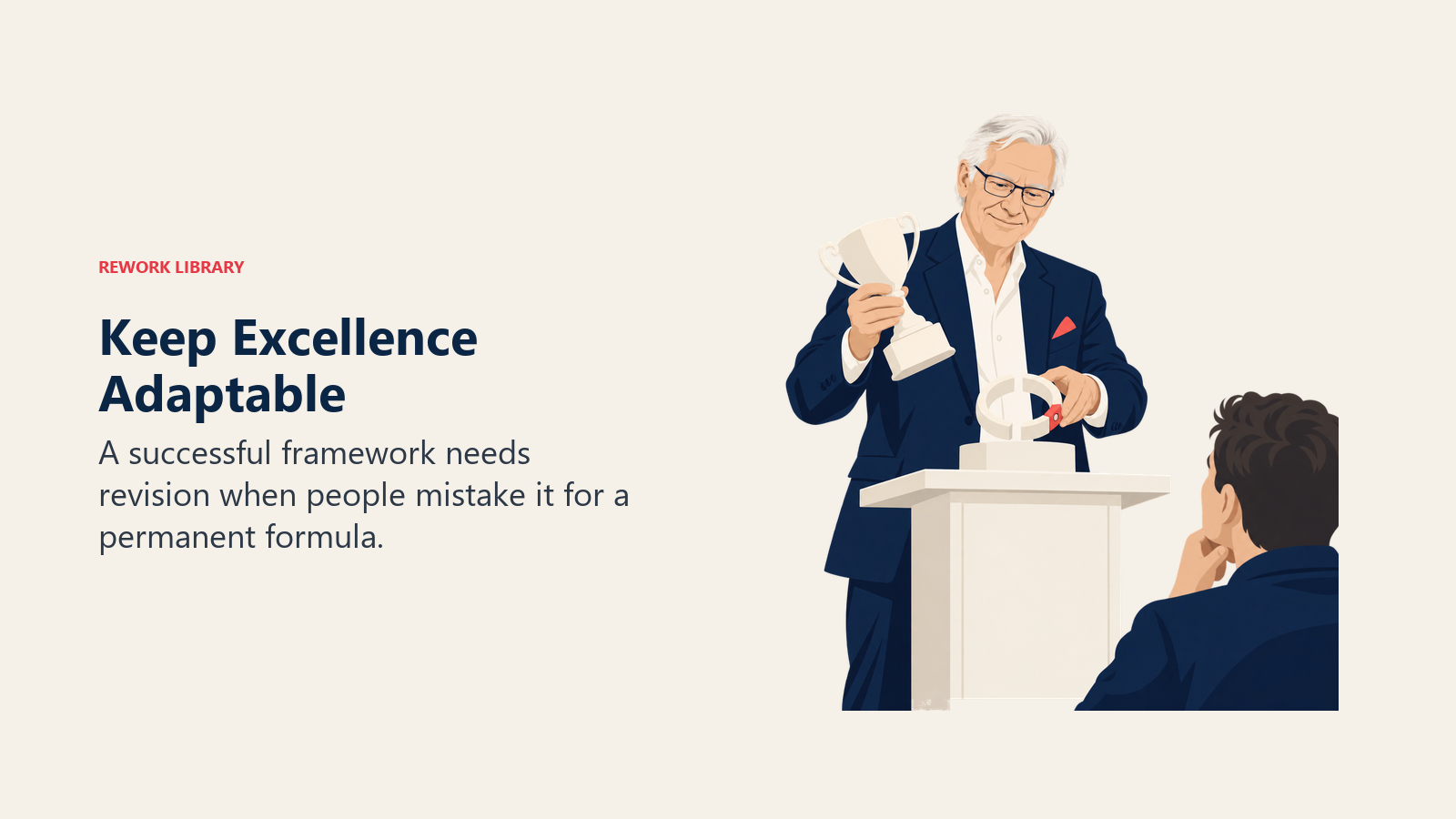
2. Publishing Thriving on Chaos to Disown His Own Bestseller's Premise (1987)
By 1986, In Search of Excellence had made Peters one of the most recognized names in American management, and the easy move was to keep selling the same idea in slightly different packaging. Instead, Thriving on Chaos (1987) argued the opposite of what most readers thought his first book had promised: that "excellence" was never a state a company could reach and then hold. The publisher's own description frames the book's premise plainly: "the winning companies will be those (and only those) that are able to adapt quickly to rapidly changing customer needs and market conditions." A company that treated its spot on the excellent-companies list as a finished achievement had already misread the book that put it there.
That is a genuinely uncomfortable message for an author to deliver about his own signature work, five years after publication, at the height of his commercial success. It would have been easier, and more profitable in the short run, to keep licensing the "excellence" brand rather than complicate it. Peters chose to update the argument instead: the soft, people-driven qualities he had identified in 1982 were still the right things to build, but no company got to declare victory and stop building them.
The instinct paid off intellectually even where it cost him some marketing simplicity. It anticipated, by decades, the now-standard idea that competitive advantage is temporary and organizations have to keep re-earning it rather than defend a fixed position, an idea that eventually became conventional wisdom in strategy circles far beyond Peters' own audience.
For you: the moment your own framework becomes popular enough that people start treating it as a finished formula is exactly the moment to go back and correct the part that made it sound finished. Protecting the brand of your own idea is a worse long-term bet than protecting its accuracy.
3. Extending the Same Argument to the Individual With The Brand You 50 (1999)
By the late 1990s, Peters had spent two decades arguing that companies win through soft, people-centered practices rather than structure or financial engineering. The Brand You 50 (1999) took that same argument and pointed it at a target nobody in mainstream management publishing had aimed it at yet: the individual professional, reframed as a brand that had to be actively built rather than assumed. The book arrived years before LinkedIn existed and well over a decade before "personal branding" became standard career advice, treating an individual's reputation and visibility as a strategic asset in exactly the way In Search of Excellence had treated a company's culture.
That was a real bet, not an obvious extension. Applying a management framework to an individual career risked looking like a gimmick, repackaging old ideas for a new buyer rather than genuinely extending the underlying doctrine. Peters made the same soft-is-hard argument at the individual level that he had made at the organizational level: your reputation, your visible track record, and how clearly other people can describe your value are not vanity metrics, they are the actual hard currency of a career, no less real than a balance sheet.
The idea outlived its initial reception. Two decades later, personal branding is a standard subject in career-development curricula, treated as a core professional competency rather than a novelty, which is a longer runway than most single-decade management fads get.
For you: when you have a working argument that has proven itself in one context, the harder and more valuable move is testing whether it holds at a completely different scale, not just repeating it inside the context where it already succeeded.
What Tom Peters Would Do in Your Role
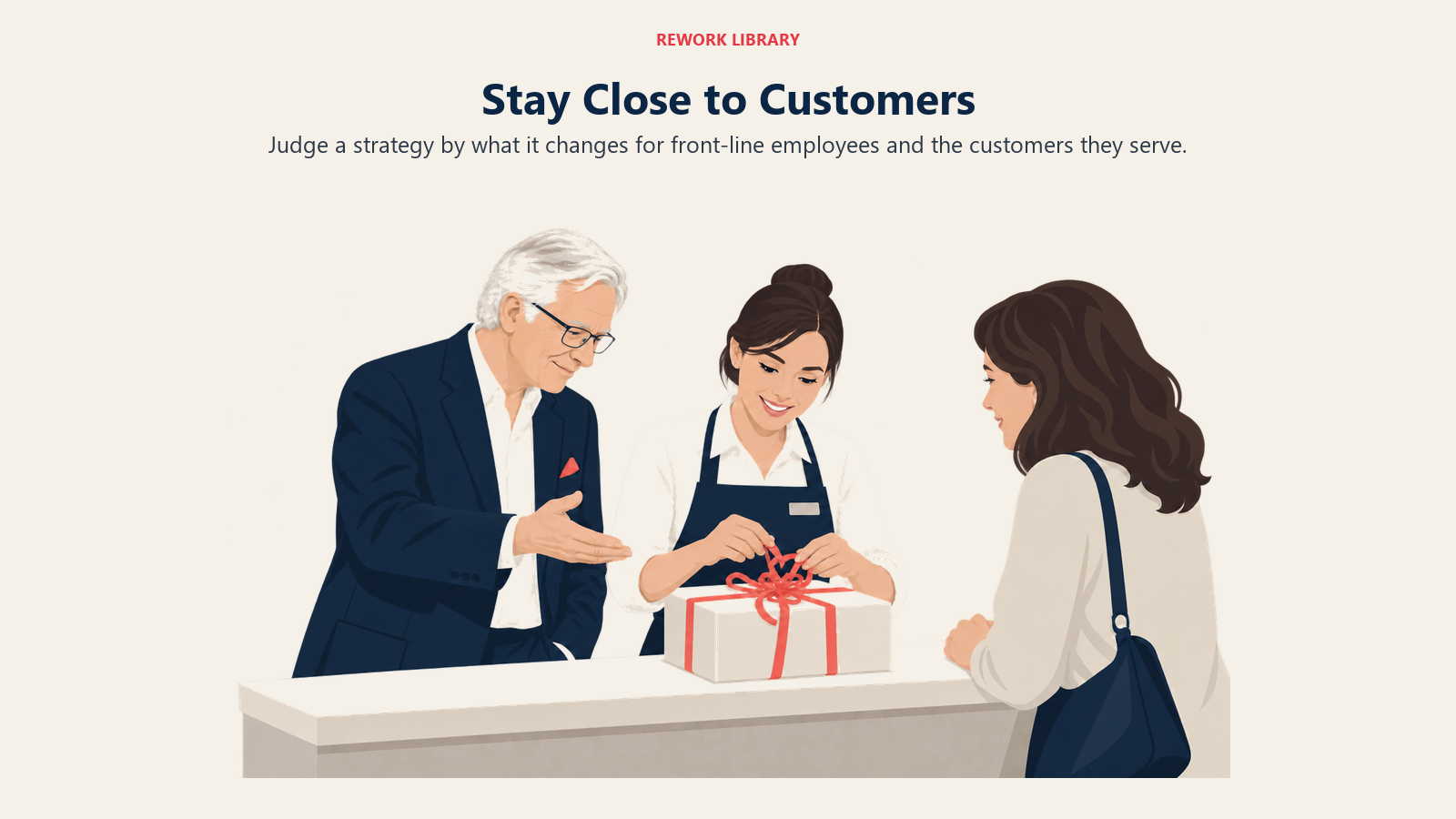
If you're a CEO drafting next year's strategic plan, Peters' framework asks you to check how much of that plan is actually analysis dressed up as decision-making. His argument was never that planning is worthless, it was that a plan full of market projections and org-chart redesigns can still fail if it doesn't touch how people are actually treated day to day. Before you finalize the deck, ask what in it changes how a front-line employee treats a customer tomorrow morning. If the answer is nothing, you have a hard document describing a soft problem you haven't actually solved.
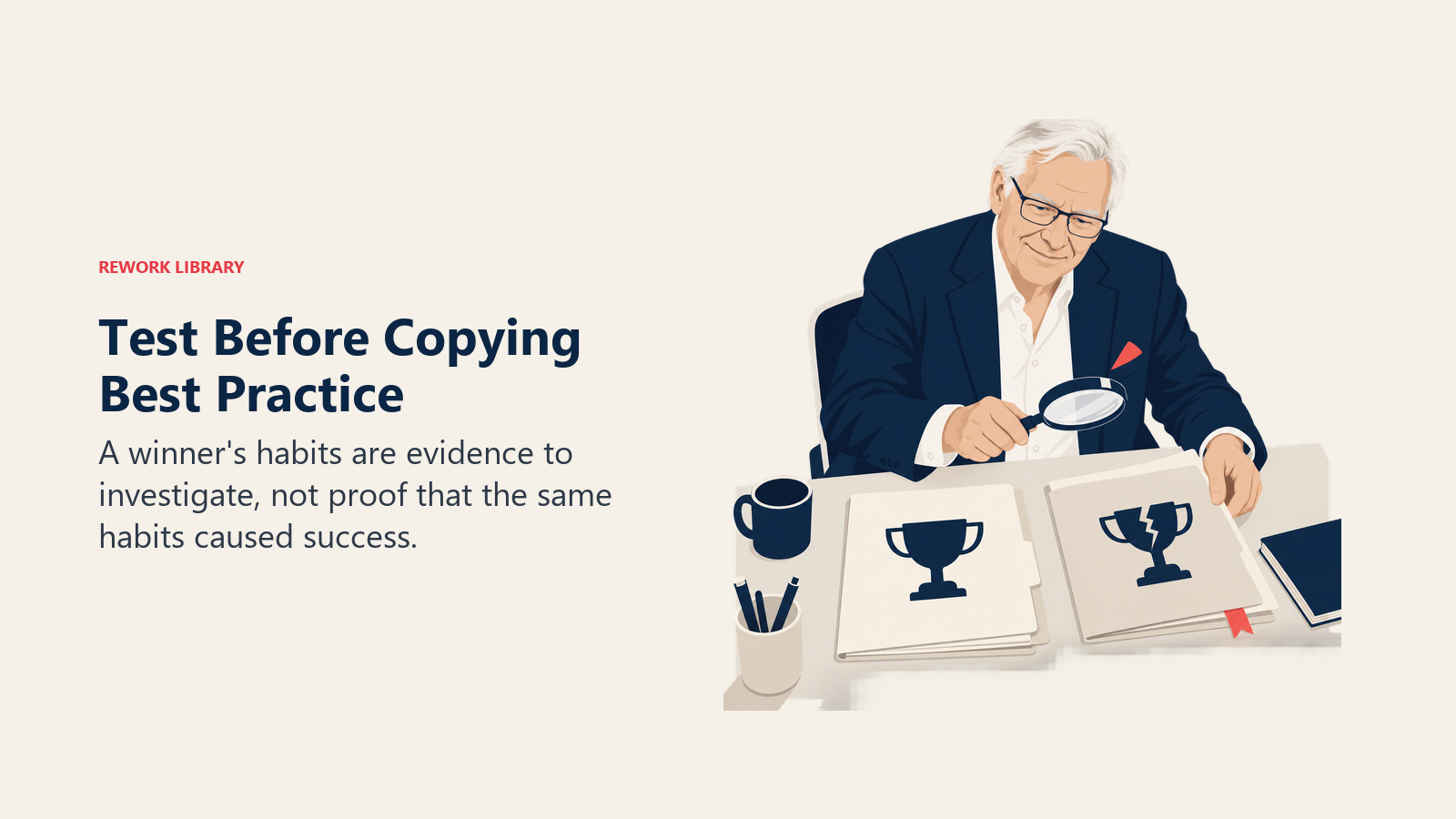
If you're a manager tempted to copy a "best practice" from a case study, the eight attributes are a warning as much as a checklist. Peters and Waterman built their list from judgment and interviews across 43 companies chosen by financial screening, not from a controlled experiment, and a third of those companies later stumbled. A practice that worked at one excellent company in one moment is a hypothesis about your company, not a guarantee. Test it against your own customers and your own people before you assume it will transfer.
If you're an individual contributor wondering whether building a personal brand is self-indulgent, Peters' answer, made explicit in The Brand You 50, is that it is closer to professional infrastructure than vanity. Nobody questions whether a company should manage its reputation deliberately. The same logic applies to a career: if you don't actively shape how your expertise and track record are visible to others, you're leaving a hard asset unmanaged, not staying humble.
| Situation you're facing | Peters' likely move |
|---|---|
| A strategic plan is full of numbers but nobody can say how it changes daily behavior | Push back until the plan names a specific change in how customers or front-line staff are treated, not just a change in projections |
| A "best practice" from a famous case study isn't working at your company | Treat the case study as one data point built on judgment calls, not a proven law, and test it against your own people and customers first |
| Your own signature idea has become popular enough that people are treating it as a finished formula | Publicly update or complicate it yourself before someone else's failure does it for you |
| Someone claims your organization's structure is what needs fixing | Check whether the real problem is culture, incentives, or customer contact hiding behind a structural symptom |
| A junior employee is excellent at the work but invisible outside their immediate team | Tell them plainly that managing how their expertise is seen is not self-promotion, it's part of the job |
Notable Quotes & Lessons Beyond the Boardroom
Peters compressed his entire argument into six words that he has repeated for decades: "Hard is soft. Soft is hard," meaning that plans, numbers, and org charts only look concrete while people, culture, and relationships only look soft, when the truth about which one is actually durable runs the other way. It is a strange thing for a former engineer, trained at Cornell to trust drawings and load calculations, to conclude that the org chart is the fictional part of the business and the culture is the load-bearing part. But that inversion, arrived at through direct observation of real companies rather than theory, is the single idea that everything else in his career elaborates.
He has also been unusually direct about his own errors in public, at a level of specificity most authors avoid. Confronting years of criticism about companies from his original excellent-companies list that later struggled, he wrote plainly: "To be sure, the likes of Wang and Atari and Kmart are today embarrassments." That kind of unhedged admission from someone whose entire public identity rests on having identified what excellence looks like is rarer than it should be in management writing, where authors more often quietly drop an inconvenient example than name it themselves.
The same directness shows up in how he responded when a magazine's cover line claimed he had confessed to faking data behind his most famous book. Rather than let the headline stand or quietly walk it back, he corrected the record precisely: "It's simply not true" that the underlying data was fudged, he wrote, explaining that his actual comment had been about how financial analysis inevitably involves judgment calls, a point he called "a country mile from 'We faked the data.'" The lesson beyond the boardroom is less about the specific dispute and more about the discipline it shows: correct an inaccurate story about your own work in exact terms, not vague ones, even years after the headline has already done its damage.
Where This Style Breaks
The most durable criticism of Peters' work is also the most obvious one in hindsight: studying only companies that were already succeeding tells you what winners had in common, not what actually caused them to win. BusinessWeek's 1984 cover story found that many of the 43 companies held up as excellent had already run into real financial trouble within about two years of the book's publication, a fast enough reversal to raise real doubts about whether the eight attributes measured a cause of success or just a snapshot of confidence taken at a lucky moment. Peters' own later analysis pushed back on the broader claim, citing a 2002 Forbes tally showing the excellent-companies group had still outperformed the Dow and S&P 500 by wide margins over the following twenty years, but even that defense concedes the point that some names on the list, Wang, Atari, and Kmart chief among them, were genuine misses.
A more overstated version of the same criticism claims Peters admitted to fabricating the underlying data, based on a 2001 magazine cover line that quoted him out of its original context. That specific claim does not hold up against Peters' own detailed account of what happened: he has said directly that faking data "is simply not true," and that his actual remark, comparing his nomination-and-financial-screening method to the different approach Jim Collins later used for Good to Great, was about how much any social-science measurement shifts depending on which assumptions you choose, a point he called "phony baloney" in the sense that all such measurement is somewhat malleable, but "a country mile" from actual fabrication. The honest version of the critique does not need the fabrication claim to land. The real methodological weakness is that the eight attributes were extracted through interviews and judgment across a hand-selected sample, not through a controlled study, which is a genuine limitation Peters has acknowledged rather than a fraud he has denied.
There is a more sympathetic reading that the harshest critics tend to skip. In Search of Excellence was never built as social science, and judging it as a failed controlled study misreads what it was for. Its real function was corrective: American management in the late 1970s had drifted toward believing that portfolio matrices and financial engineering, the exact tools Michael Porter's analytical strategy school formalized around the same period, could substitute for paying attention to customers and the people doing the work. Peters overcorrected in the opposite direction, and some of his specific examples aged badly, but the underlying argument that culture and execution deserve at least as much analytical attention as strategy documents has held up far better than the excellent-companies list itself.
Learn More
- McKinsey 7S Framework: The 7 Elements Explained
- Gemba Walk vs Management by Walking Around
- Personal Branding: Your Career's Most Powerful Asset
- Henry Mintzberg on Management and Leadership
- Peter Drucker Leadership Style: Management by Principle
- Jim Collins Leadership Style
- Michael Porter Leadership Style
- Peter Senge Leadership Style
Frequently Asked Questions about Tom Peters
Who is Tom Peters?
Tom Peters (born November 7, 1942) is an American management writer and speaker, best known for co-authoring In Search of Excellence (1982) with Robert H. Waterman Jr. He spent 1974 to 1981 at McKinsey & Company, where he made partner in 1979, before leaving to publish the research that became his best-known book. He is a Thinkers50 Hall of Fame inductee and announced his retirement from writing and speaking in November 2022.
What are the eight attributes of excellent companies from In Search of Excellence?
A bias for action, staying close to the customer, autonomy and entrepreneurship, productivity through people, being hands-on and value-driven, sticking to the business you understand, simple form and lean staff, and simultaneous loose-tight properties, meaning tight control over a few core values and loose control over everything else.
Did Tom Peters really admit he faked the data in In Search of Excellence?
No. That claim comes from an out-of-context magazine cover line based on a 2001 interview. Peters has said directly that fabricating data "is simply not true," and that his actual comment compared his research method to Jim Collins' different approach for Good to Great, describing how financial measurement can shift depending on the assumptions used, a point he has called "a country mile" from faking data.
What happened to the companies in In Search of Excellence?
Many performed well for years, but BusinessWeek's 1984 cover story found that a number of the 43 companies, including Wang, Atari, and Kmart, had already run into financial trouble within about two years of the book's publication. Peters has acknowledged those specific misses while pointing to later analysis showing the group as a whole outperformed major market indexes over the following two decades.
What is the McKinsey 7S framework and how does it connect to Tom Peters?
The McKinsey 7S framework is an organizational alignment model built by Peters and Robert Waterman alongside Anthony Athos and Richard Pascale between 1977 and 1981, identifying seven interconnected elements, Strategy, Structure, Systems, Shared Values, Style, Staff, and Skills, that determine whether a company's strategy actually takes hold in practice.
What did The Brand You 50 argue, and why does it matter now?
Published in 1999, The Brand You 50 applied Peters' argument that soft, people-centered factors drive real performance to individual careers, treating personal reputation and visibility as an asset that needs deliberate management. It anticipated the modern concept of personal branding by more than a decade, before social platforms made the idea mainstream.

Co-Founder, Rework.com
On this page
- The Soft Is Hard Doctrine
- Leadership Style Breakdown
- Key Leadership Traits
- The 3 Decisions That Defined Tom Peters as a Leader
- 1. Publishing In Search of Excellence and Leaving McKinsey Over It (1977-1982)
- 2. Publishing Thriving on Chaos to Disown His Own Bestseller's Premise (1987)
- 3. Extending the Same Argument to the Individual With The Brand You 50 (1999)
- What Tom Peters Would Do in Your Role
- Notable Quotes & Lessons Beyond the Boardroom
- Where This Style Breaks
- Learn More