Eugene Schwartz Leadership Style: Find the Desire, Don't Create It
Turn this article into takeaways for your work.


Each assistant summarizes the article only for you and suggests best practices for your work.
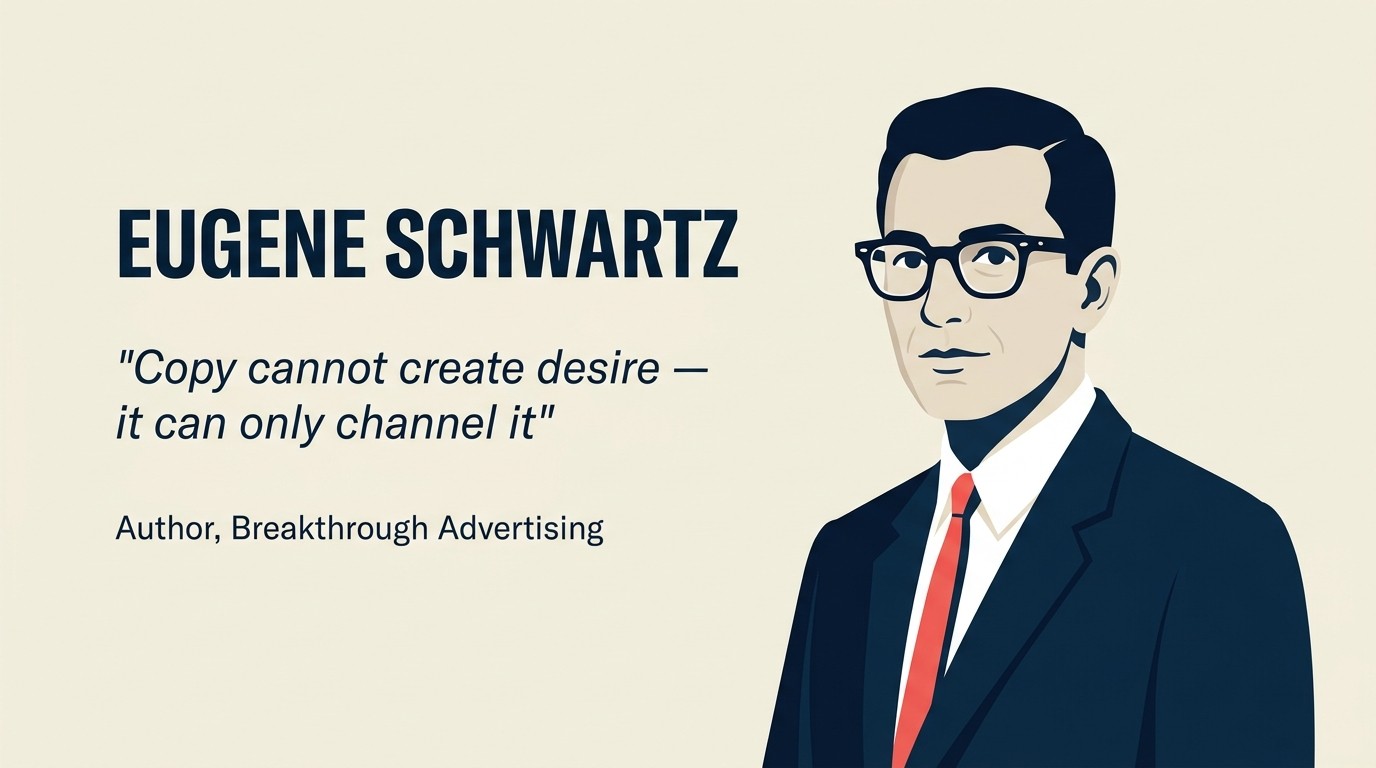
Eugene Schwartz published Breakthrough Advertising in 1966, and the first substantive claim in the book is still the most clarifying thing anyone has written about copywriting: "The power of your copy cannot create desire for a product. It can only take the desires that already exist in the marketplace, and focus those desires onto a particular product."
That sentence ended a decades-long argument about whether great copy could sell anything to anyone. Schwartz said no. The copywriter's job is to find the river and build a boat, not dig the river. The copy isn't the source of demand. It's a focusing mechanism.
Breakthrough Advertising went out of print in the 1980s and resold for $200–$900 a copy on eBay before it was reprinted in 2017. That secondary-market price is a signal about how concentrated the value is. Schwartz wrote some of the highest-grossing mail-order copy in the 1960s and 1970s, amassed a significant modern art collection (including works by Jasper Johns and Robert Rauschenberg) funded by his fees, and died in 1995 having shaped every major direct-response copywriter who came after him. Gary Halbert, Dan Kennedy, and Gary Bencivenga all cite Schwartz as their primary influence. Claude Hopkins, another direct-response pioneer who preceded Schwartz by a generation, laid similar groundwork with Scientific Advertising, the two form the foundational canon of the discipline. Schwartz spent significant years of his career working at Rodale Inc., the Pennsylvania-based health and wellness publisher, where he wrote some of his most successful direct-mail promotions.
This isn't a meditation on a past era. It's an examination of what Schwartz believed about desire, attention, and mechanism, and what's still worth applying.
Key Facts About Eugene Schwartz
- Born 1927, died 1995, American direct-response copywriter whose career spanned nearly five decades of mail-order advertising.
- Authored Breakthrough Advertising (1966), a cult classic that went out of print and resold for $150–$900 per used copy before its 2017 reprint.
- Earned roughly $54,000 per hour on some Rodale projects, a benchmark effective rate calculated from the flat fees he commanded for promotions that often took him only a handful of focused sessions to draft.
- Defined the Five Stages of Market Awareness, Unaware, Problem Aware, Solution Aware, Product Aware, Most Aware, the diagnostic framework still taught in every serious direct-response program today.
- Worked in 33.5-minute focused sprints, he set a kitchen timer, wrote with zero interruption until it rang, then took a mandatory break; three-to-four sprints was a full writing day.
- Serious modern art collector, his estate, including works by Jasper Johns and Robert Rauschenberg, sold for over $4 million after his death.
The Schwartz Desire Principle (The Five Stages of Market Awareness)
The Schwartz Desire Principle holds that copy cannot manufacture demand, it can only channel a desire that already exists in the market and focus it onto a specific product. Operationally, Schwartz expressed this through his Five Stages of Market Awareness (Unaware → Problem Aware → Solution Aware → Product Aware → Most Aware), a diagnostic that tells the writer which rung the buyer currently stands on so the opening line, proof required, and call-to-action can be matched to that exact stage. One message broadcast across all five rungs will fail at four of them.
Leadership Style Breakdown
| Style | Weight | How it showed up |
|---|---|---|
| Customer Psychology Archaeologist | 65% | Schwartz treated copywriting as a diagnostic process, not a creative one. Before writing a single word of a promotion, he mapped the market: what does this audience already want, how aware are they of the problem, what have they been promised before and how did it fail them? He wasn't writing to a blank audience. He was writing to a specific segment of people who were already motivated, he just needed to give their existing desire a precise target. That meant reading the market's language carefully: what words did buyers use in letters, complaints, testimonials? He wrote back in those words, not in the brand's vocabulary. |
| Systematic Copy Architect | 35% | Once Schwartz understood the desire, he became methodical. He structured his copy around what he called the "mechanism", the specific reason, biological or mechanical, that the product did what it promised. He believed that long-form copy worked because motivated buyers would read every word as long as each word earned the next. He also ran his writing day like a production system: four focused writing sessions per day on a timer, no exceptions, no letting copy overflow into his evenings. |
That combination, archaeologist and architect, was unusual in an industry that romanticized inspiration. Schwartz wasn't waiting for the muse. He was building a system for finding the gap between desire and delivery, then filling it.
Key Leadership Traits
| Trait | Rating | What it means in practice |
|---|---|---|
| Mass-desire identification before writing a word | Exceptional | Schwartz's central argument is that you can't sell someone something they don't already want at some level. You can reframe the desire, sharpen it, redirect it toward your product, but you can't manufacture it. The practical implication for operators: before launching a product or messaging campaign, map the specific desires your audience is already carrying. Not what you wish they wanted. What they actually want, in their own words. The copy job starts after that mapping, not before. |
| 5 Levels of Awareness as a diagnostic framework | Very High | The framework asks: where is your buyer right now in their understanding of the problem and the solution? Each level requires a completely different opening. An unaware prospect who doesn't know they have a problem can't be sold to with a product-features lead. A most-aware prospect who already knows your product just needs the offer and maybe one more piece of proof. Collapsing these into one message loses everyone. |
| Headline-first thinking | High | Schwartz believed the headline did 80% of the work. Not because the body copy didn't matter, but because the headline had to stop the right person and promise them exactly the right thing. He wrote dozens of headlines before committing to one. The test was whether it arrested the specific prospect he was targeting, not whether it was clever or memorable in the abstract. |
| Time-blocking discipline | High | Schwartz wrote for exactly 33 minutes on a timer, then took a break. He repeated this cycle four times per day and refused to let copy invade his personal life. He was a serious collector and reader. The discipline wasn't self-help theater, it was a recognition that focused output over limited hours produces better work than fatigued output over unlimited hours. Most modern operators have the discipline problem backwards. |
The 3 Frameworks That Defined Eugene Schwartz
Mass Desire: Channel What Already Exists
Schwartz's mass-desire principle is the foundation everything else builds on. The idea is simple and difficult to fully accept: copy doesn't create desire. It selects a desire that already exists in the market and focuses it on a specific product.
What does this mean in practice? It means the most important work happens before you write. Schwartz spent significant time studying the market's existing language, the words buyers used when they wrote to advertisers, the complaints they voiced in letters, the aspirations they expressed in response to competitor offers. He was doing research that looked nothing like traditional market research. He wasn't asking people what they wanted in a focus group. He was reading what they'd already said unprompted.
The copy job was then to take that existing language and existing desire and build a path from where the buyer was to where your product sat. You weren't convincing them to want something new. You were showing them that what they already wanted was exactly what your product delivered.
For product marketers and GTM leaders, this reframes the job significantly. The question isn't "how do we create demand for this?" It's "what does our ideal buyer already want, and which of those wants does our product actually satisfy?" The answer to that question determines your messaging before you write a word of copy.
5 Levels of Customer Awareness: The Diagnostic Tool
This is Schwartz's most operationally useful framework. It defines five distinct states of buyer awareness, each requiring a completely different approach:

Unaware, the prospect doesn't know they have a problem. You can't open with a solution or even a problem. You open with a broad claim about an outcome they want.
Problem Aware, the prospect knows they have a problem but doesn't know solutions exist. Your lead acknowledges the problem and introduces the category of solution.
Solution Aware, the prospect knows solutions exist but doesn't know your product. Your lead positions your approach against the alternatives they're already considering.
Product Aware, the prospect knows your product but hasn't bought. Your lead addresses their specific objection or gives them the final piece of proof they need.
Most Aware, the prospect knows your product well and just needs the offer. Your lead can be the offer itself, possibly with a price or deadline.
The framework matters because most marketing treats all buyers as if they're at the same awareness level, usually product-aware, because that's the most comfortable place for the brand to operate. But the majority of a target market at any given time is problem-aware or solution-aware at best. If your ads assume product awareness that doesn't exist, you're not just missing the wrong people, you're creating confusion in the people you're targeting.
Schwartz used awareness level to determine the opening lines of every promotion. Not the creative hook. The diagnostic finding.
The Mechanism: Making the Claim Believable
Schwartz identified a third element that separated promotions that converted from ones that didn't: the mechanism. This is the specific reason, biological, chemical, mechanical, scientific, that your product does what it promises.

Claims without mechanisms are just assertions. "Lose 10 pounds in 30 days" is an assertion. The mechanism explains why this particular approach produces that result: a specific fiber compound that slows glucose absorption, or a specific training protocol that targets fat oxidation over glycogen. The mechanism makes the claim credible because it provides an explanation the reader can evaluate.
In Schwartz's era, the mechanism framework worked especially well in health and financial direct mail, where buyers were skeptical of claims and were already burned by previous products that promised and didn't deliver. The mechanism gave the copywriter a way to differentiate not just on outcomes but on reasons.
For B2B operators, the mechanism maps directly to differentiation. Don't just claim you're faster or better. Explain the specific architectural or process reason you're faster. That specificity is both more credible and more defensible, because a competitor can promise the same outcome but can't replicate your specific mechanism unless they replicate your product.
What Eugene Schwartz Would Do in Your Role
If you're a CEO, Schwartz's first question is about your positioning foundation. Not your tagline, your desire map. What does your target market already want before they know you exist? What outcome are they pursuing, what have they tried before, and how have those attempts fallen short? Your positioning should be the answer to a desire that's already in motion, not an attempt to create a new one from scratch. Most brand platforms skip this step and wonder why their messaging doesn't resonate.
If you're a COO, the operational lesson is about information capture. Schwartz's research process was a systematic effort to extract the market's own language from letters, complaints, and testimonials. In modern terms: are you systematically capturing what your customers say (not just what they rate) in support tickets, sales calls, renewal conversations, and churn interviews? That language is your raw material for messaging. If it lives only in sales reps' heads, you're losing the input that Schwartz would consider most valuable.
If you're a product leader, the awareness-level framework is a tool for sequencing your go-to-market. Before a launch, map where your ICP actually sits on the awareness spectrum. If most of your market is problem-aware and your launch deck assumes product awareness, your messaging will fail, not because the product is wrong but because the entry point is wrong. Product launches that start with features instead of problems are usually aiming at the wrong level of the framework.
If you're in sales or marketing, the mechanism framework is the most directly applicable tool. Every campaign you run should be able to answer: why does our product produce the result we're promising? If the answer is vague ("we have better AI" or "our platform is more intuitive"), you don't have a mechanism. You have an assertion. The discipline of developing a specific, verifiable mechanism forces you to understand your product's actual differentiator, and gives you copy that converts because it explains rather than just claims.
How Rework Applies the Schwartz Awareness Ladder
Schwartz's core discipline, match the copy to the buyer's awareness stage, and channel the desire that's already there rather than invent one, is how Rework's marketing library is structured. An unaware operations leader discovers us through an insights essay about hidden cost leaks; a problem-aware revenue leader lands on a libraries explainer about lead-management breakage; a solution-aware buyer reads a comparison between Rework and the CRM they're evaluating; a product-aware prospect sees pricing and an ROI calculator. Each format answers a specific rung on Schwartz's ladder rather than pushing the same feature sheet at everyone. The desire for less operational chaos already exists in every ops leader's inbox, Rework's job is to focus that existing desire onto a specific mechanism (unified CRM + work operations, with engines starting at $69/month billed yearly) rather than manufacture urgency. Schwartz would approve of the segmentation. He'd also demand we name the mechanism more aggressively.
Notable Quotes & Lessons Beyond the Boardroom
Schwartz was direct about the limits of the copywriter's job. "Copy cannot create desire for a product. It can only channel and focus desires and needs that already exist in the millions of readers towards that particular product." This appeared in Breakthrough Advertising and has been quoted in direct-response circles for 60 years because it's fundamentally true and fundamentally uncomfortable. Eugene Schwartz remains one of the most studied direct-response copywriters in the field, even three decades after his death. If you've built a product nobody wants yet, great copy won't fix it. The desire has to exist.
He also understood the relationship between knowledge and performance: "Your job is not to create desire. It is to channel and focus desire that already exists." He treated the pre-writing research process as the majority of the job, not the setup. Most operators reverse this, they allocate 10% of effort to understanding the market and 90% to execution. Schwartz would say you've got the ratio backwards.
What's harder to quantify but worth noting: Schwartz lived a full life outside the copy world. His art collection included Jasper Johns, Robert Rauschenberg, and others from the New York school. His estate sold the collection for over $13 million after his death in 1995. He didn't treat professional discipline and personal richness as opposites. The 33-minute timer wasn't just about producing good copy. It was about protecting the rest of his life from the copy business.
Where This Style Breaks
Schwartz's 5 Levels of Awareness framework assumes a single buyer with a linear decision path, enterprise B2B procurement involves 6–10 stakeholders at different awareness levels reading the same content simultaneously. His long-form direct mail model is structurally incompatible with social media feeds where you have roughly three seconds before the scroll. The "mechanism" framework that worked in health supplements, because the FDA allowed implied claims in 1966, is harder to execute in regulated SaaS categories where legal and compliance review every claim. And his time-blocking discipline assumes you control your calendar, which most VP-level operators don't. The principles transfer. The methods need significant translation before they're useful in a modern B2B context.
Frequently Asked Questions about Eugene Schwartz's Copywriting
Who was Eugene Schwartz?
Eugene M. Schwartz (1927–1995) was an American direct-response copywriter best known for Breakthrough Advertising (1966). He wrote long-form mail-order promotions for publishers like Rodale and Boardroom Inc. through the 1960s, 70s, and 80s, and influenced nearly every major direct-response copywriter who followed him, including Gary Halbert, Dan Kennedy, and Gary Bencivenga. Outside advertising, he was a serious collector of post-war American art.
What are the five stages of market awareness?
Schwartz's five stages are Unaware (the buyer doesn't know they have a problem), Problem Aware (they know the problem but not the solution), Solution Aware (they know solutions exist but not your product), Product Aware (they know your product but haven't bought), and Most Aware (they know your product well and just need the offer). Each stage requires a different opening line, a different level of proof, and a different call to action, which is why one-size-fits-all messaging consistently underperforms.
What is Breakthrough Advertising about?
Breakthrough Advertising is Schwartz's 1966 book on the principles of direct-response copywriting. It covers mass desire, the five stages of market awareness, the five levels of market sophistication, and the mechanism concept. The book is notable for treating copywriting as a diagnostic discipline, mapping the market before writing, rather than a creative or inspirational act. It went out of print in the 1980s and used copies resold for $150–$900 before a 2017 reprint.
What does 'copy cannot create desire' mean?
It's Schwartz's foundational claim that advertising can only channel desires that already exist in the market, it cannot manufacture them from nothing. Practically, this means the copywriter's real work happens before writing: studying the market's existing language, complaints, and aspirations, then matching product benefits to those pre-existing wants. If no underlying desire exists, even brilliant copy will fail.
What was Schwartz's 33.5-minute work method?
Schwartz wrote on a kitchen timer set for 33.5 minutes. While the timer ran, he did nothing but write, no email, no research, no interruptions. When it rang, he took a mandatory break regardless of momentum. Three or four sprints was a full writing day; he refused to let copywriting spill into evenings. The method worked because motivated focus over short, bounded blocks produced more finished copy than open-ended marathon sessions, and it protected the rest of his life from the business.
What can modern copywriters learn from Schwartz?
Three things transfer directly. First, do the desire research before writing, your buyer already wants something, so find out what in their own words from support tickets, reviews, and sales calls. Second, segment content by awareness stage instead of broadcasting one message at everyone. Third, name your mechanism, the specific, explainable reason your product produces its result, rather than relying on vague claims. These apply whether you're writing a landing page, a launch email, or a sales deck.
For related reading, see David Ogilvy Leadership Style, Joe Pulizzi Leadership Style, Seth Godin Leadership Style, Gary Vaynerchuk Leadership Style, and Philip Kotler Leadership Style.

On this page
- Key Facts About Eugene Schwartz
- The Schwartz Desire Principle (The Five Stages of Market Awareness)
- Leadership Style Breakdown
- Key Leadership Traits
- The 3 Frameworks That Defined Eugene Schwartz
- Mass Desire: Channel What Already Exists
- 5 Levels of Customer Awareness: The Diagnostic Tool
- The Mechanism: Making the Claim Believable
- What Eugene Schwartz Would Do in Your Role
- How Rework Applies the Schwartz Awareness Ladder
- Notable Quotes & Lessons Beyond the Boardroom
- Where This Style Breaks