Martin Fowler Leadership Style: The Practitioner Who Defined How Software Teams Think
Turn this article into takeaways for your work.


Each assistant summarizes the article only for you and suggests best practices for your work.
Key Facts: Martin Fowler
- Role: Chief Scientist at ThoughtWorks since 2000 (joined 1999)
- Defining books: Refactoring: Improving the Design of Existing Code (1999), Patterns of Enterprise Application Architecture (2002), Microservices (co-authored article with James Lewis, 2014)
- Platform: martinfowler.com, authoritative technical essays in the "bliki" (blog + wiki) format he pioneered, continuously published since the late 1990s
- Agile Manifesto: One of 17 original signatories (Snowbird, Utah, 2001); provided the Extreme Programming technical-practices backbone
- Influence model: Purely earned, no positional authority, no company of his own, no team of thousands
Martin Fowler never ran a FAANG. He never raised a billion dollars or managed an organization of thousands. He joined ThoughtWorks in 1999 as Chief Scientist and has stayed there ever since, writing, consulting, and publishing continuously for more than 25 years.
The Fowler Influence-Without-Authority Model
A leadership model where sustained credibility is earned by naming and codifying the practices a field already does informally, publishing those definitions continuously over decades, and publicly revising positions when practice outruns theory. Authority compounds through accuracy, not hierarchy, and the body of work itself becomes the org chart.
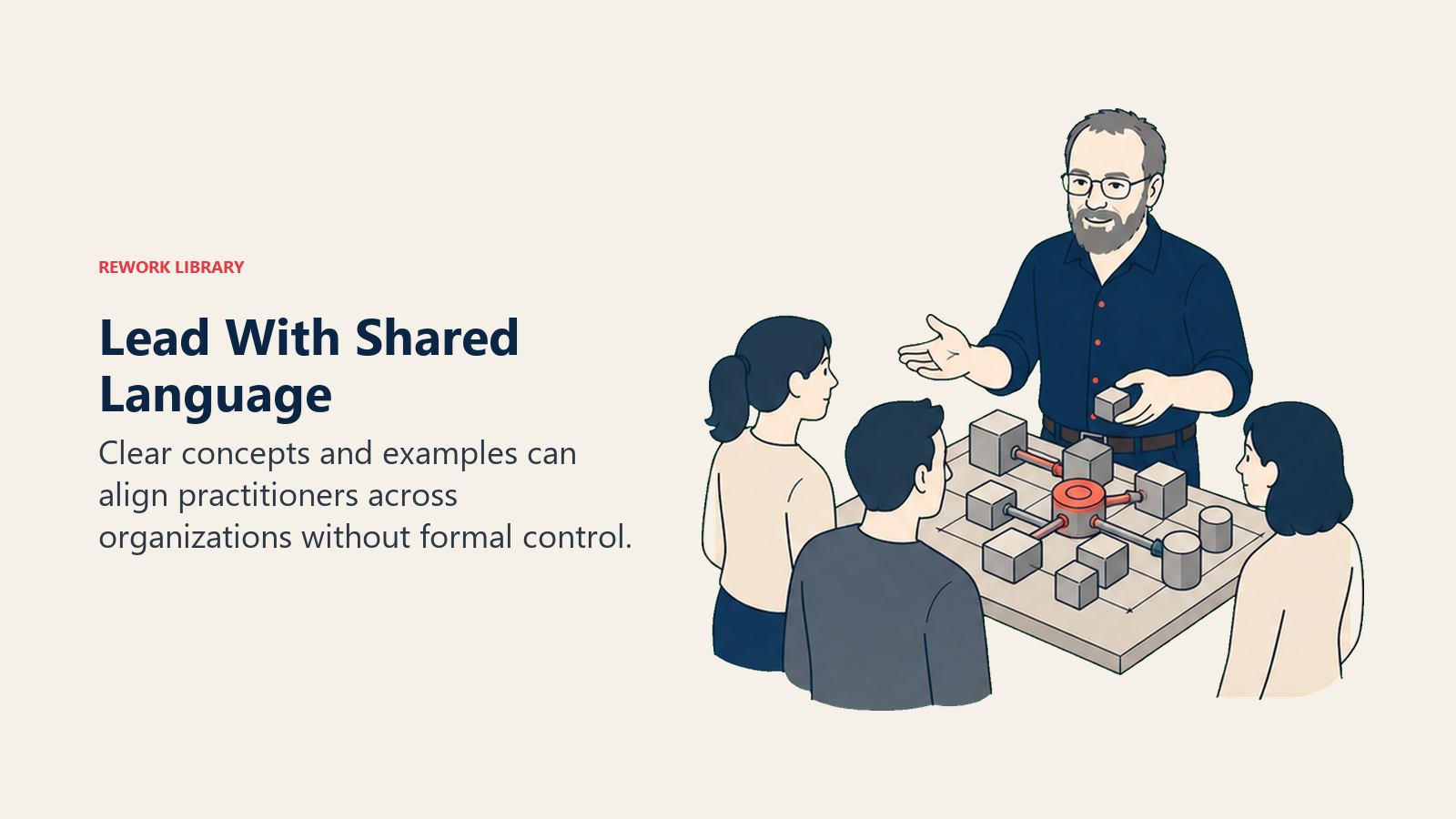
And yet nearly every software team working today uses terminology, patterns, and practices he named, defined, or popularized. Refactoring, the practice of improving code structure without changing its behavior, was something developers did silently before Fowler wrote the book that gave it a name in 1999. Continuous integration was a disciplined practice before he helped make it standard. Domain models, active records, and data mappers were architectural patterns before he catalogued them in 2002. And microservices was a word that barely existed before he and James Lewis published an article defining the concept on martinfowler.com in 2014, triggering an architectural wave that reshaped how the industry builds software.
Fowler's influence comes entirely without positional authority. He can't make anyone do anything. He leads through clarity of thought published to developers worldwide over a remarkably long time horizon.
Understanding how that works, and where it doesn't, is worth your time whether you lead a 10-person team or a 500-person engineering organization.
Leadership Style Breakdown
| Style | Weight | How it showed up |
|---|---|---|
| Practitioner-Scholar | 55% | Fowler's credibility comes from the combination of hands-on development experience and rigorous documentation. He wasn't writing theory in isolation from a university department. He was working on real projects with real clients and extracting the patterns that appeared repeatedly. "Refactoring" was based on documented techniques he and colleagues had been applying in consulting engagements. "Patterns of Enterprise Application Architecture" catalogued patterns he'd observed across dozens of enterprise systems. The practitioner foundation is what makes the scholarship land with people who have to write code every day. |
| Intellectual Infrastructure Builder | 45% | Fowler's second contribution is creating shared vocabulary. Before "refactoring" was a named practice, teams talked vaguely about "cleaning up code" or "restructuring." Once it had a name and a catalogue of specific techniques, teams could have precise conversations about what they were doing and why. The same applies to microservices: before the 2014 article, architects were building distributed services without a clear shared language for discussing the tradeoffs. Fowler gave the concept a name and a definition, which allowed the industry to have a real argument about when microservices make sense and when they don't. |
The 55/45 split explains why Fowler is studied by practitioners rather than just strategists. The intellectual infrastructure he builds is grounded in practice, which gives it a different kind of durability than frameworks created at a distance from working code.
Key Leadership Traits
| Trait | Rating | What it means in practice |
|---|---|---|
| Rigorous pattern documentation | Exceptional | Fowler's books are notable for documenting not just what a pattern is but when to use it, when not to use it, and what tradeoffs it involves. "Patterns of Enterprise Application Architecture" isn't a list of good practices. It's a decision framework: given a specific context with specific constraints, here are the patterns that apply, here's what they cost, and here's what you get. That kind of rigorous contextual documentation is rare and is what makes the books referenceable years after they were written, rather than useful only when you first read them. |
| Earned influence (no positional authority) | Very High | Fowler has influenced the practice of hundreds of thousands of developers without ever having authority over any of them. The mechanism is purely persuasion: the quality of his thinking, the clarity of his writing, and the consistency of his output over 25 years. That model is transferable to any leader who wants to build organizational influence that doesn't depend on their title. It's slow, it took Fowler years to build the authority that makes his current writing immediately influential, but it's durable in a way that positional authority isn't. |
| Long publishing cadence (25+ years) | High | The bliki at martinfowler.com has been updated continuously since the late 1990s. That's an unusual commitment: most practitioners stop publishing regularly once they've made their main contributions. Fowler's continued publishing means that his intellectual model is visible over a long time horizon, you can see how his thinking has changed, what he's reconsidered, and where he's updated positions he held publicly. That long record is part of what makes him trustworthy: he's been consistently right for long enough that new positions he takes are taken seriously. |
| Willingness to evolve public positions | High | Fowler has publicly updated his views on several major topics. He co-authored the Agile Manifesto in 2001 and has written extensively about how Agile was corrupted by certification and process bloat, essentially critiquing the industry that formed around his own contribution. He coined microservices and subsequently wrote about "microservice premium": the idea that microservices add complexity that isn't worth it for most organizations. He's not defending his own body of work. He's trying to describe the current state of practice accurately, even when that means revising positions associated with his name. |
The 3 Decisions That Defined Martin Fowler
1. Publishing "Refactoring" in 1999
Before 1999, code cleanup was an informal, undiscussable practice. Developers did it, but it lacked vocabulary, justification, or systematic technique. Managers who saw developers "cleaning up old code" instead of shipping features had no framework for understanding why that was valuable.
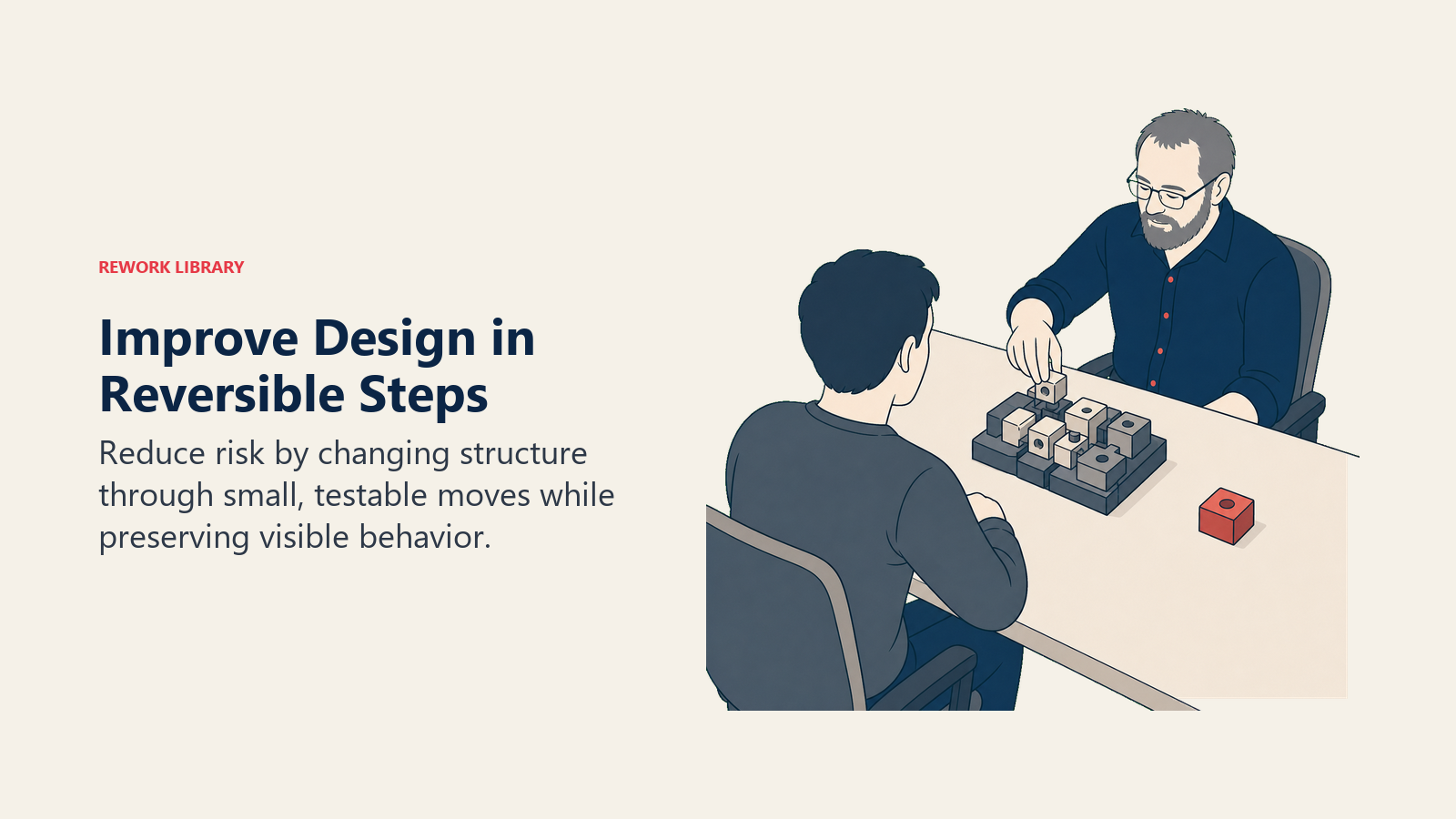
Refactoring: Improving the Design of Existing Code changed that. Fowler continues to document evolving practice on martinfowler.com, which has served as a practitioner reference for more than 25 years. Fowler's book, co-authored with Kent Beck and others, gave the practice a name and documented 72 specific refactoring techniques with precise mechanics: what to do, what to check before doing it, and what the result should look like. It also articulated the relationship between refactoring and testing, you can only safely refactor code you have tests for, because tests are what let you verify the behavior hasn't changed.
The business consequence was that teams could now have an honest conversation about technical debt. Not "we need time to clean up code", a request that sounds vague and optional, but "we need to apply these specific refactorings before adding this feature, because the current structure will make that feature expensive to test and expensive to change." That's a specific claim with a defensible justification. Fowler gave developers the vocabulary to make it.
The second edition in 2018 updated the catalogue for modern JavaScript and object-oriented patterns, demonstrating that Fowler was still engaged with current practice nearly 20 years later rather than preserving a 1999 snapshot.
For operators today, the lesson from "Refactoring" isn't about code specifically. It's about the value of naming practices that your organization does informally. Every organization has effective behaviors that work but aren't named, documented, or deliberately taught. The moment you name them, you can discuss them, improve them, and onboard new people into them. That's Fowler's method applied to any domain.
2. Co-Authoring the Agile Manifesto in 2001
In February 2001, 17 practitioners met at Snowbird, Utah, and produced the Agile Manifesto, a four-value, twelve-principle document that described a different way of building software than the heavyweight process methodologies dominant at the time. Fowler was one of the 17 signatories.
Fowler's contribution to the Manifesto wasn't the values statement itself, that was collective, but the technical practices backbone. He had been practicing and teaching Extreme Programming (XP) techniques: test-driven development, continuous integration, pair programming, small releases. Those practices are what make the Manifesto's values operational. "Responding to change over following a plan" sounds like a value. Continuous integration and test-driven development are the engineering practices that make it safe to respond to change without breaking existing functionality.
The Agile Manifesto became the most influential document in software development methodology in the 21st century. It also generated an industry of certifications, processes, and consulting frameworks that Fowler subsequently spent years criticizing as fundamentally contrary to its original intent.
In 2018, Fowler co-wrote "Agile Fluency," which explicitly distinguishes between teams that use Agile vocabulary and teams that have the underlying technical practices that make Agile valuable. His position, stated plainly: Scrum without continuous integration and test-driven development is theater. The practices matter; the ceremonies are secondary. Most organizations implement the ceremonies and skip the practices, which is why they don't get the results the manifesto's authors expected.
3. Coining "Microservices" with James Lewis in 2014
In March 2014, Fowler and James Lewis published an article on martinfowler.com titled "Microservices." The article described a software architectural style, small, independently deployable services that communicate over APIs, that teams at Netflix, Amazon, and ThoughtWorks had been building without a common name.
The article got the name right, the tradeoffs mostly right, and the adoption curve dramatically wrong. What followed was an architectural wave that swept through the industry, with thousands of companies rebuilding their monolithic applications as microservices ecosystems. The Docker and Kubernetes ecosystems that emerged in parallel made microservices technically practical at a much larger scale than had been possible before.
Fowler and Lewis described the pattern accurately. But naming something creates the demand to apply it everywhere, including places where it doesn't fit. Werner Vogels at Amazon had been building the distributed services model from the inside out, operationally, at scale, while Fowler was defining it conceptually, and the gap between Vogels's hard-won production constraints and the industry's uptake of the concept without those constraints explains a lot of the microservices failures that followed. Microservices add real overhead: network latency between services, distributed tracing complexity, service discovery infrastructure, and the operational burden of running dozens of independently deployed systems instead of one. For a team of 5 engineers shipping a product that doesn't yet need to scale, that overhead is expensive relative to the benefits.
Fowler subsequently wrote about what he called the "microservice premium", the observation that microservices only pay off at a scale and organizational size that most teams don't have. He also wrote "MonolithFirst," arguing that teams should start with a monolith and extract microservices when they understand which boundaries are actually stable. That's a significant revision of the narrative created by the 2014 article, and it reflects Fowler's willingness to course-correct even when the correction contradicts his own high-profile work.
What Martin Fowler Would Do in Your Role
If you're a CEO, the refactoring principle applies to organizational processes. Every organization accumulates process debt: approval workflows designed for problems that no longer exist, reporting structures that made sense at a previous scale, decision rights that haven't been updated since an acquisition two years ago. Fowler's insight is that you can't refactor safely without tests, feedback mechanisms that tell you whether behavior has changed unintentionally. Before redesigning a major organizational process, ask: what's the equivalent of a test suite here? What feedback mechanisms will tell you whether the change improved things or just changed them?
If you're a COO, the Agile Manifesto's technical backbone lesson is directly applicable. Most organizations that "do Agile" have implemented the sprint ceremonies, two-week sprints, daily standups, retrospectives, without the engineering practices that make those ceremonies valuable. Continuous integration, automated testing, and small frequent releases are what make it safe to plan in two-week increments without accumulating hidden risk. If your engineering teams are doing sprints but deployments take weeks and test coverage is low, you're getting the overhead of Agile without the benefits. The fix isn't more process; it's the technical practices Fowler described in 2001.
If you're a product leader, Fowler's MonolithFirst advice is worth applying to product architecture decisions. The pressure to design for scale from day one, to build the microservices architecture before you have the scale that requires it, produces systems that are complex before they're correct. You don't know which modules will need to scale independently until you've built the product and seen how it's actually used. Marty Cagan makes a parallel argument from the product side: you don't know what to build until you've learned from users, which is why premature architecture investment and premature roadmap commitment fail for the same underlying reason. Fowler's advice: build the simplest thing that works, learn from production, and extract the parts that need independent scaling when you understand what those parts are. The architecture should reflect the system you actually have, not the system you hope to have in three years.
If you're in sales or marketing, Fowler's influence model, earning trust through consistent high-quality output over a long time horizon, is more applicable to content marketing and thought leadership than any other executive's approach in this series. He built one of the most authoritative voices in software by publishing continuously, updating his positions publicly when they turned out to be wrong, and prioritizing accuracy over engagement. Most content marketing programs optimize for reach. Fowler optimized for trust. The difference compounds over years: his audience reads new articles because they trust his judgment from previous ones, not because the headline got them to click.
How Rework Operationalizes the Fowler Playbook
Fowler's leverage came from codifying patterns, taking behaviors teams performed implicitly and turning them into named, teachable, referenceable artifacts. That's exactly the gap most operations teams live in: the institutional knowledge about how deals actually close, how onboarding actually works, or how escalations actually route lives in the heads of a few senior people and nowhere else. Rework's role is to be the pattern catalogue for your operation. Pipeline stages, handoff checklists, approval flows, and cross-team playbooks become the team's "Patterns of Enterprise Application Architecture", documented, versioned, and referenceable rather than tribal. And like Fowler's work, the patterns evolve in the open: when a stage no longer fits, you rename it, revise the entry, and the whole team sees the change. That's pattern-driven ops, influence without authority, applied to how work actually flows.
Notable Quotes & Lessons Beyond the Boardroom
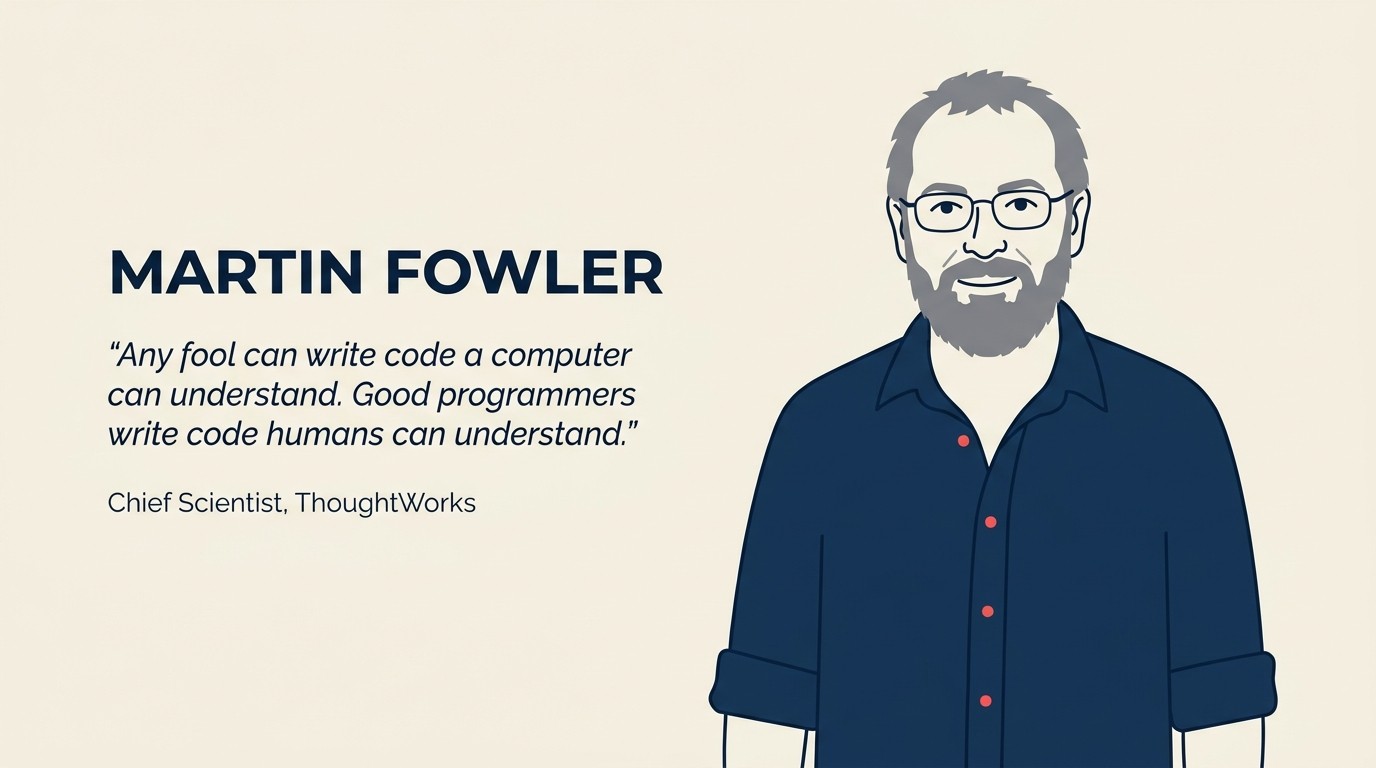
From martinfowler.com: "Any fool can write code that a computer can understand. Good programmers write code that humans can understand." Jeff Dean built systems of a scale few engineers have touched, but Fowler's point applies even there: the constraint on Google's infrastructure teams isn't raw cleverness, it's whether the people who inherit a system can understand it well enough to extend it safely. That's the practitioner-scholar principle in one sentence. Code is communication between people, not just instructions to a machine. The dominant constraint in large-scale software development isn't whether the code works, it's whether the people who need to change it six months from now can understand it well enough to change it safely. Fowler's entire body of work is an elaboration of that principle.
On refactoring, from the book's introduction: "Refactoring is a disciplined technique for restructuring an existing body of code, altering its internal structure without changing its external behavior." The precision of that definition matters. "Without changing its external behavior" is the constraint that makes refactoring safe. Every refactoring technique in his catalogue is designed to preserve behavior while improving structure. The discipline is what distinguishes refactoring from rewriting, a distinction teams lose when they use the word loosely.
He also wrote, in "Is Design Dead?" in 2000, about the relationship between design and change: "Many things that we use to justify upfront design have turned out to be wrong in practice." That's a harder statement than it looks for engineers who were trained to design before building. Fowler's argument is that design should be continuous rather than front-loaded, that you learn what the right design is by building, and that over-designing before you have that learning produces systems optimized for a problem you don't fully understand yet.
Where This Style Breaks
Influence-without-authority is slow. Fowler has been building his reputation for 25 years. You can't borrow his method on a six-month product cycle.
Naming a pattern doesn't guarantee good implementation. Microservices is the clearest example: a rigorous architectural description became a cargo cult. Teams adopted the pattern without the organizational maturity, the tooling investment, or the scale that makes it valuable. Fowler named the concept correctly, but the naming accelerated adoption faster than understanding. That's a risk inherent in intellectual infrastructure building, you're handing a powerful tool to people who may not have the context to use it safely.
And the practitioner-scholar voice doesn't translate to companies under execution pressure. Fowler's writing is deliberate, nuanced, and long. It's designed for reflection, not for making a decision under deadline. Leaders who need to choose an architecture in a week and ship in a month don't have the luxury of working through the full contextual analysis his books require. His frameworks are most useful for leaders who have enough operational stability to think carefully, which is not always the situation you're actually in.
Frequently Asked Questions about Martin Fowler's Leadership
Who is Martin Fowler?
Martin Fowler is a British software engineer, author, and Chief Scientist at ThoughtWorks, widely regarded as one of the most influential voices in software architecture and engineering practice. He has shaped the field without ever running a company, by writing books, publishing essays on martinfowler.com, and codifying the patterns practitioners use every day.
What is Refactoring per Fowler?
In his 1999 book, Fowler defined refactoring as "a disciplined technique for restructuring an existing body of code, altering its internal structure without changing its external behavior." The book catalogued 72 specific techniques with precise mechanics and tied the practice to automated testing, which is what lets you refactor safely without introducing regressions.
What is Fowler's role at ThoughtWorks?
Fowler joined ThoughtWorks in 1999 and has served as Chief Scientist since 2000. The role is unusual, it's not operational leadership of the firm but rather a mandate to write, consult on client engagements, and publish the patterns that emerge from ThoughtWorks' practice. It's the platform from which he has produced most of his public work.
What is martinfowler.com known for?
The site is known for the "bliki" format, a hybrid of blog and wiki that Fowler pioneered in the early 2000s, where long-form technical essays sit alongside continuously updated reference entries. It has served as an authoritative reference on enterprise architecture, microservices, refactoring, continuous integration, and agile practice for more than 25 years.
What did Fowler contribute to Microservices?
In March 2014, Fowler and James Lewis published an article on martinfowler.com titled "Microservices" that gave the architectural style its name and its most widely cited definition. The article described a pattern that teams at Netflix, Amazon, and ThoughtWorks were already practicing without a shared vocabulary, and it triggered the industry-wide adoption wave that followed.
What can engineering leaders learn from Martin Fowler?
Three things. First, name the practices your team does informally, naming makes them discussable, teachable, and improvable. Second, build influence through consistent, accurate output over a long time horizon rather than through title or headcount. Third, be willing to publicly revise your own positions when practice shows them to be incomplete. Fowler revised his views on Agile, on microservices, and on upfront design, and that willingness is part of why he stays trusted.
For related reading on engineering practice and culture, see Werner Vogels Leadership Style, Linus Torvalds Leadership Style, and Andy Grove Leadership Style.

On this page
- The Fowler Influence-Without-Authority Model
- Leadership Style Breakdown
- Key Leadership Traits
- The 3 Decisions That Defined Martin Fowler
- 1. Publishing "Refactoring" in 1999
- 2. Co-Authoring the Agile Manifesto in 2001
- 3. Coining "Microservices" with James Lewis in 2014
- What Martin Fowler Would Do in Your Role
- How Rework Operationalizes the Fowler Playbook
- Notable Quotes & Lessons Beyond the Boardroom
- Where This Style Breaks