Marc Andreessen Leadership Style: Software Is Eating the World, and His Bets Prove It
Turn this article into takeaways for your work.


Each assistant summarizes the article only for you and suggests best practices for your work.
Marc Andreessen is one of the few people to have both built significant technology products and then financed the next generation of them at scale. He co-created Mosaic, the browser that made the web accessible, and then Netscape, which turned that browser into a business that briefly held a $2.9 billion valuation. After Netscape, he co-founded Andreessen Horowitz (a16z), which became one of the most influential venture firms of the 2010s, with early investments in Facebook, Twitter, GitHub, Airbnb, Lyft, and Coinbase, among others.
What's most studied about Andreessen isn't his specific bets. It's his frameworks for thinking about technology adoption, product-market fit, and the conditions that make category leaders possible.
Leadership Style Breakdown
| Style | Weight | How it showed up |
|---|---|---|
| Conviction-driven thesis | Very High | Published "Software Is Eating the World" in 2011; backed companies before the thesis was consensus |
| Intellectual aggression | High | Publicly defends contrarian positions; rewards founders who challenge him |
| Systems thinking | High | A16z built like an operating company, not a traditional 2-person firm |
| Operational pragmatism | Medium | Brings operator experience (Netscape) into investment judgment |
The "Software Is Eating the World" Framework
In August 2011, Andreessen published an op-ed in The Wall Street Journal titled "Why Software Is Eating the World." The piece argued that software companies were on track to disrupt every major industry, not just technology sectors. He cited examples at the time that were not yet obvious: Netflix disrupting video stores, Amazon disrupting retail, Spotify disrupting music.
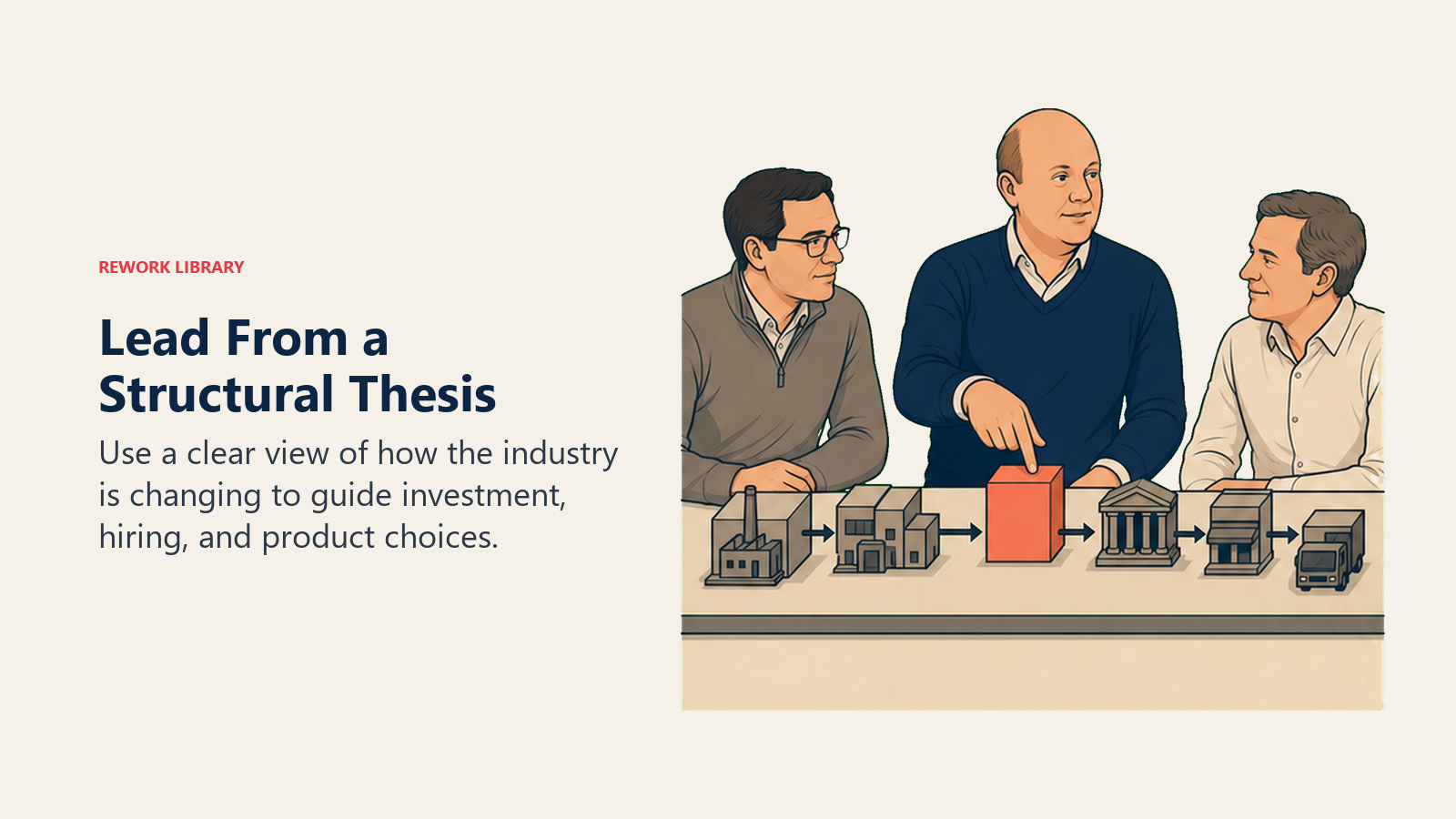
The framework behind the essay was more specific than the headline suggested. Andreessen was arguing that the economics of software distribution had crossed a threshold. Once a software product was built, distributing it to additional customers cost nearly nothing. This meant that the industries most vulnerable to disruption were those where the cost of delivery was the main economic barrier, and where incumbent players had optimized for delivery rather than for the core value proposition.
For operators, the framework translates to a useful question: in our market, is the main economic barrier distribution cost or product value? If it's distribution cost, you're vulnerable to a software-first competitor. If it's product value (because the product requires specialized expertise, physical infrastructure, or regulatory compliance that can't be replicated in software), you have a defensible position.
Building A16z as an Operating System, Not a Fund
Andreessen's most significant leadership innovation wasn't an investment thesis. It was how he and Ben Horowitz designed a16z's organizational model.
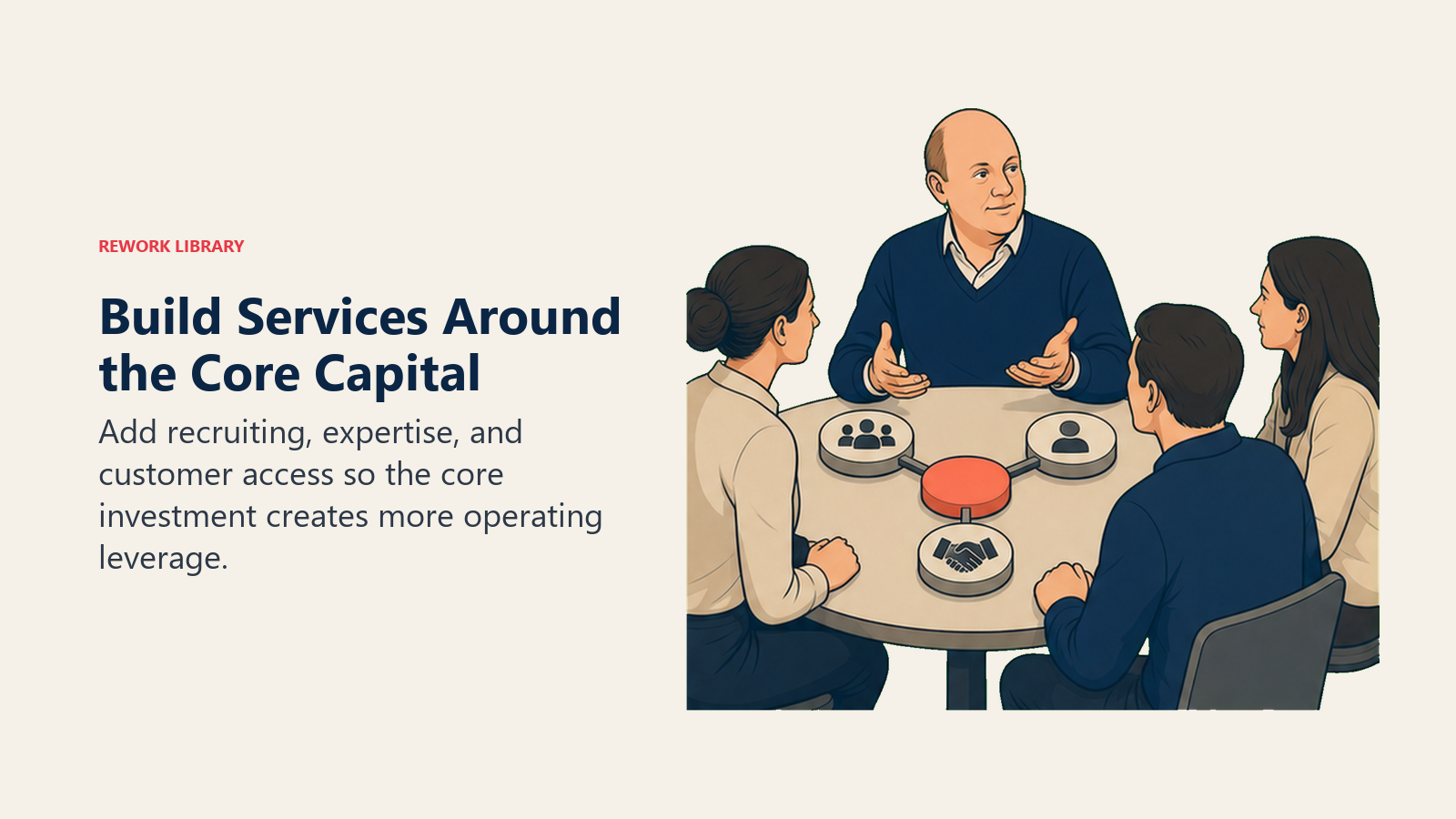
Traditional venture firms operate with a small partnership and minimal infrastructure. Partners make investment decisions; everything else is handled by portfolio companies themselves or third-party advisors. Andreessen Horowitz inverted this model deliberately.
A16z built large internal teams for recruiting, marketing, communications, legal, and technical operations. Portfolio companies got access to these resources as part of the a16z relationship. The thesis was that the most valuable thing a venture firm could provide wasn't just capital, but the operational infrastructure that early-stage companies struggle to build from scratch.
This is a documented leadership insight applicable beyond venture: the constraint in a scaling organization is usually not talent at the top but the supporting infrastructure around that talent. Building the infrastructure (recruiting systems, onboarding processes, knowledge management, legal frameworks) before you need it is more valuable than building it reactively.
Product-Market Fit as a Non-Negotiable
Andreessen's writing on product-market fit, particularly his 2007 essay "The Only Thing That Matters," defined how the startup ecosystem thinks about early-stage company health.
His framework: in a startup's early life, product, market, and team are all important. But they are not equally important. Market is the most important because you can have a great product and a great team, but if there's no market for what you're building, the company dies. Conversely, a mediocre team building a mediocre product in a large, hungry market can still build a significant company.
The operational implication: before optimizing team composition, compensation structures, or product architecture, validate that the market actually wants what you're selling at a price that makes the business viable. This sounds obvious but runs counter to how most early-stage companies are actually managed, where team-building and product refinement consume attention before the market signal is clear.
For directors and GMs managing business units inside larger companies: the same logic applies to new initiatives. Before allocating headcount and budget to build out a new product line or service offering, validate market demand explicitly. Not via internal surveys or customer advisory boards, but via actual purchase intent tested against real alternatives.
Contrarianism as a Leadership Signal
One of Andreessen's documented operating principles is a version of Peter Thiel's contrarian question: "What important truth do very few people agree with you on?"
Andreessen applies this to investment thesis construction and, more broadly, to how he evaluates arguments. The question behind every position is: if this is right, why don't other smart people believe it? If the answer is "because the data hasn't emerged yet," that's a timing bet. If the answer is "because the consensus has a structural blind spot," that's a contrarian thesis. If the answer is "I can't think of why," the position may be less defensible than it appears.
For operators, this translates to a useful management practice: before making a significant strategic bet, explicitly surface the strongest case against it. Not as a devil's advocate exercise, but as a genuine test of whether you understand the risk. If you can't articulate the best case for the opposing view, you probably haven't done the analysis.
Where His Approach Has Limits
Andreessen's documented investment record includes significant misses alongside the wins. The pattern in the misses is often a mismatch between the software-driven disruption thesis and sectors where the physical world, regulation, or human behavior creates friction that software alone can't overcome. Healthcare and education are the most cited examples. Both sectors have seen massive software investment over the past 15 years with returns well below what the thesis would predict.
His intellectual combativeness, documented across his blogging history and public appearances, is also a double-edged quality. It produces clear thinking and willingness to defend unpopular positions. But it can also produce a closed loop where the contrarian position becomes its own orthodoxy, resistant to updating when evidence moves against it.
What Directors Can Take From Andreessen
The leadership lessons most applicable to operators at the director and VP level:
Build infrastructure before you need it. Andreessen's organizational design at a16z reflects a principle applicable to any scaling function: the constraint is usually infrastructure, not talent. A strong sales leader who doesn't have a good CRM, a strong onboarding process, and a clear handoff protocol from marketing is limited. Invest in the infrastructure around your best people.
Validate the market before the product. Before investing heavily in any new initiative, validate that the market actually exists and that your offer is differentiated within it. This is Andreessen's product-market fit insight applied to functional decision-making.
Articulate your best case against your own positions. The habit of explicitly surfacing the strongest counterargument to your current thesis improves decision quality and reduces the sunk-cost effect on strategy.
Key Facts
- Andreessen co-created Mosaic in 1993 and co-founded Netscape in 1994, which went public at a $2.9 billion valuation
- A16z's portfolio companies have included Facebook, Twitter, GitHub, Airbnb, Lyft, Coinbase, and Slack
- His 2011 "Software Is Eating the World" essay is one of the most cited technology strategy frameworks of the past 15 years
- A16z was built with large operational teams, inverting the traditional minimal-infrastructure venture model
Frequently Asked Questions
What is Marc Andreessen's most important business framework?
Arguably product-market fit priority from his 2007 essay "The Only Thing That Matters." The core insight is that market size and market hunger are more predictive of early-stage success than team quality or product sophistication. Get the market right first; optimize everything else second.
How does Andreessen Horowitz differ from traditional venture firms?
A16z built large internal teams (recruiting, marketing, communications, technical operations) that portfolio companies can access. Traditional firms operate with a small partnership and minimal staff. The a16z model treats operational support as a competitive differentiator in attracting the best founders.
What can non-tech operators learn from Andreessen's framework?
The most transferable insight is the software disruption diagnostic: is the main economic barrier in your market delivery cost or product value? If it's delivery cost, a software-first competitor can undercut your economics. If it's product value, you have more durable protection. Applying this question to your own market and competitors is a useful strategic exercise regardless of industry.
Learn More
