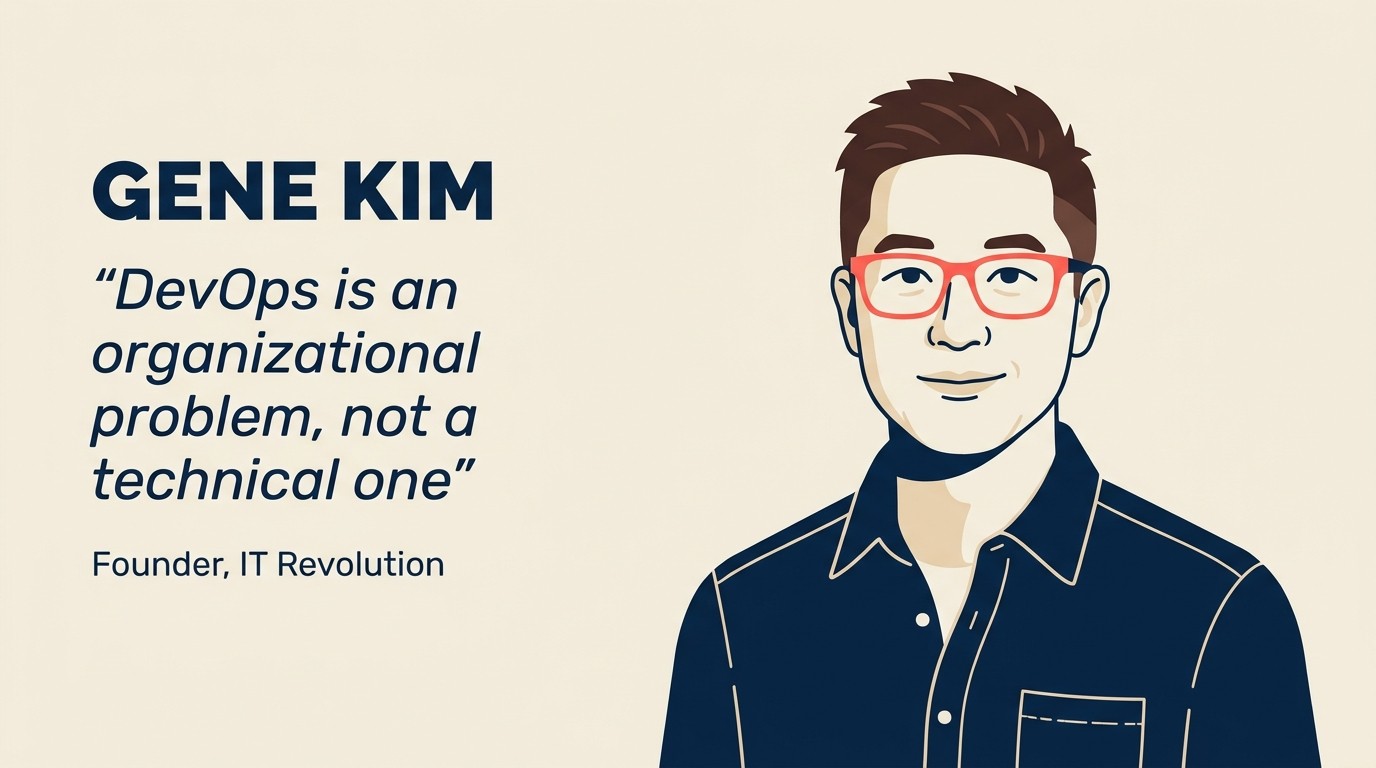
Gene Kim Leadership Style: DevOps Is an Organizational Problem, Not a Technical One
Turn this article into takeaways for your work.


Each assistant summarizes the article only for you and suggests best practices for your work.
The Phoenix Project is a novel about a fictional IT manager named Bill who has 90 days to fix a failing IT project before the plant manager shuts the department down. Published in 2013, it has sold over 750,000 copies. Not because it's great fiction, but because thousands of CTOs, VPs of Engineering, and CIOs have handed it to their CEOs and said: "This is exactly what's wrong with how we work."
Gene Kim started as a founder. He co-founded Tripwire, a security software company, at Purdue University in 1997 and served as CTO for 13 years before it sold to Thoma Bravo for $710M in 2011. He became the most influential researcher in DevOps after that, turning a set of deployment practices into a management philosophy applicable to any organization where work flows through constrained systems.
Understanding his Three Ways framework (and where it doesn't work) is worth your time whether you run engineering teams or don't touch code at all.
Key Facts About Gene Kim
- Founder and CTO of Tripwire Inc. (1997), security software company he co-founded at Purdue and led for 13 years as a DevOps and information security pioneer, before Thoma Bravo acquired it for $710M in 2011.
- Author of "The Phoenix Project" (2013), the novel-form DevOps classic that has sold over 500,000 copies and become required reading in CTO onboarding programs.
- Co-author of "The DevOps Handbook" (2016), the definitive DevOps reference, written with Jez Humble, Patrick Debois, and John Willis.
- Author of "The Unicorn Project" (2019), the sequel that introduced the Five Ideals framework for engineering culture.
- Co-author of "Wiring the Winning Organization" (2023), with Dr. Steven J. Spear, generalizing the DevOps playbook into a universal theory of high-performing organizations built on slowification, simplification, and amplification.
- Founder of the DevOps Enterprise Summit, the annual conference (launched 2014) where Fortune 500 technology leaders present case studies on large-scale DevOps transformation.
- Seven-time researcher on high-performing IT organizations, lead investigator across seven consecutive State of DevOps studies with Nicole Forsgren and the DORA team, producing the empirical foundation of modern software operations.
- Founder of IT Revolution Press, the independent publisher he built specifically to advance DevOps and technology management research.
The Three Ways of DevOps (The Phoenix Project Model)
The Three Ways of DevOps are Gene Kim's governing framework for high-performing technology organizations: Flow (optimize the left-to-right movement of work from development to operations to the customer by reducing batch sizes and limiting work in progress), Feedback (create fast right-to-left feedback loops from production back to the teams who can fix problems at the source), and Continuous Learning (institutionalize improvement and experimentation so local discoveries become organizational knowledge). Together, the Three Ways convert DevOps from a set of deployment practices into a management philosophy applicable to any value stream.
Leadership Style Breakdown
| Style | Weight | How it showed up |
|---|---|---|
| Researcher-Practitioner | 60% | Kim's credibility isn't academic. He ran Tripwire's engineering operations for over a decade, managing real compliance and security infrastructure before writing a word about DevOps. "The DevOps Handbook" (2016), co-authored with Jez Humble, Patrick Debois, and John Willis, draws on real case studies from companies like Nordstrom, Etsy, and Capital One. Kim's publisher for these works is IT Revolution Press, the independent house he co-founded specifically to advance DevOps and technology management research. The State of DevOps Report, which Kim contributed to alongside Nicole Forsgren, showed that elite performers deploy 200x more frequently than low performers with 2,604x faster lead times. That's not a framework from a distance; it's data from production systems. |
| Systems Thinker | 40% | Kim's analytical foundation is Eliyahu Goldratt's Theory of Constraints and Lean manufacturing. "The Phoenix Project" explicitly mirrors Goldratt's "The Goal": same narrative structure, same system-constraint logic, applied to IT. The novel's Wikipedia entry documents its impact, over 750,000 copies sold and widespread adoption as required reading in CTO onboarding programs. Kim doesn't think about DevOps as a toolchain problem; he thinks about it as a flow problem. The constraint isn't the deployment pipeline; it's the bottleneck in the value stream. That framing lets him generalize from software delivery to any organizational system where work queues up and compounds. |
The 60/40 split explains why Kim is studied by operators rather than just engineers. His research is grounded in operations, and his systems thinking is grounded in data, which gives his frameworks a different kind of authority than most management writing. That blend of field credibility and analytical rigor is something he shares with Werner Vogels, whose distributed-systems work at Amazon is similarly grounded in production reality rather than academic abstraction.
Key Leadership Traits
| Trait | Rating | What it means in practice |
|---|---|---|
| Novel-format teaching | Exceptional | Kim's decision to write "The Phoenix Project" as a novel instead of a management book was not an accident. Non-technical executives don't read technical books. They do read business narratives. By embedding DevOps principles inside a story about a company in crisis, Kim gave CTOs a document they could hand to their CEO and say: "Read this." The format reached an audience that "The DevOps Handbook" never would have. That's a deliberate distribution strategy, not just a stylistic choice. |
| Cross-discipline synthesis | Very High | Kim draws from Lean manufacturing, Theory of Constraints, and high-reliability organization research to explain DevOps. His synthesis of these fields is what makes his frameworks durable. Most DevOps writing stays inside software development. Kim's writing draws from Deming, Goldratt, and Sidney Dekker, which lets him make arguments about blameless postmortems, work-in-progress limits, and deployment frequency that connect to manufacturing, aviation safety, and organizational psychology simultaneously. Martin Fowler takes a comparable cross-discipline stance, anchoring continuous delivery and refactoring in Lean and XP principles rather than treating them as purely technical concerns. |
| Practitioner credibility | High | 13 years as CTO of Tripwire, running security operations for enterprise customers during a period when compliance requirements were escalating and infrastructure was increasingly complex. That's not a short stint. Kim understands what it feels like to manage on-call rotations, deal with audit requirements, and try to deploy features while keeping production stable. That experience is what makes his research credible to operators who have done the same. |
| Patience with organizational change | High | The Three Ways framework is not a 90-day project. Kim's consistent message across "The Phoenix Project," "The DevOps Handbook," and "The Unicorn Project" is that the transformation from a slow, fragile deployment process to a high-frequency, resilient one takes years of sustained effort. He doesn't promise quick wins. That patience is either a feature or a bug depending on whether you have the organizational runway to wait for compounding returns. |
The 3 Frameworks That Defined Gene Kim
The First Way, Flow
The First Way is about optimizing the flow of work from development to operations to the customer. The goal is reducing the time it takes for a code change to go from a developer's laptop to production, and increasing the reliability of that journey.
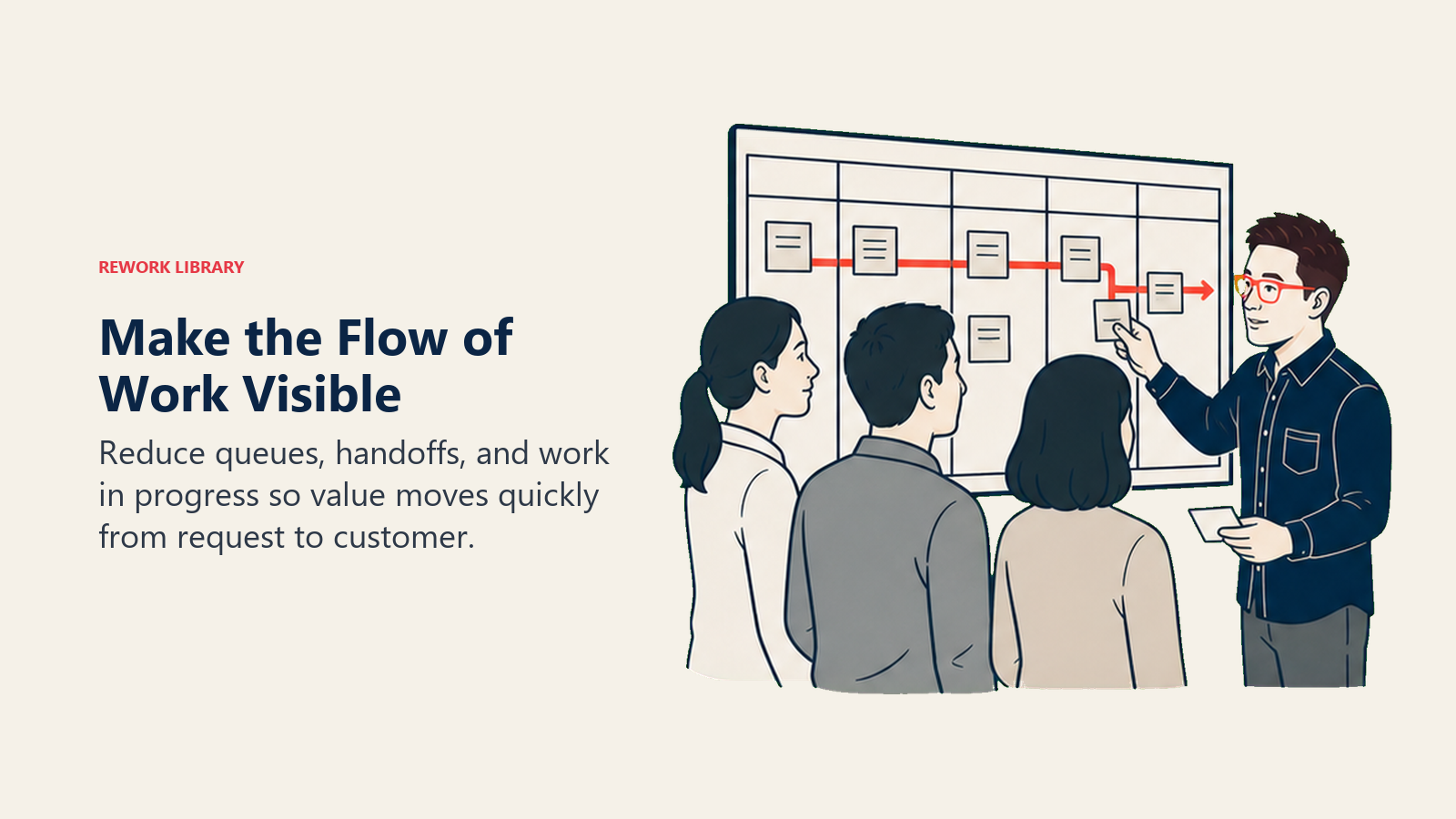
The specific practices: reduce batch sizes (don't try to deploy 3 months of work at once), limit work in progress (too many things in flight simultaneously creates more bottlenecks than it resolves), and build quality in rather than inspect it at the end. This last point is the one most organizations get wrong. Quality assurance as a phase at the end of the development process is the software equivalent of inspecting products on the factory floor after they've been built. By the time you find the defect, you've already paid for the work that created it.
For non-software operators, the First Way translates directly to any workflow with handoffs. Where does work queue up in your organization? Where does it get batched? Every batch accumulates invisible WIP cost: decisions waiting for approval, deals waiting for legal review, customer requests waiting for engineering prioritization. Kim's point is that reducing batch size and limiting WIP isn't just about speed. It's about making problems visible before they compound.
The Second Way, Feedback
The Second Way is about creating fast feedback loops from right to left in the value stream: from operations back to development, from customers back to product teams, from production data back to the engineers who wrote the code.
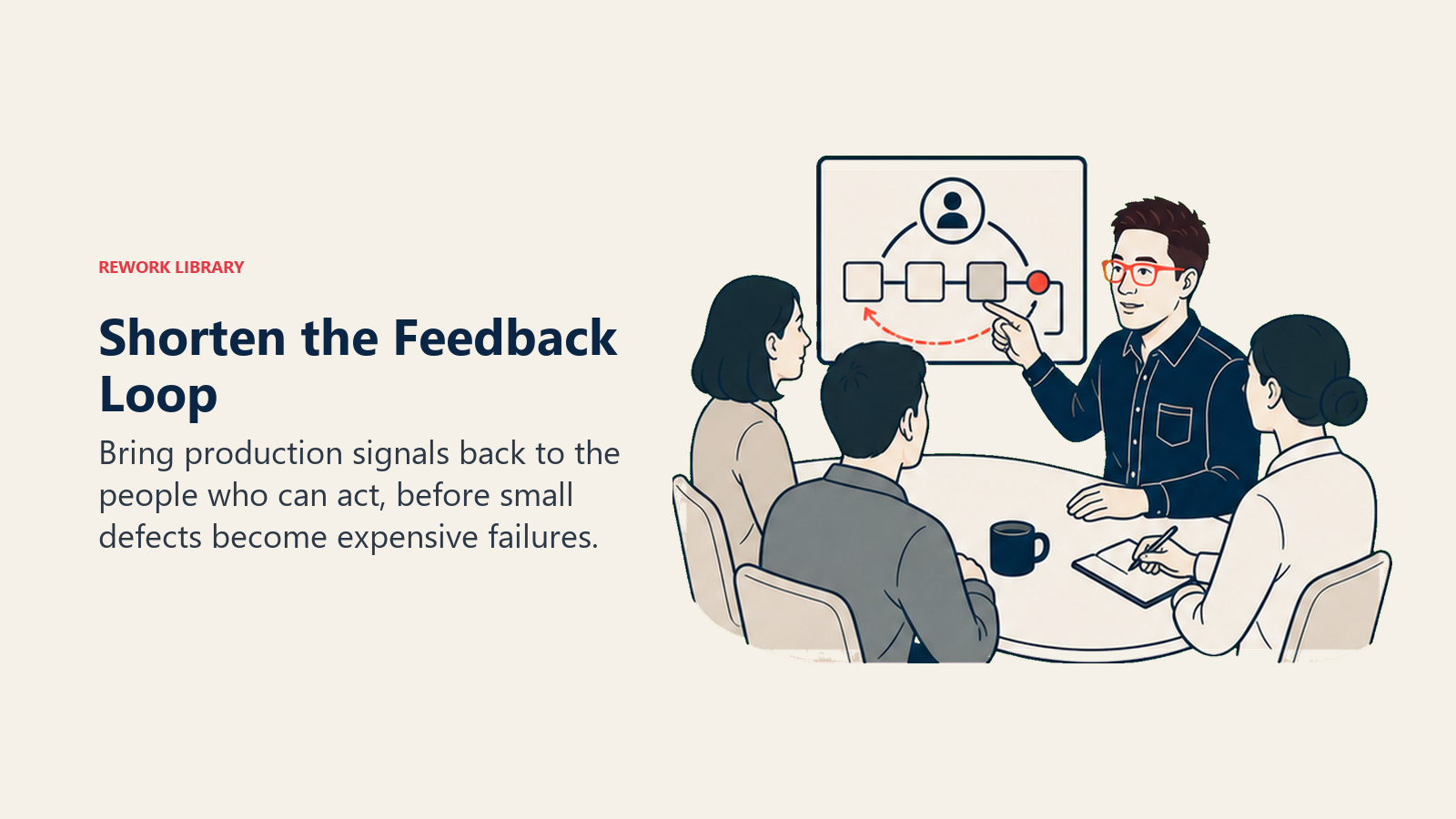
The core insight is that problems in production are most valuable the moment they happen, not weeks later in a post-mortem. Kim's research, informed by data from the DORA State of DevOps Report, shows that teams with shorter mean time to recovery from incidents learn faster than teams with lower incident rates. That's counterintuitive: teams that recover fast from more incidents outperform teams that rarely have incidents but recover slowly. The learning compounds.
The practical implications are significant. Blameless postmortems, monitoring that surfaces anomalies to the people who can fix them, and deployment pipelines that give immediate feedback on test failures are all Second Way practices. So is the habit of having engineers sit with customer support. The feedback mechanism only works if the signal reaches the person who can act on it quickly enough to matter.
The Third Way, Continuous Learning
The Third Way is about institutionalizing improvement. Not just fixing individual problems, but building a system that converts local discoveries into organizational knowledge and continuously experiments to generate new learning.
This is where Kim draws most heavily from Toyota Production System research and high-reliability organizations. The practices: dedicate time to improvement work (not just feature delivery), make experiments safe to run so that failed experiments produce learning rather than punishment, and create mechanisms for sharing what works across teams rather than leaving it local.
"The Unicorn Project" (2019), Kim's sequel to "The Phoenix Project," introduces the Five Ideals, which are the cultural conditions that make the Third Way possible: Locality and Simplicity (teams own what they change), Focus/Flow/Joy (developers doing their best work), Improvement of Daily Work (making improvement time protected, not deferred), Psychological Safety (people can surface problems without fear), and Customer Focus (decisions traced back to customer impact). The Five Ideals are Kim's attempt to name the culture that sustains DevOps transformation after the technical practices are in place.
What Gene Kim Would Do in Your Role
If you're a CEO, the most useful thing Kim offers is a diagnostic for why your technology organization can't move as fast as you need it to. The Phoenix Project's central crisis is a deployment process that's so fragile and slow that the business can't respond to market changes. If your engineering team tells you a feature takes six months and you don't understand why, Kim's framework gives you the right questions: What's the batch size? Where does work queue up? How long does it take to detect a production problem and fix it? Those questions will surface the constraint. The constraint is almost never "we need more engineers."
If you're a COO, the First Way applies directly to your operational workflows. Find the step in any cross-functional process where work accumulates the most. That's your constraint. Kim's point is that optimizing upstream of the constraint doesn't help; work just queues faster. You have to identify the constraint and subordinate everything else to elevating it. This is Goldratt's logic applied to operations. It works whether you're managing software deployment pipelines or contract review cycles.
If you're a product leader, the Second Way is your direct responsibility. The feedback loops between what you build and what users actually do with it are what drive your product decisions. Kim's research suggests that the frequency and speed of those feedback loops matter more than the sophistication of your research methodology. Weekly user data you can act on beats quarterly research you act on in planning cycles. Instrument your product to produce signal quickly, and build a team culture where that signal goes directly to the people making decisions, not into a reporting layer.
If you're in sales or marketing, Kim's content strategy is worth studying. "The Phoenix Project" exists because Kim understood that his target audience, executives who needed to change how their companies managed technology, wasn't going to read a technical handbook. He packaged the framework in the format his audience actually consumes. That's a distribution-first content strategy: identify the insight, then ask what format gets it in front of the decision-maker who needs it. That question is more interesting than "what format do we prefer to produce."
How Rework Operationalizes the Three Ways Outside Engineering
Kim's Three Ways were written for software delivery, but the logic generalizes cleanly to any team where work flows through handoffs. The question for a non-technical leader is: where is your batch size, your feedback delay, and your blocked learning loop? Rework's operational layer is what makes those questions answerable. Pipeline visibility across sales, customer operations, and account management shows exactly where work queues up, the First Way's constraint hunt, applied to revenue operations rather than deployment pipelines. Shared activity feeds and real-time status collapse the time between a problem surfacing and the person who can fix it seeing it, the Second Way, rebuilt for cross-functional teams without a monitoring stack. And because the same system captures outcomes next to the work that produced them, managers get the raw material for the Third Way: recurring retrospectives grounded in actual data, not recollection. Kim's framework turns operations from art into infrastructure when the instrumentation is there to support it.
Notable Quotes and Lessons Beyond the Boardroom
From "The Phoenix Project," the character Brent (the senior engineer everything depends on) is Kim's most useful teaching tool. Brent is the bottleneck that management has created by treating their best engineer as the solution to every problem rather than as a risk to be distributed. The quote that operators remember: "Being able to take needless work out of the system is more important than being able to put more work into the system." Every organization has a Brent. The Brent problem isn't about that person. It's about the management system that made one person's availability the constraint on everything else.
From "The DevOps Handbook": "Improvements made anywhere besides the bottleneck are an illusion." That's a precise statement of Goldratt's constraint theory applied to technology operations, and it's worth pinning above your desk if you're managing any complex system. Most optimization efforts in organizations target the parts that are easy to optimize, not the constraint. The result is efficiency in areas that don't control throughput and no improvement in overall output.
Kim has also said, in various talks and interviews, that the State of DevOps research changed his view of what high performance looks like. His research partnership with Nicole Forsgren and the broader DevOps community mirrors the open, collaborative ethos that Linus Torvalds established in open-source software, the idea that distributed peer review produces more reliable systems than centralized gatekeeping. Before the data, he assumed high-deployment-frequency organizations would have more stability problems. The data showed the opposite: elite performers deploy more frequently and have higher stability simultaneously. That finding, that speed and stability aren't in tension if the underlying practices are right, is the most important empirical result in modern software operations research.
Where This Style Breaks
Kim's Three Ways work best in product organizations with a stable, identifiable value stream from development to customer. They're harder to apply in consulting firms, agencies, or project-based businesses where "flow" looks different on every engagement. The framework also requires an IT function with enough organizational standing to implement cross-team practices. In companies where engineering lacks executive backing, the Three Ways produce insight but not movement.
And the novel format that made Kim broadly influential also limits the depth his frameworks can reach. "The Phoenix Project" is accessible because it's a story. It's limited because the story can only illustrate, not fully specify. Operators who read the novel and stop there get a diagnosis without a treatment protocol. "The DevOps Handbook" is the treatment protocol, but it requires significantly more commitment to work through.
Frequently Asked Questions about Gene Kim's DevOps Philosophy
Who is Gene Kim?
Gene Kim is an American researcher, author, and entrepreneur best known for reframing DevOps as a management discipline rather than a technical one. He co-founded the security software company Tripwire at Purdue in 1997 and served as its CTO for 13 years until it was acquired by Thoma Bravo for $710M in 2011. He is the author of "The Phoenix Project" (2013), "The Unicorn Project" (2019), and co-author of "The DevOps Handbook" (2016) and "Wiring the Winning Organization" (2023). He founded IT Revolution Press, created the DevOps Enterprise Summit, and led seven consecutive State of DevOps research studies.
What is The Phoenix Project?
"The Phoenix Project" is Kim's 2013 business novel about a fictional IT manager named Bill Palmer who is given 90 days to rescue a failing, over-budget IT initiative before his company shuts the department down. The book mirrors Eliyahu Goldratt's "The Goal" in structure and uses the story to teach Theory of Constraints, Lean, and DevOps principles. Published by IT Revolution Press, it has sold over 500,000 copies and is widely used as an onboarding text for CTOs, VPs of Engineering, and senior operators who need to explain DevOps thinking to non-technical executives.
What are the Three Ways of DevOps?
The Three Ways are Kim's core framework for high-performing technology organizations. The First Way is Flow, optimizing the left-to-right movement of work from development to operations to customer by reducing batch sizes, limiting work in progress, and building quality in rather than inspecting it at the end. The Second Way is Feedback, creating fast right-to-left feedback loops from production back to the teams that can act on problems. The Third Way is Continuous Learning, institutionalizing improvement and experimentation so local discoveries compound into organizational knowledge.
What is the DevOps Enterprise Summit?
The DevOps Enterprise Summit is the annual conference Kim founded in 2014 through IT Revolution Press to bring together Fortune 500 technology leaders who are applying DevOps principles at scale. Unlike a typical vendor conference, the program is built around practitioner case studies, CIOs, VPs of Engineering, and transformation leads from companies like Target, Capital One, Nationwide, and USAA presenting what actually worked and what did not across multi-year engagements. The Summit has become the primary venue where large-enterprise DevOps transformation evidence is documented and shared.
What is Wiring the Winning Organization about?
"Wiring the Winning Organization," co-authored with Dr. Steven J. Spear and published in 2023, generalizes the DevOps playbook into a universal theory of high-performing organizations. The book argues that winners consistently deploy three mechanisms, slowification (pulling hard problems out of the performance zone into a learning zone), simplification (modularizing work so experts can act independently), and amplification (surfacing problems early so they can be solved before they cascade). The framework is explicitly industry-agnostic, applying to software, manufacturing, healthcare, and any operational context where work moves through complex systems.
What can modern engineering leaders learn from Gene Kim?
Engineering leaders can take three things from Kim's body of work. First, that high performance is not a trade-off between speed and stability, seven years of State of DevOps data show elite performers deploy more frequently AND recover faster than low performers. Second, that transformation requires patience, the Three Ways compound over years, not quarters, and leaders who chase 90-day wins miss the real payoff. Third, that the constraint is usually organizational, not technical, most slow engineering organizations are slow because of batch size, handoff design, and feedback latency, not because of their toolchain.
For related reading on engineering practice and culture, see Martin Fowler Leadership Style, Werner Vogels Leadership Style, Linus Torvalds Leadership Style, Will Larson Leadership Style, and Camille Fournier Leadership Style.

On this page
- Key Facts About Gene Kim
- The Three Ways of DevOps (The Phoenix Project Model)
- Leadership Style Breakdown
- Key Leadership Traits
- The 3 Frameworks That Defined Gene Kim
- The First Way, Flow
- The Second Way, Feedback
- The Third Way, Continuous Learning
- What Gene Kim Would Do in Your Role
- How Rework Operationalizes the Three Ways Outside Engineering
- Notable Quotes and Lessons Beyond the Boardroom
- Where This Style Breaks