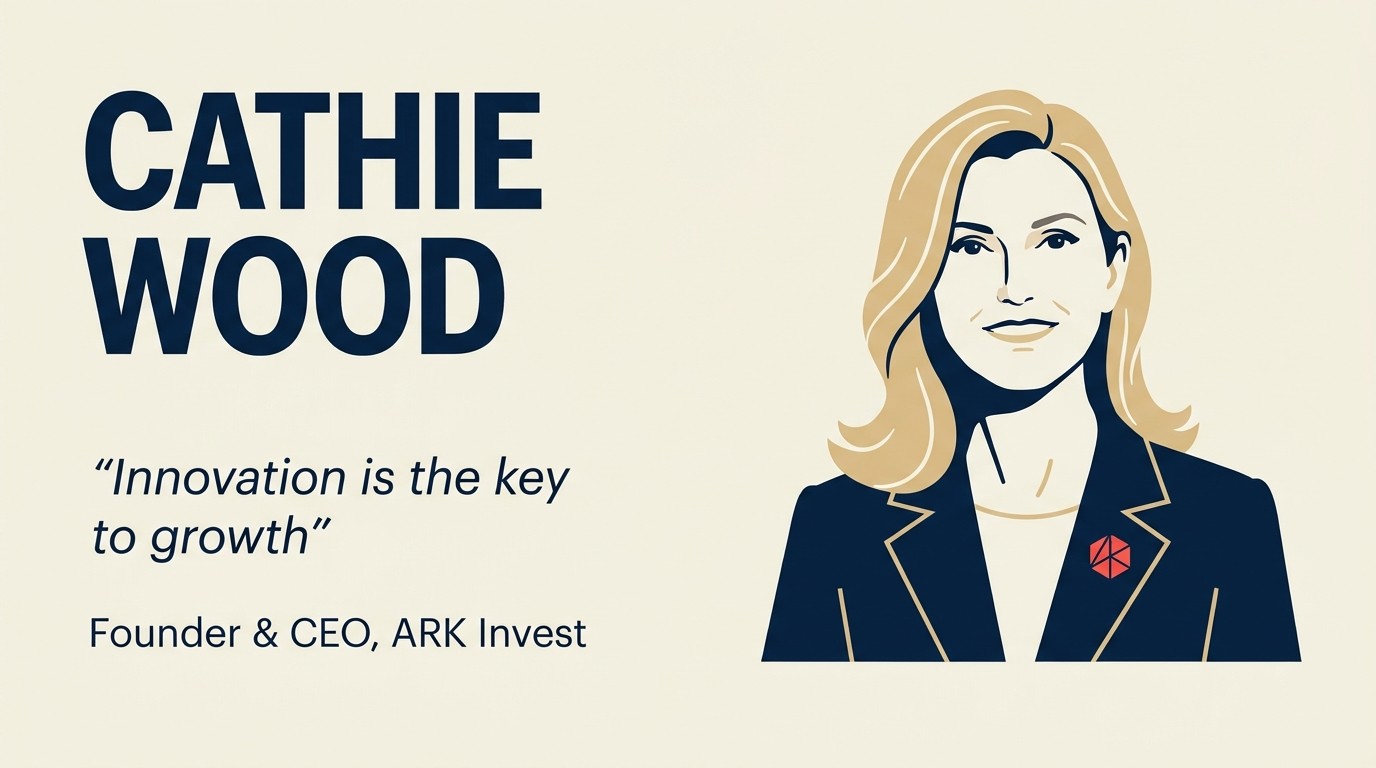
Cathie Wood Leadership Style: Conviction Investing in Disruptive Technology
Turn this article into takeaways for your work.


Each assistant summarizes the article only for you and suggests best practices for your work.
Key Facts: Cathie Wood (born 1955) founded ARK Invest in 2014 after two decades as Chief Investment Officer of Global Thematic Strategies at AllianceBernstein. ARK's flagship ETF ARKK reached an approximate peak AUM of $28 billion in early 2021 (firm-wide ARK assets peaked around $60 billion at that time, $150 billion at the top of the retail bull cycle when combined with follower copy-trading). Wood is best known for her conviction bets on Tesla and Bitcoin, her $1M+ Bitcoin price target by 2030, and ARK's unprecedented daily portfolio transparency, every trade disclosed at market close.
The Disruptive Innovation Thesis (The ARK Conviction Model)
Wood's framework holds that five technology platforms, AI, robotics, energy storage, DNA sequencing, and blockchain, will compound value faster than public markets price them because institutional investors are structurally anchored to 12-month performance windows. The ARK Conviction Model commits capital to 5-year price targets derived from Wright's Law cost curves, discloses every trade daily to build community trust, and holds positions through drawdowns rather than reducing exposure under pressure.
In 2016, when Tesla stock traded around $40 per share (split-adjusted), Cathie Wood published a $4 price target, on the upside. She was one of the only institutional analysts calling for a 10x return on a car company that had never turned an annual profit. Most of her peers thought the call was reckless. Some called it embarrassing.
In 2020, ARKK returned 150% and Wood became the most talked-about fund manager in America. Two years later, ARKK had fallen nearly 80% from its peak. Whether you think Wood is a visionary or a cautionary tale, she built ARK Invest from scratch in 2014 into a $60B AUM firm at its peak, doing it by being transparently wrong and right in public, in real time.
That combination of conviction, transparency, and volatility is what makes her worth studying regardless of whether you agree with her investment thesis.
Leadership Style Breakdown
| Style | Weight | How it showed up |
|---|---|---|
| Conviction-Driven Investor | 65% | Wood's primary mode is deep fundamental analysis built on technology cost curves and long-duration adoption models. She spent 20 years at Alliance Bernstein as Chief Investment Officer of Global Thematic Strategies before founding ARK. Forbes has covered her rise and the fund's volatility in depth. When she left to start ARK in 2014 at age 58, she did it because Alliance Bernstein rejected her proposal to launch a disruption-focused ETF. She self-funded the launch. The conviction to bet her career on a thesis that her employer wouldn't underwrite tells you more about her leadership style than any performance year does. She spent those 20 years at AB developing the framework she now applies, the conviction runs deep and is analytically grounded, not just temperamental. |
| Transparent Communicator | 35% | ARK discloses its trades at the end of every trading day, something no other major active fund manager does. ARK's research reports are free and public. Wood speaks at conferences, gives media interviews, publishes price targets explicitly, and defends positions publicly when they're challenged. The transparency is a deliberate brand and distribution strategy: it generates media coverage, builds retail investor loyalty, and creates a research-sharing community that ARK doesn't have to pay to maintain. The 35% weight reflects that the transparency is a strategic choice layered on top of the conviction, not the primary identity. |
The 65/35 split matters because it tells you which element drives the other. Wood's transparency is compelling because the conviction is genuine. An investor who disclosed daily trades without deep conviction would just be making their mistakes public faster. The transparency works because she actually believes what she's saying, and her willingness to defend specific numerical price targets in public is evidence of that.
Key Leadership Traits
| Trait | Rating | What it means in practice |
|---|---|---|
| Willingness to hold contrarian positions under public pressure | Exceptional | Wood's Tesla call is the most visible example, but it's not the only one. She maintained Bitcoin price targets of $1M+ by 2030 when crypto collapsed in 2022. She doubled down on ARKK holdings during the 2022 drawdown rather than cutting positions to reduce volatility. The willingness to hold a thesis through public ridicule and significant paper losses is genuinely rare in institutional investing, where career risk makes managers more likely to reduce deviation from benchmarks as pressure increases. Whether the thesis proves correct is a separate question from whether the conviction is authentic. |
| Transparent daily trading disclosures | Very High | No major active fund discloses trades the same day they're made. The standard in active management is quarterly filings, which give competitors no real-time signal about positioning. ARK's daily disclosure is unusual enough that it's become a signal in itself: some traders monitor ARK's daily filings to front-run positions, which creates market impact for ARK. Wood has acknowledged this tradeoff and maintained the policy anyway, which reinforces the brand commitment to transparency. For operators outside investing, the lesson is that radical transparency is a strategic choice with real costs and real benefits, and that the benefits sometimes include building a community of supporters who treat your openness as a form of trust. |
| Long-duration thinking (5-year price targets, not quarterly) | High | ARK's price targets are explicit 5-year forecasts, not 12-month targets. That time horizon is structurally different from how most institutional investors and equity analysts think. It creates a specific kind of analytical work, modeling technology adoption curves, cost declines, and market size expansion over years rather than quarters, and a specific kind of performance evaluation that's hard to apply on a standard quarterly review cycle. The long duration creates the intellectual conditions for genuine disruption investing, but it also creates the conditions for sustained underperformance without accountability if the thesis is wrong. |
| Missionary investor identity, disruption as a moral thesis | High | Wood is a practicing Christian, and she's explicitly connected her investment philosophy to her values. She describes disruptive innovation not just as a financial opportunity but as a moral force, technologies that improve human lives, reduce costs for consumers, and create value that incumbents and legacy systems have been capturing inefficiently. That identity gives her conviction a foundation that's deeper than pure financial analysis. It also makes her harder to reason with when the financial evidence conflicts with the thesis, because the thesis isn't purely financial. |
The 3 Frameworks That Defined Cathie Wood
1. Wright's Law and the Disruptive Innovation Thesis
ARK's core analytical framework is Wright's Law: as cumulative production of a technology doubles, costs fall by a fixed percentage. The law was derived from aircraft manufacturing in the 1930s and has been validated across solar panels, lithium-ion batteries, DNA sequencing, and several other technology categories.

For Wood, Wright's Law is the analytical foundation for long-duration technology investing. If you can identify technologies where cumulative production is doubling rapidly and the cost decline rate is steep, you can make probabilistic forecasts about where adoption curves will go 5 to 10 years out. That's not prediction. It's structured extrapolation from a well-validated empirical pattern.
The practical application: in 2016, ARK's analysts modeled the cost curve for electric vehicle batteries and concluded that if the curve held, EVs would reach cost parity with internal combustion vehicles by the early 2020s. At cost parity, adoption accelerates nonlinearly because the primary consumer barrier (price premium) disappears. The Tesla thesis wasn't that Tesla was a great company with talented management. It was that the cost curve meant EV adoption was inevitable at scale, and Tesla was the best-positioned player to capture that transition.
This framework extends beyond batteries. ARK applies it to genomic sequencing (where costs have fallen from $100M per genome in 2001 to under $1,000 today), to AI training costs, to energy storage, and to satellite internet. The analytical work is finding the technologies where Wright's Law is operating at a rapid rate and identifying the companies positioned to benefit most from the resulting adoption.
The critique worth holding: Wright's Law describes historical cost curves. It doesn't guarantee that any specific company captures the value from those cost declines. Commoditization is the default outcome of most technology cost curves. Warren Buffett would frame this as the moat question, a cost curve creates an opportunity, but durable returns require a competitive advantage that persists after the technology commoditizes. And Ray Dalio's macro framework would add a second-order check: even a correct technology thesis can produce poor returns if the macroeconomic cycle compresses valuations on long-duration assets before the adoption curve plays out, which is exactly what the 2022 rate environment demonstrated. The companies that ride the curve to mass market often see their margins compressed as the technology becomes standardized. Wood's framework identifies the technology transition correctly but sometimes underweights the competitive dynamics that determine which company captures the value.
2. Radical Transparency as Brand and Distribution Strategy
When Wood founded ARK in 2014, she was starting from scratch at age 58 with no AUM, no institutional client base, and a thesis that most of the investment industry found implausible. She needed a distribution strategy that didn't require traditional institutional sales channels.
The radical transparency model (daily trade disclosures, free public research reports, open-sourced price targets) was the answer. It created a community of retail investors who understood exactly what ARK owned and why. It generated media coverage with every trade, because any media outlet could monitor daily filings and report on what ARK was buying or selling. And it built a research-sharing community that amplified ARK's ideas through networks that traditional institutional marketing couldn't reach.
By 2020, when ARKK returned 150%, ARK had become the dominant active ETF brand in retail investing. The transparency strategy had worked: the community ARK built with free research and open portfolios became the most loyal retail investor base of any active manager. At peak AUM of approximately $60 billion in early 2021, ARK had more assets under management than many established fund families that had been building for decades.
The transparency strategy has real costs that are worth understanding. Daily trade disclosures mean that sophisticated traders can front-run ARK's positions, increasing market impact costs. The media coverage that transparency generates is amplified in both directions: ARKK's 150% gain in 2020 was major news, and so was the subsequent 79% drawdown from 2021 to 2022. Radical transparency doesn't let you manage your narrative. It only lets you be honest about it.
For operators outside investing, the transparency model has applications anywhere distribution depends on trust and community. Open-sourcing your methodology, sharing your analytical frameworks publicly, publishing your reasoning before you have results: these are investments in credibility that pay off when you're right and cost you when you're wrong. The bet is that the credibility compounds faster than the mistakes compound.
3. Technology Convergence as the Source of the Next Decade's Returns
Wood's most distinctive analytical argument is about convergence: she believes the highest-returning investments of the next decade will come from the intersections of disruptive technologies, not from any single sector.
The five innovation platforms ARK focuses on are: artificial intelligence, robotics, energy storage, DNA sequencing, and blockchain technology. The convergence argument is that these platforms are increasingly interdependent: AI improves genomic sequencing analysis, which accelerates drug discovery; energy storage enables the autonomous vehicle transition, which is a robotic deployment problem, which depends on AI inference at scale.
Tesla is the clearest example of the convergence thesis in practice: it's simultaneously an energy storage company (Powerwall, Megapack), a robotics company (Optimus), an AI company (full self-driving), and a manufacturing company deploying Wright's Law cost curve advantages at scale. Wood's argument is that the market prices each segment independently and misses the compounding value of their interaction.
The convergence argument is directionally compelling. The critique is about timing. Being right about a 10-year technology convergence doesn't produce investment returns if you're positioned 3 years before the market is ready to price it. The 2022 rate-rising environment compressed valuations on long-duration assets precisely because the market repriced the time value of future cash flows. ARK's convergence thesis was based on 5-year technology forecasts but the market applied a 2-year performance window to assess it. That tension between long-duration analysis and short-duration accountability is where Wood's framework is most vulnerable.
What Cathie Wood Would Do in Your Role
If you're a CEO, Wood's most applicable framework is Wright's Law applied to your own cost structure and competitive position. What are the cost curves operating in your industry? Are there technologies where cumulative production is accelerating costs down in ways that will restructure your competitive position in 5 years? Most CEOs do quarterly competitor monitoring. Wood would push you to do 5-year technology cost curve mapping, identifying the specific inputs to your business that will be dramatically cheaper or dramatically more capable in 5 years and building your strategy around those curves rather than around current competitive positioning.
If you're a COO or operations leader, the daily transparency model has applications to how you run operational reporting. ARK's disclosure model reduces information asymmetry between the investment team and the investor community. The operational equivalent is designing reporting and communication systems that reduce information asymmetry between your team and the functions that depend on them. Not because transparency feels good, but because information asymmetry creates coordination costs and trust deficits that compound over time.
If you're a product leader, Wood's convergence thinking is the most transferable concept. The highest-value product opportunities rarely come from a single technology improving incrementally. They come from two or three technologies reaching threshold capability simultaneously, enabling something that was previously impossible. Identify the specific technology convergences in your market, where AI capability, hardware costs, and connectivity are simultaneously reaching usable thresholds, and position product bets at those intersections rather than in the center of any single existing category.
If you're in sales or marketing, the transparency strategy is worth studying for what it says about building trust with audiences that are skeptical of traditional marketing. Wood's free research reports are functionally content marketing, but they work because the content is genuinely analytical rather than promotional. If you're building an audience in a category where buyers are sophisticated and skeptical, publishing your actual reasoning, including the things you're uncertain about, tends to build more credibility than polished positioning. The mechanism is the same as ARK's: transparency creates a community of people who feel informed rather than sold to.
The Rework Analysis: Conviction Allocation for Scaling Teams
Wood's discipline translates directly to how operators allocate their scarcest resource: people. Conviction-driven allocation means concentrating teams on the 2-3 bets that compound over a 3-5 year horizon rather than spreading headcount across every plausible initiative. Long-horizon thinking rewards the leader who can hold an unpopular bet through quarterly pressure, but only if the organization can see the bet, the thesis, and the evidence in real time. That's where Rework becomes the operational equivalent of ARK's daily disclosures. When the Work Ops workspace holds every cross-team bet (product, GTM, R&D) with visible milestones, dependencies, and decision logs, executives can defend conviction with evidence instead of narrative. Wood's transparency built retail loyalty; internal transparency builds execution loyalty across product, engineering, and revenue teams that would otherwise optimize for their own 12-month windows at the expense of the 5-year thesis.

Notable Quotes and Lessons Beyond the Boardroom
Wood on conviction: "If we are right, and I believe we are right, then the opportunity in innovation has never been greater." The conviction-versus-stubbornness distinction is one Larry Fink has raised indirectly through BlackRock's passive-versus-active debate: systematic exposure to the market tends to outperform concentrated conviction bets over most 10-year windows, which is the structural argument that Wood's model has to beat. George Soros's reflexivity framework is also worth applying here: markets don't just price reality, they shape it, and the retail investor community ARK built through transparency became a self-reinforcing price signal during the 2020 run-up, until it reversed. She's said variations of this through the 2022 drawdown, the 2023 partial recovery, and the continued volatility since. The consistency of the conviction under pressure is either evidence of genuine analytical confidence or of confirmation bias. From the outside you can't always tell the difference.
Her argument about the market's inability to price long-duration innovation is worth taking seriously as an analytical claim: "Wall Street is optimized for the next 12 months. Our models are optimized for the next 5 years. If we're right about 5-year returns, we will be wrong about 12-month returns, and we have to be comfortable with that." That's an honest description of the tradeoff her strategy requires, and it explains why institutional investors with quarterly accountability windows can't use her approach even if they agree with the thesis.
On the equivalent moments in her own career, specifically the sustained underperformance since 2021, Wood has been consistent in defending the thesis rather than revising it. That's either intellectual integrity or inability to update. The 5-year window she demands for evaluation isn't unreasonable. But it also means the thesis won't be definitively tested until after most investors have decided whether to stay or leave.
Where This Style Breaks
Wood's conviction model requires a very long time horizon and a tolerance for drawdowns that most institutional investors don't have. ARKK's 79% drawdown from peak to trough between 2021 and 2022 destroyed substantial wealth for investors who bought near the peak in early 2021, many of whom were retail investors who had watched the 2020 returns and assumed the model had been validated. For those investors, the 5-year thesis is cold comfort.
The radical transparency strategy is effective for brand building but also means every mistake is public and immediate. Short sellers can monitor ARK's daily filings to identify positions they want to trade against. Media coverage amplifies both the wins and the losses. And doubling down publicly during a drawdown, which Wood has done consistently, creates a narrative of stubbornness that's hard to distinguish from conviction until the 5-year window closes.
Her technology convergence thesis is compelling in direction but imprecise on timing. Being right about a 10-year trend is not useful if you're 3 years early in a rate-rising environment, and the market's evaluation window doesn't extend to match the analyst's time horizon.
Frequently Asked Questions about Cathie Wood's Leadership
Who is Cathie Wood?
Cathie Wood (born 1955) is the founder and CEO of ARK Invest, which she launched in 2014 at age 58 after 20 years as Chief Investment Officer of Global Thematic Strategies at AllianceBernstein. She is best known for her disruptive innovation thesis and her early, high-conviction bets on Tesla and Bitcoin.
What is ARK Invest?
ARK Invest is an active ETF manager founded in 2014 that focuses on disruptive innovation across five platforms: artificial intelligence, robotics, energy storage, DNA sequencing, and blockchain. ARK's firm-wide AUM peaked near $60 billion in early 2021, driven by ARKK's 150% return in 2020. The firm is unusual for disclosing every trade at the end of each trading day.
What is Wood's disruptive innovation thesis?
Wood's thesis applies Wright's Law, the empirical finding that as cumulative production of a technology doubles, costs fall by a fixed percentage, to identify technologies where cost curves will restructure markets over 5 to 10 years. She argues that public markets systematically underprice these trajectories because institutional investors are anchored to 12-month performance windows.
Why was Wood controversial during 2022-23?
ARKK fell roughly 79% from its February 2021 peak through the 2022 drawdown as rising interest rates compressed valuations on long-duration growth assets. Rather than reduce positions, Wood doubled down and maintained her price targets. Critics called it stubbornness; supporters called it conviction. The 5-year thesis requires a longer window than most retail investors had patience for.
What is Wood's approach to conviction investing?
Wood commits to explicit 5-year price targets derived from modeled cost curves and technology adoption rates, then holds those positions through public volatility rather than trimming to reduce tracking error. She pairs conviction with radical transparency: daily trade disclosures and free public research reports that let the market scrutinize her reasoning in real time.
What can founders learn from Cathie Wood?
Three transferable lessons: map the 5-year cost curves operating in your industry rather than only quarterly competitor moves; use radical transparency as a distribution strategy when traditional channels are closed to you; and understand that long-horizon conviction requires a tolerance for public drawdowns that most organizations and investors don't have. The model compounds credibility when the thesis proves right, and compounds the cost of being wrong when it doesn't.
For related reading on finance leadership and conviction-based strategy, see Warren Buffett Leadership Style, Ray Dalio Leadership Style, Larry Fink Leadership Style, George Soros Leadership Style, and Jamie Dimon Leadership Style.

On this page
- The Disruptive Innovation Thesis (The ARK Conviction Model)
- Leadership Style Breakdown
- Key Leadership Traits
- The 3 Frameworks That Defined Cathie Wood
- 1. Wright's Law and the Disruptive Innovation Thesis
- 2. Radical Transparency as Brand and Distribution Strategy
- 3. Technology Convergence as the Source of the Next Decade's Returns
- What Cathie Wood Would Do in Your Role
- The Rework Analysis: Conviction Allocation for Scaling Teams
- Notable Quotes and Lessons Beyond the Boardroom
- Where This Style Breaks