Christine Lagarde Leadership Style: Institutional Credibility and Leading Through Systemic Crisis
Turn this article into takeaways for your work.


Each assistant summarizes the article only for you and suggests best practices for your work.
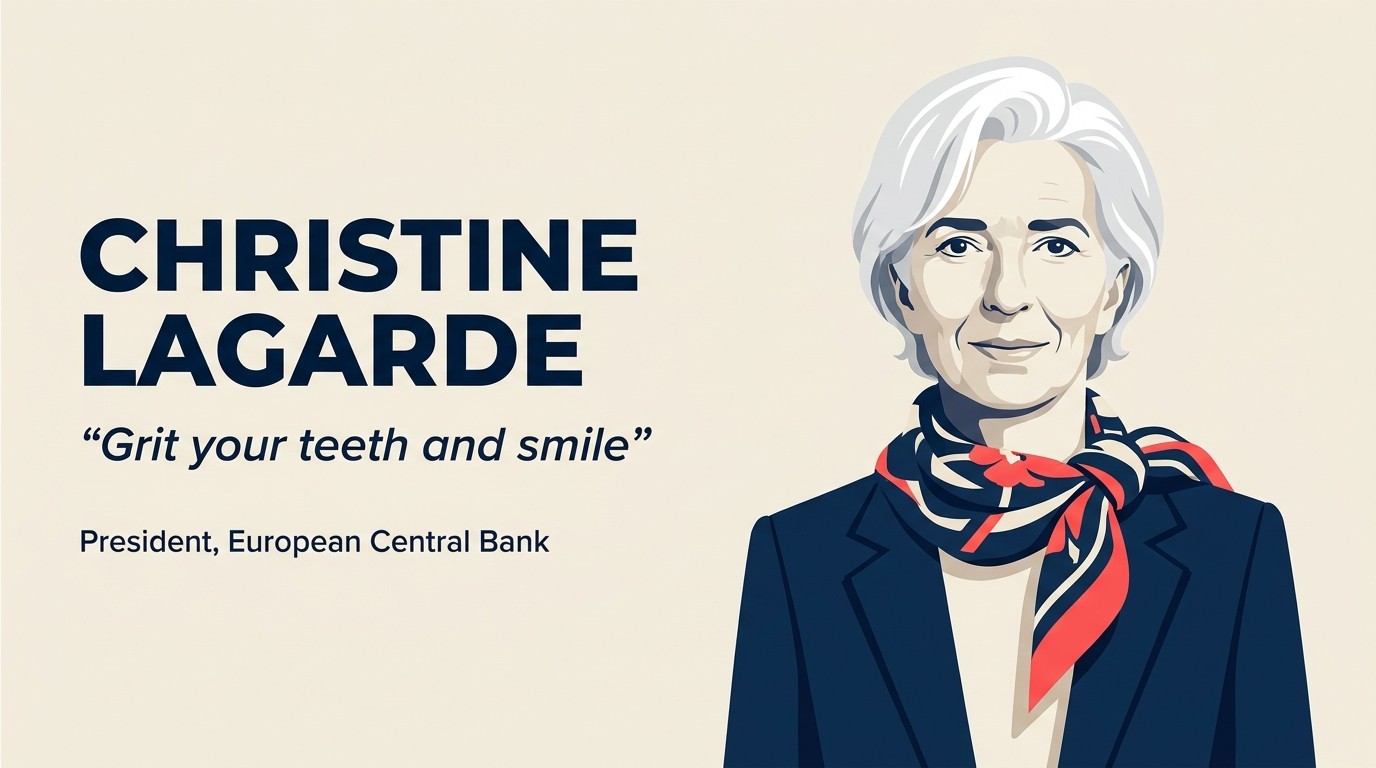
Key Facts: Christine Lagarde (born January 1, 1956, Paris) is a French lawyer and former synchronized swimming champion (French national team, 1970s) who became the first female chair of Baker McKenzie in 1999, the first female Finance Minister of any G7 country in 2007, the first female Managing Director of the IMF in 2011 (serving until 2019), and the first female President of the European Central Bank in November 2019. She is known for the personal mantra "grit your teeth and smile," a discipline she traces back to her synchronized swimming career.
Christine Lagarde is a French lawyer who became the global chair of Baker McKenzie, one of the world's largest law firms with 3,800 lawyers, and then walked into politics as France's Trade Minister in 2005, Agriculture Minister the same year, and Finance Minister in 2007, becoming the first woman to hold that role in any G7 nation.
In 2011, she took over the International Monetary Fund under pressure and scandal after Dominique Strauss-Kahn's arrest, steered the institution through the European sovereign debt crisis, and held the job for eight years. In November 2019, she became the first woman to lead the European Central Bank. She then launched a €1.85 trillion pandemic bond-buying program within ten days of the COVID lockdowns and oversaw 450 basis points of rate hikes (the fastest tightening cycle in ECB history) to fight post-energy-shock inflation. Her full biography is covered on her ECB profile page and in her Wikipedia entry.
Each of those institutions had a culture that didn't anticipate her. She didn't try to become what they expected. She built credibility faster than the skeptics could organize their objections, and she's done it four times now. As an institution-builder operating across sovereign mandates, her career invites comparison with Michael Bloomberg, who similarly built authority inside institutions that weren't designed around his style, and with Larry Fink, whose three-decade tenure at BlackRock represents a parallel model of compounding institutional credibility in finance.
The Composed Leadership Model (Institutional Authority Doctrine)
Lagarde's operating model holds that leadership authority inside legacy institutions is earned by demonstrating composure and technical mastery faster than skeptics can coordinate resistance. The doctrine fuses disciplined public composure ("grit your teeth and smile") with narrow, rules-based reading of institutional mandate, so that credibility compounds across domains rather than resetting with each new role.
Leadership Style Breakdown
| Style | Weight | How it showed up |
|---|---|---|
| Institutional Pragmatist | 65% | Lagarde reads institutional mandates carefully and works within them rather than around them. At the IMF, she expanded the SDR basket to include China's yuan in 2016, a politically complex move she framed as technical and rules-based. At the ECB, she structured the Pandemic Emergency Purchase Programme (PEPP) to fall within the legal architecture Draghi had established, not to reinvent it. She's not a disruptor. She's a navigator. |
| Consensus Builder Under Pressure | 35% | The ECB Governing Council has 26 members across 20 eurozone countries, each with distinct inflation expectations, fiscal traditions, and political constraints. Lagarde built consensus there through one-on-one engagement before formal votes, something Draghi also did but that she's taken further into public communication. Ruth Porat at Alphabet offers a comparable study in finance-trained leaders who impose discipline on institutions that historically resisted it, and Jamie Dimon at JPMorgan Chase stands as the dominant peer in using financial institution leadership to project systemic influence. During the 2022-2023 rate hike cycle, she managed the Council's hawkish and dovish wings by giving each side something they could point to in press conferences. |
The 65/35 split matters because both instincts reinforce each other. Institutional pragmatism without consensus-building makes you a technocrat no one follows. Consensus-building without institutional grounding makes you a politician, and central banks can't afford the market perception of being politicized.
Key Leadership Traits
| Trait | Rating | What it means in practice |
|---|---|---|
| Cross-domain credibility (law → government → central banking) | Very High | Most careers involve deepening expertise in one domain. Lagarde built authority across three distinct ones, each with its own epistemology and professional culture. Her credibility in each successive role came from demonstrating mastery of the prior one. When she arrived at the IMF, her G7 Finance Minister record gave her standing with governments. When she arrived at the ECB, her IMF record gave her standing with markets. Each transition compounded. |
| Communication precision in markets-sensitive roles | Very High | Central bank communication moves bond yields and exchange rates. Lagarde learned this the hard way. In March 2020, she said "we are not here to close spreads" at a press conference and triggered a bond sell-off within minutes. She adapted quickly, releasing a "no limits" statement that same evening that reversed the damage. That kind of real-time course correction under global scrutiny is its own leadership competency. |
| Consensus-building across fractious multi-stakeholder institutions | High | At the IMF she managed relationships between the troika (IMF, ECB, European Commission), debtor governments, and creditor governments simultaneously, each with incompatible interests. At the ECB she manages 26 central bank governors. The skill isn't just persuasion; it's knowing which stakeholder needs what signal at which moment. |
| Composure in succession crises and politically charged environments | High | She took the IMF job under conditions of institutional crisis and global press scrutiny. In 2016, a French court convicted her of negligence for her role in a state arbitration payout to businessman Bernard Tapie, an unusual footnote for a sitting IMF Managing Director. She kept her role, communicated steadily, and her institutions stood behind her. That kind of composure under personal legal pressure while managing a global institution is rare. |
The 3 Decisions That Defined Lagarde
1. Managing the Greek Debt Crisis and Troika Conditionality (2011-2012)
When Lagarde took over the IMF in 2011, the eurozone's sovereign debt crisis was accelerating. Greece, Ireland, and Portugal had already requested bailouts. Spain and Italy were being watched nervously by bond markets.
The IMF's role in the Greek program was controversial from the start. The troika model (IMF, ECB, and European Commission acting together) imposed austerity conditions that creditors demanded and debtor populations protested. The IMF's own economists later acknowledged, in a 2013 internal review, that the initial Greek program had underestimated the fiscal multiplier, meaning the austerity was more contractionary than projected. The Greek government-debt crisis Wikipedia article covers the full scope of the troika negotiations she navigated.
Lagarde was the public face of an institution that was both firefighter and accused arsonist in that crisis. She held the position that debt relief needed to be part of the Greek solution, a view that put her at odds with Germany and the European Commission, but she worked within institutional constraints that limited how forcefully she could push it.
What this shows about her leadership: she operated with a clear private view and a more constrained public position. That's a specific kind of discipline: knowing which battles you can win inside an institution and which you'll lose by fighting publicly. It's not universally admirable, but it's realistic at the level she was operating.
For today's leaders: when you disagree with a decision made by a coalition you're part of, the choice isn't always "say nothing" or "go public." There's a third option: work the room before the vote, document your position internally, and pick the right moment to push harder. Lagarde used all three at different points in the Greek crisis.
2. Launching PEPP in 10 Days (March 2020)
The Pandemic Emergency Purchase Programme was announced on March 18, 2020, ten days after the WHO declared COVID-19 a pandemic. The initial package was €750 billion. It was later expanded to €1.85 trillion. The program suspended the rules that normally required the ECB to buy government bonds proportional to each country's share of the ECB's capital base, which meant it could direct firepower where spread pressure was most acute.
The speed and scale were remarkable by ECB standards. But the decisions that made PEPP possible were made under conditions of genuine uncertainty: nobody knew how long the economic disruption would last, whether the legal architecture would hold, or whether southern European governments would face the kind of bond market attack that had defined 2011-2012.
Lagarde made two bets simultaneously: that the scale needed to be large enough to be credible before it was precise, and that the ECB's legal mandate was broad enough to justify emergency flexibility. Both bets paid off. Bond spreads compressed. Markets stabilized. The "no limits" framing she invoked, echoing Draghi's "whatever it takes" from 2012, was deliberate.
For executives making decisions under uncertainty: Lagarde's PEPP response illustrates a specific principle. When the cost of under-responding exceeds the cost of over-responding, err large and adjust. She committed to €750 billion before anyone knew if €200 billion would have been enough. That's not recklessness. It's a calibrated bet on the asymmetry of outcomes.
3. The 450 Basis Points Rate Hike Cycle (2022-2023)
In July 2022, the ECB raised rates for the first time since 2011, starting a cycle that would add 450 basis points and bring the deposit facility rate to 4.0% by September 2023. It was the fastest tightening in the ECB's history.
The criticism that she moved too slowly is partly fair. The ECB's first rate hike came after the Federal Reserve had already raised rates twice. Lagarde had said as recently as February 2022 that a 2022 rate hike was "very unlikely." The energy price shock that followed Russia's invasion of Ukraine compressed the timeline, but the slow start contributed to inflation running above target longer than it needed to.
The management of this cycle, across 26 central bank governors each facing different domestic inflation trajectories and political pressure, was genuinely complex. Lagarde held the Council together through forward guidance that gave each wing something to claim: the pace of tightening was gradual enough for southern European dovish members, and the cumulative total was hawkish enough for German and Dutch governors.
For leaders managing across complex stakeholder maps: the lesson isn't that slow starts are acceptable. It's that when you're working through consensus-based institutions, you sometimes pay a lag cost in exchange for coalition integrity. That trade-off is real. The question is whether the coalition would have fractured, with more damaging consequences, if she had moved faster and with less consensus.
What Lagarde Would Do in Your Role
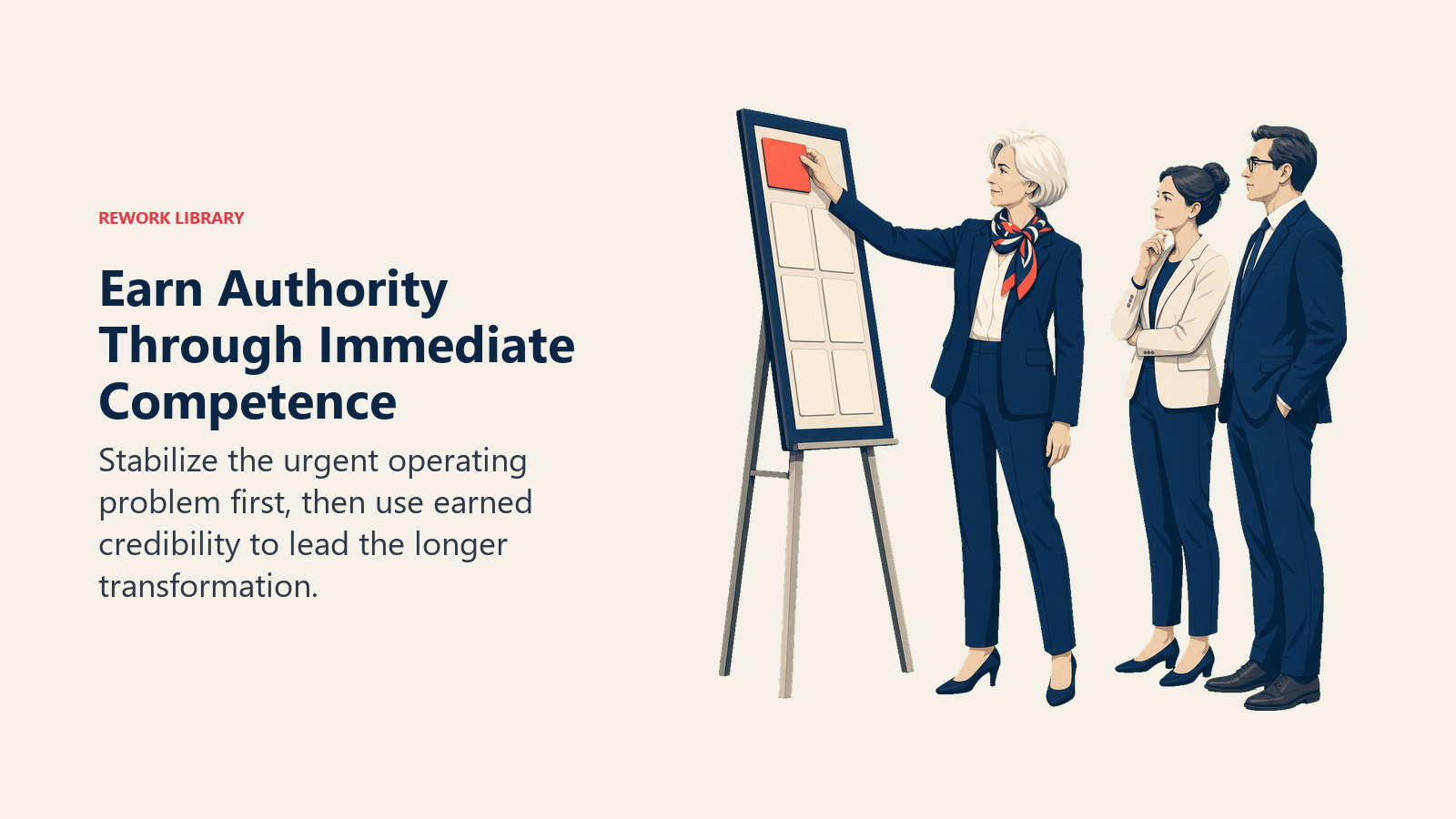
If you're a CEO stepping into an institution in crisis, Lagarde's first move at the IMF is worth studying. She didn't announce a new vision. She demonstrated competence on the immediate problem, the Greek crisis, before asserting her own agenda. She built credibility in the domain that was on fire before expanding into what she actually wanted to do. If you're a new leader inheriting a crisis, the temptation to lay out a transformation roadmap is understandable. But demonstrating that you can manage the immediate situation earns you the standing to do the longer-term work.
If you're a COO building consensus across competing factions, the ECB Governing Council model has a lesson. Lagarde does the hard consensus-building work before the formal meeting, not in it. Public votes with surprise outcomes are a failure of her process. She invests in one-on-one relationships with the most difficult stakeholders so that by the time the Council meets, the major objections have been surfaced and partially addressed. Applied to your world: if you're managing a steering committee or cross-functional council, the meeting itself should be the last step in consensus-building, not the first.
If you're a product or strategy leader managing a communications-sensitive position, Lagarde's "no limits" pivot on March 18, 2020 is instructive. She recognized within hours that her "we are not here to close spreads" phrasing at a press conference had been read as a withdrawal of support, not as a clarification of mandate. She issued a corrective statement that same evening that reversed the market response. The lesson isn't to avoid imprecise communication. Under pressure, everyone is imprecise sometimes. The lesson is to monitor the signal your communication sends and course-correct fast when it's misread.
If you're in sales or client-facing leadership, Lagarde's cross-domain credibility has a direct application. She built authority in each new domain by being credible in the prior one. If you're expanding your role, moving from IC to manager to director, or moving from one function to another, the question to ask is: what's the one thing from your prior domain that gives you credibility in the new one? Don't try to demonstrate everything at once. Identify the one area of prior expertise that is most legible and useful in the new context, and lead with that until you've built enough standing to expand.
Rework Analysis: Composure as Operating Infrastructure
Lagarde's signature move is holding institutional credibility steady while the ground shifts underneath. PEPP in ten days, a 450bp tightening cycle across 26 governors, a 2016 French court conviction she absorbed without losing IMF standing, each required composure as a leadership competency, not a personality trait. "Grit your teeth and smile" is a public discipline that buys time for consensus to form behind the scenes.
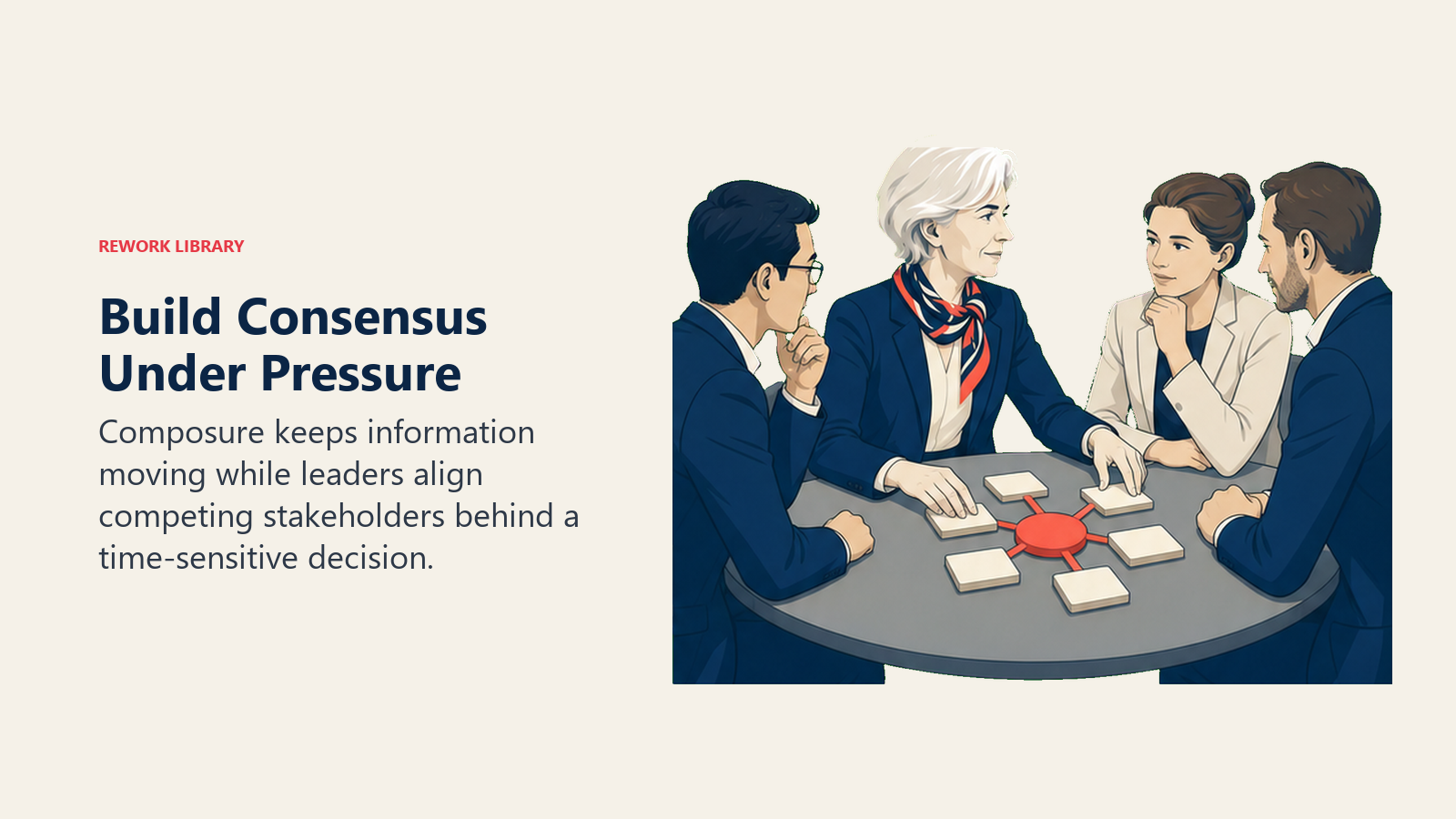
That same pattern shows up in Rework-scale cross-functional alignment. When sales, CS, RevOps, and product each have partial views of the same customer during a turbulent quarter, leaders don't win by declaring a new direction. They win by keeping the cross-functional council coherent until the data clarifies. Rework's sales operations platform centralizes pipeline, handoffs, and activity signals in one place so that leadership can act on a shared picture of reality rather than reconcile four dashboards mid-crisis. Composure is cheaper when the underlying system isn't fighting you.
Notable Quotes and Lessons Beyond the Boardroom
Lagarde has spoken carefully about what it means to lead institutions that weren't built with you in mind. "I always had to work harder because I was a woman in a man's world," she told CNN in 2019, but she followed it with something less expected: "I actually think you have to work harder anyway, regardless of gender, if you want to earn your place." That's not a complaint or a claim to victimhood. It's a performance standard she internalized.
On central banking communication, she's said: "Words matter. Central bank communication is policy." That sentence should be on the wall of every leadership team that thinks messaging is downstream of strategy. For Lagarde, messaging is strategy. What the ECB says about its future intentions moves capital allocation decisions before a single bond is bought or sold.
One lesser-cited observation from her IMF tenure: "The world does not have a government, but it has institutions. Those institutions are only as strong as the people who work inside them." That's a reminder for executives inside legacy organizations who feel constrained by institutional inertia. The institution isn't just a constraint. It's infrastructure. Your job is to make it more capable, not to escape it.
Where This Style Breaks
Lagarde's consensus-first instinct is a genuine strength in multi-stakeholder environments. But it has a real ceiling. Her March 2020 press conference comment, "we are not here to close spreads," wasn't a policy mistake; it was a communication failure that moved markets negatively within minutes. Consensus builders sometimes optimize for process integrity at the expense of message clarity. In markets-sensitive roles, those two things can't be traded against each other.
Her legal background means she reads institutional mandate narrowly, which is appropriate until the institution needs to expand its role. The 2022 inflation response lag (the ECB moved after the Fed, after the Bank of England, after most developed-market peers) reflects an institution that reads its price-stability mandate conservatively rather than dynamically. And the Greek austerity programs she oversaw were later acknowledged, even by IMF economists, to have underestimated the human cost of the conditionality. Institutional pragmatism operates best when the institution itself has the right design. When it doesn't, pragmatism can look like complicity.
Frequently Asked Questions about Christine Lagarde's Leadership
Who is Christine Lagarde?
Christine Lagarde (born 1956) is a French lawyer who chaired Baker McKenzie, served as France's Finance Minister (2007-2011, the first woman in a G7 country), ran the IMF (2011-2019), and has led the European Central Bank since November 2019.
What did Lagarde achieve at the IMF?
She led the IMF through the European sovereign debt crisis, oversaw the Greek bailout programs, and in 2016 expanded the SDR currency basket to include China's yuan. She served the full eight-year term starting in 2011 after Dominique Strauss-Kahn's resignation.
How did Lagarde lead the ECB through crisis?
She launched the €750 billion Pandemic Emergency Purchase Programme (PEPP) on March 18, 2020, ten days after the WHO declared COVID a pandemic. The program was later expanded to €1.85 trillion and stabilized eurozone bond spreads during the pandemic shock.
What is Lagarde's leadership style?
Institutional pragmatist with disciplined consensus-building. She reads institutional mandates narrowly, builds one-on-one agreement before formal votes, and prioritizes composure and precise communication in markets-sensitive roles.
What did Lagarde say about 'grit your teeth and smile'?
Lagarde has cited "grit your teeth and smile" as a personal mantra traced to her teenage years on the French national synchronized swimming team. It captures her approach to holding public composure while absorbing pressure privately, a discipline she has applied through IMF scandal succession, a 2016 French court case, and ECB crisis management.
What can executives learn from Christine Lagarde?
Four things: build credibility in the immediate crisis before asserting a broader agenda; do consensus work before the meeting, not in it; monitor how your communication is received and course-correct fast when it's misread; and when moving between domains, lead with the one piece of prior expertise that is most legible in the new context.
Learn More
- Satya Nadella Leadership Style: How Growth Mindset and Empathy Transformed Microsoft
- Indra Nooyi Leadership Style: How PepsiCo's CEO Built a Purpose-Driven Strategy at Fortune 50 Scale
- Jacinda Ardern Leadership Style: Empathetic Governance and What "Kindness" Actually Costs
- Ginni Rometty Leadership Style: Transformation Under Pressure and the Limits of Reinventing Slowly
- Julie Sweet Leadership Style: Scale, Reinvention, and Leading 750,000 People Through the AI Era

On this page
- The Composed Leadership Model (Institutional Authority Doctrine)
- Leadership Style Breakdown
- Key Leadership Traits
- The 3 Decisions That Defined Lagarde
- 1. Managing the Greek Debt Crisis and Troika Conditionality (2011-2012)
- 2. Launching PEPP in 10 Days (March 2020)
- 3. The 450 Basis Points Rate Hike Cycle (2022-2023)
- What Lagarde Would Do in Your Role
- Rework Analysis: Composure as Operating Infrastructure
- Notable Quotes and Lessons Beyond the Boardroom
- Where This Style Breaks
- Learn More