Abraham Lincoln Leadership Style: The Team of Rivals and the Art of Leading Through Disagreement
Turn this article into takeaways for your work.


Each assistant summarizes the article only for you and suggests best practices for your work.
Key Facts: Abraham Lincoln
- 16th President of the United States, serving from March 4, 1861 until his assassination on April 15, 1865
- Led the Union through the American Civil War (1861-1865), preserving a fractured nation through its bloodiest conflict with roughly 620,000 military deaths
- Issued the Emancipation Proclamation on January 1, 1863, declaring enslaved people in Confederate states to be free and reframing the war's moral purpose
- Delivered the Gettysburg Address on November 19, 1863-272 words that redefined the founding commitment of the United States
- Assassinated by John Wilkes Booth at Ford's Theatre in Washington, D.C. on April 14, 1865, dying the following morning, just days after Lee's surrender at Appomattox
Abraham Lincoln was a self-taught lawyer from Illinois with one unremarkable term in the House of Representatives and a Senate race he lost to Stephen Douglas in 1858. He won the Republican nomination for president two years later and took the White House in November 1860 with less than 40 percent of the popular vote. Seven Southern states had seceded before he was inaugurated.
His response to that fractured situation was to appoint his three main rivals for the Republican nomination, William Seward, Salmon Chase, and Edward Bates, to his cabinet. Seward had been the prohibitive favorite for the nomination. Chase would spend years maneuvering to replace Lincoln on the ticket. Bates disagreed with Lincoln on fundamental questions of war powers. Lincoln put all three in the room anyway. His bet was that disagreement inside the tent was more useful than consensus outside it.
He presided over 620,000 dead. He held the union together. Nelson Mandela faced a structurally similar moral calculus a century later, a leader who could have demanded retribution and chose reconciliation instead, because the long-term outcome mattered more than the personally justifiable response. The Gettysburg Address, delivered on November 19, 1863, was 272 words. Edward Everett, the most celebrated orator in the country, had spoken for two hours before Lincoln took the platform for two minutes. Everett wrote to Lincoln the following day: "I should be glad if I could flatter myself that I came as near to the central idea of the occasion in two hours as you did in two minutes."
That compression, saying the essential thing with no waste, is also a leadership lesson. And it came from a man who failed repeatedly before he was in position to matter.
Leadership Style Breakdown
| Style | Weight | How it showed up |
|---|---|---|
| Inclusive Deliberator | 60% | Lincoln didn't just tolerate disagreement, he institutionalized it by placing his strongest critics at the cabinet table. He listened to Seward and Chase even when they were transparently advancing their own political interests. He cycled through 5 commanding generals before finding Grant, which required acknowledging failure and changing direction repeatedly in a public war context. He gave subordinates genuine authority and endured the political cost when they used that authority badly. |
| Moral Anchor | 40% | He moved slowly on abolition, carefully, under significant pressure from abolitionists who considered his early war framing (preserving the Union, not ending slavery) a moral failure. But he moved. The Emancipation Proclamation was calibrated as a war measure and issued when he judged the military and political moment right, not when the pressure was loudest. He held the moral position under the weight of 620,000 deaths and re-election uncertainty in 1864, when peace candidates were offering an end to the war at the cost of the Union's position on slavery. |
The 60/40 split reflects how Lincoln sequenced these two styles. The inclusive deliberation was almost always primary, he spent enormous effort understanding every perspective in the room before he moved. The moral anchor function was what he returned to when the deliberation produced either paralysis or options he couldn't accept. He didn't lead with moral certainty. He arrived there after exhausting the alternatives.
Key Leadership Traits
| Trait | Rating | What it means in practice |
|---|---|---|
| Tolerance for dissent and ego-heavy advisors | Exceptional | Chase repeatedly leaked cabinet discussions to curry favor with Radical Republicans. Seward tried to effectively take over foreign policy in the administration's first weeks. Stanton was rude to Lincoln in person and obstinate about military decisions. Lincoln kept all three because their competence outweighed their difficulty. That trade-off, productive friction over comfortable consensus, requires a level of personal security that most leaders don't actually have. |
| Communication precision | Very High | The Gettysburg Address used 272 words to reframe the entire purpose of the Civil War, from preserving the Union to honoring the equality principle of the Declaration of Independence. Lincoln's legal training gave him precision with language. His political experience gave him judgment about what an audience could absorb. The combination produced the most studied example of compressed public communication in American history: nothing generic, nothing wasted, every word load-bearing. |
| Personal resilience through repeated failure | High | Business failure at 22, another at 34. Lost runs for state legislature, Senate, and vice presidential nomination. Lost the 1858 Senate race to Douglas in a contest that should have been his career-defining win. Each failure produced more public exposure, more political network, and more refined public communication. He didn't treat failure as disqualifying. He treated it as the price of staying in the argument long enough to be in position when the moment came. |
| Moral clarity that resisted popular pressure | High | In 1864, with the war going badly and peace sentiment rising, Lincoln expected to lose the election. He didn't soften his position on slavery or the Union's war aims to improve his electoral prospects. He prepared a memorandum, which he had his cabinet sign without reading, committing his administration to cooperate with the incoming president in saving the Union even if he lost. He thought he was going to lose, and he still refused to move off the position. |
The Team of Rivals Principle
The Team of Rivals Principle is the deliberate practice of staffing the most consequential seats in an organization with the most capable candidates available, including, especially, those who actively contested your authority or hold divergent views. It trades the comfort of consensus for the strategic value of productive friction, and it only works when the leader has enough personal security to be outargued in the room without losing command of the decision. Adoption requires accepting that internal dissent managed well is cheaper than external opposition managed poorly.
The 3 Decisions That Defined Lincoln as a Leader
1. Appointing Rivals Seward, Chase, and Bates to His Cabinet in 1861
The conventional approach after winning the presidency would have been to reward loyal supporters with cabinet positions. Lincoln did the opposite. He identified the three men who had most seriously contested his nomination, Seward at State, Chase at Treasury, Bates at Attorney General, and gave them the three most powerful cabinet positions in his administration.
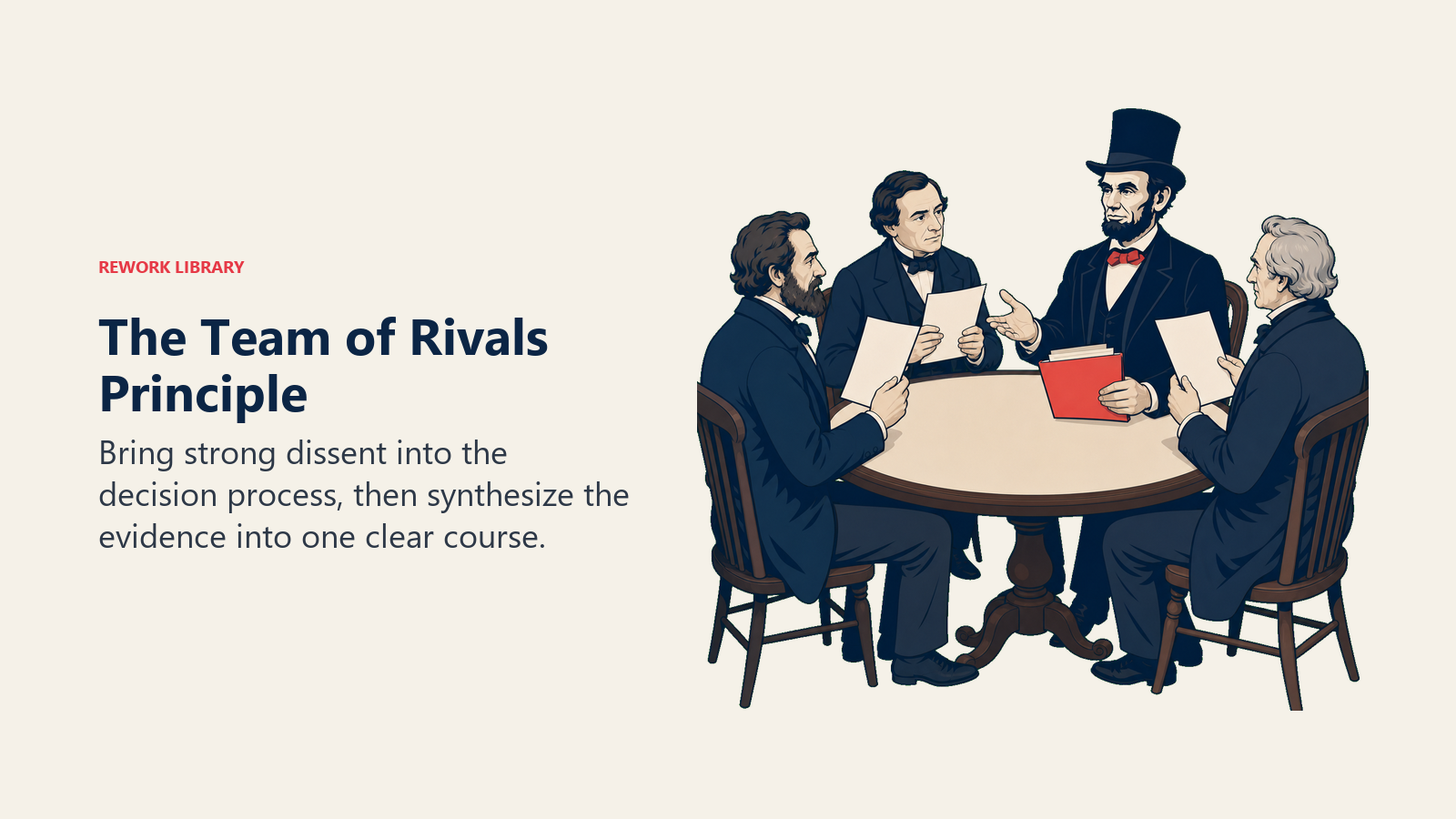
Seward had arrived at the Republican convention in 1860 as the clear favorite. When Lincoln won on the third ballot, Seward's reaction was not gracious. He wrote to his wife that he would "convert a defeat into a triumph" and effectively proposed to Lincoln's transition team that he, Seward, should function as a de facto prime minister handling the crisis. Lincoln's response was a private letter that gently but completely rejected the premise while keeping Seward inside.
Chase was worse. He spent his entire tenure as Treasury Secretary positioning himself as a more principled alternative to Lincoln, leaking cabinet discussions to Radical Republicans, and pursuing the 1864 presidential nomination while still in Lincoln's cabinet. Lincoln tolerated it because Chase was a brilliant financial administrator and because removing him would have created a more dangerous enemy outside the tent than he was inside it.
The leadership principle Doris Kearns Goodwin documented in her 2005 book "Team of Rivals" is real but frequently misapplied: the Team of Rivals strategy doesn't mean you hire everyone who disagrees with you. It means you hire the people who are most capable, even if they're most threatening, because the cost of having their capability in opposition is higher than the cost of managing their ambition inside the organization. Lincoln ran that calculation correctly on Seward and Chase. It required genuine personal security: a belief that his own authority didn't depend on being the smartest person in the room, only on making the best decisions with the information the room produced.
2. Issuing the Emancipation Proclamation on January 1, 1863
Lincoln had been under pressure from abolitionists since the war began. Frederick Douglass, Horace Greeley, and the Radical Republicans in his own party all argued that the war's purpose should be explicitly framed as the abolition of slavery, not merely the preservation of the Union. Lincoln's public position through 1861 and most of 1862 was that the war was about the Union: he would preserve it with slavery if he could, without it if he must.
In August 1862, he wrote to Greeley: "If I could save the Union without freeing any slave, I would do it; and if I could save it by freeing all the slaves, I would do that... I have here stated my purpose according to my view of official duty, and I intend no modification of my oft-expressed personal wish that all men, everywhere, could be free."
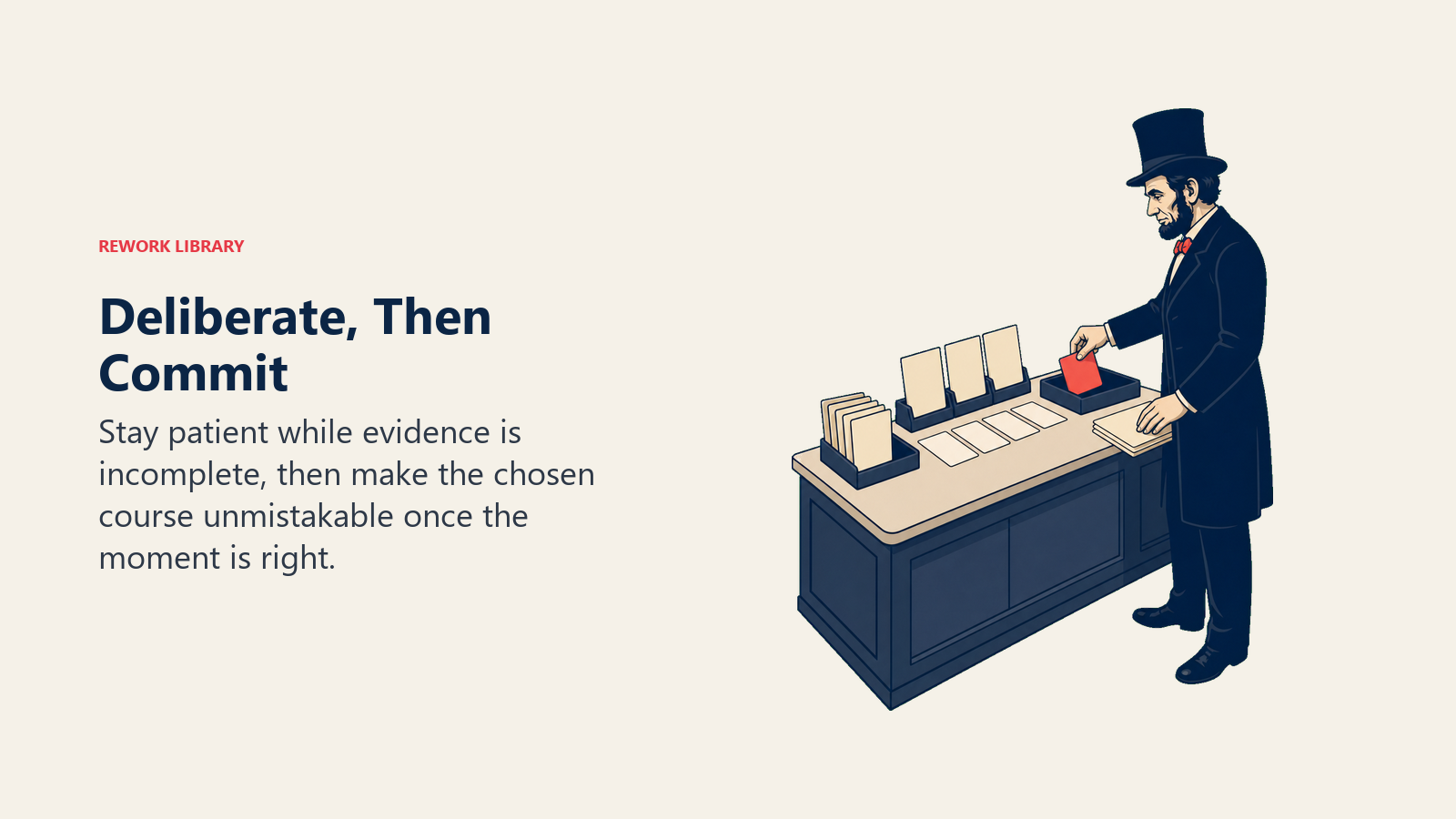
He'd drafted the Emancipation Proclamation two months earlier. Secretary of State Seward advised him to wait for a Union military victory before issuing it. Otherwise it would look like a desperate measure from a losing government. Lincoln waited. The Union won at Antietam in September 1862. He issued a preliminary proclamation, then the final Emancipation Proclamation on January 1, 1863.
The document freed enslaved people only in Confederate states. It didn't cover the border states loyal to the Union, where Lincoln had no constitutional authority under his commander-in-chief rationale. Abolitionists immediately criticized it as partial and political. They were right on both counts. But it reframed the war in a way that made European recognition of the Confederacy politically impossible, gave the Union army a recruiting argument among Black Americans (180,000 would eventually serve), and set the moral direction that the 13th Amendment completed after his death.
Lincoln issued it when the military and political timing was right, not when the moral argument was loudest. That's the specific kind of moral-anchor leadership that's difficult to maintain: holding the correct position under pressure to move early, and then moving when the conditions allow it to actually work.
3. Delivering the Gettysburg Address in 272 Words on November 19, 1863
The dedication ceremony at the Soldiers' National Cemetery in Gettysburg, Pennsylvania had a featured speaker: Edward Everett, former president of Harvard and the most celebrated orator in America. He spoke for two hours. Lincoln followed with a two-minute address that he had largely composed on the train from Washington.
The text begins: "Four score and seven years ago our fathers brought forth on this continent, a new nation, conceived in Liberty, and dedicated to the proposition that all men are created equal." In one sentence, Lincoln moved the founding of the United States from the Constitution (1787, which included protection of slavery) to the Declaration of Independence (1776, which stated all men are created equal). That was a significant and deliberate reframing of what the war was about and what the nation's founding commitment had been.
The address ends by asking "that this nation, under God, shall have a new birth of freedom, and that government of the people, by the people, for the people, shall not perish from the earth."
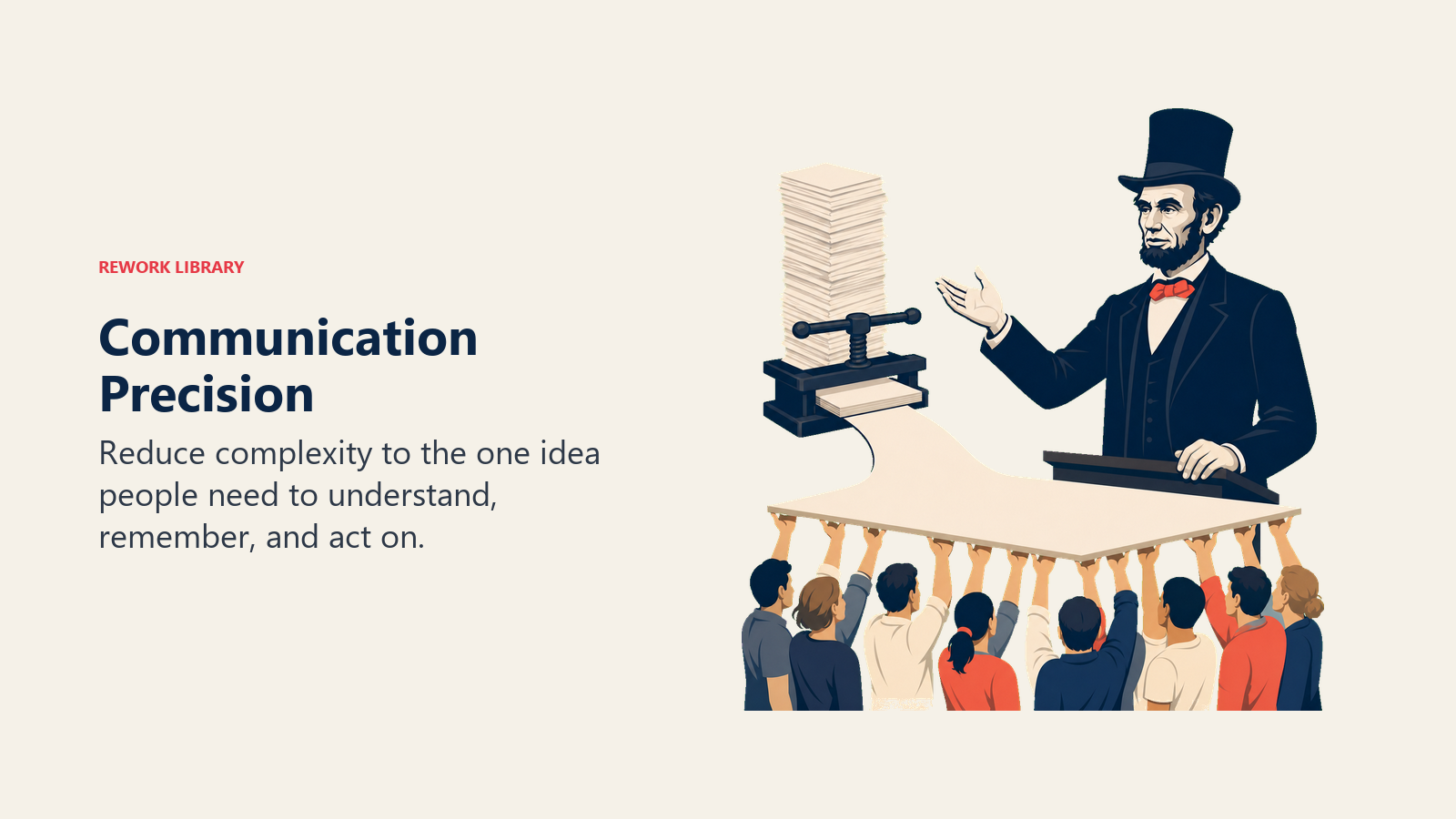
It was written in plain language that any literate person in the country could understand. There are no Latinate abstractions, no rhetorical flourishes for their own sake. Lincoln's legal training gave him the habit of precision, and his political experience gave him the habit of speaking to the specific audience in front of him. The combination at Gettysburg produced 272 words that are still memorized by schoolchildren 160 years later, while Everett's two-hour address has been almost completely forgotten.
The leadership lesson isn't about speeches. It's about compression as a form of clarity. Lincoln knew what he was trying to say, said it in the most direct language available, and stopped. Most organizational communication fails because the communicator isn't actually sure what the essential thing is, so they say everything, hoping the important part will be audible in the noise.
What Lincoln Would Do in Your Role
If you're a CEO, his playbook tells you to hire the most capable people who challenge you, not the most loyal people who agree with you. Seward and Chase were genuinely dangerous to Lincoln's political position. They were also genuinely necessary for the administration to function. The question isn't whether your best candidates will be difficult, they almost certainly will be. The question is whether you have enough personal security to have people in the room who are smarter than you about specific things and who aren't afraid to say so.
If you're a COO, his playbook tells you that cycling through the wrong solution is sometimes necessary before the right one becomes available. Lincoln went through five commanding generals before Grant. McClellan was brilliant at organizing an army and paralyzed when it came to using it. Dwight Eisenhower drew the institutional lesson from this pattern, his entire planning philosophy at D-Day was designed to eliminate the command ambiguity that had crippled Lincoln's early generals. Burnside was disastrous at Fredericksburg. Hooker collapsed at Chancellorsville. Each failure eliminated an option and clarified what the position actually required. If you're managing a function that isn't working, the question isn't always how to fix the current leader, sometimes it's whether you've found the right person yet.
If you're a product leader, his playbook tells you to write the essential thing, then stop. The Gettysburg Address worked because Lincoln knew exactly what he was trying to communicate, the moral purpose of the war, the nation's founding commitment, the stakes of failure, and used exactly enough words to say it. Before your next major product communication or strategic document, ask: if you had 272 words, what would you actually say? Then say that, whether or not the document is 272 words in the end.
If you're in sales or marketing, his playbook tells you that timing matters as much as the argument. Lincoln held the correct position on slavery long before he acted on it publicly. He moved when the military and political conditions made the action effective, not when the moral argument was at its loudest. In sales, the right argument at the wrong time produces the wrong result. Understand your customer's window, not just when they should buy your product, but when the internal conditions make them actually capable of saying yes.
Rework Analysis
Modern executive teams still run on the same core tension Lincoln faced: the most capable operators often hold the sharpest disagreements, and the cheapest path, hiring for loyalty, produces cabinets that nod and organizations that drift. A Team of Rivals only functions when disagreement is visible, sequenced, and resolved in the open rather than re-litigated in hallway conversations. That is an operating problem, not a personality one. Rework's cross-functional workspace gives rival functions, sales, ops, finance, product, a shared surface to debate priorities against the same data, with decisions captured where the team can see them. When your Seward is pushing back on strategy and your Chase is quietly running a parallel agenda, moral clarity at the top is not enough. You need the workflow layer that forces dissent into the record and commits the cabinet to the decision once it is made. That is the modern analog of Lincoln's cabinet room.
Notable Quotes and Lessons Beyond the Boardroom
"With malice toward none, with charity for all, with firmness in the right as God gives us to see the right, let us strive on to finish the work we are in, to bind up the nation's wounds." Winston Churchill faced a comparable moment of wartime communication pressure, a leader who had to tell a nation the worst was not yet over while keeping the moral argument intact. Second Inaugural Address, March 4, 1865. Lincoln gave this address 41 days before his assassination, knowing the war was nearly over. It's not a victory speech. It doesn't frame the Confederacy's defeat as punishment deserved. It asks the country to finish the work of reconstruction with the same commitment the war required, without the hatred that four years of killing had generated. That framing required genuine moral discipline at the moment of maximum vindication.
Lincoln wrote more than he spoke. His letters are precise and often quietly devastating in their logic. When General McClellan repeatedly failed to advance despite Lincoln's explicit orders, Lincoln wrote: "If you don't want to use the army, I should like to borrow it for a while." That sentence contains more leadership clarity about accountability, delegation, and performance expectations than most management frameworks produce in 100 pages. He didn't give speeches about accountability culture. He wrote it into a single sentence and sent it to the general who needed to read it.
His plain-language legal training gave him a specific resistance to abstraction that most political leaders don't develop. Sun Tzu's strategic tradition reinforces the same point from a different tradition: the most effective strategic communication is compressed, concrete, and impossible to misread, which is exactly what Lincoln achieved at Gettysburg. He thought in concrete propositions, "All men are created equal" is either true or it isn't, and acted on those propositions with more consistency than most people who held them as principles but treated them as flexible when inconvenient.
Where This Style Breaks
Lincoln's inclusive deliberation was painfully slow in the war's early years. He spent months managing McClellan's political connections and ego rather than replacing him when the operational failures were clear. He gave the Team of Rivals so much internal latitude that Chase was actively working to replace him while serving in his cabinet. That's a structural inefficiency that more authoritarian leaders wouldn't have tolerated, and they'd have been right that it was inefficient, even if the deliberation ultimately produced better outcomes.
The Team of Rivals model requires a leader secure enough to not feel threatened by people who are smarter than them about specific things. Most executives aren't that secure. They hire for loyalty over capability and build cabinets that agree with them, then wonder why the decisions are bad. The model also requires enough personal credibility that subordinates who disagree still implement decisions they didn't choose. Lincoln had that credibility by 1863. He'd earned it through failure. You can't import that credibility. You have to build it the same way he did.
And the moral clarity that held the Union position through 620,000 deaths very nearly cost him the 1864 election as war fatigue peaked. Being right is not sufficient to survive democratically when the people bearing the cost are exhausted. Lincoln survived. His Reconstruction program didn't, it collapsed within years of his death when the moral anchor that had held it together was gone.
Frequently Asked Questions about Abraham Lincoln's Leadership
What was Abraham Lincoln's leadership style?
Lincoln's leadership style combined inclusive deliberation with moral anchoring. He spent enormous effort understanding every perspective in the room, including from rivals who openly opposed him, and then acted from a fixed moral position when the deliberation produced unacceptable options. The result was a decision-making pattern that looked slow in the moment but produced durable outcomes.
What is the Team of Rivals approach?
The Team of Rivals approach is Lincoln's practice of staffing his cabinet with the three men who most seriously contested his nomination for president, William Seward, Salmon Chase, and Edward Bates. Rather than rewarding loyal supporters, he put his most capable critics in his most powerful seats. The principle, documented by Doris Kearns Goodwin, is that capability in opposition is more expensive than capability inside the tent.
How did Lincoln hold the Union together during the Civil War?
Lincoln held the Union together through a combination of constitutional arguments, military command decisions, and carefully sequenced moral escalation. He framed the war's early purpose narrowly as preserving the Union to keep border states loyal, then reframed it with the Emancipation Proclamation in 1863 once a Union military victory at Antietam made the timing credible. He also cycled through five commanding generals before Grant, accepting the political cost of public failure to find a general who would actually fight.
What can modern CEOs learn from Lincoln?
Modern CEOs can learn three things from Lincoln. First, hire for capability over loyalty, and expect the best candidates to be difficult. Second, compress communication, if you cannot say the essential thing in plain language, you probably do not know what it is. Third, hold moral positions under pressure but act on them when conditions make the action effective, not when the argument is loudest.
What was Lincoln's biggest leadership mistake?
Lincoln's biggest leadership mistake was staying with General George McClellan far too long. McClellan was brilliant at organizing an army and chronically unwilling to use it in combat. Lincoln managed his ego and political connections for over a year before replacing him, at real cost in Union lives and momentum. His inclusive deliberation style extended to operational commanders where clearer authority would have produced better outcomes sooner.
What books or speeches best capture Lincoln's philosophy?
The Gettysburg Address (November 19, 1863) and the Second Inaugural Address (March 4, 1865) are the two primary-source documents that most fully capture Lincoln's philosophy on national purpose and post-war reconciliation. For a modern study of his executive leadership, Doris Kearns Goodwin's 2005 book "Team of Rivals: The Political Genius of Abraham Lincoln" remains the standard reference. Together they give you Lincoln's own voice and a contemporary analysis of how his cabinet actually functioned.

On this page
- Leadership Style Breakdown
- Key Leadership Traits
- The Team of Rivals Principle
- The 3 Decisions That Defined Lincoln as a Leader
- 1. Appointing Rivals Seward, Chase, and Bates to His Cabinet in 1861
- 2. Issuing the Emancipation Proclamation on January 1, 1863
- 3. Delivering the Gettysburg Address in 272 Words on November 19, 1863
- What Lincoln Would Do in Your Role
- Rework Analysis
- Notable Quotes and Lessons Beyond the Boardroom
- Where This Style Breaks