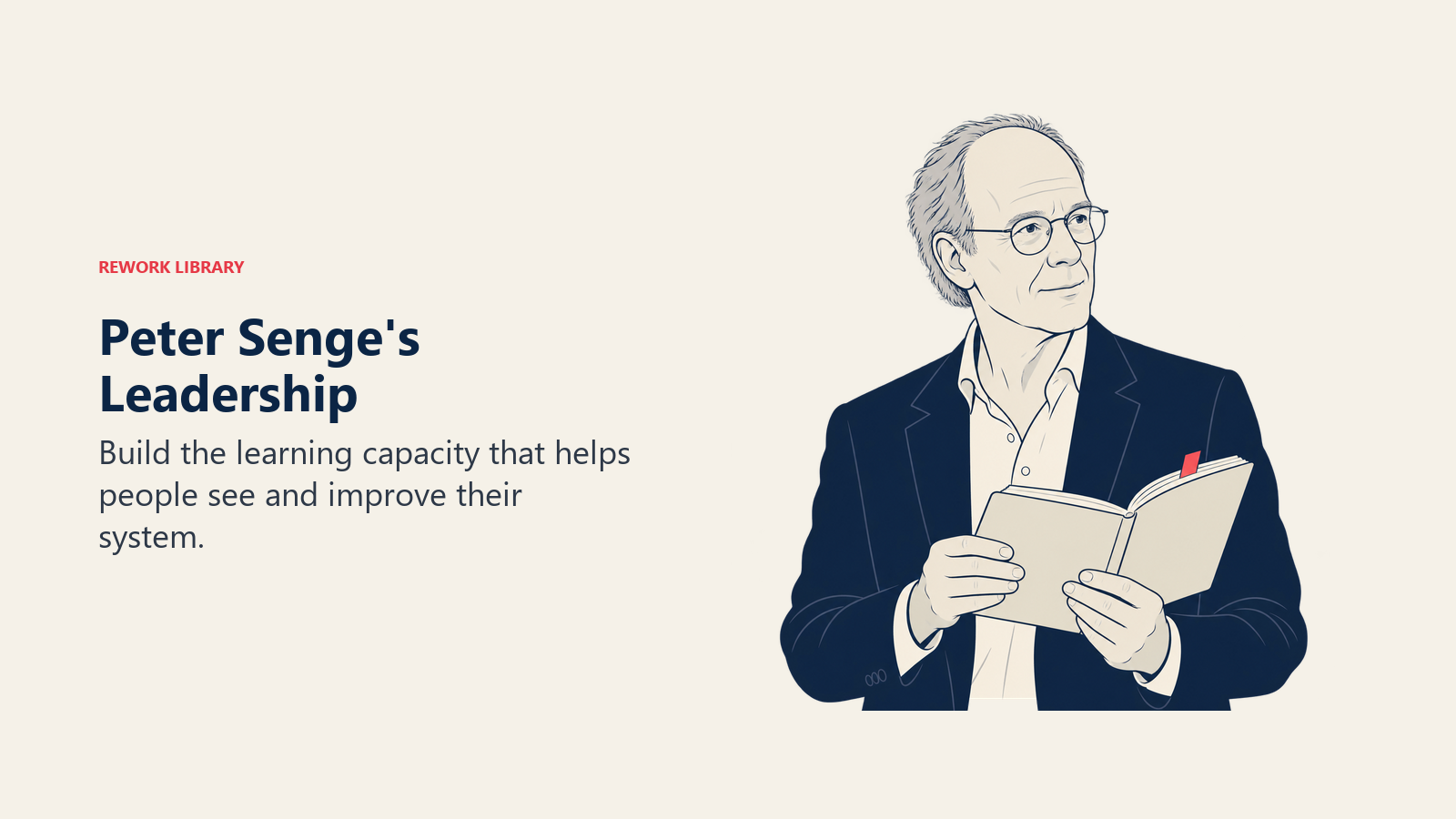
Peter Senge's Leadership: The Learning Organization
Turn this article into takeaways for your work.


Each assistant summarizes the article only for you and suggests best practices for your work.
Key Facts: Peter Senge was born in 1947 and earned a BS in engineering from Stanford before moving to MIT, where he took an MS in social systems modeling and a PhD in management, according to MIT Sloan's own faculty directory. At MIT he became a student of Jay Forrester, the professor who had founded the field of system dynamics a decade earlier. He still teaches at MIT Sloan today, holding the title Senior Lecturer, Leadership and Sustainability, not full professor, inside the Work and Organization Studies and System Dynamics groups. His 1990 book The Fifth Discipline: The Art and Practice of the Learning Organization (Doubleday/Currency) has sold over two million copies and was named by Harvard Business Review one of "the seminal management books of the last 75 years". He followed it with The Fifth Discipline Fieldbook (1994), The Dance of Change (1999), Schools That Learn (2000), Presence (2004), and The Necessary Revolution (2008). In 1997 he became founding chair of the Society for Organizational Learning, and he later co-founded the Academy for Systems Change, an organization formed through a 2016 merger with the Donella Meadows Institute. He is also listed as "Co-founder, Elder Advisor" of the Center for Systems Awareness.
The Designer-Steward-Teacher Doctrine
Senge's leadership model rejects the idea that a leader's job is to be the smartest person in the room, deciding while everyone else executes. He built his career on a different claim: in a learning organization, leaders are designers, stewards and teachers, not heroes. A designer builds the structures, purpose, and feedback loops that let an organization keep improving without the leader personally directing every decision. A steward holds a larger purpose in trust instead of treating the company as an extension of personal ambition. A teacher helps people see the assumptions and patterns shaping their own behavior, patterns that are usually invisible to the people living inside them. Call it the Designer-Steward-Teacher Doctrine: a leader's real leverage isn't the decisions they personally make, it's the learning capacity they build into everyone else.
He arrived at this by way of engineering, not psychology. Jay Forrester had spent decades building system dynamics, a rigorous method for modeling how feedback loops and delays inside a system, not the individual competence of the people in it, produce most of the outcomes an organization sees. Forrester's own research group at MIT built the Beer Game in the early 1960s, a simple supply-chain simulation in which players managing a retailer, wholesaler, distributor, and factory reliably produce wild demand swings and stockouts even when actual customer orders barely change. MIT's System Dynamics Group is blunt about the lesson: "the collective results of individually sensible decisions can be disastrous," and the cause is structure, not the people playing the roles. Senge, then an instructor at MIT, took that finding and asked a question Forrester's engineering-first program never quite asked out loud: if structure drives behavior more than individual talent does, what does that mean for how a person should actually lead.
The answer became The Fifth Discipline in 1990, and it required a trade Senge has been candid about. Forrester trained people to build formal simulation models, an approach with real analytical power and a years-long learning curve. Senge later admitted he "grew impatient" with that timeline and instead packaged system dynamics into something a manager could apply within months: five disciplines (personal mastery, mental models, shared vision, team learning, and systems thinking as the discipline that integrates the other four), plus a handful of reusable "systems archetypes" like limits to growth and shifting the burden. Forrester's reaction, by Senge's own account, was ambivalent: glad of the book's success, uneasy that it doesn't examine the modeling assumptions behind the archetypes as carefully as a full simulation would. That tension, between Forrester's rigor and Senge's reach, put The Fifth Discipline on the opposite pole from Tom Peters' In Search of Excellence in the era's two biggest management ideas: Peters sold culture and passion as the answer, Senge sold structure and disciplined reflection, and a whole generation of executives read both without noticing how little the two books actually agreed.
Compared with other legends who built theory from close observation, Senge's method sits closer to Henry Mintzberg's fieldwork instinct than to Peter Drucker's synthesis from wide reading. But where Mintzberg counted minutes on an executive's calendar, Senge inherited an actual quantitative modeling discipline and then chose, on purpose, to trade away some of its precision to reach more people. That decision, build the rigorous thing first and then decide how much of it to give up for reach, runs through the rest of his career.
Leadership Style Breakdown
| Style | Weight | How it showed up |
|---|---|---|
| Systems-Dynamics Translator | 40% | Took Jay Forrester's rigorous, simulation-based system dynamics and repackaged it as five learning disciplines and a set of reusable archetypes managers could apply without building a formal model. |
| Institution Builder | 35% | Did not stop at the book. Founded the Society for Organizational Learning in 1997 as its chair, then co-founded the Academy for Systems Change through a 2016 merger, building durable membership organizations instead of resting on royalties. |
| Reflective Teacher | 25% | Insisted the two "inner" disciplines, personal mastery and mental models, come before any structural fix, and built entire programs around examining assumptions before trying to change behavior, later extending that into schools through Compassionate Systems. |
The 40/35/25 split matters because the first number is what earned Senge standing for the other two. A consultant who shows up with reusable diagrams and no underlying discipline gets treated as a fad. Senge's frameworks landed because they came out of an actual engineering tradition, system dynamics, that had already been tested in industry for roughly two decades before The Fifth Discipline simplified it for a general audience. That borrowed credibility is also what let the institution-building work stick: the Society for Organizational Learning could recruit corporations like Ford, Shell, and Unilever as members because the underlying model wasn't invented for the launch. It was decades old by the time SoL opened its doors.
Key Leadership Traits
| Trait | Rating | What it means in practice |
|---|---|---|
| Grounding leadership claims in a hard technical discipline | Very High | Built five accessible "disciplines" on top of system dynamics, a modeling field with real predictive track record, instead of inventing a leadership framework from anecdote. |
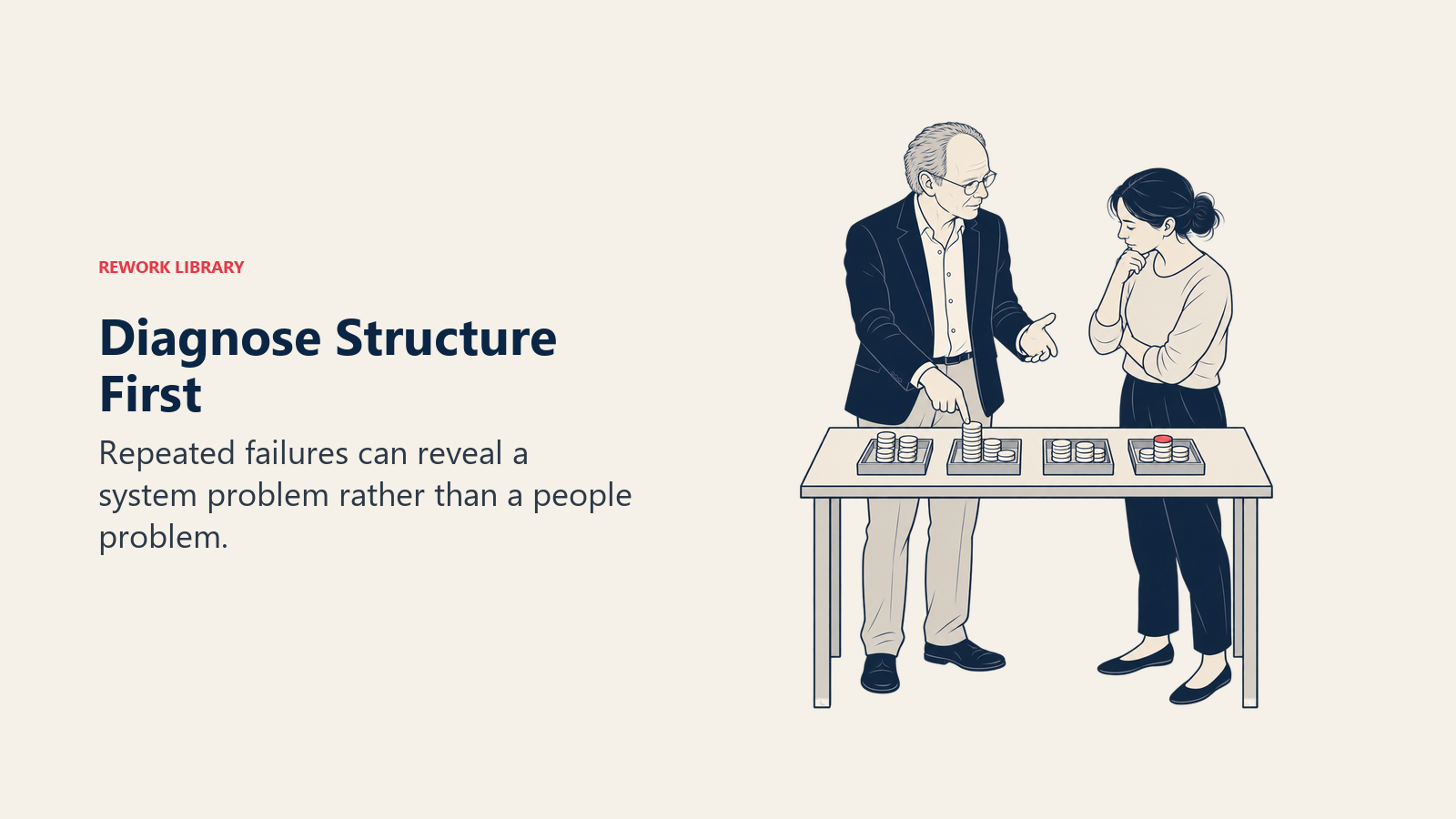
| Diagnosing structure before blaming individuals | Very High | The Beer Game exists to prove, in MIT Technology Review's words, that "it's not the people, it's the system." Senge applies the same instinct everywhere teams and companies fail. |
| Naming organizational dysfunction bluntly | High | Opened The Fifth Discipline by naming "learning disabilities," patterns like fixation on events and the delusion of learning from experience, that most executives recognize immediately and almost never say out loud. |
| Follow-through from book to institution | Exceptional | Spent 1997 founding the Society for Organizational Learning rather than continuing solo as an author, then did it again in 2016 with the Academy for Systems Change. |
| Extending the model beyond the corporation | High | Took disciplines built for manufacturers and insurers and applied them to K-12 education through Schools That Learn and the Compassionate Systems framework, betting the model wasn't corporate-specific. |
The 3 Decisions That Defined Peter Senge as a Leader
Three decisions, each one trading something Senge already had (precision, sole authorship, a proven market) for something riskier, explain how a system dynamics researcher became one of the most cited names in leadership.
1. Trading Forrester's Rigor for Reach (1990)
By the late 1980s, system dynamics was a mature discipline inside MIT's Sloan School, capable of modeling everything from urban decay to corporate growth cycles, but it required years of training to build a model correctly. Executives weren't going to learn differential equations to fix their organizations. Senge's own description of his motivation, that Forrester "has always been focused on the high ground, training people who can develop advanced simulation models," and that he personally "grew impatient" with how long that took, is the clearest window into the decision behind The Fifth Discipline.
What he built instead kept the underlying logic of system dynamics, feedback loops, delays, structure over individual blame, but replaced formal modeling with something closer to pattern recognition: nine or so recurring systems archetypes like limits to growth, shifting the burden, and tragedy of the commons, plus the Beer Game as a hands-on teaching tool that lets people feel the trap of a bad structure instead of just reading about it. It is a simplified version of a rigorous tool, and Senge never pretended otherwise.
The cost of that simplification is real, and Forrester himself named it. Senge has said Forrester was glad the book succeeded but uneasy that the archetypes get used without the underlying model assumptions ever being checked, exactly the gap that lets a manager misapply "shifting the burden" to a situation that doesn't actually fit it. Senge made the trade anyway, on the bet that a slightly-wrong tool millions of people would actually use beats a fully-rigorous tool almost nobody has time to learn.
For you: when a technical discipline is too slow or too specialized for the people who need it, the leadership move isn't to insist they learn the discipline properly. It's to build the simplified version honestly, name what got left out, and accept that some rigor is the price of reach.
2. Founding the Society for Organizational Learning Instead of Writing Alone (1997)
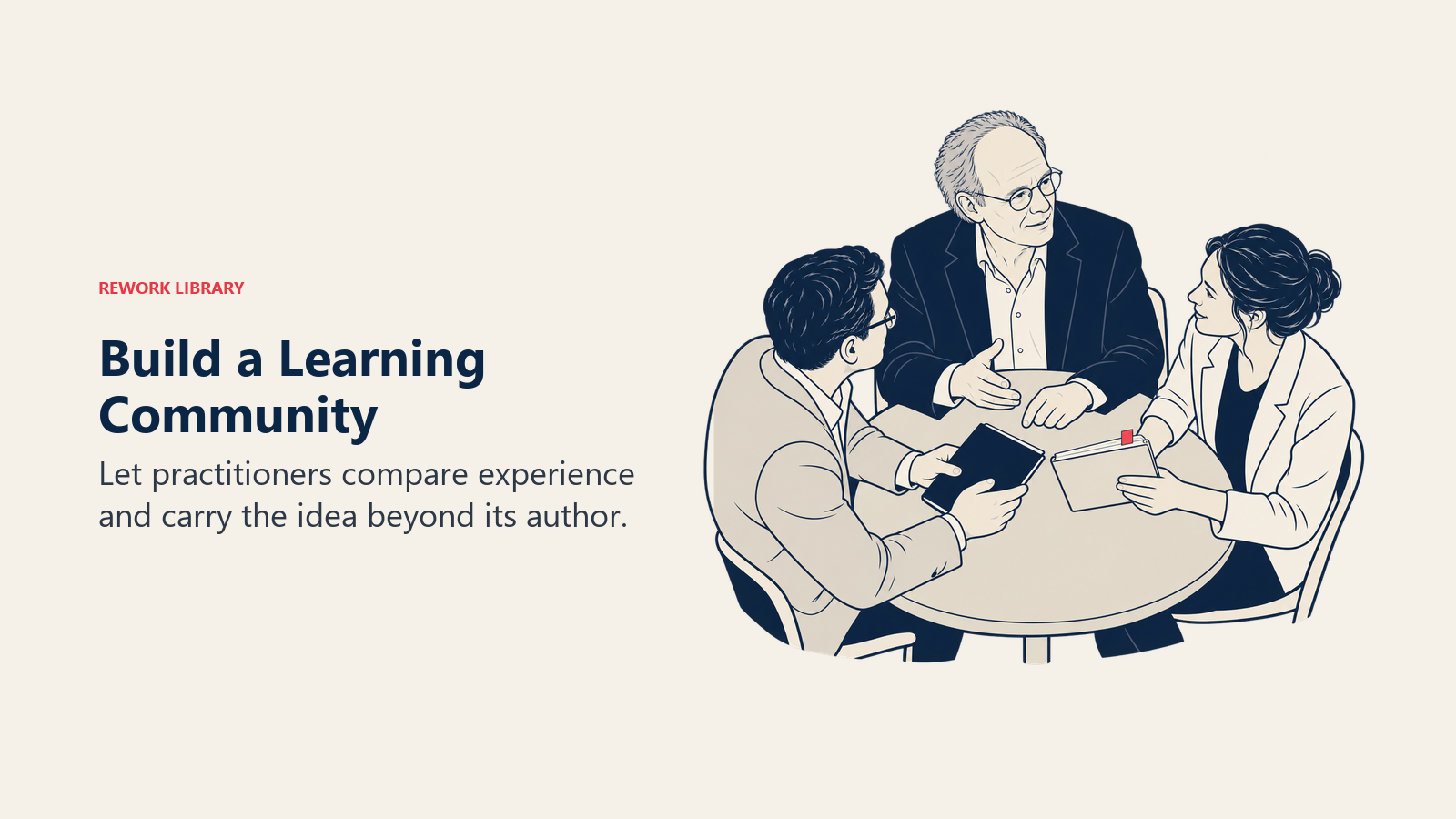
After The Fifth Discipline became a bestseller, the obvious path was to keep writing and consulting as an individual thought leader, the model most management authors follow. Senge chose something more expensive instead. In 1997 he became founding chair of the Society for Organizational Learning (SoL), a membership organization that absorbed the work MIT's own Center for Organizational Learning had been doing and turned it into an independent, cross-company network. Early corporate members included Ford, Shell, and Unilever, organizations that needed a place to compare notes on applying the five disciplines that a single consultant's client list could never provide.
A membership society does something a bestselling book cannot: it creates ongoing peer pressure and shared infrastructure. SoL published its own journal, Reflections, from 1999 to 2016, ran practitioner communities, and gave companies a forum to admit where the five disciplines weren't working, which is a very different thing from reading a case study written by an outside author. Founding it meant recruiting other organizations to co-govern something Senge no longer fully controlled, a genuine loss of authorial control that most successful authors never choose to accept.
For you: if your idea only spreads through your own books, talks, or consulting hours, you haven't built anything that outlives your attention. The harder, more durable move is building a structure where other people carry the idea forward without you in the room.
3. Extending the Framework Into Schools and Global Systems Instead of Staying in Corporate Consulting (2000 to 2016)
By 2000, Senge had a comfortable, proven lane: corporate learning organizations, with Fortune 500 clients and an established consulting practice around SoL. He chose to test the same five disciplines somewhere with none of that infrastructure. Schools That Learn (2000) applied personal mastery, mental models, and systems thinking to K-12 classrooms, where there is no P&L, no CEO mandate, and teachers who were never asked whether they wanted a "learning organization." Two decades later that work became the Compassionate Systems framework, now taught to educators directly.
The bigger extension came in 2016, when Senge and collaborator Hal Hamilton merged the Academy for Systemic Change with the Donella Meadows Institute to form the Academy for Systems Change, moving the work from individual organizations into whole systems: food, climate, and regenerative economies, the scale at which no single company's org chart is the unit of analysis anymore. Donella Meadows, the systems scientist behind Limits to Growth and Thinking in Systems, had built a complementary but separate body of work; merging into her institute's legacy meant Senge's own framework had to prove it could operate one level up from the corporation, at the level of an entire food system or a regional economy.
For you: a framework that only ever gets tested in the context that produced it hasn't really been tested. If you believe your model is general, the credible move is finding the least comfortable, least resourced environment where it should still apply, and running it there in public.
What Peter Senge Would Do in Your Role
If you're a CEO facing the same crisis for the third year running, Senge's framework asks you to stop asking who is responsible this time and start asking what structure keeps producing this exact outcome regardless of who is in the seat. A learning organization treats a recurring failure as data about the system, not as a performance problem with this quarter's manager. If you keep replacing the person and the pattern keeps returning, you have diagnosed the wrong layer.
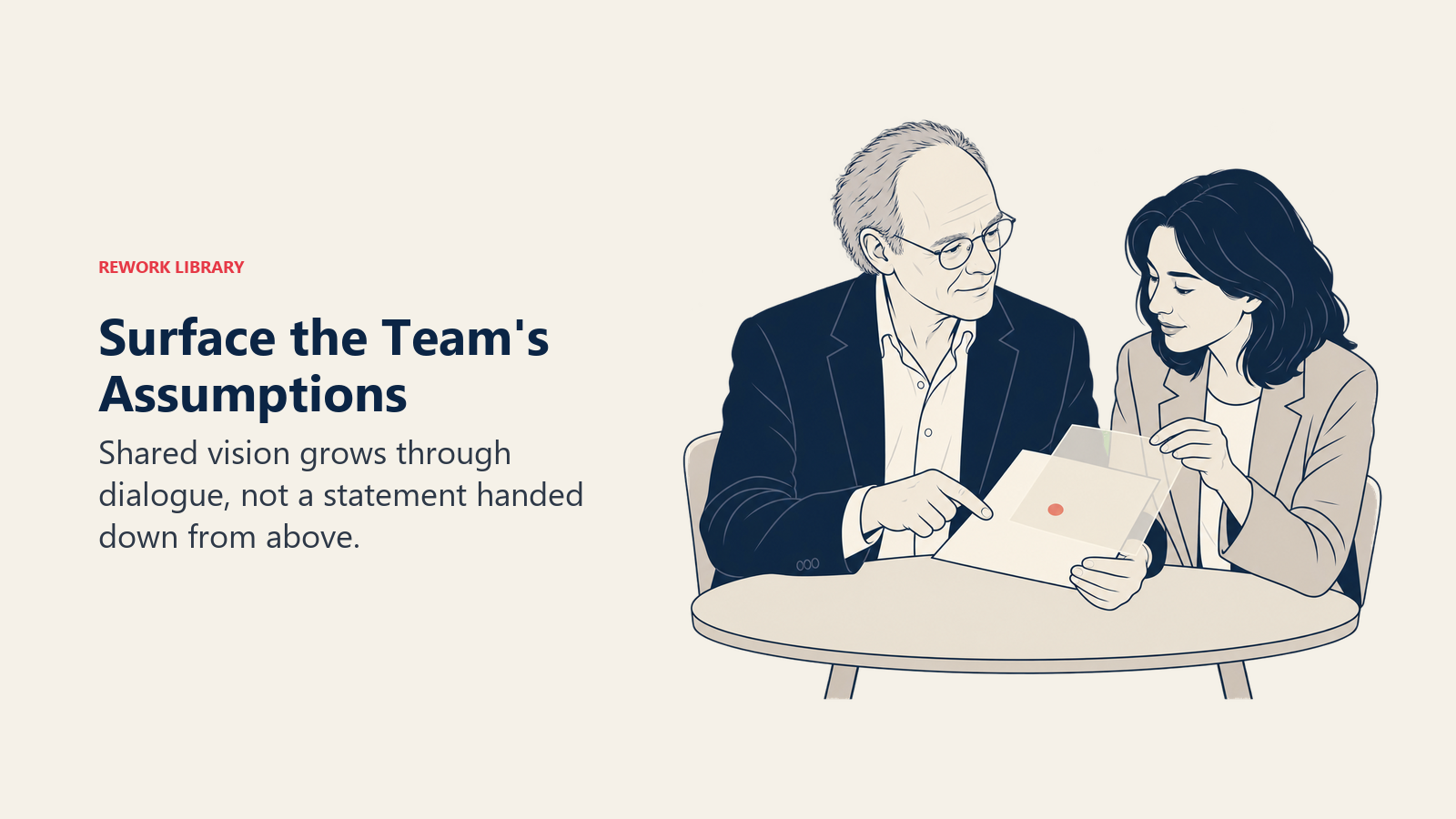
If you're an HR or L&D leader running a "culture transformation," the mental models and shared vision disciplines are the test your program probably isn't passing. A vision statement handed down from leadership produces compliance. A shared vision, in Senge's sense, is built through genuine dialogue where people's actual mental models get surfaced and challenged, not printed on a poster after the fact. If your transformation initiative has a launch deck but no mechanism for people to say the current direction is wrong, it is not the discipline Senge described.
If you're a product or operations leader caught between two departments that keep undoing each other's fixes, reach for the systems archetypes before you reach for a mediator. Shifting the burden describes exactly this pattern: a quick fix that relieves the symptom while quietly weakening the team's capacity to solve the underlying problem, so the same fire returns bigger. Map which team is applying the quick fix and which capability is atrophying as a result before you assign blame to either side.
| Situation you're facing | Senge's likely move |
|---|---|
| The same failure keeps recurring under different managers | Diagnose the structure producing it instead of replacing the person currently in the role |
| A culture change initiative isn't sticking | Check whether people were handed a vision to comply with, or built a shared one through real dialogue |
| Two teams keep undermining each other's fixes | Map it as a systems archetype like shifting the burden before assigning blame to either side |
| Leadership training isn't changing behavior | Separate personal mastery, individual clarity of purpose, from team learning, collective dialogue skill; most programs only ever build one |
| A short-term fix works, then the underlying problem returns worse | Recognize the fix may be trading a symptomatic solution for a fundamental one, and plan for the rebound |
Notable Quotes & Lessons Beyond the Boardroom
Senge's most quoted line is also his clearest statement of the doctrine: "in a learning organization, leaders are designers, stewards and teachers", responsible for building organizations where people continually expand their capacity to understand complexity and improve their own shared mental models. He defined the whole project in The Fifth Discipline by what it produces, not what it measures: organizations "where people continually expand their capacity to create the results they truly desire."
On why he chose accessibility over the years-long modeling training Jay Forrester's own program demanded, Senge's own words carry more weight than any summary: "Jay has always been focused on the high ground, training people who can develop advanced simulation models. I think that's great, but it takes years, and I grew impatient." That admission, made decades after the book's success, is a rare case of a management author naming exactly what his own bestseller traded away.
And on the deeper claim behind the Beer Game, the one that runs under everything else Senge built: "it's not the people, it's the system," as MIT Technology Review summarized it. The same simulation that convinces retail, wholesale, distribution, and factory teams to blame each other for a stockout is engineered so that swapping out any single player changes nothing. MIT's own System Dynamics Group built it specifically because "the collective results of individually sensible decisions can be disastrous," a lesson Senge spent the rest of his career translating out of the classroom and into the boardroom.
Where This Style Breaks
The learning organization idea was enormously influential, and it is also the concept most responsible for its own dilution. Within a decade of The Fifth Discipline, "learning organization" had drifted into the same category as "synergy" and "paradigm shift," a phrase consultants attached to any training initiative regardless of whether the underlying disciplines were present. Even a sympathetic academic review of Senge's work concedes the vision can be "too idealistic" for organizations built around short-term profit, and that most managers asked to run the five disciplines lack the theoretical grounding and the psychological patience the model actually requires. Senge built something real. The market around him mostly bought the label.
There is a harder problem underneath the branding one: the five disciplines resist measurement in a way that frustrates any executive who needs a business case before funding a program. Personal mastery and mental models are, by design, about internal clarity and examined assumptions, not quarterly metrics. Contrast that with Ray Dalio, whose Principles pushes the same instinct toward radical transparency and structural honesty into something closer to daily quantified data. Where Dalio built dashboards, Senge built reflection practices. Both bet that naming a system's real behavior beats managing its symptoms, but only one of them gives a CFO something to put in a spreadsheet, and that gap is exactly why "learning organization" programs get cut first when budgets tighten.
The deepest mismatch is time horizon. Senge's disciplines, especially team learning, only work once people trust each other enough to surface the mental models they'd normally protect, and that trust is the specific mechanism Amy Edmondson later named psychological safety, a full generation after Senge assumed teams could simply choose to have it. Building it takes years, not quarters. A leader with four quarters to turn around a struggling division does not have the runway for a multi-year systems-thinking journey, and Senge's own framework offers little for that leader beyond "the fix you're about to apply may be shifting the burden." True, and not actionable enough for someone who has ninety days.
Learn More
- Henry Mintzberg on Management and Leadership
- Peter Drucker Leadership Style: Management as a Humane Discipline
- W. Edwards Deming Leadership Style: Quality Is a System, Not an Inspection
- Amy Edmondson Leadership: Psychological Safety and Fearless Teams
- Ray Dalio Leadership Style
- Satya Nadella Leadership Style
- Tom Peters Leadership Style: In Search of Excellence
- Systems Thinking Competency Framework
- McKinsey 7S Framework: The 7 Elements Explained

Co-Founder, Rework.com
On this page
- The Designer-Steward-Teacher Doctrine
- Leadership Style Breakdown
- Key Leadership Traits
- The 3 Decisions That Defined Peter Senge as a Leader
- 1. Trading Forrester's Rigor for Reach (1990)
- 2. Founding the Society for Organizational Learning Instead of Writing Alone (1997)
- 3. Extending the Framework Into Schools and Global Systems Instead of Staying in Corporate Consulting (2000 to 2016)
- What Peter Senge Would Do in Your Role
- Notable Quotes & Lessons Beyond the Boardroom
- Where This Style Breaks
- Learn More