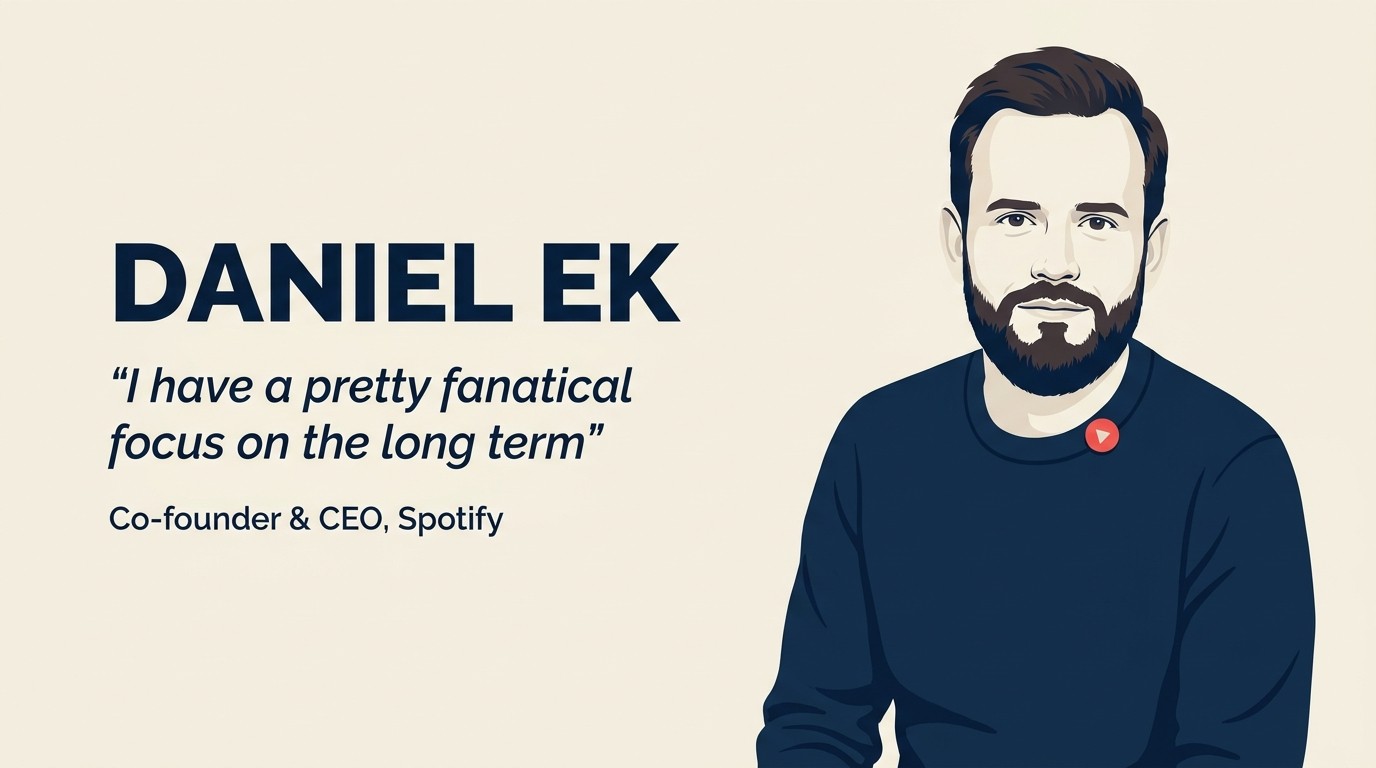
Daniel Ek Leadership Style: The Diplomat Who Disrupts
Turn this article into takeaways for your work.


Each assistant summarizes the article only for you and suggests best practices for your work.
Daniel Ek's leadership style is diplomatic disruption backed by strategic patience: he restructures fights with powerful incumbents into aligned partnerships, then moves faster than they expect once the alignment holds. It is the model that convinced the major labels to license Spotify, funded a billion-dollar podcast bet, and beat Apple in a five-year EU antitrust case.
In 2006, the major music labels were watching their business get eaten by piracy. Napster had already died, but BitTorrent was replacing it. Millions of people had decided music should be free. The record industry's response was aggressive lawsuits, they sued teenagers, college students, and file-sharing platforms in waves, and it wasn't working.
Daniel Ek walked into that environment with a proposition that should have been laughed out of the room: let me build the legal streaming service that competes with piracy, and I'll give you equity in exchange for your catalog. The labels would essentially be funding the company that made their traditional sales model obsolete.
They said yes. Not enthusiastically, it took two years of negotiations from 2006 to 2008 before Spotify launched. But they said yes because Ek made the math work. He wasn't selling disruption. He was selling alignment. That negotiation is the clearest window into how Ek leads: he finds the frame where incumbents become partners rather than obstacles, then moves faster than anyone expects.
Key Facts About Daniel Ek
- Born: 1983 in Stockholm, Sweden
- Co-founded Spotify: 2006 with Martin Lorentzon; service launched 2008 after two years of label negotiations
- Public listing: NYSE direct listing on April 3, 2018, no underwriters, no roadshow, ~$26B initial market cap
- Scale: 500M+ monthly active users reported in 2024, on track toward 600M+
- Signature deal structure: Equity to the four major labels (Universal, Sony, Warner, EMI) in exchange for licensing
- Podcast bet: $1B+ invested 2019-2020, Gimlet, Anchor, The Ringer, plus a reported $200M+ Joe Rogan deal
- Regulatory win: 2019 EU antitrust complaint against Apple resulted in a 1.84B euro fine in March 2024
The Diplomat Disruptor Doctrine
The Diplomat Disruptor Doctrine is the discipline of restructuring adversarial negotiations with powerful incumbents by offering them a credible stake in your upside, then moving faster than they expect once alignment is secured. It treats patience in negotiation as a competitive weapon, not a cost, and assumes most structural conflicts can be re-framed into shared-incentive partnerships before they have to be fought.
Leadership Style Breakdown
| Style | Weight | How it showed up |
|---|---|---|
| Diplomatic Disruptor | 55% | Ek's default move when facing a powerful incumbent is to find the alignment, the structure where their interests and Spotify's interests overlap enough to make cooperation rational. The label-equity deal is the foundational example. The Apple EU antitrust fight is the inverse: when alignment wasn't possible, Ek was willing to go to regulators and play a long game. He doesn't confuse diplomacy with passivity. |
| Operational Scaler | 45% | Spotify went from Swedish startup to NYSE-listed platform in a decade. Ek built the operational infrastructure for that, international expansion, licensing infrastructure across 180+ markets, the podcast acquisition strategy, and the 2023 pivot toward profitability. Swedish management culture (flat, consensus-oriented, long-term) runs through how Spotify makes decisions internally, which creates its own trade-offs. |
The 55/45 split reflects that Ek's strongest differentiator is the negotiating intelligence he brought to an industry that had never faced a founder willing to spend two years in a room with hostile counterparties to get the licensing structure right. The operational scaling was necessary but not distinctive. The diplomatic architecture was.
Key Leadership Traits
| Trait | Rating | What it means in practice |
|---|---|---|
| Hostile-party negotiation | Exceptional | Ek didn't just negotiate with music labels, he negotiated with entities whose business model his company was structurally undermining. The ability to make that conversation productive rather than adversarial, over two years, across four major labels, is a specific and rare skill. He did it by making the equity offer credible and by being genuinely patient. Most founders move too fast in existential negotiations. |
| Strategic patience | Very High | The direct listing in April 2018 came 10 years after co-founding. The EU antitrust complaint against Apple was filed in 2019 and vindicated in 2024. Ek runs on a five-year clock when the industry around him runs on quarters. That patience is a feature, not a limitation, it lets him take positions that shorter-horizon operators can't afford. |
| Platform bet conviction | High | The $1B+ podcast acquisition spree in 2019-2020 was not an obvious move. Buying Gimlet, Anchor, The Ringer, and signing Joe Rogan for a reported $200M was a large-scale bet that audio entertainment was converging on streaming platforms the same way music had. The bet's execution was messy, Spotify reversed parts of the podcast strategy in 2023 and laid off 17% of staff. But the strategic logic (own the category before it consolidates) was coherent. |
| Consensus-driven decision-making | Medium | Ek openly discusses Swedish management values, flat hierarchy, consensus-seeking, long discussion cycles. It produces a culture that's relatively respectful and stable. But it creates product decision lag. Spotify has been persistently criticized for being slow to ship features that competitors build in months. The same culture that made the label negotiations work makes urgent product calls slower. |
The 3 Decisions That Defined Daniel Ek as a Leader
1. Giving Equity to the Labels, Turning Gatekeepers Into Stakeholders
The labels didn't want to license their catalogs to Spotify. They'd watched Napster build on their content and capture value without sharing it. They'd watched YouTube grow on user-uploaded music while paying low royalty rates. Mark Zuckerberg faced a structurally similar problem when Instagram and WhatsApp were growing on his platform's ecosystem, he solved it by acquiring them, a move Ek couldn't make with Universal. The idea of handing their assets to another startup felt like being robbed a third time.
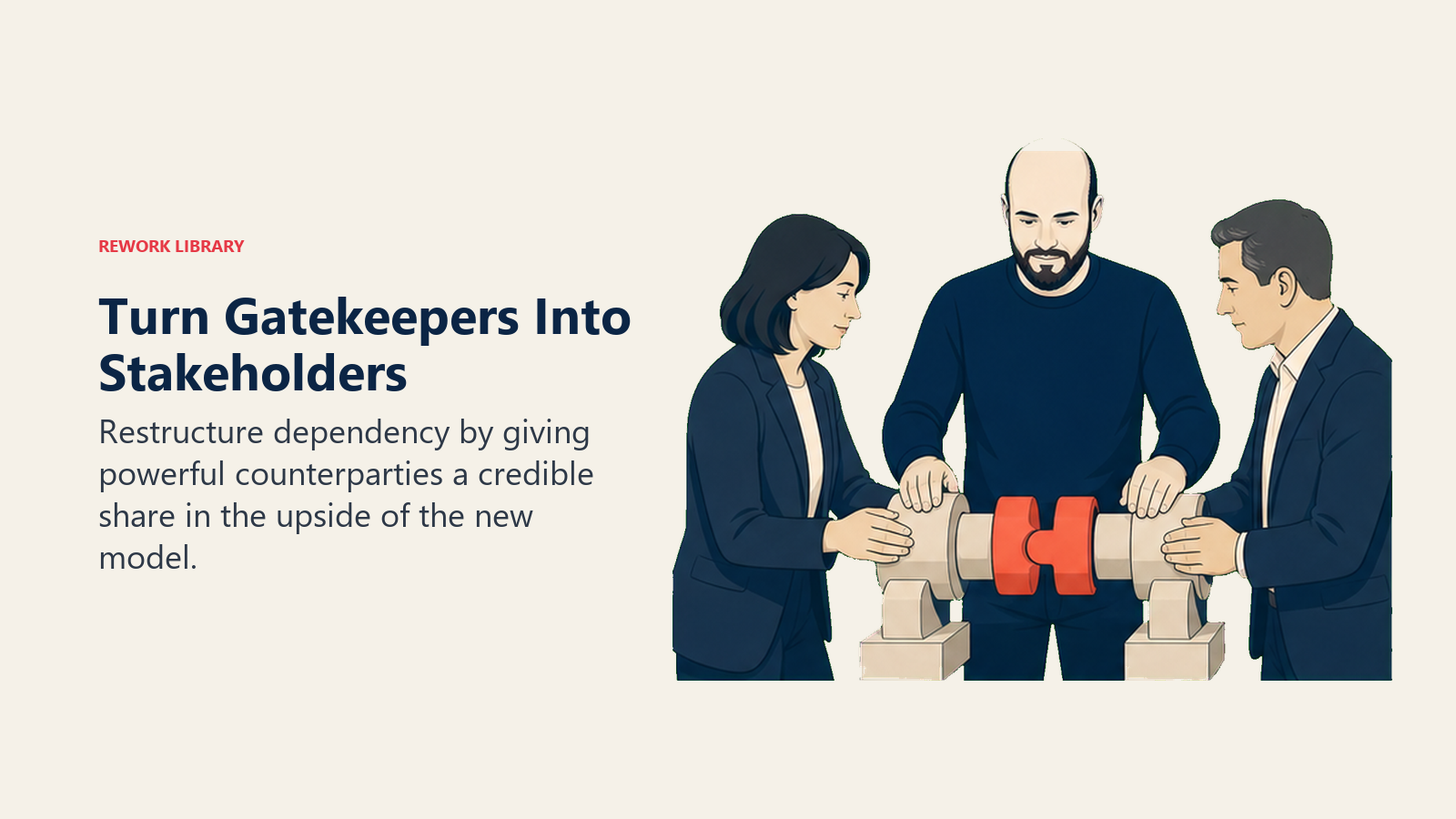
Ek's solution was structurally elegant: give the labels equity. If Spotify wins, the labels win too. Universal, Sony, Warner, and EMI collectively received stakes that eventually represented significant value, estimates put the labels' combined equity share in the 15-20% range at launch. When Spotify went public in 2018, those equity positions were worth hundreds of millions of dollars.
That structure changed the negotiation from adversarial to aligned. The labels shifted from "how do we stop this" to "how do we help this succeed so our equity is worth more." They gave Spotify access to back catalogs, they licensed at rates that made streaming economically viable, and they became invested in Spotify's success.
For operators, the lesson is about restructuring adversarial negotiations. When you're facing a counterparty whose default position is to block you, ask what structure would change their incentive. The answer isn't always equity, but it's almost always some form of alignment. What would make your biggest obstacle a stakeholder in your success?
2. The 2018 Direct Listing, A Structural Statement, Not Just a Liquidity Event
On April 3, 2018, Spotify listed directly on the New York Stock Exchange without an IPO. No underwriters. No lock-up periods. No roadshow. The company set a reference price, opened trading, and let the market find the clearing price on day one. Patrick Collison made the same structural choice years later, both founders treating the traditional IPO machinery as an intermediary worth bypassing.
This was unusual. IPOs existed for a reason, they gave investment banks fees, they gave early investors an orderly exit, and they gave companies a chance to market themselves to institutional investors in controlled settings. Ek rejected that structure. The direct listing was consistent with Spotify's operating philosophy: don't pay middlemen you don't need, be transparent about your business rather than presenting a managed narrative, and let the market price you honestly.
The 2018 listing set a template that Slack and Palantir later followed. At $26B, Spotify's initial market cap was a signal that direct listings could work at scale.
But the decision had a secondary effect that matters for how you think about Ek as a leader: it positioned Spotify as a tech company that was willing to challenge financial industry conventions the same way it had challenged music industry conventions. The direct listing wasn't just a financing choice. It was a statement about what kind of company Spotify intended to be.
3. Filing the Apple Antitrust Complaint in 2019 and Playing the Five-Year Game
In March 2019, Spotify filed a formal antitrust complaint with the European Commission against Apple. The charge: Apple was using its App Store monopoly to charge Spotify a 30% tax on subscriptions while competing directly with Apple Music, which paid no such tax. This was a structural disadvantage that made Spotify's premium tier pricing non-competitive.
Ek didn't just complain publicly. He built a sustained regulatory campaign, "Time to Play Fair", that documented the practice, gathered support from other developers, and kept the pressure on European regulators for years.
In March 2024, five years after the complaint was filed, the EU ruled against Apple and fined the company 1.84 billion euros. Apple was ordered to change its App Store rules. Spotify had won.
The leadership model here is rare. Most CEOs in Ek's position would have focused on product workarounds, building web-based subscription flows, negotiating side agreements, absorbing the cost. Ek decided to fight the structural problem at the regulatory level and was willing to spend five years on it. Travis Kalanick ran a faster, louder version of the same playbook, launch before the rules exist and let consumer demand force regulators to negotiate.
For operators dealing with platform dependencies, this is a meaningful data point. Regulatory strategy is a legitimate competitive tool when structural market conditions are unfair. It's slow, expensive, and uncertain. But Spotify is the example that it can work if you have the patience and the credibility to see it through.
What Daniel Ek Would Do in Your Role
If you're a CEO running a company that depends on partners you don't fully control, Ek's label-deal playbook is the reference. When you're structurally dependent on a counterparty who could hurt you, don't assume you're at their mercy. Ask what structure would change their incentive. The question isn't "how do we survive this dependency", it's "how do we restructure this so their interest and ours align." Equity, revenue share, exclusivity, co-development, these are tools. Use them before the adversarial negotiation starts.
If you're a COO or operations leader, the 2023 profitability pivot is worth studying. Spotify spent years operating at losses in pursuit of scale, gross margins in the 25-30% range while investing heavily in podcasts and original content. When the pivot happened, Ek moved decisively: 17% headcount reduction in January 2023, another round in December 2023. The operational lesson is that a company can sustain a growth-at-all-costs phase only if the leadership has a clear trigger for when the phase ends. Ek was slow to pull the trigger, but he eventually pulled it. What's your trigger?
If you're a product leader, Spotify's product history is a case study in what happens when strategic decisions outpace product execution. The podcast acquisitions created a content library that Spotify's product surface wasn't ready to surface well. The recommendation engine and discovery UX lagged the content investment by years. The lesson: when you make a major content or feature bet, the product infrastructure to support it needs to be part of the plan, not a follow-on initiative.
If you're a sales or marketing leader, Ek's "Time to Play Fair" campaign against Apple is the best recent example of turning a regulatory fight into a brand story. Spotify framed itself as the underdog challenging a monopolist, which resonated with creators, developers, and consumers simultaneously. The campaign created earned media and stakeholder sympathy that no ad budget could buy. When you have a legitimate structural grievance against a dominant market player, making it public and making it coherent is a marketing move, not just a legal one.
Running Ek's Playbook on Rework
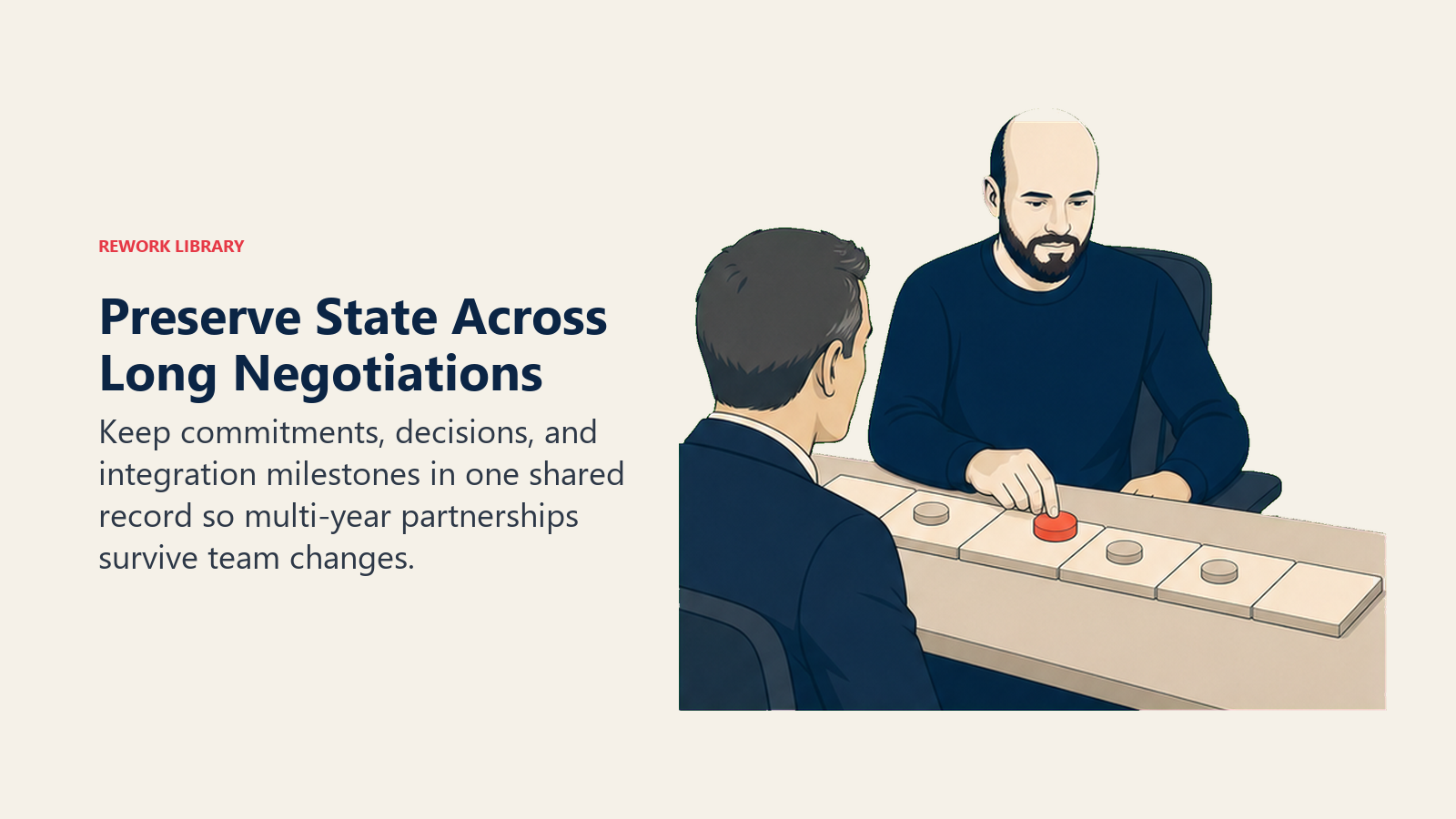
Ek's model only works if you can hold a coherent position across multi-year negotiations while still shipping product weekly. That's an operational problem, not a philosophical one. SaaS teams running label-style deals, licensing, channel partnerships, enterprise co-development, are usually tracking commitments across CRM notes, legal shared drives, Slack threads, and slide decks, and the context leaks every time a deal lead rotates. Rework gives you one surface where the CRM pipeline for each partner, the project plan for integration milestones, and the internal chat live together, so a two-year negotiation doesn't lose state when someone goes on leave. For product teams running podcast-scale category bets, the same workspace links the strategic thesis to the delivery tickets, so when the market turns and you need to pivot toward profitability, as Ek did in 2023, you can see which commitments are still load-bearing and which you can safely cut.
Notable Quotes and Lessons Beyond the Boardroom
Ek has spoken publicly about the Swedish management philosophy that shaped Spotify's culture. He talks about "agile squads" and flat decision-making, about hiring people who are more expert than you and getting out of their way. That model produces a certain kind of culture, one that's relatively safe and respectful but that can be slow when the market requires fast turns.
He's said: "We're not in the music business. We're in the audio business." That reframing echoes how Steve Jobs repositioned Apple from a computer company into a device company, change the category definition and you change the entire competitive map. That's a statement he made around 2018-2019 when the podcast pivot was beginning, and it captures something real about how he thinks about Spotify's mission. Music was the founding category. Audio was the actual TAM. The distinction matters because it justifies the podcast investment, if your business is music streaming, buying podcast companies is a distraction. If your business is audio, it's core.
On the label negotiations: "I spent two years in rooms with people who didn't want us to succeed. I knew that if I could just make the math work, the rest would follow." That pragmatism, not idealism about disruption, just math-making, is the most useful framing of the Spotify founding story for operators who need to bring incumbents along.
Where This Style Breaks
Ek's diplomacy-first style works brilliantly when the problem is negotiating with resistant incumbents. It creates real drag when the problem requires fast internal product decisions. Spotify has been criticized for years for product stagnation, slow feature development, an app UI that changed less between 2016 and 2022 than users expected, and a podcast discovery experience that never matched the quality of its content library.
The consensus-driven Swedish culture that made the label negotiations possible also means that product calls take longer to make and are harder to reverse. When competitors like Apple Music and Amazon Music were shipping features quickly, Spotify's internal deliberation cycle left product gaps open for years. Diplomatic intelligence and operational urgency are genuinely different skills. Leaders who are exceptional at one are often structurally weak at the other.
Frequently Asked Questions about Daniel Ek's Leadership
Who is Daniel Ek?
Daniel Ek is the Swedish entrepreneur who co-founded Spotify with Martin Lorentzon in 2006. Born in Stockholm in 1983, he has served as CEO since launch and took the company public via NYSE direct listing in April 2018.
How did Ek convince labels to license Spotify?
He offered Universal, Sony, Warner, and EMI equity in Spotify in exchange for licensing rights, a combined stake estimated at 15-20% at launch. That structure turned the labels from gatekeepers into stakeholders whose upside depended on Spotify's success. The negotiations took roughly two years from 2006 to 2008.
Why did Spotify do a direct listing?
Ek bypassed the traditional IPO on April 3, 2018 to avoid underwriter fees, lock-up periods, and a managed roadshow. Spotify set a reference price and let the market find the clearing price, opening around a $26B market cap. The move became a template Slack and Palantir later followed.
What is Ek's approach to podcasts?
Between 2019 and 2020, Spotify spent over $1B acquiring Gimlet, Anchor, The Ringer, and Parcast, plus a reported $200M+ exclusive deal with Joe Rogan. The thesis was that audio entertainment would consolidate on streaming platforms the way music had, so Spotify should own the category early.
What is Daniel Ek's leadership style?
Diplomatic disruption plus strategic patience. Ek prefers to restructure adversarial negotiations into aligned partnerships, as he did with the labels, and is willing to spend years on regulatory fights, as shown by the 2019 EU antitrust complaint against Apple that produced a 1.84B euro fine in 2024. Internally he operates a flat, consensus-driven Swedish management model.
What can founders learn from Daniel Ek?
Three lessons. First, when you're structurally dependent on a hostile counterparty, find the equity or revenue structure that changes their incentive before you negotiate terms. Second, long-horizon bets, listings, regulatory campaigns, category pivots, require a clock measured in years, not quarters. Third, know the trade-off: diplomacy-first cultures win slow-burning structural fights but lose fast-moving product races.
Learn More

On this page
- Key Facts About Daniel Ek
- The Diplomat Disruptor Doctrine
- Leadership Style Breakdown
- Key Leadership Traits
- The 3 Decisions That Defined Daniel Ek as a Leader
- 1. Giving Equity to the Labels, Turning Gatekeepers Into Stakeholders
- 2. The 2018 Direct Listing, A Structural Statement, Not Just a Liquidity Event
- 3. Filing the Apple Antitrust Complaint in 2019 and Playing the Five-Year Game
- What Daniel Ek Would Do in Your Role
- Running Ek's Playbook on Rework
- Notable Quotes and Lessons Beyond the Boardroom
- Where This Style Breaks
- Learn More