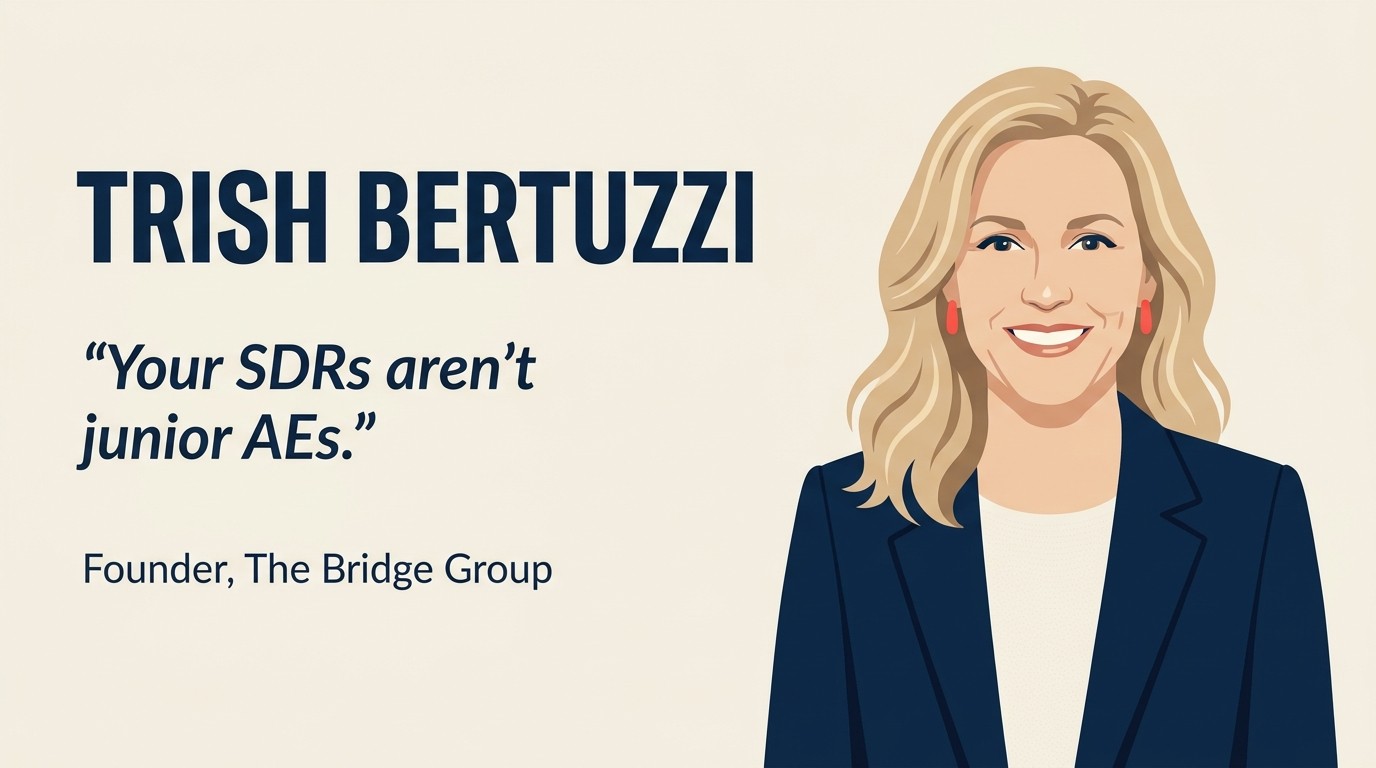
Trish Bertuzzi's Leadership Style: The Woman Who Designed the Modern SDR Organization
Turn this article into takeaways for your work.


Each assistant summarizes the article only for you and suggests best practices for your work.
Key Facts: Trish Bertuzzi is founder and CEO of The Bridge Group Inc, which she launched in 1998 as a specialist consultancy for B2B technology inside sales. Under her leadership, The Bridge Group has consulted with 400+ B2B tech sales organizations on SDR development, team design, and pipeline economics. Her 2015 book "The Sales Development Playbook" is widely regarded as the category-defining operational guide for building SDR teams. She also produces the annual SDR Metrics & Compensation report, the most-cited primary benchmarking data in the field, and is considered the pioneer of the modern SDR role definition.
The Bertuzzi SDR Architecture Model
The Bertuzzi SDR Architecture Model treats sales development as a measurable pipeline system built from six interlocking design factors, strategy, specialization, recruiting, retaining, coaching, and execution, rather than a talent program. It argues that SDR output is determined structurally (by how the function is designed) more than it is determined by individual rep effort, and that compensation architecture, ramp-time modeling, and career-path design are the load-bearing variables most leaders underinvest in.
In 1998, Trish Bertuzzi founded The Bridge Group with a specific focus: inside sales strategy for B2B technology companies. At the time, most enterprise sales organizations were built around field reps. Inside sales was still considered a second-tier model. The idea that you'd deliberately separate prospecting from closing (building an entire team whose only job was to find and qualify pipeline rather than close it) was not yet standard practice.
Bertuzzi made it standard practice.
Over the next two decades, The Bridge Group consulted for more than 300 technology companies, including Salesforce and HubSpot, across Series A startups and public SaaS businesses. She published annual benchmarking reports on SDR metrics (activity rates, conversion rates, ramp time, compensation) that gave the field its first primary data. And in 2016, she published "The Sales Development Playbook", which remains the most comprehensive operational guide to building an SDR organization ever written.
She didn't invent the SDR role. But she systematized it, benchmarked it, and gave revenue leaders the data they needed to build it with confidence. That's a different kind of contribution than invention, and in many ways it's more durable.
Leadership Style Breakdown
| Style | Weight | How it showed up |
|---|---|---|
| Practitioner-Researcher | 60% | Bertuzzi's most distinctive trait is that she built her frameworks from primary data rather than theory. The Bridge Group's annual benchmarking studies weren't thought leadership pieces, they were surveys of actual companies measuring actual outcomes. When she made recommendations about SDR-to-AE ratios or ramp time expectations, she was citing data from hundreds of engagements, not extrapolating from first principles. That practitioner-researcher combination gave her recommendations a credibility that pure consultants and pure academics rarely achieve simultaneously. |
| Systems Architect | 40% | Bertuzzi thought about SDR organizations the way an engineer thinks about a system: you define the inputs, measure the throughput, diagnose the leakage, and optimize the conversion at each stage. Her playbook is structured around six factors, her "6-factor model" for SDR success, that she identified as the variables most correlated with predictable pipeline output across her client base. She wasn't interested in motivational frameworks or cultural aspirations. She wanted to know what specifically produced meetings that converted to revenue, and she built her consulting methodology around isolating those variables. |
The 60/40 split explains both her influence and her relative public profile. Bertuzzi was never a keynote-circuit personality in the way that Jeb Blount or Zig Ziglar built their followings. She was known deeply among revenue operators who read benchmarking data and built teams for a living. Her audience wasn't everyone. It was the specific group of people who needed to make correct structural decisions about SDR organizations. For that audience, she was the authoritative source.
Key Leadership Traits
| Trait | Rating | What it means in practice |
|---|---|---|
| Pipeline Factory Design | Very High | Bertuzzi's most important contribution is the conceptual frame of the SDR team as a pipeline factory, a dedicated function whose output is qualified pipeline, measured and managed like a production system rather than a talent program. This framing has specific design implications. A pipeline factory has inputs (ICP lists, outreach sequences, tools), throughput (connect rates, conversation rates, meeting-held rates), and output (meetings converted to opportunities). Each variable is measurable. Each bottleneck is diagnosable. You don't motivate your way out of a conversion problem, you redesign the stage where conversion is leaking. |
| Compensation Architecture | Very High | Bertuzzi's research on SDR compensation was among the most practically useful work The Bridge Group produced. Her core finding: the base/variable split signals organizational culture as much as it drives behavior. A 90/10 base-heavy split says "we think of SDRs as junior employees in a training program." A 60/40 or 70/30 split says "we think of SDRs as quota-carrying professionals with performance expectations." The compensation structure also determines who applies, higher variable attracts sellers, lower variable attracts people who want the stability of a training program. Neither is wrong, but they're different design choices with different downstream consequences on SDR-to-AE promotion rates. |
| SDR-to-AE Ratio Discipline | High | One of Bertuzzi's most referenced data points is her SDR-to-AE ratio recommendations by market segment. Her benchmarks varied significantly: SMB-focused AEs with high transaction volume can support a 1:1 or 2:1 SDR-to-AE ratio. Enterprise AEs with long sales cycles and low deal volume often need 2 or 3 SDRs per AE to maintain a full pipeline. Most companies set this ratio based on intuition or imitation rather than data. Getting it wrong in either direction produces predictable failures, either AEs without enough pipeline or SDRs without enough capacity to receive qualified meetings. |
| Against the Junior-AE Model | Strong | Bertuzzi's most persistently useful insight is her critique of treating the SDR role as a junior AE training program. She was explicit: the skills that make a great SDR (high activity, curiosity, resilience to rejection, ability to quickly qualify fit) are not the same skills that make a great AE (patient discovery, complex negotiation, executive presence, deal architecture). When you hire SDRs primarily as AE candidates, you optimize for promotion potential rather than SDR performance, which degrades the pipeline factory. The two roles need different profiles, different management, and different success metrics. |
The 3 Frameworks That Defined Trish Bertuzzi
1. The Sales Development Playbook: Six Factors for Predictable Pipeline
Bertuzzi's 2016 book is structured around six factors she identified as the core levers of SDR performance across more than 300 consulting engagements. They are: strategy (ICP definition, account segmentation, and outreach prioritization), specialization (how you segment the SDR team by market, product line, or geography), recruiting (who you hire and how you assess them before they start), retaining (what keeps SDRs on the team long enough to be productive), coaching (how managers actually develop SDR skill in real time), and execution (the daily operating rhythm of the team).

The six-factor structure is more useful than a prioritized checklist because it forces leaders to evaluate all six levers simultaneously. Most SDR improvement efforts focus on execution: messaging, cadence, tooling. Bertuzzi's framework says execution problems are frequently caused by strategy and specialization problems that no amount of execution refinement will fix.
The example she used repeatedly: a company with an undefined ICP will build sequences for every prospect, get mediocre connect rates, see mediocre conversion, and blame the messaging. The real problem is that the sequences are being sent to prospects who don't have the problem the product solves. Fix the strategy first. Then fix the execution. The downstream processes that SDR-sourced pipeline flows into, qualification, handoff, and pipeline management, are covered in the lead management library, which addresses what happens after the meeting is booked.
For CROs: if your SDR team is underperforming and you're on your second or third set of new email sequences, work through the six factors from the top before you redesign the sequences again.
2. The Ramp Time Framework
Bertuzzi's benchmarking work on SDR ramp time was some of the most practically useful data The Bridge Group produced, and it's still the most commonly referenced source for this question.
Her finding: across enterprise-focused SDR organizations, median ramp time from hire to full quota attainment was 3.2 months. In mid-market focused teams it was faster, closer to 2.5 months. In enterprise-heavy teams with complex products and long sales cycles, it was sometimes 4-5 months. These aren't aspirational targets. They're what actually happened across hundreds of organizations.
The implication: headcount planning for SDR teams needs to account for ramp time as a structural cost. If you're building an SDR team of 10 and you plan to hire 5 now and 5 in 90 days, your fully ramped capacity isn't 10 for the first five months. It's a ramp curve that you need to model explicitly. Most VP of Sales headcount plans ignore this. Most CROs discover it the hard way in Q3 when the pipeline that was supposed to come from new SDR hires in Q1 hasn't materialized.
Bertuzzi's prescription: build the ramp time assumption into your headcount model, plan hiring 90 days ahead of when you need the pipeline output, and measure ramp time per cohort so you know whether your onboarding program is shortening or extending it.
3. The SDR Career Path Design
One of Bertuzzi's most underrated contributions was her thinking on SDR career path design, specifically the argument that the career path matters operationally, not just for retention.

Her observation: SDR teams where every rep is planning to promote to AE within 18 months have a structural attention problem. Reps in their last 3-6 months before promotion are mentally preparing for a different job rather than optimizing the current one. Managers spend disproportionate time on promotion readiness rather than SDR performance improvement. And when someone doesn't get promoted on schedule, the retention problem is acute because there was no alternative path offered.
Bertuzzi's prescription was explicit career path alternatives: a senior SDR track for reps who are exceptional at the role and don't want to close (with higher compensation and responsibility for training newer reps), an SDR management track for reps who show coaching instincts, and an AE track for the smaller subset of reps who demonstrate genuine readiness for quota-carrying responsibility. The three-track model retains high performers who fit the SDR profile, develops managers from within, and produces better AEs because you're not promoting every rep on a fixed schedule.
What Trish Bertuzzi Would Do in Your Role
If you're a CEO trying to understand why your pipeline has been inconsistent despite investing in SDRs, Bertuzzi would run you through the six factors before looking at anything else. Her first question is always strategy: is your ICP defined with enough specificity that your SDRs know which accounts to prioritize and can articulate why? If the answer is "our ICP is companies with 50-500 employees that could benefit from our solution," your pipeline problem isn't an SDR problem. It's a strategy problem that your SDR investment is absorbing.
If you're a COO building the revenue operations infrastructure, Bertuzzi's compensation architecture research is the most immediately actionable thing in her body of work. Before your next SDR compensation review, model the effect of your current base/variable split on the type of candidate it attracts and the behavior it incentivizes. If you're paying 85% base and 15% variable and wondering why your SDRs treat the role like a training program rather than a quota-carrying position, the answer is in the structure. Change the structure before you change the management.
If you're in product building the pitch and positioning that SDRs deliver, Bertuzzi's framework has a direct implication for how you think about SDR enablement. The common model is to train SDRs on product features and benefits and then set them loose. Bertuzzi's framework says SDRs need to be trained on ICP pain and qualification signals, not product knowledge, but customer knowledge. Can your SDRs describe the three most common problems your best customers had before they bought from you? If not, product enablement is giving SDRs the wrong inputs.
If you're in sales leadership evaluating your current SDR model, the most important question Bertuzzi would ask you is: are you measuring the right outputs? Most SDR metrics focus on meetings booked. Bertuzzi's argument is that meetings-booked is a vanity metric if the meetings don't convert to qualified opportunities. The pipeline factory model requires you to track the full conversion chain: outreach contacts, connect rate, meeting-held rate, meeting-to-opportunity rate, and opportunity-to-close rate attributable to SDR-sourced pipeline. You can't optimize a factory you're not measuring end-to-end.
How Rework Operationalizes the Bertuzzi SDR Architecture
Bertuzzi's SDR-as-system thesis only holds up if the conversion chain is instrumented end-to-end. Most CRMs treat SDR activity as a counter, dials, emails, meetings booked, and stop there, which is exactly the vanity-metric trap her work critiques. Rework CRM is designed around the pipeline-factory model: connect rate, meeting-held rate, meeting-to-opportunity rate, and SDR-sourced revenue are tracked as a single conversion funnel per rep, per segment, and per cohort. That makes six-factor diagnosis possible in the product, not just on a slide. For data-driven compensation design, Rework ties ramp curves and conversion metrics back to the comp plan, so a 60/40 or 70/30 base/variable decision is informed by actual rep behavior rather than intuition. Pair that with lead management workflows for handoff discipline and the SDR-to-AE boundary stays measurable. The Sales Engine starts at $69/month billed yearly with 5 sales seats included, see rework.com/pricing.
Notable Quotes and Lessons Beyond the Boardroom
"The SDR role is not a junior AE training program. It is a professional role with its own skill set, its own success metrics, and its own career path. If you treat it as a holding pattern, you'll get holding-pattern performance."
This quote captures the central critique in Bertuzzi's work. The organizational treatment of SDRs as temporary tenants waiting for a real job produces exactly the performance that treatment signals is acceptable. The companies that build professional-grade SDR organizations (with real career paths, real compensation, real management investment) consistently outproduce the ones that don't.
"Data doesn't lie. Your SDR team's conversion metrics tell you exactly where the system is breaking. The question is whether you're looking."
Bertuzzi's practitioner-researcher orientation shows up here. She was consistently frustrated by sales leaders who attributed SDR underperformance to individual motivation or effort when the data clearly showed a structural problem at a specific conversion stage. Pipeline factory design requires data-driven diagnosis, not intuition-based coaching.
"Hire for SDR, not for future AE."
Her most referenceable prescription and the one most consistently violated. The instinct to hire SDRs as AE candidates is so strong in most sales organizations that it takes deliberate counter-pressure to override it. Bertuzzi's point: if your SDR profile is "someone who wants to be an AE," you're filtering against the people who might be exceptional at the SDR role. And those exceptional SDRs are the ones who build your pipeline.
Bertuzzi's frameworks intersect most directly with Aaron Ross, who provided the SDR model's structural blueprint in "Predictable Revenue," and with Mark Roberge, whose data-driven scaling work at HubSpot validated the same practitioner-researcher approach Bertuzzi applied from the consulting side. Where Ross defined the role and Roberge proved it at scale, Bertuzzi gave the rest of the market the benchmarks to build it correctly.
Bertuzzi's own career carries a lesson about the value of specialization. She spent 25 years working on a specific problem in a specific market segment. She didn't try to be a general sales guru or a broad leadership coach. She built deep expertise in SDR and inside sales strategy for B2B tech. That specificity made The Bridge Group the first call for anyone building an SDR function. Breadth gets you visibility. Depth gets you authority. In a field full of generalist sales consultants, Bertuzzi's specialization was the differentiator.
Where This Style Breaks
Bertuzzi's playbook faces its most serious challenge in 2024-2026, and it's not a small one.
The SDR model she systematized was built for a specific set of conditions: buyers who hadn't yet been saturated by sequenced outreach, email channels that still had high deliverability, phone connections that were accessible, and an outbound cost structure that made SDR-sourced pipeline economically attractive relative to inbound and product-led alternatives. Most of those conditions have deteriorated.
Email open rates in B2B have declined significantly since 2020. AI-generated outreach has flooded inboxes to the point where even well-crafted personalized sequences are being filtered by buyers as noise. The SDR burnout rates documented in 2024-2026 industry surveys are higher than at any point in the model's history. McKinsey's research on B2B sales growth found that companies combining digital self-serve with human outreach outperform those relying on outbound-only models by a significant margin, context Bertuzzi's playbook didn't anticipate but that her six-factor framework can still accommodate. And an increasing number of SaaS companies have reduced or eliminated their SDR teams in favor of product-led and community-led pipeline strategies.
Bertuzzi's playbook is still the best operational guide to the traditional SDR model. But the model itself is under structural pressure that no amount of playbook optimization will fully address. Revenue leaders applying her frameworks today need to be honest about whether the SDR model fits their current buyer behavior, and not just default to it because it worked from 2010 to 2020.
The second limitation is transferability. Her research was almost entirely focused on B2B SaaS companies with $1B+ TAMs and relatively standard buyer profiles. The frameworks generalize poorly to industries with different procurement cycles, complex channel dynamics, or non-digital buying behavior.
Frequently Asked Questions about Trish Bertuzzi's SDR Philosophy
Who is Trish Bertuzzi?
Trish Bertuzzi is the founder and CEO of The Bridge Group Inc, an inside sales consultancy she launched in 1998. She has advised 400+ B2B technology sales organizations on SDR strategy, team design, and compensation, and is the author of "The Sales Development Playbook" (2015). She is widely recognized as the pioneer of the modern SDR role definition.
What is the Sales Development Playbook?
"The Sales Development Playbook," published by Bertuzzi in 2015, is the category-defining operational guide for building an SDR organization. It is structured around six factors, strategy, specialization, recruiting, retaining, coaching, and execution, that she identified across hundreds of consulting engagements as the variables most correlated with predictable pipeline output.
What is an SDR team structure per Bertuzzi?
Bertuzzi frames SDR team structure as a pipeline factory with specialized inputs and measurable throughput. Her recommendations include tiering SDR-to-AE ratios by segment (roughly 1:1 to 2:1 for SMB, 2:1 to 3:1 for enterprise), separating inbound and outbound specializations, and building explicit career tracks so not every SDR is on an AE promotion path.
What are the SDR Metrics & Compensation benchmarks?
The Bridge Group's annual SDR Metrics & Compensation report is a primary-data benchmarking study covering activity rates, connect and conversion rates, ramp time (median around 3.2 months in enterprise teams), SDR-to-AE ratios, and base/variable compensation splits. It is the most frequently cited data source for SDR planning and is used by revenue leaders to calibrate quotas and comp design.
How does Bertuzzi define the ideal SDR hire?
Bertuzzi's core rule is "hire for SDR, not for future AE." The ideal SDR shows high activity tolerance, curiosity, resilience to rejection, and the ability to quickly qualify fit, not the patient discovery and deal architecture skills that make a great AE. She argues that filtering for AE-readiness selects against the profile that actually excels at prospecting.
What can sales leaders learn from Trish Bertuzzi?
Sales leaders can learn to treat SDR as a designed system rather than a talent program, diagnosing underperformance at the conversion stage, not the motivation layer. Her work pushes leaders to model ramp time into headcount planning, align compensation architecture with the behavior they want, and instrument the full conversion chain instead of optimizing on meetings booked.
Learn More
- Aaron Ross Leadership Style: How Predictable Revenue Invented the Modern SDR Model
- Mark Roberge Leadership Style: The Science of Scaling Revenue at HubSpot
- Jeb Blount Leadership Style: The Fanatical Prospecting Mindset That Built Sales Gravy
- Jill Konrath Leadership Style: How SNAP Selling and Agile Selling Redefined Complex B2B
- Neil Rackham Leadership Style: How the SPIN Selling Framework Changed B2B Sales Forever

On this page
- The Bertuzzi SDR Architecture Model
- Leadership Style Breakdown
- Key Leadership Traits
- The 3 Frameworks That Defined Trish Bertuzzi
- 1. The Sales Development Playbook: Six Factors for Predictable Pipeline
- 2. The Ramp Time Framework
- 3. The SDR Career Path Design
- What Trish Bertuzzi Would Do in Your Role
- How Rework Operationalizes the Bertuzzi SDR Architecture
- Notable Quotes and Lessons Beyond the Boardroom
- Where This Style Breaks
- Learn More