Reed Hastings Leadership Style: No Rules, Three Pivots, and a Culture Deck That Changed Management
Turn this article into takeaways for your work.


Each assistant summarizes the article only for you and suggests best practices for your work.
Reed Hastings' leadership style runs on high talent density, radical candor, and minimal controls: he replaced policies with context and judgment, then proved the model by pivoting Netflix three times. The core lesson for leaders is to treat culture as a primary input to strategy, not a downstream output of it.
Key Facts: Reed Hastings (born 1960) co-founded Netflix in 1997 with Marc Randolph and served as CEO from 1998 to 2023. Under his leadership, Netflix pivoted three times, DVD-by-mail to streaming in 2007, streaming to originals in 2013, and domestic to global in 2016, reaching 260M+ subscribers worldwide. He co-authored "No Rules Rules" (2020) with INSEAD professor Erin Meyer, and has donated over $350M to education causes including Bowdoin College and the UNCF.
The No Rules Rules Doctrine
The No Rules Rules Doctrine is Reed Hastings' management philosophy that high talent density plus radical candor plus minimal controls produces better outcomes than policies and process. It replaces rules with context, treating professional judgment, hired for deliberately and reinforced through the keeper test, as the primary operating mechanism. The doctrine only works when all three preconditions hold simultaneously; removing controls without first raising talent density produces chaos, not autonomy.
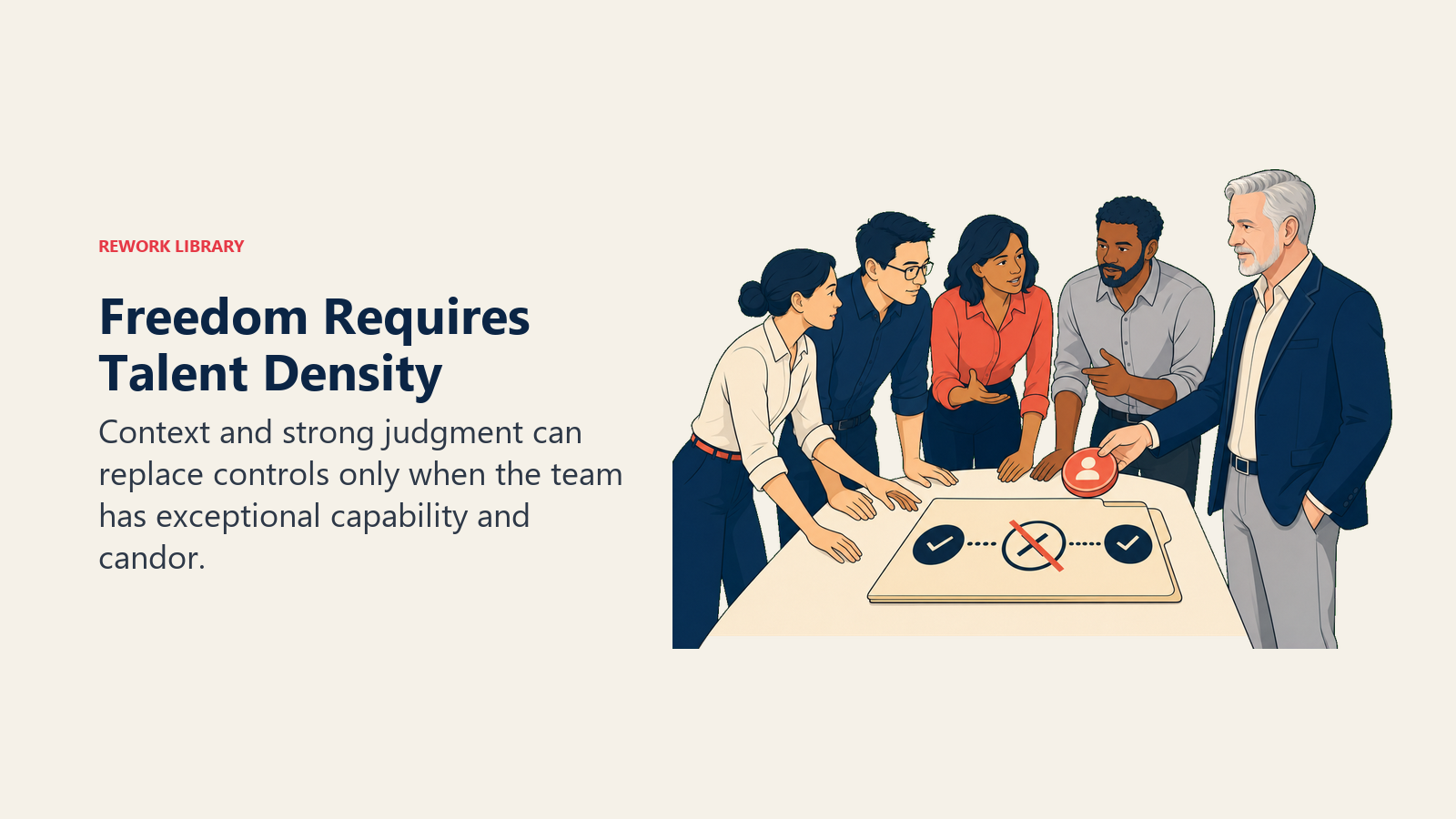
In 2009, Sheryl Sandberg called the Netflix Culture Deck "the most important document to come out of Silicon Valley." It's 125 slides. It's been viewed over 15 million times. And its central thesis is genuinely uncomfortable for most managers: adequate performance gets generous severance. Not a performance improvement plan. Not another quarter to turn it around. Severance.
Hastings published that document at a point when Netflix had about 11 million subscribers and was still primarily a DVD-by-mail company. Reed Hastings' career arc, from Pure Software to Netflix co-founder to executive chairman is well documented, but the culture document is where most operators find the practical leverage. What he understood, years before most CEOs did, was that the management model you build in the early years determines what kind of company you can become later. He wasn't writing a culture document for the company he had. He was writing it for the company he intended to build.
That forward-looking quality explains most of what Hastings did as CEO from 1998 to 2023. He pivoted the business three times, DVD mail to streaming, streaming to original content, and content to global scale, and he executed each of those pivots through an organization built on high talent density, extreme transparency, and the willingness to cannibalize what was working before someone else did. The subscriber count at his exit was over 220 million. That doesn't happen by accident. The willingness to cannibalize a healthy business before someone else does is a trait he shares with Jeff Bezos, who built AWS while retail was still growing, both leaders moved before the pressure arrived.
Leadership Style Breakdown
| Style | Weight | How it showed up |
|---|---|---|
| Culture Architect | 55% | Built the talent density model, no vacation policy, no expense policy, and radical candor norms before they became popular management concepts. Published the Culture Deck publicly, an unusual move that forced internal consistency. Designed the organization to run on judgment rather than rules, which required extraordinary hiring precision. |
| Visionary | 45% | Called the streaming transition years before broadband made it technically viable for most households. Committed $100M to original content when Netflix was still primarily a licensing business. Set up a global content operation that produced local-language originals in markets Netflix had entered only recently. |
The 55/45 split is more interesting than it looks. Most visionary CEOs treat culture as a downstream consequence of strategy. Hastings treated it as the primary input. He believed that if you got the people and the norms right, the strategy would be executable. That's a specific philosophical bet, and it produced a specific organizational type: one that could move fast, absorb failure, and pivot without losing institutional coherence.
Key Leadership Traits
| Trait | Rating | What it means in practice |
|---|---|---|
| Radical candor | Exceptional | Netflix's feedback norms weren't a management training initiative. They were structurally enforced by the keeper test: managers were expected to fight to keep every person on their team, and if they wouldn't, the person was let go. That accountability for candor went both ways, Hastings was famously direct about his own mistakes, including publicly acknowledging the Qwikster fiasco as a failure of his own judgment. |
| Strategic foresight | Very High | The DVD-to-streaming transition began internally in 2007, when Netflix's DVD business was still growing 25%+ annually. Hastings invested in a business that was cannibalizing a healthy one because he believed the alternative was worse. That's a specific kind of foresight: not just seeing where the market is going, but being willing to act on it before financial pressure forces you to. |
| Talent density focus | Very High | The "keeper test" was the mechanism. But the philosophy behind it was that a team of 50 exceptional people outperforms a team of 100 average people, and that the cost of carrying average performers goes beyond salary, it sets a standard that exceptional people don't want to work at. Netflix's compensation was at the top of the market for every role. The bar for staying was equally high. |
| Willingness to cannibalize own business | High | Netflix launched streaming at $7.99 per month while still running a DVD business that charged more per customer and had better margins. The streaming product was worse in the short term, fewer titles, lower quality than DVD, and Hastings launched it anyway because he knew where the business was going. Then he did it again with originals, building a production studio inside a company that had no production culture. |
The 3 Decisions That Defined Reed Hastings as a Leader
1. Publishing the Netflix Culture Deck Publicly (2009)
Most companies treat their internal management frameworks as proprietary. Hastings posted Netflix's culture document on SlideShare and let anyone read it. The slide deck covered Netflix's approach to values, performance, freedom, responsibility, and what adequate performance actually meant inside the company.
The act of publishing it was itself a leadership decision worth analyzing. By making it public, Hastings created an accountability mechanism that was more durable than any internal policy. Every Netflix employee, manager, and recruiter knew that the norms described in that document were the real ones, not a softened version for external consumption. If a manager at Netflix treated someone the way a typical Silicon Valley company would treat them during a layoff (PIP, documentation, six months of managed underperformance), it would be visible as a violation of publicly stated principles.
It also changed recruiting. Candidates who joined Netflix after reading the deck knew what they were signing up for. The self-selection mechanism meant the people who took the job valued autonomy, could handle direct feedback, and didn't need structure to stay productive. That's not the right hire for every company, but for Netflix's specific operating model, it was exactly right.
The Culture Deck also functions as a hiring filter at scale. Netflix can't individually assess every candidate's values alignment before an offer. But candidates who've read the deck and accepted the job have already opted into the model. The self-selection that happens before onboarding reduces the culture tax that most companies pay during the first 6 months of every new hire's tenure.
One nuance worth understanding: Hastings updated the Culture Deck multiple times over the years. It wasn't a static document. As Netflix grew from 2,000 employees to 12,000, specific norms got refined. The principle of "freedom and responsibility" stayed constant. The mechanics of how it operated at different scales changed. That willingness to iterate on the document itself modeled the kind of intellectual honesty he expected from the organization.
For you: publishing your operating principles publicly is a forcing function that most leaders avoid because it removes wiggle room. That's also why it works. If your stated values and your actual behavior can diverge privately, they will. Hastings removed that escape hatch, and then he kept the document current enough that it remained honest rather than aspirational.
2. The Qwikster Disaster and Backtrack (2011)
In July 2011, Netflix raised its prices by 60%, splitting the DVD and streaming plans that had previously been bundled. The company lost 800,000 subscribers in a single quarter and its stock dropped more than 70% over the following months. Hastings sent an apologetic email to customers that was widely mocked for its tone. Then, in September 2011, he announced that Netflix would spin its DVD business into a separate company called Qwikster, a decision he reversed within three weeks.
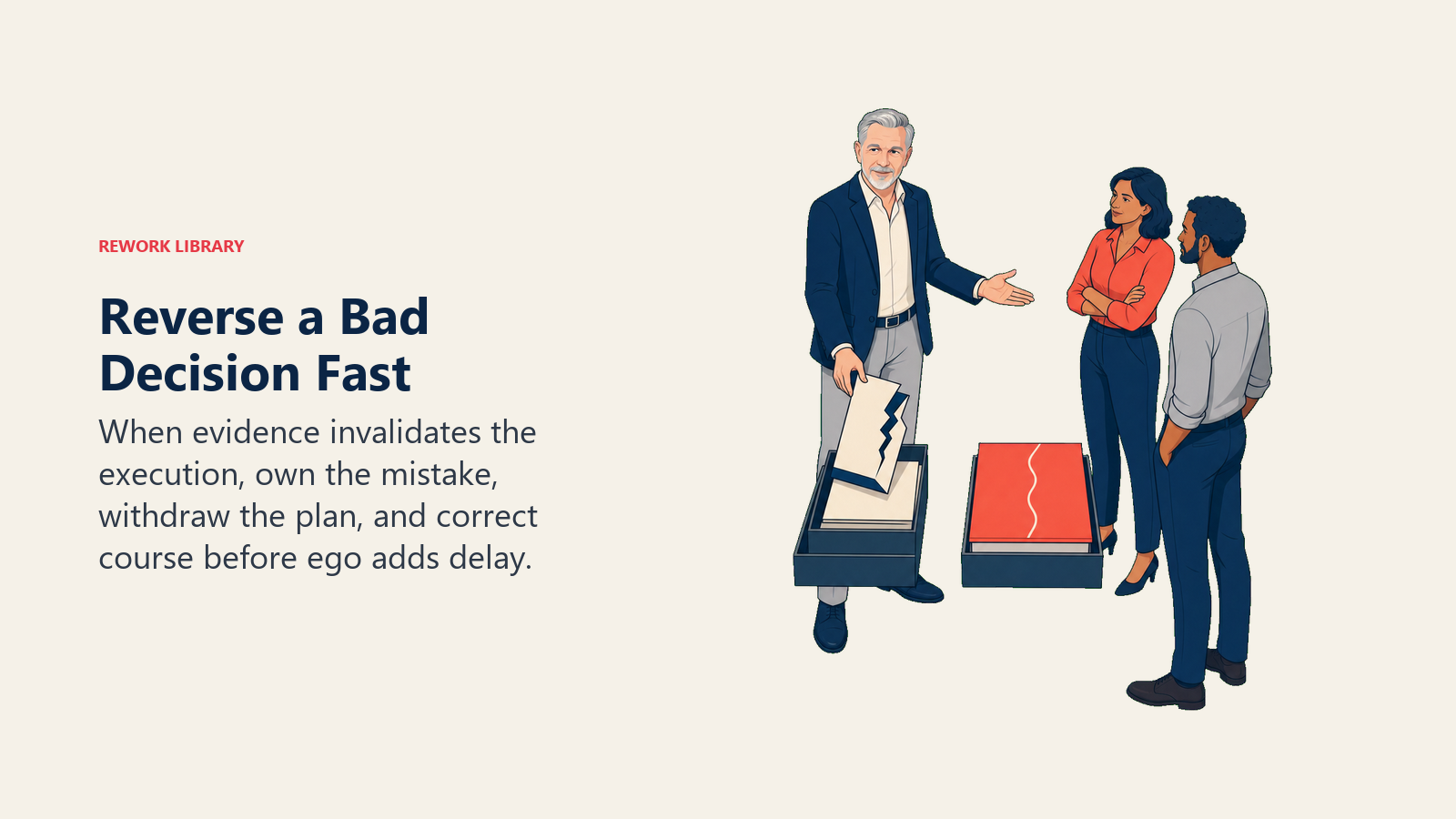
The Qwikster announcement made the price increase feel like a prelude to abandoning DVD customers entirely. The backlash was immediate and severe. Within three weeks, Hastings reversed the decision and announced Netflix would keep both businesses under one brand.
That three-week reversal is often cited as a failure. It's more useful to read it as a decision-making case study. Hastings made a strategic bet (separating the businesses) that was probably correct in its long-term direction but wrong in its execution and timing. When the evidence came back clearly, he reversed. Fast. He didn't defend the decision for another two quarters to save face. He acknowledged the mistake publicly and moved on.
There's also a second lesson embedded in what Hastings didn't do during the Qwikster reversal. He didn't fire anyone. He didn't blame the team that built the plan. He didn't commission a review to find the responsible party. He owned it personally and moved. That's significant because the decision to spin out DVD and streaming into separate companies was a real strategic idea, not an operational blunder. The failure was in the execution sequence and the customer communication, and those were things Hastings controlled. He treated it as his failure to fix, not someone else's failure to explain.
The leadership lesson isn't that you shouldn't make bold moves that upset customers. It's that when you're wrong, the speed of your reversal matters more than the dignity of your reversal. Hastings burned some credibility in 2011. He recovered it by being right about streaming for the next decade. Most leaders sacrifice future credibility to protect short-term reputation. He did the opposite, and his track record earned back the trust the reversal cost.
3. The $100M Bet on House of Cards (2013)
When Netflix committed $100 million to two seasons of House of Cards before seeing any episode, Netflix was spending about $300 million total on licensed content in a year. The decision to commit that kind of capital to original production, without a pilot, was unusual by any measure.
The strategic logic was specific. Hastings and content chief Ted Sarandos believed that licensing existing content from studios was a structural vulnerability. Studios could pull their content at any point, raise prices, or sell exclusive rights to a competing platform. Original content couldn't be pulled. It also created intellectual property that belonged to Netflix permanently.
House of Cards premiered in February 2013 with all 13 episodes available simultaneously. That release model, releasing an entire season at once rather than weekly episodes, was itself a statement. Netflix was designing for binge-watching before the word was commonly used. The model proved correct. The show won three Emmy Awards and drove a measurable subscriber spike.
But the deeper significance wasn't House of Cards. It was what it signaled about where Netflix's competitive moat would come from. By 2020, Netflix was spending $17 billion annually on content. The original content bet, made when Netflix had about 25 million subscribers, built the product differentiation that made Netflix defensible against Disney+, HBO Max, and Amazon Prime when they launched at scale.
The House of Cards bet also validated the data approach Netflix had been building since its DVD recommendation era. Netflix didn't greenlight House of Cards purely on instinct. It had subscriber viewing data, browsing patterns, and completion rates that told it something specific: subscribers who watched political dramas also tended to watch David Fincher films and content with Kevin Spacey. The network of those overlapping audiences was large enough to justify the investment. Hastings combined that data confidence with the creative boldness to commit without a pilot.
For you: the lesson is about recognizing which investment in your business builds a defensible asset versus which investment rents one. Licensing someone else's content is renting. Building original IP is owning. In your business, ask what you're paying for that you could own, and whether the ownership cost would be worth the defensibility it creates. And if you have usage data about what your customers actually do inside your product, you're already sitting on the inputs for that decision.
What Reed Hastings Would Do in Your Role
If you're a CEO running a 50-500 person company, the most Hastings-like move you can make is implementing the keeper test as an honest management tool rather than a performance management ritual. Before your next 1:1 cycle, ask yourself for each direct report: if this person came to me and said they're leaving, how hard would I fight to keep them? If the answer is "not very," that's information you need to act on, not in your next performance review cycle, but now. Hastings would say the cost of carrying someone you wouldn't fight to keep is higher than the cost of the transition.
If you're a COO or operations leader, the "no rules, rules" philosophy has a specific operational translation. Netflix didn't abolish policies because it didn't care about outcomes. It abolished policies because it found that good judgment, well-hired, produced better outcomes than rules-following did. The question for you is whether your current policy stack is compensating for judgment gaps in your team or preventing judgment your team actually has. Most operations teams over-index on process. Hastings would audit every policy and ask: what behavior is this preventing, and can I hire to prevent that behavior instead?
If you're a product leader, the simultaneous season release model is worth thinking about in your context. Hastings released all of House of Cards at once because he was designing for the customer's consumption pattern, not the distribution model that TV had inherited from broadcasting constraints. In your product, which feature sequencing or release cadence decisions are you making based on how the industry does it versus how your users actually want to use it? That gap is where the next differentiation usually lives.
If you're a sales or marketing leader, the Culture Deck publishing decision is directly applicable. The companies that are genuinely transparent about how they operate attract customers and candidates who value transparency, and repel the ones who don't, which saves you recruiting and sales cycles. The move Hastings made isn't available to most leaders because most leaders don't actually want that accountability. If you do, making your operating principles public is one of the highest-leverage moves you can make on both the talent and customer acquisition fronts.
The Rework Angle: Running Freedom + Responsibility Without Losing Visibility
Hastings' model requires two things most operators underestimate: talent density you can verify and context-not-control management that still produces an accurate picture of what's happening. Autonomy without visibility becomes chaos; visibility without autonomy becomes micromanagement. Rework is built for the middle path. Shared pipelines, deal rooms, and cross-functional project views give leaders situational awareness without requiring status meetings, approval gates, or process layers that suffocate judgment. Managers see where work actually stands, which deals are progressing, which aren't, where context is missing, and use that signal to coach rather than control. For companies trying to import even a fraction of the Netflix model, the hardest unlock isn't abolishing policies. It's building the operating system that lets a high-trust team run without the old reporting overhead. Rework replaces the overhead, not the accountability.
Notable Quotes and Lessons Beyond the Boardroom
Hastings has been unusually candid about the Qwikster failure in public conversations: "I should have been quicker to realize that my view of what we were was different from what our customers wanted us to be." That candor about public missteps sets Hastings apart from most tech CEOs, though Mark Zuckerberg's radical transparency about Facebook's internal culture comes from a similar instinct to make values visible rather than managed. That admission, made years after the fact, is more useful than the original decision. He's modeling that recognizing your own reasoning failure is more valuable than protecting your reputation as someone who doesn't fail.
On talent, his most direct quote is from the Culture Deck itself: "We are a team, not a family. A sports team, not a recreational one." That distinction matters. Families don't cut members for underperformance. Teams do. If you've been running your company like a family, where loyalty to individuals overrides performance accountability, you're probably carrying people who are limiting the team around them.
Hastings has also been more candid than most CEOs about why the culture model requires specific pre-conditions to work. He's said in various contexts: "The percentage of people who do better with no process is probably 10 to 20 percent." That's a striking admission from someone who built a company on freedom and responsibility. What he means is that the model isn't for everyone, and building it requires both a high threshold for who you hire and an ongoing commitment to honest feedback. Without both, you don't get creative freedom. You get chaos with a culture deck on top of it.
The less-quoted lesson from Hastings' tenure: he co-wrote a book ("No Rules Rules," 2020) with INSEAD professor Erin Meyer that explains the Netflix culture model in more detail than any case study can. Erin Meyer's research on cross-cultural feedback and the conditions under which radical candor works, published in Harvard Business Review, is a useful companion read for leaders considering whether this model fits their team composition. Peter Drucker's work on knowledge workers is the intellectual ancestor of Hastings' talent density model, both argued that managing professionals requires autonomy and clear results, not rules and supervision. If you're going to adopt any part of his approach, read the book first. The elements that look simple from outside are harder to implement than they appear, and the sequencing matters significantly.
Where This Style Breaks
The keeper test and talent density model work when you have the recruitment infrastructure to backfill positions quickly and the compensation budget to hire at the top of the market. At Netflix, both were true. At a 50-person company that can't pay top-of-market for every role and takes three months to hire a senior engineer, applying Netflix's approach directly produces high turnover without the replacement mechanism that makes the model work.
The "culture of fear" pieces from former Netflix employees are worth taking seriously. Multiple senior employees have described an environment where the threat of the keeper test created anxiety that impaired collaboration. When everyone knows they can be let go cleanly at any point, some people respond with exceptional performance. Others respond by protecting themselves politically. The model assumes the exceptional performers dominate. When they don't, you get a low-trust organization that looks like meritocracy from outside and feels like instability from inside.
The 2022 subscriber loss and stock decline of about 70% revealed a limit of the model: when the external environment shifts sharply, even well-run talent-dense organizations need time to adjust. Hastings had built Netflix for growth. When growth reversed, the organization had to relearn cost discipline quickly. That's not a failure of the culture model. But it's worth noting that optimizing for one phase of a company's life can create real gaps for the next phase.
Learn More
If this profile reshaped how you're thinking about culture and talent, these articles go deeper:

On this page
- The No Rules Rules Doctrine
- Leadership Style Breakdown
- Key Leadership Traits
- The 3 Decisions That Defined Reed Hastings as a Leader
- 1. Publishing the Netflix Culture Deck Publicly (2009)
- 2. The Qwikster Disaster and Backtrack (2011)
- 3. The $100M Bet on House of Cards (2013)
- What Reed Hastings Would Do in Your Role
- The Rework Angle: Running Freedom + Responsibility Without Losing Visibility
- Notable Quotes and Lessons Beyond the Boardroom
- Where This Style Breaks
- Learn More