Seth Godin Leadership Style: Tribes, Permission, and the Art of Being Remarkable
Turn this article into takeaways for your work.


Each assistant summarizes the article only for you and suggests best practices for your work.
Seth Godin has published a blog post every single day since January 2002. That's over 8,000 consecutive posts. No comments section. No ads. No algorithm optimization. No sponsored content. No exceptions.
Most companies can't sustain a consistent content program for six weeks.
That discipline is either performance art or the most consistent demonstration of a marketing thesis in business history. In Godin's case, it's the thesis. His argument, that building a permission asset with people who actually want to hear from you outperforms interrupting strangers at scale, is what his entire career has been built to prove.
Key Facts: Seth Godin (born 1960) is the author of 20+ bestsellers including "Permission Marketing" (1999), "Purple Cow" (2003), "The Dip" (2007), "Tribes" (2008), and "Linchpin" (2010). He founded Yoyodyne, an early email marketing company sold to Yahoo in 1998 for $30 million, and later founded Akimbo workshops and the altMBA online school. His daily blog has published without interruption for 20+ years running, making it one of the longest-standing content programs in business.
The Godin Purple Cow Principle
In a crowded market where "good" is invisible, the only durable marketing strategy is to build a product remarkable enough that customers talk about it unprompted. Remarkability is not aesthetic polish, it is the structural property of being worth remarking on. Permission-based communication with a small, specific audience who cares deeply beats mass interruption marketing at every meaningful economic measure.
He wrote "Permission Marketing" in 1999 and coined the term. He wrote "Purple Cow" in 2003 and popularized the idea that safe is the riskiest strategy. He wrote "Tribes" in 2008 and argued that leadership is about connecting people around a shared idea. In 21 bestselling books and 8,000-plus blog posts, he's been saying the same thing in different ways: the old interruption model of marketing is dying, and the only durable path is to earn attention from people who choose to pay it.
What makes Godin worth studying now, when there are ten thousand marketing voices online, is that he was right before the platforms made being right expensive. And he's still applying the same principles, in public, every day.
Leadership Style Breakdown
| Style | Weight | How it showed up |
|---|---|---|
| Contrarian Publisher | 55% | Godin's primary mode is publishing ideas that contradict conventional wisdom about marketing, business, and work, and doing it at a volume and consistency that most publishers can't match. He founded Yoyodyne in 1995 as an early email marketing company, sold it to Yahoo for $30 million in 1998, and then spent the next two decades writing about why the marketing models that most companies were scaling, interruption, mass media, paid acquisition, were wrong. His thesis was contrarian before it was consensus. His daily blog is the long-form proof: he's been testing ideas in public, at no charge, with no paywall, since 2002. That practice is more than consistency. It's a deliberate operating philosophy about how trust is built. |
| Tribe Organizer | 45% | Godin's "Tribes" thesis is that the most important leadership act is connecting people around a shared idea, not managing them from the top. He applied this to his own audience: he's built one of the most engaged non-media, non-celebrity audiences in business by consistently publishing ideas that a specific type of person, curious, contrarian, interested in why things work, actually wanted to receive. His 2009 TED talk, "The Tribes We Lead," compressed the core thesis into 17 minutes and introduced the framework to a much wider audience. He didn't build that audience through scale. He built it through specificity and duration. His Akimbo workshops and the altMBA program extend that model into structured learning: cohort-based, peer-driven, no lectures. The format reflects the tribal organizing principle, leadership through connection rather than instruction. |
The 55/45 split reflects the tension in Godin's career between the publisher who challenges conventional wisdom and the organizer who builds communities around shared ideas. At his best, he does both simultaneously: a blog post that challenges a marketing assumption also connects the people who agree with it. The daily blog is both content and community, which is why it's lasted 23 years.
Key Leadership Traits
| Trait | Rating | What it means in practice |
|---|---|---|
| Consistency as a competitive moat | Exceptional | Godin's single most imitable competitive advantage is consistency. Not quality alone, there are writers who publish more polished individual pieces. Not volume alone, there are publishers who produce more content. It's consistency at quality, over duration, without exception. Nobody has missed a day in 23 years. That's a moat because the majority of competitors give up. A company that commits to publishing three genuinely useful pieces of content per week for five years will outlast almost every competitor that doesn't, not because the content is better but because duration compounds. Godin's career proves it. |
| Smallest-viable-audience thinking | Very High | Godin's argument in "This Is Marketing" (2018) is that "the smallest viable audience" beats mass targeting as a marketing strategy. Find the specific people who would miss you if you stopped. Build something for them. Solve their specific problem. The instinct in most marketing organizations is to reach more people, more impressions, bigger list, wider funnel. Godin's counter is that trying to reach everyone is how you become forgettable to everyone. The smallest viable audience thinking is the opposite of reach optimization. It's about depth with a specific group who actually care, which builds the trust that eventually creates word of mouth. |
| Discomfort with interruption marketing | High | Godin's critique of interruption marketing isn't aesthetic. It's economic. Interrupting strangers is getting more expensive as attention fragments across more channels. The performance of cold outreach, display advertising, and paid acquisition has declined steadily as those channels saturate. Permission marketing, building a list of people who've chosen to receive your communication, gets more valuable as interruption gets less effective. Godin identified this dynamic in 1999 when most marketers were scaling interruption. His discomfort with the model was a bet about where economics were heading. He was right. |
| Belief that generosity compounds | High | Godin gives away more value than he charges for. His blog has always been free. His books are sold, but the frameworks inside them are repeated publicly and shared constantly. The altMBA and Akimbo workshops charge, but they're structured on peer learning rather than access to Godin's lectures. His operating hypothesis is that generosity builds trust, trust builds audience, and audience builds leverage. Most companies model this backwards: they protect their best thinking behind paywalls and give away the lowest-quality content for free. Godin's model suggests that giving away your best thinking is the marketing strategy, not a cost of the marketing strategy. |
The 3 Frameworks That Defined Seth Godin
1. Permission Marketing, Earning Attention vs. Buying It
Godin published "Permission Marketing" in 1999, when email was 5 years old as a commercial medium and most marketers were treating it like a new direct mail channel. David Ogilvy had defined the classical version of that interruption model, the carefully crafted ad placed in front of the right demographic at the right moment. Godin's framework is the structural critique of everything Ogilvy built, updated for a world where audience attention is opt-in. His thesis was structural: marketing that interrupts people without their consent is inherently less effective than marketing that reaches people who've chosen to receive it.
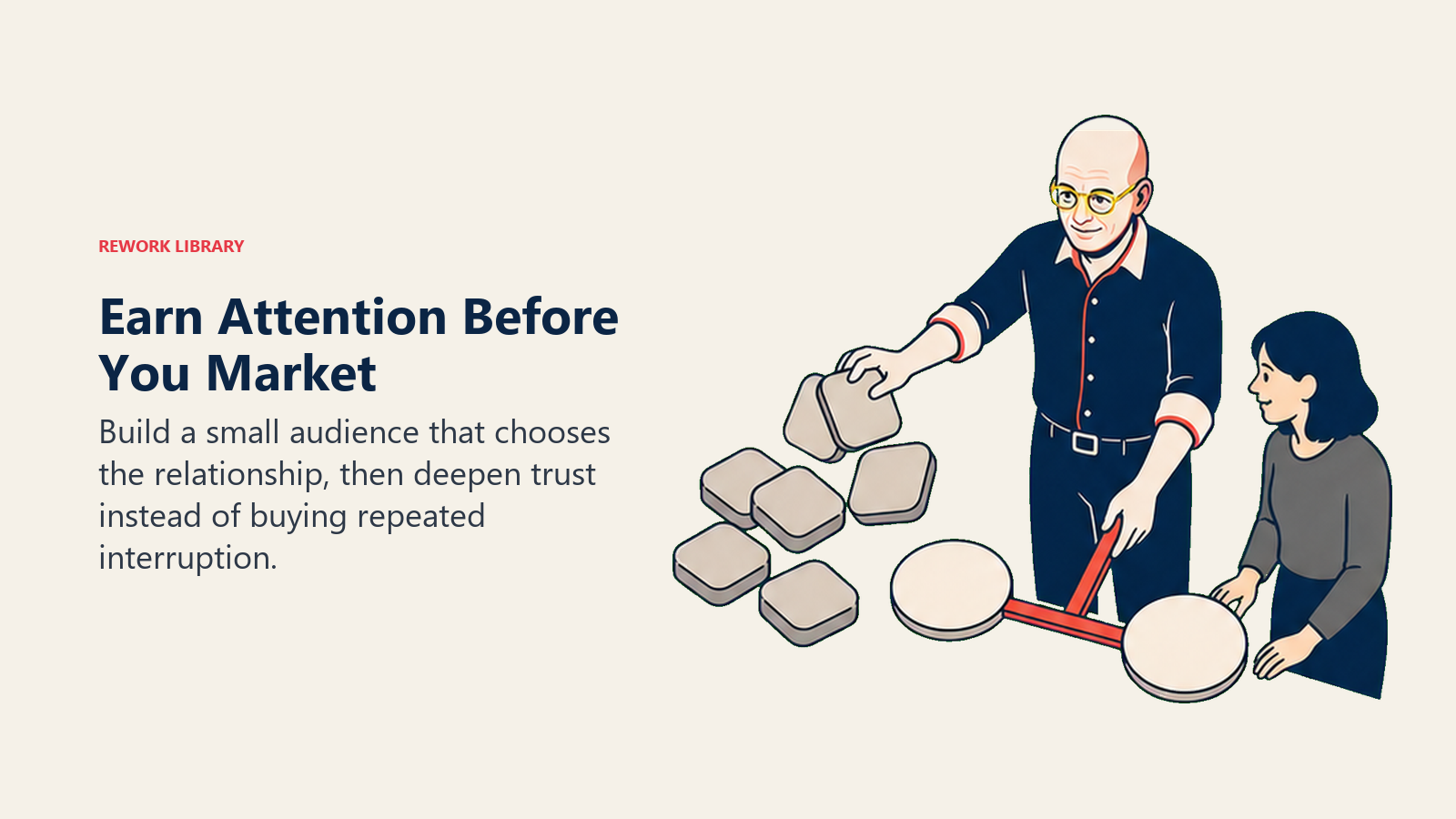
He defined permission marketing by three criteria. It's anticipated, people expect to hear from you. It's personal, the message is relevant to the person receiving it. It's relevant, it has something to do with what they actually care about. Most advertising and cold outreach fails all three criteria by design: it's unexpected, generic, and often irrelevant.
Godin founded Yoyodyne in 1995 to test this thesis operationally. Yoyodyne ran promotion marketing programs (early sweepstakes and engagement campaigns) designed to get customers to opt in to brand communication rather than receiving unsolicited messages. It was a clunky early implementation of the permission principle, the technology of 1995 limited what was possible, but the underlying logic was correct.
When Yahoo bought Yoyodyne for $30 million in 1998 and made Godin VP of Direct Marketing, it gave him a platform to apply the framework at scale. His time at Yahoo reinforced his view that the platform's asset was its permission base, people who'd signed up for email and search, and that the risk was treating that permission as an interruption opportunity.
The permission marketing framework is more actionable today than it was in 1999 because the infrastructure for building permission assets is now universal: email lists, podcast subscribers, social followers who've explicitly opted in. The problem is that most companies still evaluate their marketing by reach rather than permission quality. They count list size rather than open rate. They optimize for impressions rather than engagement. Godin's framework says that's the wrong measurement, and the data on email marketing, where companies with smaller but more engaged lists consistently outperform larger but colder ones, supports him.
2. Purple Cow, Being Remarkable Is the Only Marketing That Survives
Godin published "Purple Cow" in 2003 with a deliberate provocation: the most effective marketing strategy is to build something worth talking about, because everything else is getting more expensive and less effective.
The purple cow metaphor is simple. If you drive through a field of brown cows, you stop noticing them quickly. But a purple cow, one that's actually remarkable, you notice immediately and you tell people about it. Remarkable isn't about aesthetics. It's about being worth remarking on. Worth talking about. Worth passing along.
The business implication is that being "good" or "solid" or "reliable" is insufficient. In a market with hundreds of options, good is invisible. You're either remarkable or you're commodity. And the path to remarkable isn't through marketing, it's through the product itself. The best marketing is a product people can't stop talking about because it does something nobody else does for a specific group of people who care deeply.
Godin wrote "Purple Cow" when the consumer internet was mature enough to show that incumbents who didn't take the thesis seriously were getting disrupted by products that were. The book predicted the Netflix/Blockbuster dynamic (remarkable delivery of an existing product), the Zappos story (remarkable customer service as a marketing strategy), and the entire direct-to-consumer brand wave of the 2010s.
The thesis has weakened in one specific way: content saturation. In 2003, a remarkable product had more runway to spread through word of mouth before the category got crowded. Today, every product category has three remarkable competitors within 18 months. The "be remarkable" advice is still correct, but the duration of advantage it produces is shorter. Godin acknowledges this in later writing without fully resolving the tension.
3. Tribes, 1,000 True Fans Before Mass Reach
"Tribes" (2008) is Godin's most directly applicable leadership framework and the one that translated most cleanly from marketing into organizational thinking.
The thesis: a tribe is a group of people connected to each other, connected to a leader, and connected to an idea. Leadership is the act of enabling that connection, finding people who share a concern, giving them language to articulate it, and creating the conditions for them to connect with each other.
Godin's argument was that the internet had made tribal organizing cheap and fast in ways that made the mass-marketing model obsolete. You didn't need a broadcast network to reach a million people anymore. You needed to find the 1,000 people who cared most about what you were doing and give them something worth connecting around.
That's the precursor to Kevin Kelly's "1,000 True Fans" concept, and it predicts the creator economy dynamic that emerged a decade later. Gary Vaynerchuk is the most visible heir to this thesis in the social media era, but where Godin built a slow-compounding permission asset through books and daily blogging, Vaynerchuk operationalized tribal attention through volume and platform-native content at a speed Godin's model never anticipated. And Neil Patel scaled the same permission-through-content principle into a data-driven SEO machine, proving that the underlying logic survives translation to algorithmic distribution. The most successful independent creators, niche media companies, and B2B content programs are the ones that found a specific tribe, went deep rather than wide, and built trust over years before asking for money.
For operators, the tribal framing translates to product communities, customer success, and brand. The companies with the best retention aren't the ones with the stickiest product features. They're the ones where customers feel like they're part of something, a community, a movement, a shared way of doing the work. That's a tribal asset, and it's built through consistent communication, genuine values, and leadership that shows up, not through loyalty programs.
Godin built the Akimbo workshops and the altMBA on the tribal model: cohort-based, peer-learning, no celebrity lectures. The learning happens through the connections between participants, not through transmission from the teacher. That structure limits scale but maximizes trust and depth, exactly what the tribal organizing principle predicts.
What Seth Godin Would Do in Your Role
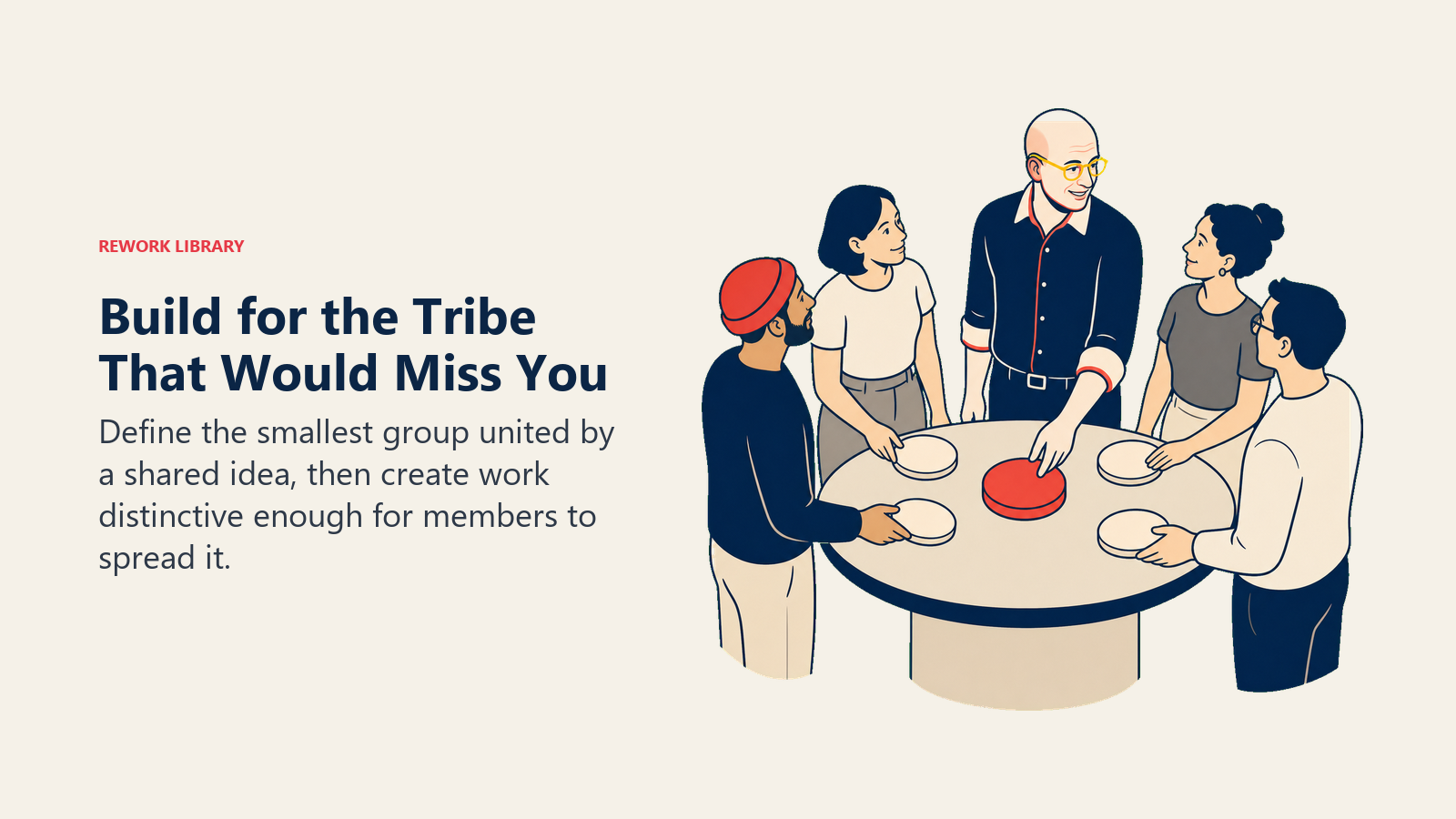
If you're a CEO, Godin's question for you is about who your tribe is. Not your total addressable market. Not your customer segments. Your tribe: the specific group of people who would genuinely miss you if you stopped, who share values that your company embodies, who tell other people about you without being asked. If you can't describe that group specifically, you don't have a tribe yet. You have customers. Tribes require a shared idea, a position on how work should be done, what matters, what's worth paying attention to, and most companies don't have one because having a position means excluding people who disagree with it.
If you're a COO, the most applicable Godin principle is the permission asset question. What communication does your company have with customers who've explicitly chosen to hear from you? That list, email subscribers, podcast listeners, community members, notification opt-ins, is your most durable marketing asset. It doesn't depend on algorithm changes. It doesn't get more expensive when ad prices rise. And it compounds over time rather than depleting. Most operations leaders undervalue this asset because it's not on the balance sheet and its ROI is hard to attribute to a single quarter. But it's the one marketing asset that compounds instead of depreciates.
If you're a product leader, Godin's "smallest viable audience" principle gives you a useful lens for product positioning. Before asking how many people could use this feature, ask who would be devastated if it didn't exist. That's the smallest viable audience for the feature. Building for that group, really solving their specific problem at depth, produces a better product than optimizing for the broadest possible use case. Most product features fail not because they're poorly executed but because they were designed for too broad an audience to be useful to anyone specific.
If you're in sales or marketing, the Purple Cow thesis asks a direct question about your product: is it remarkable? Not by your standards. By the standards of the customer who would tell a colleague about it unsolicited. If your best marketing is still outbound cold outreach, that's a signal that the product hasn't yet earned word-of-mouth. Godin's argument isn't that outbound doesn't work, it's that products that generate organic word-of-mouth have a fundamental cost advantage over products that don't, and that the way to get to word-of-mouth is through the product, not through the marketing. The marketing team can't fix a product that isn't remarkable. But they get blamed for the results anyway.
How Rework Operationalizes Godin's Permission + Remarkability Doctrine
Godin's framework fails most marketing teams not because the principles are wrong but because the tooling rewards interruption. Reach dashboards count impressions. Campaign platforms optimize for lists, not permission quality. Rework inverts that. The CRM treats every subscriber, trial user, and customer as a permission asset, tracking engagement depth and opt-in strength, not just list size. Marketing workflows are structured around the smallest-viable-audience question: who would genuinely miss this if we stopped sending it? Content ops in Rework lets teams ship consistently, a daily cadence, weekly newsletter, or segment-specific drip, without the coordination overhead that breaks most publishing programs by week six. And because marketing, sales, and success share the same permission graph, remarkable work gets amplified by the people closest to customers rather than trapped inside a campaign tool. Godin's advice is structurally compatible with how Rework is built: permission compounds, remarkability spreads, and the system makes that default.
Notable Quotes and Lessons Beyond the Boardroom
"Marketing is no longer about the stuff that you make, but about the stories you tell." Godin wrote this in "All Marketers Are Liars" (later retitled "All Marketers Tell Stories"), and it's more precise than it sounds. He's not saying marketing is fiction. He's saying customers buy meaning, not product specifications. The story you tell about your product, who it's for, what it represents, what using it says about you, is inseparable from the product itself. Companies that think they make products and marketing is separate are leaving the story to chance.
His observation from "Purple Cow" is still the right challenge for any product team: "In a crowded marketplace, fitting in is a failure. In a busy marketplace, not standing out is the same as being invisible." That's not a creative brief. It's an economic argument. Standing out requires making choices that make you wrong for some customers in order to be right for others. The temptation to optimize for everybody is exactly what produces average products that nobody talks about.
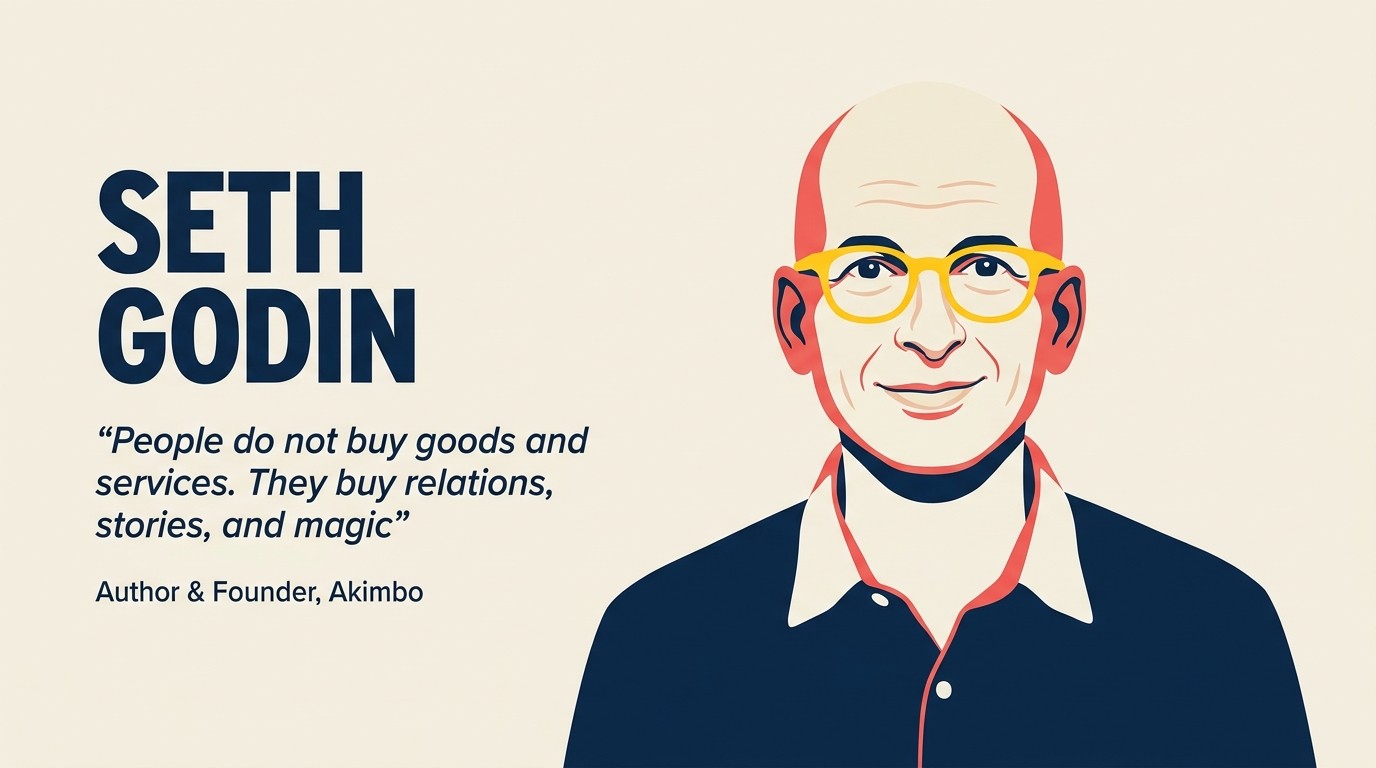
"People do not buy goods and services. They buy relations, stories, and magic." That's from "All Marketers Tell Stories," and it's the framing that connects "Purple Cow" to "Tribes" to "Permission Marketing." The permission asset you build, the tribe you organize, the remarkableness you create, they're all in service of that underlying insight. People aren't looking for the best product. They're looking for the product that feels like it was made for them, by people who understand them.
Where This Style Breaks
Godin's model requires a long permission-building runway. Most B2B companies need pipeline now, not in three years. His aversion to paid acquisition leaves money on the table in markets where distribution is winner-take-most and the company with the largest sales org wins. Being remarkable is the right long-term strategy; it's often insufficient as a near-term survival strategy.
"Be remarkable" is also advice that sounds clear but is nearly impossible to operationalize inside a 500-person organization. Remarkableness requires making choices that exclude people, which creates internal resistance from every team trying to maximize their addressable market. And Godin's blogging-and-book model doesn't translate to most products, which require different distribution mechanics than ideas.
Squidoo, his user-generated content platform founded in 2005, tested these principles at product scale and was eventually sold to HubPages in 2014. The product had genuine elements of the tribal model but couldn't compete with the scale of Wikipedia and the SEO dominance of larger platforms. Being remarkable isn't sufficient when the competitive dynamics reward scale over depth.
Frequently Asked Questions about Seth Godin's Marketing Philosophy
Who is Seth Godin?
Seth Godin (born 1960) is an American author, entrepreneur, and marketing thinker who has published 20+ bestselling books including "Permission Marketing," "Purple Cow," and "Tribes." He founded Yoyodyne, sold it to Yahoo in 1998 for $30 million, and has written a daily blog post without interruption since January 2002. He also founded the altMBA online school and Akimbo workshops.
What is Permission Marketing?
Permission Marketing is Godin's 1999 framework arguing that marketing which reaches people who have explicitly opted in, anticipated, personal, and relevant, outperforms interruption-based advertising. Email subscribers, podcast listeners, and opted-in community members form a permission asset that compounds over time rather than depreciating like paid reach.
What is the Purple Cow concept?
The Purple Cow, from Godin's 2003 book of the same name, argues that in a saturated market "being good" is invisible. The only marketing that survives is being remarkable, literally worth remarking on. The purple cow stands out in a field of brown cows, and the metaphor pushes companies to build products so distinctive that customers spread them through word of mouth.
What does Godin mean by 'tribes'?
In "Tribes" (2008), Godin defines a tribe as a group of people connected to each other, connected to a leader, and connected to an idea. Leadership is the act of organizing that connection, finding people who share a concern, giving them language, and creating the conditions for them to connect. It predates and predicts the creator economy and community-led growth models.
What is 'The Dip' about?
"The Dip" (2007) is Godin's short book arguing that most meaningful pursuits involve a difficult middle stretch, "the dip", where progress feels impossible and most people quit. His thesis is that winners quit strategically (when they're in a dead-end, not a dip) and push through the dip when the market rewards being best in the world at a narrow thing. Knowing which is which is the skill.
What can modern marketers learn from Seth Godin?
Three durable lessons: build a permission asset (email list, subscriber base) rather than renting reach from ad platforms; design for the smallest viable audience who would genuinely miss you rather than the broadest possible market; and invest in product remarkability as the marketing strategy, because advertising can't rescue a forgettable product. Consistency of output over years compounds faster than any growth hack.
For related reading on marketing strategy and brand building, see Peter Drucker Leadership Style, Sam Altman Leadership Style, and Content Marketing Strategy for B2B.

On this page
- The Godin Purple Cow Principle
- Leadership Style Breakdown
- Key Leadership Traits
- The 3 Frameworks That Defined Seth Godin
- 1. Permission Marketing, Earning Attention vs. Buying It
- 2. Purple Cow, Being Remarkable Is the Only Marketing That Survives
- 3. Tribes, 1,000 True Fans Before Mass Reach
- What Seth Godin Would Do in Your Role
- How Rework Operationalizes Godin's Permission + Remarkability Doctrine
- Notable Quotes and Lessons Beyond the Boardroom
- Where This Style Breaks