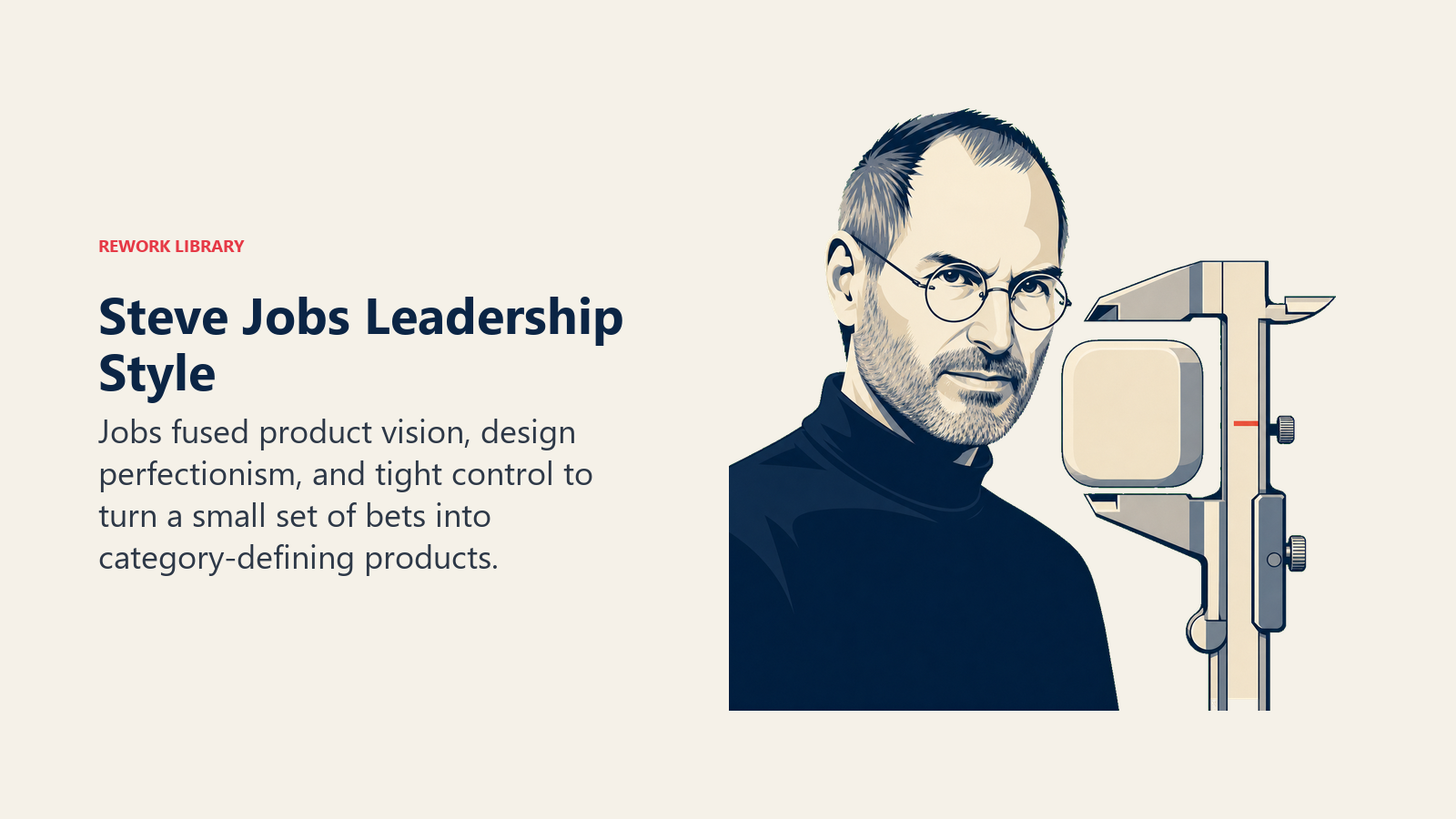
Steve Jobs Leadership Style: How Perfectionism and Vision Built the World's Most Valuable Company
Turn this article into takeaways for your work.


Each assistant summarizes the article only for you and suggests best practices for your work.
Most leadership profiles start with a biography. This one won't. You already know Jobs was adopted, dropped out of Reed College, co-founded Apple in a garage, got fired, came back, and transformed four industries before he died at 56. What matters more for you, right now, is what his leadership decisions tell you about building something that outlasts you.
Jobs is studied not because he was the nicest executive or the most consensus-driven CEO. He's studied because almost everything he touched at scale (Apple, Pixar, the iPod, the iPhone) worked. Understanding how he thought, what he optimized for, and where his style broke down gives you a map. Not one to copy blindly, but one to navigate by.
Leadership Style Breakdown
| Style | Weight | How it showed up |
|---|---|---|
| Visionary | 75% | Set product direction years ahead of market readiness. Killed entire product lines to focus on fewer, better things. Held the team to a future customers couldn't yet articulate. |
| Autocratic | 25% | Final say on design, copy, and product decisions. Bypassed committees. Expected disagreement to be won with quality work, not politics. |
The 75/25 split matters. Jobs wasn't primarily a control freak. He was primarily a person who saw where things were going before others did. The autocratic layer existed to protect the vision from compromise. That's different from autocracy as a default mode.
Key Leadership Traits
| Trait | Rating | What it means in practice |
|---|---|---|
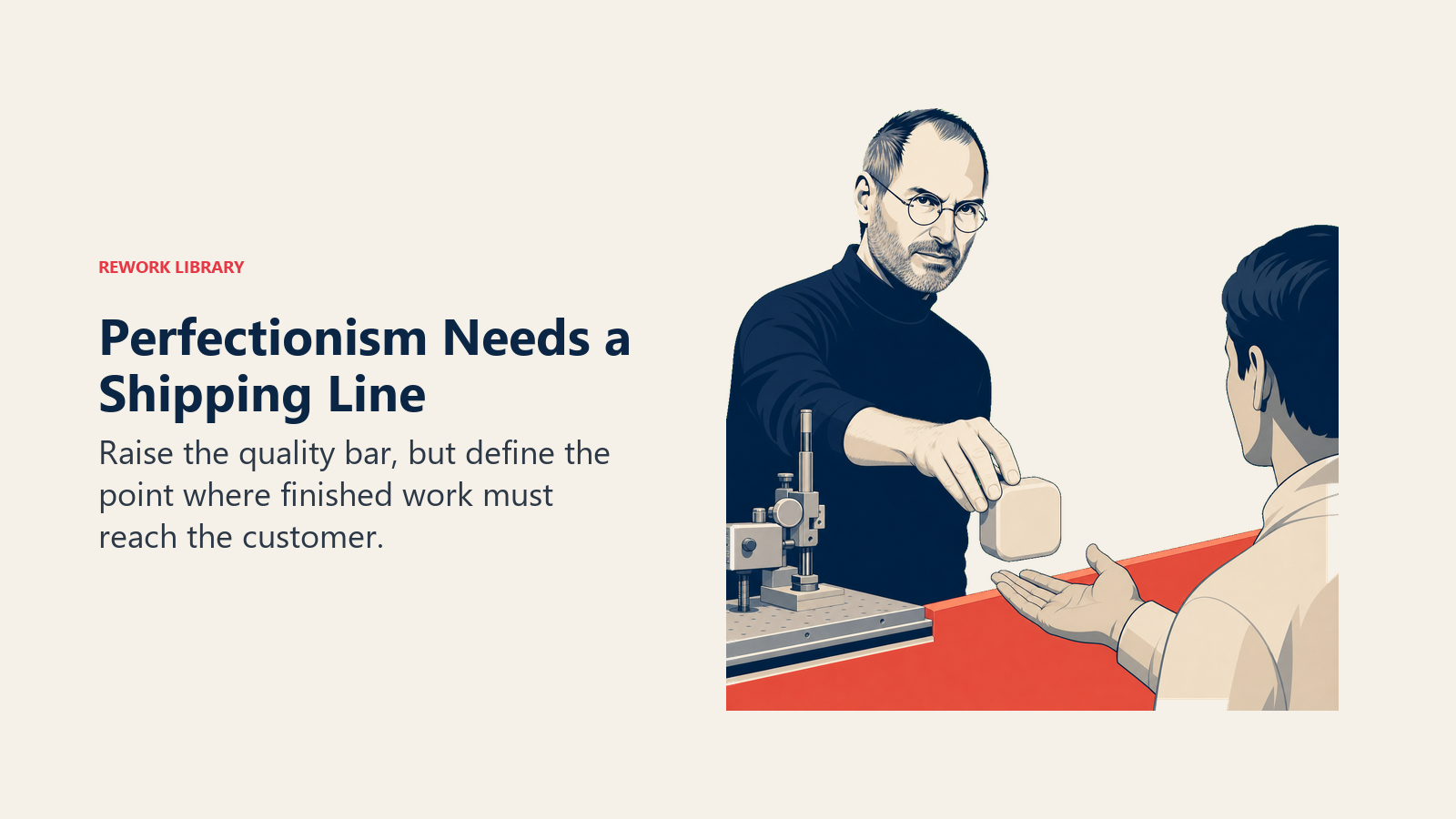
| Perfectionism | Exceptional | "Real artists ship", but ship right. Jobs delayed products when they weren't ready and once ordered the original Mac team to redo the circuit board layout because it "wasn't beautiful enough," even though customers would never see it. That standard propagated through teams. |
| Design Focus | Exceptional | Design wasn't a department. It was a decision-making lens. Jobs sat in on Jony Ive's design reviews personally. He believed the feel of a product in your hand communicated trust and quality before a single feature was used. |
| Innovation | Very High | Jobs defined innovation as "saying no to 1,000 things." Apple under his return eliminated 70% of its product lineup. Focus, not invention volume, was the innovation strategy. |
| Charisma | High | The "reality distortion field" wasn't manipulation, it was the ability to make people believe something difficult was achievable. Engineers routinely delivered what they told Jobs was impossible after he refused to accept their timelines. |
The Jobs Perfectionism Doctrine
The Jobs Perfectionism Doctrine is the operating principle that taste and obsessive attention to unseen details are non-negotiable inputs to durable products, not optional polish applied at the end. It treats every surface a customer touches, and many they never will, as a trust signal that either compounds brand equity or erodes it. Under this doctrine, shipping late beats shipping compromised, and "good enough" is treated as the most dangerous phrase a team can normalize.
The 3 Decisions That Defined Jobs as a Leader
1. Returning to Apple as Interim CEO in 1997
When Jobs returned, Apple had 90 days of cash left and a product lineup so fragmented it took a whiteboard and a diagram to explain. He didn't restructure incrementally. He cut the product line from 350 items to 10. He killed entire divisions. He told the board he'd work for $1 a year and made that public.
What this shows about his leadership: Jobs understood that most struggling organizations don't need more. They need ruthless subtraction. He was willing to be wrong and be blamed for it. That's different from being reckless. He had a thesis, and he committed to it fully.
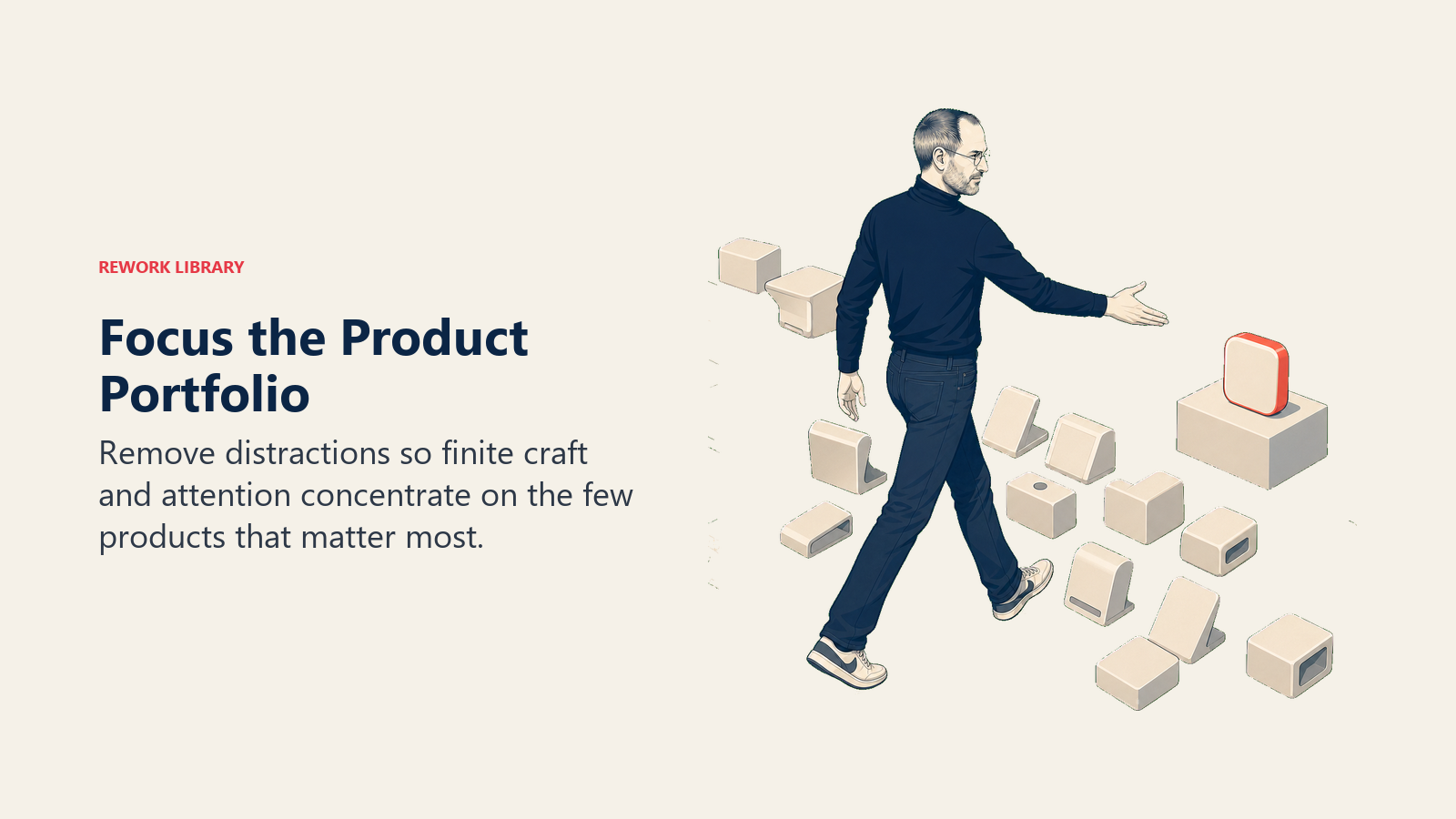
For today's leaders: before your next planning cycle, ask what you're keeping that you should kill. Not what you could add, but what you're holding onto out of momentum or internal politics.
2. The iPod and iTunes Ecosystem (2001-2003)
The iPod wasn't the first digital music player. Diamond Multimedia's Rio had launched years earlier. What Jobs did was recognize that the problem wasn't the device. It was the entire system around it. Buying songs was painful, ripping CDs was painful, organizing libraries was painful.
He pushed for the iTunes Music Store when the major labels were convinced digital distribution would destroy them. He negotiated 99-cent singles, a simple interface, and DRM that satisfied label lawyers. The store launched in 2003 and sold a million songs in six days.
The leadership lesson: Jobs solved the full experience, not just the product. He saw the friction points competitors ignored because they were technically outside the device's scope. When you're building a product or service today, the real differentiator is often adjacent to the feature your team is focused on.
3. The iPhone Bet in 2005-2007
In 2005, Apple's market cap was around $50 billion. The iPhone project burned hundreds of millions in R&D before launch, required deep partnerships with AT&T that didn't fully favor Apple, and forced the company to write an entirely new operating system. Jobs was betting a meaningful portion of the company on a product category he didn't yet fully know how to build.
He launched in January 2007 with a device that couldn't run third-party apps, couldn't send MMS, and was sold exclusively through one carrier. The press criticized all of it. It didn't matter. The underlying thesis, that a phone was a pocket computer, was correct. Apple captured 92% of smartphone profits within a decade of that launch.
What this shows: Jobs was willing to ship an incomplete product if the core thesis was right and the experience was better than what existed. He didn't wait for perfection across every dimension. He optimized ruthlessly for a few things and tolerated weakness elsewhere in version one.
What Jobs Would Do in Your Role
If you're a CEO running a 50-200 person company, the most Jobs-like move you can make is simplifying your offering. Most companies at this stage are trying to be too many things to too many buyers. Jobs would look at your product line and ask: what's the one thing? Cut the rest until you can answer that cleanly.
If you're a COO or operations leader, Jobs' lesson is that constraints drive quality. He gave teams fewer options, tighter timelines, and harder standards, and that pressure produced some of the most durable hardware ever built. Where are you giving your teams too much room to compromise on the essentials?
If you're a product leader, the trait to steal is Jobs' insistence on owning the full customer experience. He controlled hardware, software, packaging, retail, and post-sale support. Not because he was a control freak, but because each of those touchpoints built or destroyed trust. Ask which part of your customer journey your company currently doesn't own, and whether that gap is hurting you.
If you're a sales or marketing leader, the charisma lesson isn't about personality. It's about conviction. Jobs communicated certainty about the future he was building. Buyers and partners trust people who believe what they're saying. You don't need to be charismatic, you need to know your product's thesis cold and be willing to defend it under pressure.
Running Jobs-Style Product Ops with Rework
Perfectionism and taste-driven leadership aren't sustainable as vibes, they only scale when the daily operating surface forces the team to confront quality before it ships. That's where Rework fits. For product leaders trying to channel Jobs' standards without becoming Jobs the person, Rework acts as the connective tissue between design reviews, engineering sprints, QA, and customer feedback loops. Obsessive iteration requires that every cut design, every open defect, every deferred decision stays visible and assigned, not buried in a side thread. Rework's unified workspace (Project Engine from $99/month, Sales Engine from $69/month, billed yearly, pricing) lets a small product team keep a Jobs-style quality bar traceable across hardware, software, support, and go-to-market without needing a stack of five disconnected tools. The doctrine survives when the ops around it do.
The Shadow Side: What Jobs Got Wrong
This section matters as much as the profile above.
Jobs' management style caused real damage. Engineers and designers who worked at Apple during the peak years describe a culture where public humiliation was common, where years of work could be canceled in an afternoon without explanation, and where fear of his reaction shaped decisions more than good judgment. Several key contributors burned out or left despite achieving remarkable things.
His firing approach was notorious. People learned they'd been let go from third parties. There was rarely a performance conversation: just a decision, delivered fast. That approach may have kept the company lean, but it also destroyed trust and made psychological safety structurally impossible for many teams.
The contrast with Tim Cook's operational turn after Jobs' death is instructive. Cook inherited the same company and rebuilt the culture around process, supplier relationships, and team stability, without abandoning the quality bar. That transition is one of the clearest examples in modern business of a successor preserving a product vision while discarding a management style.
Jobs also made serious product errors. The original Apple Maps launch under his successor was partly a Jobs-era strategic decision. The MobileMe service was a disaster he famously acknowledged by calling his own team out in front of the company. His contempt for market research led to the antenna design flaw in iPhone 4, which he defended publicly before Apple eventually offered free cases as a fix.
His health decisions (delaying cancer treatment in favor of alternative approaches for months after his diagnosis) reflect the same certainty that made him a great product leader and a poor medical patient. That rigidity was the flip side of conviction.
The honest summary: Jobs' style works as an accelerant when the vision is right. When it's wrong, or when it scales into a culture, it produces teams that are afraid to tell their leaders the truth. That's a dangerous organizational state. Mark Zuckerberg's dual-class control at Meta reflects a similar founder-dictator pattern, concentrated authority that insulates long-term vision from short-term market pressure, with the same tradeoffs around accountability and error correction. And Elon Musk's visionary-autocrat approach takes those tradeoffs further still, deploying founder authority at simultaneous scale across multiple capital-intensive industries.
Leadership Lessons You Can Use This Week
1. Subtract before you add. This week, identify one product, initiative, or meeting series that exists because of momentum, not because it's working. Cut it or put it on pause. Jobs-level focus starts with what you remove.
2. Raise one standard, visibly. Pick one quality bar that your team currently treats as optional (a deliverable format, a response time, a design detail) and hold to it publicly this week. Not as discipline, but as a signal about what matters here.
3. Solve the adjacent friction. Look at your core customer journey and identify the step immediately before or after your product where customers experience pain. That's your next product thesis, not a feature request from inside your current offering.
4. Separate conviction from certainty. Jobs was wrong about things. But he held positions long enough to find out. This week, pick one thing you've been hedging on (a market bet, a product direction, a hire) and commit enough to get real signal. Uncertainty resolved by time costs more than uncertainty resolved by action. For a parallel study in founder conviction applied to competing platforms, Zuckerberg's decade-long bet on mobile-first social is worth comparing directly.
Frequently Asked Questions about Steve Jobs's Leadership
Who was Steve Jobs?
Steve Jobs (1955-2011) was the co-founder and longtime CEO of Apple Inc. He co-founded the company in 1976 with Steve Wozniak, was forced out in 1985, founded NeXT and acquired Pixar during his exile, and returned to Apple as interim CEO in 1997. Under his second tenure he launched the iMac (1998), iPod (2001), iTunes Store (2003), iPhone (2007), and iPad (2010), taking Apple from near-bankruptcy to a market cap above $300 billion by the time of his death in 2011.
What was the Reality Distortion Field?
The Reality Distortion Field was a term coined by Apple engineer Bud Tribble in 1981 to describe Jobs' ability to convince himself and those around him that any schedule, feature, or constraint could be bent through sheer conviction and charisma. In practice it meant teams routinely delivered outcomes they had called impossible days earlier, because Jobs refused to accept their timelines. Colleagues treated it as part manipulation, part belief system, and part leadership tool.
Why was Jobs fired from Apple in 1985?
Jobs lost a boardroom power struggle with CEO John Sculley (whom Jobs himself had recruited from Pepsi in 1983). The Macintosh had shipped in 1984 but sold below expectations, and Jobs' management of the Mac division had created friction with other teams. After Jobs attempted to reorganize the company behind Sculley's back, the board sided with Sculley in May 1985 and stripped Jobs of operational responsibilities. He resigned months later and went on to found NeXT.
How did Jobs transform Apple upon his return?
When Jobs returned in 1997, Apple had roughly 90 days of cash left and a fragmented product line. He cut the lineup from around 350 products to 10 organized on a 2x2 grid (consumer/pro, desktop/portable), ended the Mac clone licensing program, killed the Newton, struck a $150 million investment deal with Microsoft, and set the stage for the iMac in 1998. Over the next fourteen years Apple went from near-bankruptcy to the most valuable company in the world.
What is Jobs's philosophy on focus and saying no?
Jobs believed innovation came from subtraction, not addition. He described focus as "saying no to 1,000 things" so that the remaining few could be done exceptionally. His product-line cut from 350 to 10 in 1997 was the clearest operational expression of this. The principle extended to features, partnerships, and meetings, Jobs deliberately kept Apple's executive team small and its product catalog narrower than any comparable company at its scale.
What can modern CEOs learn from Steve Jobs?
The transferable lessons are focus through subtraction, ownership of the full customer experience, and willingness to ship a product that is incomplete on some dimensions if the core thesis is right. The pattern to avoid is the management style, public humiliation, abrupt terminations, and contempt for disagreement created cultures where people feared their leader more than they respected him. Tim Cook's post-2011 rebuild of Apple's culture shows the standards and the style can be decoupled.
Learn More
If this profile shaped how you're thinking about leadership, these articles go deeper on the underlying ideas:

On this page
- Leadership Style Breakdown
- Key Leadership Traits
- The Jobs Perfectionism Doctrine
- The 3 Decisions That Defined Jobs as a Leader
- 1. Returning to Apple as Interim CEO in 1997
- 2. The iPod and iTunes Ecosystem (2001-2003)
- 3. The iPhone Bet in 2005-2007
- What Jobs Would Do in Your Role
- Running Jobs-Style Product Ops with Rework
- The Shadow Side: What Jobs Got Wrong
- Leadership Lessons You Can Use This Week
- Learn More