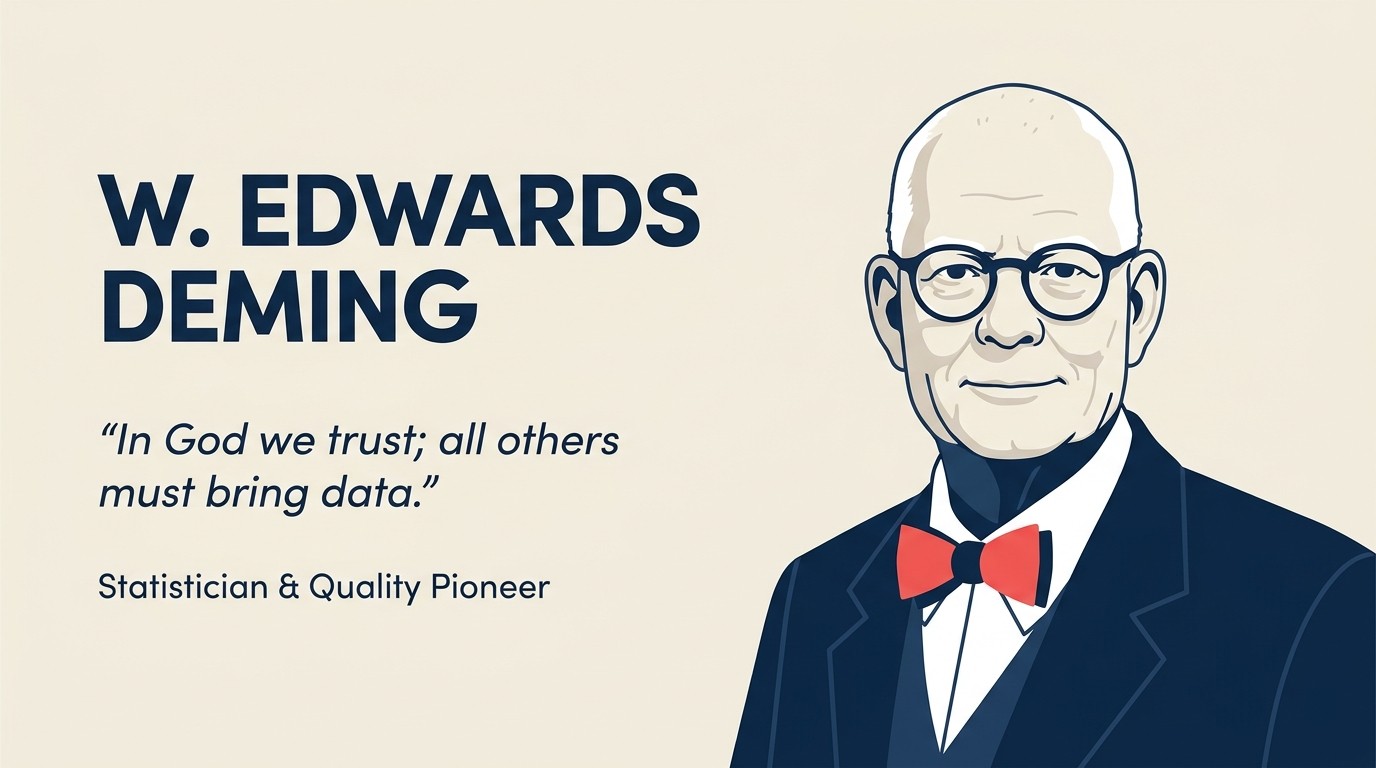
W. Edwards Deming Leadership Style: Quality Is a System, Not an Inspection
Turn this article into takeaways for your work.


Each assistant summarizes the article only for you and suggests best practices for your work.
Key Facts, W. Edwards Deming
- Lifespan: 1900–1993 (age 93)
- Role: American statistician, management consultant, author, and professor
- Education: PhD in mathematical physics from Yale University (1928)
- Japan mission: Taught statistical quality control to Japanese industry starting 1950, catalyzing the postwar "Japanese economic miracle"
- Core frameworks: 14 Points for Management; PDCA/PDSA cycle (Plan-Do-Check/Study-Act); System of Profound Knowledge
- Signature book: "Out of the Crisis" (MIT Press, 1982)
- Legacy awards: The Deming Prize, established by JUSE in 1951, is Japan's highest industrial honor for quality management
- American recognition: Came late, after the 1980 NBC documentary "If Japan Can... Why Can't We?"
After World War II, the US government sent W. Edwards Deming to Japan to help rebuild the country's industrial base. Japanese manufacturers listened. They attended his lectures on statistical process control. They applied his ideas about reducing variation, understanding systems, and removing defects at the source rather than catching them at the end. Among those who absorbed the principles most completely was Taiichi Ohno, who used them as the backbone of the Toyota Production System, and Akio Toyoda, whose family had built the company that proved Deming's methods at industrial scale. By the 1970s, Japanese manufacturers were outcompeting American companies on quality and cost simultaneously, in markets the US had dominated for decades.
American executives finally invited Deming home in 1980, when NBC aired a documentary called "If Japan Can... Why Can't We?" He was 79 years old.
He spent the next 13 years running seminars, publishing "Out of the Crisis," and advising companies including Ford, which used his principles to reverse a decade of quality failures under Donald Petersen. He died in December 1993 at age 93, four days after completing a consulting engagement. The Deming Institute, founded in 1993, continues to advance his methods.
Most of his core argument, that 94% of problems come from the system, not the workers, is still routinely ignored. Peter Drucker was developing complementary ideas about management effectiveness during the same era, and Mary Barra later inherited the operational legacy Deming helped shape at American manufacturers when she became CEO of GM.
Leadership Style Breakdown
| Style | Weight | How it showed up |
|---|---|---|
| Statistician-in-Chief | 60% | Deming didn't lead through vision or charisma. He led through data. His training under Walter Shewhart at Bell Labs in the 1920s gave him a framework for understanding variation, the difference between common-cause variation (built into the system) and special-cause variation (an unusual event). Most managers treat all variation as special cause, which leads them to tamper with processes that are actually working normally. Deming's contribution was teaching people to look at data before acting on it. |
| System Critic | 40% | Deming's second role was attacking the assumptions underneath American management practice. He was openly hostile to annual performance reviews, numerical production quotas, and lowest-bid purchasing. He didn't argue these were imperfect, he argued they were structurally harmful, because they optimized for the wrong thing and created fear as a side effect. His 14 Points weren't tips. They were an indictment of what most companies were doing and a prescription to stop. |
That split explains why Deming was difficult to absorb. Managers who wanted tools could use his statistical methods. But applying those tools while keeping annual performance reviews and numerical quotas is like installing a better engine in a car with four flat tires. Deming kept saying the tires were the problem.
Key Leadership Traits
| Trait | Rating | What it means in practice |
|---|---|---|
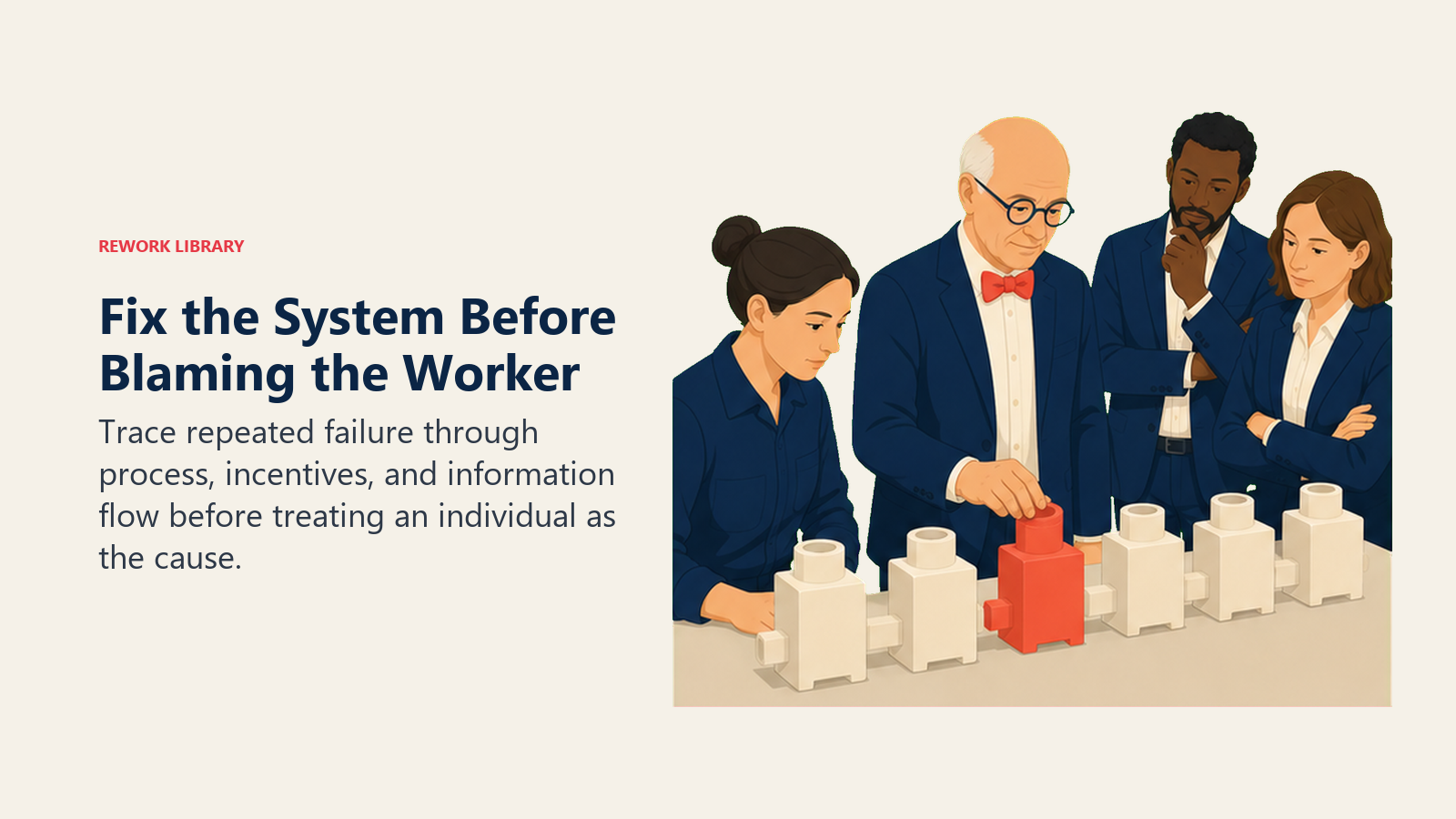
| Belief that 94% of defects come from systems, not workers | Exceptional | Deming's most counterintuitive and most important claim. When a product ships with defects, the instinct is to find who made the mistake and fix their behavior. Deming's data from manufacturing showed that the overwhelming majority of defects were built into the process design, wrong tolerances, inconsistent inputs, inadequate training embedded in the system, not caused by individual worker failures. Blaming workers for system defects makes the problem worse: it creates fear, suppresses honest reporting, and leaves the actual cause untouched. |
| Hostility to performance reviews and numerical quotas | Very High | Deming's Point 12 in his 14 Points is "remove barriers that rob people of pride of workmanship," which includes annual merit ratings and management-by-objective as he saw it practiced. His argument wasn't sentimental, it was analytical. Numerical quotas shift workers' attention from quality to hitting the number. Annual ratings destroy collaboration by forcing individuals to compete internally. His position was that these systems generate the dysfunction executives then spend time managing. |
| Long-term supplier relationships over lowest-bid purchasing | High | Point 4 in the 14 Points: "end the practice of awarding business on price tag alone." Deming had seen what lowest-bid procurement did to quality. When suppliers know they'll be replaced the moment a cheaper competitor appears, they have no incentive to invest in process improvement. When you build a long-term relationship with a supplier and share quality data with them, you're extending your own system. Most procurement departments are structured to do the opposite, and Deming spent significant time in "Out of the Crisis" explaining why that was self-defeating. |
| Statistical process control as a management language | High | Deming wanted managers to understand control charts, the distinction between common and special cause variation, and the consequences of tampering with a stable process. This wasn't about training everyone to be a statistician. It was about having a shared language for conversations about process performance that didn't rely on gut feeling or anecdote. His seminars at JUSE in 1950 were attended by Japan's top engineers and executives precisely because he was teaching them to see what was happening inside their processes rather than just reacting to outputs. |
Deming's 14 Points / The PDCA Quality Doctrine
Deming's 14 Points / The PDCA Quality Doctrine is a management philosophy stating that 94% of organizational defects originate in the system, not in the worker, and that sustained quality comes from disciplined improvement loops (Plan-Do-Check/Study-Act) applied by leadership. The doctrine pairs 14 structural mandates (drive out fear, end lowest-bid purchasing, eliminate numerical quotas, break down silos) with a statistical method for learning from every change. It reframes quality as a leadership responsibility embedded in process design, rather than an inspection step catching failures at the end of the line.
The 3 Frameworks That Defined W. Edwards Deming
1. 14 Points for Management
Deming published his 14 Points in "Out of the Crisis" in 1982, though he'd been developing them through his consulting practice for years. They're worth reading in full rather than as a summary, because the specific language carries the argument.
The 14 Points for Management are: create constancy of purpose toward improvement; adopt the new philosophy (stop tolerating defects); cease dependence on mass inspection; end the practice of awarding business on price tag alone; improve constantly every process; institute training on the job; adopt and institute leadership; drive out fear; break down barriers between departments; eliminate slogans and exhortations; eliminate numerical quotas; remove barriers to pride of workmanship; institute a vigorous program of education and self-improvement; put everyone in the organization to work on the transformation.
For operators, Points 8 ("drive out fear") and 11 ("eliminate numerical quotas") are the most controversial because they conflict directly with how most organizations run performance management. Deming's argument is that fear suppresses the honest reporting of problems, which means you only hear about defects and failures after they've compounded. Numerical quotas create the incentive to hit the number through whatever means available, including degrading quality, falsifying records, or destroying downstream processes that can't keep up.
The 14 Points aren't a checklist you complete. They're interdependent. Driving out fear doesn't work if you keep numerical quotas, the fear just shifts to a different source. That interdependence is why partial implementations usually don't work, and why companies that cherry-pick the easier points see limited results.
2. PDSA Cycle: Why "Study" Replaced "Check"
Walter Shewhart originally described the cycle as Plan-Do-Check-Act. Deming revised it to Plan-Do-Study-Act, and the difference is significant.
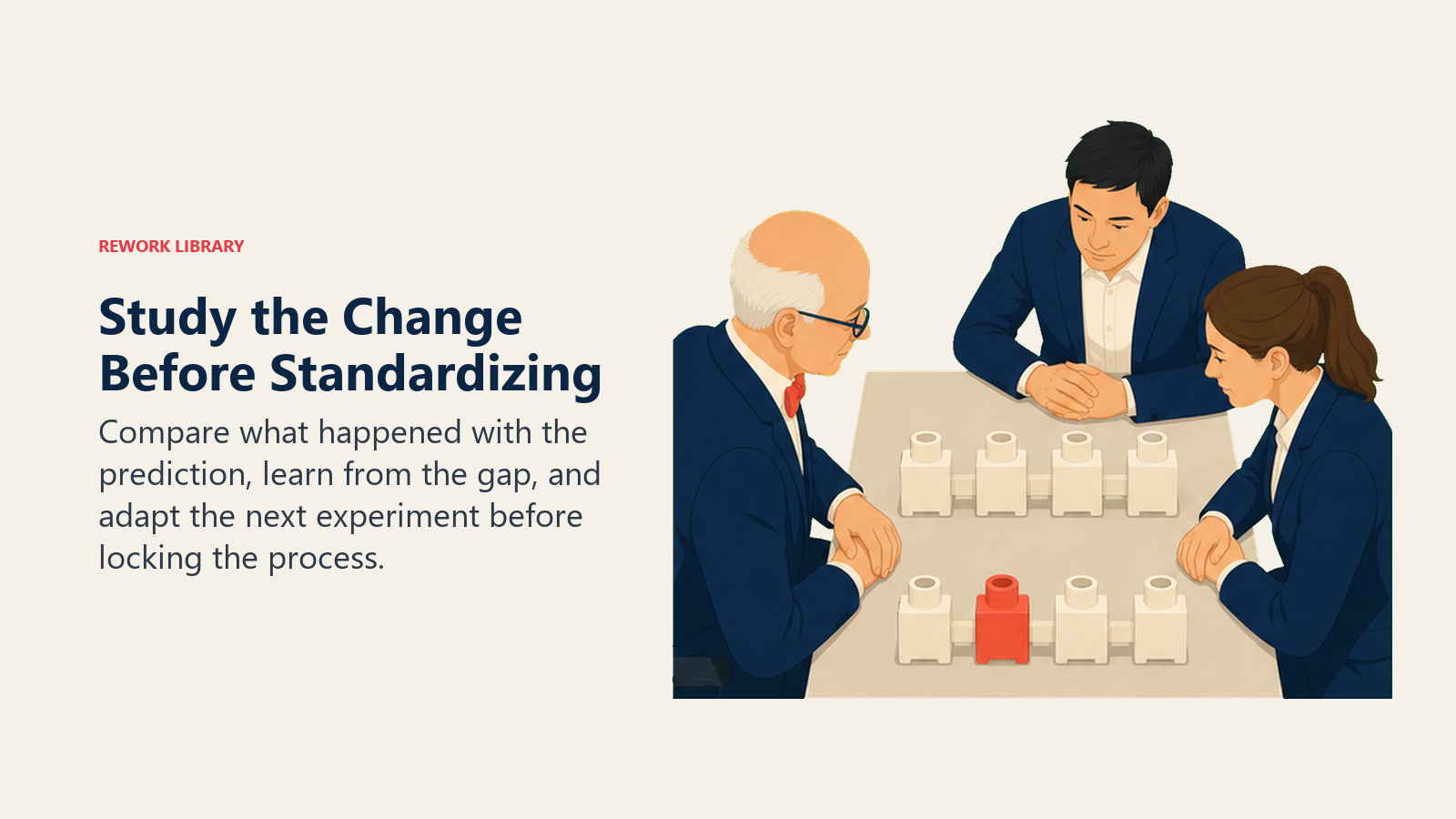
"Check" implies verification: did we pass or fail? "Study" implies analysis: what did we learn about the system? Deming's version requires you to analyze the data from the Do phase before acting, not just confirm whether the result met a threshold. You're trying to understand why something happened, not just whether it happened.
The four stages in practice look like this. In Plan, you define the objective, predict the outcome, and design the test. In Do, you carry out the plan on a small scale. In Study, you analyze the results against your prediction, specifically, what did the data tell you about your theory? In Act, you either adopt the change, adapt the plan for another cycle, or abandon the approach.
The PDSA cycle is more than an improvement framework. It's a theory of learning: you're building knowledge about your system, not just iterating toward a target. Most improvement projects skip the Study phase and jump directly from Do to Act, which means they're operating on assumption rather than evidence. Deming's insistence on the distinction between prediction and result is the point most practitioners lose.
3. System of Profound Knowledge
Deming's last book, "The New Economics for Industry, Government, Education," published the year he died, introduced what he called the System of Profound Knowledge, his unified theory of why management fails and what it requires to succeed.
The system has four interconnected parts. Appreciation for a system means understanding your organization as a set of interdependent parts aimed at a purpose, and recognizing that optimizing individual components at the expense of the whole is self-defeating. Knowledge about variation means understanding the difference between common-cause and special-cause variation, and not confusing one for the other when making decisions. Theory of knowledge means recognizing that management decisions are predictions, hypotheses about what will happen, and that those predictions require a model, not just data. Psychology means understanding what motivates people, why fear degrades performance, and why intrinsic motivation produces better results than extrinsic incentives for complex work.
The System of Profound Knowledge matters because it explains why good tools fail in bad contexts. Statistical process control techniques applied in an organization that runs on fear and internal competition will produce different results than the same techniques applied in an organization built around the other three components. Deming's argument was that you need all four, you can't pick the part that's least threatening to current management practice and expect the rest to work.
What W. Edwards Deming Would Do in Your Role
If you're a CEO, the first Deming question for you is: what percentage of your organizational problems are system problems versus people problems? Most executive teams, if they're honest, attribute the majority of problems to individuals: the sales rep who lost the deal, the engineer who shipped the bug, the manager who didn't communicate clearly. Deming's data suggests that ratio is inverted. If you're spending most of your leadership energy on individual performance issues, you're probably solving the wrong thing. The question is what's built into your processes, your incentive structures, and your information systems that's producing those individual failures repeatedly.
If you're a COO, the PDSA cycle is your most direct operational tool. Before you roll out a process change organization-wide, run it as a small test. Write down your prediction before you start, specifically, what do you expect to happen and why? Then compare the result to the prediction. The gap between your prediction and what happened is the learning. Most operations organizations run changes and then evaluate whether the result was acceptable. Deming's approach is to evaluate whether your understanding of the system was accurate, which is a different and more useful question.
If you're a product leader, the supplier relationship principle applies directly to your vendor and partner ecosystem. If you're managing your tool vendors, data providers, or integration partners entirely on lowest-cost renewal cycles, you're preventing them from investing in quality for your use case. Deming's argument is that a smaller number of deeper partnerships, where you share quality data, communicate problems early, and commit to multi-year relationships, produces better outcomes than a constant market for cheapest-available. That's not how most procurement processes are designed, but it's worth testing in the vendor relationships that most affect your core product reliability.
If you're in sales or marketing, Point 9, "break down barriers between departments", is the Deming principle most relevant to the sales/marketing handoff. The dysfunction here is structural: marketing measures MQLs; sales measures closed revenue; neither team is measured on the quality of the entire pipeline. Deming would say that optimizing each department's local metric while ignoring the handoff between them is system destruction. The shared metric, revenue from customers who stay and expand, is the one that actually matters, and both departments need to be accountable to it.
Applying Deming Through Rework
Deming's core insight, that 94% of defects are system defects, only becomes actionable when leaders can actually see the system. In most companies, quality data lives in silos: sales pipeline problems sit in the CRM, handoff failures hide in Slack threads, process regressions surface only in quarterly retros. That fragmentation is itself a system defect.
Rework is designed to give operators the cross-team visibility Deming's doctrine requires. When CRM, lead management, sales engagement, and internal chat share one operational layer, PDCA cycles become tractable: you can form a prediction about a handoff, run a small-scale test, study the actual routing and response data, and act on evidence rather than anecdote. Managers stop blaming individual reps for blown SLAs and start fixing the routing rule, the qualification template, or the cross-functional dependency that produced the failure repeatedly.
That's the Deming move, turning recurring "people problems" back into solvable system problems, with shared data and shared accountability replacing internal blame.
Notable Quotes & Lessons Beyond the Boardroom
"Every system is perfectly designed to get the results it gets." This line, attributed to Deming in various forms across his seminars and writing, is the most direct statement of his core claim. If your organization is producing a result you don't want, high defect rates, high turnover, slow product cycles, poor customer satisfaction, the correct diagnostic question isn't who is responsible. It's what in the system design is producing that result reliably.
From "Out of the Crisis": "It is not enough to do your best; you must know what to do, and then do your best." That's a harder statement than it looks. Deming is saying that effort and intention aren't sufficient, you need a theory, a prediction about what will work, based on understanding the system. Hard work applied to the wrong theory produces reliable failure. Most quality improvement programs reward effort rather than learning.
He also said, in various forms across his seminars, that the most important figures for running an organization are unknown and unknowable. The cost of a dissatisfied customer. The cost of a good employee who leaves because the system frustrates them. The long-run cost of cutting training in a downturn. Deming wasn't saying measurement doesn't matter. He was saying that limiting your management attention to what's easily quantifiable guarantees you'll optimize the less important things and neglect the critical ones.
Where This Style Breaks
Deming's 14 Points assume repeatable, measurable processes. Manufacturing gives you that. Software product development, creative services, and early-stage companies often don't have enough repetition for statistical control to produce meaningful signals. You can't build a control chart around a three-person team shipping a novel product category.
His hostility to performance reviews is analytically correct but politically difficult. Public companies with quarterly earnings guidance, investor expectations, and equity compensation plans can't easily abandon individual performance ratings without creating new problems. The principle is sound; the implementation in most real org structures requires more adaptation than Deming's writing acknowledged.
And his long-supplier-relationship principle runs directly into procurement departments whose success metrics are cost reduction. Changing that requires executive alignment across functions that usually have competing incentives, which is, ironically, exactly what his Point 9 predicts.
Learn More
For related reading on systems leadership, see Andy Grove Leadership Style and Werner Vogels Leadership Style.

On this page
- Leadership Style Breakdown
- Key Leadership Traits
- Deming's 14 Points / The PDCA Quality Doctrine
- The 3 Frameworks That Defined W. Edwards Deming
- 1. 14 Points for Management
- 2. PDSA Cycle: Why "Study" Replaced "Check"
- 3. System of Profound Knowledge
- What W. Edwards Deming Would Do in Your Role
- Applying Deming Through Rework
- Notable Quotes & Lessons Beyond the Boardroom
- Where This Style Breaks
- Learn More