Meg Whitman Leadership Style: The Operator CEO Who Scaled eBay 2,000x and Split HP
Turn this article into takeaways for your work.


Each assistant summarizes the article only for you and suggests best practices for your work.
Key Facts: Meg Whitman at a Glance
- Born: 1956 (Cold Spring Harbor, New York)
- Education: Princeton University (BA, Economics); Harvard Business School (MBA)
- Early Career: Brand management at Procter & Gamble; later Bain & Company, Disney, Stride Rite, FTD, Hasbro
- eBay CEO: 1998–2008, scaled company from 30 employees and $4M revenue to 15,000 employees and $8B revenue
- HP / HPE CEO: 2011–2018, led the $11B Autonomy writedown fallout and engineered the 2015 split into HP Inc. and Hewlett Packard Enterprise
- Quibi CEO: 2018–2020, short-form mobile video startup that raised $1.75B and shut down six months after launch
- Political Run: 2010 Republican nominee for Governor of California (lost to Jerry Brown); spent ~$144M of personal funds
- US Ambassador to Kenya: 2022–2024 (appointed by President Biden)
- Notable Acquisition: PayPal for $1.5B in 2002, arguably one of the best internet-era deals ever
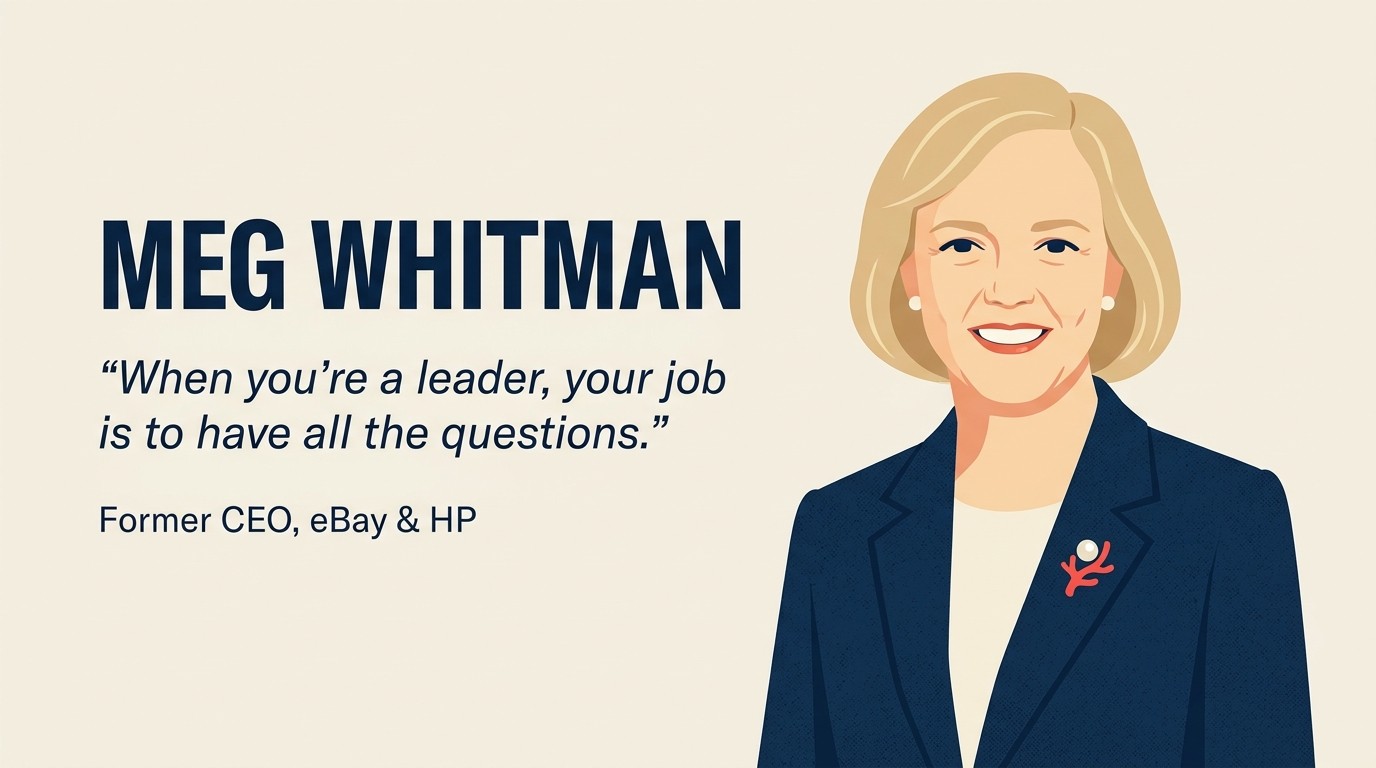
When Meg Whitman joined eBay in 1998, the company had $4M in annual revenue and 30 employees. By the time she stepped down in 2008, it had $8 billion in revenue and 15,000 people. That's a 2,000x revenue run in a decade, and it remains one of the most disciplined marketplace scaling stories in tech.
Most people look at that number and think: genius CEO. What they miss is that Whitman didn't invent eBay's model. She systematized it. She built the trust infrastructure, the payment rails, the seller incentive structure, and the operational backbone that turned a quirky auction site into a global commerce platform. That's a different skill set than founding. It's arguably rarer.
The reason her story matters today isn't just the eBay run. It's what happened after: the HP turnaround that produced real structural results alongside real writedowns, and Quibi, where her playbook failed completely. That full arc, including the failures, gives you something useful. Whitman ran eBay during the same era that Bob Iger was rebuilding Disney through acquisition, two operators who shaped very different industries by applying disciplined process thinking at scale.
Leadership Style Breakdown
| Style | Weight | How it showed up |
|---|---|---|
| Operator-Scaler | 65% | Built eBay's trust and feedback systems from scratch; formalized seller policies; ran integration playbooks for PayPal and other acquisitions; focused relentlessly on unit economics and marketplace health metrics. |
| Institutional Builder | 35% | Created HP's Accelerate transformation plan; split HP into two publicly traded companies; built governance structures and investor messaging for an enterprise turnaround at scale. |
The 65/35 split isn't arbitrary. Whitman's dominant mode is operational. She comes at problems through process, structure, and repeatable systems. The institutional builder layer kicked in most visibly at HP, where the company needed a reorganization thesis, not just better operations. When those two modes lined up, she was effective. When the situation called for something else entirely, like Quibi, where the product needed creative reinvention, not institutional muscle, the playbook didn't translate.
The Whitman Operator Model (The eBay Scale Doctrine)
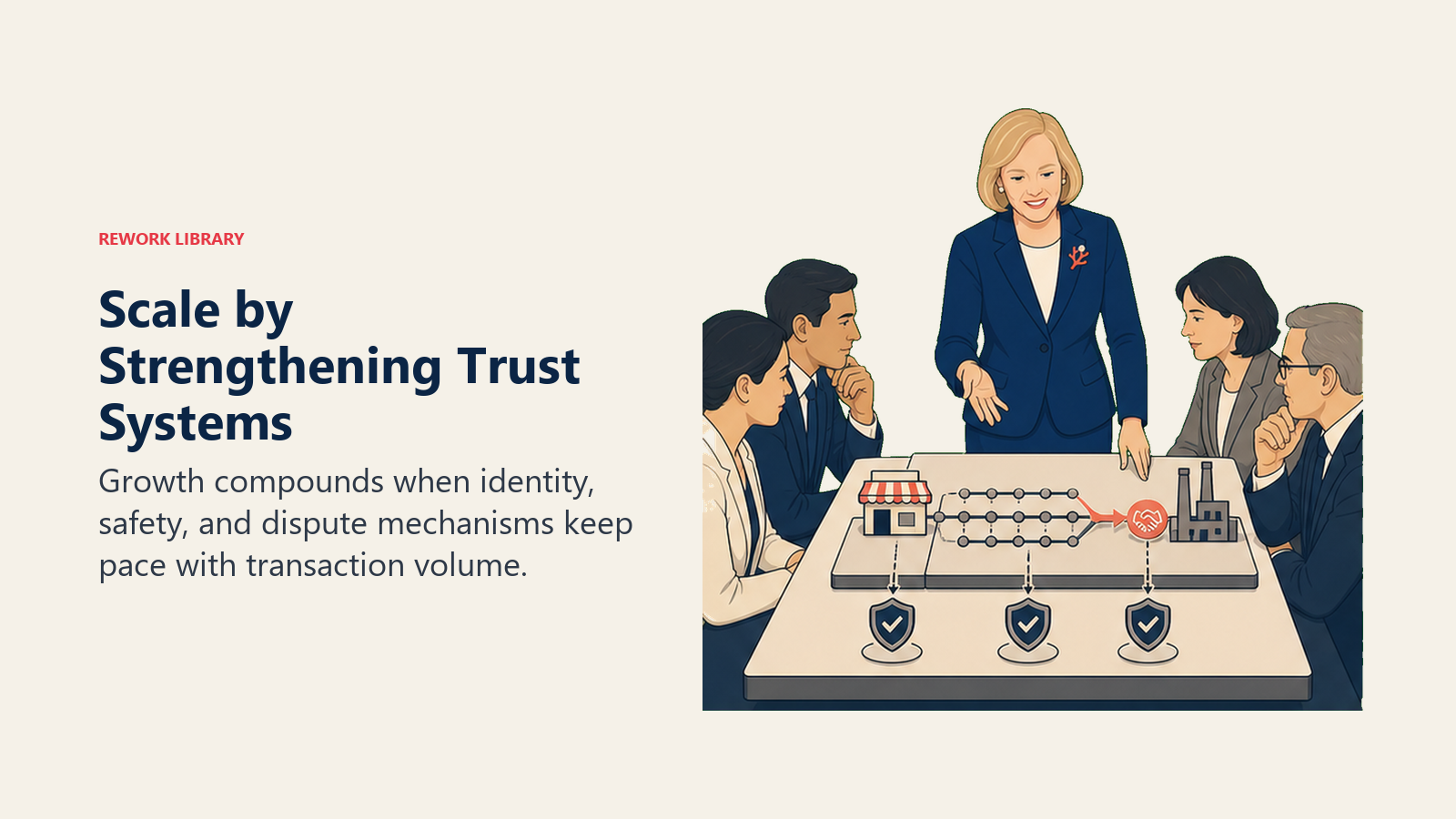
The Whitman Operator Model is a CEO playbook for scaling a proven business model through trust infrastructure, process formalization, and community tiering, not product reinvention. It treats marketplace integrity (fraud prevention, feedback loops, seller economics) as the dominant growth lever and assumes the founder-invented product is the input, while operational discipline is the multiplier. The model wins in two-sided marketplaces and structurally healthy categories; it breaks in fast-iterating creative markets or in businesses requiring a product thesis change.
Key Leadership Traits
| Trait | Rating | What it means in practice |
|---|---|---|
| Marketplace scaling discipline | Exceptional | Whitman understood that a two-sided marketplace lives or dies on trust at scale. She built eBay's feedback system, invested heavily in fraud prevention, and created Powerseller tiers that gave the best sellers visibility and tools. These weren't flashy moves. They were the structural conditions for growth. |
| Process formalization | Very High | At both eBay and HP, Whitman installed formal operating rhythms: defined reporting cadences, clear accountability frameworks, and documented integration processes for acquisitions. This is what allowed eBay to absorb PayPal and other properties without losing operating focus. |
| Community trust-building | High | eBay in 1998 was genuinely mistrusted by mainstream buyers. Whitman invested in buyer protection programs, launched guarantees, and treated the seller community as a partner class rather than a vendor pool. That community orientation became a competitive moat. |
| Acquisition judgment | Medium | PayPal was one of the best acquisition calls in internet history. Skype ($2.6B in 2005, sold at a loss in 2009) was a strategic mismatch that she acknowledged and reversed. At HP, the $11B Autonomy writedown happened on her watch. Her acquisition track record is genuinely mixed. |
The 3 Decisions That Defined Meg Whitman as a Leader
1. Building eBay's Trust and Safety Model When Online Commerce Was Still Mistrusted (1998-2002)
In 1998, buying from a stranger on the internet was not a normal behavior. Credit card fraud was rampant, dispute resolution didn't exist, and the idea of paying someone you'd never met for a product you hadn't touched required a leap of faith most consumers weren't ready to take.
Whitman's response wasn't to market her way around that problem. She built infrastructure to solve it. The feedback system, where buyers and sellers rated each other after every transaction, was expanded and made central to the platform identity. eBay Guarantees gave buyers protection on high-value purchases. The Powerseller program created a trusted seller tier with public credibility signals.
None of this was technologically sophisticated. All of it was operationally hard. It required constant iteration on fraud detection, policy enforcement, and community norms. Whitman treated trust as a product feature, not a marketing message. That distinction is what made eBay scalable past its early adopter base.
For you: if you're running a marketplace or platform product, the trust infrastructure is usually underfunded because it doesn't ship in a release note. It's the thing that makes your product usable at scale. Where is your team treating trust as a marketing problem when it's actually an operations problem?
2. Acquiring PayPal for $1.5B in 2002
When eBay acquired PayPal in October 2002, it was already eBay's most popular unofficial payment method. Buyers preferred it over eBay's own payment product, Billpoint. Whitman's decision was to stop fighting that and own it instead.
The deal closed at $1.5 billion. When eBay and PayPal split in 2015, PayPal's standalone market cap was roughly $45 billion, eventually exceeding eBay's own valuation. That's not hindsight; the strategic logic was clear even at the time. Payment friction was the single biggest barrier to transaction completion on the platform. Owning the payment layer removed it.
What Whitman got right here was recognizing product-market fit in something she didn't build. PayPal wasn't a bet on an unproven concept. It was a recognition that her own users had already voted with their behavior. The acquisition capital was just formalizing what the market had already decided. Marc Benioff made a similar read on platform extension at Salesforce, Benioff's cloud platform instinct shows how customer behavior signals can drive a company's entire growth arc.
The leadership lesson: don't let internal pride in what you built blind you to what your customers have already chosen. Whitman killed Billpoint rather than protect it. That's operationally difficult and organizationally correct.
3. Splitting Hewlett-Packard into HP Inc. and Hewlett Packard Enterprise in 2015
When Whitman took the HP CEO role in 2011, she inherited one of the most operationally broken large-cap tech companies in the market. The stock had dropped from $52 to under $23. The Autonomy acquisition ($11.1B closed in 2011) would later produce an $8.8B writedown as HP alleged accounting fraud. The culture was fragmented across printer, PC, and enterprise divisions that had almost nothing in common.
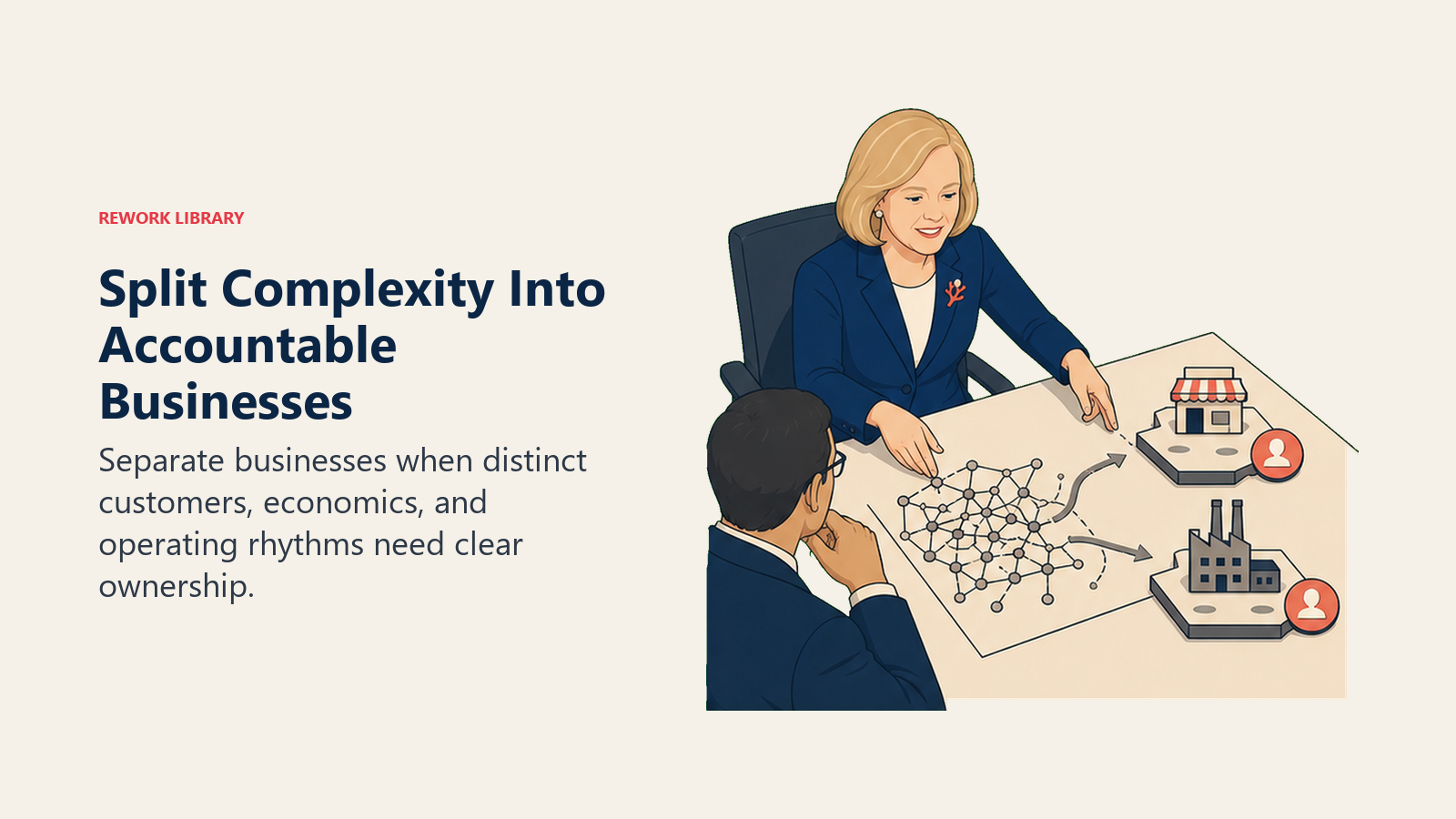
Whitman's thesis was that HP's problems weren't fixable as a single entity. The printer and PC business (HP Inc.) had a fundamentally different business model, capital cycle, and competitive environment than the enterprise IT business (Hewlett Packard Enterprise). Running them under one roof forced governance compromises that neither side could afford.
The split closed in November 2015, creating HP Inc. and Hewlett Packard Enterprise as separate publicly traded companies. Both traded at premiums relative to the unified HP in the years that followed. It was a structurally correct call made in an operationally difficult environment.
But the honest accounting matters. The Autonomy writedown happened under her watch. HP Inc. has faced structural decline as PC and printer markets contracted. The split was the right surgical move, but it didn't fully solve HP's longer-run competitiveness problems. Whitman's record at HP is real improvement alongside real unresolved problems. That's a more accurate read than either "she fixed HP" or "she failed at HP."
What Meg Whitman Would Do in Your Role
If you're a CEO running a 50-200 person company, Whitman's most applicable lesson is about trust infrastructure. Before your next growth push, ask what structural guarantees you're offering buyers, partners, or users that make your product safe to choose. Marketing can acquire customers. Trust infrastructure keeps them. Where are you treating trust as a branding problem when it's actually a product problem?
If you're a COO or operations leader, look at your acquisition integration playbook. Whitman ran eBay's PayPal integration without losing operational momentum on the core marketplace because she had a defined process for how new assets get absorbed. If your company is doing M&A or major partnerships without a documented integration model, you're absorbing risk you don't need to take.
If you're a product leader, the PayPal lesson applies directly. Your users have probably already told you what they prefer through their behavior. Look at where they're using workarounds, third-party tools, or unofficial integrations. That's your next product move. Don't build your version of Billpoint when PayPal already exists.
If you're a sales or marketing leader, Whitman's community-building approach at eBay translates directly to customer success and advocacy programs. She gave her best sellers real tools, real visibility, and real economic incentives. That's not a loyalty program. It's a partner tier. Which of your top customers could become advocates if you gave them the right structural reasons to?
Rework Analysis: Operator-Mode Scaling for Fast-Growth SMBs
Whitman's model works because operating discipline scales faster than headcount, provided you have the systems to formalize it. The failure mode for most 50-500 person companies isn't strategy; it's that tribal knowledge gets encoded in one person's head, integration playbooks live in a Google Doc nobody updates, and marketplace-style trust signals (SLA compliance, CSAT trends, churn cohorts) never surface in a shared operating cadence. That's the gap Rework is built for. Rework's Process Engine (from $99/month billed yearly, with 5 seats included) gives operators a shared source of truth for process documentation, cross-team workflows, and accountability rhythms, the equivalent of eBay's feedback infrastructure at SMB scale. Paired with Rework's Sales Engine (from $69/month billed yearly), fast-growth teams can run Whitman-style acquisition integrations, partner tiers, and customer health reviews without hiring a dedicated ops function to maintain them. Operator CEOs don't need more strategy decks. They need the operating layer to hold.
Notable Quotes and Lessons Beyond the Boardroom
Whitman has been candid about the Quibi failure in a way most executives avoid. In post-mortems, she acknowledged that the timing was wrong (launching days before COVID lockdowns started when people were home on full screens, not commuting), the format was wrong (10-minute premium content for mobile only), and the team didn't move fast enough when the market signaled problems. "I think the company wasn't successful. There's lots of blame to go around," she told The New York Times in late 2020.
That's worth noting. Most executives at her level don't say that out loud. Howard Schultz earned a similar reputation for honest post-mortems at Starbucks, Schultz's consumer brand leadership is worth reading alongside Whitman's for how differently two operators can rebuild trust after a stumble.
On scaling, she's offered this in various interviews: "You have to be willing to invest in infrastructure before you need it." That's the eBay playbook in one sentence. She built the fraud systems and seller tools before they became critical, not in response to crises.
On leadership at scale: "The soft stuff is the hard stuff." A line she's repeated across multiple settings, referring to culture, communication, and organizational trust as the actual constraints on performance, not strategy or capital.
Where This Style Breaks
Whitman's operator model works when you're scaling a proven model in a market that rewards process discipline and trust infrastructure. It breaks in two specific scenarios.
First, turnarounds in structurally declining categories. HP's printer and PC business needed more than operational discipline; it needed a product reinvention thesis that Whitman wasn't positioned to deliver. Process excellence can't rescue a business model the market is walking away from.
Second, fast creative markets. Quibi raised $1.75 billion and shut down six months after its April 2020 launch. The failure wasn't operational. It was conceptual. The format didn't fit how people actually consumed mobile content. No amount of process formalization fixes a wrong product bet, and Whitman's strengths didn't include rapid creative pivoting based on early market signals. If you're in a category where the winning move is fast iteration and format experimentation, the operator playbook becomes a liability.
Frequently Asked Questions about Meg Whitman's Leadership
Who is Meg Whitman?
Meg Whitman (born 1956) is an American business executive best known for scaling eBay from a 30-person startup into a $8B global marketplace between 1998 and 2008. She later served as CEO of Hewlett-Packard and HPE (2011–2018), led the short-form video startup Quibi (2018–2020), and served as US Ambassador to Kenya from 2022 to 2024. A Princeton graduate with a Harvard MBA, she built her operator foundation through early brand management roles at Procter & Gamble.
How did Whitman grow eBay 2,000x?
Whitman didn't invent eBay's auction model, she systematized it. Her playbook centered on trust infrastructure (the feedback system, buyer guarantees, fraud prevention), community tiering (the Powerseller program), and the $1.5B acquisition of PayPal in 2002, which removed the biggest friction point in platform transactions. She treated operational discipline as the growth lever, not marketing.
How did Whitman lead HP's split?
Whitman took over HP in 2011 with the stock at multi-year lows and the culture fractured across incompatible divisions. Her thesis was that the printer/PC business and the enterprise IT business couldn't share governance. In November 2015, she split HP into HP Inc. and Hewlett Packard Enterprise as two publicly traded companies, a structurally correct surgical move that produced cleaner operating focus on both sides.
Why did Quibi fail under Whitman?
Quibi raised $1.75B and shut down six months after its April 2020 launch. The failure was conceptual, not operational. The 10-minute premium mobile-only format didn't match how people actually consumed content, and the COVID timing kept potential users on big screens at home instead of commuting. Whitman acknowledged publicly that the operator playbook didn't fit a market requiring rapid creative pivoting.
What is Whitman's operator philosophy?
Whitman's core belief is that "the soft stuff is the hard stuff", culture, trust, and organizational clarity are the real constraints on scale, not strategy or capital. She's also said you have to invest in infrastructure before you need it, which is why eBay's fraud systems and seller tools were built ahead of crises, not in response to them.
What can CEOs learn from Meg Whitman?
Three lessons stand out. First, trust is a product feature, not a marketing message, fund it as infrastructure. Second, your users have already voted with their behavior; stop defending internal pride projects when the market has picked a different tool (the PayPal-over-Billpoint lesson). Third, match your playbook to the category, operator discipline compounds in structurally healthy markets and breaks in fast-iterating creative ones.
Learn More
If this profile shaped how you're thinking about leadership, these articles go deeper on the underlying ideas:
- Marketplace Trust: The Hidden Infrastructure Behind Platform Growth
- How to Run an Acquisition Integration Without Losing Momentum
- When to Split a Company: Lessons from Corporate Restructuring

On this page
- Key Facts: Meg Whitman at a Glance
- Leadership Style Breakdown
- The Whitman Operator Model (The eBay Scale Doctrine)
- Key Leadership Traits
- The 3 Decisions That Defined Meg Whitman as a Leader
- 1. Building eBay's Trust and Safety Model When Online Commerce Was Still Mistrusted (1998-2002)
- 2. Acquiring PayPal for $1.5B in 2002
- 3. Splitting Hewlett-Packard into HP Inc. and Hewlett Packard Enterprise in 2015
- What Meg Whitman Would Do in Your Role
- Rework Analysis: Operator-Mode Scaling for Fast-Growth SMBs
- Notable Quotes and Lessons Beyond the Boardroom
- Where This Style Breaks
- Learn More