Indra Nooyi Leadership Style: How PepsiCo's CEO Built a Purpose-Driven Strategy at Fortune 50 Scale
Turn this article into takeaways for your work.


Each assistant summarizes the article only for you and suggests best practices for your work.
Key Facts: Indra Nooyi (b. 1955), PepsiCo CEO 2006–2018, first female CEO of PepsiCo, grew revenue from $35B to $63B, launched the Performance with Purpose platform, author of the 2021 memoir My Life in Full, Yale SOM MBA, and current Amazon Board member.
Indra Nooyi became PepsiCo's CEO in 2006, inheriting a $35 billion revenue company whose core products (Pepsi, Lay's, Mountain Dew) were increasingly on the wrong side of a long-run consumer trend toward healthier food. She led it for 12 years. When she left in 2018, revenue had grown to $63 billion.
She didn't get there by doubling down on what already existed. She built a strategy called Performance with Purpose that attempted to shift PepsiCo's portfolio, reduce its environmental footprint, and expand into healthier product categories, all while maintaining the financial performance shareholders expected. Investors often hated it. Activists tried to break the company apart. And yet she navigated it.
Her story is one of the most useful in modern executive leadership because it's not a clean success story. It's a case study in what sustained strategic conviction under pressure actually looks like.
Leadership Style Breakdown
| Style | Weight | How it showed up |
|---|---|---|
| Transformational | 70% | Nooyi didn't manage PepsiCo incrementally. She reframed its purpose, restructured its portfolio strategy, and built a long-range thesis that required the company to operate differently across R&D, marketing, and acquisitions. She asked PepsiCo to be a different kind of company than it had been. |
| Servant | 30% | She was known for writing personal letters to the parents of her direct reports, thanking them for raising the people who now worked on her team. She invested heavily in employee development and talked openly about her own navigation of career and family. The servant dimension showed up in how she invested in people, not just in how she communicated strategy. |
That 70/30 split explains a tension in her tenure. The transformational ambition was high, and it needed servant-side investment in culture to move through the organization. Without the personal dimension, Performance with Purpose would have been a marketing tagline. She made it structural because she modeled it.
Key Leadership Traits
| Trait | Rating | What it means in practice |
|---|---|---|
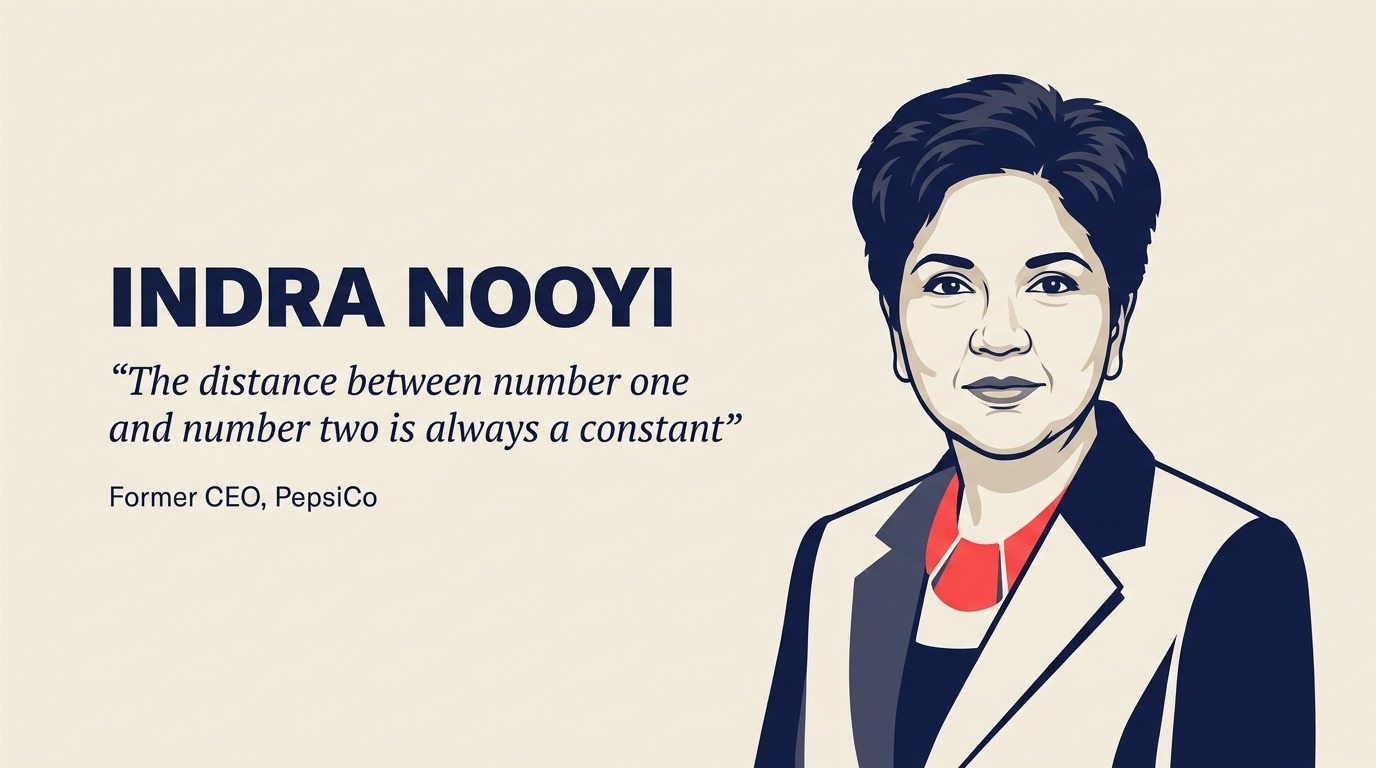
| Strategic Vision | Very High | "The distance between number one and number two is always a constant." Nooyi understood that in mature categories, the gap between winning and losing is narrow and sustained. She set strategy with a long horizon, Performance with Purpose was a 10-year thesis, not a quarterly initiative. Her ability to hold that direction under pressure from activists and short-term investors is rare at this scale. |
| Cultural Intelligence | Very High | Nooyi grew up in Chennai, India, and carried that background into her leadership of a global company operating in 200 markets. She understood that a product strategy designed in Purchase, New York couldn't simply be deployed globally without local adaptation. She pushed PepsiCo's marketing and R&D functions to build genuine regional intelligence rather than just localizing American products. |
| Stakeholder Management | High | Managing a company that faces activist hedge funds, health regulators, environmental critics, and retail customers simultaneously requires a specific kind of communication discipline. Nooyi was willing to have hard conversations with all of them, including being direct with Nelson Peltz when Trian Partners pushed for a breakup, while still moving her agenda forward. |
| Innovation | Strong | The healthier products pivot required real R&D investment, not just reformulation. Nooyi funded product development in Quaker snacks, Tropicana, and lower-calorie beverage lines while also commissioning research into reduced-sodium and reduced-sugar versions of core products. The innovation wasn't always successful, but it was genuine. |
The 3 Decisions That Defined Nooyi as a Leader
The Nooyi Dual Mandate (Performance with Purpose)
The Nooyi Dual Mandate is the leadership principle that financial performance and societal purpose are not opposing forces but complementary halves of the same long-run strategy. It requires every major capital, portfolio, and talent decision to pass two tests simultaneously: does it deliver returns to shareholders, and does it advance a defined purpose across human, environmental, and talent sustainability? In practice, the mandate forces trade-offs that pure-profit or pure-purpose strategies avoid.

1. Performance with Purpose as a Strategic Framework
When Nooyi articulated Performance with Purpose in 2006, she was making a claim that would be tested for the next 12 years: that doing right by employees, consumers, and the environment was a long-run competitive advantage, not a cost.
The framework had three pillars. Human sustainability meant shifting PepsiCo's product portfolio toward more nutritious options. Environmental sustainability meant reducing water use, packaging waste, and carbon footprint. Talent sustainability meant investing in employee development and diversity.
Each pillar created real decisions. PepsiCo acquired Naked Juice. It reduced the sugar in Gatorade. It reformulated Frito-Lay products to remove trans fats. These weren't symbolic moves. They required capital allocation, R&D prioritization, and the willingness to accept lower margins in the short term.
What this shows about her leadership: Nooyi understood that strategy only becomes real when it forces trade-offs. Performance with Purpose wasn't an aspiration. It was a decision filter. When a new acquisition or product line was proposed, it had to fit both halves of the thesis. That discipline gave the strategy teeth.
For today's leaders: if your company has a purpose statement that doesn't force any decisions, it isn't a strategy. What would you have to say no to if you took your stated values seriously?
2. The Healthier Products Portfolio Pivot
Between 2006 and 2018, Nooyi shifted PepsiCo's portfolio mix so that "good for you" and "better for you" products (defined by nutritional profiles rather than brand image) grew from a small fraction of revenue to a meaningful portion. She set a public target: triple the revenue from nutritious products to $30 billion by 2020.
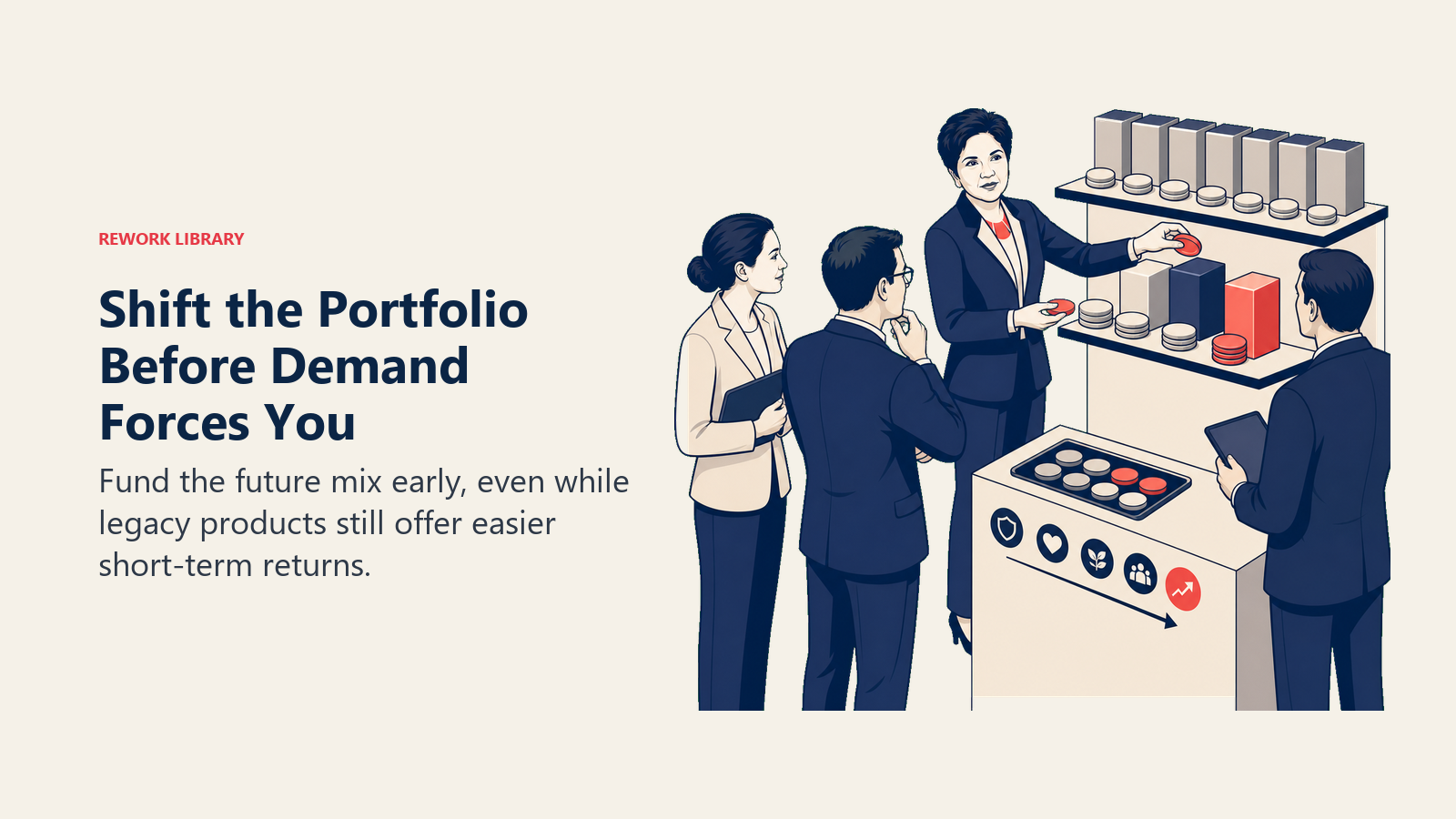
This required uncomfortable decisions. She reduced marketing investment in some of PepsiCo's most iconic brands. She invested in categories with lower margins than core snacks and beverages. She turned down product line extensions that would have boosted short-term revenue but moved against the portfolio thesis.
Activist investors, led by Nelson Peltz, argued that this was empire-building that diluted shareholder returns. They pushed for PepsiCo to be split, separating the snacks business from beverages, and argued that the healthier product push was destroying value. Nooyi held her position.
The result was mixed. Pepsi lost its number-two position in carbonated beverages to Diet Coke during her tenure, a fact critics used against her. But PepsiCo's overall revenue grew substantially, driven by exactly the diversification she had argued for. The long-term portfolio bet proved more durable than the critics predicted.
The leadership lesson: when you're making a portfolio shift that looks wrong in year three but is designed for year seven, the communication challenge is as hard as the strategic challenge. Nooyi's willingness to stay publicly committed to her thesis while accepting near-term criticism is what sustained the strategy long enough to produce results.
3. Global Expansion and Market-Specific Investment
One of Nooyi's less-discussed decisions was her investment in developing markets, particularly India, China, and the Middle East, at a time when many U.S. consumer companies were treating international markets as extension opportunities rather than growth priorities.
She built local R&D capacity in these markets rather than just exporting American products. She allowed regional teams more autonomy to adapt products to local taste profiles. She made acquisitions, including Wimm-Bill-Dann in Russia, that gave PepsiCo real local infrastructure rather than just distribution.
This required a specific leadership discipline: trusting people in markets she couldn't personally oversee and resisting the corporate impulse to standardize everything from the center. Her cultural intelligence made her better at this than most American executives in comparable roles.
What this shows: the ability to hold a strategic vision without needing to control every execution decision is a distinct leadership competency. Nooyi could articulate the global thesis clearly enough that regional leaders could make local decisions within it. That combination of strong direction and execution trust scales in a way that centralized control can't.
What Nooyi Would Do in Your Role
If you're a CEO building a multi-year strategy, the Performance with Purpose model has a lesson that applies at any scale: your strategy has to be explicit enough to force allocation decisions. If every initiative fits your strategy, your strategy isn't a strategy. Pick the two or three things you're actually optimizing for, and be willing to say no to profitable things that don't fit.
If you're a COO or operations leader, Nooyi's environmental sustainability work is worth studying as an operational discipline. Reducing water use and packaging waste weren't just PR initiatives. They were efficiency improvements that reduced cost at scale. Ask where your operational sustainability goals overlap with your cost reduction goals. That's where the ROI actually lives.
If you're a marketing or product leader, the healthier portfolio pivot has a lesson about managing a product transition without abandoning your core. PepsiCo didn't stop making Doritos. It diversified around them. When you're managing a product portfolio that has a long-term headwind (a legacy product in a declining category), the answer isn't usually to kill it. It's to build adjacent to it while the core still has value.
If you're building a diverse global team, Nooyi's cultural intelligence was a real competitive advantage. Mary Barra at GM navigated a comparable challenge, inheriting a cultural crisis (the ignition switch scandal) at a Fortune 50 legacy industrial company and building a transformation thesis around safety, electrification, and long-term portfolio repositioning while activist investors pushed for faster returns. Ginni Rometty at IBM faced structurally similar pressure: defend a mature hardware and services business while pivoting toward cloud and AI on a timeline that the market never found convincing enough. She could read a market she hadn't grown up in because she understood what it felt like to be in a cultural minority inside a dominant institution. That skill is learnable. Invest in it deliberately rather than assuming your best performers in your home market will translate globally.
Applying the Nooyi Dual Mandate with Rework
Nooyi's dual-mandate strategy only works when leaders can see both halves of the thesis at once, the quarterly P&L and the multi-year purpose metrics, without one hiding the other. Most leadership teams default to whichever dashboard is easier to pull up, and purpose-side commitments drift into the "we'll report on it annually" bucket until an activist or regulator forces the conversation.
Rework is built for executives who want to run a Nooyi-style dual scorecard without bolting on a second system. In the same workspace where sales operations tracks revenue pipeline, leaders can track sustainability initiatives, portfolio-shift targets, talent development programs, and stakeholder commitments, with the same cadence, the same dashboards, and the same accountability. Financial metrics stay honest because strategic metrics sit next to them. When a new acquisition, product line, or partnership comes up, the dual-mandate filter Nooyi described becomes operational, not aspirational. See Rework's pricing: the Process and Project Engines start at $99/month billed yearly, with 5 seats included.
The Shadow Side: What Nooyi Got Wrong
The activist pressure she faced wasn't entirely without merit. Under Nooyi's tenure, PepsiCo's stock significantly underperformed the S&P 500 and its primary competitor, Coca-Cola. Shareholders who owned PepsiCo rather than an index fund during her 12 years had real opportunity cost. The purpose-driven strategy may have been right long-term but it was expensive short-term, and some of that cost was real, not just optics.
The Diet Pepsi backlash is an instructive story. In 2015, PepsiCo removed aspartame from Diet Pepsi in response to consumer concern about artificial sweeteners. Sales fell sharply. The company reversed course within two years and brought aspartame back. It's a case of over-indexing on one slice of consumer sentiment without sufficient testing, a failure of the same consumer insight capability that was supposed to be a core strength.
The Quaker Oats and Tropicana businesses had well-documented underperformance during parts of her tenure. The acquisitions that were meant to accelerate the healthier portfolio pivot required more integration work than anticipated, and both businesses lost market share at various points. The strategy was right; the execution was uneven.
Nooyi also faced criticism that Performance with Purpose, while genuine in its intent, was partly a defensive narrative. Satya Nadella's modern transformation at Microsoft is the cleaner counter-example: a purpose-framed thesis ("mobile-first, cloud-first") that produced measurable financial re-rating because the portfolio shift and the margin structure moved in the same direction at the same time. Comparing the two shows when purpose-and-profit alignment works and when it becomes a communication problem. a story that made PepsiCo's portfolio complexity look like strategic sophistication rather than an organization that hadn't fully committed to any single direction. That critique isn't entirely fair, but it has enough truth in it to be worth noting.
Leadership Lessons You Can Use This Week
1. Make your strategy say no to something. This week, identify one initiative, partnership, or product extension that is profitable or promising but doesn't fit your stated strategic priorities. Make a decision about it. The decision itself communicates what your strategy actually is.
2. Write a letter to someone's family. Nooyi's practice of writing to the parents of her direct reports sounds small. It isn't. Pick one person on your team who did something this week that deserves recognition. Write a note to someone in their life who would care. The signal it sends about how you see people as whole humans, not just employees, is disproportionate to the effort.
3. Test your stakeholder communication. When did you last proactively communicate your long-term thesis to someone whose time horizon is shorter than yours: a board member, an investor, a major customer? Nooyi held her strategy by explaining it relentlessly. Pick one stakeholder this week and have that conversation before you're forced to.
4. Find where your sustainability goals overlap with your efficiency goals. Most companies treat environmental or social commitments as cost centers. Nooyi found where they overlapped with operational savings. This week, pick one sustainability initiative and ask your operations team where it could also reduce waste or cost.
Frequently Asked Questions about Indra Nooyi's Leadership
Who is Indra Nooyi?
Indra Nooyi (born 1955 in Chennai, India) is the former CEO of PepsiCo, serving from 2006 to 2018. She was PepsiCo's first female CEO, holds an MBA from Yale School of Management, and currently sits on the Amazon Board of Directors. Under her leadership, PepsiCo revenue grew from $35 billion to $63 billion.
What is 'Performance with Purpose'?
Performance with Purpose is the strategic platform Nooyi launched in 2006, built on three pillars: human sustainability (shifting the portfolio toward more nutritious products), environmental sustainability (reducing water use, packaging waste, and carbon footprint), and talent sustainability (investing in employee development and diversity). It argues that long-term financial performance and societal purpose reinforce each other rather than compete.
How did Nooyi transform PepsiCo?
She grew revenue from $35B to $63B over 12 years by diversifying the portfolio toward healthier products (acquiring Naked Juice, reformulating Frito-Lay and Gatorade, expanding Quaker and Tropicana), investing in developing markets like India, China, and Russia (Wimm-Bill-Dann acquisition), and building regional R&D capacity rather than exporting American products. She held this strategy publicly despite activist pressure from Nelson Peltz's Trian Partners.
What is Nooyi's leadership style?
Her style is roughly 70% transformational and 30% servant leadership. The transformational side showed in her decade-long portfolio repositioning and long-range strategic thesis. The servant side showed in her well-documented practice of writing personal letters to the parents of her direct reports and her heavy investment in talent development. Cultural intelligence, drawn from her Chennai upbringing, was a defining competitive advantage.
What is 'My Life in Full' about?
My Life in Full is Nooyi's 2021 memoir covering her upbringing in Chennai, her path through Yale SOM to U.S. consulting and corporate leadership, her 12 years running PepsiCo, and her arguments for why corporate policy on caregiving, family leave, and workplace flexibility needs to catch up with how modern professionals actually live. It blends personal narrative with a policy case for supporting working families.
What can modern CEOs learn from Indra Nooyi?
Three durable lessons: (1) strategy becomes real only when it forces trade-offs, a purpose statement that never makes you say no to anything isn't a strategy; (2) sustained communication of a long-range thesis is as hard as the strategy itself, especially when near-term results look ambiguous; (3) cultural intelligence scales, treating global markets as places with their own logic rather than as extensions of the home market is a learnable competency that compounds over a tenure.
Learn More
If this profile raised questions you want to go deeper on, these articles connect the ideas:
- Stakeholder Management for Executives: How to Hold Direction Under Pressure
- Purpose-Driven Business: When Values Create Competitive Advantage
- Jack Welch Leadership Style: How GE's CEO Turned Operational Rigor into Competitive Advantage
- Steve Jobs Leadership Style: How Perfectionism and Vision Built the World's Most Valuable Company

On this page
- Leadership Style Breakdown
- Key Leadership Traits
- The 3 Decisions That Defined Nooyi as a Leader
- The Nooyi Dual Mandate (Performance with Purpose)
- 1. Performance with Purpose as a Strategic Framework
- 2. The Healthier Products Portfolio Pivot
- 3. Global Expansion and Market-Specific Investment
- What Nooyi Would Do in Your Role
- Applying the Nooyi Dual Mandate with Rework
- The Shadow Side: What Nooyi Got Wrong
- Leadership Lessons You Can Use This Week
- Learn More