Tony Xu Leadership Style: Merchant Obsession, Market-Share Wars, and Building DoorDash to Win
Turn this article into takeaways for your work.


Each assistant summarizes the article only for you and suggests best practices for your work.
Tony Xu's leadership style is best defined as merchant-first, market-share-patient operating: he wins by serving the side of the marketplace everyone else ignores and holding that bet through subsidy wars. That discipline took DoorDash from four Stanford students to a $71B IPO and over 67% U.S. food delivery share, beating better-funded rivals.
Key Facts: Tony Xu (born 1984) co-founded DoorDash in 2013 while at Stanford Graduate School of Business and has served as CEO ever since. The company went public in December 2020 with a peak valuation of $72 billion and now carries a $24B+ market cap. Under Xu, DoorDash expanded beyond restaurants into grocery (DashMart), alcohol, and convenience, all anchored by a "merchant first" philosophy shaped by his Chinese immigrant childhood in Illinois, where his mother worked as a waitress.
DoorDash had no business winning. Uber Eats had more capital, an existing driver network, and a brand. Grubhub had a decade of market share. DoorDash launched in 2013 with four Stanford students, a website called paloaltodelivery.com, and a merchant-first thesis that every other player in food delivery had either ignored or deprioritized.
By December 2020, DoorDash went public at a $71 billion first-day valuation. Today it holds over 67% of U.S. food delivery market share, more than Uber Eats and Grubhub combined.
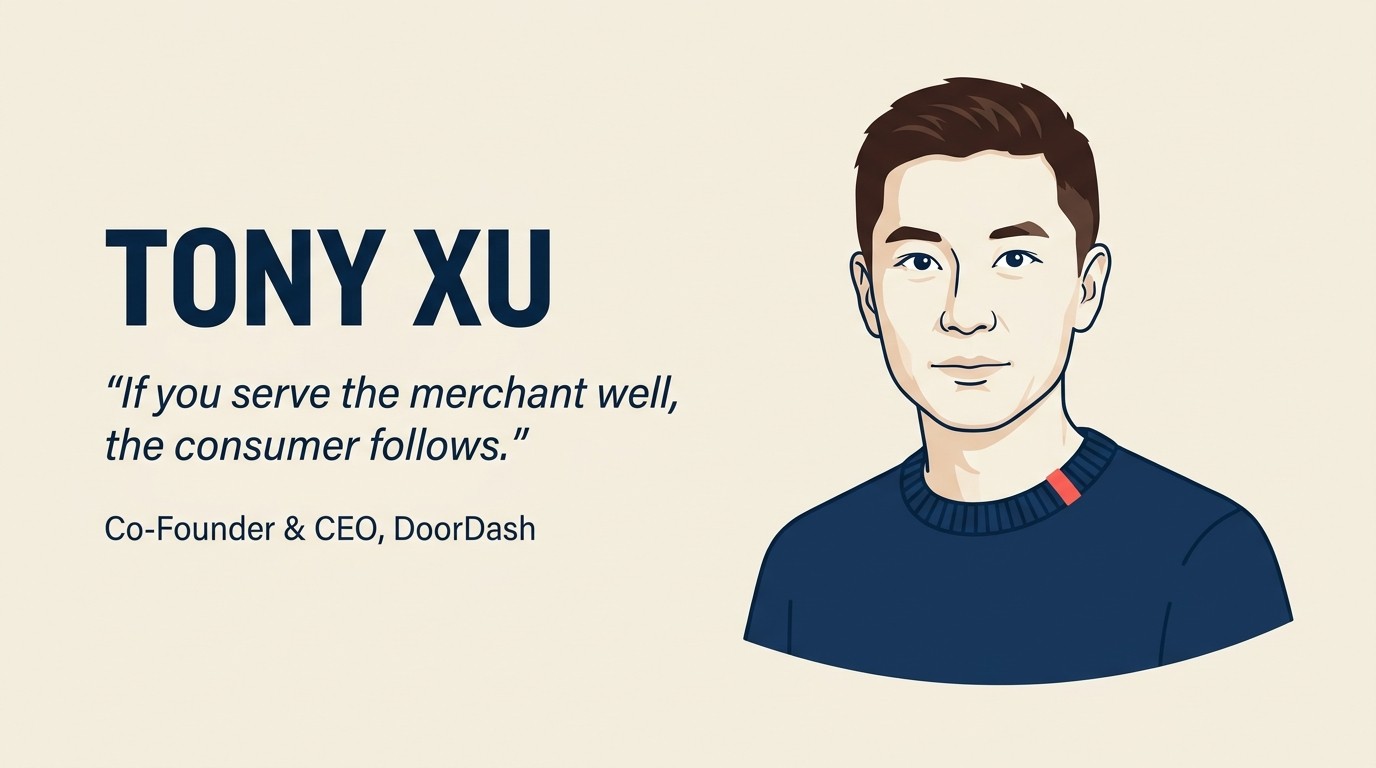
Tony Xu is a Chinese immigrant who arrived in Illinois at age 5. His mother worked as a waitress. That wasn't just a hardship story he told on the fundraising circuit. It shaped a specific leadership lens: if you serve the merchant, the consumer follows. If you only serve the consumer, you've built a business that depends on discounts you can't sustain. It's a harder model. It's also the reason DoorDash is still standing while better-funded competitors burned out.
Leadership Style Breakdown
| Style | Weight | How it showed up |
|---|---|---|
| Merchant-Obsessed Operator | 60% | Xu personally delivered food on DoorDash in the early days, not for optics, but to understand the operational reality on both sides. He built merchant dashboards, analytics tools, and revenue-sharing models that treated restaurant owners as business partners, not commodities. The acquisition of Caviar from Square in 2019 for $410 million was a merchant upgrade play, not a consumer feature. The $8 billion acquisition of Wolt in 2022 extended the merchant-first model to European markets. |
| Underdog Competitor | 40% | DoorDash entered markets where it was outspent and outgunned. Xu's competitive instinct was to find the segments nobody else was fighting for (suburban restaurants, smaller chains, independent operators) and own them before the larger players noticed. The underdog frame wasn't a marketing position. It was an actual strategic filter for where to allocate resources when capital was limited. |
The 60/40 split explains why DoorDash's growth didn't collapse when consumer subsidies declined. When your model is built on merchant value rather than consumer discounts alone, you've got a second engine. Xu understood earlier than most that the supply side of a two-sided marketplace is where sustainable unit economics come from.
The Merchant-First Doctrine (The Xu Three-Sided Marketplace Model)
The Merchant-First Doctrine is Tony Xu's operating thesis that in a three-sided marketplace of merchants, Dashers, and consumers, the merchant relationship is the durable competitive asset because consumers follow selection and Dashers follow order volume, but merchants only stay if the platform actively grows their business. Unlike two-sided marketplace theory, which treats supply and demand as symmetrical, the Xu model deliberately over-invests in merchant tools, analytics, and revenue share so that switching costs compound on the supply side. Consumer subsidies win transactions; merchant services win contracts.
Key Leadership Traits
| Trait | Rating | What it means in practice |
|---|---|---|
| Customer segment clarity | Exceptional | Most food delivery operators talk about "serving customers." Xu was specific: the underserved customer in DoorDash's early thesis was the merchant, not the diner. That clarity drove product investment in merchant tools, restaurant analytics, and DoorDash for Business that competitors weren't building because they were too focused on the consumer side. Segment clarity at the founder level propagates through the entire product roadmap. |
| Long-term market share patience | Very High | DoorDash spent years with razor-thin unit economics and a stock that dropped 30%+ from its 2021 peak. Xu didn't abandon the market-share-first playbook. He kept investing in suburban expansion and merchant relationships while analysts questioned the model. The patience wasn't passive, it was active conviction that the model worked if you held it long enough for the network effects to compound. |
| Ground-level operational instinct | Very High | Xu delivered food himself. He worked restaurant kitchens. He understood pick-up friction, parking logistics, and order accuracy failures from personal experience. That's not an unusual founding story. What's unusual is that he built organizational structures (Dashers are drivers, but DoorDash also employs operational staff who do the same thing) that kept ground-level signal flowing into product decisions at scale. |
| Resilience in low-margin economics | High | Food delivery margins are notoriously thin. Xu built DoorDash in a sector where every unit of growth requires defending against subsidy wars, driver turnover, and restaurant fee negotiations simultaneously. The company survived a near-death period in 2017 when Postmates was dominating specific markets. That resilience wasn't just personal, it was built into how DoorDash structured its financial model, always looking for the next revenue layer (DashPass, enterprise catering, advertising) before the current one reached its ceiling. |
The 3 Decisions That Defined Tony Xu as a Leader
1. Starting with Suburban Restaurants When Competitors Focused on Urban Density
In 2013, every food delivery company was racing to dominate Manhattan, San Francisco, and Chicago. Dense urban areas meant more orders per delivery mile, which made the unit economics easier to defend on a spreadsheet.
Xu went the other direction. DoorDash launched in Palo Alto and expanded into suburban markets, places where restaurants had demand but no delivery infrastructure at all. There was no competition. Restaurants were grateful for any delivery capability. Drivers could handle more orders per hour because distances were predictable. And the suburban restaurant owner became a loyal DoorDash partner because DoorDash was the only player who showed up for them.
That geographic bet opened a market nobody was fighting for. By the time Uber Eats realized the suburbs mattered, DoorDash had merchant relationships that took years to displace. Market share in a segment with no competition compounds differently than market share won through subsidy wars. It's the same instinct Patrick Collison used at Stripe, find the infrastructure layer everyone else decided wasn't worth building, and own it before the incumbents notice.
The leadership lesson isn't "go suburban." It's: where is the customer segment your competitors have decided isn't worth the effort? That gap is almost always larger than it looks from the outside.
2. Surviving the Post-IPO Uber Eats Price War by Doubling Merchant Services
After DoorDash's December 2020 IPO, Uber Eats intensified its competition with aggressive consumer discounting. The standard playbook for a market-share war in consumer delivery is to match the discounts, lower fees for consumers, bigger promotions, faster delivery guarantees.
Xu didn't play that game directly. Instead of matching Uber Eats' consumer promotions dollar for dollar, DoorDash doubled down on the merchant services layer. That's a move Brian Chesky made at Airbnb during COVID. When competitors retreated on costs, he invested deeper in the host relationship, treating supply-side loyalty as the durable asset. New tools for restaurant analytics. Expanded DoorDash Drive (white-label delivery for restaurants who wanted to own the customer relationship). Advertising products that let restaurants pay for placement in the app. Enterprise catering programs.
The strategic logic was clear: if DoorDash built services merchants couldn't get anywhere else, the merchant wouldn't switch platforms even if a competitor temporarily offered lower consumer fees. The merchant relationship became the switching cost. Consumer subsidies win transactions; merchant services win contracts.
It worked. DoorDash's merchant base held through the price war. And the new revenue lines from merchant services improved unit economics in ways that pure consumer discount competition couldn't.
3. Launching DashPass to Shift from Transaction Revenue to Recurring Revenue
In 2018, DoorDash launched DashPass at $9.99 per month, a subscription that gave subscribers free delivery on orders above a minimum purchase. The immediate effect was a reduction in per-order revenue from subscribers. That's a counterintuitive thing to do when you're trying to improve margins.
The structural effect was what Xu was betting on. DashPass subscribers ordered more frequently. They became loyal to DoorDash as a default, not just a convenience check. The recurring revenue base made financial planning more predictable. And subscribers were more likely to try new restaurant categories, which expanded the merchant base's viable audience.
By 2024, DashPass had tens of millions of subscribers. It also created a meaningful moat against Uber Eats: a subscriber who's already paying $9.99 a month has a real cost to switching. The decision to accept lower per-transaction revenue in exchange for higher order frequency and subscriber loyalty is a structural bet that changed DoorDash's unit economics permanently.
The leadership frame: when you shift from transaction revenue to subscription revenue, you're making a long-term bet on customer lifetime value over short-term margin. Xu made that bet earlier than most of his competitors and at a time when DoorDash was already under market pressure. That's when contrarian bets are hardest and most valuable. Travis Kalanick's gig-economy model at Uber faced the same recurring-versus-transactional tension, and the contrast in how each founder resolved it explains a lot about where both companies ended up.
What Tony Xu Would Do in Your Role
If you're a CEO running a 50-200 person company, the DoorDash founding story has one direct question for you: which side of your two-sided marketplace or value chain are you underserving? Most companies default to obsessing over the end consumer because the consumer is visible and vocal. But in marketplace and platform businesses, the supply side, merchants, sellers, service providers, often determines whether your growth is defensible. Where are the underserved operators in your market who would be grateful to have you show up for them?
If you're a COO or operations leader, the DashPass launch is the relevant model. Xu's team had to absorb short-term revenue compression to achieve long-term subscriber loyalty. That kind of structural shift requires operational forecasting that can hold the vision through the period when the numbers look worse. What's the equivalent shift in your business where accepting short-term pain creates a recurring revenue structure you don't currently have?
If you're a product leader, Xu's personal delivery work is the discipline to copy. He understood operational failure modes, pick-up delays, order accuracy problems, driver navigation issues, not from dashboards but from experiencing them. At your current stage, what's the equivalent ground-level product knowledge you're building from abstracted data instead of direct experience? Take the thing you're building and use it the way your least-technical customer would. Run that experiment this week.
If you're a sales or marketing leader, the suburban restaurant bet has a direct application. Go find the customer segment your top three competitors have decided isn't worth the effort. That might be a geographic market, a company size range, or an industry vertical. Competitors ignore segments because the economics look thin or the sales cycle looks long. That's often because nobody's built the right offer for that segment yet. That gap is your DoorDash moment.
How Rework Supports Three-Sided Marketplace Leaders
Xu's playbook is relentless: treat merchants, Dashers, and consumers as three separate operating functions, then compete on the one everyone else ignores. For founders building marketplaces, SaaS platforms with a partner channel, or any business with more than one customer side, the execution problem is coordination, keeping merchant onboarding, supply operations, and consumer growth moving in sync without the CEO becoming the integration layer.
Rework's Sales Engine (from $69/month billed yearly) lets founders run merchant acquisition, partner health, and enterprise deals from one pipeline view, while the Process Engine (from $99/month billed yearly) handles the cross-functional projects, onboarding checklists, and ops playbooks that keep supply quality high as you scale. That's the difference between Xu-style disciplined expansion and the competitors who burned out chasing consumer growth without a system for the other two sides.
Notable Quotes and Lessons Beyond the Boardroom
Xu has described his mother's experience as a restaurant waitress as the founding insight behind DoorDash's merchant focus. That kind of immigrant-shaped founder conviction runs through Daniel Ek's Spotify origin story too, a European founder who used a personal sense of what was broken to build infrastructure the American incumbents missed. "I saw how hard small business owners worked and how little support they had," he's said in multiple interviews. That's not a soft origin story. It's a product brief: build the infrastructure layer that lets small restaurant operators compete with chains.
He also holds a Stanford MBA, which gives him the analytical vocabulary to talk about unit economics, market share dynamics, and two-sided marketplace theory fluently. But Xu has been deliberate about not letting the MBA frame override the operational instinct. He's described the early days of delivering food himself as more valuable market research than anything he learned in a classroom.
The most instructive lens on Xu's leadership style is what he built around the "forgotten" side of the marketplace. Every major platform has a supply side that gets less attention than the consumer. Merchants on Amazon, drivers on Uber, sellers on eBay. DoorDash wasn't the first company to notice this. But Xu was among the few founders who built the entire company around it rather than treating merchant satisfaction as a secondary metric.
That orientation produced the $8 billion Wolt acquisition in 2022. Wolt was a European food delivery company with a strong merchant reputation in Nordic and Central European markets. The strategic logic was consistent with everything DoorDash had done since paloaltodelivery.com: find markets where merchants are underserved, build relationships before competitors notice, and use those relationships as the durable competitive asset.
Where This Style Breaks
Xu's merchant-obsession model creates a competitive moat in low-margin logistics businesses where supplier loyalty matters and where the supply side is fragmented enough that aggregating it creates defensible value. It's the right model for food delivery, local commerce, and similar categories.
But in markets where consumers hold all the switching power, and where there's no meaningful supply-side fragmentation, over-investing in the supply side can slow consumer growth without building a moat. DoorDash's model also required massive capital to sustain during the market-share war period. Operators without access to late-stage VC funding can't run the same acquisition-and-expansion playbook. And ongoing gig-worker classification lawsuits and thin unit economics mean the model's long-term profitability is still being stress-tested.

On this page
- Leadership Style Breakdown
- The Merchant-First Doctrine (The Xu Three-Sided Marketplace Model)
- Key Leadership Traits
- The 3 Decisions That Defined Tony Xu as a Leader
- 1. Starting with Suburban Restaurants When Competitors Focused on Urban Density
- 2. Surviving the Post-IPO Uber Eats Price War by Doubling Merchant Services
- 3. Launching DashPass to Shift from Transaction Revenue to Recurring Revenue
- What Tony Xu Would Do in Your Role
- How Rework Supports Three-Sided Marketplace Leaders
- Notable Quotes and Lessons Beyond the Boardroom
- Where This Style Breaks