Amy Edmondson Leadership Style: Psychological Safety, Intelligent Failure, and the Research That Changed How Teams Work
Turn this article into takeaways for your work.


Each assistant summarizes the article only for you and suggests best practices for your work.
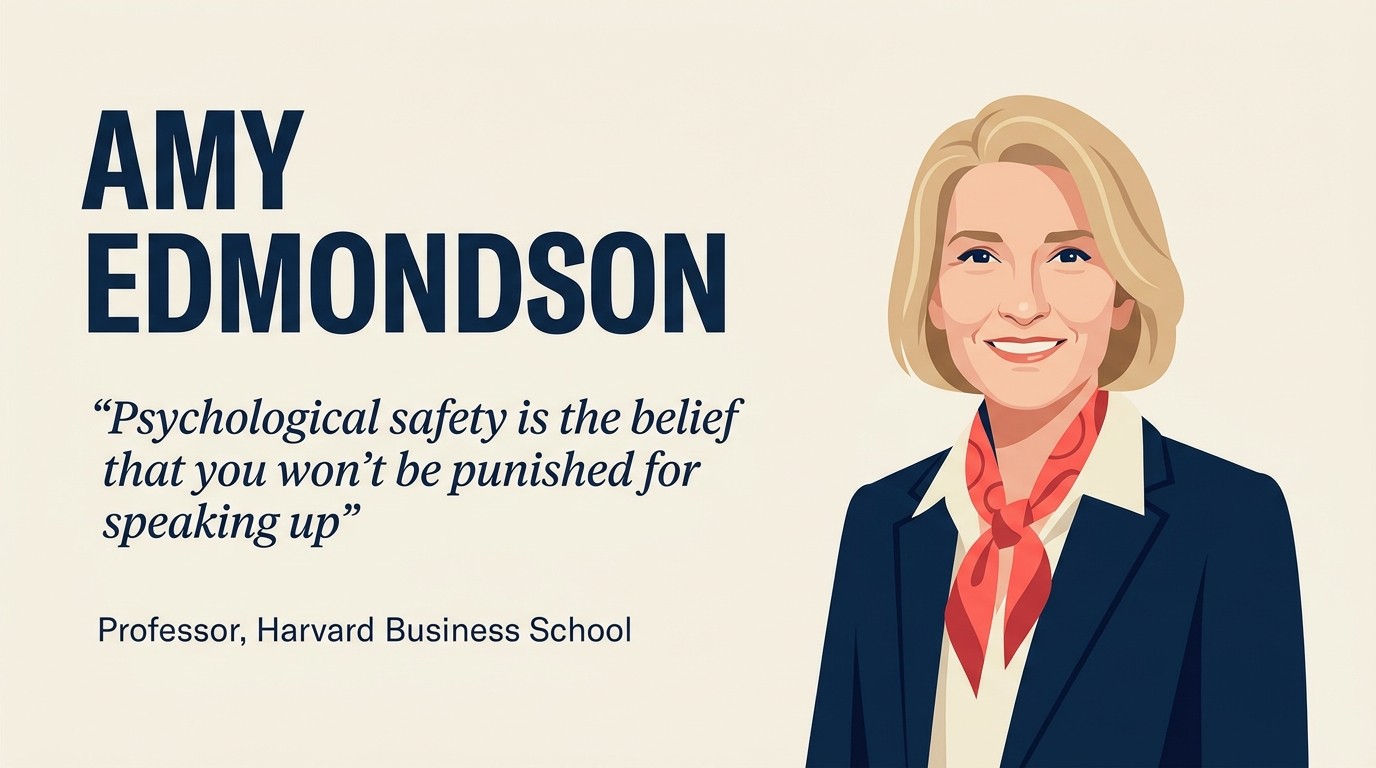
Key Facts: Amy Edmondson is the Novartis Professor of Leadership and Management at Harvard Business School, where she has been a faculty member since 1996. She coined the term "psychological safety" in her 1999 Administrative Science Quarterly paper "Psychological Safety and Learning Behavior in Work Teams." Her books include "Teaming" (2012), "The Fearless Organization" (2018), and "Right Kind of Wrong" (2023), the last a Wall Street Journal bestseller. She was ranked #1 management thinker in the world by Thinkers50 in 2021.
The Psychological Safety Model
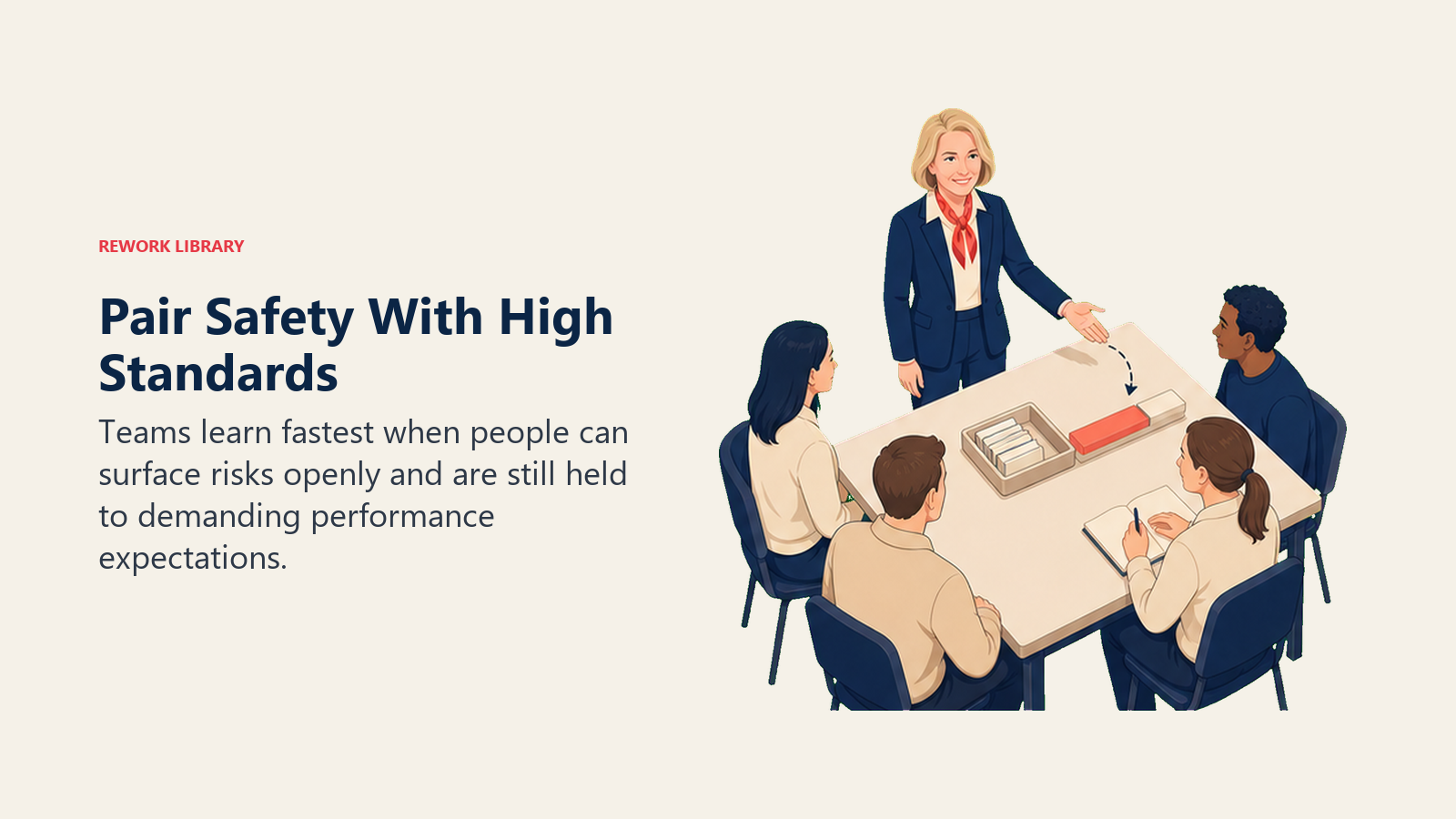
The Psychological Safety Model, also known as the Fearless Organization Doctrine, defines psychological safety as a shared belief that a team is safe for interpersonal risk-taking, the willingness to speak up with ideas, questions, concerns, or mistakes without fear of embarrassment or punishment. Edmondson's doctrine pairs psychological safety with high performance standards on two axes, producing four zones: learning (high safety, high standards), comfort (high safety, low standards), anxiety (low safety, high standards), and apathy (low safety, low standards). Only the learning zone produces sustainable high performance, because only there do teams surface the information leadership needs to make good decisions.
In 1999, Amy Edmondson set out to study medical error rates. She expected that better-performing hospital teams would make fewer mistakes. Instead, she found the opposite: high-performing teams reported more errors. The reason wasn't that they were worse. They felt safe enough to talk about what went wrong.
That single observation became one of the most influential findings in organizational behavior of the last 30 years. Google ran a two-year internal study called Project Aristotle between 2012 and 2015 and arrived at the same conclusion: psychological safety was the top predictor of team effectiveness across 180 teams, more than skills, IQ, or effort. Laszlo Bock, who led People Operations at Google during that study, built the HR architecture that made Project Aristotle possible and acted on its findings at scale. Edmondson coined the term. She spent two decades building the research behind it.
If your teams are quiet in meetings and problems only surface in post-mortems, you have a psychological safety problem. And she's already mapped the solution.
Leadership Style Breakdown
| Style | Weight | How it showed up |
|---|---|---|
| Rigorous Researcher-Practitioner | 65% | Edmondson holds the Novartis Professor of Leadership and Management chair at Harvard Business School. Her academic work is peer-reviewed, longitudinal, and methodologically precise. She doesn't publish frameworks because they're catchy, she publishes them because the data supports them. The 1999 paper in Administrative Science Quarterly is a model of intellectual precision: she defined psychological safety as a specific construct (perceived interpersonal risk in speaking up), measured it separately from trust and job satisfaction, and controlled for the things people assumed would explain her findings. That rigor is what gave her framework durability when Google replicated it 15 years later. |
| Systems-Oriented Educator | 35% | Edmondson's books, "The Fearless Organization" (2018) and "The Right Kind of Wrong" (2023), translate academic findings into tools that operators can deploy. "The Fearless Organization" provides a practical map for leaders who want to build psychologically safe teams without a PhD in organizational behavior. The 35% weight reflects that her primary identity is researcher, but her influence on actual organizations comes disproportionately from the practitioner translation work. |
The 65/35 split is important because it explains why Edmondson's work has lasted while other "culture" frameworks faded. It was built on evidence first. The practitioner layer came after. That sequence matters: frameworks built on evidence update as evidence changes. Frameworks built on consulting intuition can't.
Key Leadership Traits
| Trait | Rating | What it means in practice |
|---|---|---|
| Precision in defining constructs | Exceptional | Edmondson's definition of psychological safety is specific: "a belief that the work environment is safe for interpersonal risk-taking." Not comfort. Not harmony. Not being nice. Interpersonal risk-taking, the willingness to say something that might make you look wrong, ignorant, or disruptive. That precision matters enormously in practice because organizations misapply her framework constantly, treating psychological safety as a synonym for low-conflict environments. The precision is what separates teams that apply the framework correctly from teams that use it as a cover for avoiding accountability. |
| Ability to bridge academia and practice | Exceptional | Edmondson has done what almost no organizational psychologist has: she produced research rigorous enough for HBS and practical enough for Google's People Operations team to act on. "The Fearless Organization" is cited in academic papers and in CEO offsites. "The Right Kind of Wrong" was a Wall Street Journal bestseller. Most researchers who achieve that kind of reach do so by simplifying. Edmondson achieved it without sacrificing accuracy. |
| Reframing failure as organizational data | Very High | Her failure typology, preventable, complex, and intelligent failures, is the most operationally useful framework she's produced for non-researchers. It shifts the question from "should we tolerate failure?" to "what kind of failure are we looking at?" Preventable failures (deviations from known processes) should be minimized. Complex failures (multi-factor system breakdowns) should be understood and prevented where possible. Intelligent failures (fast experiments in new territory) should be celebrated. Most organizations conflate all three and end up either punishing everything or excusing everything. |
| Long-horizon intellectual patience | High | The gap between Edmondson's 1999 paper and "The Fearless Organization" in 2018 is 19 years. During that time, she wasn't waiting for the right moment, she was continuing to research, refine, and test her framework in real organizations. Most researchers who have a breakout finding rush to publish a trade book within two years. Edmondson waited until the research was robust enough to support a practical guide that wouldn't embarrass the underlying science. |
The 3 Decisions That Defined Amy Edmondson as a Leader
1. Publishing the 1999 Paper That Named Psychological Safety
Edmondson's paper "Psychological Safety and Learning Behavior in Work Teams" was published in Administrative Science Quarterly in 1999. The core finding, that higher-performing teams reported more errors because they felt safe enough to surface them, was counterintuitive, and she was precise about why.
She defined psychological safety carefully: it's not about how people feel in general. It's about whether people believe they can speak up without being punished, embarrassed, or marginalized. That distinction matters because it separates the construct from personality traits (some people are more candid by nature), from team cohesion (teams can be close-knit and still punish dissent), and from trust in the abstract sense.
Why naming a construct matters: before Edmondson, practitioners had vague intuitions about why some teams shared bad news early and others surfaced problems only after they'd become crises. They called it "culture," or "communication," or "leadership style." None of those terms were precise enough to measure, diagnose, or intervene in. Edmondson gave them a term that was precise enough to operationalize.
The organizational implication is specific and underutilized. If you want to know whether your teams have psychological safety, don't ask "do people feel comfortable here?" Ask: "In the last month, did anyone on your team surface a problem before you asked about it?" Or: "Did anyone disagree with a decision in the meeting where the decision was made, rather than after?" Those are behavioral tests of the construct, not attitude surveys.
Edmondson's other contribution in 1999 was methodological. She measured psychological safety separately from team performance, which meant she could identify teams that were high on one and low on the other. That comparison (high psychological safety/low performance versus low psychological safety/high performance) is where the interesting findings live.
2. Writing "The Fearless Organization" as a Practical Field Guide
The Fearless Organization came out in 2018, 19 years after the original research. That gap is intentional. Edmondson spent those years running studies across hospitals, financial services firms, manufacturing plants, and technology companies. By 2018, she had enough replications across enough contexts to write a guide that wasn't just "here's the finding from one hospital study" but "here's how this plays out across industries, organizational sizes, and leadership structures."
The book's most useful contribution is its three-level model of how leaders create or destroy psychological safety. At the individual level, leaders signal safety through how they respond to bad news and challenging questions. At the team level, safety is a function of norms: whether the team has collectively agreed that surfacing problems is valued, not penalized. At the organizational level, safety is a function of systems: how performance reviews are structured, whether failure is discussed publicly and analytically, whether people who raise concerns are rewarded or marginalized.
The 19-year gap between research and book was a feature, not a delay. Trade books built on thin research have short shelf lives. "The Fearless Organization" is still being assigned in business school courses and cited in People Analytics reports because the evidence base is deep enough that new research tends to extend rather than contradict it.
The practical deployment she describes is worth noting specifically. Edmondson is explicit that psychological safety without accountability is not a high-performance environment. It's a comfortable one. Her framework requires both simultaneously: leaders who set high standards and leaders who make it safe to surface the gap between current performance and those standards. The mistake most organizations make is treating safety and accountability as a tradeoff.
3. Developing the Failure Typology
"The Right Kind of Wrong" (2023) extends Edmondson's research into failure science. The core contribution is the three-category typology: preventable failures, complex failures, and intelligent failures. Each requires a different response.
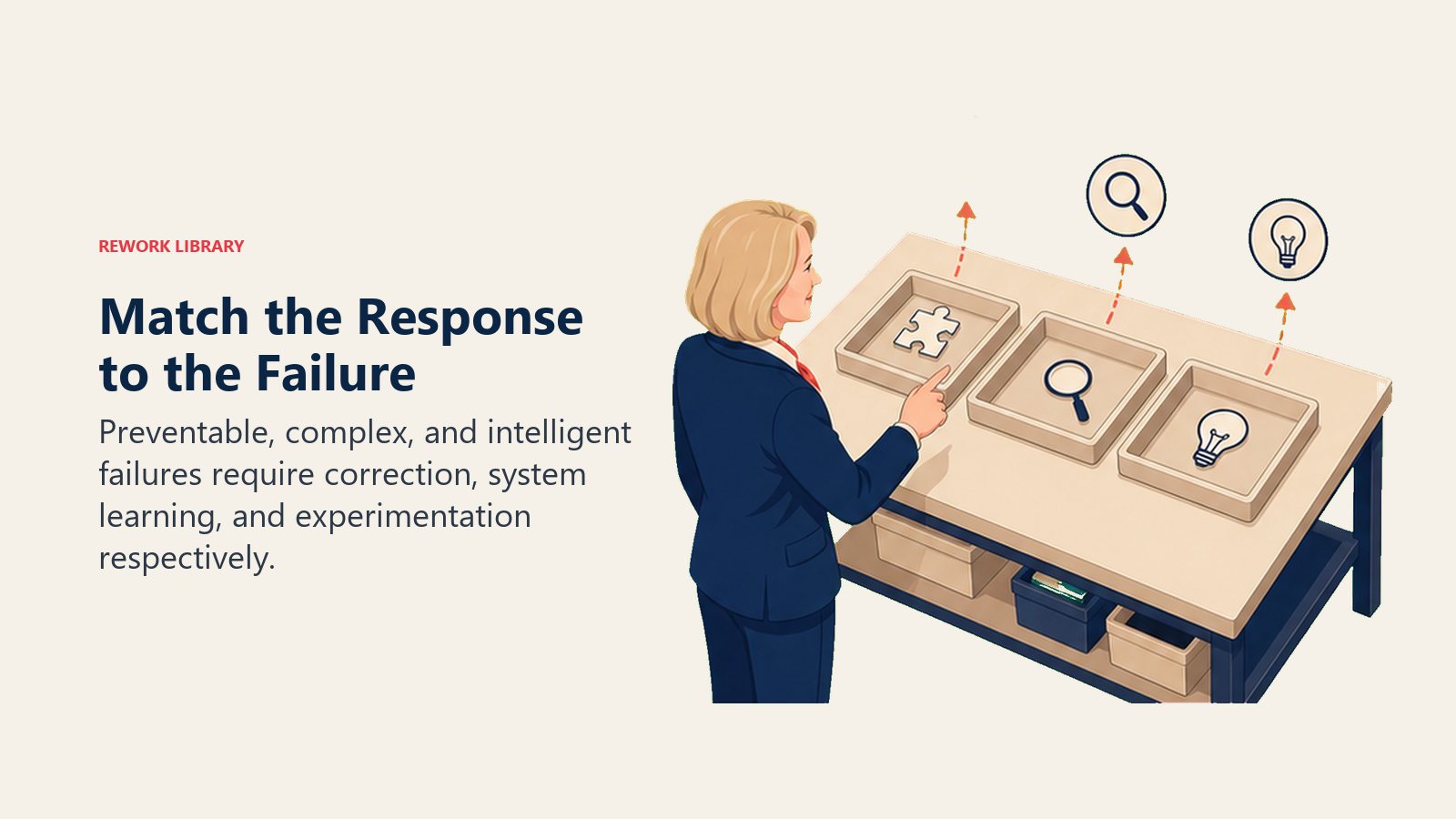
Preventable failures are deviations from established processes in contexts where the right process is known and the conditions are familiar. A surgical checklist error, a manufacturing defect from skipping a step, a financial reporting mistake from not following the standard. These should be minimized through process discipline, training, and design. Celebrating preventable failures as "learning opportunities" is a misapplication of failure tolerance.
Complex failures emerge from multiple interacting factors in systems where cause and effect are hard to trace in advance. A product launch that fails because pricing, timing, and competitive dynamics all shifted simultaneously. These aren't preventable through better process alone. They require systems thinking and honest post-analysis.
Intelligent failures are hypotheses tested in genuinely new territory, where the outcome couldn't have been predicted in advance. An A/B test that definitively rules out a promising approach. A market entry that reveals a customer insight you couldn't have gotten any other way. These should be celebrated because they produce information that reduces uncertainty for the next decision.
The typology matters because most organizations have a single failure policy: either "we learn from everything" (which excuses preventable failures) or "failures are bad" (which punishes intelligent experiments). Edmondson's argument is that undifferentiated failure tolerance is as damaging as undifferentiated failure punishment. The analytical value of the typology is that it forces you to categorize the failure before you decide how to respond.
What Amy Edmondson Would Do in Your Role
If you're a CEO, Edmondson's most direct diagnostic for you is about what you do when someone brings you bad news unprompted. Not how you respond verbally. Most CEOs say the right things. What matters is what happens to that person's standing in the organization in the following months. If people who surface problems early tend to get less access, fewer resources, or subtler forms of marginalization, you've already answered the question about whether your organization has psychological safety. And the answer isn't culture change. It's behavior change, starting with you.
If you're a COO or operations leader, the failure typology has an immediate application to how you run post-mortems. Most operational post-mortems conflate all three failure types, treating a process deviation and a systemic breakdown and an experimental failure as the same category of problem. That conflation produces either blanket blame or blanket absolution, neither of which generates useful learning. Edmondson would push you to triage every significant failure into one of the three categories before you discuss causes. The category determines the right diagnostic questions.
If you're a product leader, the psychological safety research has a specific product application that Adam Grant has extended in his own work: the features and strategies your team isn't telling you about are often more important than the ones they are. If your team consistently brings you polished ideas rather than rough hypotheses, you've created a filtering system that eliminates the most interesting early-stage thinking. Edmondson would ask you to explicitly invite the half-formed ideas, the dissents, the "I'm not sure if this is stupid" observations, and to respond in ways that make it safe to bring the next one.
If you're in sales or marketing, the fearless organization principles translate directly into how you run pipeline reviews and creative debriefs. The question isn't whether people feel good about the meeting. It's whether the people who knew the deal was in trouble or the campaign was underperforming said so before you asked. If your team waits to be asked, you're running a psychologically unsafe environment for sharing bad news, which means problems arrive late, at higher cost, with fewer options.
Edmondson's Model in the Rework Era: Distributed Teams, Visible Work
Psychological safety gets harder in distributed teams. When half your team is remote, the informal signals that tell people whether it's safe to speak up, facial reactions, hallway conversations, body language in the room, thin out. What replaces them is the design of the tools teams work in. If a platform exposes every task, message, and status change to management scrutiny without mutual context, it becomes surveillance, and surveillance is the opposite of safety. People performance-manage their own visibility rather than surface problems.
Rework's team operations design treats visibility as reciprocal, not extractive. Work in progress is shared laterally across the team, not just upward to managers. Blockers and late-stage issues can be flagged without escalation drama, because the tool is built for surfacing, not scoring. The distinction Edmondson draws between accountability and anxiety shows up in the product: high standards are visible in the goals and commitments, and the path to flagging what isn't working is frictionless. That's how you run a fearless organization when the team is spread across six time zones.
Notable Quotes and Lessons Beyond the Boardroom
Edmondson's most important distinction is between psychological safety and accountability. She's explicit that conflating the two is the most common misapplication of her work: "Psychological safety is not about being nice. It's not about low standards. It's about creating the conditions where people can do their best work, which requires that they can tell you when something isn't working." The combination of high standards and high safety is what she calls the "learning zone." Low safety with high standards is the "anxiety zone." High safety with low standards is the "comfort zone." Low safety with low standards is the "apathy zone." Most high-performing teams operate from the learning zone, where the pressure is real and the honesty is too.
Google's Project Aristotle validated her 1999 finding across 180 teams with a 2015 report that became one of the most cited documents in People Analytics. The study controlled for team composition, skills, tenure, and management quality. Psychological safety was the single most predictive variable for team effectiveness, more predictive than any individual characteristic of the team members. That's a finding with significant practical implications: you can have a team of exceptional individuals who produce mediocre outcomes because the interpersonal environment makes them unwilling to take the risks that exceptional work requires.
Her argument about intelligent failure, that the most important organizational skill is not avoiding failure but learning from the right kind, is worth applying to your own leadership development. The leaders who develop fastest aren't the ones who avoid making mistakes. They're the ones who design small, fast experiments, analyze what they learn honestly, and update their approach accordingly. That's the intelligent-failure model applied to leadership itself.
Where This Style Breaks
Edmondson's framework assumes enough organizational stability to invest in culture over time. In a genuine turnaround (cash crisis, imminent layoffs, existential product failure), building psychological safety is a medium-term project that competes with short-term survival. You can't run a 6-month cultural intervention when you have 90 days of runway.
Her typology also presupposes that leadership genuinely wants honest information. In cultures where the top team punishes candor privately while endorsing it publicly, the framework describes a destination the organization hasn't agreed to reach. The tools work. But they require a leadership team that actually wants the feedback the tools will surface, and that condition isn't universally present. Edmondson names this honestly. She doesn't pretend the framework installs itself.
Frequently Asked Questions about Amy Edmondson's Leadership Research
Who is Amy Edmondson?
Amy Edmondson is the Novartis Professor of Leadership and Management at Harvard Business School, where she has taught since 1996. She is an organizational behavior researcher best known for coining the term "psychological safety" and for her work on team learning, failure science, and fearless organizations. Thinkers50 ranked her the #1 management thinker in the world in 2021.
What is psychological safety?
Psychological safety is the shared belief that a team is safe for interpersonal risk-taking, speaking up with ideas, questions, concerns, or admissions of mistakes without fear of embarrassment or punishment. Edmondson defined it in her 1999 paper as a specific construct distinct from trust, cohesion, or team satisfaction. It is about whether people believe they can take candor risks, not whether they feel generally comfortable.
Why does psychological safety matter for performance?
Google's two-year Project Aristotle study of 180 teams (2012–2015) identified psychological safety as the single strongest predictor of team effectiveness, outranking individual skills, tenure, and team composition. Teams without it hide problems until they become crises, while teams with it surface issues early when they are cheaper to fix. The effect compounds: safer teams learn faster, experiment more, and ship better decisions.
What are the four types of failure per Edmondson?
In "Right Kind of Wrong" (2023), Edmondson distinguishes three failure categories, not four: preventable failures (deviations from known processes in familiar conditions, which should be minimized), complex failures (multi-factor system breakdowns that require honest post-analysis), and intelligent failures (fast experiments in genuinely new territory, which should be celebrated). Applying a single failure policy to all three is the most common mistake leaders make.
What can managers learn from Edmondson?
Managers should pair high performance standards with high psychological safety, what Edmondson calls the "learning zone." Practical applications include running post-mortems that triage failures into her three categories, testing safety with behavioral questions ("did anyone surface a problem before you asked?") rather than attitude surveys, and tracking how people who deliver bad news fare in the organization over the following months.
What books has Amy Edmondson written?
Her major books are "Teaming: How Organizations Learn, Innovate, and Compete in the Knowledge Economy" (2012), "The Fearless Organization: Creating Psychological Safety in the Workplace for Learning, Innovation, and Growth" (2018), and "Right Kind of Wrong: The Science of Failing Well" (2023). "Right Kind of Wrong" was a Wall Street Journal bestseller and won the Financial Times Business Book of the Year award in 2023.
For related reading on team dynamics and organizational culture, see Adam Grant Leadership Style, Laszlo Bock Leadership Style, Kim Scott Leadership Style, Brené Brown Leadership Style, Patrick Lencioni Leadership Style, and Daniel Goleman Leadership Style.

On this page
- The Psychological Safety Model
- Leadership Style Breakdown
- Key Leadership Traits
- The 3 Decisions That Defined Amy Edmondson as a Leader
- 1. Publishing the 1999 Paper That Named Psychological Safety
- 2. Writing "The Fearless Organization" as a Practical Field Guide
- 3. Developing the Failure Typology
- What Amy Edmondson Would Do in Your Role
- Edmondson's Model in the Rework Era: Distributed Teams, Visible Work
- Notable Quotes and Lessons Beyond the Boardroom
- Where This Style Breaks