Peter Drucker Leadership Style: Management as a Humane Discipline
Turn this article into takeaways for your work.


Each assistant summarizes the article only for you and suggests best practices for your work.
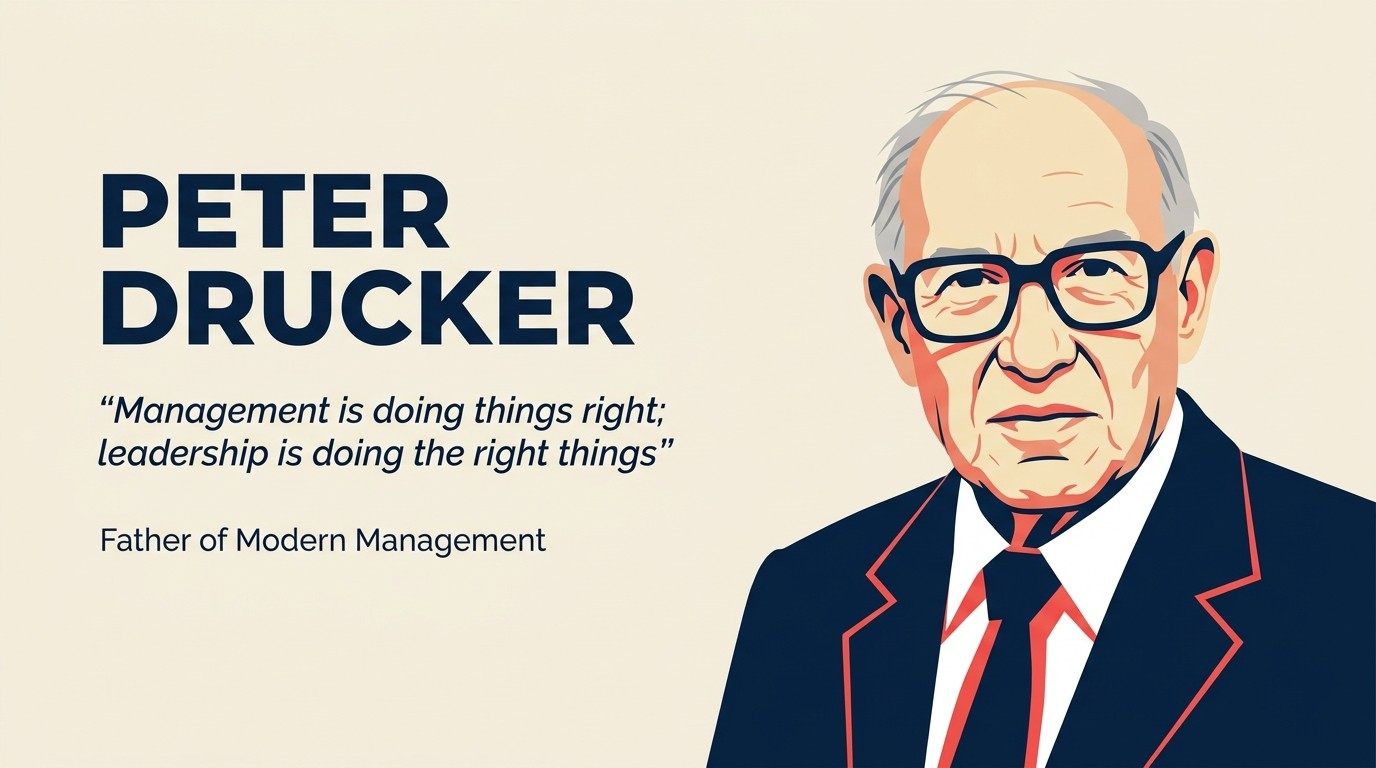
Key Facts: Peter Drucker (1909–2005) was an Austrian-American management consultant, educator, and author widely called the "father of modern management." He published 39+ books, including The Practice of Management (1954, which introduced Management by Objectives), Management: Tasks, Responsibilities, Practices (1973), and The Effective Executive (1967). President George W. Bush awarded him the Presidential Medal of Freedom in 2002 for his lifetime contribution to management thinking.
The Drucker Humane Discipline Doctrine (Management by Objectives)
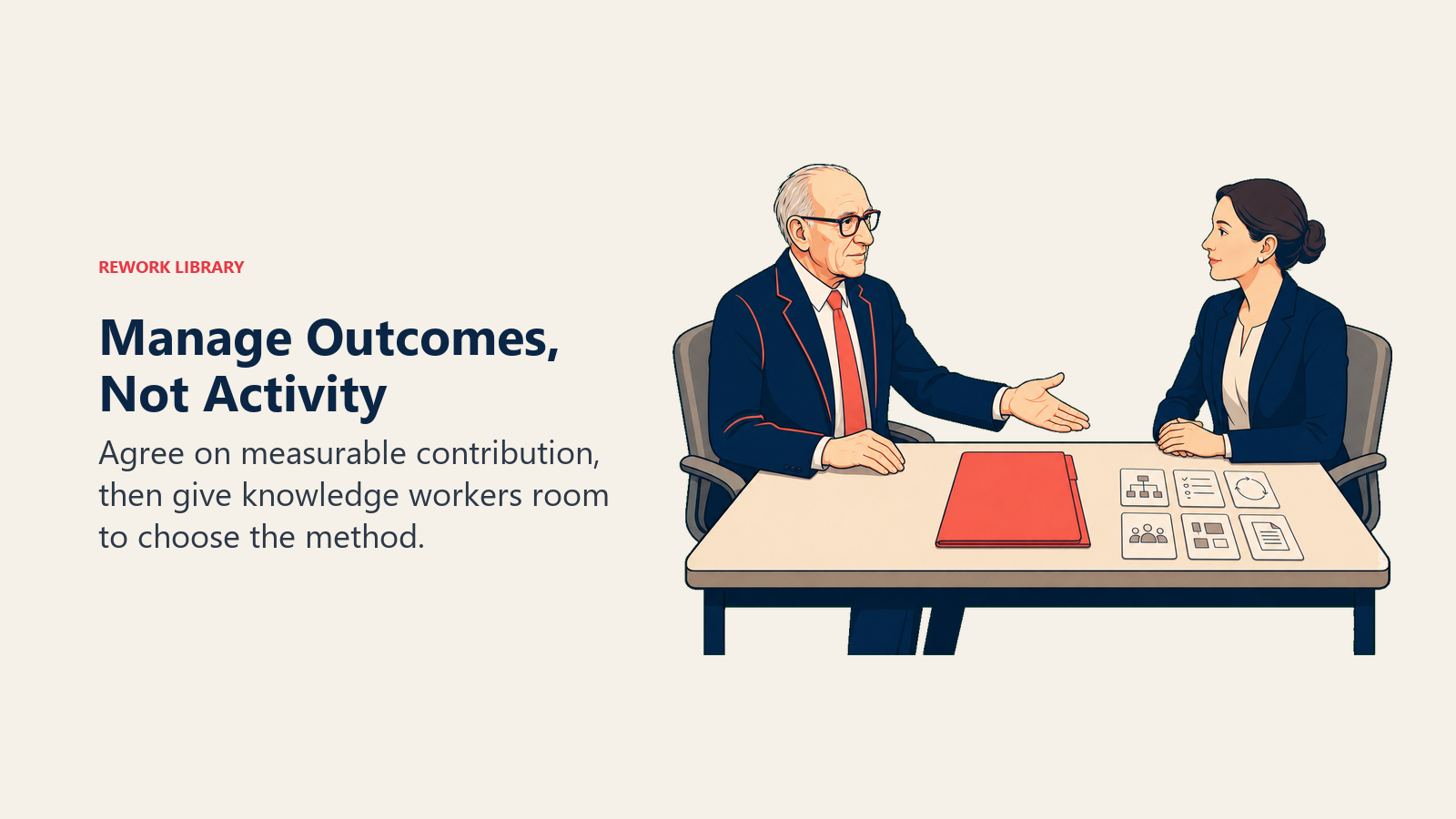
Management by Objectives (MBO) is the practice of agreeing on measurable results with each worker, aligning individual objectives to organizational goals, and letting people decide the means. Drucker framed management as a humane discipline: its job is not to control activity but to make knowledge workers productive by giving them clarity about contribution. Effectiveness, not efficiency, is the test.
Peter Drucker published 39 books between 1939 and 2005. He wrote his last one at age 94. He advised GE, IBM, Procter & Gamble, Intel, the Red Cross, and the Salvation Army. He coined the term "knowledge worker" in 1959, 40 years before knowledge work became the defining category of economic activity. He invented Management by Objectives, which most organizations today use in a broken form called OKRs and complain about constantly.
Most of his core warnings are still being ignored.
That's the strange thing about Drucker's legacy. He's universally cited and routinely violated. Executives know his quotes. They repeat "culture eats strategy for breakfast" and "what gets measured gets managed" in strategy offsite decks. And then they go back to measuring the wrong things, managing to the metric instead of the goal, and ignoring the knowledge workers who actually produce the results.
This profile isn't about celebrating Drucker's achievements. It's about understanding why his frameworks still diagnose what's broken in most organizations, and what you can actually do with that diagnosis this week.
Leadership Style Breakdown
| Style | Weight | How it showed up |
|---|---|---|
| Conceptual Architect | 60% | Drucker's primary contribution wasn't advice. It was frameworks: ways of thinking about organizations that made previously confusing problems tractable. Management by Objectives, the knowledge worker concept, the five questions of customer value, these are not action steps. They're lenses. He built them by studying organizations closely (GM, GE, nonprofits) and identifying the underlying structure of what made them work or fail. |
| Socratic Consultant | 40% | Drucker famously said his job was to ask questions, not to give answers. When he consulted with GE's Jack Welch, he'd come in with a short list of questions, listen carefully, and leave. He refused to own stock in any company he advised so he could stay genuinely independent. His questions, "What is our business? Who is our customer? What does the customer consider value?", are designed to surface assumptions the organization didn't know it was making. |
That combination is unusual. Most consultants sell solutions. Drucker sold the right questions. He believed that most organizational failures weren't failures of execution, they were failures of premise. The company was doing the wrong thing very efficiently. His role was to make that visible before it became terminal.
Key Leadership Traits
| Trait | Rating | What it means in practice |
|---|---|---|
| Clarity about purpose | Exceptional | Drucker spent 70 years asking one variant of the same question: what is this organization actually for? Not what does it produce, not what does it measure, but what purpose does it serve for the people outside it? His insistence on defining purpose from the customer's perspective, not the organization's self-image, is still more consistently ignored than applied. |
| Skepticism of measurement-as-management | Very High | Drucker's "what gets measured gets managed" is almost always quoted without the second half: "but not everything that can be counted counts, and not everything that counts can be counted." He was a consistent critic of organizations that substituted measurement for judgment. He thought financial metrics were necessary but insufficient, and that over-reliance on quantifiable outcomes was a symptom of managerial timidity rather than rigor. |
| Long-term institutional thinking | High | Drucker thought in decades, not quarters. His GM study in 1946 wasn't about that year's results. It was about whether GM had the organizational structure to sustain its performance over 20 years. He was correct that it didn't, as it turned out, though it took 60 years for the diagnosis to fully materialize. He consistently pressed organizations to ask what decisions made today would look wise in 10 years. |
| Respect for the knowledge worker | High | Drucker's insight in 1959 was that managing knowledge workers like factory workers would fail. They weren't inputs to be optimized. They were assets to be understood and deployed. He argued that knowledge workers needed clarity about outcomes, not instructions about process, and that the manager's job was to remove obstacles, not to supervise activity. Most people still supervise activity. Satya Nadella's transformation of Microsoft is one of the cleaner modern applications of this principle, replacing a stack-ranking culture that treated engineers as performance inputs with a growth-mindset model that treated them as self-directed contributors. Tim Cook applied a different interpretation at Apple: rigorous operational clarity about who owns what decision, which removed friction for knowledge workers without sacrificing accountability. |
The 3 Frameworks That Defined Drucker
1. Management by Objectives (MBO) and Its Limits
Drucker introduced Management by Objectives in The Practice of Management in 1954. The core idea was simple: instead of telling people what to do and monitoring their compliance, agree on what results are needed and let people figure out how to achieve them. Align individual objectives with organizational goals. Measure outcomes, not activities.
This was genuinely radical in 1954. Most management practice was still rooted in Frederick Taylor's scientific management, process specification, close supervision, time-motion studies. MBO said that was the wrong model for organizations that employed people to think, not just produce.
But Drucker also warned repeatedly about how MBO would be misapplied. He predicted that organizations would use it as a compliance theater rather than a genuine alignment tool, setting objectives top-down without real negotiation, measuring the metric without evaluating the goal, and treating the annual review cycle as an accountability ritual rather than a strategic conversation. He was right on all counts. OKRs, the direct descendant of MBO, suffer from precisely those pathologies in most implementations. Jack Welch, Drucker's most famous corporate disciple, applied MBO at GE with genuine rigor, but also pushed it in directions Drucker warned against, including the rank-and-yank system that optimized individual performance at the cost of organizational trust. Andy Grove at Intel took a more Druckerian version of the same framework and built it into a culture of genuine strategic alignment through OKRs that Intel employees actually internalized.
The framework's actual contribution was the underlying principle: clarity about expected contribution precedes performance. Most organizations think they have this. They have cascading dashboards and quarterly targets. But ask any manager whether their direct reports could state, without prompting, what result they're supposed to produce this quarter and why it matters to the organization's goals. The answer is usually revealing.
2. The Knowledge Worker Concept (1959)
In Landmarks of Tomorrow, published in 1959, Drucker coined the term "knowledge worker" to describe people whose primary job was to work with information rather than produce physical output. He predicted that knowledge workers would become the dominant category of economic activity in developed economies within a generation.
He was correct. By the early 2000s, knowledge workers represented the majority of employment in the United States. But the management infrastructure built around them hadn't caught up. Organizations were still measuring activity instead of contribution, still supervising process instead of enabling outcomes, still rewarding presence rather than results.
Drucker's argument was that knowledge workers are fundamentally different from manual workers in one critical way: they own their means of production. A factory worker needs the factory. A knowledge worker needs their expertise, judgment, and the ability to apply it. You can't manage them out of contribution. You can only enable or obstruct it.
That logic has direct implications for how you structure work today. The organizations seeing the best results from remote and hybrid work are the ones that understood the knowledge worker principle before the pandemic forced the experiment. They already managed to outcomes rather than visibility. The ones struggling are the ones that confused physical presence with contribution.
3. The Effective Executive's 5 Practices
The Effective Executive, published in 1967, is still the single most useful book on personal productivity for leaders. It identifies five practices that distinguish executives who actually get important things done from those who stay perpetually busy without impact.
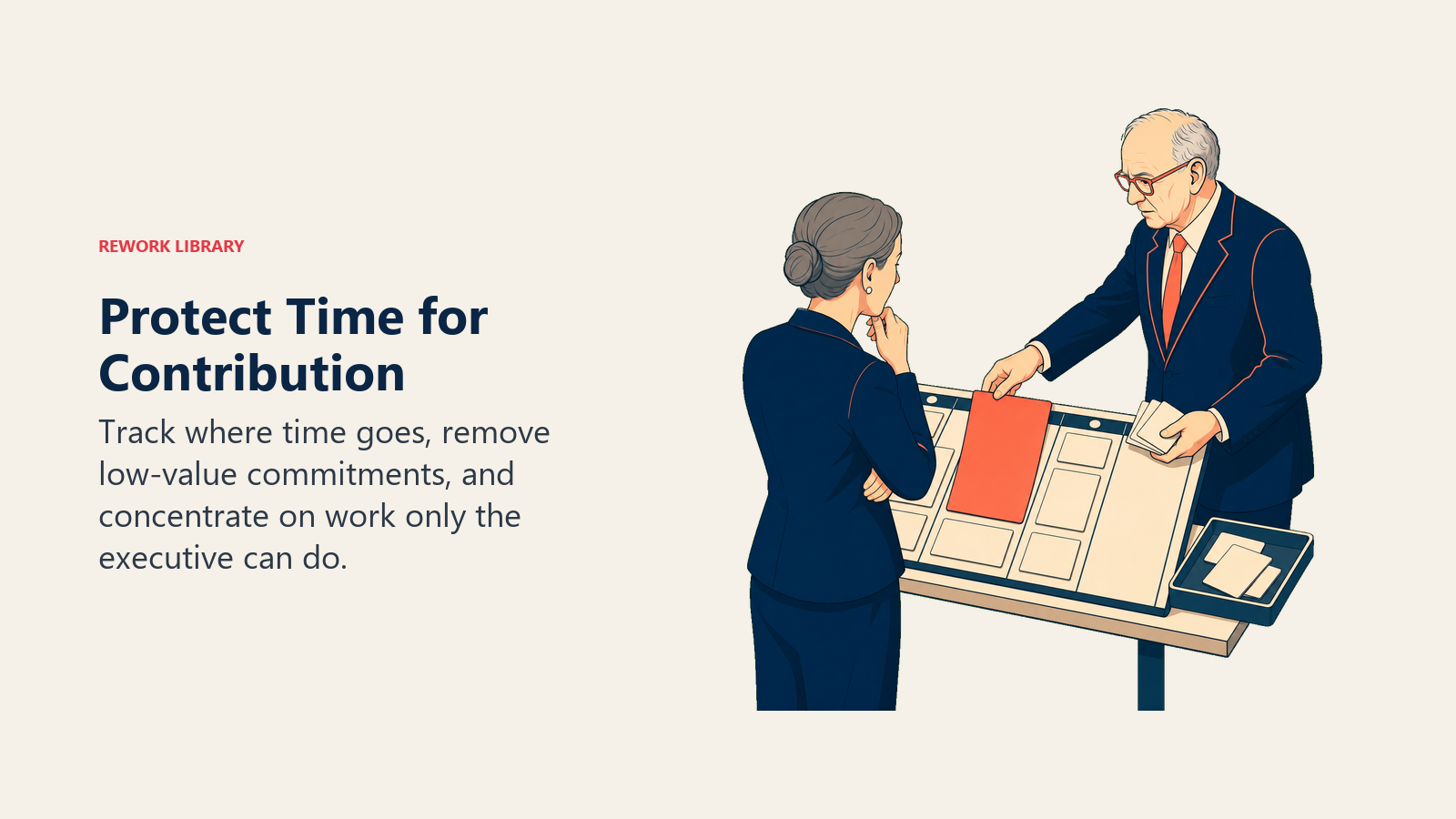
The five practices are: knowing where your time actually goes (not where you think it goes), focusing on contribution (what result do I exist to produce?), building on strengths (yours and your team's), concentrating on first things first (doing one thing at a time rather than many things poorly), and making effective decisions (understanding what decisions require and when not to decide).
The time practice is where most executives fail first. Drucker recommended keeping a time log for two weeks before attempting any other productivity change, just recording what you actually did, in 30-minute blocks, without editing. Most executives who do this are shocked. Meeting-to-meeting calendar density looks like busyness. The log reveals how little of that time was spent on work only the executive could do.
The contribution practice is where most organizations fail institutionally. Drucker asked: what contribution are you making to the results of the whole organization, not just your function? That question forces upward orientation. Most managers manage down and sideways. Drucker argued that the most effective executives consistently asked what the person above them and the customer outside the organization needed from their work, and organized their time accordingly.
What Drucker Would Do in Your Role
If you're a CEO, the first Drucker question for you is: what is your business? Not your product category or your revenue model, what problem do you exist to solve for the customer, in terms the customer would use to describe it? Most CEOs have an internal answer. Drucker's point is that the internal answer is almost always wrong, or at least incomplete. The useful version of the question requires talking to customers, not reviewing strategy decks. He recommended doing this regularly, not as a research project but as an ongoing practice.
If you're a COO, the operational Drucker insight is about first things first. Most operations organizations are very good at managing what's already running. They're poor at concentrating effort on the one or two constraints that actually limit throughput. Drucker's approach was to ask: if we could only do one thing this quarter, what would it be? Then do that until it's done before adding the second priority. The fragmentation of operational attention across 12 simultaneous initiatives is the most common operational failure Drucker identified, and it's more common now than it was in 1967.
If you're a product leader, Drucker's customer questions apply directly: who is the customer, what do they consider value, and what would they pay for? Not what do they say they want in a survey, what would they actually change their behavior to get? He was suspicious of market research that asked people to rate features. He thought the useful question was behavioral: what are customers already doing that tells you what they need? Build the product intelligence practice around that question instead of the satisfaction score.
If you're in sales or marketing, the most useful Drucker frame is his distinction between selling and marketing. "The aim of marketing is to know and understand the customer so well that the product or service fits him and sells itself." That's not a sales process insight. It's a product-market fit insight. If your sales team is working hard to close deals, ask honestly whether the resistance is a sales execution problem or a marketing problem, whether you've understood the customer well enough that the value proposition is self-evident. Most companies have the diagnosis backwards.
How Rework Operationalizes Drucker's MBO Principles
Drucker's core insight, that management is a discipline, not a personality trait, and that effective execution depends on clarity of contribution, requires infrastructure most teams lack. MBO fails in practice when objectives live in one tool, activity lives in another, and outcomes live in a spreadsheet nobody updates. Rework closes that gap by tying individual objectives directly to the work that produces them. Instead of quarterly check-ins that audit compliance, managers see real-time alignment between stated goals and actual contribution. Knowledge workers see what results they're accountable for without being supervised on process, the exact distinction Drucker made in 1959. Cross-functional dependencies become visible before they become blockers, which lets executives concentrate on the one or two constraints that actually limit throughput. That's Drucker's "first things first" practice, made operational rather than aspirational, across a team managing to outcomes instead of activity.
Notable Quotes & Lessons Beyond the Boardroom
"The most important thing in communication is to hear what isn't being said." Drucker wrote this in The Practice of Management, and it's a direct application of his Socratic consultant style. The unstated assumption, the problem nobody names in the meeting, the result everyone knows isn't working but no one wants to report, these are where organizational failure lives. His advice was to build a practice of asking: what are we not talking about?
"Efficiency is doing things right. Effectiveness is doing the right things." That distinction, from The Effective Executive, is the most commonly cited Drucker quote in business, and the most commonly ignored. Organizations invest enormous effort in process improvement, operational efficiency, and execution discipline. Most of them would benefit more from honestly asking whether the thing they're executing so efficiently is worth doing at all. Drucker's point wasn't that efficiency doesn't matter. It was that efficiency on the wrong task compounds the problem rather than solving it.
He also refused to own stock in any company he advised, on the principle that he couldn't give honest counsel if he had a financial interest in the advice being followed. That's a model of integrity that has almost no analog in modern consulting. Most advisory relationships have structural conflicts between honest assessment and continued engagement. Drucker solved it by removing the conflict structurally rather than managing it through personal ethics. That's a more durable solution.
Where This Style Breaks
Drucker's frameworks assume organizations with enough stability to think in three-to-five year arcs. Most of his consulting was with large industrial companies and nonprofits operating in relatively slow-moving competitive environments. His frameworks don't map cleanly onto 90-day SaaS growth cycles, two-sided marketplace dynamics, or software businesses where the product can change completely in six months.
MBO and its OKR descendants get weaponized into compliance theater precisely because Drucker's underlying principle, clarity about expected contribution, requires genuine trust and negotiation. In organizations with weak trust, the framework becomes a performance ritual rather than an alignment tool.
And his aphorism-heavy style, while memorable, allows selective quoting. "What gets measured gets managed" gets repeated in contexts that justify exactly what Drucker was criticizing: substituting measurement for judgment. His body of work requires reading in context, not extracting sentences. Leaders who quote Drucker frequently but haven't read The Effective Executive or The Practice of Management are probably misapplying him.
Learn More
For related reading on management and leadership, see Jack Welch Leadership Style, Sam Altman Leadership Style, and Building High-Performance Teams.

On this page
- The Drucker Humane Discipline Doctrine (Management by Objectives)
- Leadership Style Breakdown
- Key Leadership Traits
- The 3 Frameworks That Defined Drucker
- 1. Management by Objectives (MBO) and Its Limits
- 2. The Knowledge Worker Concept (1959)
- 3. The Effective Executive's 5 Practices
- What Drucker Would Do in Your Role
- How Rework Operationalizes Drucker's MBO Principles
- Notable Quotes & Lessons Beyond the Boardroom
- Where This Style Breaks
- Learn More