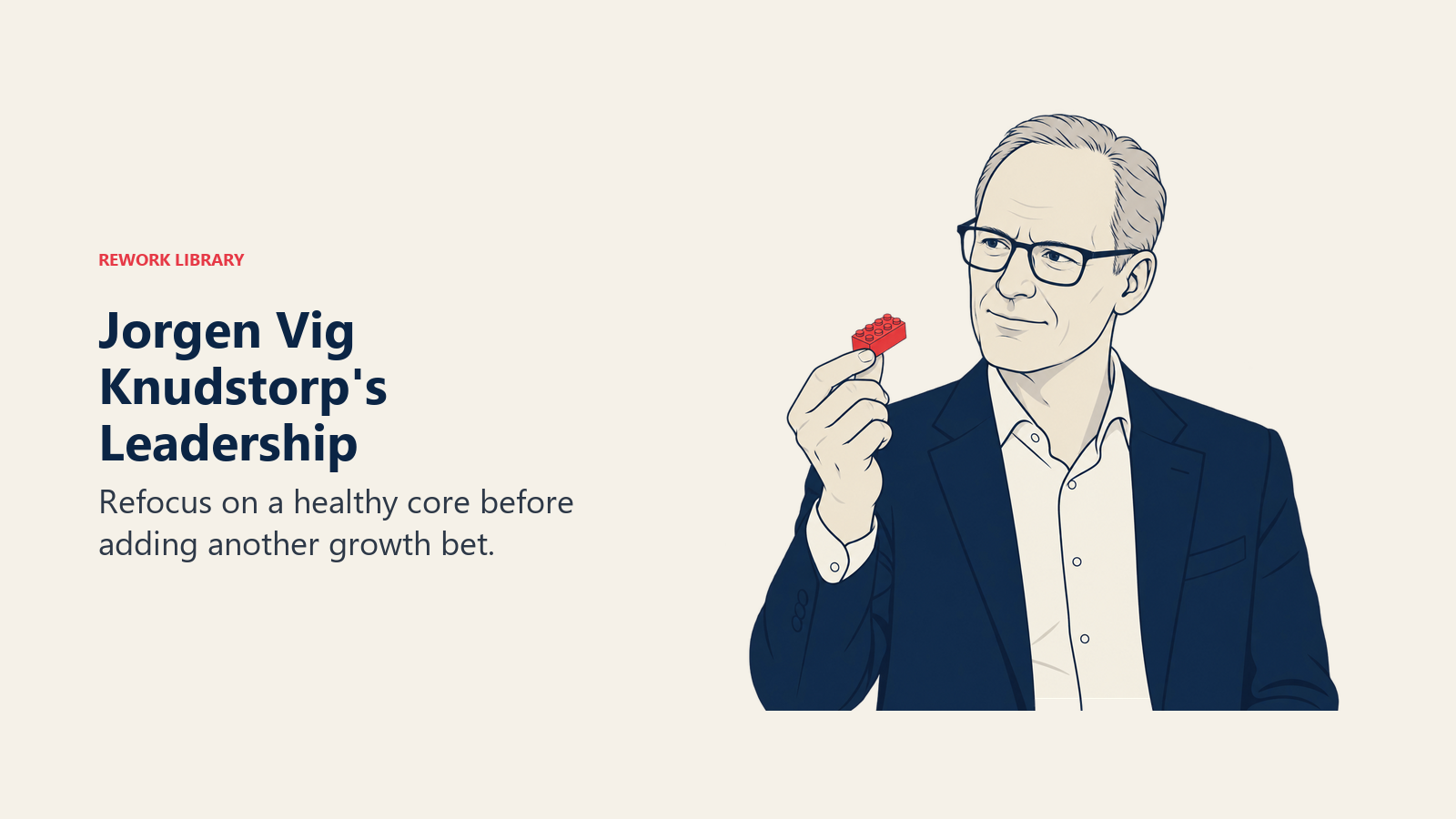
Jorgen Vig Knudstorp's Leadership: The LEGO Turnaround
Turn this article into takeaways for your work.


Each assistant summarizes the article only for you and suggests best practices for your work.
Key Facts: Jorgen Vig Knudstorp (born November 21, 1968, in Fredericia, Denmark; Danish: Jørgen Vig Knudstorp, written with the letter o-slash) earned a bachelor's degree, a master's, and a PhD in economics from Aarhus University, spent three years as a management consultant at McKinsey & Company, then joined LEGO in 2001 as a strategy director. In 2003 he told the board LEGO was "on a burning platform, losing money with negative cash flow, and at real risk of debt default which could lead to a breakup of the company," the same year the company guided the market to expect a pre-tax loss of roughly DKK 1.4 billion. He became CEO in 2004 at age 35, only the second person from outside the founding Kirk Kristiansen family to run the company, after Vagn Holck Andersen's six-year tenure in the 1970s. LEGO's full-year 2004 net loss came in at DKK 1.93 billion, on revenue of about DKK 6.3 billion, the largest loss in the company's history. Rather than diversify further, Knudstorp cut: LEGO sold a 70 percent majority stake in its LEGOLAND parks to Blackstone Capital Partners for $460 million, forming Merlin Entertainments, in 2005, closed its in-house video game studio and licensed the brand to outside developers instead, and pared back a parts catalog that had climbed past 12,000 unique elements by the early 2000s. The company returned to profit in 2005, posting a net profit of DKK 505 million, and by 2016, LEGO Group revenue reached DKK 37.9 billion, the year Knudstorp stepped down as CEO. Bali Padda succeeded him for nine months before Niels Christiansen took over in October 2017, and Knudstorp moved into the Executive Chairman role at the LEGO Brand Group, which he held from 2017 to 2023. He transitioned into a fully non-executive role at the end of 2024, and today he is lead independent director of Starbucks, a board member elected to Nike's board in September 2025, and, effective January 1, 2026, chair of IMD Business School's Supervisory and Foundation Boards.
The Subtraction Doctrine
The Subtraction Doctrine is Knudstorp's operating premise that a business which has drifted into too many adjacent bets does not need a bigger vision. It needs less business. When he took over LEGO, the company was not shrinking because its core product had gone out of style. It was shrinking because it had spent the 1990s buying and building its way into theme parks, branded clothing, video game publishing, retail stores, and television production, and none of that periphery was paying for itself. Knudstorp's fix ran opposite to the standard turnaround playbook. He did not acquire a new growth engine. He sold the parks, closed the game studio, and cut the number of different bricks the company made, then let LEGO get profitable again on a business roughly the size of what was left once the periphery was gone.
That is a genuinely unusual instinct for a newly appointed CEO to act on, and it is worth sitting with why it worked. Knudstorp was 35, had no toy industry background, and was not related to the Kirk Kristiansen family that had run LEGO since 1932. What he did have was a strategy director's read of the balance sheet and no emotional investment in the parks, the clothing line, or any of the other ventures his predecessors had approved. Where an outsider CEO in real trouble often reaches for a big acquisition to prove they can grow the company, Knudstorp reached for a smaller company instead, on the theory that LEGO's actual problem was complexity, not scale.
This is the direct opposite of the case study built around Ursula Burns at Xerox. Burns inherited a company whose core printing business was structurally losing ground to digital substitution, so she spent $6.4 billion buying a services company to build a second, growing revenue base, and when that bet could not fully outrun the decline, she split the company in two. Knudstorp's core product, the brick itself, was not the problem. Toy retail sales overall were healthy; LEGO's own diversification was what had gone wrong. So where Burns had to answer "how do we replace a dying core," Knudstorp only had to answer "how do we stop paying for things that are not the core," a much narrower and, it turned out, much more solvable question. Alan Mulally ran a closer parallel at Ford, selling Jaguar, Land Rover, Aston Martin, and Volvo to concentrate capital on the Ford brand itself under "One Ford." Knudstorp did the same thing at a smaller scale and a much earlier stage in his tenure, cutting on his way in rather than partway through.
Leadership Style Breakdown
| Style | Weight | How it showed up |
|---|---|---|
| Subtractive Operator | 50% | Treated LEGO's crisis as a portfolio problem solved by removing businesses, not adding them. Sold the majority stake in LEGOLAND, closed the in-house video game studio, and cut back a parts catalog that had grown past 12,000 unique elements, all within the first two years of taking over. |
| Quantitative Outsider | 30% | Came from McKinsey with no toy industry background and no family tie to the founders, which let him treat sacred-cow ventures like the theme parks and clothing line as line items rather than legacy. The 2003 "burning platform" diagnosis to the board was built on cash flow and debt risk, not sentiment. |
| Institutional Handoff Planner | 20% | Stepped down as CEO in 2016 while the company was profitable and growing, moved into a chairman role rather than clinging to the operating seat, and spent the following years building board experience elsewhere (Starbucks, IMD, later Nike) rather than trying to run LEGO indefinitely. |
The 50/30/20 split matters because the second trait is what made the first one possible. A lifelong LEGO executive who had championed the theme parks or the clothing line years earlier would have had a much harder time cutting them. Knudstorp had been at the company two years and had championed none of it, which is exactly why the board could hand a 35-year-old with no CEO experience the job of making cuts that a longer-tenured internal candidate might have kept defending.
Key Leadership Traits
| Trait | Rating | What it means in practice |
|---|---|---|
| Willingness to shrink before trying to grow | Very High | Selling a majority stake in your own theme parks and closing a media business three years into your tenure is not a hedge. It is a bet that the company is better off smaller and focused than bigger and scattered, made before there was any proof the focus would pay off. |
| Diagnosis under pressure, without inherited bias | High | Knudstorp's "burning platform" memo to the board in 2003 read LEGO's finances the way an external consultant would: cash flow, debt risk, and market share, not brand mythology. That outsider's read is part of why the board believed the diagnosis enough to hand him the job. |
| Comfort exiting adjacent businesses others had built | Very High | The theme parks, the clothing line, and the in-house video game studio were all real bets earlier leadership had made in good faith. Knudstorp unwound each one without treating the reversal as a referendum on the people who built them. |
| Discipline to step back once the fix held | High | He left the CEO chair in 2016 with the company profitable and growing, choosing a chairman role over staying in the operating seat, a rarer move than it should be for a leader whose name is this closely tied to a turnaround's success. |
| Building a second career on governance rather than a second operating role | Strong | Rather than chase another CEO seat after LEGO, Knudstorp built a portfolio of board roles, Starbucks, IMD, later Nike, treating governance experience as its own long-term asset rather than a retirement lap. |
The 3 Decisions That Defined Jorgen Vig Knudstorp as a Leader
1. Choosing Subtraction Over a New Growth Bet (2003 to 2005)
When Knudstorp told LEGO's board in 2003 that the company was "on a burning platform, losing money with negative cash flow, and at real risk of debt default which could lead to a breakup of the company," the easy next move for a new CEO chasing credibility would have been a bold acquisition, something to point to as proof the company was moving forward. Knudstorp did the opposite. He treated LEGO's problem as one of complexity rather than scale: too many components, too many side businesses, not enough focus on the brick itself. The parts catalog that had climbed past 12,000 unique elements got cut back down, and the company closed its in-house video game studio, licensing the LEGO name to outside developers instead of continuing to run the business itself.
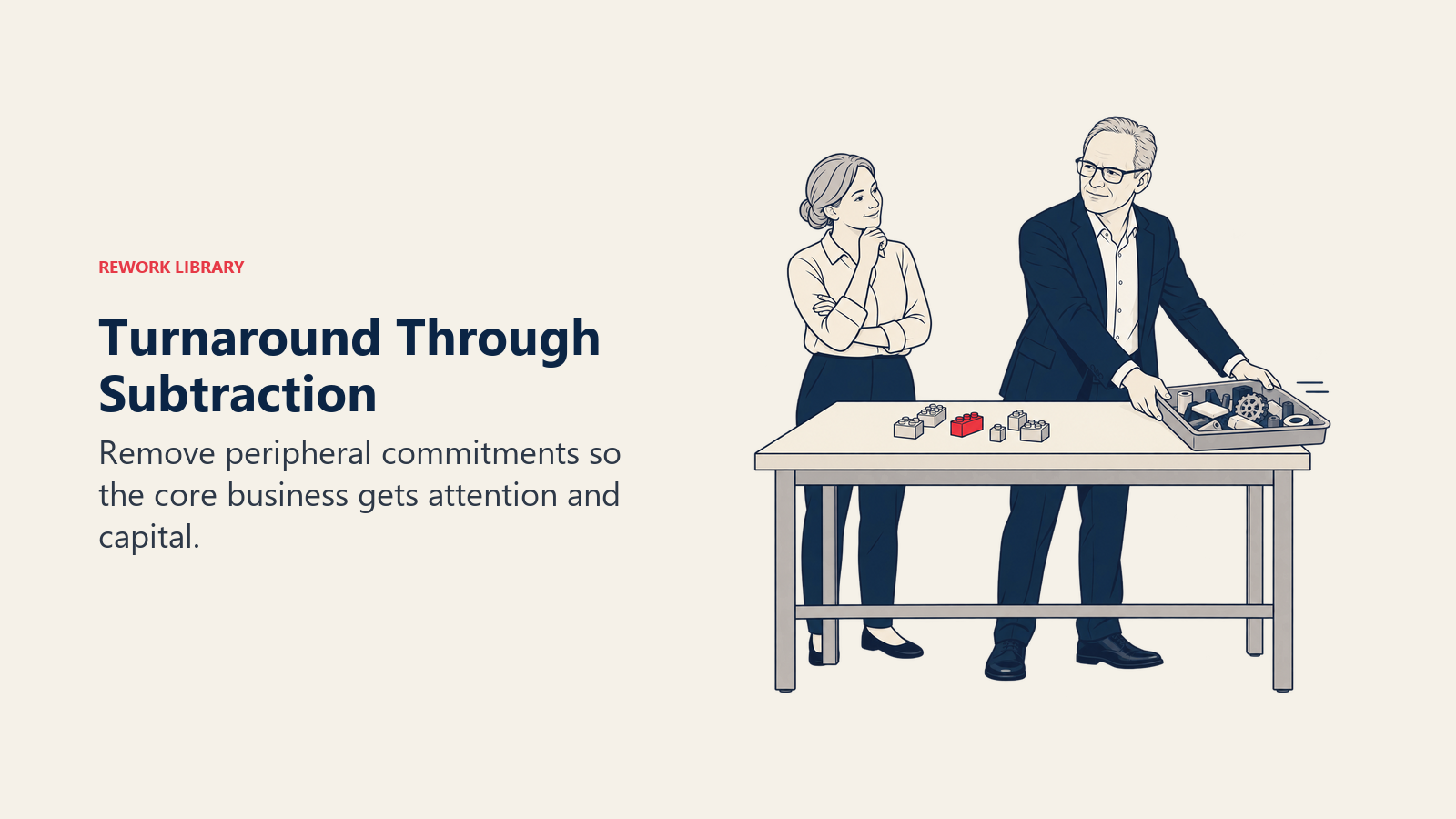
This is the reverse of the diversification strategy that most struggling companies reach for, spreading risk by entering new categories. Knudstorp bet on the opposite logic: that LEGO's core product was fine and its diversification was the liability. It is a much less common instinct in a first-time CEO, most of whom want to be associated with a growth story, not a series of exits.
For you: when a business is underperforming, the first question worth asking honestly is whether the core product is actually the problem, or whether the real damage is coming from ventures built around it. Knudstorp's read, that LEGO's core was healthy and its periphery was not, only works if you're willing to test it against the actual numbers rather than assume growth requires more, not less.
2. Selling Majority Control of LEGOLAND to Blackstone (2005)
In 2005, LEGO sold a 70 percent stake in its LEGOLAND theme parks to Blackstone Capital Partners for $460 million, with the family holding company KIRKBI retaining the remaining 30 percent, forming a new entity that became Merlin Entertainments. The parks were a real, physical piece of the LEGO brand experience, not an abstract side bet, which made this a harder call to make publicly than cutting an internal product line. Giving up majority control of a business bearing the company's own name, while the company was still in crisis and every headline was scrutinized, took a specific kind of conviction that the core toy business needed the capital and management focus more than it needed to keep running amusement parks.
The decision also reflected a pragmatic read of what LEGO was actually good at. Running theme parks profitably requires a different operating discipline than designing and manufacturing toys, and LEGO's leadership team was already stretched thin fixing the core business. Handing park operations to a partner built for that specific business, while keeping a minority financial stake, let Knudstorp's team focus everything else on the brick.
For you: giving up control of something that carries your name is one of the hardest sells to a board and to the public, even when it is clearly the right capital allocation call. The willingness to make that call publicly, rather than quietly protecting a visible asset for reputational reasons, is the harder half of a subtraction strategy to execute.
3. Stepping Down as CEO While the Company Was Still Growing (2016 to 2017)
Knudstorp announced in 2016 that he would step down as CEO once LEGO's turnaround had run its full course, handing the role to Bali Padda, LEGO's chief operating officer, at the end of that year. LEGO had just posted DKK 37.9 billion in annual revenue, a record, and Knudstorp was widely credited as the executive who had saved the company. Most leaders in that position stay as long as the results keep justifying it. Knudstorp moved to the chairman's seat instead, taking the Executive Chairman role at the LEGO Brand Group.
The handoff did not go smoothly on the first attempt. Padda's tenure was always understood internally to be transitional given his age, and within nine months LEGO announced Niels Christiansen would take over as CEO in October 2017. That stumble is worth naming honestly rather than smoothing over: even a CEO who plans his own succession years in advance can get the first handoff wrong, and LEGO needed a second attempt before the leadership transition actually stuck. Knudstorp stayed on as Executive Chairman through that adjustment and for years afterward, eventually transitioning into a fully non-executive role at the end of 2024, moving into board seats at Starbucks, later Nike, and, from 2026, chairing IMD Business School's governing boards.
For you: recognizing that your specific turnaround skill set has done its job is not the same as recognizing that the company no longer needs oversight. Knudstorp handed off the operating role at the peak of his own credibility rather than waiting for a forced exit, but he also stayed close enough, and long enough, to help fix the succession when the first attempt did not hold.
What Jorgen Vig Knudstorp Would Do in Your Role
If you're a CEO inheriting a company that has diversified its way into trouble, Knudstorp's playbook starts with an honest split between the core product and everything built around it. He did not ask LEGO's toy designers to sell harder. He sold the theme parks, closed the game studio, and cut the parts catalog, testing whether the core brick business was healthy enough to carry the company alone before assuming it needed a new growth bet layered on top.
If you're a board member weighing whether to hand a major operating decision to an outsider with no industry background, the useful signal from LEGO's board in 2004 is what they were actually buying: not toy industry experience, but a read of the balance sheet unclouded by two decades of internal loyalty to the parks or the clothing line. An insider candidate might have found the same diagnosis. A 35-year-old strategy director with no history of championing those ventures was simply freer to act on it.
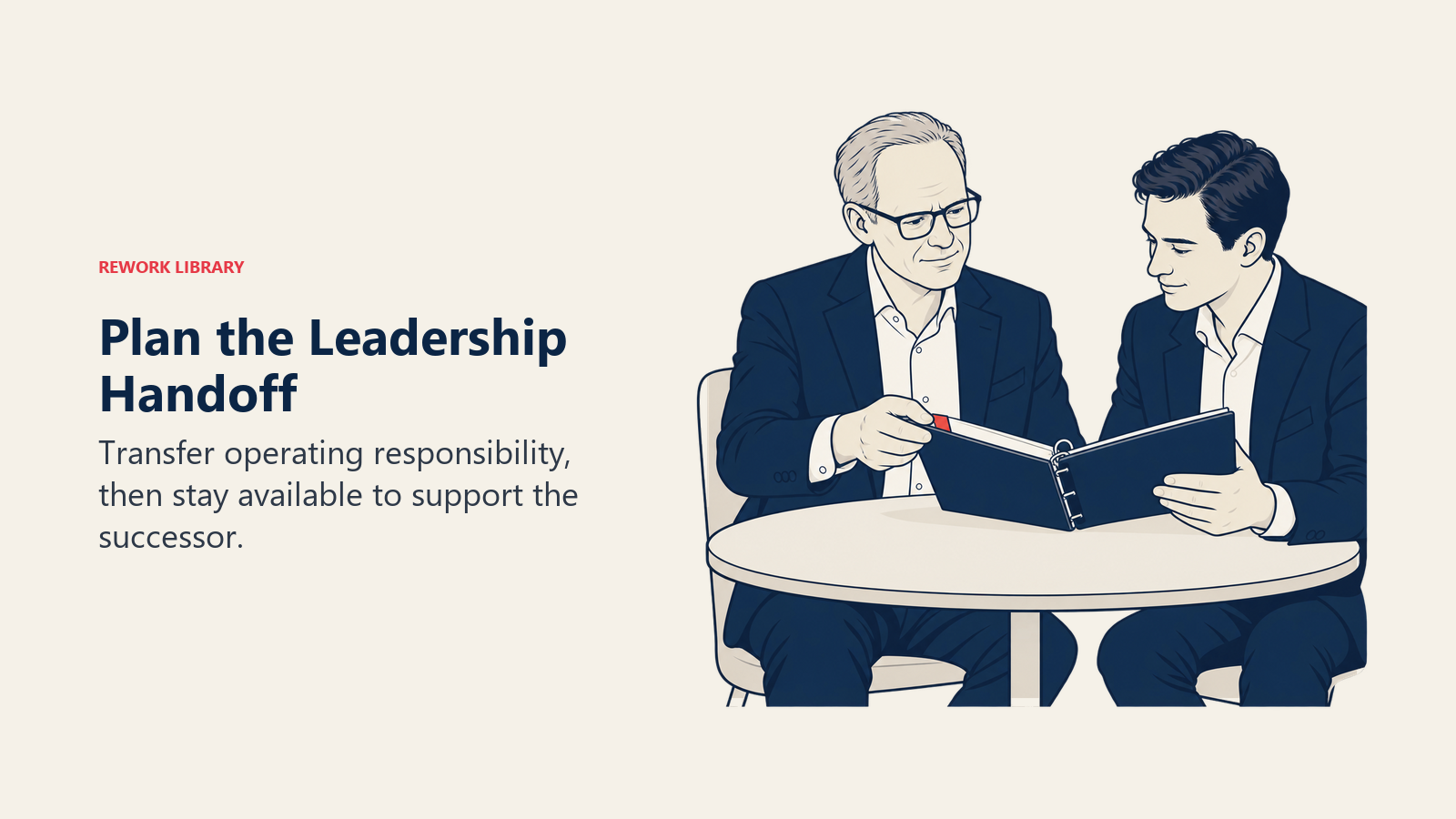
If you're an executive planning your own succession, the LEGO case is a useful correction to the idea that a clean plan guarantees a clean handoff. Knudstorp stepped back at the height of his credibility and still needed two attempts to land the right successor. The lesson isn't "plan less." It's "stay close enough to fix it if the first plan doesn't hold," which is exactly what the Executive Chairman role let him do.
| Situation you're facing | Knudstorp's likely move |
|---|---|
| A struggling business has spread into too many adjacent ventures | Cut the periphery first and test whether the core product alone can carry the company, before assuming growth requires expansion |
| A visible, brand-carrying asset is underperforming relative to the core business | Sell majority control to a partner built for that specific operating model, keeping a minority stake rather than a full exit |
| You've been credited with fixing a company and the results are strong | Hand off the operating role at the peak of your credibility rather than waiting for the results to force the decision |
| Your chosen successor is not working out | Stay close enough in a governance role to help correct course quickly, rather than treating the first handoff as final |
| You're evaluating an outsider candidate with no industry background for a top job | Weigh what the lack of institutional loyalty buys you: freedom to cut what an insider might still be defending |
Notable Quotes & Lessons Beyond the Boardroom
The line most associated with Knudstorp's tenure is the one he gave LEGO's board in 2003, before he was CEO: "We are on a burning platform, losing money with negative cash flow, and at real risk of debt default which could lead to a breakup of the company." It reads less like a rallying cry and more like an internal memo, which is exactly what made it effective. It gave the board a reason to act rather than a reason to feel inspired.
Years later, reflecting on what had actually gone wrong before the turnaround, he put it plainly in an interview with the Boston Consulting Group: "the company was struggling because it did too many things at the same time. It lost its focus and its core." In the same interview, describing the clothing line LEGO had built and later abandoned, he said flatly: "It turns out that LEGO clothing was a bad idea." That kind of unhedged retrospective admission is rare from an executive describing a decision made under his own watch.
On how he tried to run the company day to day rather than through top-down control, he told BCG: "I don't want to control. I want to create context. I want to create clarity of culture and strategic choice." And on how LEGO's leadership team handled mistakes internally, he said the standard was not to punish failure itself: "The blame is not for failure. It is failing to help or ask for help." Coming from the executive who had just spent several years cutting businesses other leaders had built, that framing of blame is worth sitting with: it is easier to ask a team to admit what is not working when the person asking has already done the same thing publicly, at the theme park and video game level, years earlier.
Where This Style Breaks
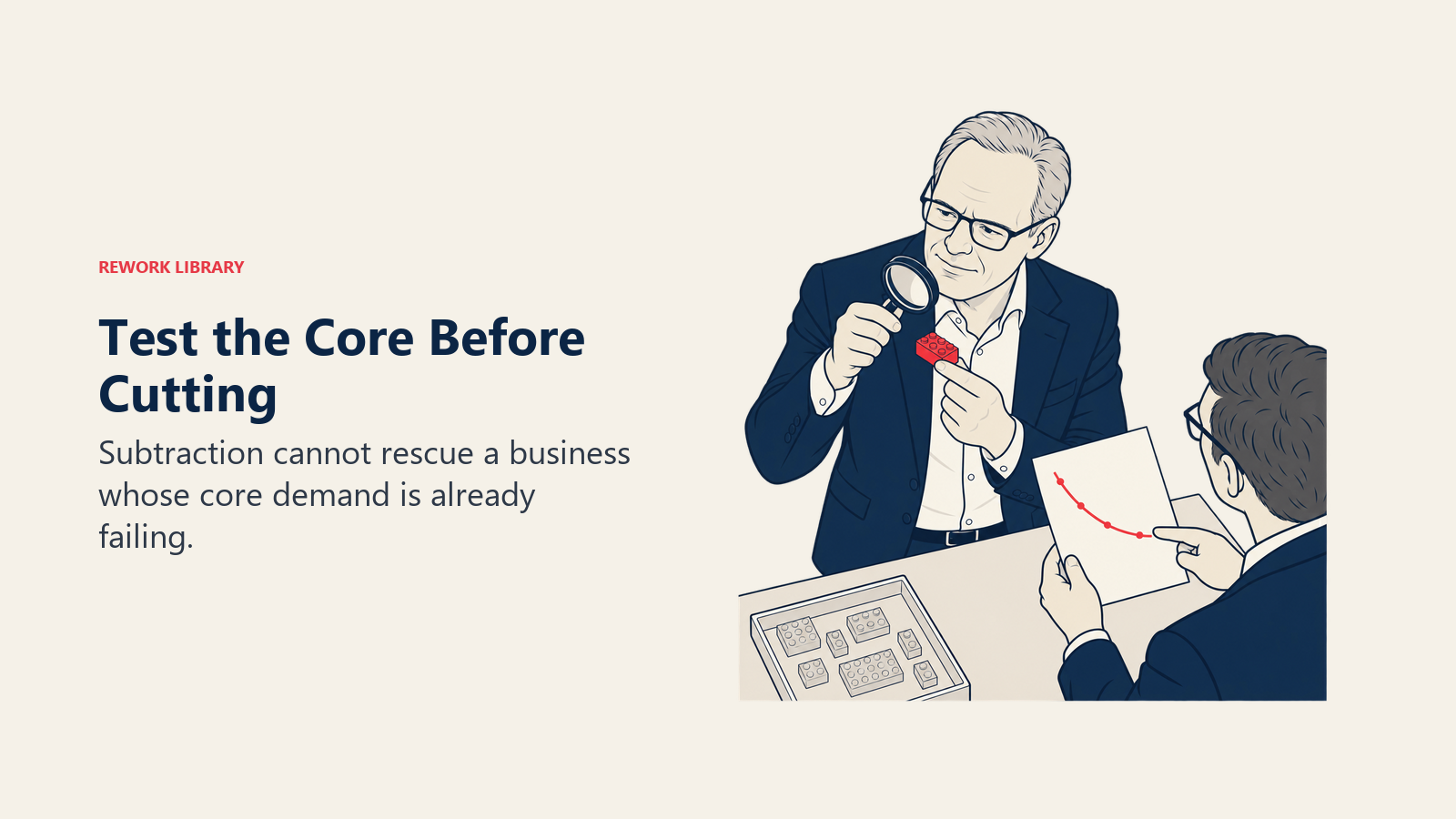
The Subtraction Doctrine has a real precondition that is easy to miss when the LEGO story gets retold as a universal turnaround template: it only works when the core product itself is healthy and the periphery is what's failing. LEGO's problem in 2003 was diversification, not demand for bricks. That is a fundamentally different diagnosis from Ursula Burns's Xerox, where the core printing business was structurally losing ground to digital substitution, or from the pattern Clayton Christensen documented across an entire generation of incumbents whose actual core product was being disrupted from below. Cutting the periphery does nothing for a company whose core is the part that is dying. A leader who imports Knudstorp's playbook wholesale into a genuinely disrupted core business risks shrinking a company down to a smaller version of the exact thing that is failing.
The LEGOLAND sale also came with a real, visible cost that the turnaround narrative tends to skip. LEGO gave up majority control of a business at a price set during the depths of its own crisis, when its negotiating position was weakest. Selling low and needing capital urgently are not unrelated facts, and any leader running the same play should expect to sell scarce, valuable assets at a discount precisely because the sale is happening under pressure, not from strength.
The succession also did not run as cleanly as the "planned his own exit years in advance" version of the story suggests. Bali Padda's nine months as CEO before Niels Christiansen took over in October 2017 is a reminder that even a CEO with a strong track record and years of lead time can misjudge the first handoff. Howard Schultz faced a similar pattern at Starbucks, stepping away and later having to return when a successor's approach did not hold, a loop Knudstorp avoided only because he stayed close enough as chairman to help correct course quickly. Subtraction fixed LEGO's balance sheet. It did not, by itself, guarantee a clean leadership transition, and treating the two as the same accomplishment overstates how finished the job actually was in 2016.
Learn More
- Ursula Burns' Leadership Style at Xerox
- Alan Mulally Leadership Style: One Ford and the Discipline of Focus
- Howard Schultz Leadership Style at Starbucks
- Lou Gerstner Leadership Style: The IBM Turnaround That Kept It Whole
- Clayton Christensen Leadership Style: Disruption Theory From the Man Who Named It
- Bob Iger Leadership Style at Disney
- Turnaround Leadership: The Full Framework
- Diversification Strategy: When Spreading Risk Works and When It Doesn't
Frequently Asked Questions about Jorgen Vig Knudstorp
Who is Jorgen Vig Knudstorp?
Jorgen Vig Knudstorp (born November 21, 1968) is a Danish former CEO of the LEGO Group who served as chief executive from 2004 to December 2016. A former McKinsey consultant with no toy industry background, he joined LEGO in 2001 as a strategy director and became CEO at age 35, only the second person from outside the founding Kirk Kristiansen family to run the company. He currently serves on the boards of Starbucks, Nike, and IMD Business School.
What was Jorgen Vig Knudstorp's biggest decision as LEGO CEO?
His defining decision was choosing subtraction over diversification when LEGO was in crisis: selling a 70 percent majority stake in the LEGOLAND theme parks to Blackstone in 2005, closing LEGO's in-house video game studio, and cutting back a parts catalog that had grown past 12,000 unique elements, rather than pursuing a new acquisition or growth bet.
How bad was LEGO's financial crisis before Knudstorp became CEO?
LEGO guided the market in early 2004 to expect a pre-tax loss of roughly DKK 1.4 billion for 2003. The company's full-year 2004 net loss came in at DKK 1.93 billion on revenue of about DKK 6.3 billion, the largest loss in LEGO's history. The company returned to profit in 2005 with a net profit of DKK 505 million.
Why did LEGO sell its LEGOLAND theme parks?
LEGO's leadership team was stretched thin fixing the core toy business during the 2003-2004 financial crisis, and running theme parks profitably requires different operational skills than designing and manufacturing toys. In 2005, LEGO sold a 70 percent stake in the LEGOLAND parks to Blackstone Capital Partners for $460 million, retaining a 30 percent stake through the family holding company KIRKBI, in a deal that formed Merlin Entertainments.
Did Knudstorp's successor as CEO work out immediately?
Not on the first attempt. Knudstorp stepped down as CEO at the end of 2016 and was succeeded by Bali Padda, LEGO's chief operating officer, whose tenure was always understood to be transitional. Padda served for nine months before Niels Christiansen took over as CEO in October 2017. Knudstorp remained as Executive Chairman of the LEGO Brand Group through the transition and for years afterward.
What is Jorgen Vig Knudstorp doing now?
He transitioned into a fully non-executive role at the end of 2024 after more than two decades of leadership at LEGO and its family holding company, KIRKBI. He currently serves as lead independent director of Starbucks, a board member of Nike since September 2025, Deputy Chair of the LEGO Foundation, and, effective January 1, 2026, chair of IMD Business School's Supervisory and Foundation Boards.

Co-Founder, Rework.com
On this page
- The Subtraction Doctrine
- Leadership Style Breakdown
- Key Leadership Traits
- The 3 Decisions That Defined Jorgen Vig Knudstorp as a Leader
- 1. Choosing Subtraction Over a New Growth Bet (2003 to 2005)
- 2. Selling Majority Control of LEGOLAND to Blackstone (2005)
- 3. Stepping Down as CEO While the Company Was Still Growing (2016 to 2017)
- What Jorgen Vig Knudstorp Would Do in Your Role
- Notable Quotes & Lessons Beyond the Boardroom
- Where This Style Breaks
- Learn More