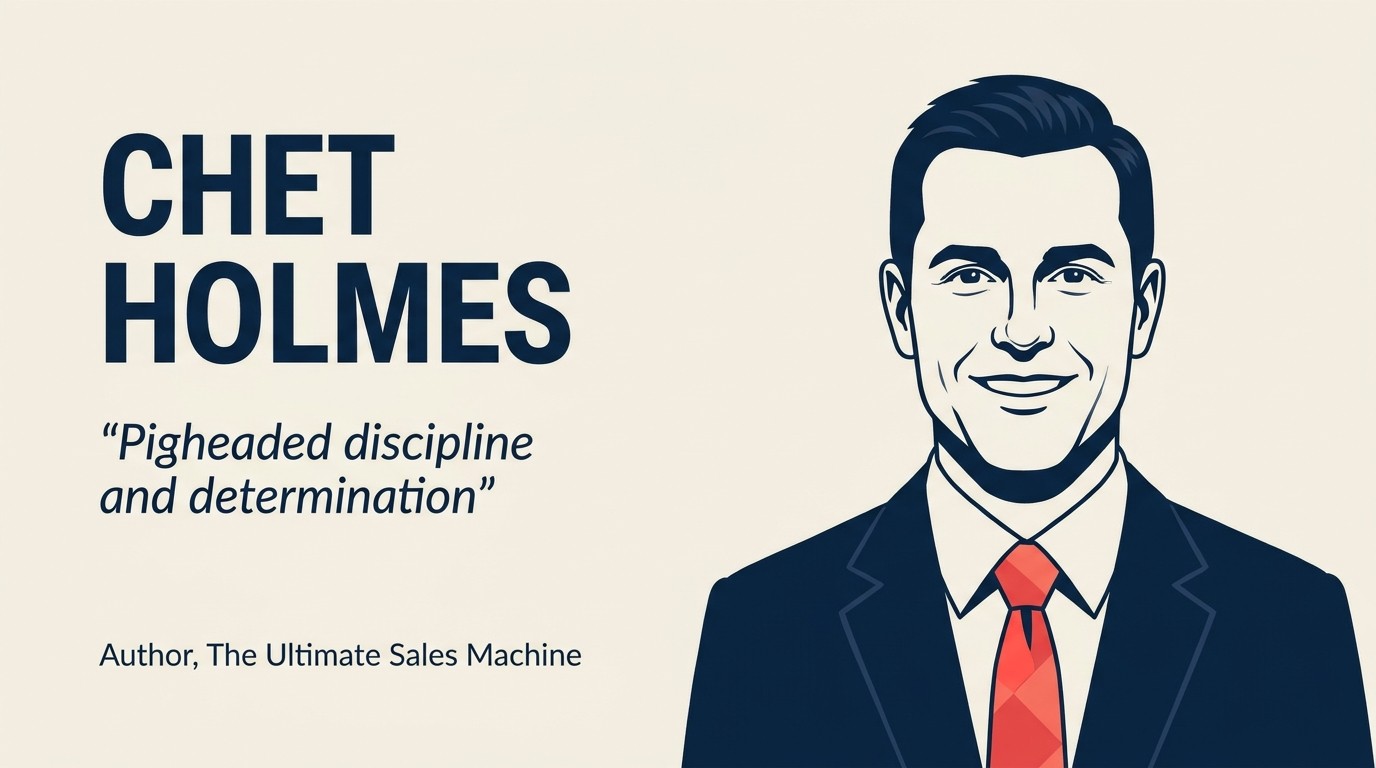
Chet Holmes Leadership Style: Pigheaded Discipline and the Dream 100 That Defined Enterprise Sales
Turn this article into takeaways for your work.


Each assistant summarizes the article only for you and suggests best practices for your work.
Key Facts: Chet Holmes (1957–2012) was an American sales strategist and author of "The Ultimate Sales Machine" (2007). Before 30, he doubled sales at nine divisions of Charlie Munger's International Magazine Group. He coined the terms "pigheaded discipline" and the "Dream 100" targeting framework, and founded Chet Holmes International, the consultancy that codified his 12-pillar sales operating system.
Chet Holmes was in his late 20s when Charlie Munger (the same Charlie Munger who served as Warren Buffett's partner at Berkshire Hathaway for six decades) gave him control of nine businesses. Holmes didn't just maintain them. He doubled sales in every one. Nine different companies, nine different markets, one consistent result. The mechanism wasn't a secret. It was the opposite: relentless application of fundamentals that most sales organizations say they understand but don't actually execute.
Holmes spent the rest of his career turning those fundamentals into a teachable system. "The Ultimate Sales Machine," published in 2007, laid out 12 specific competencies and made the central argument that mastery in a focused set of disciplines beats mediocre execution across a hundred activities. His Dream 100 framework changed how enterprise sales teams think about pipeline. And the concept he called "pigheaded discipline and determination" gave a name to the thing most organizations have the least of.
He died of leukemia in 2012, at 55 years old, with unfinished work. But what he left behind is operationally dense enough that serious sales organizations are still running his playbook.
Leadership Style Breakdown
| Style | Weight | How it showed up |
|---|---|---|
| Systematic Sales Operator | 70% | Holmes's entire career was built on the conviction that sales underperformance is almost never a talent problem. It's an execution problem, specifically, an inconsistency problem. His answer was always structural: build systems that force consistent behavior, track the right metrics, train relentlessly on the fundamentals, and the results follow. The 12 pillars in "The Ultimate Sales Machine" are a complete operating system for a sales organization, not a collection of tips. |
| High-Conviction Challenger | 30% | Holmes genuinely believed that most sales organizations were making the same preventable mistakes and he wasn't diplomatic about saying so. His "pigheaded discipline" framing was partly a challenge to the culture of variability that most sales teams normalize, different reps running different processes, different managers tolerating different levels of activity. He believed that inconsistency was the primary organizational disease and that the cure required a kind of institutional stubbornness most leaders are uncomfortable with. |
The 70/30 split captures the tension in Holmes's work. He was fundamentally a builder of systems, but the systems required a level of organizational commitment that's harder to install than the systems themselves. The challenger dimension is about what happened when he encountered resistance to that commitment.
Key Leadership Traits
| Trait | Rating | What it means in practice |
|---|---|---|
| Pigheaded Discipline | Exceptional | Holmes's term for the non-negotiable commitment to consistent execution is the most important concept in his body of work. He wasn't describing stubbornness for its own sake. He was describing the specific discipline required to do the same things at the same quality level, week after week, even when results lag the effort. Most sales organizations stop doing things that don't immediately produce measurable results. Holmes's research showed that the best-performing activities, systematic follow-up, weekly training, structured Dream 100 pursuit, require 6-18 months of consistent execution before they compound into clearly attributable revenue. The organizations that stop at month 3 never see the payoff. |
| Dream 100 Focus | Very High | Holmes's Dream 100 is a specific targeting methodology: identify the 100 clients that would most transform your business, build a persistent pursuit campaign for exactly those 100, and don't stop. The insight is about concentration of effort. Most sales organizations scatter their prospecting across hundreds of leads at varying quality levels. Holmes argued that a well-identified Dream 100, the right companies at the right scale in the right markets, was worth more than a thousand random leads, because the relationship investment compounds in a way that broad-based prospecting doesn't. |
| Training Discipline | Very High | Holmes required one hour of structured sales skills training every week, every week, no exceptions. Not product training. Not pipeline reviews. Skills training, specifically the techniques in his 12 competencies. It's a discipline that Aaron Ross would later operationalize through specialized role separation at Salesforce: if you're serious about skills development, you don't split focus between prospecting, closing, and account management in the same rep. His argument was that the difference between average and exceptional performance in most sales roles was 10-20 specific techniques that could be learned, practiced, and improved. One hour a week of deliberate practice compounds: over two years, it's more than 100 hours of focused skills development. Most sales teams deliver that kind of training approximately never. |
| Management by Metrics | Strong | Holmes built his turnaround of Munger's nine businesses partly on a simple discipline: identify the 5-6 metrics that actually drive revenue, track them weekly, and make every management decision through that lens. This sounds obvious, but most organizations track outputs (revenue, closed deals) while under-tracking the inputs (call volumes, follow-up rates, meeting-to-close ratios) that actually predict those outputs. Holmes forced the conversation upstream: don't manage the revenue number; manage the activities that produce it. |
The Pigheaded Discipline Doctrine
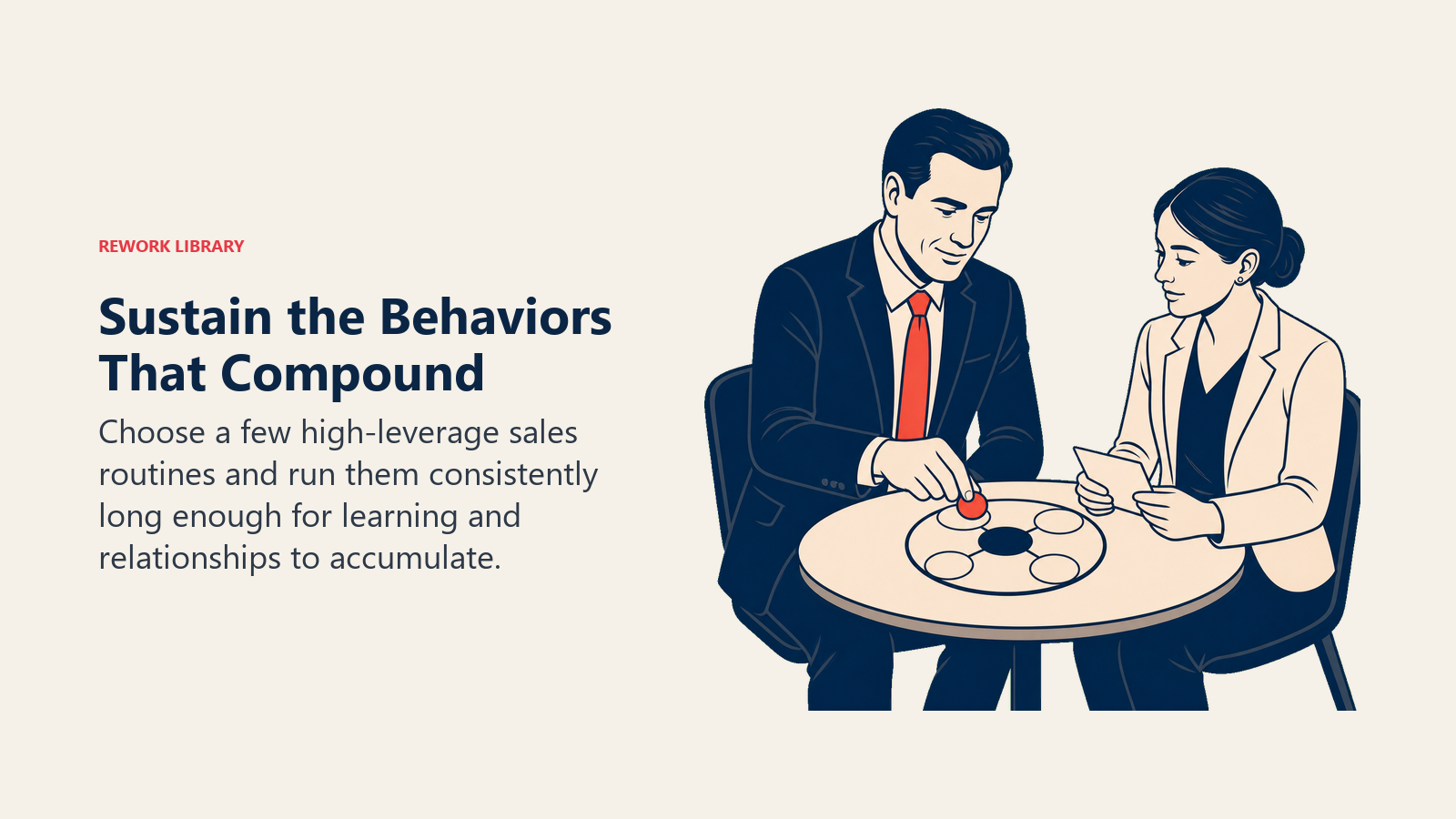
The Pigheaded Discipline Doctrine is Chet Holmes's principle that revenue performance is determined less by talent or strategy than by the institutional stubbornness to execute the same high-leverage activities, weekly training, systematic follow-up, Dream 100 touches, consistently for 12 to 18 months before results compound. The doctrine holds that most sales organizations abandon the right behaviors at month three, and that "pigheaded" commitment to the fundamentals is the single largest separator between average and exceptional teams.
The 3 Frameworks That Defined Chet Holmes
1. The Ultimate Sales Machine: 12 Pillars as an Operating System
"The Ultimate Sales Machine" isn't a book about selling techniques. It's a book about organizational mastery. Holmes's central thesis is that most businesses suffer from "a severe case of idea du jour": a constant stream of new initiatives, new tools, new strategies, none of which are executed consistently enough to compound.
His alternative: identify the 12 core competencies that drive business performance, master each one, and build systems that execute them week in and week out. The 12 pillars span time management, training, hiring, strategy meetings, marketing materials, lead generation, follow-up, referrals, goal setting, and management systems. Each pillar has specific prescribed behaviors, metrics, and checkpoints.
The design is deliberate. Holmes structured the 12 as an integrated system rather than a menu of options. An organization that implements time management discipline but ignores weekly training is like an engine missing a cylinder. The compounding effect requires all 12 running in parallel.
The most operationally useful pillar is the weekly training requirement. Holmes prescribed exactly one hour per week of sales skills training, led by the manager, focused on specific technique improvement. He documented the content, the format, and the progression. For a sales team that currently runs no structured skills training, adding this single hour produces measurable improvements in technique within 90 days. That's not a promise. It's what the data from his client work showed.
For today's operators: the most common implementation mistake is treating the 12 pillars as a project rather than a system. You don't "implement" the Ultimate Sales Machine; you run it. The difference is the same as the difference between reading about exercise and going to the gym every week.
2. Dream 100: Enterprise Targeting as a Patience Game
Holmes developed the Dream 100 framework while working at a media company that needed to close large advertising contracts. The company was selling to a market of hundreds of potential accounts. Holmes's insight was that 100 of those accounts (the largest, most profitable, most strategically valuable) represented the bulk of the available revenue. But most salespeople avoided them because they were the hardest to penetrate.
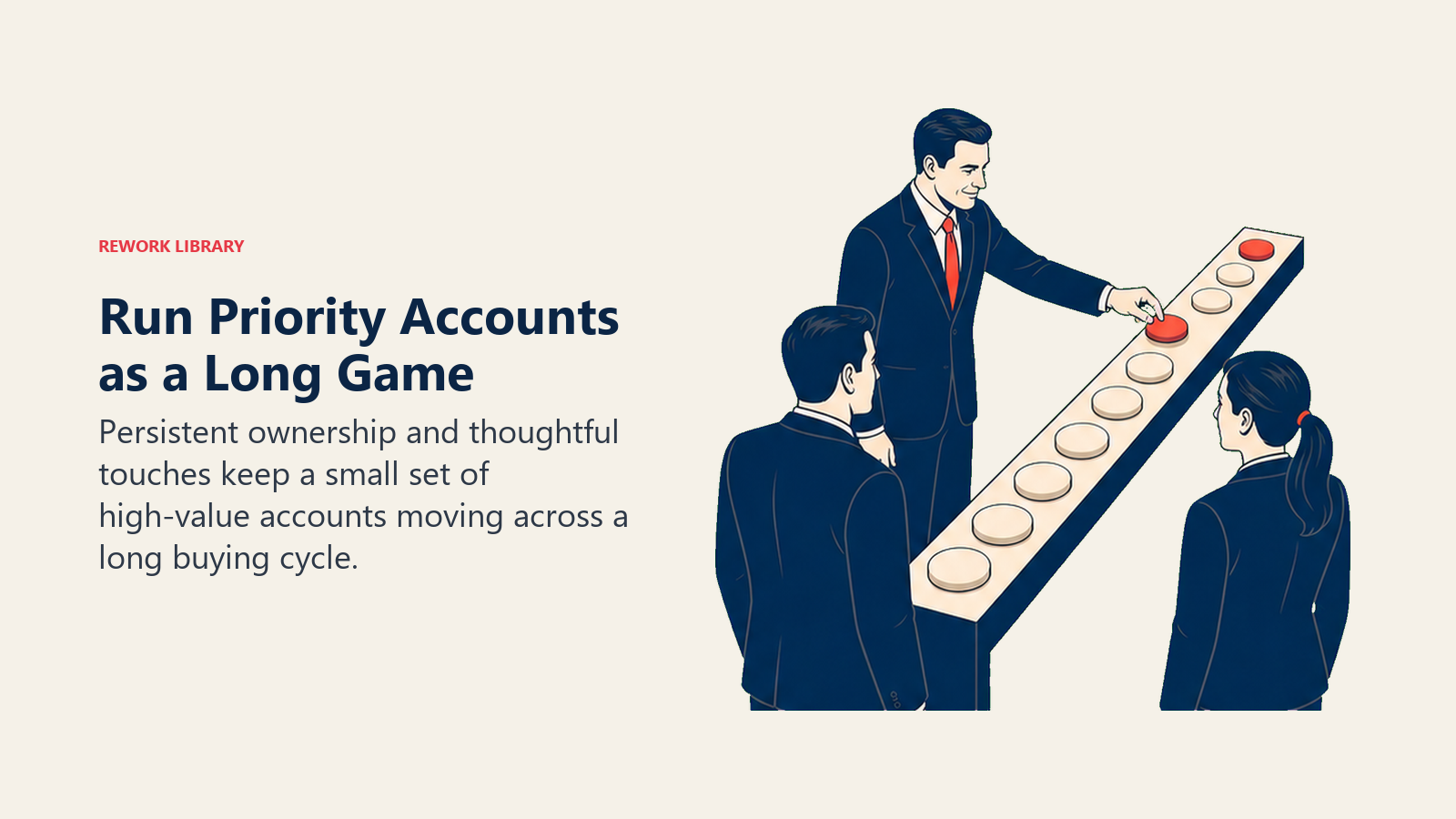
The Dream 100 methodology flips the avoidance instinct. Instead of starting with the easiest prospects and working up, you start with the most valuable prospects and build relationships persistently enough that, when they're ready to buy, you're already known to them.
The operational structure: identify the 100 companies. Build a 12-month contact campaign that alternates channels: direct mail, phone, email, LinkedIn, events, referrals. Each touch delivers something of value: research, content, insight, invitation. Never sell on the first five contacts. The goal is to be known and trusted before you ever ask for a meeting.
Holmes's data from client implementations showed that Dream 100 campaigns consistently reached 5-10% penetration within 12-18 months, meaning 5 to 10 new enterprise relationships that would not have happened through inbound or standard outbound. For a company where one enterprise deal is worth $500,000 or more, that math transforms the pipeline.
The critical constraint is patience. Dream 100 doesn't produce pipeline in 90 days. Organizations that try it and abandon it at month 3 have invested resources with no return. The compounding starts around month 9-12. That timeline is the reason most organizations don't run it, and it's also the reason the ones that do have a structural advantage over those that don't.
3. The Stadium Pitch: Content Marketing Before It Had a Name
Holmes's "Stadium Pitch" concept appeared in "The Ultimate Sales Machine" as an exercise in repositioning your company from vendor to expert. The prompt: if you had one hour in front of your entire target market, everyone who could ever buy from you, what would you teach them?
Not what would you pitch. What would you teach.
The insight was that buyers don't attend events to be sold to. Neil Rackham's SPIN Selling research supports the same conclusion from a different angle: the reps who ask insight-generating questions consistently outperform those who lead with product capability, because they reframe the conversation around the buyer's problem rather than the seller's solution. But they'll spend hours with someone who helps them understand something they didn't understand before. If you can be that person for your target market, the sales relationship starts from a fundamentally different place.
Holmes applied this through what he called "education-based marketing": content, events, seminars, and research that genuinely improves the buyer's understanding of their own problem. In 2007, when he wrote about this, it was a contrarian practice. In 2026, it's the foundation of B2B marketing strategy. But Holmes's operational version was more specific than most content marketing programs today: the content had to be valuable enough that prospects would pay for it if it weren't free, it had to connect directly to the problem your product solves, and it had to be delivered at scale through your Dream 100 campaign.
For operators today: the Stadium Pitch exercise is worth doing as a strategy session, not just a marketing exercise. Put your senior leadership team in a room and ask: if we had an hour with every CEO in our target market, what would we teach them? The answer reveals both your content strategy and your actual competitive positioning. Research from Harvard Business Review on consultative selling consistently supports the same conclusion: buyers engage with vendors who teach rather than pitch.
What Chet Holmes Would Do in Your Role
If you're a CEO, Holmes's most urgent question for you is whether your organization has "a severe case of idea du jour." Make a list of every major initiative launched in the last 12 months. For each one, ask whether it's been executed consistently enough to generate real data. If the answer is mostly no, that's not a resource problem. It's a discipline problem. Identify the three highest-leverage initiatives, commit to running them for 18 months without pivoting, and track the right leading metrics.
If you're a COO, the management-by-metrics framework has an immediate application. Identify the 5-6 input metrics that actually predict revenue in your business, not the output metrics but the activity metrics. Then build a weekly rhythm of reviewing those numbers with your revenue teams. If you don't currently know which input metrics predict your close rates, that's the first project.
If you're leading sales, the weekly training discipline is the highest-ROI change you can make with no budget. Block one hour every Friday, pick one technique from Holmes's 12 competencies, and run structured practice with your team. Do this for 52 weeks. The compounding effect on your team's skills at month 12 is qualitatively different from anything you could buy.
If you're in marketing, the Stadium Pitch exercise will clarify your content strategy better than any channel audit. Write the one-hour presentation that your CEO would give to your entire target market if they could. That presentation is your content calendar, your event strategy, and your Dream 100 campaign anchor. If you can't write it, that's a positioning problem worth solving before you spend another dollar on paid acquisition.
Rework Analysis: Operationalizing Dream 100 at Scale
Holmes's Dream 100 is the original target-account-based selling framework, and it lives or dies on sustained pipeline discipline, the ability to track 100 named accounts across 12 to 18 months of touches without losing the thread when reps churn, priorities shift, or quarterly pressure crowds out long-cycle work. That's a CRM problem, not a willpower problem. Rework CRM is built for this specific pattern: named-account lists with persistent ownership, multi-channel touch sequences (email, LinkedIn, direct mail, event invites) logged against each Dream 100 company, and cadence rules that surface stalled relationships before they go dark. Pipeline velocity reports separate "Dream 100 inbound-ready" from "still warming" so leadership knows whether the patience investment is compounding. At $90/month billed yearly for 10 sales seats on the Sales Engine, a 10-rep team running a 1,000-account Dream 100 program gets the infrastructure Holmes described, sustained pipeline discipline at enterprise scale, without the custom tooling his clients had to build from scratch in 2007.
Notable Quotes and Lessons Beyond the Boardroom
Holmes's most quoted line is also his most operational: "Pigheaded discipline and determination is the real secret of success." The word "pigheaded" is intentional. He wasn't describing moderate persistence. He was describing the kind of commitment that looks unreasonable to observers but is actually just consistent execution in the face of slow early results.
"There are only so many things you can be great at. Being great at 12 things and competent at 100 things will always beat being competent at all 100." This captures the core philosophy behind "The Ultimate Sales Machine" more cleanly than any framework description.
Holmes built his consulting business, Chet Holmes International, in part through his friendship with Jay Abraham, one of the most influential marketing strategists of the 1980s and 1990s. Their collaboration produced a body of joint work on revenue growth and positioning. The partnership is worth studying as a model for how two distinct frameworks (Holmes's operational discipline, Abraham's positioning strategies) can reinforce each other when the underlying philosophies align.
He died at 55, with the kind of unfinished work that raises the question of what he would have built next. His daughter, Amanda Holmes, took over Chet Holmes International after his death and has continued running the Dream 100 methodology with updated case studies. The core frameworks have held up.
Where This Style Breaks
Holmes's Dream 100 framework was designed for companies with the budget and patience to run 12-18 month relationship campaigns. For teams that need to compress that timeline through process rather than patience, Mark Roberge's scientific approach to sales hiring and ramp metrics offers a complementary framework, one that helps you build the team capable of running a Dream 100 program without burning through reps in the first six months. And where Holmes focused on direct outbound campaigns, Trish Bertuzzi's enterprise sales development playbook provides the tactical architecture for the inside sales team executing those Dream 100 touches at scale. For early-stage companies with runway measured in months, it's the wrong tool. The investment required to pursue 100 enterprise targets systematically (content, outreach, events, time) assumes that you can afford not to close them in the next quarter.
The 2007 publication date also shows in specific ways. Holmes's outbound frameworks assume buyers who are harder to reach than a well-crafted LinkedIn message allows. Cold calling sequences that worked in 2007 need redesigning for a market where buyers have 3-5 alternative vendors surfaced in their inbox every week. The principles are right; some of the mechanics need updating.
The deeper constraint is that "pigheaded discipline" is genuinely hard to install in organizations that haven't selected for it. Holmes could impose it when Munger gave him operational authority. Consultants rarely have that authority.
Frequently Asked Questions about Chet Holmes's Sales Philosophy
Who was Chet Holmes?
Chet Holmes (1957–2012) was an American sales strategist, consultant, and author who doubled revenue at nine divisions of Charlie Munger's International Magazine Group before age 30. He later founded Chet Holmes International and wrote "The Ultimate Sales Machine," becoming one of the most cited voices on enterprise sales discipline before his death from leukemia at 55.
What is the Dream 100 sales strategy?
The Dream 100 is Holmes's enterprise targeting framework: identify the 100 accounts that would most transform your business, then pursue them with a 12- to 18-month multi-channel relationship campaign (direct mail, phone, email, LinkedIn, events, referrals) that delivers value, research, insight, invitations, before ever asking for a meeting. Holmes's client data showed 5–10% penetration within 12–18 months, which for enterprise deal sizes resets the pipeline math.
What does 'pigheaded discipline' mean?
"Pigheaded discipline and determination" was Holmes's phrase for the institutional stubbornness required to keep executing high-leverage sales activities, weekly training, systematic follow-up, Dream 100 touches, for 12 to 18 months before results compound. It's not stubbornness for its own sake; it's the specific refusal to abandon proven practices during the early period when effort outruns visible returns.
What is The Ultimate Sales Machine?
"The Ultimate Sales Machine," published in 2007, is Holmes's book outlining 12 core competencies that function as an integrated operating system for a sales organization. Its thesis: being great at 12 things beats being competent at 100, and organizational mastery comes from running the 12 pillars consistently rather than cycling through "idea du jour" initiatives.
What are Holmes's 12 core competencies?
The 12 pillars span time management, weekly sales training, superior hiring, effective strategy meetings, world-class marketing materials, the best buyer sales strategy (education-based marketing), the seven musts of marketing, sales skills mastery, systematic follow-up and client bonding, goal setting, exceptional execution, and measurement. Holmes designed them as one integrated system, implementing a subset is like running an engine missing cylinders.
What can modern salespeople learn from Chet Holmes?
The most transferable lessons are the weekly one-hour skills training discipline, managing by input metrics rather than output metrics, and the Dream 100 patience framework. The specific 2007 outbound mechanics need updating for today's buyer, but the underlying principles, mastery through consistency, concentrated targeting, education-led relationship building, map directly onto modern account-based selling and content-led B2B marketing.
Learn More

On this page
- Leadership Style Breakdown
- Key Leadership Traits
- The Pigheaded Discipline Doctrine
- The 3 Frameworks That Defined Chet Holmes
- 1. The Ultimate Sales Machine: 12 Pillars as an Operating System
- 2. Dream 100: Enterprise Targeting as a Patience Game
- 3. The Stadium Pitch: Content Marketing Before It Had a Name
- What Chet Holmes Would Do in Your Role
- Rework Analysis: Operationalizing Dream 100 at Scale
- Notable Quotes and Lessons Beyond the Boardroom
- Where This Style Breaks
- Learn More