Jacinda Ardern Leadership Style: Empathetic Governance and What 'Kindness' Actually Costs
Turn this article into takeaways for your work.


Each assistant summarizes the article only for you and suggests best practices for your work.
Key Facts at a Glance
- Born: July 26, 1980 (Hamilton, New Zealand)
- Prime Minister: October 2017 – January 2023
- Age at appointment: 37, youngest female head of government in the world at the time
- Defining crises: Christchurch mosque attacks (March 2019, 51 killed), White Island volcanic eruption (December 2019, 22 dead), COVID-19 pandemic (2020–2022)
- "Ardern kindness" doctrine: empathetic communication paired with decisive action, gun reform passed in 26 days, Level 4 COVID lockdown triggered at 102 cases
- First in office: first New Zealand PM to give birth while serving (Neve Te Aroha, June 2018); second elected world leader after Benazir Bhutto
- Resignation: January 19, 2023, "I no longer have enough in the tank to do it justice"
Jacinda Ardern became New Zealand Labour Party leader on September 7, 2017, seven weeks before New Zealand's general election, with Labour polling at 23%. She won. She became Prime Minister in October 2017 at 37, the world's youngest female head of government at the time. Her full political biography is covered in her Wikipedia entry. Lee Kuan Yew had taken office at a similar age when Singapore was younger than New Zealand's Labour Party, what connects them is the challenge of building national credibility from a position that the establishment hadn't expected to give you.
On March 15, 2019, a terrorist killed 51 people at two Christchurch mosques in what became known as the Christchurch mosque shootings. Ardern's response was studied globally as a model of crisis communication: she wore a hijab to meet victims' families, refused to say the attacker's name on national television, and passed gun reform within 26 days. She then led New Zealand's COVID-Zero strategy, implementing a Level 4 lockdown 48 hours after reaching 102 confirmed cases. New Zealand's 2020 death toll was a fraction of comparable nations.
On January 19, 2023, she resigned. "I no longer have enough in the tank to do it justice," she said. That statement was also a leadership act, one of the most unusual in modern politics.
Her tenure isn't a story of sustained triumph. It's a case study in what empathy-forward leadership costs, where it works, and where it breaks under the weight of real governance. The contrast with Winston Churchill is instructive: both led nations through acute crisis with a communication style that shaped national identity, but where Churchill's wartime register was combative and resolute, Ardern's was empathetic and collective. Nelson Mandela offers a closer peer in moral leadership, governing through the weight of a nation's grief rather than its anger.
The Kindness Doctrine (The Ardern Empathetic Strength Model)
The Kindness Doctrine is the leadership principle that empathy and decisiveness are not opposing forces but sequential instruments, moral framing first, rapid policy second. Ardern operationalized it by centering the human weight of a crisis before announcing the government response, earning the standing to act fast (26-day gun reform, 48-hour COVID lockdown) without appearing cold or reactive. It rejects the traditional executive assumption that compassion signals weakness; instead, it treats empathy as the earned license for decisive execution.
Leadership Style Breakdown
| Style | Weight | How it showed up |
|---|---|---|
| Empathetic Communicator | 60% | Ardern's communication operated at an emotional register most political leaders avoid. After Christchurch, she set the moral frame before the policy detail; she established that the nation was grieving before she announced what the government would do. She gave birth while in office in June 2018 (only the second elected world leader to do so after Benazir Bhutto in 1990) and made no effort to hide the dual identity of being a mother and a head of state. Her Facebook Live sessions from her couch during COVID lockdowns were a communication strategy as much as an authentic choice, and the two aren't mutually exclusive. |
| Crisis Decision-Maker | 40% | When Ardern made a decisive call, she made it fast and completely. The Christchurch gun reform passed in 26 days. The COVID Level 4 lockdown was called 48 hours after 102 cases. She didn't make incremental decisions when the situation required a definitive one. The limitation was that this mode of decision-making required a crisis to activate it. In sustained, slow-moving policy problems like housing affordability, poverty, and infrastructure, the decisiveness was harder to find. |
The 60/40 split describes the gap in her leadership that critics identified most clearly. The communication instinct was always on. The policy decisiveness was crisis-triggered. When the crisis was acute and defined, a shooting or a pandemic wave, she performed at an exceptional level. When the problem was chronic and diffuse, the empathetic communication often substituted for the harder policy execution.
Key Leadership Traits
| Trait | Rating | What it means in practice |
|---|---|---|
| Crisis communication that sets moral framing before policy details | Very High | After Christchurch, Ardern's first public statements were about grief, solidarity, and moral clarity, not about legislative timelines. She wore a hijab. She said the killer's name would not be spoken. These choices established the emotional and moral register of the national response before a single policy was announced. That sequencing matters: moral framing first, policy second, made the policy feel inevitable rather than reactive. Most executives invert this and lead with the action plan. |
| Decisive action on values-driven issues | High | When the issue was unambiguous, a mass shooting or a pandemic, Ardern moved faster than comparable leaders. Gun reform in 26 days. COVID lockdown in 48 hours. Her Labour Party won an outright parliamentary majority in October 2020, the first time that had happened under New Zealand's proportional representation system (in place since 1996). Voters were signaling that they trusted her with fast decisions under pressure. |
| COVID strategy execution | High | New Zealand's COVID-Zero strategy in 2020 was one of the most successful early pandemic responses globally. The combination of early lockdown, border controls, and public compliance drove case counts low enough that New Zealand remained largely open domestically for much of 2020-2021 while most of the world stayed shut. The strategy worked until it didn't. Omicron made elimination impossible, and the economic cost of sustained border closure eventually forced a rethink. |
| Self-awareness to recognize personal capacity limits | Very High | The resignation is its own leadership case study. Ardern didn't wait until a scandal forced her out or until she lost an election. She identified that she no longer had the energy to do the job at the level it required, and she left. That kind of self-aware exit, not defensive, not managed for optics, just honest, is genuinely unusual. Whether it's a model worth following depends entirely on your situation, but the honesty about limits is worth examining. |
The 3 Decisions That Defined Ardern
1. Banning Semi-Automatic Weapons Within 26 Days of Christchurch (March-April 2019)
The Christchurch mosque attacks happened on March 15, 2019. Fifty-one people were killed. It was the deadliest mass shooting in New Zealand's history.
Within hours, Ardern had made a public commitment to change gun laws. The Arms (Prohibited Firearms, Magazines, and Parts) Amendment Act passed on April 10, 2019, just 26 days after the attack. It banned military-style semi-automatic weapons and assault rifles, with a government buyback program.
The speed was remarkable. Most comparable gun reform efforts, particularly in the United States, stall for years in legislative process and political opposition. Ardern's government moved in 26 days because she made it a personal and political priority and had a parliamentary majority that could pass it.
But the Christchurch response wasn't just legislative. The communication choices were studied globally. She wore a hijab when meeting victims' families, a choice that signaled solidarity rather than performative sympathy. She refused to say the attacker's name publicly, saying she intended to deny him the fame he sought. She framed the national response as one of collective grief rather than political argument.
Those choices didn't emerge from a media strategy document. But they functioned as a coherent communication approach: establish the moral register, center the victims, move to policy once the human response is clear.
For leaders: Ardern's Christchurch response illustrates a specific principle about crisis communication. In a genuine crisis, the first question people are asking isn't "what are you going to do?" It's "do you understand what just happened?" Answering the second question first, with genuine humanity rather than managed empathy, earns you the standing to answer the first.
2. COVID-Zero Level 4 Lockdown (March 2020)
New Zealand confirmed its first COVID-19 death on March 29, 2020. But the Level 4 lockdown, the strictest possible restrictions requiring everyone except essential workers to stay home, was implemented on March 25, when New Zealand had 102 confirmed cases.
The decision to lock down before the situation looked critical was the decision. Most governments moved when hospitals were under pressure. Ardern moved on epidemiological modeling rather than visible crisis. The result: New Zealand had 22 deaths by the end of 2020. The United Kingdom, with 14 times the population, had over 70,000.
She communicated the lockdown through a combination of formal press conferences and Facebook Live sessions from her house, sometimes with her baby in the background. The informality was deliberate. "We're a team of five million," she told New Zealanders. The framing positioned the lockdown as collective action rather than government imposition.
The COVID-Zero strategy worked through most of 2020-2021. It began to break when the Delta variant accelerated in late 2021 and became untenable when Omicron made elimination impossible. New Zealand abandoned COVID-Zero in October 2021. The economic cost of sustained border closure, particularly to tourism and international education, was significant and unevenly distributed.
For executives: the COVID-Zero story has a lesson about strategies that are right until they're not. Ardern's early lockdown was the right call in a world where elimination was possible. When the virus changed and elimination became impossible, holding the same strategy past its window became costly. Knowing when to end a strategy that was working requires the same kind of intellectual honesty that knowing when to start a new one does.
3. Resigning in January 2023
This is the decision that most shaped how Ardern will be remembered, and it's worth examining carefully rather than simply praising.
On January 19, 2023, she announced her resignation with a statement that was prepared, clear, and honest: "I have given my absolute best, but it is also clear that I no longer have enough in the tank to do it justice."
She'd been Prime Minister for five years and three months. She'd governed through the Christchurch attacks, the White Island volcanic eruption (22 dead, December 2019), a global pandemic, and the domestic policy pressures of a government that had made promises on housing, poverty, and climate that were only partially delivered.
The resignation was unusual on two dimensions. First, she left voluntarily and honestly, without the cover of an electoral defeat or a manufactured reason. Second, she was 42. Most leaders of her visibility don't leave voluntarily at 42. They stay until forced out or until an election takes the decision out of their hands.
The Labour Party lost the October 2023 election under her successor Chris Hipkins, which gave critics ammunition to argue that her departure accelerated Labour's collapse. But the alternative framing is that she recognized something real: that governing below the level the role requires, because you're running on depleted energy, is its own form of leadership failure.
For executives: the resignation question Ardern answered is one most leaders never directly face: when do you choose to leave a role before it asks more of you than you can give? Most professional contexts have different stakes than national leadership. But the underlying question, am I still the right person for this at this moment with the energy I actually have, is one worth asking honestly and regularly.
What Ardern Would Do in Your Role
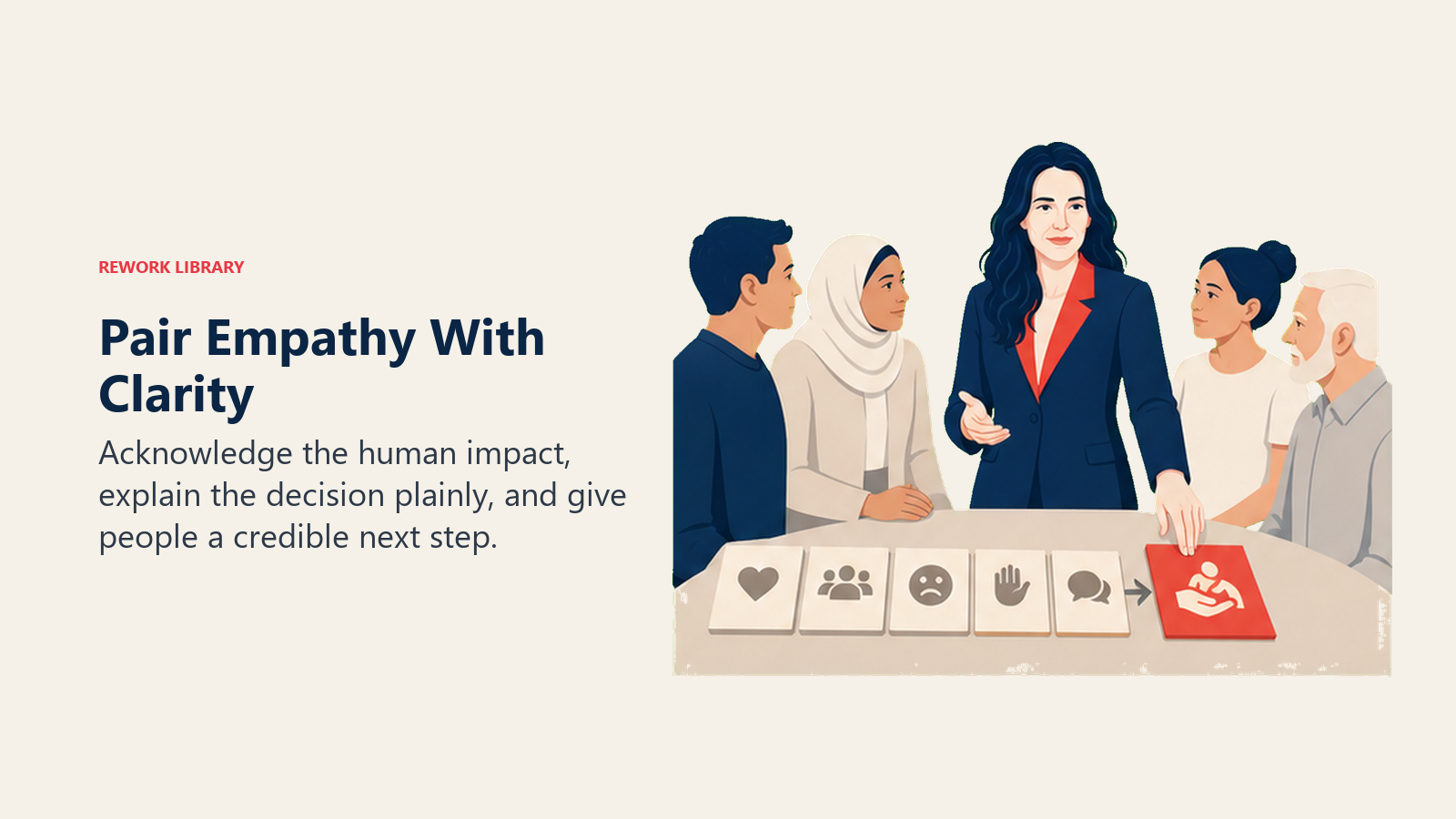
If you're a CEO navigating a genuine crisis, the Christchurch sequencing is a direct model. Before you communicate the action plan, establish the human register. What does this mean for the people it affects most? Say that clearly, in your own words, before you move to the response framework. Most executives rush to the action plan because it gives them something concrete to say and signals control. But the action plan lands differently when the audience knows you understand the situation's human weight first.
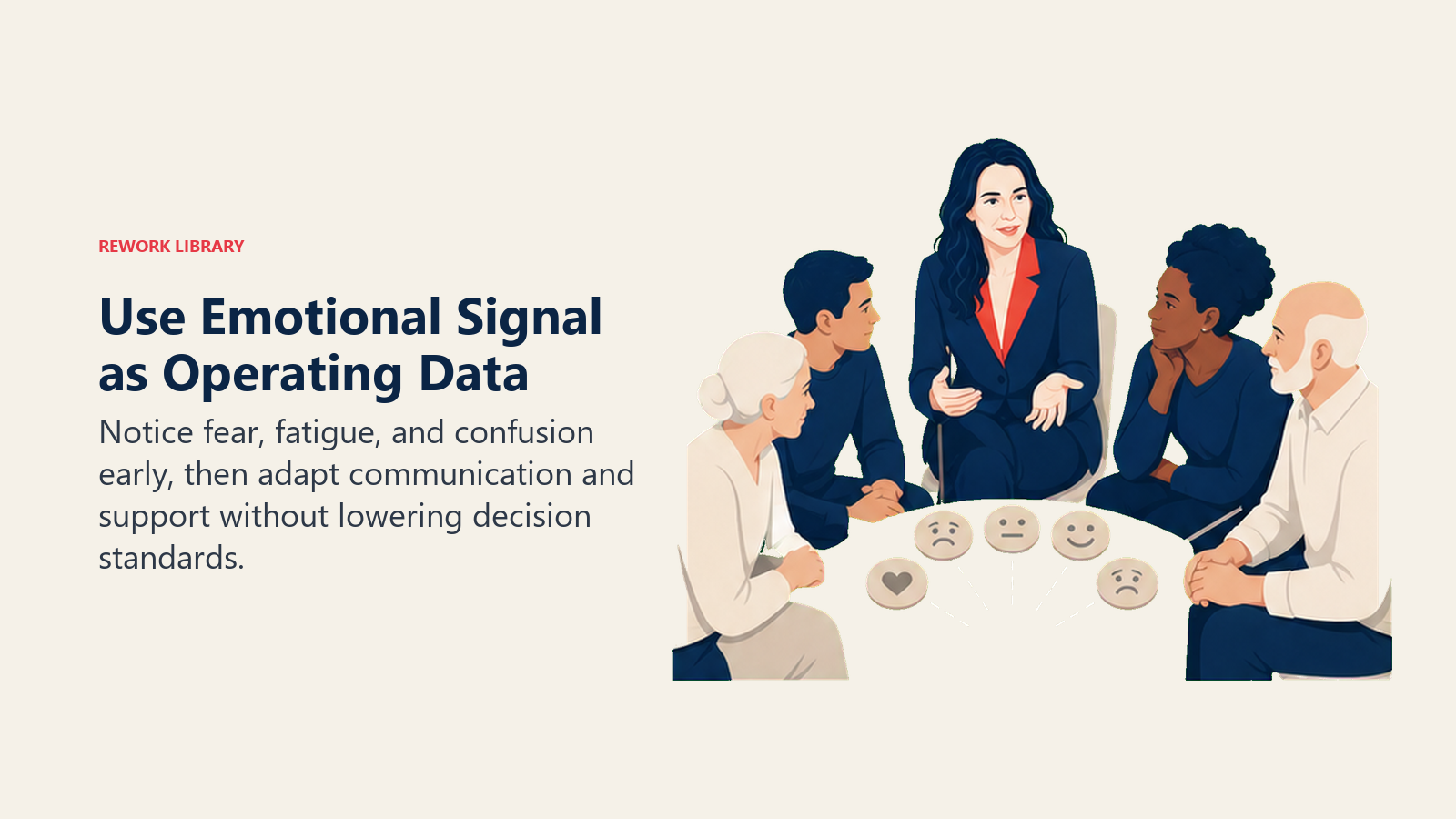
If you're a COO managing rapid response operations, the COVID-Zero lockdown decision has an operational lesson. Ardern's team moved on modeling rather than waiting for visible crisis. Ask your team: at what point in a developing problem do we escalate? What's the leading indicator that tells us to act before the lagging indicator tells us we're already late? Building that tripwire, and trusting it, is harder than it sounds.
If you're a product or communications leader, Ardern's Facebook Live approach during COVID is worth examining. She didn't wait for official communications infrastructure to be set up before talking to the public. She used what was available, spoke directly, and maintained a human register while still being substantive. The informality wasn't a lack of preparation. It was a communication choice. When your team is waiting to communicate until everything is polished, ask whether the polish is serving the audience or protecting you.
If you're a sales or relationship leader, the "team of five million" framing during COVID is a positioning lesson. She turned a compliance requirement, stay home, into collective participation in a shared goal. When you're asking your team or your clients to do something difficult, the framing matters. "We need you to do this" lands differently than "here's what we're building together." Both can be true. Only one of them generates commitment rather than compliance.
How Rework Operationalizes the Ardern Doctrine
Ardern's tenure proved that empathy isn't the opposite of execution, it's the interface layer that makes rapid execution land without shredding trust. Crisis leadership, whether it's a Christchurch-scale external shock or a quarter where your pipeline cratered, collapses when leaders skip the human register and race to the action plan. Teams read the gap. They stop reporting bad news early, and the organization's tripwires stop working right when you need them most.
Rework is built to hold that interface layer during turbulent periods. Shared dashboards surface the leading indicators (at-risk deals, missed SLAs, burnout signals in task load) before they become lagging ones, so leaders can move on modeling rather than visible crisis, the same pattern that let Ardern's team lock down at 102 cases. And because the work operations side (Process and Project Engines, from $99/month billed yearly) gives every function a visible artifact of what's actually happening, the "team of five million" framing scales down to a team of fifty. People see the shared goal, not just their individual compliance requirement. That's how empathetic strength stops being a personality trait and becomes operational infrastructure.
Notable Quotes and Lessons Beyond the Boardroom
"One of the criticisms I've faced over the years is that I'm not aggressive enough, or assertive enough, or maybe somehow, because I'm empathetic, it means I'm weak. I totally rebel against that. I refuse to believe that you cannot be both compassionate and strong."
That's not a political statement. It's a leadership position, one that a lot of executives in aggressive organizational cultures haven't fully resolved for themselves. The assumption that empathy trades off against decisiveness is one Ardern challenged through her actions: she banned semi-automatic weapons in 26 days. That's not soft governance.
Her resignation address had a line that stayed with people: "I am not leaving because it was hard. Hard is part of the job." She left because she'd been honest with herself about where her reserves were. That's a rare thing to model publicly, particularly for people in visible leadership roles where admitting limits is usually a reputational risk.
Post-PM, she's been a Harvard Kennedy School visiting fellow and has worked on the Christchurch Call, an international initiative to eliminate terrorist and violent extremist content online. Among female executives who built institutional authority through sustained personal conviction rather than traditional power structures, Indra Nooyi at PepsiCo is the closest corporate analog, both are studied for how values-led leadership actually functions under the pressure of real accountability. The Christchurch Call now includes 120+ governments and 22 major technology companies. She continued doing real work in the domain where she had the most credibility, rather than taking the most lucrative speaking circuit path.
Where This Style Breaks
Ardern's empathy-first communication was powerful in acute crisis. It struggled in sustained operational governance, where the emotional register that worked for Christchurch doesn't transfer to housing affordability or infrastructure.
New Zealand's housing costs rose significantly during her tenure despite specific promises to fix the housing market. Child poverty metrics improved modestly. Climate legislation passed but faced implementation gaps. These aren't small failures. They were central commitments of her government. The "kindness" brand she built created a standard that every policy disappointment measured against, and policy always eventually disappoints someone.
The COVID-Zero strategy was right until Omicron made it structurally impossible. Holding it past the point of viability cost New Zealand economically. And the Labour Party's collapse in the 2023 election, losing to the centre-right by a substantial margin, suggests that her departure didn't solve the deeper problems in Labour's policy delivery record.
The honest conclusion: empathy is a real leadership asset, not a soft one. But it's insufficient on its own. Sustained governance requires that the empathetic communication be matched by operational execution. When the execution doesn't deliver, the communication becomes a liability rather than a strength, because you've set expectations the policy can't meet.
Frequently Asked Questions about Jacinda Ardern's Leadership
Who is Jacinda Ardern?
Jacinda Ardern (born July 26, 1980) is a New Zealand politician who served as the 40th Prime Minister from October 2017 to January 2023. She became Labour Party leader just seven weeks before the 2017 general election and, at 37, was the world's youngest female head of government at the time. She is widely studied for her crisis leadership through the Christchurch mosque attacks, the White Island eruption, and the COVID-19 pandemic.
How did Ardern respond to the Christchurch attacks?
After a terrorist killed 51 people at two Christchurch mosques on March 15, 2019, Ardern wore a hijab to meet victims' families, refused to speak the attacker's name publicly, and framed the national response as collective grief rather than political argument. She passed the Arms (Prohibited Firearms, Magazines, and Parts) Amendment Act on April 10, 2019, just 26 days after the attack, banning military-style semi-automatic weapons with a government buyback program.
What did Ardern mean by 'kindness' as a leadership principle?
Ardern treated kindness as the pairing of empathetic communication with decisive action, not as softness. She argued directly that compassion and strength are not opposites: "I refuse to believe that you cannot be both compassionate and strong." In practice this meant establishing the moral and human register of a situation first, then moving to policy fast, the sequencing that made her 26-day gun reform and 48-hour COVID lockdown land as inevitable rather than reactive.
Why did Ardern resign in January 2023?
On January 19, 2023, Ardern announced she would step down, saying "I have given my absolute best, but it is also clear that I no longer have enough in the tank to do it justice." After five years and three months governing through Christchurch, the White Island eruption, and the pandemic, she chose to leave voluntarily at 42, without the cover of an electoral defeat, on the grounds that governing below the level the role requires is itself a form of leadership failure.
How did New Zealand handle COVID-19 under Ardern?
New Zealand implemented a Level 4 lockdown on March 25, 2020, with just 102 confirmed cases, moving on epidemiological modeling rather than visible hospital pressure. The COVID-Zero strategy combined early lockdown, strict border controls, and collective "team of five million" messaging delivered partly through Facebook Live sessions from Ardern's home. New Zealand had 22 deaths by the end of 2020. The strategy was abandoned in October 2021 once Omicron made elimination impossible.
What can modern leaders learn from Jacinda Ardern?
Three portable lessons stand out. First, in a crisis, lead with the human register before the action plan, people need to know you understand what happened before they care what you'll do. Second, move on leading indicators rather than waiting for visible failure, as the early COVID lockdown demonstrated. Third, be honest about capacity: recognizing when you can no longer serve a role at the level it requires is a leadership act, not a retreat. Empathy paired with execution is a real asset; empathy without execution becomes a liability.
Learn More
- Satya Nadella Leadership Style: How Growth Mindset and Empathy Transformed Microsoft
- Indra Nooyi Leadership Style: How PepsiCo's CEO Built a Purpose-Driven Strategy at Fortune 50 Scale
- Christine Lagarde Leadership Style: Institutional Credibility and Leading Through Systemic Crisis
- Ginni Rometty Leadership Style: Transformation Under Pressure and the Limits of Reinventing Slowly
- Julie Sweet Leadership Style: Scale, Reinvention, and Leading 750,000 People Through the AI Era

On this page
- The Kindness Doctrine (The Ardern Empathetic Strength Model)
- Leadership Style Breakdown
- Key Leadership Traits
- The 3 Decisions That Defined Ardern
- 1. Banning Semi-Automatic Weapons Within 26 Days of Christchurch (March-April 2019)
- 2. COVID-Zero Level 4 Lockdown (March 2020)
- 3. Resigning in January 2023
- What Ardern Would Do in Your Role
- How Rework Operationalizes the Ardern Doctrine
- Notable Quotes and Lessons Beyond the Boardroom
- Where This Style Breaks
- Learn More