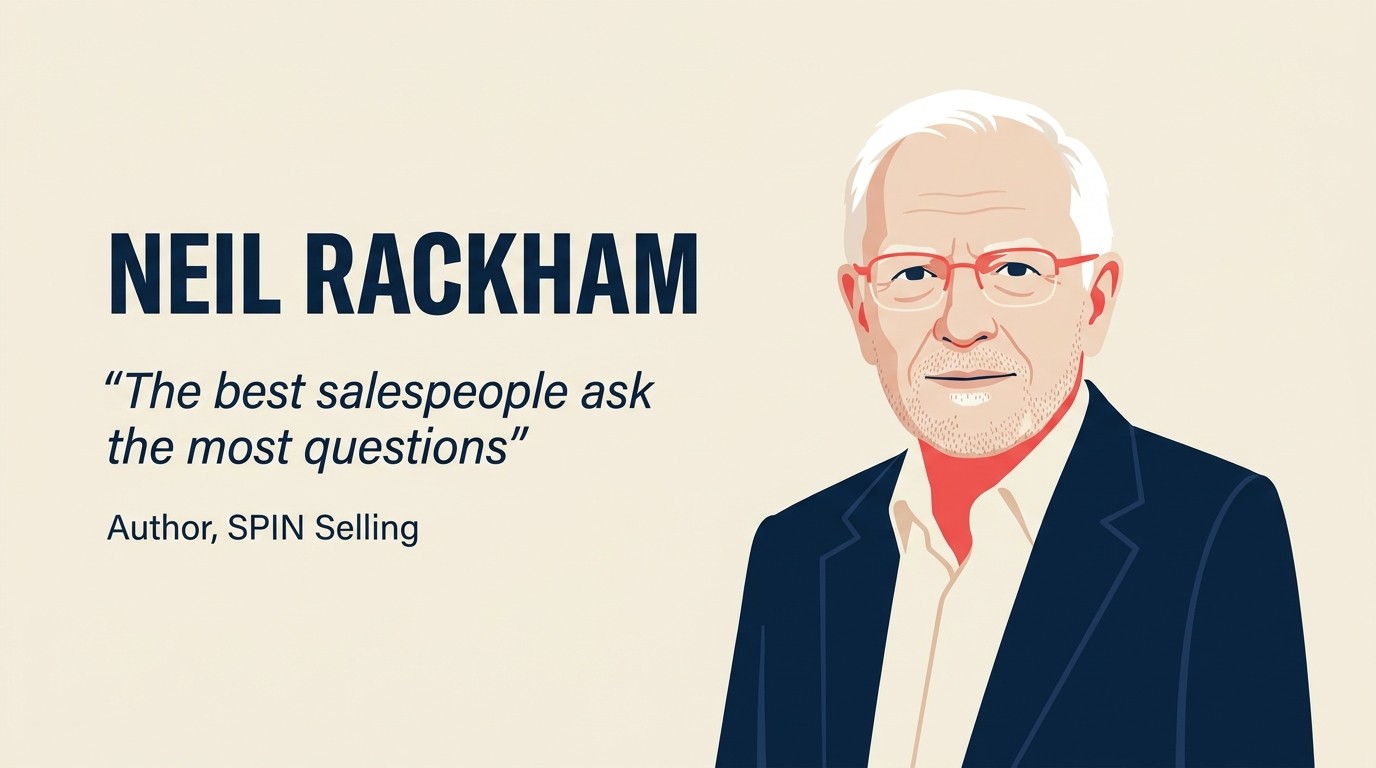
Neil Rackham Leadership Style: Research-First, Question Everything
Turn this article into takeaways for your work.


Each assistant summarizes the article only for you and suggests best practices for your work.
Key Facts: Neil Rackham is a British behavioral psychologist who founded Huthwaite Inc and led the largest sales research study ever conducted, a 12-year project analyzing more than 35,000 sales calls across 27 countries. He coined the SPIN Selling methodology, published SPIN Selling (1988) and Major Account Sales Strategy (1989), and has served as visiting professor at the University of Oxford's Templeton College and at Sheffield Hallam University.
The SPIN Selling Model (The Rackham Research-First Doctrine)
The SPIN Selling Model is an empirically derived diagnostic framework that sequences buyer conversations through four question types, Situation, Problem, Implication, and Need-Payoff, to advance complex B2B deals. Rackham built it from behavioral coding of 35,000+ real sales calls, not from practitioner intuition. Its core claim: in large sales, top performers win by making buyers articulate the cost of their own problem, not by pitching features or pressuring closes.
Most sales training in the 1970s was folklore. Trainers taught closing techniques, objection-handling scripts, and product pitch structures based on what experienced reps believed worked. Nobody had actually measured whether it worked. Nobody had compared the behaviors of top performers against average performers across thousands of real calls. The whole field was built on anecdote and authority.
Neil Rackham decided to study it instead.
He wasn't a sales practitioner. He was a British behavioral psychologist trained at Sheffield University. Through his Huthwaite Research Group, he and his team observed and coded more than 35,000 sales calls across 27 countries over 12 years, with companies including IBM, Xerox, and Kodak. It was the largest behavioral study of sales interactions ever conducted at the time.
What he found overturned most of the conventional wisdom. Closing techniques that worked in small transactional sales actively damaged conversion rates in large complex deals. Objection handling, a cornerstone of most sales training programs, was less predictive of success than most people assumed. And the most powerful thing a rep could do was ask a specific kind of question that made the buyer articulate the cost of their own problem.
He published the results in 1988 as SPIN Selling. It's still in print. And the framework it introduced is still the most empirically grounded approach to enterprise sales methodology we have.
Leadership Style Breakdown
| Style | Weight | How it showed up |
|---|---|---|
| Research-Led Thinker | 70% | Rackham built nothing on assumption. Before he trained sales teams, he studied what top performers actually did, not what they said they did in interviews. The Huthwaite research model observed real sales calls in real time, coded specific behaviors (types of questions asked, types of commitments obtained, how objections arose), and ran statistical analysis on which behaviors correlated with successful outcomes. His willingness to let the data overturn his own hypotheses is what separates his work from most sales methodology. Most frameworks are built by practitioners who succeeded and then rationalized why. Rackham built his framework from evidence up. |
| Contrarian Challenger | 30% | Rackham's core findings were direct challenges to established sales training programs. He said closing techniques hurt complex deals. He said product features were less powerful than implication questions. He said the distinction between large and small sales was so fundamental that a rep trained only in transactional selling was actually worse at enterprise deals than an untrained rep, because the habits were counterproductive. These weren't gentle refinements. They were direct attacks on the consensus. He published them with data, which made them hard to dismiss even for practitioners who disagreed. |
The research-first posture is what gives his contrarian positions credibility. Without it, SPIN Selling is just another sales opinion. With it, it's a methodology with an evidentiary foundation that nobody else in the field had produced.
Key Leadership Traits
| Trait | Rating | What it means in practice |
|---|---|---|
| Intellectual Rigor | Very High | Rackham didn't just observe sales calls, he built a coding framework to categorize behavior, ran inter-rater reliability tests to make sure different observers categorized the same behaviors the same way, and then correlated behavioral frequencies with outcome data. That's a research methodology, not a practitioner memoir. The rigor is what allowed him to claim, credibly, that his findings applied across industries and cultures rather than just to the specific salespeople he happened to know. |
| Evidence Over Intuition | Very High | The most important moment in the Huthwaite research came when the data contradicted what experienced sales managers believed. Closing techniques, the ABCs of traditional sales training, didn't increase close rates in large complex deals. They actually reduced them. Rackham published this finding despite knowing it would be resisted by every sales trainer whose livelihood depended on closing technique curricula. The willingness to follow the evidence wherever it went, including to uncomfortable conclusions, is the defining trait of his leadership posture. |
| Long-Horizon Patience | High | The Huthwaite study ran for 12 years before Rackham published SPIN Selling. That's not a product sprint or a thought leadership article. It's a commitment to building a foundation that would hold up to scrutiny, even at the cost of speed to market. Most practitioners don't have that patience. They observe a pattern in their own experience, generalize it quickly, and publish before the sample size is meaningful. Rackham waited until he had 35,000 data points across 27 countries before making claims. |
| Willingness to Disprove Convention | High | He didn't set out to confirm what sales trainers already believed. He set out to measure what actually happened. When the measurements contradicted conventional wisdom, he reported them accurately. The implication question finding, that the most powerful sales behavior is asking buyers about the consequences of their problem, not explaining the features of your solution, was genuinely counterintuitive to most practitioners. It required reps to invest more time and skill in the discovery phase than most training programs allocated. That's a harder thing to teach and sell, but it was what the data supported. |
The 3 Frameworks That Defined Rackham
1. SPIN Selling: Situation, Problem, Implication, Need-Payoff
The SPIN framework isn't a script. It's a diagnostic model for the types of questions that move a complex deal forward, ordered by the function each type of question serves.
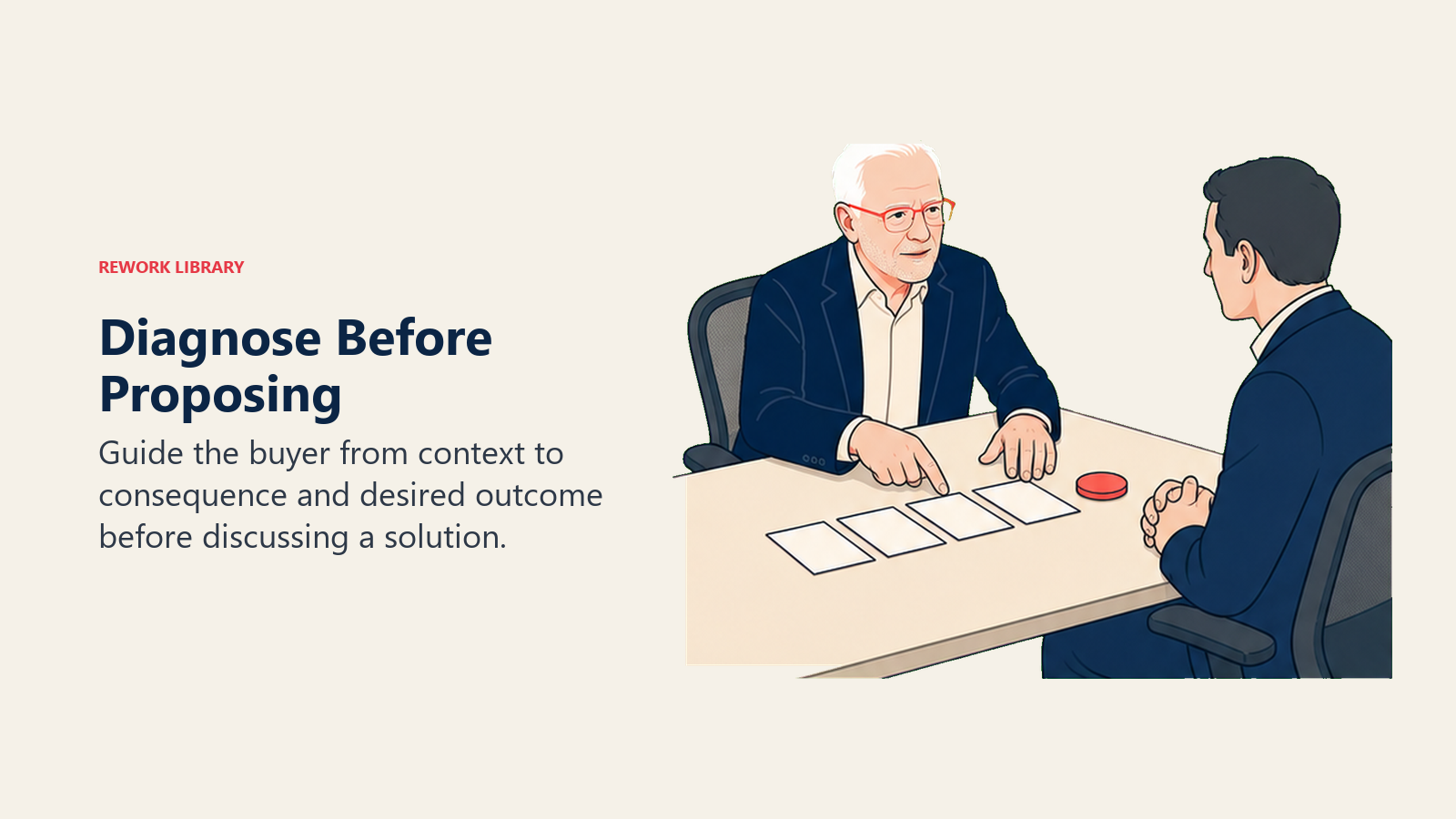
Situation questions establish context: what systems are you using, how many people are involved, what's the current process. These are necessary but have low persuasive value. Rackham's research showed that top performers asked fewer situation questions than average performers, they came prepared, did pre-call research, and got to the substantive questions faster.
Problem questions identify explicit difficulties: where does the current process break down, what doesn't work, what would you change if you could. These matter, but they're not sufficient. A buyer who acknowledges a problem doesn't necessarily feel enough pain to act. That gap between "yes, this is a problem" and "I need to fix this now" is where most deals stall.
Implication questions are the leverage point. They ask about the consequences of the problem: if this keeps happening, what does it cost you, who else is affected, how does this limit what you can do. The function is to expand the buyer's felt sense of the problem's magnitude. A rep doesn't tell the buyer the problem is serious. The implication question leads the buyer to articulate why it's serious themselves. That's a fundamentally different persuasive structure. The buyer's own words carry more weight than any rep's.
Need-payoff questions close the loop: if you could eliminate this problem, what would that make possible. This invites the buyer to articulate the value of a solution in their own language before you've presented one. When the buyer says "we'd save 40 hours a month in manual reconciliation," they've just written your value proposition for you. The rep's job is then to show that their solution delivers exactly what the buyer just described.
The sequence isn't rigid. Skilled reps move between question types based on where the conversation is. But the underlying logic, build the problem before you present the solution, is consistent and well-supported by the data.
2. Large vs. Small Sale Distinction
Rackham's most practically important finding is one that most sales leaders still resist: small sale selling techniques don't scale to large sales. They actually make results worse.
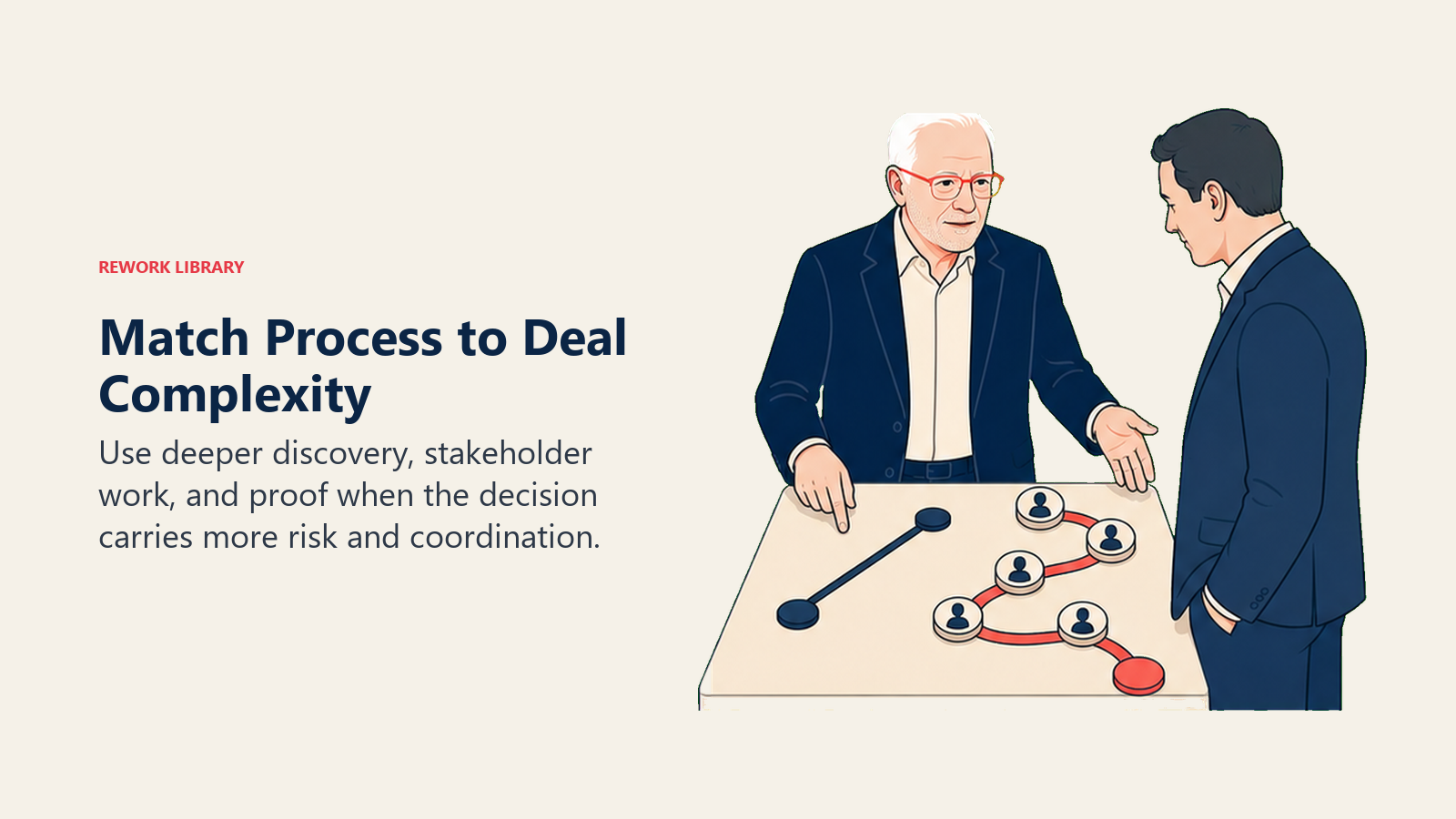
A small sale is a transaction where the buyer can decide in a single conversation, the risk of a bad decision is low, and impulse has a role. A large sale involves multiple stakeholders, extended evaluation cycles, significant financial and organizational risk, and decisions that get reviewed above the rep's primary contact.
In small sales, closing pressure works. The buyer can reverse the decision quickly if it turns out to be wrong. The social dynamics of the room favor commitment when a skilled closer applies the right technique. Traditional sales training, trial closes, alternative closes, urgency creation, is calibrated for this environment.
In large sales, the same behaviors produce the opposite result. Closing pressure on a buyer who reports to a CFO who hasn't approved the deal doesn't accelerate the decision. It creates resistance. The buyer who felt pressured in a meeting has to justify the decision to people who weren't in the room, and the pressure creates doubt rather than commitment.
Rackham's data showed that enterprise reps trained primarily in closing techniques were getting worse outcomes than reps who'd received no formal training, because the training gave them tools that were actively counterproductive in complex deal dynamics. This is the finding that made SPIN Selling genuinely disruptive. It wasn't just "here's a better technique." It was "most of what you're teaching makes your best reps worse at the deals that matter most."
3. Strategic Selling vs. Tactical Selling
Rackham extended his research in Major Account Sales Strategy (1989) to the question of how enterprise reps should approach accounts with multiple stakeholders and long buying cycles.
His distinction between strategic and tactical selling is about time horizon and focus. Tactical selling is call-by-call, preparing for the next meeting, handling the current objection, advancing this opportunity. Strategic selling is account-level: who are all the decision influencers, what does each one care about, where is this account in its buying cycle, what's our position relative to competitors who are also working this account.
Most rep training focuses almost entirely on the tactical level. Reps learn to give better demos, handle objections, and close on the right signals. But in major accounts, the strategic questions determine whether the tactical execution ever gets a chance to matter. If you're talking to the wrong person, optimizing your discovery questions doesn't help. If you've misidentified the real decision-maker, the best SPIN-structured conversation in the world ends at "let me run this by someone else" and never comes back.
The practical implication is that enterprise sales managers need to review both levels in their coaching cadence. Call coaching addresses tactical execution. Account reviews address strategic positioning. Most sales orgs do one or the other, not both. Rackham argued they're different skills that require different management attention.
What Rackham Would Do in Your Role
If you're a CEO, Rackham would push you to measure your sales process with the same rigor you apply to your product. Do you know which specific behaviors in your reps' discovery calls correlate with deals that close? Do you know whether your training is improving those behaviors or introducing counterproductive ones? If you're running a sales training program built primarily on closing technique, and your average deal size is above $30K, the Huthwaite data suggests you should review what you're teaching. It may be calibrated for the wrong kind of sale.
If you're a COO or sales operations leader, the large vs. small sale distinction has direct implications for how you segment your sales team and design your process. If you have reps handling both transactional deals and complex enterprise pursuits, they're probably applying the same behaviors to both, and getting suboptimal results in at least one. Rackham would argue for separate process flows, separate coaching frameworks, and possibly separate teams, because the skills and behaviors required are genuinely different.
If you're a product leader, the need-payoff question structure from SPIN has a direct analog in how you run customer discovery. When you're trying to understand what buyers need, the instinct is to ask what features they want. The better question is "what would become possible if this problem were solved?" That's need-payoff framing. It forces the buyer to articulate value in terms of outcomes, not functionality, which is exactly the information you need to prioritize your roadmap correctly.
If you're a sales or marketing leader, the most actionable thing to take from Rackham is to audit your sales training curriculum for the ratio of problem discovery to closing technique. If your training spends more time on how to close than on how to build implication, you've built a program calibrated for small transactional sales. For any deal above $20K with multiple stakeholders, the research says you're over-investing in the wrong skill set.
How This Applies Inside Rework
Rackham's doctrine translates directly to how modern B2B teams should run complex pipelines. Question-driven consultative selling only pays off if the organization can track which SPIN stage each opportunity sits in, where buyers have surfaced implications, where need-payoff language has been captured, and where reps are still stuck asking situation questions. Rework CRM supports this by letting teams structure deal stages around discovery milestones rather than activity counts, attach call notes that tag implication and need-payoff moments, and surface deals that haven't advanced past problem identification. For enterprise pursuits with multiple stakeholders, sales managers can review account-level positioning alongside call-level tactics in a single view, the dual-coaching cadence Rackham argued for in Major Account Sales Strategy. The point isn't to script SPIN into a checklist; it's to give reps and managers a shared system where research-first habits are visible, coachable, and compounding across the team.
Notable Quotes and Lessons Beyond the Boardroom
In SPIN Selling, Rackham writes: "Successful salespeople in large sales spend much more call time asking Implication and Need-payoff questions than do less successful salespeople. In smaller sales this difference isn't present." The operative word is "asking." Not presenting, not closing, not handling objections. Asking.
He's also direct about the limits of instinct as a management tool: "The most dangerous part of sales training is that it makes you more confident in techniques that don't work." This is the observation that makes SPIN Selling genuinely uncomfortable for practitioners. It doesn't say conventional training is useless. It says it can make you worse by giving you high confidence in low-value behaviors.
Rackham has continued to publish occasionally into the 2010s and remains engaged in sales research discussions. His later work has focused on how digital channels have changed buyer behavior and what that means for consultative selling models. His core position holds: the principles of SPIN don't change because the medium changes. Buyers still need to feel the magnitude of their problem before they can act. What changes is how and where you ask the questions.
Where This Style Breaks
SPIN's power is concentrated in complex B2B deals with long evaluation cycles and multiple stakeholders. It breaks down in transactional or velocity sales, where buyers don't have time for a structured discovery conversation and the deal economics don't justify it. Implication questions, the most powerful element of the framework, are also genuinely hard to apply well in remote or async selling environments, where the emotional weight of a well-constructed question loses something without the physical presence of the conversation. And reps who learn SPIN mechanically, moving through S-P-I-N as a checklist rather than as a conversational logic, often come across as interrogative rather than consultative. The framework requires real skill to execute naturally, and organizations that deploy it without sustained coaching rarely see the full effect.
Frequently Asked Questions about Neil Rackham's Sales Research
Who is Neil Rackham?
Neil Rackham is a British behavioral psychologist, researcher, and author who founded Huthwaite Inc. He is best known for conducting the largest behavioral study of sales interactions ever undertaken, more than 35,000 sales calls across 27 countries over 12 years, and for developing the SPIN Selling methodology from that data. He has also served as a visiting professor at Oxford's Templeton College and Sheffield Hallam University.
What is SPIN Selling?
SPIN Selling is a research-based sales methodology introduced in Rackham's 1988 book of the same name. It organizes effective discovery conversations around four question types, Situation, Problem, Implication, and Need-Payoff, that together help buyers articulate the cost of their problem and the value of a solution in their own words. It is designed specifically for complex, high-stakes B2B sales.
What are the four SPIN questions?
Situation questions establish context about the buyer's current environment. Problem questions surface explicit difficulties. Implication questions expand the felt cost of those problems by exploring consequences. Need-Payoff questions ask the buyer to describe the value of solving the problem, which lets them articulate the business case before the rep presents a solution.
How did Rackham's research change sales?
Rackham's Huthwaite study produced the first large-scale empirical evidence that closing techniques, long considered the core of sales training, actually reduce close rates in large complex deals. His data showed top performers ask more implication and need-payoff questions, spend less time on closing pressure, and invest heavily in discovery. This shifted enterprise sales training from technique-driven to research- and diagnosis-driven.
How is SPIN different for large vs small deals?
Rackham's research showed the two environments require fundamentally different behaviors. Small transactional sales reward closing techniques, urgency, and single-call commitment. Large sales, multiple stakeholders, long evaluation cycles, significant risk, punish the same behaviors, because pressured buyers face internal review and create resistance. SPIN is calibrated for large sales; applying it to transactional deals is overkill, and applying closing-heavy methods to enterprise deals produces worse outcomes than no training at all.
What can modern salespeople learn from Neil Rackham?
The most durable lesson is to build the problem before presenting the solution. Top reps in Rackham's data won by making buyers articulate the implications and payoffs themselves, not by out-pitching competitors. Modern teams should audit how much of their training focuses on discovery versus closing, coach both tactical call execution and strategic account positioning, and track SPIN stages inside their CRM so research-first habits become visible and repeatable.
Learn More
- Enterprise Sales Strategy: Closing Complex Deals with Multiple Stakeholders
- Sales Discovery Best Practices: How to Ask Questions That Actually Move Deals Forward
- Chris Voss Leadership Style: Tactical Empathy Over Pressure
- Mark Roberge Leadership Style: Engineering a Repeatable Sales Machine
- Jill Konrath Leadership Style: Selling to the Overloaded Buyer
- Peter Drucker Leadership Style: The Founder of Modern Management
- Marc Benioff Leadership Style: How Salesforce's CEO Built the Cloud CRM Era

On this page
- The SPIN Selling Model (The Rackham Research-First Doctrine)
- Leadership Style Breakdown
- Key Leadership Traits
- The 3 Frameworks That Defined Rackham
- 1. SPIN Selling: Situation, Problem, Implication, Need-Payoff
- 2. Large vs. Small Sale Distinction
- 3. Strategic Selling vs. Tactical Selling
- What Rackham Would Do in Your Role
- How This Applies Inside Rework
- Notable Quotes and Lessons Beyond the Boardroom
- Where This Style Breaks
- Learn More