Jeff Dean Leadership Style: The Engineer Who Scaled Google's Brain
Turn this article into takeaways for your work.


Each assistant summarizes the article only for you and suggests best practices for your work.
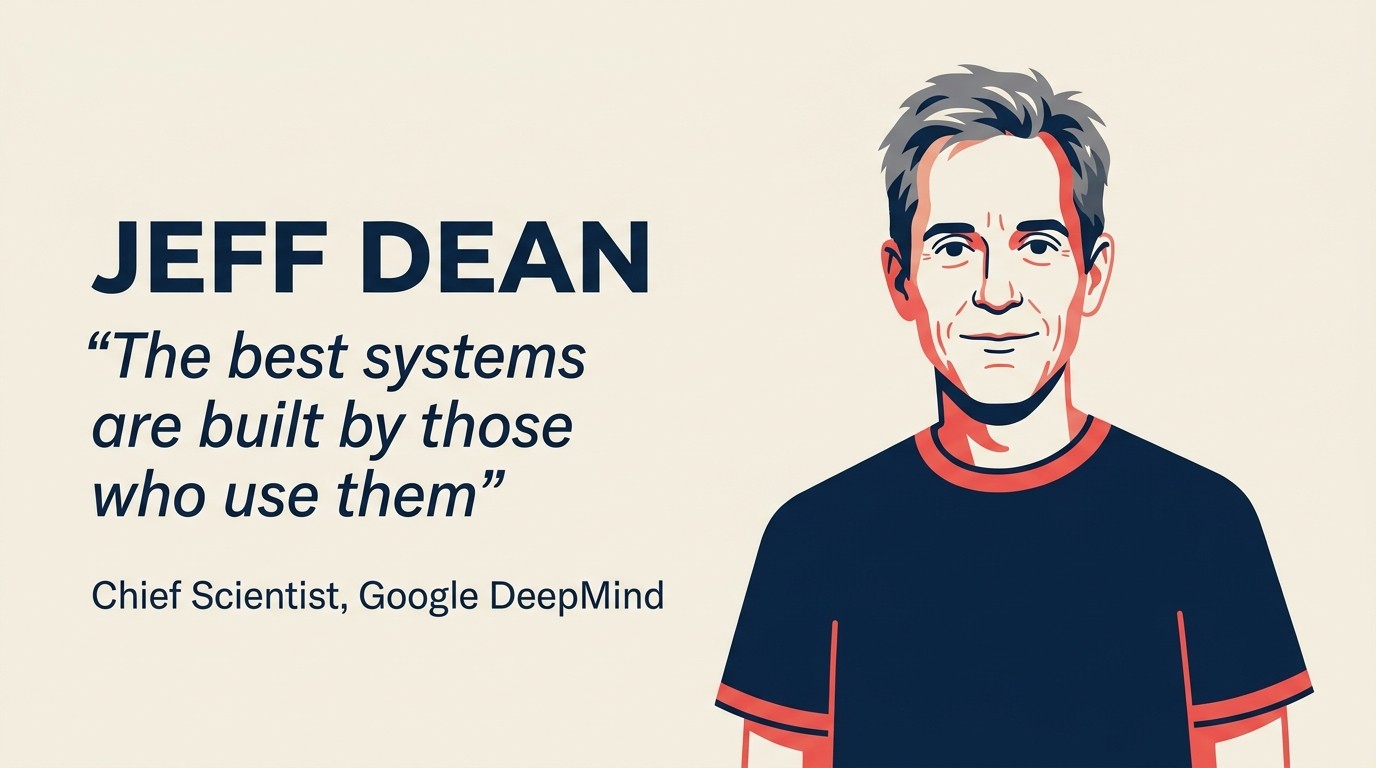
Jeff Dean's leadership style is built on deep technical authority rather than positional power. As a Google Senior Fellow, he influences direction by being the engineer whose judgment is trusted to be most accurate, then builds research cultures where others do their best work. The result: decades of industry influence without ever needing a traditional management title.
Jeff Dean joined Google in 1999. He was approximately the 20th employee. He didn't found a company, didn't do a TED talk, didn't write a memoir. He wrote papers.
Those papers, MapReduce (2004), BigTable (2006), Spanner (2012), and eventually TensorFlow (2015) and the Gemini model family, became the architectural DNA of modern cloud computing and large-scale AI. Most of the distributed systems running your SaaS applications descend from Dean's 2004 infrastructure decisions. The deep learning framework your data science team uses almost certainly traces back to TensorFlow's open-source release. The multimodal AI model you're using for content generation is built on a platform he leads.
The "Jeff Dean facts" internet meme, a parody of "Chuck Norris facts" circulated in engineering communities, exists because his real accomplishments read like fiction. "Jeff Dean's code doesn't have bugs, it has random features. Sometimes they ship themselves." The jokes are affectionate because the underlying reality is actually extraordinary.
But the meme obscures the more interesting story, which is about how someone with no positional authority beyond "really good engineer" accumulated more long-term influence over a technology industry than most CEOs ever do, and what that model looks like for people running teams today.
Key Facts
- Joined Google in 1999 as approximately employee #20, making him one of the earliest engineers at the company and the architect of much of its foundational infrastructure.
- Google Senior Fellow, the highest technical rank at Google, a title held by only a handful of engineers in the company's history.
- Co-designed MapReduce (2004), BigTable (2006), Spanner (2012), and TensorFlow (2015) with Sanjay Ghemawat and others, the systems that became the blueprint for modern cloud computing and deep learning.
- Inspired the "Jeff Dean facts" internet meme, a parody of "Chuck Norris facts" circulated among engineers, with jokes like "Jeff Dean's code doesn't have bugs, it has random features."
- Co-founded Google Brain in 2011 with Andrew Ng and Greg Corrado, establishing one of the most productive AI research groups in history.
- Led Google AI and then became Chief Scientist of Google DeepMind after the April 2023 merger of Google Brain and DeepMind under unified leadership with Demis Hassabis.
Leadership Style Breakdown
| Style | Weight | How it showed up |
|---|---|---|
| Deep Technical Authority | 60% | Dean's influence inside Google has always run through technical credibility, not organizational hierarchy. He doesn't lead by title or mandate. He leads by being the person whose judgment on systems architecture, research direction, and engineering tradeoffs is trusted to be more accurate than anyone else's. That trust was built over 25 years of being right about things that were hard to be right about, MapReduce when Google needed to process petabytes, TensorFlow when the field needed a common framework, Pathways when the question was how to build models that generalize. The 60% technical authority weight means his decisions carry weight even when he has no formal authority over the person making the call. |
| Collaborative Research Culture Builder | 40% | Dean runs research teams, which means his output isn't code, it's the conditions under which other people do their best technical work. Google Brain, which he founded in 2011, became one of the most productive AI research groups in history not because Dean did all the work but because he built a culture of rigorous engineering, public publication, and cross-functional collaboration. The 40% culture-builder weight is what explains how Brain produced seminal papers in NLP, computer vision, and reinforcement learning simultaneously, with dozens of researchers, over a decade. |
The combination is unusual. Pure technical leaders often struggle to build teams because they can't communicate at non-expert levels. Pure culture builders without technical depth struggle to make credible calls on hard technical questions. Dean has maintained both, which is why the 2023 merger of Google Brain and DeepMind, combining two of the world's top AI research groups under his co-leadership with Demis Hassabis, was structurally possible.
The Infrastructure-First Doctrine (The Dean Scalability Model)
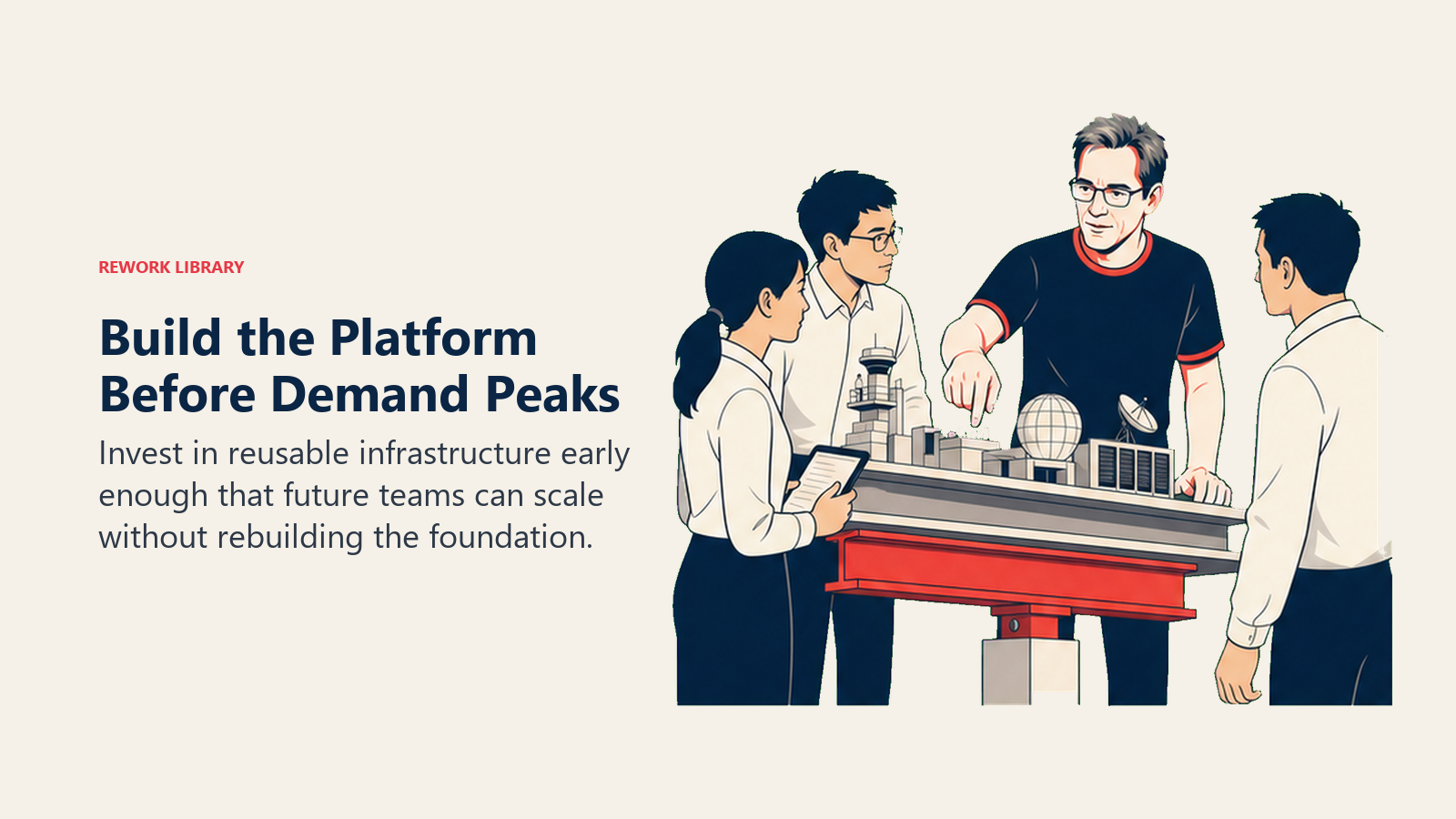
The Infrastructure-First Doctrine is the principle that durable competitive advantage in technology comes from redesigning the layer beneath the product, not from optimizing the product itself. When scaling limits are hit, Dean's model says to rebuild the underlying architecture from first principles rather than add complexity to the existing one, because the new platform compounds for a decade while the patched one degrades in months.
Key Leadership Traits
| Trait | Rating | What it means in practice |
|---|---|---|
| First-principles systems design | Exceptional | Dean doesn't optimize existing systems. He redesigns the underlying architecture when the existing model hits its scaling limits. MapReduce wasn't an improvement on previous Google infrastructure, it was a different model for distributed computation. TensorFlow wasn't a better version of existing deep learning tools, it was a new execution model. This first-principles tendency is expensive in the short term (you have to rebuild from scratch) and disproportionately valuable over long timeframes because the new architecture doesn't inherit the scaling limits of the old one. |
| Peer respect over positional authority | Very High | Dean has spent most of his career as a senior individual contributor, not a manager. His influence on Google's technical direction has consistently outpaced his formal position. That's only possible in organizations where respect is earned through demonstrated competence rather than through hierarchy. He's known internally for being willing to review code from junior engineers, answer technical questions from people far below him in the org chart, and engage seriously with ideas regardless of who's proposing them. That culture of peer-level engagement is directly responsible for Google's ability to recruit and retain the researchers who built the AI systems it's now competing with. |
| Long publication track record | Very High | Dean has co-authored or contributed to papers over 25 consecutive years at the same organization. That's an unusual commitment to public scientific discourse from someone inside a commercial company. The papers serve multiple purposes: they attract researchers who want to publish, they establish technical credibility with the academic community, and they create a public record of Google's technical priorities that's more honest than any earnings call. The publication culture Dean helped build at Brain is one reason Google has retained top AI talent despite intense competition from OpenAI, Anthropic, and others. |
| Capacity to co-lead across research and product | High | The 2023 merger of Google Brain and DeepMind was the most significant reorganization in Google's AI history. Dean and Hassabis became co-leads of Google DeepMind, which combined two organizations with different cultures, different research priorities, and different relationships with Google's commercial products. Co-leading that merger required Dean to operate at a level of organizational complexity that most technical leaders never face, integrating teams with strong independent identities while maintaining the research output that justified the merger in the first place. |
The 3 Decisions That Defined Dean
1. MapReduce and BigTable (2004-2006): Infrastructure That Made Google Scale
By 2003, Google had a problem. The web was growing faster than any single machine could index it. The company needed to process petabytes of data across hundreds of thousands of commodity servers, coordinate that computation reliably, and do it at low cost. The existing infrastructure couldn't do this.
Dean and Sanjay Ghemawat wrote MapReduce, a programming model that broke large data processing jobs into small parallel tasks, distributed them across commodity hardware, and reassembled the results. The paper was published in 2004. It became one of the most cited papers in computer science history.
BigTable followed in 2006: a distributed storage system that could handle petabytes of structured data across thousands of servers. Together, MapReduce and BigTable gave Google the infrastructure to dominate web search for the next decade.
But the more important consequence was what happened outside Google. The MapReduce and BigTable papers inspired the open-source Hadoop ecosystem, which became the infrastructure backbone of enterprise data processing for a generation. Companies that had nothing to do with Google built their data pipelines on architecture that traced directly to Dean's 2004 design decisions.
For operators, this is a lesson about the compound return on infrastructure investment. Google didn't have to give away MapReduce, publishing the paper was a choice. Dean and Ghemawat could have kept the architecture proprietary. Instead, the publication created an industry-wide shift toward distributed computing that made Google's competitive advantage look like it was running on a shared platform rather than a proprietary moat. That perception was strategically useful.
2. TensorFlow Open-Source Release (November 2015): Democratizing Deep Learning
In 2015, deep learning was a genuine competitive advantage for the handful of companies that could afford to build and maintain proprietary frameworks. Google, Facebook, and a few university labs had internal tools. Everyone else was trying to reverse-engineer what they were doing.
Dean led the decision to open-source TensorFlow in November 2015. Within three years, it had 200M+ downloads and was the default deep learning framework across industry, academia, and government. The majority of AI models trained in 2017-2020 used TensorFlow or a framework it influenced.
The strategic logic was counterintuitive. Google was giving away a tool that competitors could use to build AI systems that competed with Google. But the actual effect was the opposite: TensorFlow became synonymous with Google in AI infrastructure, attracted thousands of external contributors who improved the framework, and created a massive ecosystem of researchers and engineers who trained their mental models of deep learning on a Google-designed system. When those researchers joined companies, they used TensorFlow. When they needed help, they engaged with Google's research team. When their companies needed cloud compute to run TensorFlow, they ran it on Google Cloud.
The open-source release was a long-term competitive strategy disguised as a philanthropic gesture.
For operators, the TensorFlow story applies to any decision about proprietary versus open-source capability. The question isn't whether to protect what you've built. It's whether the network effects from broad adoption outweigh the direct competitive value of keeping it proprietary. For infrastructure and tooling, open-source almost always wins on this calculation because the ecosystem value exceeds the direct value many times over.
3. Co-Leading Google DeepMind (2023): Merging Two Research Cultures
The 2023 reorganization that merged Google Brain and DeepMind into Google DeepMind was driven by the ChatGPT moment. In November 2022, OpenAI launched a product that demonstrated language model capability at a level that caught Google's leadership off guard despite Google having the underlying technology. The response was to consolidate AI research under unified leadership, Hassabis and Dean together.
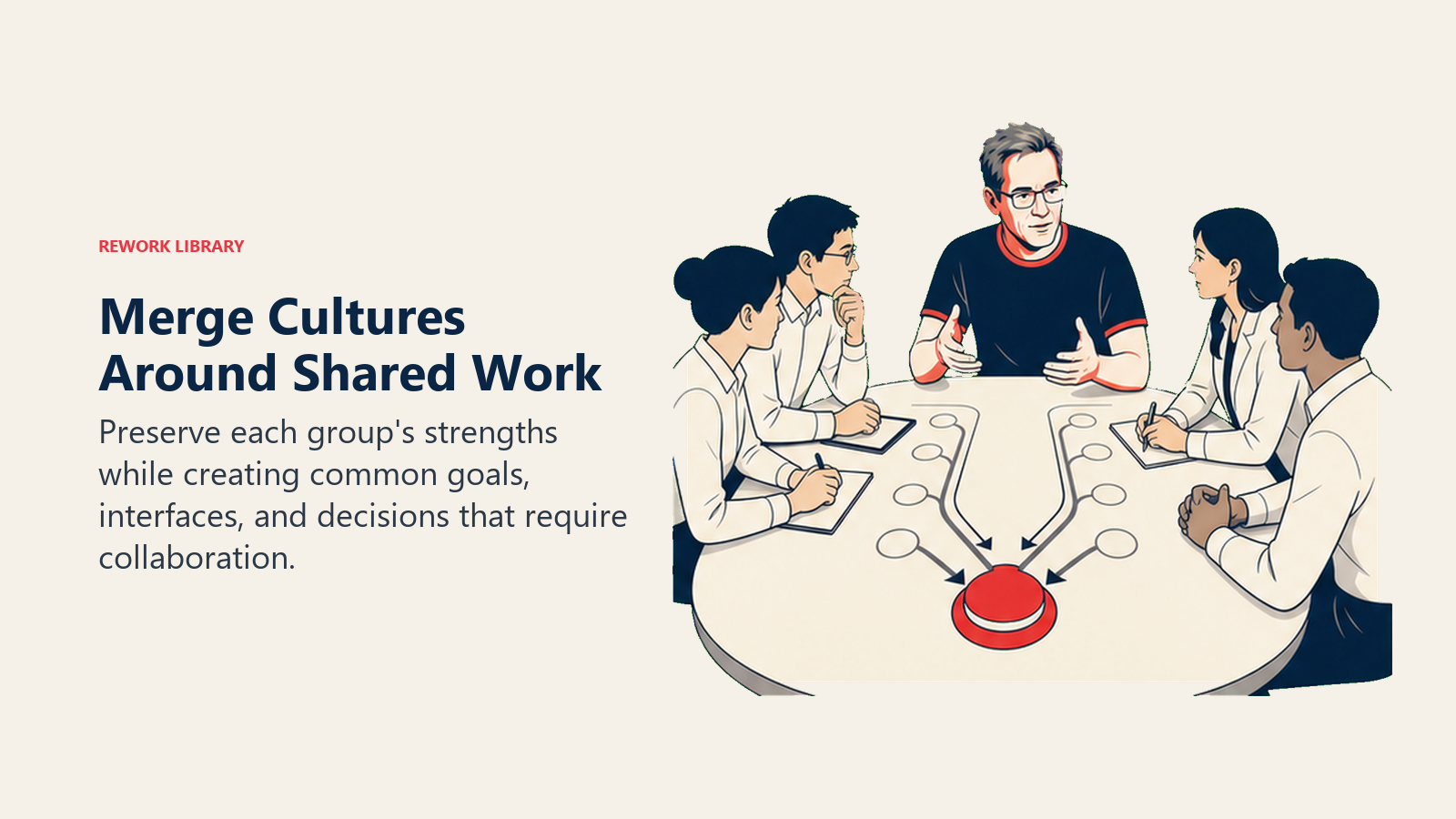
The merger was operationally difficult. Brain and DeepMind had different cultures: Brain was more applied and product-adjacent; DeepMind was more fundamental and research-pure. They had different relationships with Google's product teams, different publication norms, and different internal hierarchies. Dean and Hassabis had to integrate those organizations without losing the researchers who defined each one.
The merger produced Gemini, Google's flagship multimodal AI model family, announced in December 2023. The launch had quality issues, some of the benchmark claims were disputed, and the demo video was edited in ways that obscured what the model could actually do in real time. That was a product execution failure in a high-stakes competitive window.
But the underlying research capacity that the merger assembled is formidable. The question of whether Dean and Hassabis can translate that research depth into product execution at OpenAI's pace is still open.
What Dean Would Do in Your Role
If you're a CEO, the most transferable principle from Dean's career is the compound return on publishing what you learn. He's spent 25 years writing papers that gave away Google's technical insights, and Google is still the dominant AI infrastructure company. That's not a coincidence. Public knowledge of what you've built attracts the people who can extend it, creates credibility with the community that matters most for your talent pipeline, and often generates network effects that proprietary secrecy can't. If your company learns something significant about how to do something better, ask seriously whether publishing that learning would return more in talent attraction and ecosystem development than keeping it internal.
If you're a COO, the MapReduce architecture is a model for systems thinking applied to operational scaling. Dean's approach to infrastructure bottlenecks, don't optimize the existing system, redesign the layer that's causing the constraint, applies directly to operations. Most operational scaling problems are solved by optimizing within existing architecture: adding headcount, improving process, buying better tools. Dean would ask whether the architecture itself is the constraint, and whether the right move is to build a different model rather than run the old one harder. That's a more expensive question to ask but produces more durable answers.
If you're in product, TensorFlow's open-source strategy is a template for ecosystem-led growth. If you build a product in a category where the underlying framework matters, developer tools, data infrastructure, ML platforms, consider whether open-sourcing the foundation while monetizing the workflow creates more durable competitive position than keeping the foundation proprietary. The math works when your commercial advantage lies in the cloud compute, the managed service, or the enterprise features layered on top of the open core, not in the core itself. TensorFlow running on Google Cloud is the model.
If you're in sales or marketing, Dean's technical credibility strategy has a direct analog in enterprise sales. In technical markets, the most durable sales asset isn't case studies or ROI calculators, it's demonstrated expertise that the buyer can't get anywhere else. Dean built that credibility by publishing research over 25 years. Your team can build a version of it by committing to public technical depth: detailed engineering blog posts, conference talks that show your actual architecture, documentation that's honest about tradeoffs. Buyers in technical markets can tell the difference between marketing content and real expertise. Dean's model is to produce the real thing and let the marketing follow.
Rework Analysis: Platform-First Engineering Leadership
Dean's career is a case study in why the right layer of abstraction is the one that produces the most leverage for the teams running on top of it. MapReduce won because it hid distributed computing complexity from programmers. TensorFlow won because it hid hardware accelerator complexity from researchers. The pattern, build the platform beneath the product team and let the product team compound, is directly applicable to how modern operating systems for work get adopted.
This is where Rework fits. For CEOs and operators running sales, service, and cross-functional teams, the question isn't whether to build a custom CRM or bolt together ten point tools, it's whether the underlying platform absorbs AI, automation, and workflow complexity so your product and GTM teams focus on customers, not integration debt. Rework's Sales Engine and Process Engine (from $69/month and $99/month, billed yearly) are designed as the Dean-model layer: a single platform beneath the teams doing the compounding work. When the platform is right, the teams on top scale. When it's not, every quarter is an integration project.
Notable Quotes & Lessons Beyond the Boardroom
In a 2020 talk at Stanford, Dean said: "The key insight we had with MapReduce was that programmer productivity matters more than machine efficiency. You could write a lot of code to perfectly optimize for your specific cluster, or you could write a simple program in our framework and let the system figure out the distribution. We made the programmer's job easier and the system handled the rest." That's a product philosophy statement as much as a systems design statement. He was willing to leave performance on the table to reduce complexity. That tradeoff is almost always worth it, and most engineers make it in the wrong direction.
He's also been quoted on the pace of AI progress: "The advances we've seen in the last five years in machine learning have been absolutely extraordinary. We've gone from systems that could do narrow tasks to systems that can do a wide range of tasks at human or near-human level. What's exciting is that we're still in the early innings." What's notable about that framing is the modesty. He's not claiming the problem is solved. He's calibrating against what remains, and he's been watching the field long enough that his calibration is more reliable than most. Andrew Ng, who built Google Brain alongside Dean before leaving to found Coursera and DeepLearning.AI, carries a similar long-arc perspective: both men trained their intuitions on the same decade of research and draw remarkably similar conclusions about what the next decade requires.
The broader lesson from Dean's career is about choosing technical depth over public profile at every fork in the road. He could have left Google many times to found a company. He could have built a personal brand through podcasts and keynotes. He chose to keep building systems. That choice looks less glamorous in the short term and produces compounding advantages over decades that the alternative doesn't. It's worth comparing to Werner Vogels at Amazon, another career infrastructure engineer who built a hyperscaler from the inside out, both men made the same bet that deep technical work inside a large platform would compound more than founding their own companies.
Where This Style Breaks
Deep technical authority without charismatic public communication limits your ability to shape narratives outside your organization. When Google needed to define the Gemini story for journalists, investors, and the public, the company's AI narrative fell to Sundar Pichai and product marketing teams, not to Dean. That's a real gap. The Gemini December 2023 launch stumbled partly because the gap between what the research team had built and what the marketing team communicated was too large, and there was no one in the middle who could translate accurately under public pressure.
The superstar individual contributor model also doesn't scale through hiring. Dean's impact depends on Dean. You can't hire five people who together replicate what he does. That creates a single point of organizational dependency that's real even if it's usually worth accepting. And the research culture he built moves at a pace that's incompatible with the 90-day product cycles that competitive AI requires in 2024. The tension between deep research and fast shipping is the defining challenge of Google DeepMind's next chapter.
Frequently Asked Questions about Jeff Dean's Leadership
Who is Jeff Dean?
Jeff Dean is a Google Senior Fellow and Chief Scientist of Google DeepMind. He joined Google in 1999 as approximately employee #20 and became the primary architect of much of the company's foundational infrastructure, including MapReduce, BigTable, Spanner, and TensorFlow.
What did Dean invent at Google?
Dean co-designed MapReduce (2004), BigTable (2006), Spanner (2012), and TensorFlow (2015), systems that became the blueprint for modern cloud computing, distributed storage, and deep learning frameworks. He also leads work on the Gemini model family and Google's Pathways architecture.
What is Google Brain?
Google Brain was the AI research group Dean co-founded in 2011 with Andrew Ng and Greg Corrado. It produced landmark papers in NLP, computer vision, and reinforcement learning before merging with DeepMind in April 2023 to form Google DeepMind.
What are 'Jeff Dean facts'?
"Jeff Dean facts" is an internet meme parodying "Chuck Norris facts" that circulated in engineering communities. Examples include "Jeff Dean's code doesn't have bugs, it has random features" and "Compilers don't warn Jeff Dean; Jeff Dean warns compilers." The jokes exist because his real technical accomplishments are genuinely legendary.
What is Dean's role at Google DeepMind?
After the April 2023 merger of Google Brain and DeepMind, Dean became Chief Scientist of Google DeepMind, co-leading the combined research organization with Demis Hassabis. The merger consolidated Google's AI research in response to the competitive pressure from OpenAI's ChatGPT launch.
What can engineering leaders learn from Jeff Dean?
Three lessons: build influence through demonstrated technical judgment rather than hierarchy; redesign the architecture when it hits scaling limits instead of optimizing the old one; and publish what you learn, the compound returns on public technical credibility outweigh the short-term value of keeping insights proprietary.
Learn More
- Demis Hassabis Leadership Style: Long Bets, Deep Research
- Mustafa Suleyman Leadership Style: From DeepMind Ethics to Microsoft AI CEO
- Andy Grove Leadership Style: Managing the Paranoid Organization
- Building AI-First Teams: What Operators Need to Know
- AI Infrastructure for Enterprises: A Practical Guide

On this page
- Key Facts
- Leadership Style Breakdown
- The Infrastructure-First Doctrine (The Dean Scalability Model)
- Key Leadership Traits
- The 3 Decisions That Defined Dean
- 1. MapReduce and BigTable (2004-2006): Infrastructure That Made Google Scale
- 2. TensorFlow Open-Source Release (November 2015): Democratizing Deep Learning
- 3. Co-Leading Google DeepMind (2023): Merging Two Research Cultures
- What Dean Would Do in Your Role
- Rework Analysis: Platform-First Engineering Leadership
- Notable Quotes & Lessons Beyond the Boardroom
- Where This Style Breaks
- Learn More