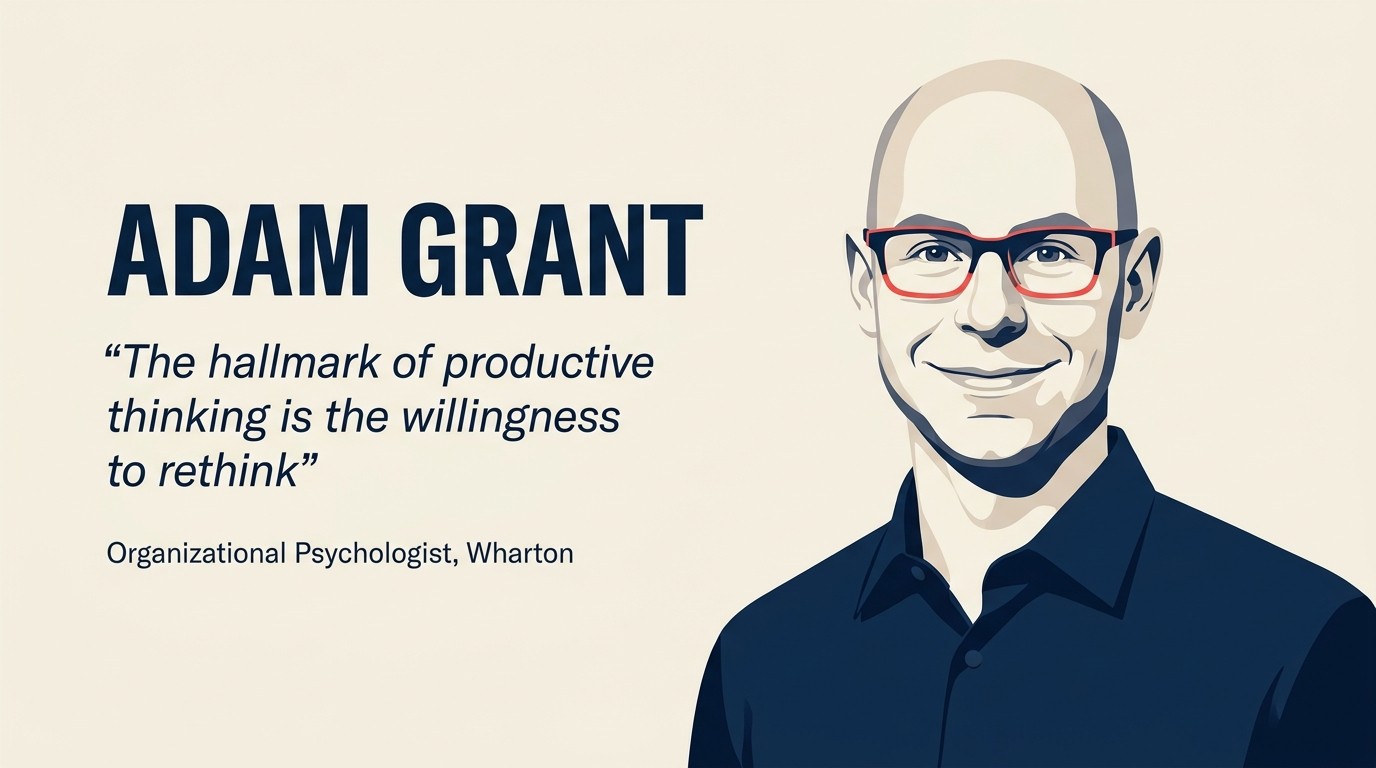
Adam Grant Leadership Style: Givers, Rethinking, and the Organizational Psychology of Getting Work Done
Turn this article into takeaways for your work.


Each assistant summarizes the article only for you and suggests best practices for your work.
Key Facts: Adam Grant
- Wharton professor since 2007; became the school's youngest tenured professor at age 28
- Author of four New York Times bestsellers: Give and Take (2013), Originals (2016), Think Again (2021), Hidden Potential (2023)
- Host of the TED-produced WorkLife podcast and the Re:Thinking podcast, reaching millions of listeners
- Organizational psychologist whose research has been applied at Google, Pixar, Bridgewater, and the NBA
- TED talks have surpassed 30 million combined views, with "Are You a Giver or a Taker?" alone at 10M+
Adam Grant became Wharton's youngest tenured professor at 28. His first book, "Give and Take", argued that the most generous people in an organization, the ones who give time, credit, and knowledge without keeping score, are simultaneously the biggest underperformers and the highest performers, depending on one variable.
That finding is either obvious or counterintuitive depending on how carefully you read it.
Grant's body of work sits at the intersection of research and practice in a way that most academics never manage. His ideas show up in how Google structures feedback, how the best product managers think about psychological safety, and how leaders at Pixar and Bridgewater think about intellectual humility. He's not summarizing other people's research. He's running studies, challenging findings that don't replicate, and updating his conclusions in public.
If you lead people and haven't engaged seriously with his frameworks, you're working harder than you need to on problems he's already worked through. "Give and Take," "Originals," "Think Again," and "Hidden Potential" represent probably 3,000 hours of research distilled into arguments you can apply next week. The TED talks have 30 million combined views for a reason.
Leadership Style Breakdown
| Style | Weight | How it showed up |
|---|---|---|
| Evidence-Based Teacher | 60% | Grant's primary mode is researcher-as-practitioner. He doesn't write books that advocate for a position and then find studies to support it. He runs the research first, then publishes what it says, including when it says something he didn't expect. "Give and Take" came from a research question about whether generosity correlated with professional success. The answer was complicated, and he published the complexity. "Think Again" started from data on how often people update their beliefs when confronted with new evidence. The answer was "rarely, and with significant psychological cost," and he published that too. His teaching and speaking translate the research for practitioners without simplifying it dishonestly. |
| Reciprocal-Network Builder | 40% | Grant's platform, 30 million TED views, the WorkLife podcast, his Re:Thinking podcast, his newsletter, isn't primarily a media business. It's a network architecture. By giving away research insights for free at scale, he creates the kind of intellectual gravity that attracts the most interesting practitioners and researchers to want to collaborate with him. His "Option B" co-authorship with Sheryl Sandberg came from a relationship where he'd been intellectually generous first. His ability to get access to companies like Google, Bridgewater, and Pixar for research is a direct result of the trust his public generosity created. |
The 60/40 split reflects a genuine tension in Grant's work. He's a more effective researcher because his platform gives him access to real organizations. And his platform is more credible because it's built on real research rather than consultant opinion. But there's a risk in that feedback loop: the more successful the platform becomes, the more pressure there is to produce content that builds the platform rather than content that challenges its audience. Grant's best work is when the research and the platform stay in tension rather than reinforcing each other.
Key Leadership Traits
| Trait | Rating | What it means in practice |
|---|---|---|
| Intellectual rigor paired with accessibility | Exceptional | Most organizational psychologists write for other academics. Grant writes for managers who'll read on a plane. But the simplification doesn't sacrifice accuracy. He distinguishes between findings that replicate reliably and findings that are suggestive but contested. He cites effect sizes. He acknowledges limitations. That combination, accessible without being dumbed down, is genuinely rare, and it's why practitioners trust him in a way they don't trust most researchers. |
| Willingness to publicly revise positions | Very High | Grant has updated his positions on several findings in public, including walking back some claims from "Give and Take" when replication studies produced weaker effects. He's debated Elon Musk on Twitter about return-to-office research and held his position under sustained pressure. He's also changed his mind publicly about procrastination research after follow-up studies challenged the original findings. That willingness to revise is the "think again" thesis applied to himself, which makes his arguments about intellectual humility land differently than they would from someone who doesn't model them. |
| Prolific knowledge sharing | High | Between the books, the TED talks, the podcasts, the newsletter, and his social media presence, Grant is one of the highest-volume knowledge producers in management writing. The volume isn't without risk, more output creates more surface area for oversimplification and for findings that don't survive scrutiny. But the net effect for practitioners is that there's an unusual density of actionable, research-backed content available for free. |
| Contrarian comfort | High | Grant's books are systematically built around findings that challenge what practitioners believe. "Give and Take" challenged the assumption that ambitious people are self-interested. "Originals" challenged the assumption that the most creative people are risk-takers who don't second-guess themselves. "Think Again" challenged the assumption that accumulated expertise is a competitive advantage. Each of those challenges has evidence behind it, and each one has a real cost to people who've built careers on the conventional wisdom. Grant publishes them anyway. |
The Giver-Taker-Matcher Model
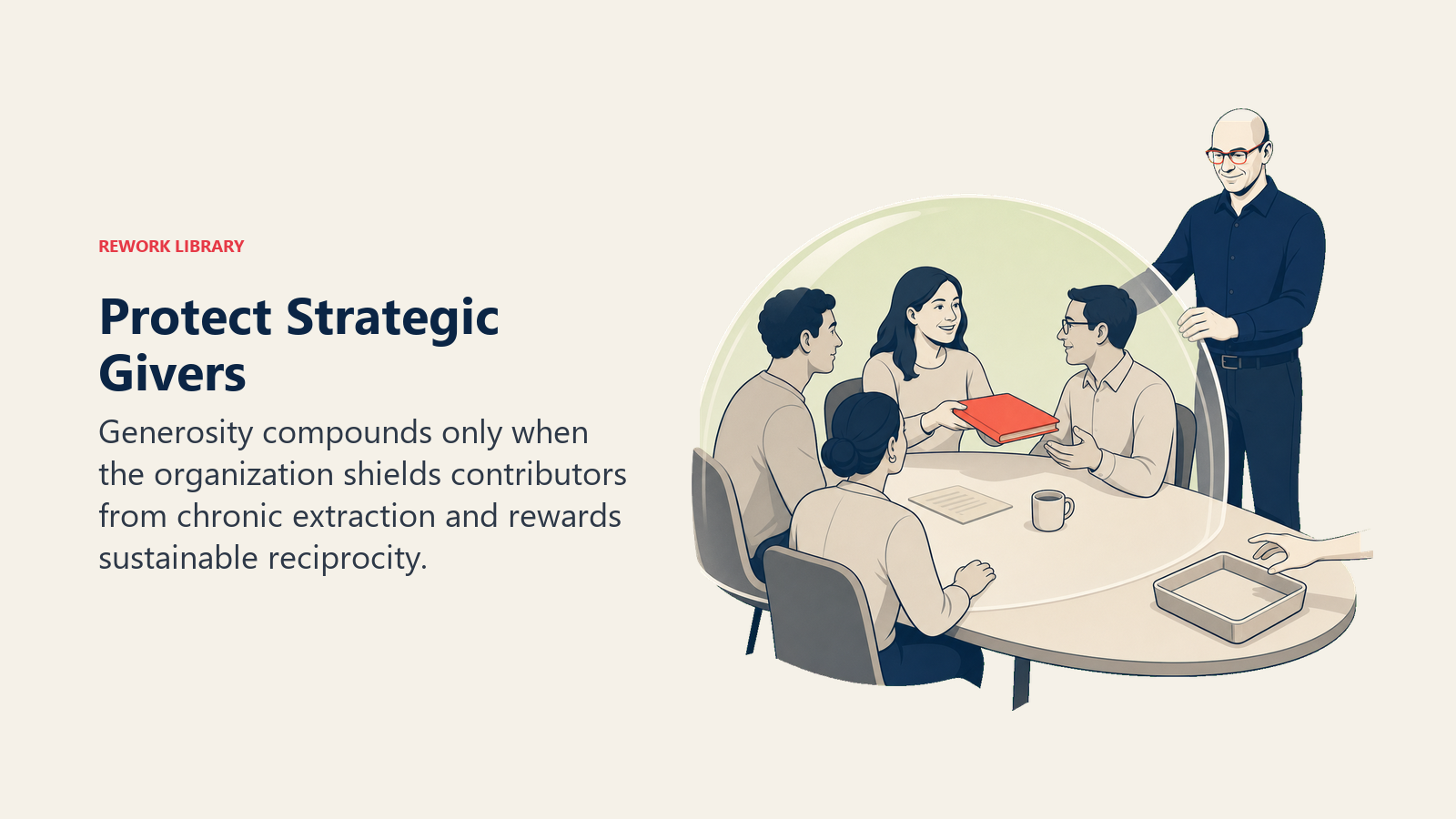
The Giver-Taker-Matcher Model is Adam Grant's research-derived framework for categorizing how people approach professional reciprocity: givers contribute more than they take, takers extract more than they give, and matchers trade in equal proportion. Grant's central finding is that givers occupy both the bottom and the top of performance distributions, the differentiator is whether they give strategically ("otherish") or self-sacrificially. Organizations that design structures to protect otherish givers from exploitation unlock their compounding effects; those that don't burn through their most generous contributors first.
The 3 Decisions That Defined Adam Grant as a Leader
1. Writing "Give and Take" (2013) as a Performance Argument, Not a Moral One
Before "Give and Take," the conventional management argument for generosity was essentially moral: be generous because it's the right thing to do, and it'll come back to you eventually. That's not testable, and it doesn't survive the counterexample of the high-performing jerk who gets promoted anyway.
Grant's version was different: he framed generosity as a performance variable and asked what conditions determined whether givers ended up at the bottom or the top of performance distributions. His finding was that the outcome depended on whether givers were "otherish" or self-sacrificing. Otherish givers, people who give strategically and sustainably, protecting their own time and energy while being generous, ended up at the top. Self-sacrificing givers, who said yes to every request regardless of whether it helped them, ended up at the bottom.
That reframe is important because it takes the moral argument off the table. You don't need to believe in the intrinsic value of generosity to apply Grant's framework. You just need to understand which giving behaviors build the networks and reputation that compound over time, versus which ones drain the giver without producing the compounding.
The practical implication for operators: takers are easy to identify and are usually obvious to the teams around them. Matchers, people who help others in proportion to what they receive, are the norm and produce roughly average outcomes. The organizational leverage is in identifying your givers and making sure they're protected from the requests that will burn them out before the compounding happens. Most organizations don't do this, and then wonder why their most generous people leave first.
Grant's framing also changed how companies think about hiring for cultural fit. If givers are the highest performers and the lowest performers depending on organizational structure, "is this person a giver?" is a useful interview signal only if you've built an organization that protects givers from exploitation. Otherwise, you're hiring for a trait that will produce the worst outcome.
For you: audit your current team against the giver/taker/matcher framework. You probably have one or two people who consistently help others without keeping score. Are they the highest performers, or are they drowning in requests? If it's the latter, the problem isn't their generosity, it's the structure that's exploiting it.
2. "Think Again" (2021) as a Challenge to Expertise Culture
By 2021, Grant had enough of a platform that he could have written a book that validated what his audience already believed. "Think Again" didn't do that.
The book's central argument, summarized in Grant's HBR piece "Persuading the Unpersuadable", is that accumulated expertise can become a liability when the environment changes. When you know a lot about something, you have strong priors that resist updating. The more confident you are in your knowledge, the less likely you are to notice when it stops being accurate. Grant calls the zone of confident incompetence the "armchair", you feel settled, you've got a position, and you're not going anywhere.
The antidote he identifies is "confident humility": holding your views with conviction while remaining genuinely open to revising them when evidence changes. That's different from imposter syndrome (I'm not sure my views are right) and different from overconfidence (my views are certainly right). It's the stance of a scientist rather than a preacher or a prosecutor.
The organizational implication is specific: your most experienced people are the most likely to be confidently wrong about things that have changed. Not because they're less intelligent than junior employees, but because they've built strong mental models from experience, and strong mental models are slow to update. Building an organization where experience and seniority don't immunize you from challenge is harder than it sounds, it requires the senior people to model intellectual humility publicly, not just endorse it in a values document.
Grant has been candid about where "Think Again" creates real friction for operators. If your business model requires fast decisions at scale, building a culture of questioning and rethinking can slow you down in ways that are costly. He doesn't resolve this tension, he names it and argues that the cost of rethinking is lower than the cost of confidently persisting with a wrong view. That's probably true in most knowledge-work environments. It's less clearly true in contexts where speed matters more than precision.
For you: the "Think Again" application for most operators is narrower than the book's framing suggests. You don't need to rebuild your organization's epistemics from scratch. The practical move is to identify your three or four most entrenched organizational beliefs, the things that "everyone knows" are true about your market, your customers, or your product, and actively schedule time to challenge each of them with recent evidence.
3. Building a Platform That Makes Research Accessible to Practitioners
Grant's TED talk "The Surprising Habits of Original Thinkers" has been viewed over 20 million times. "Are You a Giver or a Taker?" has another 10 million. His WorkLife podcast was an Apple Podcast chart-topper. His newsletter reaches hundreds of thousands of people.
The decision to build that platform, and the specific way he built it, grounded in research rather than personal opinion, has done something unusual: it's created a practitioner community that expects management ideas to be evidence-backed. That's not the default in business publishing. Most management bestsellers are built around a charismatic author's experience and then retrofitted with research. Grant reversed the sequence.
That reversal has real consequences for how his ideas spread. When a manager cites Grant's giver/taker framework in a team meeting, they're not citing an opinion about how people should work. They're citing a research finding about how people actually do work. The distinction changes the quality of the conversation that follows.
It also created a model that other researcher-practitioners have followed: Brené Brown building a platform around vulnerability research, Laszlo Bock publishing "Work Rules!" as applied People Analytics, Amy Edmondson making psychological safety research accessible to non-academics. On the applied side, Kim Scott translated similar org-psych principles into the Radical Candor framework, and Patty McCord put comparable ideas into practice at Netflix in a way that predates Grant's academic framing. The lineage traces back further to Peter Drucker, whose management-thought foundations Grant's work consistently builds on. Grant's platform demonstrated that there's a large audience for rigorous research made accessible, which changed what publishing houses would take risks on and what corporate learning and development teams would buy.
The downside: platform scale creates pressure toward consistency that can conflict with intellectual revision. Grant has managed this better than most. But the risk of celebrity-academic status is real, when your ideas become brand, updating them feels like brand dilution. The tension shows up most clearly in how Grant handles findings that contradict his published positions. He usually handles it well. It's worth watching for when he doesn't.
For you: Grant's platform-building model is relevant if you're a practitioner who wants your ideas to have reach beyond your organization. The specific move, ground everything in research, attribute rigorously, acknowledge limitations, update publicly, builds a different kind of credibility than thought leadership built on experience alone. It's slower to build and harder to fake. Those are usually signs you're building something that lasts.
What Adam Grant Would Do in Your Role
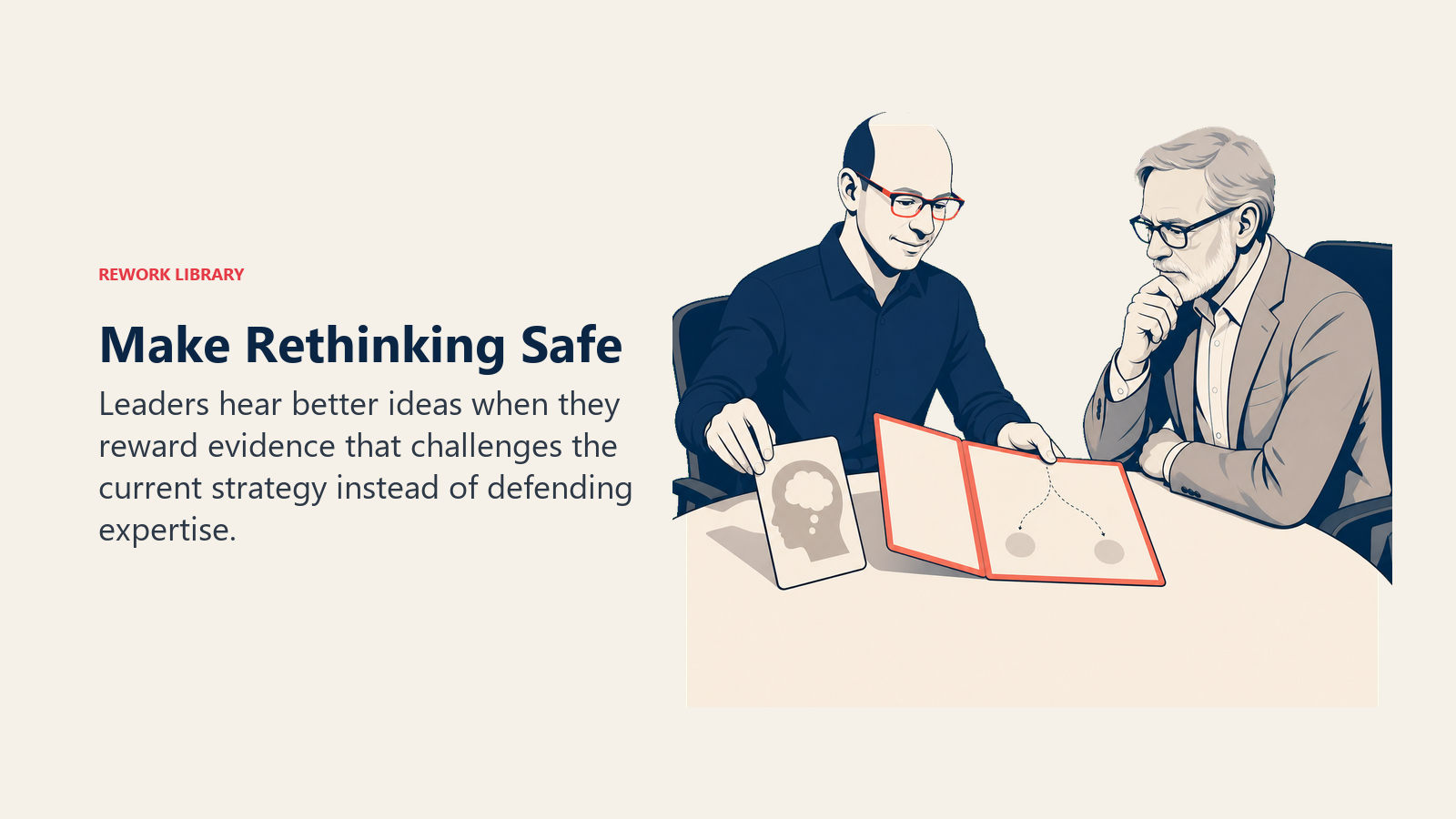
If you're a CEO, Grant's most applicable insight is from "Originals": the leaders who create the most innovative organizations aren't the ones who generate the most ideas. They're the ones who create the conditions where other people generate ideas and feel safe bringing them forward. Practically, that means you should be more worried about the ideas you never hear than the ideas you reject. If your team isn't bringing you ideas that challenge your current strategy, that's not a talent problem, it's a psychological safety problem, and it usually starts with how you respond to the first bad idea someone brings you.
If you're a COO or operations leader, the giver/taker/matcher framework has a direct application to how you design cross-functional work. Operations is the function most likely to be the victim of organizational taking, other teams request ops resources, bandwidth, and support without proportionate reciprocation. Before accepting that as structural, map which teams and individuals in your organization consistently take more than they give. The matchers and givers in your team are subsidizing those relationships. That subsidy has a cost that shows up in attrition and burnout before it shows up in a metric.
If you're a product leader, "Think Again" has a specific product application: the features that were right for your product three years ago may be wrong now, and the teams closest to those features are the least likely to see that. Grant would push you to build a practice of challenging your own product's assumptions systematically, not just when the metrics are bad, but on a schedule. Treat your core product bets as hypotheses that need regular revalidation rather than decisions that were made and implemented.
If you're in sales or marketing, the "Originals" finding on how the best champions of new ideas build support has direct applications to how you sell internally. Grant found that the most successful originators don't lead with their idea's strengths, they lead by naming its weaknesses first. That counterintuitive approach works because it signals intellectual honesty and disarms the skeptic's first objection. If you're proposing a new marketing strategy or a sales process change, try leading with the two or three things most likely to go wrong. You'll spend less time defending and more time problem-solving with people who would otherwise be your opposition.
Rework Analysis: Applying Grant's Research to Your Team
Grant's research has three direct applications for teams running on Rework. First, hiring: the giver/taker/matcher signal belongs in your interview scorecard, but only after you've audited whether your org structure actually protects givers. Use Rework's CRM to track which reps share leads, coach peers, or hand off accounts without keeping score, these are your otherish givers, and their retention should be a board-level metric. Second, cross-team collaboration: Ops, Support, and Enablement are the functions most exploited by organizational taking. Map request flows in Rework's Work Ops to surface which teams consistently draw on others without reciprocation, then redesign workflows so givers aren't subsidizing the imbalance. Third, KPIs without killing curiosity: Grant's "Think Again" warning applies directly to dashboard-driven cultures. Schedule quarterly reviews where teams use Rework's reporting to challenge, not just report, their own metrics, asking which numbers still measure what matters and which have quietly become theater.
Notable Quotes and Lessons Beyond the Boardroom
Grant's most useful framing on psychological safety comes from his extensions of Amy Edmondson's research: "The most important signal a leader sends isn't what they say about psychological safety. It's how they respond when someone disagrees with them in a meeting." He's not just advocating for the concept, he's identifying the specific observable behavior that most leaders get wrong. You can say you value disagreement in every all-hands and then visibly shut down the first engineer who pushes back on your product direction. Your team will remember the behavior, not the stated value.
On the giver/taker/matcher distinction, Grant has been explicit that most organizations are designed to protect takers rather than givers: "The problem with organizational politics isn't that takers are too aggressive. It's that we make it too easy for them to take. Givers do more for organizations than any other group, but we exhaust them first and then wonder why we can't keep them." That framing is useful because it shifts the intervention from "identify and remove the takers" (which is hard and slow) to "protect the givers from exploitation" (which is a systems design question that's faster to act on).
His argument about intellectual humility has a specific format he uses publicly: when Musk challenged his return-to-office research on Twitter in 2023, Grant didn't capitulate or attack. He asked what evidence would change Musk's view, acknowledged what the data did and didn't support, and maintained his position on the parts the evidence covered. That's the "confident humility" posture from "Think Again" in practice. It's harder than it looks, especially when the person challenging you has 130 million followers.
Where This Style Breaks
Grant's work is evidence-based but often drawn from large organizations, knowledge-work environments, and survey-based methodologies. The giver/taker/matcher framework makes the most operational sense in companies large enough to have meaningful cross-functional interactions. In a 12-person startup where everyone works on everything, the framework adds less value than it does in a 500-person company with defined functional boundaries.
His "Think Again" thesis also creates a real tension with the speed requirements of founder-led cultures. In a company making five major strategic decisions a month, building deliberate space for rethinking every belief that gets challenged can paralyze execution. Grant's frameworks are most powerful when you have organizational slack to apply them, which means they're most valuable in established companies navigating complexity, not in early-stage companies where speed is the primary constraint.
The giver thesis also depends on organizational design: if your incentive structure rewards individual performance exclusively, givers burn out regardless of how good the research is. Grant is clear about this, but many practitioners adopt the framework without changing the incentive structure, then conclude that it doesn't work. It does work. Just not as a belief layered on top of a structure that punishes the behavior it advocates.
Frequently Asked Questions about Adam Grant's Leadership Research
Who is Adam Grant?
Adam Grant is an organizational psychologist and the Saul P. Steinberg Professor of Management at the Wharton School, where he became the youngest tenured professor at age 28. He is the author of four New York Times bestsellers and hosts the WorkLife and Re:Thinking podcasts.
What is the giver/taker/matcher framework?
It is Grant's research-backed model from Give and Take for classifying reciprocity styles: givers contribute more than they take, takers extract more than they give, and matchers trade evenly. Grant found that givers occupy both the top and bottom of performance distributions, strategic "otherish" givers rise, while self-sacrificing givers burn out.
What does Adam Grant say about rethinking?
In Think Again, Grant argues that accumulated expertise can become a liability when environments change because strong priors resist updating. He advocates "confident humility", holding views with conviction while remaining genuinely open to revising them when evidence shifts, and contrasts it with the mindsets of preachers, prosecutors, and politicians.
What are Adam Grant's most influential books?
His four bestsellers are Give and Take (2013) on reciprocity styles, Originals (2016) on how non-conformists move the world, Think Again (2021) on intellectual humility and rethinking, and Hidden Potential (2023) on how anyone can achieve greater things. Together they represent roughly 3,000 hours of research translated for practitioners.
How does Grant define psychological safety?
Grant builds on Amy Edmondson's research and argues that psychological safety is signaled less by what leaders say and more by how they respond when someone disagrees in a meeting. The observable behavior, whether leaders engage pushback or shut it down, teaches teams what is actually safe to say, regardless of stated values.
What can CEOs learn from Adam Grant?
The most applicable lesson from Originals is that the most innovative leaders are not the ones generating the most ideas, they are the ones building conditions where others feel safe surfacing ideas that challenge current strategy. CEOs should worry more about the ideas they never hear than the ones they reject, and audit whether their first response to contrarian input invites or shuts down future dissent.
Learn More
- Laszlo Bock Leadership Style: Data-Driven People Ops, Hiring Science, and What Google Learned from 50,000 Employees
- Kim Scott Leadership Style: Radical Candor, Care Personally, and the Feedback Framework That Changed Management
- Patty McCord Leadership Style: High-Performance Teams, Radical Honesty, and the Culture Deck That Changed HR

On this page
- Leadership Style Breakdown
- Key Leadership Traits
- The Giver-Taker-Matcher Model
- The 3 Decisions That Defined Adam Grant as a Leader
- 1. Writing "Give and Take" (2013) as a Performance Argument, Not a Moral One
- 2. "Think Again" (2021) as a Challenge to Expertise Culture
- 3. Building a Platform That Makes Research Accessible to Practitioners
- What Adam Grant Would Do in Your Role
- Rework Analysis: Applying Grant's Research to Your Team
- Notable Quotes and Lessons Beyond the Boardroom
- Where This Style Breaks
- Learn More