Akio Toyoda Leadership Style: Heritage, Crisis, and the Hybrid Stand
Turn this article into takeaways for your work.


Each assistant summarizes the article only for you and suggests best practices for your work.
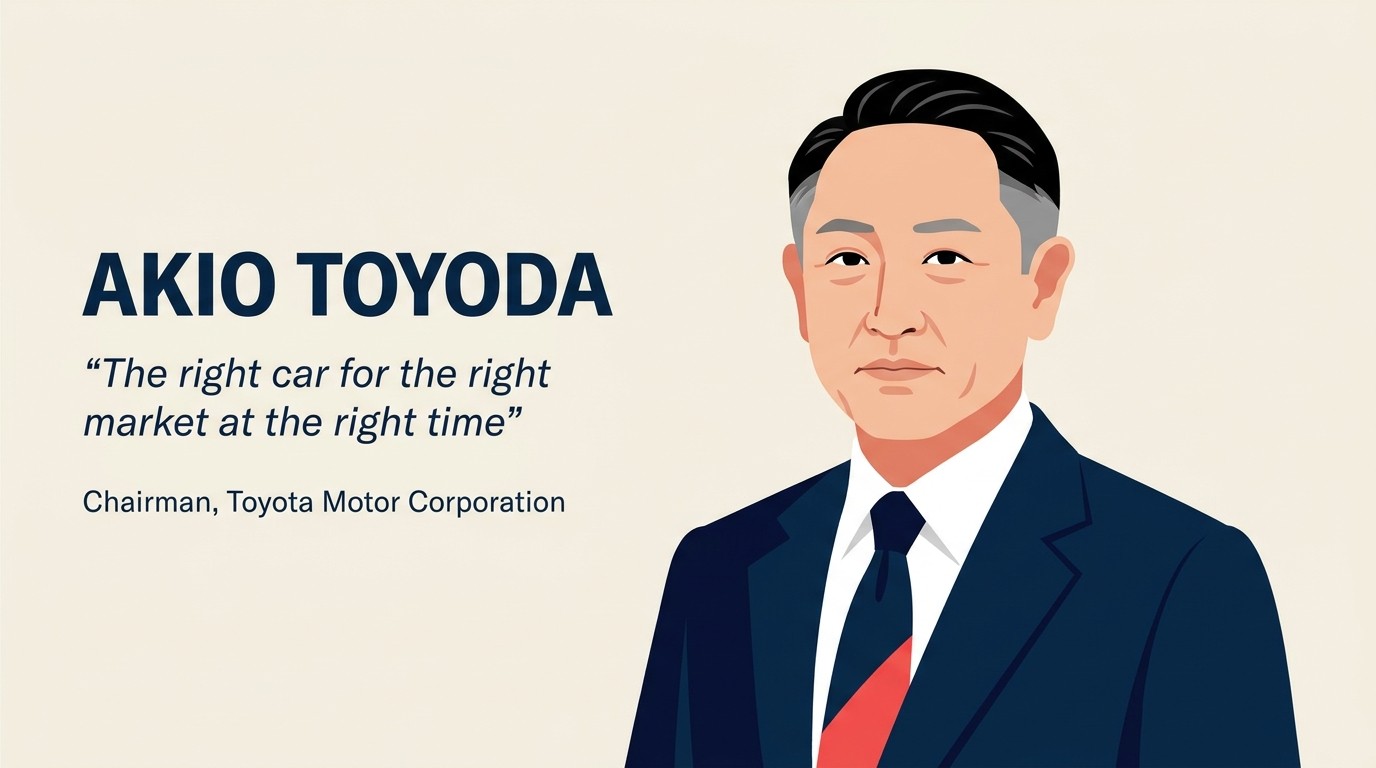
Akio Toyoda's leadership style blends servant leadership with long-horizon contrarian conviction. As Toyota's president from 2009 to 2023, he led from the factory floor, owned the 2010 recall crisis through personal accountability, and defended a hybrid-first strategy against full-EV pressure when the data, not pride, backed the call.
Key Facts: Akio Toyoda at a Glance
- Role: Toyota Motor Corporation President (2009–2023), Chairman (2023–present)
- Heritage: Grandson of Toyota founder Kiichiro Toyoda; joined the company in 1984
- Crisis test: Led response to the 2009–2011 unintended-acceleration recalls covering 10M+ vehicles; testified personally before US Congress in February 2010
- Contrarian call: Publicly defended hybrid and hydrogen strategy against full-EV industry pressure from 2019 through 2023
- Transition: Stepped up to Chairman in April 2023, handing the president role to Koji Sato while retaining oversight of TPS and long-term R&D
- Company value: Toyota's market capitalization grew from roughly $130B at the start of his tenure to approximately $280B by the time he transitioned to chairman
In 2021, when every major automaker was announcing full-EV commitments and Tesla's market cap exceeded Toyota's for the first time, Akio Toyoda stood in front of reporters and said the industry was wrong. Not diplomatically. He called the all-EV push a "silent majority" problem, arguing that manufacturers, media, and policy makers were moving faster than infrastructure, customers, and the planet could follow. In Japan, where most electricity still came from fossil fuels, an all-EV fleet would produce more emissions than hybrids. The math wasn't complicated.
Nobody wanted to hear it. Toyoda had just spent two years watching Toyota get hammered in the press for being behind on EVs while Ford, GM, and Volkswagen announced massive battery commitments. His stock underperformed. Analysts called him out of touch. And he held the line anyway, doubling down on hybrid and hydrogen while methodically building an EV architecture that would come to market on Toyota's timeline, not Wall Street's.
Whether he was right or wrong depends on which year you're asking. But his willingness to defend a contrarian position under sustained public pressure, while managing one of the most complex manufacturing organizations on earth, makes him one of the more instructive leadership cases in recent corporate history.
Leadership Style Breakdown
| Style | Weight | How it showed up |
|---|---|---|
| Servant | 55% | Spent 27 years in Toyota's operations before becoming CEO in 2009. Regularly visited factory floors and dealer networks. During the 2009-2011 recall crisis, flew to Washington DC personally for Congressional testimony and bowed publicly, a rare display of corporate accountability. Protected Toyota Production System (TPS) workers and principles against pressure to cut corners for cost. |
| Strategic | 45% | Held a multi-year view on electrification that diverged from the industry consensus. Invested in solid-state battery R&D and hydrogen fuel cells when other automakers dismissed both as too slow. Defended the "right car for the right market at the right time" thesis publicly and consistently, even when it cost him in quarterly comparisons. |
The split matters. Toyoda wasn't primarily a cost-cutter or a charismatic visionary. He led from the floor up. His credibility inside Toyota came from knowing the operations, and he used that credibility to defend a long-term strategic bet that required resisting enormous institutional pressure. It's a lineage worth tracing: Jack Welch's operator CEO philosophy shaped how the previous generation thought about running large industrial organizations, and Toyoda absorbed that ethos while pushing back against Welch's more aggressive talent-culling instincts.
Key Leadership Traits
| Trait | Rating | What it means in practice |
|---|---|---|
| Crisis Composure | Exceptional | Took over as Toyota CEO in January 2009, the month the company posted its first operating loss in 71 years. By early 2010, the unintended-acceleration recall was consuming 9 million vehicles and generating Congressional hearings. Toyoda testified in Washington, acknowledged faults without deflecting, and committed to an independent safety commission. The company recovered its US market share within two years. |
| Institutional Loyalty | Very High | Could have distanced himself from TPS and legacy manufacturing to position Toyota as a tech company. Didn't. He consistently cited TPS as Toyota's primary competitive advantage, staffed operations leadership with TPS practitioners, and pushed back against suggestions to outsource manufacturing processes that the system depended on. |
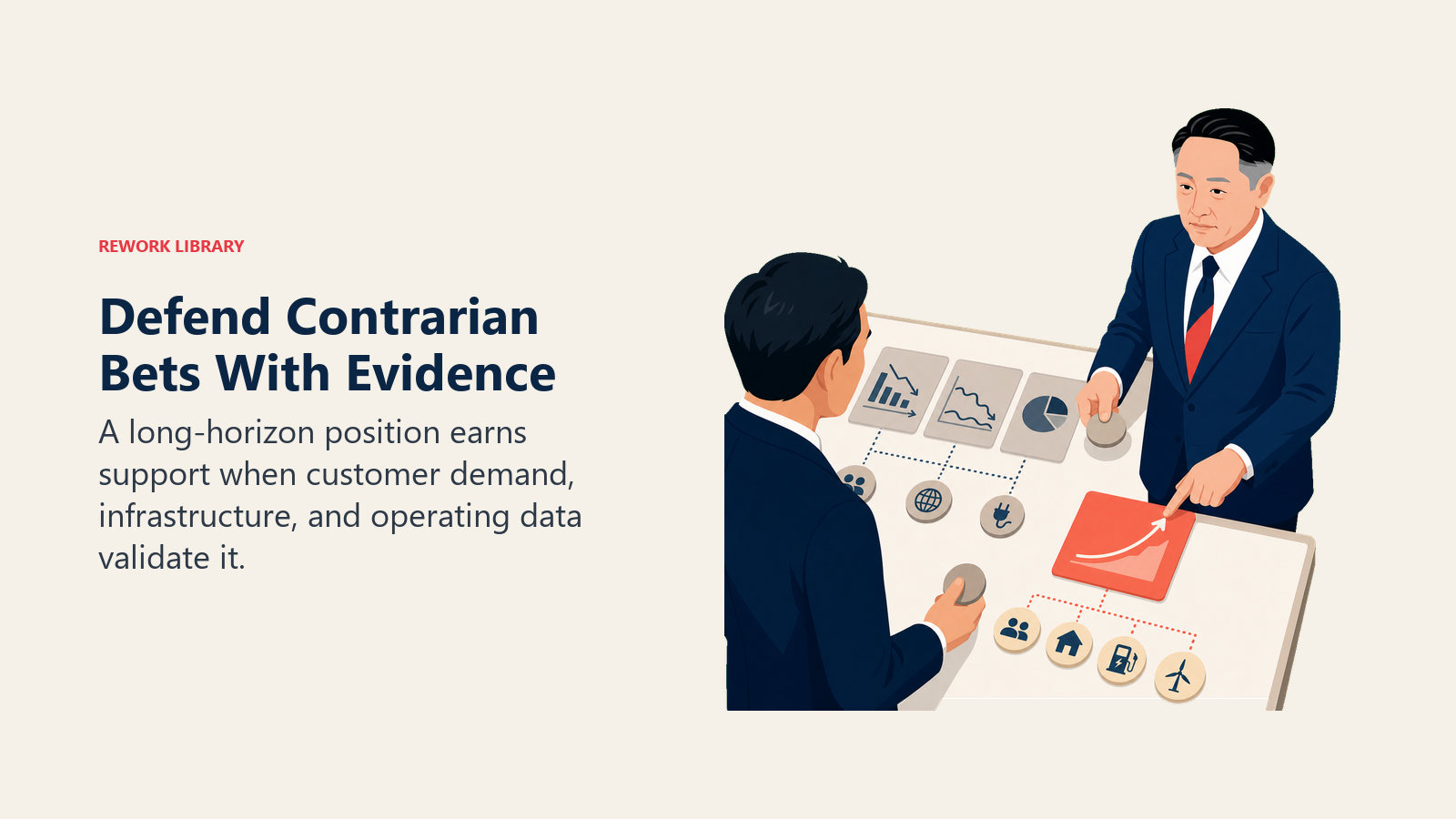
| Contrarian Conviction | High | From 2019 through 2023, the EV narrative was overwhelming. Toyota was publicly criticized by environmental groups, institutional investors, and tech media for its hybrid position. Toyoda held it. By 2023, Toyota's hybrid and plug-in hybrid vehicles represented over 30% of its global sales mix, and the charging infrastructure gaps that Toyoda had cited were proving real in multiple markets. |
| Humility Under Pressure | High | Bowing in public before a Congressional committee is not a Western instinct. It's also not legally required. Toyoda did it because he understood that Toyota's long-term relationship with American customers and regulators depended on genuine accountability, not PR management. He absorbed blame that could have been distributed to engineers, suppliers, or previous leadership. |
The Hybrid Stand Doctrine
Toyoda's operating doctrine can be summarized in one line: defend the long-horizon bet with data, not pride, and pace transformation at the speed the infrastructure can actually absorb. The Hybrid Stand Doctrine treats consensus-defying strategy as legitimate only when customer research, supply chains, and physics back the contrarian view. Otherwise it's just stubbornness wearing a CEO's suit.
The 3 Decisions That Defined Akio Toyoda as a Leader
1. The 2010 Congressional Testimony
By February 2010, Toyota had recalled roughly 8-9 million vehicles globally for unintended-acceleration issues tied to floor mat and accelerator pedal problems, a crisis now documented as the 2009–2011 Toyota vehicle recalls. The cause was disputed. The Congressional hearings were not a friendly audience, and members were publicly hostile, some calling for criminal referrals.
Toyoda flew to Washington and testified in person. He didn't send a lawyer. He didn't delegate to the American CEO. He acknowledged that "Toyota had grown too fast" and that quality systems hadn't kept up with expansion. Akio Toyoda was the first Toyota president to testify before the US Congress. He announced an independent quality advisory committee. He bowed.
What this decision reveals about his leadership: he understood that institutions survive crises through accountability, not through defense. Toyota's market share in the US dropped sharply in 2010 but recovered within 18 months. Competitors who tried similar recall situations and managed them with PR instead of ownership (and there have been several) took longer to recover and left more lasting damage with regulators.
For you: when your company makes a genuine mistake that affects customers, the impulse is to minimize it. Toyoda's answer was to maximize the response. Tim Cook has navigated a similar tension at Apple. Cook's operational precision under public scrutiny offers a modern parallel for how a non-founding CEO earns institutional trust through accountability rather than charisma. The overcorrection (independent committee, personal testimony, public acknowledgment) rebuilt trust faster than any damage-control strategy would have.
2. Defending the Hybrid-First EV Strategy (2019-2023)
In 2019, Toyota's EV lineup was minimal by industry standards. Tesla had already defined the premium EV category. The Volkswagen ID series was coming. Ford announced $22 billion in EV investment. Toyota sold the Prius and a handful of plug-in hybrids. Analysts, environmental groups, and several major institutional investors publicly pushed Toyota to commit to a full-EV transition timeline.
Toyoda's public position: the all-electric path was one option, not the only one. Toyota would build EVs for markets that had the infrastructure and customer demand. For markets that included most of Southeast Asia, large parts of South America, and rural segments globally, it would offer hybrids and plug-in hybrids. Hydrogen remained on the table for commercial vehicles.
This wasn't popular. Toyota's stock underperformed Tesla and BYD significantly through 2021-2022. Toyoda was personally criticized in the business press as a defender of old technology.
By late 2023, the EV transition was running materially slower in most markets than the 2021 projections had suggested. Charging infrastructure gaps were real. Used EV resale values were declining. Toyota's hybrid sales were at record highs. The verdict isn't final, and EV adoption continues, but the hybrid-first thesis was more defensible by 2024 than it looked in 2021.
3. Stepping Down as President in 2023 While Staying Chairman
In April 2023, Toyoda stepped down as Toyota's president, handing the role to Koji Sato, a 53-year-old executive who had led the Lexus brand. Toyoda became chairman.
The move was significant for two reasons. First, it acknowledged that Toyota needed a CEO who could accelerate the EV program without Toyoda's hybrid baggage in the press narrative. Second, staying as chairman allowed Toyoda to protect TPS and long-term strategic direction without the day-to-day pressure of managing quarterly earnings expectations.
This is a harder decision than it looks. Most founders and long-tenured CEOs who transition to chairman roles either become irrelevant immediately or create an informal parallel power structure that confuses the new CEO. Toyoda's version was deliberate: he'd identified the specific areas where his presence helped (manufacturing philosophy, supplier relationships, long-term R&D bets) and the areas where a fresh face helped more (EV narrative, investor relations, software partnerships). He divided the role rather than hoarding it.
What Akio Toyoda Would Do in Your Role
If you're a CEO facing a narrative problem, where your company's positioning is genuinely out of step with where the market says it's going, Toyoda's most transferable lesson is this: make sure your contrarian position is based on data, not pride. He held the hybrid line because Toyota's customer research, infrastructure analysis, and battery cost projections supported it. He wasn't contrarian for its own sake. If your company is swimming against a market trend, ask yourself whether you have real evidence or whether you're defending a previous decision because abandoning it feels like admitting failure.
If you're a COO, the TPS lesson is directly applicable at any scale. The Toyota Production System isn't primarily a manufacturing methodology; it's a philosophy about continuous improvement and waste reduction that works in software, logistics, and service operations. Toyoda's protection of TPS under cost pressure is a signal: your operating principles are only worth something if you hold them when cutting them would be easier. Which of your core operating practices are you actually willing to defend when someone with a spreadsheet argues otherwise?
If you're a product leader, the "right product for the right market at the right time" framing is worth holding. Toyoda's argument was that different markets needed different solutions, not a single global answer that worked everywhere the same way. If your product roadmap is built around one customer persona or one geography, you're doing what Toyoda argued against. Segmenting your roadmap by market maturity, infrastructure, and customer context isn't hedging. It's precision.
If you're a sales or marketing leader, the recall response contains a direct lesson. When a customer has a genuinely bad experience with your product, the fastest path to recovery isn't your damage-control playbook. It's personal accountability, a specific corrective action, and a mechanism that prevents recurrence. Toyota's independent safety committee was that mechanism. What's yours? What would your equivalent of flying to Washington and testifying in person look like for your customer base?
The Rework Take: Crisis Composure and Long-Horizon Bets at SMB Scale
Toyoda's playbook has two moving parts SMB leaders can steal directly: absorbing a crisis through visible ownership rather than PR, and defending a long-horizon bet when the market's short-term signals disagree. Both require the same underlying capability, knowing, in real time, what's actually happening across the operation. You can't own a quality crisis you didn't see coming, and you can't hold a contrarian strategic line if your weekly metrics contradict you.
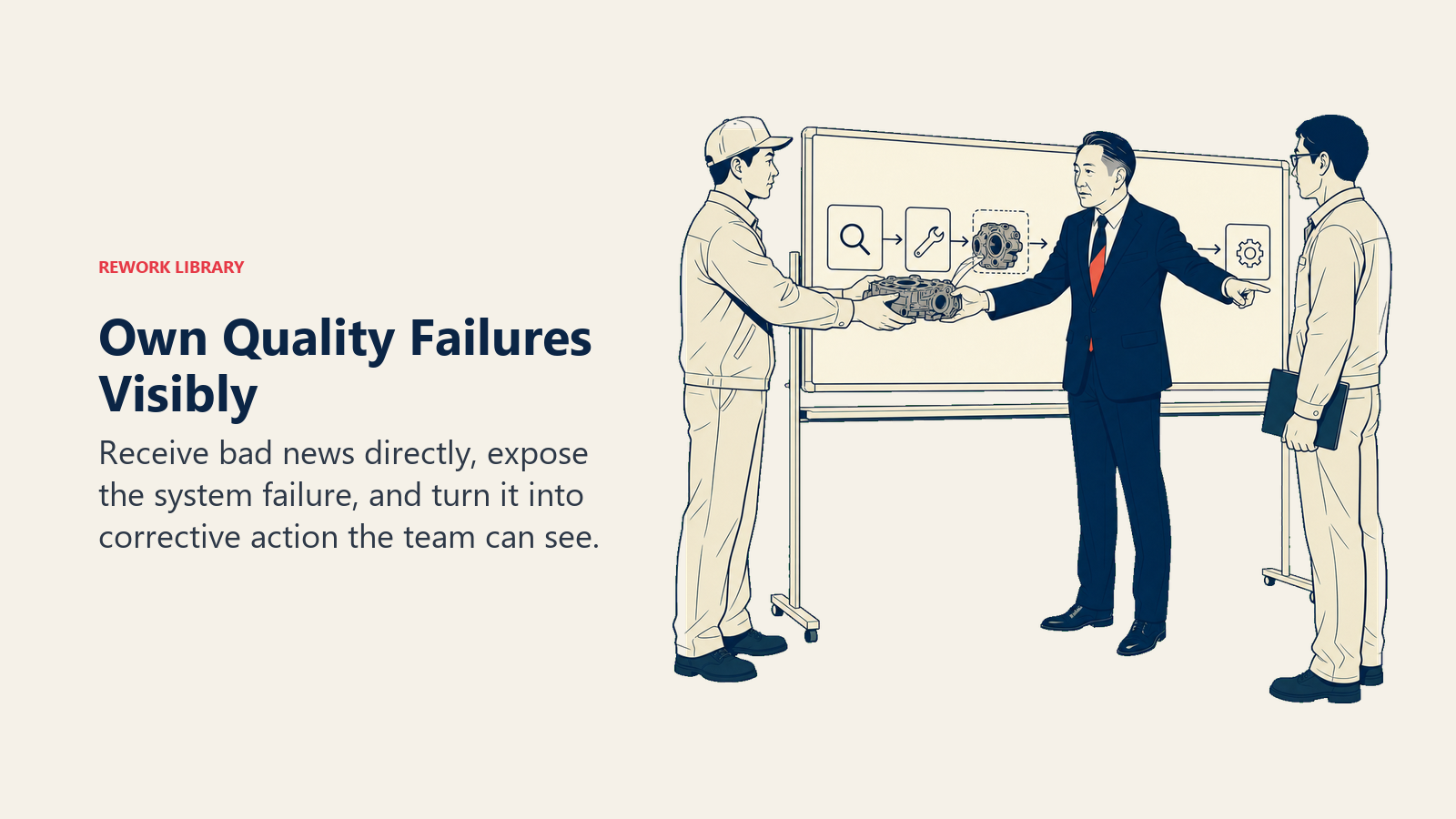
That's where Rework's operations platform earns its keep at SMB scale. Cross-team visibility across sales, support, and delivery means a spike in customer escalations surfaces in hours, not quarters. Shared pipelines and work ops dashboards give you the same kind of floor-level awareness Toyoda built by walking factories, scaled down to a 50-person team. When you need to defend a contrarian bet to your board, the argument lands better when the operational data is already in the room.
Notable Quotes and Lessons Beyond the Boardroom
"I would like to ask you all to consider what kind of car society do we want to have in the future." Toyoda said this at a 2021 auto industry conference, pushing back against the assumption that "EV as fast as possible" was the only defensible answer. The framing was characteristic: he didn't say EVs were wrong. He asked whether the industry was asking the right question.
His other frequently cited line: "The true speed is not one where we run as fast as we can. It's the speed that allows us to maintain quality and sustainability." Drucker framed a version of this decades earlier. Drucker's management discipline around quality and effectiveness is the philosophical ancestor of TPS thinking, which Toyoda consistently cited as his operating north star. This is TPS thinking applied to corporate strategy. In manufacturing, the fastest possible throughput that creates defects is slower in total than a deliberate pace that produces zero defects. Toyoda applied the same logic to EV adoption: moving at the rate that infrastructure, workforce, and supply chains could actually support would produce better outcomes than racing to announcements.
The part that doesn't fit the clean narrative: Toyoda's hybrid stand was partly right and partly a function of where Toyota's existing assets were concentrated. The company had 30 years of hybrid manufacturing expertise and supply chain relationships that would have depreciated under a hard pivot to pure EVs. Was the hybrid defense entirely principled, or was some of it protecting sunk costs? Probably both. That complexity doesn't make him a worse leader. It makes him a more honest case study.
Where This Style Breaks
Toyoda's servant-and-TPS model has real limits. The same institutional loyalty that preserved Toyota's manufacturing culture slowed its software and connected-vehicle capabilities. While Tesla built over-the-air updates into its operating model in 2013, Toyota was still treating software as a subset of hardware engineering a decade later. The culture that made TPS work, careful, consensus-driven, and iterative, doesn't produce software at tech-company speed.
His consensus-oriented decision-making also created a lag problem. Toyota's EV platform announcements came years after competitors', partly because Toyoda needed internal alignment before committing publicly. In fast-moving markets, the time cost of consensus can exceed the quality benefit. His successor's first job is exactly this: preserving what TPS discipline produces while building a parallel operating culture that can ship software on a different clock.
Frequently Asked Questions about Akio Toyoda's Leadership
Who is Akio Toyoda?
Akio Toyoda is the grandson of Toyota founder Kiichiro Toyoda and served as Toyota Motor Corporation's president from 2009 to 2023. He became chairman in April 2023, handing the president role to Koji Sato while retaining oversight of manufacturing philosophy and long-term strategic direction.
How did Toyoda handle the 2010 Toyota recall crisis?
Toyoda flew to Washington personally and testified before the US Congress in February 2010, the first Toyota president to do so. He acknowledged that Toyota had grown too fast, announced an independent quality advisory committee, and bowed publicly. Toyota's US market share recovered within roughly 18 months.
Why did Akio Toyoda defend hybrid cars against full-EV strategy?
Toyoda argued that the all-EV path assumed charging infrastructure, grid capacity, and battery supply chains that didn't yet exist in most markets. In Japan and much of Southeast Asia, where grids still relied heavily on fossil fuels, he pointed out that hybrids produced lower lifecycle emissions than EVs. By late 2023, slower-than-projected EV adoption and record hybrid sales made the thesis more defensible.
What does Akio Toyoda mean by 'the right car for the right market'?
The phrase is shorthand for Toyoda's view that different markets need different drivetrains based on infrastructure, customer demand, and grid composition. Mature markets with dense charging networks can absorb EVs quickly; markets with weaker infrastructure benefit from hybrids and plug-in hybrids as a bridge. One global answer, he argued, was a strategic mistake disguised as simplicity.
What can modern CEOs learn from Akio Toyoda?
Three things: crisis ownership beats crisis PR, contrarian strategy only works when it's backed by data rather than pride, and the Toyota Production System's discipline of continuous improvement, waste reduction, and respect for operators translates directly to software, logistics, and service operations. His transition to chairman also models a disciplined handoff that avoids the shadow-CEO trap.
What was Akio Toyoda's biggest mistake?
The most common critique is that his consensus-driven culture slowed Toyota's software and connected-vehicle capabilities. While Tesla shipped over-the-air updates starting in 2013, Toyota treated software as a subset of hardware engineering for much of the following decade. Some of his hybrid defense also protected existing supply chain investments, not just principle, a complexity he has acknowledged more than critics sometimes credit.
Learn More
- Crisis Leadership: How to Lead When Everything Goes Wrong
- Toyota Production System: What Kaizen Actually Means for Non-Manufacturers
- Contrarian Strategy: When to Hold a Position the Market Disagrees With

On this page
- Leadership Style Breakdown
- Key Leadership Traits
- The Hybrid Stand Doctrine
- The 3 Decisions That Defined Akio Toyoda as a Leader
- 1. The 2010 Congressional Testimony
- 2. Defending the Hybrid-First EV Strategy (2019-2023)
- 3. Stepping Down as President in 2023 While Staying Chairman
- What Akio Toyoda Would Do in Your Role
- The Rework Take: Crisis Composure and Long-Horizon Bets at SMB Scale
- Notable Quotes and Lessons Beyond the Boardroom
- Where This Style Breaks
- Learn More