Brian Tracy Leadership Style: The 70/30 Discipline That Turned Self-Help Into a Sales Science
Turn this article into takeaways for your work.


Each assistant summarizes the article only for you and suggests best practices for your work.
Key Facts, Brian Tracy
- Born 1944 in Charlottetown, Canada; left school at 15 and entered sales at 24 with no formal training
- Author of 80+ books, including Eat That Frog!, The Psychology of Selling, and Maximum Achievement
- Over 10 million books sold worldwide, translated into 40+ languages
- Founder of Brian Tracy International (1984) and the Focal Point coaching program for executives and entrepreneurs
- Delivered talks and training to more than 5 million people across 70+ countries over a 40-year speaking career
The Eat That Frog Principle (Tracy's 70/30 Rule)
Tracy's signature discipline fuses two ideas into one daily operating rule: identify the single highest-value task on your list (the "frog") and complete it before anything else, then allocate 70% of your remaining working time to activities that actually produce results and 30% to the maintenance work that keeps the system running. The principle treats attention as a depreciating asset, spend it on what matters most while it's still sharp, and refuse to let reactive work set your priorities.
Brian Tracy left school at 15 in Canada and spent his late teens and early 20s working manual jobs: washing dishes, laboring on farms, and eventually working his way across Africa. He talked his way into a sales job at 24 with no training, no credentials, and no obvious aptitude. What he discovered over the next decade is that selling was learnable, not through charisma but through structure. He started writing down what worked. Then he started teaching it. Then he started speaking about it in front of groups.
By 1984, he'd founded Brian Tracy International. By 2001, he'd published "Eat That Frog!" which sold over 1.5 million copies. By now, he's published more than 80 books and delivered programs in more than 70 countries. The throughline across all of it is the same conviction he arrived at in his first sales job: performance is a function of habits, and habits are a function of discipline applied consistently enough to become automatic.
Leadership Style Breakdown
| Style | Weight | How it showed up |
|---|---|---|
| Results-Driven Coach | 65% | Tracy built his entire career on the premise that skill gaps are the primary cause of underperformance, not motivation, not market conditions, not management failure. His training programs, books, and speaking engagements are all structured around the same output: tell someone exactly what to do, give them a framework to practice it, and let the results compound. The 70/30 rule, the "frog" habit, SMART goals, each is a specific behavioral prescription that doesn't require the learner to interpret anything. |
| Disciplined Systematizer | 35% | Tracy's real contribution isn't any single idea. It's the volume and consistency with which he packaged applied psychology for practitioners. His framework output, across time management, selling, goal-setting, and leadership, represents a career-long effort to turn what works in performance into replicable instructions. That systematizing instinct is the intellectual engine behind everything he's built. |
The 65/35 split reflects how Tracy actually operated. He's primarily a transfer agent: his job is to take what research and experience show about performance and package it so that a salesperson with no formal training can execute it tomorrow. The systematizer dimension is what separates him from pure motivational speakers. His frameworks have structure, not just energy.
Key Leadership Traits
| Trait | Rating | What it means in practice |
|---|---|---|
| Prioritization Discipline | Very High | Tracy's "eat the frog" framework, do your most important, most-avoided task first every morning, is built on a simple insight: willpower and clarity both decay across the day. The thing you're most reluctant to tackle at 9 a.m. becomes nearly impossible by 3 p.m. Across a career, people who consistently tackle the hardest task first accumulate an enormous lead over people who defer it. Tracy applied this to his own writing output: 80+ books written by treating writing as the frog, not the afterthought. |
| 70/30 Listening Discipline | Very High | The 70/30 rule, spend 70% of a sales conversation listening, 30% talking, sounds obvious. But it runs against how most salespeople are wired. Untrained reps talk to fill space, to prove competence, to avoid silence. Tracy's argument is that talking reveals what you know; listening reveals what the buyer needs. The rep who listens more sells more, because they can actually connect their solution to a specific articulated problem rather than a generic pitch. |
| SMART Goals Framework | High | Tracy is one of the primary popularizers of SMART goal-setting, specific, measurable, achievable, relevant, time-bound. Whether he coined the acronym is contested; what's not contested is that he embedded it into more training programs, in more countries, than almost anyone else. The practical value isn't the acronym, it's the discipline of converting vague aspirations into testable commitments that can be reviewed and adjusted. |
| Psychological Selling | Strong | Tracy's "Psychology of Selling", first released as an audio cassette program before it became a bestselling book, is built on the "law of reversibility": if you act as confident people act, you become more confident. The behavioral change precedes the internal state, not the other way around. This isn't just motivational framing. It aligns with decades of research on how deliberate behavioral practice reshapes self-perception. For sales coaches, it has a specific application: don't wait for your rep to feel confident. Coach the behavior; the feeling follows. |
The 3 Frameworks That Defined Brian Tracy
1. Eat That Frog: Task Sequencing as a Competitive Advantage
In 2001, Tracy published "Eat That Frog!" with a deceptively simple premise: the single most effective productivity habit you can develop is completing your most important task before you do anything else each day.
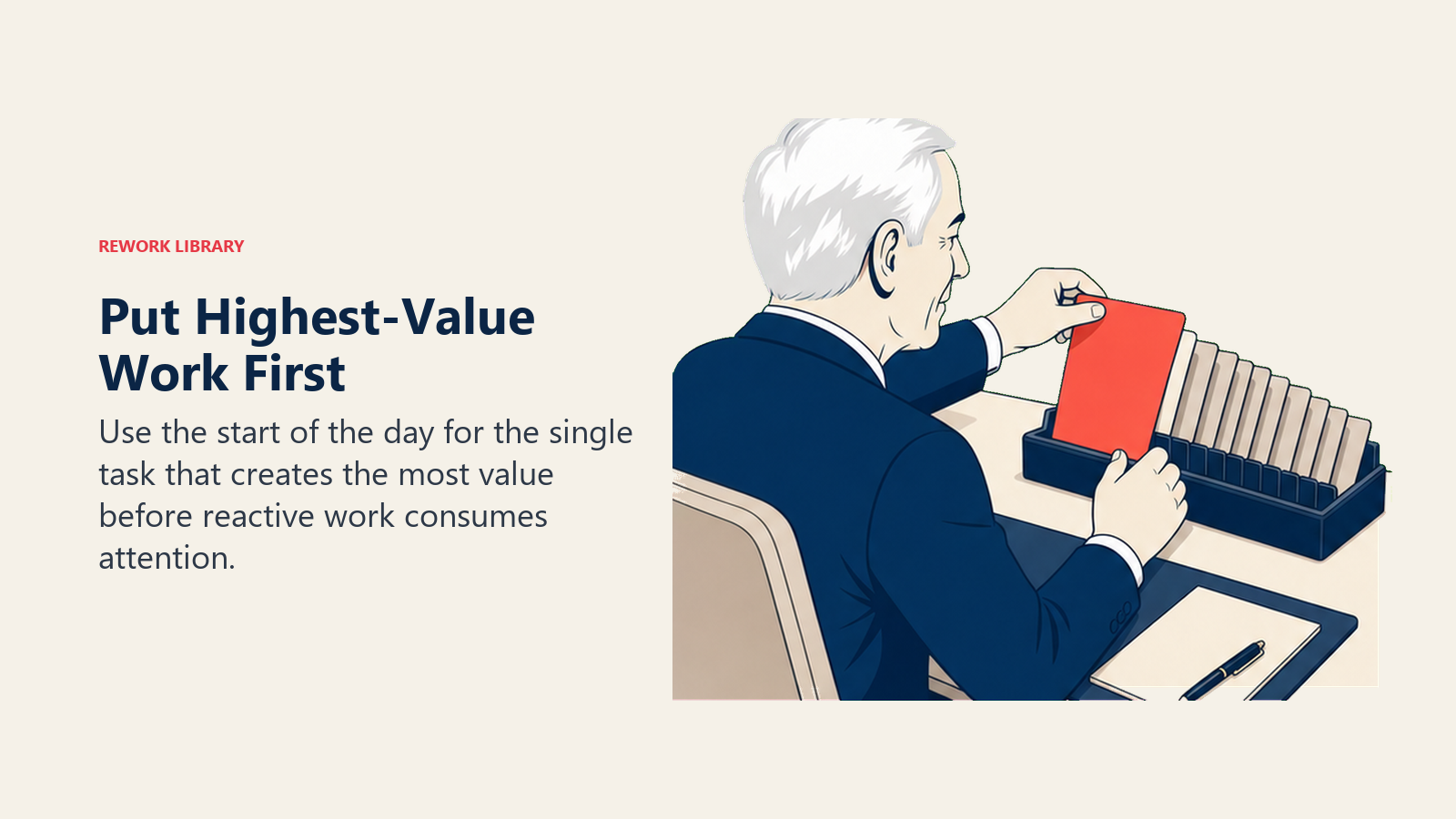
The "frog" is Mark Twain's metaphor, if you have to eat a live frog, do it first thing in the morning and everything else will be easy. Tracy adapted it to mean the task you're most likely to procrastinate on: the proposal you've been avoiding, the difficult conversation with a direct report, the strategic document that requires uninterrupted thinking.
Why does sequencing matter? Because most executives' calendars are structured around responsiveness, not priority. Meetings, email, and reactive work expand to fill available time. The highest-leverage work (the stuff that actually moves the business) gets deferred to the end of the day, when cognitive resources are lowest and interruptions have accumulated.
Tracy's framework doesn't require a new tool or a different calendar system. It requires one decision made the night before: what's the frog tomorrow? Then it requires the discipline not to check email, not to take a meeting, and not to do anything else until the frog is done.
Across a career, this habit compounds. An executive who consistently front-loads the hardest, most important work produces more output on high-leverage tasks than a peer who spends the same total hours but distributes them reactively. The 1.5 million copies "Eat That Frog!" has sold since 2001 are mostly not to motivational junkies. They're to people who recognize the gap between how they want to spend their time and how their days actually unfold.
2. The Psychology of Selling: Teaching Before Pitching
Tracy's "Psychology of Selling" audio program, released on cassette tapes before it was a book, made the case that selling is a learnable technical skill with specific psychological principles that, when understood, make the process more predictable and less exhausting. Where Zig Ziglar leaned on motivation and belief to unlock performance, Tracy leaned on structure and behavioral rehearsal, the two approaches are complementary rather than competing.
The central frameworks: First, the "law of reversibility": behavior drives emotion, not the reverse. Train the behavior (prospecting calls, confident openers, structured questioning) and the emotional state follows. This is why Tracy's programs focus heavily on scripts and behavioral rehearsal rather than motivational content.
Second, the listening architecture. Tracy's research and observation pointed consistently to the same pattern: top performers listened more and talked less. They asked questions designed to surface the buyer's core pain. They let silence sit. They resisted the instinct to fill every gap with product information.
Third, the concept of "positive expectation": approaching every sales call with the genuine belief that you can help the prospect, and that helping them requires understanding them first. This isn't affirmation practice. It's a cognitive framing that reduces defensiveness in the rep and creates a different quality of attention in the conversation.
The audio cassette format mattered more than it might seem. In the 1980s, most salespeople had no access to formal training. Tracy's cassette programs made expert coaching available in a car during a commute, the first generation of scalable sales education before the internet existed.
3. The 80/20 Time Allocation for Executives
Tracy adapted the Pareto principle (80% of results come from 20% of activities) into a time management framework that has specific implications for how senior leaders structure their weeks.
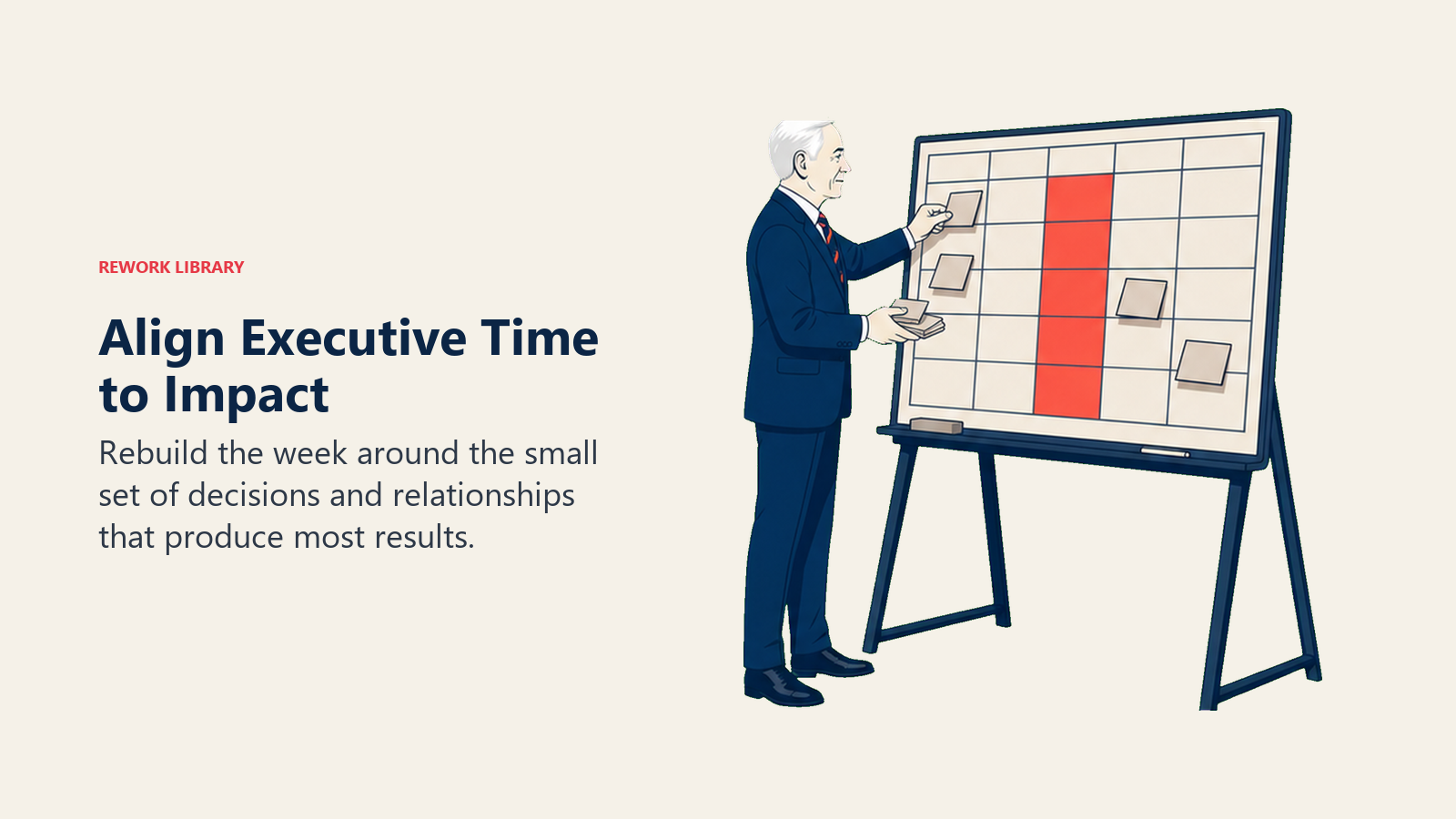
The logic: if 80% of your output comes from 20% of your activities, then the most important executive decision you make every week is identifying that 20% and protecting it from the other 80%. Most executives get this backwards. They attend to the high-volume, low-leverage demands (meetings, email, routine approvals) and squeeze the high-leverage work into whatever time remains.
Tracy's prescription is to audit your last month's output and identify which activities actually produced results that mattered. Then build your week around those activities, not around the meetings that appear on your calendar by default.
He paired this with a 70/30 model for how managers should spend their selling time: 70% on their highest-value activities (the 20% identified above), and 30% on maintenance activities that don't move the needle but can't be eliminated. Most managers invert this without noticing.
Applied practically: block two to three hours of uninterrupted time daily for your highest-leverage work before anyone can book your calendar. Delegate or decline everything that doesn't fit the 20%. Tracy ran this discipline himself. Writing 80+ books while running a global training business required it.
What Brian Tracy Would Do in Your Role
If you're a CEO, Tracy's most relevant framework is the 80/20 audit. Take the last three months and honestly categorize where your time went versus where your results came from. The gap is almost certainly larger than you'd expect. Then ask: what decisions would restructure your week to align your time with your 20%? That's the strategic priority, not the Q3 planning session that's consuming two hours a week.
If you're a COO, the "eat the frog" discipline has a systems application. Look at the projects your team keeps deferring: the infrastructure upgrade, the process documentation, the difficult vendor conversation. These are organizational frogs. Build a weekly ritual of identifying the biggest deferred item in your operations and front-loading work on it before the day's reactive demands consume your team's attention.
If you're leading a product team, Tracy's SMART goals framework is worth applying literally to product specifications. Vague feature descriptions produce vague implementations. Force every feature into a SMART structure: what specifically does this do, how do we measure whether it works, what's achievable in this sprint, why is it relevant to user outcomes, and when is it done? The discipline of answering those questions before development starts eliminates most mid-sprint scope debates.
If you're a sales or marketing leader, the 70/30 rule is the most immediately applicable lever. Listen to five recorded sales calls and measure how long your reps talk versus how long prospects talk. If you're seeing reps at 60%+ of airtime, that's a structural problem, not a talent problem. Build training around questioning discipline and structured silence. The output (more qualified pipeline, shorter cycles, higher close rates) is measurable within a quarter.
Rework Analysis: Discipline as a Sales-Team Advantage
Tracy's core bet, that performance compounds from repeated, disciplined behavior, lands harder in 2026 than it did in 1985. Modern reps lose hours to tab-switching, half-tracked conversations, and pipeline reviews that run on stale data. The "frog" gets eaten last, if at all. Rework's CRM, the Sales Engine (from $69/month billed yearly, with 5 sales seats included) is built around that exact friction. Deal stages surface the one or two opportunities a rep should touch first each morning, conversation notes sync back to the record without manual logging, and activity dashboards make it obvious when a rep has drifted from 70/30 listening back into broadcast mode.
The point isn't to automate discipline, Tracy would be the first to say that's impossible. The point is to remove the small drags that let discipline slip. When the system tells a rep what their frog is at 9 a.m. and makes the next hour of focused selling the path of least resistance, Tracy's framework stops being a motivational poster and starts being the default way the team operates.
Notable Quotes and Lessons Beyond the Boardroom
Tracy's most useful quotes aren't the motivational ones that circulate on LinkedIn. They're the diagnostic ones. That same directness appears in Dale Carnegie's canon, both men built their reputations on influence frameworks that practitioners could apply immediately, without organizational authority or a formal credential.
"Eat a live frog first thing in the morning and nothing worse will happen to you the rest of the day." The practical application: you already know what your frog is. The question is whether you're willing to sequence your day to eat it first.
"The key to success is to focus our conscious mind on things we desire, not things we fear." This one has a specific professional application: most performance anxiety in sales is about fear of rejection rather than focus on helping the buyer. Tracy's coaching consistently redirected attention from what might go wrong to what the buyer actually needs.
Tracy built Brian Tracy International in the 1980s and 1990s, decades before "personal brand" was a recognized career asset. His approach to building a speaking and training business was methodical: develop a body of proven content, deliver it at scale through cassettes and seminars, let results create referrals. It was essentially a content flywheel with a 30-year head start on the influencer economy.
His personal story also has an underrated lesson about credentials. He had none. His career was built entirely on demonstrated results in sales and the ability to teach what produced those results. In an era where credentials increasingly substitute for demonstrated competence, that's a worth-keeping distinction.
Where This Style Breaks
Tracy's frameworks were built for a selling environment that was more transactional, less informed, and more receptive to structured pitching than the current B2B landscape. Chris Voss's negotiation psychology fills that gap usefully, where Tracy built a system for the pre-internet buyer, Voss built one for a buyer who has already done the research and needs to be met differently. And Daniel Pink's attunement-buoyancy-clarity framework offers the modern academic update to the same underlying discipline Tracy was teaching by ear in the 1980s. His "Psychology of Selling" was designed for a world where buyers had less information than sellers. Modern B2B buyers often arrive with 60-70% of their research done before the first sales conversation. The 70/30 listening rule still applies, but the questions need to be different, because the prospect already knows your product's basic value proposition.
His 80+ book output also creates a diminishing-returns problem. The core frameworks appear across dozens of titles with surface-level variation. If you've read "Eat That Frog!" and "The Psychology of Selling," you've captured most of the durable value. The additional books add context but not substantially new insight. Read the two or three core texts and extract what you can apply this week.
Learn More

On this page
- The Eat That Frog Principle (Tracy's 70/30 Rule)
- Leadership Style Breakdown
- Key Leadership Traits
- The 3 Frameworks That Defined Brian Tracy
- 1. Eat That Frog: Task Sequencing as a Competitive Advantage
- 2. The Psychology of Selling: Teaching Before Pitching
- 3. The 80/20 Time Allocation for Executives
- What Brian Tracy Would Do in Your Role
- Rework Analysis: Discipline as a Sales-Team Advantage
- Notable Quotes and Lessons Beyond the Boardroom
- Where This Style Breaks
- Learn More