Aaron Ross Leadership Style: The SDR Model and the Architecture of Predictable Revenue
Turn this article into takeaways for your work.


Each assistant summarizes the article only for you and suggests best practices for your work.
Key Facts: Aaron Ross
- Built Salesforce's outbound sales team starting around 2002, generating a reported $100M+ in new recurring revenue
- Co-authored Predictable Revenue with Marylou Tyler in 2011, self-published, selling roughly 100,000 copies in its first years
- Co-authored From Impossible to Inevitable with SaaStr founder Jason Lemkin in 2016
- Known for pioneering the modern SDR (Sales Development Representative) role and the "Cold Calling 2.0" email-first outbound methodology
- His playbook has been implemented by thousands of B2B SaaS companies and helped create the multi-billion dollar Sales Development labor category
Most people in B2B SaaS know the name Aaron Ross because of Predictable Revenue, the 2011 book he co-wrote with Marylou Tyler that became required reading for CROs and VPs of Sales for the better part of a decade. But the book came after the experiment. Ross built the outbound engine at Salesforce first, running it as a scrappy internal project with a handful of reps and a simple hypothesis: if you separate prospecting from closing, both functions get better at their jobs.
That hypothesis turned out to be right. The model he built at Salesforce, cold email outreach, SDR qualification, handoff to AE, became the default org design for B2B SaaS companies globally. A profession that didn't exist before 2004 (Sales Development Representative) now employs hundreds of thousands of people worldwide. The company where Ross built this system was itself the product of Marc Benioff's platform vision, Benioff's Salesforce and the cloud CRM era is the organizational context that made Ross's outbound experiment possible and gave it the brand credibility to spread. Salesforce was founded in 1999 and became the world's largest CRM platform, the environment that gave Ross's outbound model its first proof point at scale.
What makes Ross worth studying in 2026 isn't reverence. It's that the system he built is under real pressure, from AI-assisted outbound, from inbox fatigue, from companies that over-specialized their way into losing customer relationships, and understanding what he actually built, versus how it got misapplied, gives you a clearer picture of what to keep and what to fix.
Leadership Style Breakdown
| Style | Weight | How it showed up |
|---|---|---|
| Systems Builder | 65% | Ross's core contribution wasn't a tactic, it was a structural insight about role specialization. He built the Salesforce outbound engine as a repeatable system with defined inputs, clear handoffs, and measurable outputs. The "Cold Calling 2.0" approach (email-first, referral-seeking, high-title prospecting) was documented as a process, not a playbook dependent on individual rep skill. That made it teachable and scalable. |
| Teacher-Practitioner | 35% | After Salesforce, Ross didn't go run another sales org. He wrote the book, built a consulting practice, and spent the next decade helping other companies implement the model. His leadership extended through writing and direct client work rather than through org headcount. That's an unusual career choice for someone with his profile, but it's consistent with his stated view that distributing the system broadly mattered more than scaling one company. |
The 65/35 split reflects how Ross thinks about impact. He's not primarily a manager of people. He's a designer of systems that other people operate. That distinction matters when you're evaluating what to take from his work.
Key Leadership Traits
| Trait | Rating | What it means in practice |
|---|---|---|
| Systems thinking | Exceptional | The SDR model's durability comes from its structural clarity. Ross didn't just invent a prospecting tactic, he articulated why role specialization produces better outcomes than generalist selling, and he designed the handoff points carefully. When the model works, it's because someone implemented the structure. When it fails, it's usually because they implemented only the job titles. |
| Intellectual honesty | Very High | Ross has been public about where his own frameworks need updating. In later work and interviews, he's acknowledged that "Predictable Revenue" was written for a specific company stage and market condition that doesn't apply universally. That's not common among authors whose books are treated as scripture in their field. |
| Specificity over inspiration | High | His writing is notable for what it doesn't include: motivational language, vague frameworks, and leadership platitudes. Ross writes in numbers, org charts, and email templates. That specificity is what made the book spreadable inside sales teams, you could act on it the same week you read it. |
| Work-life integration as a stated value | Moderate | Ross has been public about having a large family (around six children) and building his consulting practice around that constraint. He writes about this in a way that's unusual for B2B business authors, not as a brand story, but as an actual operating parameter. Whether that's inspiring or irrelevant depends on what you're looking for. |
The Predictable Revenue Specialization Framework
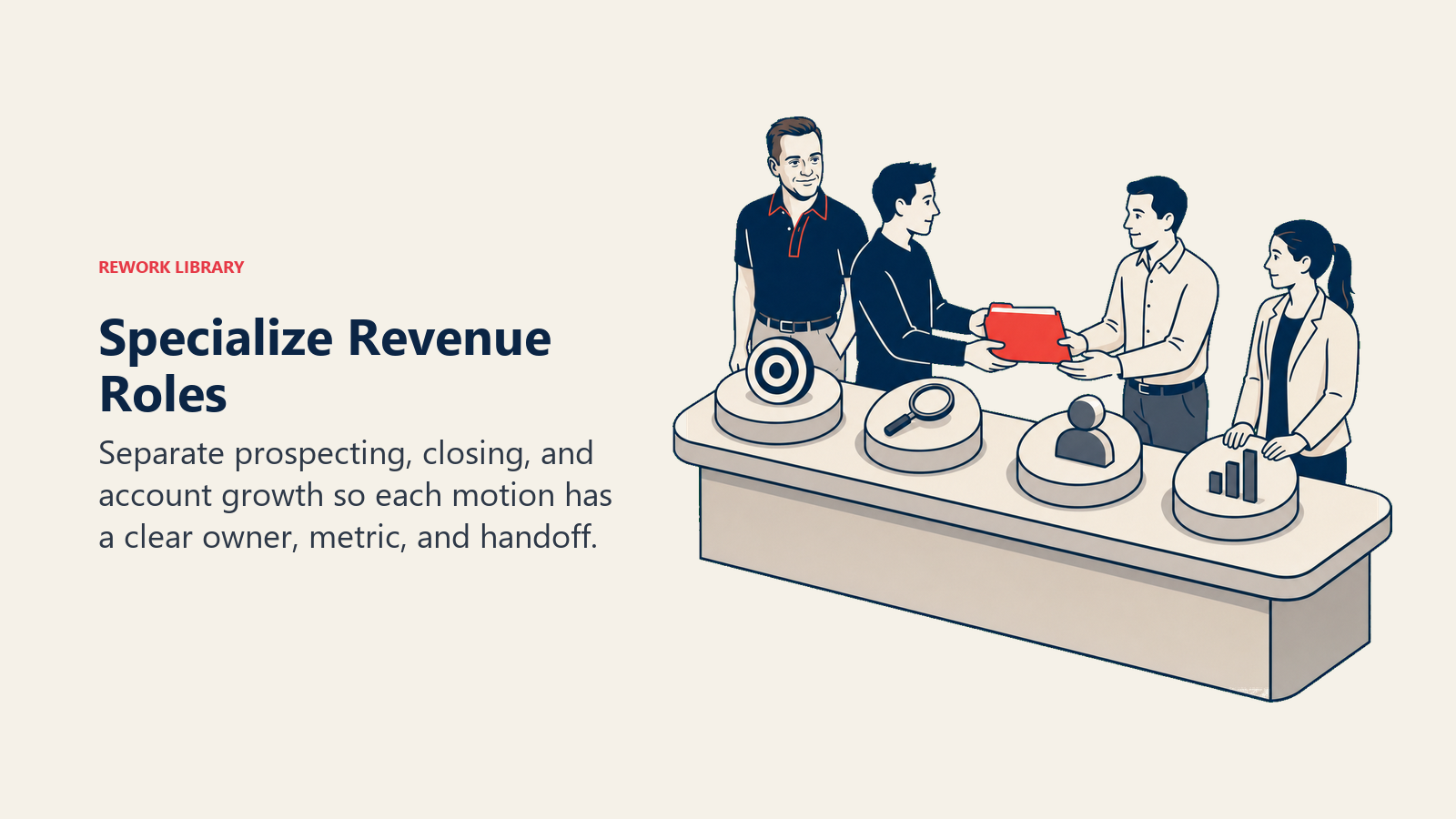
Aaron Ross's Predictable Revenue framework separates the revenue function into four specialized roles: inbound response reps who handle marketing-generated leads, outbound prospectors (SDRs) who create new pipeline from cold accounts, account executives who close qualified opportunities, and account managers who retain and expand existing customers. The structural insight is that each role requires a different skill profile and metric set, and that trying to collapse them into a generalist "salesperson" produces mediocrity in all four activities rather than mastery in any one.
The 3 Decisions That Defined Aaron Ross as a Leader
1. Designing the Cold Calling 2.0 System at Salesforce
When Ross joined Salesforce around 2002, the sales org had account executives doing everything: prospecting, qualifying, and closing. That meant AEs spent roughly half their time on outbound prospecting, calls that didn't convert into qualified pipeline, and the other half on deals. Neither activity got the focus it deserved.
Ross's core insight was simple: closing is a skill, and prospecting is a different skill. If you try to optimize one person to do both, you get mediocrity in both. He proposed building a dedicated outbound team, eventually called Sales Development Representatives, whose only job was to generate qualified meetings for AEs.
But the other half of the insight was equally important: he changed the outbound motion from cold calling to cold email. His approach, which he named "Cold Calling 2.0", involved sending short, targeted emails to senior contacts at target accounts, asking not for a meeting but for a referral to the right person. The senior contact would often respond with "talk to my VP of Sales." That referral converted at dramatically higher rates than cold outreach with no context.
The Salesforce outbound team he built generated over $100 million in new revenue. That number, repeated in every summary of his work, understates the structural contribution: he proved that a small, specialized team with a disciplined process could predictably generate pipeline at a cost and reliability that generalist selling couldn't match.
2. Writing Predictable Revenue Instead of Running Another Sales Org
After leaving Salesforce, Ross had a choice that most operators in his position would make differently: go run sales at a growth-stage startup, get the VP title, chase the equity. Instead, he spent two years writing Predictable Revenue with Marylou Tyler and self-published it in 2011.
It sold roughly 100,000 copies in its first few years and is still widely assigned in B2B sales training. More importantly, it spread the model he built at Salesforce to thousands of companies that couldn't afford to reverse-engineer it independently. Mark Roberge was building a parallel architecture at HubSpot at roughly the same time, Roberge's data-driven sales engineering approach is the complementary framework to Ross's outbound system, and together they define most of what modern B2B SaaS sales ops still runs on. Companies from Zendesk to HubSpot to hundreds of Series A and B SaaS startups built their SDR functions on the framework in that book.
The decision to write rather than operate reflects a specific theory of leverage: Ross believed the system he'd designed was more valuable distributed broadly than implemented at a single company. Whether that was right depends on how you count impact. He didn't capture much of the financial upside that other people generated by implementing his framework. But the professional category he helped create, Sales Development, is now a multi-billion dollar labor market.
For today's leaders, the lesson is about where you apply your insight. Ross had something that worked and a choice about how to deploy it. Writing was a lower-prestige, lower-compensation option in 2011. It turned out to be the higher-impact one.
3. Publishing "From Impossible to Inevitable" with Jason Lemkin in 2016
Ross's second major book, co-written with SaaStr founder Jason Lemkin, was a direct response to the most common misapplication of Predictable Revenue: founders and CROs who built an SDR team and a cold email machine, but still didn't have predictable revenue. Neil Rackham encountered the same pattern decades earlier, practitioners applying SPIN Selling as a script rather than a framework, and Rackham's challenge-based selling research is the intellectual lineage that both Ross and Roberge drew from when they moved beyond tactics into system design. For teams implementing any of these frameworks today, the lead management fundamentals library covers the mechanics in depth.
The problem, Ross and Lemkin argued, was that most companies were trying to scale sales before they'd found their "nail", their repeatable, documented path from prospect to closed customer. The SDR model is a scale mechanism. It doesn't work if you haven't first found a customer segment that actually converts, with a value proposition that works, at a price point that makes economic sense.
From Impossible to Inevitable laid out a seven-step framework: nail a niche, create predictable pipeline, make sales scalable, double your deal size, do the time, build an inside sales team, and fix the parts that break as you grow. It was less a tactical manual than a sequencing framework, here's the order in which you build the machine.
The book's contribution was intellectual honesty about what the first book missed. Ross didn't just extend the brand. He used the platform he'd built to correct the misunderstanding that had grown around his own work. That's a leadership decision that most people in his position don't make.
What Aaron Ross Would Do in Your Role
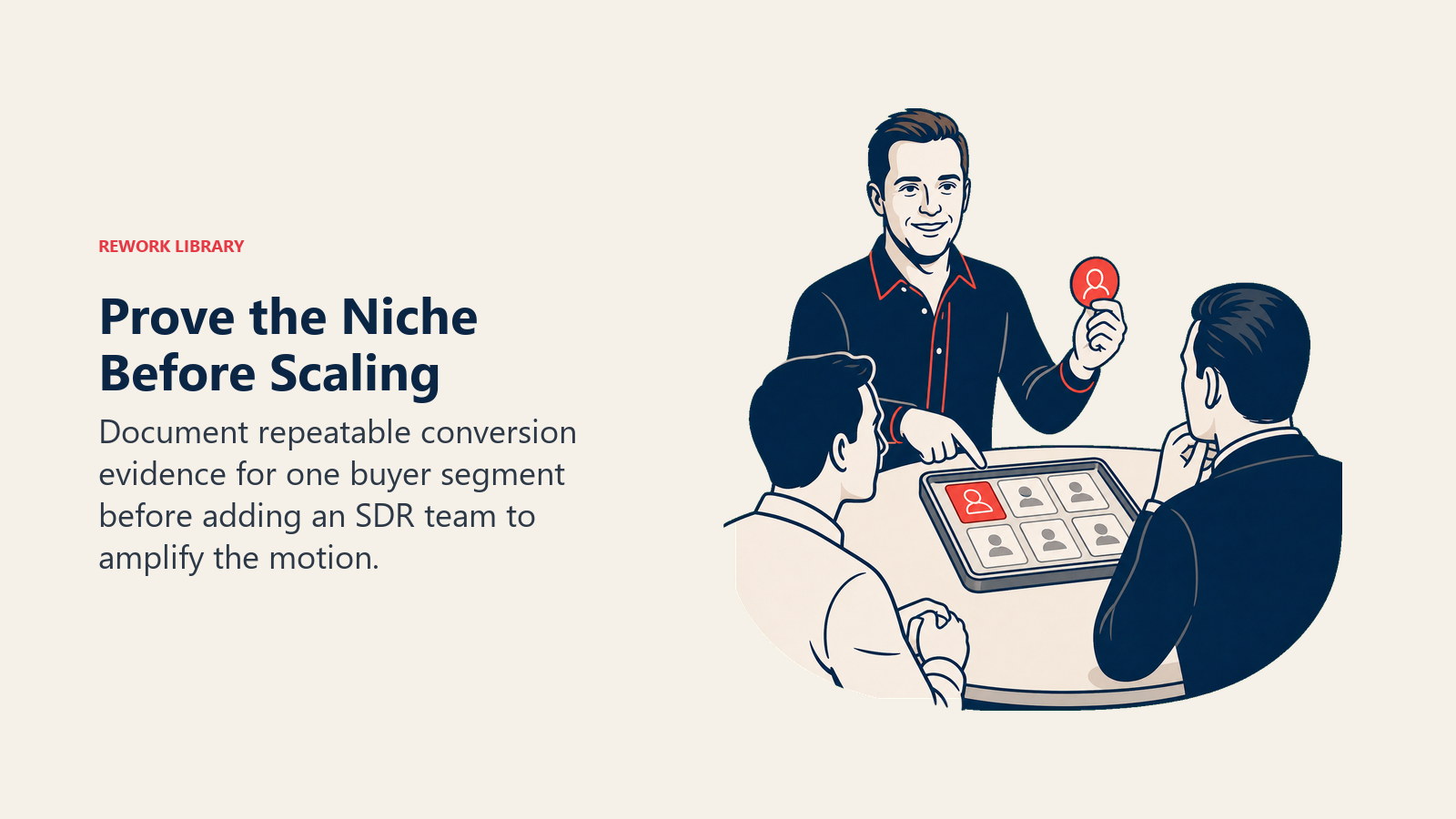
If you're a CEO trying to build a scalable sales motion, Ross's first question would be whether you've nailed the niche. Not "do you have an ICP," but "do you have documented, repeatable evidence that a specific type of buyer converts to revenue at a predictable rate?" If the answer is no, building an SDR team will amplify your uncertainty, not solve it. The SDR model is a scaling mechanism for a motion that already works, it's not a way to find the motion.
If you're a COO or revenue operations leader, the structural lesson from Ross is about role clarity and handoff design. Most SDR programs that underperform do so because the handoff from SDR to AE is poorly defined. What counts as a qualified meeting? Who decides? What happens when an AE says the SDR-sourced meeting wasn't ready? Ross was precise about all of this at Salesforce, and that precision is what made the system repeatable. If your SDR program is producing activity but not pipeline, check the handoff definition before you check the email templates.
If you're a product leader at a B2B company, Ross's work has a quiet implication: your product's ICP definition matters for sales efficiency as much as it matters for product-market fit. The SDR model works best when reps can quickly identify and exclude accounts that won't convert. If your product solves a problem for a wide range of company types and sizes, your SDR team will spend most of its time on low-probability outreach. Tighter product positioning directly reduces SDR wasted motion.
If you're a VP of Sales or CRO, the 2026 version of this question is what the SDR model looks like with AI-assisted prospecting. Signal-based outbound, where AI identifies accounts showing buying intent before a rep reaches out, compresses the research phase that used to take SDRs hours per account. Ross's structural insight (specialization produces better outcomes) still holds. But the work that justified SDR headcount in 2011 is increasingly automated. The question isn't whether to have SDRs, it's what their job description looks like when AI handles the first three steps they used to own.
Rework Analysis
Ross's specialization framework lives or dies on handoff discipline, the moment an SDR-qualified meeting becomes an AE's opportunity, and later when that opportunity becomes an active customer. Most teams lose pipeline in those seams, not in the individual stages. Rework's CRM and pipeline management is designed around that reality: SDR qualification criteria, AE opportunity stages, and handoff rules live in the same system so nothing falls through the cracks when ownership changes.
For teams running Ross's playbook in 2026, the other pressure point is lead volume without lead quality. Rework's lead management module captures inbound and outbound activity side by side, tags accounts by ICP fit, and routes only the ones worth an SDR's time, which is the modern version of Ross's "nail the niche" discipline. Combined with work ops for the cross-functional coordination that sales, marketing, and success need to keep pipeline moving, it gives revenue leaders the same structural clarity Ross built at Salesforce, without requiring a team of ops engineers to stitch tools together.
Notable Quotes & Lessons Beyond the Boardroom
Ross's writing is unusually candid about the limits of his own frameworks, which is rarer than it sounds among business authors. In interviews after 2020, he was direct about the fact that Predictable Revenue was a snapshot of what worked at Salesforce in a specific growth phase, at a time when cold email response rates were much higher than they are today. "The book wasn't meant to be a bible," he said in a 2022 podcast. "It was meant to document one way that worked. A lot of people took it as the only way."
That distinction, one way that worked versus the only way, is the most important thing to carry from his work. The SDR model succeeded at Salesforce because it solved a real specialization problem in a company that already had strong inbound demand. When companies without inbound demand tried to replicate it purely through cold outreach, they got cost without the pipeline. The framework wasn't broken. The context was wrong.
His other persistent theme is organizational clarity. In From Impossible to Inevitable, he writes: "You can't build a great sales team without being clear about who you're selling to, what you're selling, and why it's worth what you're charging." That sounds obvious. But the number of Series B companies that can't answer all three questions cleanly, without hedging, is surprisingly high.
Where This Style Breaks
The SDR model under-delivers in three predictable scenarios. First: if your company doesn't have repeatable pipeline data to confirm that a specific buyer type converts, an SDR team will generate activity but not revenue, and you'll spend 12 months troubleshooting the wrong variable. Second: over-specialization kills relationship quality. When SDRs are optimized purely for meeting volume, they hand off prospects before genuine trust is built. AEs then spend the first meeting re-establishing credibility, which adds cycle length.
Third, and most pressing in 2026: the cold email economics that made "Cold Calling 2.0" powerful in 2011 have degraded substantially. The sales operations discipline that Ross helped define now has to contend with AI-generated outbound at scale, which compresses the response rates his original model relied on. Response rates are lower, spam filters are smarter, and buyers are more sophisticated about outbound sequences. Ross's structural insight is still sound. But the specific mechanics he documented need updating for a world where AI is generating outbound at scale and signal-based prospecting is replacing volume-based outreach.
Frequently Asked Questions about Aaron Ross's Leadership
What was Aaron Ross's leadership style?
Aaron Ross led primarily as a systems builder rather than a people manager. His core contribution was designing a specialized, repeatable outbound sales process at Salesforce, then teaching that system to thousands of companies through books and consulting rather than scaling a single organization himself.
What is the Predictable Revenue model?
The Predictable Revenue model separates the revenue function into specialized roles, inbound response, outbound prospecting (SDRs), closing (AEs), and account management, so each person focuses on the skill they are best suited for. The goal is a documented, measurable pipeline machine where new revenue can be forecasted with reasonable accuracy rather than depending on star reps.
How did Aaron Ross build Salesforce's outbound team?
Starting around 2002, Ross proposed removing prospecting from account executives and giving it to a dedicated team he eventually called Sales Development Representatives. He also shifted outbound from cold calling to short, referral-seeking cold emails sent to senior executives, a method he named "Cold Calling 2.0," and the team reportedly generated over $100 million in new revenue for Salesforce.
What can modern sales leaders learn from Aaron Ross?
The durable lesson is that specialization and clean handoffs beat generalist selling at scale, but only after a company has proven a repeatable path from prospect to closed customer. Leaders should nail the niche and document the conversion math before hiring SDRs, and they should treat the SDR-to-AE handoff definition as a first-class design problem rather than a detail.
What books did Aaron Ross write?
Aaron Ross co-authored Predictable Revenue with Marylou Tyler in 2011, which documented the outbound system he built at Salesforce. He later co-authored From Impossible to Inevitable with SaaStr founder Jason Lemkin in 2016, a sequencing framework explaining why so many companies failed to replicate the first book's results.
What was Aaron Ross's biggest leadership mistake?
Ross has publicly acknowledged that Predictable Revenue was written as a snapshot of what worked at Salesforce in a specific growth phase, and that too many readers treated it as a universal script. The resulting misapplications, companies building SDR teams before finding a repeatable motion, were what he wrote From Impossible to Inevitable to correct.
Learn More

On this page
- Leadership Style Breakdown
- Key Leadership Traits
- The Predictable Revenue Specialization Framework
- The 3 Decisions That Defined Aaron Ross as a Leader
- 1. Designing the Cold Calling 2.0 System at Salesforce
- 2. Writing Predictable Revenue Instead of Running Another Sales Org
- 3. Publishing "From Impossible to Inevitable" with Jason Lemkin in 2016
- What Aaron Ross Would Do in Your Role
- Rework Analysis
- Notable Quotes & Lessons Beyond the Boardroom
- Where This Style Breaks
- Learn More