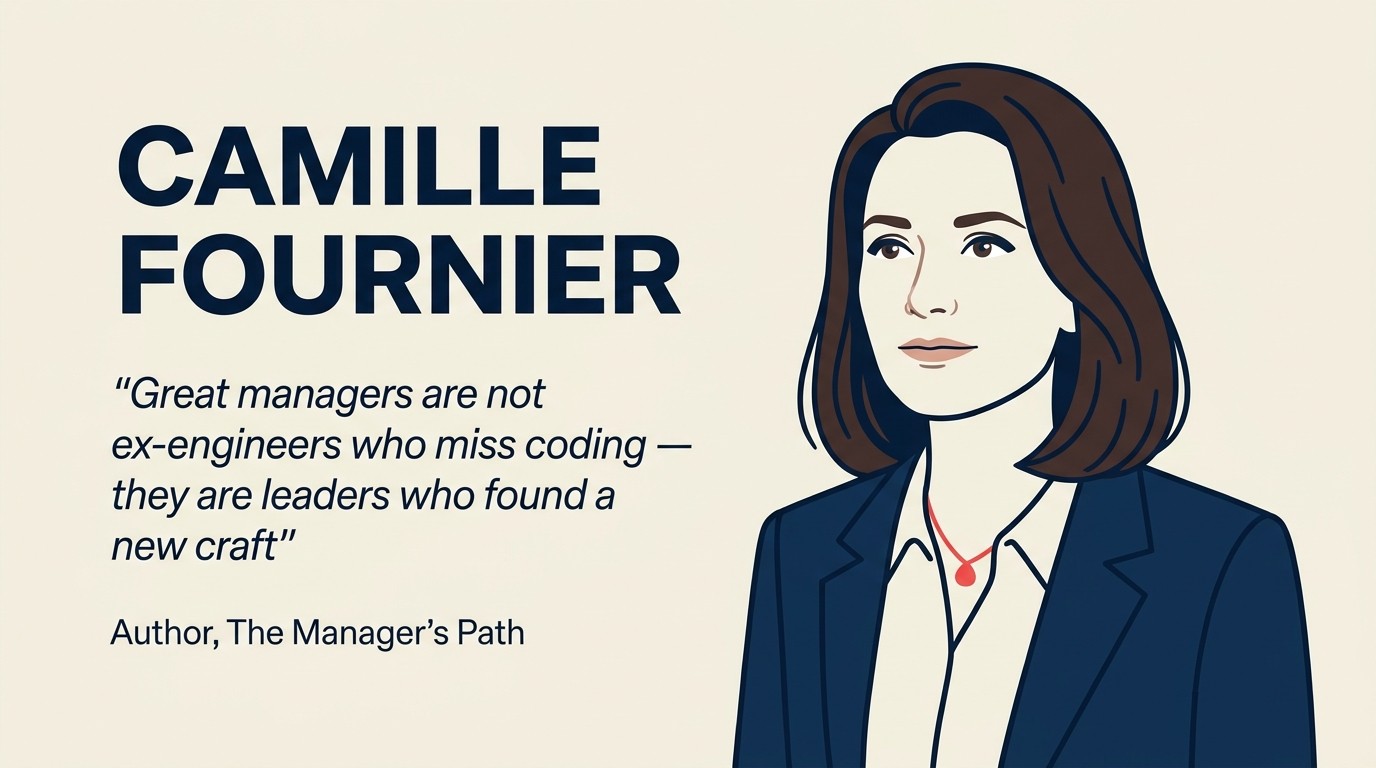
Camille Fournier Leadership Style: The Technical Manager's Playbook
Turn this article into takeaways for your work.


Each assistant summarizes the article only for you and suggests best practices for your work.
Key Facts: Camille Fournier
- Former CTO, Rent the Runway (2013–2017)
- Managing Director & Head of Platform Engineering, Two Sigma
- Author, "The Manager's Path" (O'Reilly, 2017), bestselling engineering management book
- Contributor, "97 Things Every Engineering Manager Should Know"
- Apache ZooKeeper committer, core contributor to the distributed coordination service
- Earlier career: Managing Director, Goldman Sachs (infrastructure engineering)
The Manager's Path is not a business book about vision or culture. It's a manual, chapter by chapter, from tech lead to CTO, about what the job actually requires at each stage of management. Published in 2017, it became the most-recommended engineering management book in Silicon Valley because it answered questions that no other book had asked: What do you do when your best engineer wants to become a manager and probably shouldn't? How do you manage skip-level conversations when your directs are also managers? What's the actual difference between a Director and a VP of Engineering?
Camille Fournier wrote it from experience. She was CTO of Rent the Runway from 2013 to 2017, one of the fastest-scaling fashion technology companies of that era. Before that, she spent time at Goldman Sachs as a Managing Director running infrastructure engineering, which meant managing large teams inside one of the most technology-dependent financial institutions in the world. Earlier in her career she was a major contributor to Apache ZooKeeper, the distributed coordination service that underpins many of the infrastructure systems she later managed at scale. She didn't learn management theory in a business school. She learned it by managing engineers at Goldman, scaling a consumer technology company at Rent the Runway, and returning to hands-on technical work at Two Sigma as a Principal Software Engineer.
That combination is what makes her frameworks land with people who actually run engineering organizations.
Leadership Style Breakdown
| Style | Weight | How it showed up |
|---|---|---|
| Structured Mentor | 55% | Fournier's primary contribution is giving engineering managers a clear picture of what their job is at each level of seniority, and critically, what it isn't. Most engineering manager failure modes happen when people keep doing the job they were good at rather than the job they're now supposed to do: the tech lead who becomes a manager but can't stop writing all the code, the senior manager who keeps running 1-on-1s with individual contributors instead of managing their managers. "The Manager's Path" names these failure modes explicitly, level by level, which makes them discussable. That's the mentor function: giving people a map before they need it. |
| Pragmatic Systems Builder | 45% | Fournier thinks about engineering organizations as systems with identifiable inputs, outputs, and failure modes. Her Goldman Sachs and Two Sigma background shows in how she approaches organizational design: analytically, with attention to incentive structures and information flows. Her writing on technical debt treats it not as a code-quality problem but as a business-risk problem, which is how it has to be framed to get budget. That's systems thinking applied to organizational management rather than to software architecture. |
The 55/45 split means Fournier is most valuable to people in the middle of a management transition: moving from individual contributor to team lead, from team lead to manager, from manager to Director. Her frameworks are less about the final destination than about the transitions. Will Larson picks up where Fournier's ladder ends, his "Staff Engineer" archetypes address the IC track that "The Manager's Path" deliberately leaves aside.
Key Leadership Traits
| Trait | Rating | What it means in practice |
|---|---|---|
| Clarity about what each management level requires | Exceptional | Most organizations promote people into management without telling them what the new job is. "The Manager's Path" solves this by defining each level specifically: what decisions you own, what relationships you're responsible for, what success looks like, and what failure looks like. The chapter on "Managing Multiple Teams" is not about general leadership theory. It's about the specific job of a Director who manages other managers, including how to avoid the trap of skipping the managers and doing their work for them. That level of specificity is rare in management writing. |
| Willingness to discuss management failure modes openly | Very High | Fournier doesn't write about management the way most management books do, aspirationally, focused on success patterns. She writes about failure modes: the technical manager who can't stop coding, the new manager who becomes best friends with all their reports, the CTO who won't delegate organizational decisions because they don't trust their VP of Engineering. Naming failure modes explicitly is more useful than describing ideal behavior, because it gives people a way to recognize when they're making a mistake before it compounds. |
| Technical depth maintained as an executive | High | Most executives who have been CTOs stop writing real code. Fournier returned to Principal Software Engineer work at Two Sigma after leaving Goldman Sachs at the Managing Director level. The same refusal to drift from the technical work is visible in Jeff Dean, who kept shipping foundational systems research at Google even after his work defined how the company's infrastructure scaled. That's an unusual career move: backwards in title, forward in technical engagement. It means her management advice is written by someone who has actually stayed close to the work, which gives her a different perspective on the gap between management theory and the daily experience of engineers than most management writers have. |
| Specificity over abstraction | High | Fournier's frameworks are checklists and decision trees, not philosophies. The 1-on-1 framework doesn't say "build rapport with your reports." It specifies what to cover, what questions surface what kinds of information, and how to distinguish a 1-on-1 that's going well from one that's becoming a status meeting. The technical debt framework doesn't say "communicate technical concerns clearly." It gives you the translation: here's how to render a code-quality problem as a risk and velocity problem that a CFO can make a budget decision about. |
The 3 Frameworks That Defined Camille Fournier
The Manager's Path (Fournier Engineering Leadership Ladder)
The Manager's Path, also called the Fournier Engineering Leadership Ladder, is a level-by-level definition of the engineering management career track from individual contributor through tech lead, manager, senior manager, director, VP of Engineering, and CTO. Each rung specifies a distinct primary relationship, unit of work, and named failure mode, most commonly, doing the previous level's job instead of the current one. The ladder is the dominant reference model for engineering management career paths in modern software organizations.
The Management Ladder
The central framework of "The Manager's Path" is simple: each level of the engineering management hierarchy has a distinct job, and the most common failure mode at every level is doing the previous level's job instead of the current one.
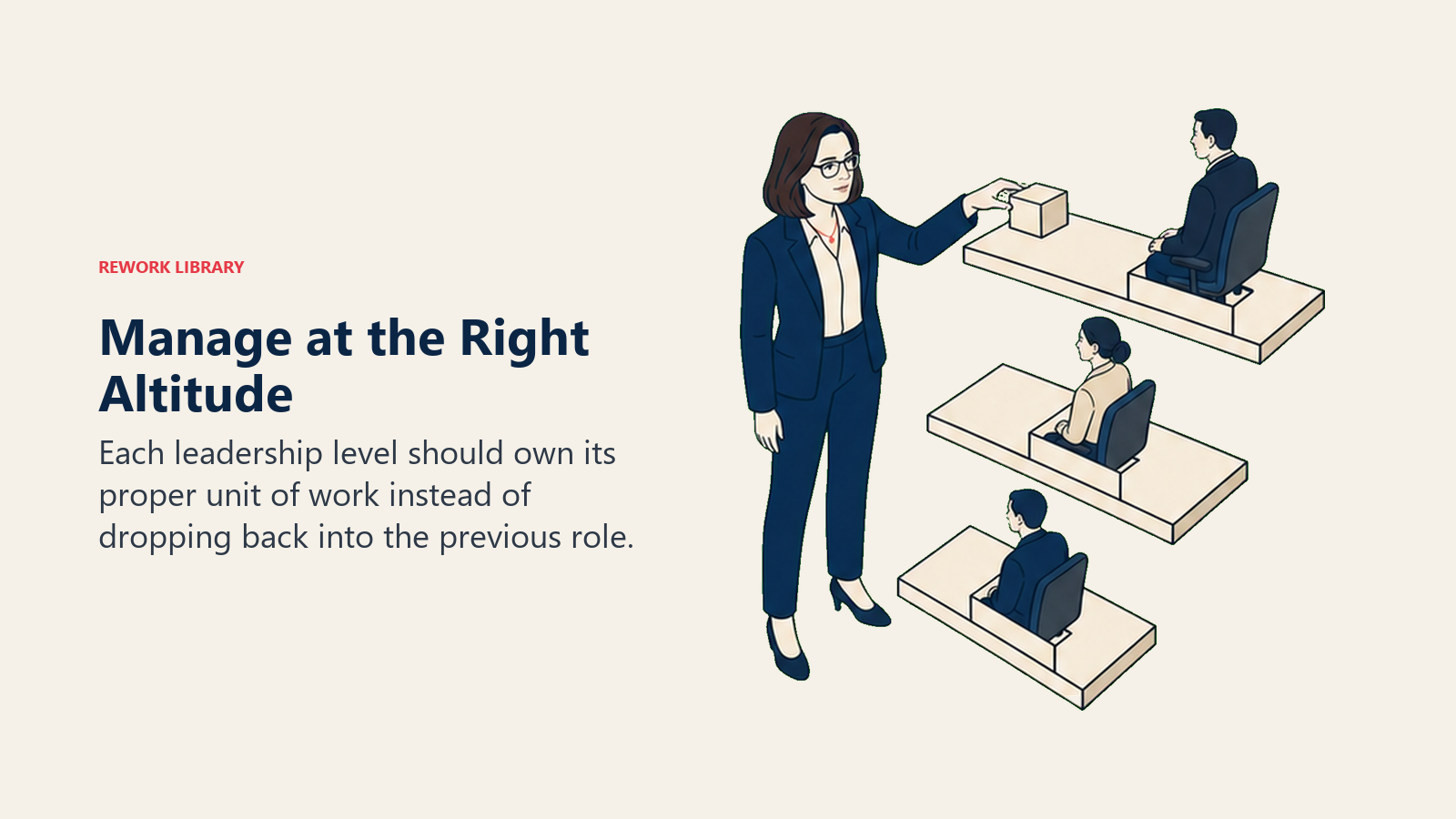
Fournier maps the ladder specifically: individual contributor, tech lead, manager of individual contributors, senior manager (manager of managers), director, VP of Engineering, CTO. Each level has a different primary relationship and a different unit of work. A tech lead's primary relationship is with the code and the team. A manager's primary relationship is with individual contributors. A Director's primary relationship is with their managers. A VP's primary relationship is with organizational systems and hiring pipelines. A CTO's primary relationship is with the company's technical strategy and the board.
The failure mode at each level is well-defined. The tech lead who becomes a manager keeps writing all the code and doesn't invest in making their engineers better. The manager who becomes a Senior Manager keeps doing 1-on-1s with all the individual contributors instead of building up their managers. The Director who becomes a VP keeps making individual team-level decisions instead of designing organizational structures. Each of these failures is recognizable in practice, and naming them is what makes them correctable.
For operators outside engineering, the ladder framework applies to any organization with management hierarchy. The question at every promotion is: what does the new job require that the old job didn't? If you can't answer that clearly, you're promoting people into roles they'll fill with the skills that got them promoted, not the skills the role needs.
The 1-on-1 Audit
Fournier is specific about what 1-on-1s are for and what they're not for. They're not status meetings. They're not check-ins on project progress. They're the primary tool managers have for early warning on talent risk, career dissatisfaction, and team dynamics problems that don't surface in any other format.
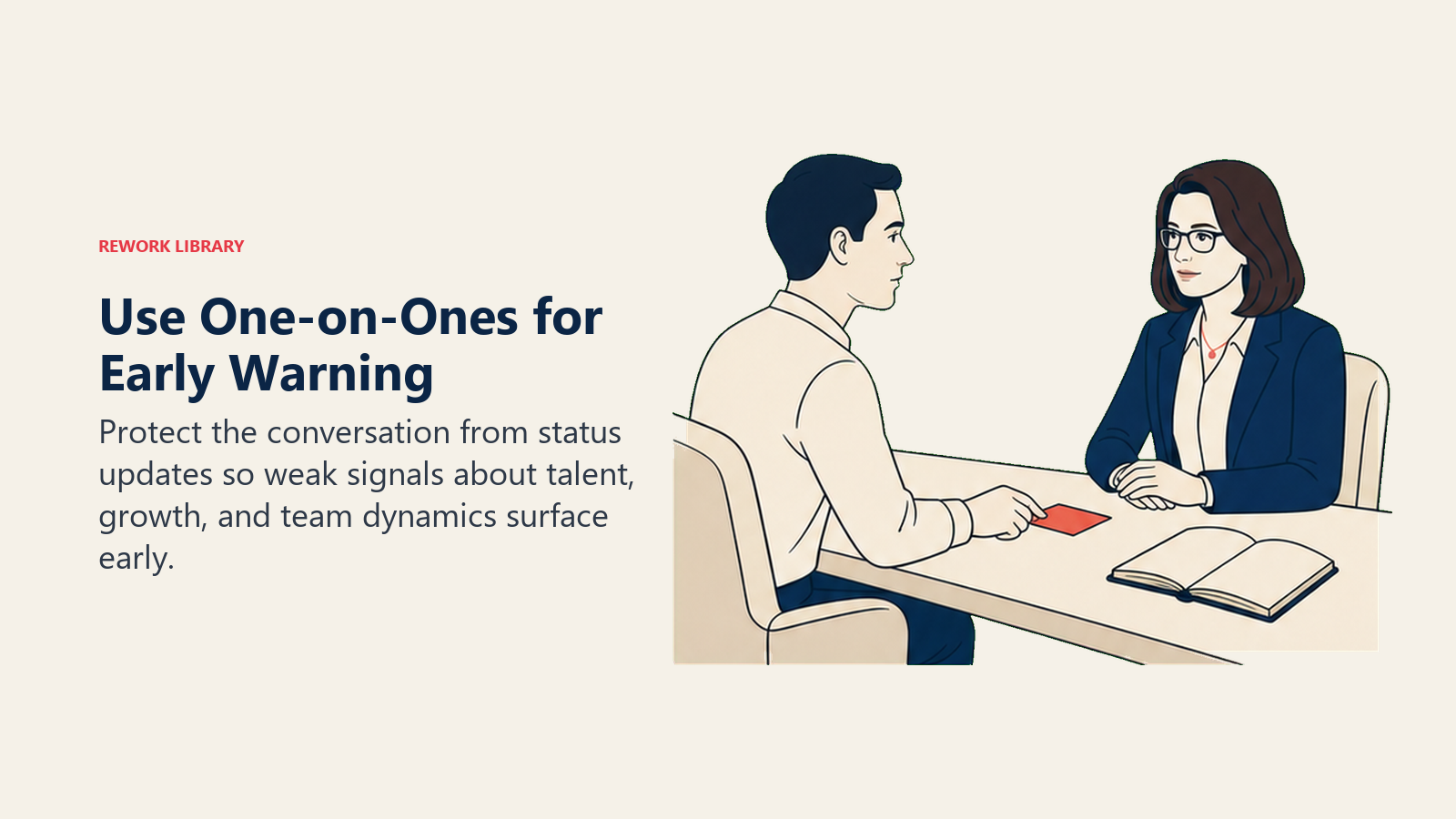
The specific agenda she recommends has three parts. Career: what is this person working toward, and is their current work moving them toward it? Current challenges: what's getting in their way right now, and is there anything only you can remove? Team dynamics: how are things going with the people around them, and are there friction points that haven't reached the surface yet?
The reason most 1-on-1s become status meetings is that managers are more comfortable discussing project status than having direct conversations about career satisfaction or team friction. Status is safe. The actual 1-on-1 agenda surfaces problems the manager might have to own and fix. Fournier's point is that the discomfort is the information. The moment a direct stops raising problems in 1-on-1s, you've lost your early warning system. By the time they tell you in a resignation letter, you've already lost the window to fix it.
Technical Debt as a Business Decision
Fournier has written and spoken extensively on one of the most common failure modes for engineering leaders: the inability to translate technical concerns into language that gets budget.
The engineering framing of technical debt is quality-oriented: "the code is messy, it makes it hard to add features, it increases the risk of bugs." That framing is true but useless to a CFO or a CEO making resource allocation decisions. The business framing is different: "this technical constraint is slowing our release velocity by roughly 30% relative to where it should be, which delays our ability to respond to market changes, and here's what the risk profile looks like if we don't address it in the next two quarters."
Fournier's argument is that CTOs who can't make that translation don't get the budget to fix the problem, which means the debt compounds, which means the velocity penalty grows, which means the next budget argument is even harder to win. The translation isn't about simplifying complex technical issues. It's about reframing them in terms of business consequences: time, risk, and velocity. Those are the three currencies executives actually allocate against. Gene Kim addresses the same problem from the operations side, his First Way of DevOps reframes deployment bottlenecks as a flow and constraint problem that CFOs and COOs can engage with, not just engineers.
She's also direct about what happens when the CTO can't make this argument: the debt becomes invisible to the business, the engineering team becomes frustrated that legitimate technical concerns are ignored, and the organization gets slower without understanding why.
What Camille Fournier Would Do in Your Role
If you're a CEO, the most useful thing Fournier offers is a diagnostic for your engineering organization's management quality. The question isn't "do we have good engineers?" It's "do our engineering managers know what their job is?" If your VP of Engineering is still doing Director-level work (managing teams directly instead of managing managers), your Director-level capacity is either atrophied or nonexistent. If your Directors are doing tech lead work, your team leads aren't developing. The ladder framework tells you where the management system is stuck, which tells you where organizational capacity is being consumed by the wrong level doing work that should belong to the level below.
If you're a COO, Fournier's 1-on-1 framework applies to every team with a management hierarchy. The question to ask your managers: when was the last time a report surprised you with a resignation? If the answer is "recently" or "regularly," your managers are running status meetings, not 1-on-1s. The 1-on-1 is the only early warning system managers have for talent risk. If they're not using it, you're running blind on retention until people walk out the door.
If you're a product leader, Fournier's technical debt framework is directly useful. You're on one side of the most common organizational conflict in product companies: engineering wants time to reduce technical debt and product wants features. The reason that conflict doesn't resolve is that neither side is speaking the other's language. Fournier's framing, translate debt into velocity and risk, gives you a shared decision framework. Instead of "engineering needs time to fix technical debt" versus "product needs features," you can ask: "what's the velocity cost of not addressing this, and does it exceed the opportunity cost of delaying these features?" That's a question both sides can engage with.
If you're in sales or marketing, the management ladder applies to your own organization. Every sales manager who got promoted because they were the best rep carries the risk of continuing to do sales instead of doing management. Fournier's framework gives you a way to check whether your sales managers are actually managing: building pipeline across their team, developing reps who were struggling, running forecasts that reflect team-level judgment rather than the manager's personal deals. The failure mode is the same: promoted for skills that worked at the previous level, not equipped with the skills the new level requires.
How Rework Operationalizes the Fournier Ladder
Fournier's ladder only works if managers can actually see the unit of work that matches their level. Rework is built for that visibility. Engineering management pipelines in Rework's Project Engine (from $99/month billed yearly, with 5 seats included) let tech leads and managers track delivery at their own altitude, ICs see tasks, managers see team throughput, directors see cross-team flow, without forcing everyone into the same view. Career ladder templates can be modeled as structured checklists per role, so the "what does this level actually require" question has a concrete answer engineers and managers can refer back to during 1-on-1s and promotion reviews.
For technical leads, Rework supports the exact transition Fournier describes: team ops dashboards surface whether the lead is still carrying too much of the code versus developing their engineers, and cross-team visibility lets directors spot when a manager is skipping a level, doing IC work or running the project themselves instead of through their team. Rework's Sales Engine (from $69/month billed yearly, with 5 sales seats included) applies the same ladder logic to sales management, matching Fournier's point that the failure mode generalizes across any management hierarchy.
Notable Quotes and Lessons Beyond the Boardroom
Fournier has said in various talks: "The best engineering managers I know are the ones who can clearly tell you what they're not responsible for." That's a counterintuitive statement. Most management advice is about expanding accountability. Her point is about clarity: a manager who can't identify the boundaries of their role will fill the role with whatever they're comfortable doing, which is usually the job they used to have.
From "The Manager's Path": "As a manager, your job is to do as little as possible." She immediately clarifies: little as possible doesn't mean minimal effort. It means the manager's job is to create conditions where engineers can do their best work, not to do the work for them. Every task a manager takes off a strong engineer's plate that the engineer could have handled is a missed development opportunity and an increased dependency on the manager. The goal is a team that runs well when you're not there.
She's also been direct in public writing about the book's limitations: "The Manager's Path" was written for product companies with stable engineering organizations. She's acknowledged that the ladder model gets complicated in highly matrixed organizations or consulting firms where reporting lines and project scope shift constantly. That's not a disclaimer. It's a useful boundary for knowing when to apply the framework and when to adapt it.
Where This Style Breaks
Fournier's ladder model works cleanest in product companies with stable management hierarchy: companies big enough to have a Director layer but not so big that the organizational chart has dozens of competing reporting structures. In consulting firms, agencies, or heavily matrixed enterprises where reporting lines change with every project, the "here's what your level's job is" framing struggles because the job isn't stable enough to describe precisely.
And the book's depth on individual management transitions can obscure the organizational design questions that matter most once you're at the CTO level: team topology, platform versus product engineering split, build versus buy decisions. "The Manager's Path" will make you a much better manager at every level below CTO. At the CTO level, the problems shift from managing people well to designing the system they work in. That's a different book.
Frequently Asked Questions about Camille Fournier's Leadership
Who is Camille Fournier?
Camille Fournier is a software engineer and engineering executive best known as the former CTO of Rent the Runway (2013–2017) and the author of "The Manager's Path." She has also been a Managing Director at Goldman Sachs running infrastructure engineering and Head of Platform Engineering at Two Sigma, and is a committer on the Apache ZooKeeper distributed coordination project.
What is The Manager's Path about?
"The Manager's Path," published by O'Reilly in 2017, is a level-by-level guide to the engineering management career track from individual contributor through CTO. Each chapter defines what the job is at a specific rung, tech lead, manager, senior manager, director, VP of engineering, CTO, and names the most common failure mode at that level. It became the most-recommended engineering management book in the industry because it answered practical questions that other leadership books ignored.
What is the tech lead to CTO career ladder?
The tech lead to CTO ladder is Fournier's mapping of engineering management levels, where each rung has a distinct primary relationship and unit of work. A tech lead's focus is the code and the team, a manager's is individual contributors, a director's is their managers, a VP's is organizational systems, and a CTO's is technical strategy and the board. The ladder's key insight is that the most common failure at every level is continuing to do the previous level's job.
What does Fournier say about engineering management?
Fournier argues that engineering management is a distinct skill set from engineering, not simply a promotion for senior engineers. Her core message is that managers must consciously stop doing the job they were good at and invest in developing their team, translating technical concerns into business language, and using 1-on-1s as an early warning system rather than a status meeting. She treats clarity about role boundaries as the single most important management skill.
What can new managers learn from Camille Fournier?
New managers can learn how to run effective 1-on-1s that surface career and team friction rather than project status, how to recognize when they're falling into the "can't stop coding" trap, and how to translate technical debt into velocity and risk language that earns budget. Fournier's framing of "do as little as possible" teaches new managers that every task they take off an engineer's plate is a missed development opportunity. Her ladder also gives new managers a map of what comes next so they can prepare for the transition before the promotion.
What books has Camille Fournier written?
Fournier's best-known book is "The Manager's Path: A Guide for Tech Leaders Navigating Growth and Change" (O'Reilly, 2017). She is also a contributor to "97 Things Every Engineering Manager Should Know" (O'Reilly, 2019), a curated collection of essays on engineering leadership. She has additionally written extensively on her blog and in industry talks about technical debt, platform engineering, and the mechanics of managing managers.
For related reading on engineering management and technical leadership, see Will Larson Leadership Style, Gene Kim Leadership Style, Martin Fowler Leadership Style, and Jeff Dean Leadership Style.

On this page
- Leadership Style Breakdown
- Key Leadership Traits
- The 3 Frameworks That Defined Camille Fournier
- The Manager's Path (Fournier Engineering Leadership Ladder)
- The Management Ladder
- The 1-on-1 Audit
- Technical Debt as a Business Decision
- What Camille Fournier Would Do in Your Role
- How Rework Operationalizes the Fournier Ladder
- Notable Quotes and Lessons Beyond the Boardroom
- Where This Style Breaks