Brené Brown Leadership Style: Vulnerability, Shame Resilience, and Daring to Lead Without Armor
Turn this article into takeaways for your work.


Each assistant summarizes the article only for you and suggests best practices for your work.
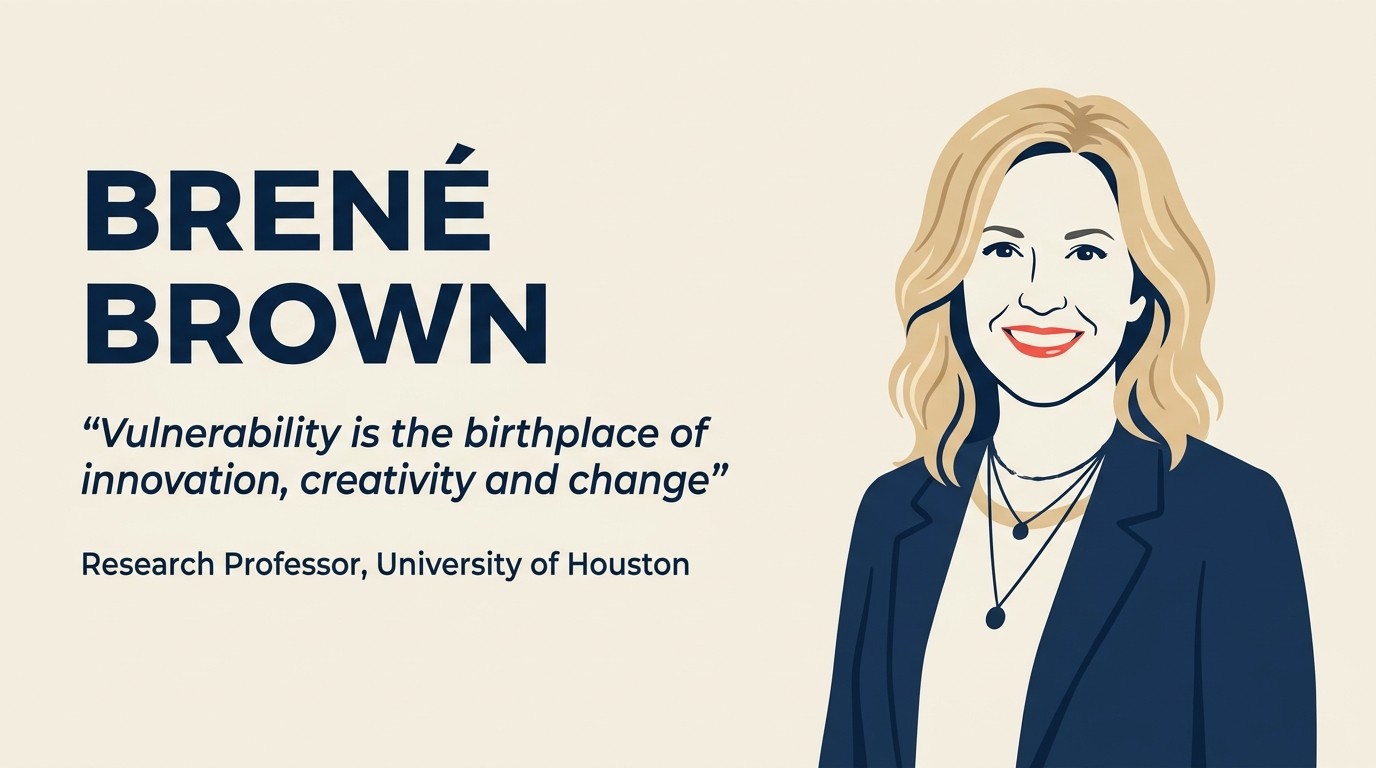
Key Facts: Brené Brown is a research professor at the University of Houston Graduate College of Social Work, where she has spent over two decades studying courage, vulnerability, shame, and empathy. Her 2010 TEDxHouston talk "The Power of Vulnerability" has accumulated more than 60 million views. She is the author of five #1 New York Times bestsellers, including Daring Greatly (2012), Rising Strong (2015), Dare to Lead (2018), and Atlas of the Heart (2021). Her HBO Max (now Max) Netflix special The Call to Courage aired in 2019, and she hosts the podcasts Unlocking Us and Dare to Lead.
The Vulnerability Doctrine (Daring Leadership Model)
Daring leadership is the practice of showing up and being seen without armor when the outcome is uncertain. Brown's doctrine defines vulnerability not as weakness but as the measurable capacity to tolerate uncertainty, risk, and emotional exposure, and argues that this capacity is the precondition for courage, trust, innovation, and change inside organizations. Armored leadership protects the leader; daring leadership protects the work.
In 2010, Brené Brown gave a TED talk on vulnerability that was watched 60 million times and became one of the most-viewed talks in TED history. She's a researcher, not a CEO. She doesn't run a company with 10,000 employees or manage a sales team hitting quarterly numbers. And yet her work shows up more often in executive leadership training than most former Fortune 500 CEOs.
Why? Because she identified something that almost every operator feels but almost none will say out loud: leadership requires you to be seen, and being seen is terrifying.
If you manage people and you've built your professional identity around having the right answers, "Dare to Lead" is a direct challenge to that identity. Brown spent 20 years at the University of Houston Graduate College of Social Work studying shame, vulnerability, and what makes people willing to take risks. Her conclusion is uncomfortable: the leaders who can tolerate uncertainty without armor are the ones who build cultures where people actually do their best work.
That's not a soft insight. It's a structural one about what makes organizations capable of courage.
Leadership Style Breakdown
| Style | Weight | How it showed up |
|---|---|---|
| Vulnerability-Based Leader | 60% | Brown's research consistently found that vulnerability, defined as "uncertainty, risk, and emotional exposure", is not a weakness in leadership. It's the precondition for courage. She modeled this personally: when she gave the 2010 TEDx talk, she described having what she calls a "breakdown" (or "spiritual awakening") after her research forced her to confront the armor she'd built around her own vulnerability. She didn't lead from distance or from credential. She led from the findings of her own life. Her corporate programs teach leaders to distinguish between "armored leadership" (self-protection, perfectionism, using busyness as a shield) and "daring leadership" (rumbling with discomfort, leading with values, building trust through BRAVING). |
| Values-Driven Researcher-Practitioner | 40% | Brown is a social work professor who publishes peer-reviewed research. She has 5 #1 New York Times bestsellers. But her academic credibility and her popular appeal exist in tension. The rigor behind her frameworks is real: she published the data, defended the methodology, built the theory over 6 years of shame research before the TED talk. And then she translated it into certification programs, a Netflix special, and corporate workshops. That translation from research to practice is where most academics fail. Brown's contribution is that she did both without completely sacrificing either. |
The split matters because it defines where Brown is strongest and where she's most vulnerable to criticism. When she's in researcher mode, the frameworks hold up. When she's in popular-content mode, the nuance sometimes gets lost. The best way to use her work is to read the books, not just the summaries.
Key Leadership Traits
| Trait | Rating | What it means in practice |
|---|---|---|
| Courage to expose uncertainty | Exceptional | Brown argues that leaders who pretend certainty they don't have are doing two things simultaneously: undermining their own credibility over time and signaling to their team that uncertainty is a career risk. Daring leadership requires naming what you don't know. Her research found that this is the single hardest behavior change for senior leaders, especially those who built careers in cultures that rewarded decisive confidence. |
| Shame resilience in high-stakes environments | Very High | Brown distinguishes guilt ("I did something wrong") from shame ("I am wrong"). Guilt is useful. Shame is corrosive. Her research shows that leaders who operate from shame, who tie their self-worth to their professional performance, tend to make worse decisions under pressure, respond to failure with blame displacement, and create cultures where people hide mistakes. Shame resilience means being able to receive criticism, acknowledge failure, and continue functioning without complete identity collapse. That's not a nice-to-have. In a high-accountability executive role, it's a survival skill. |
| Values clarity over comfort-seeking | High | Brown's "Dare to Lead" framework includes what she calls "values clarification", identifying the two core values that guide your behavior and testing whether your actual decisions align with them. Most leaders think they're operating from values. Brown's research found that most organizations list 8-12 values and operationalize none of them. Her argument is that you can only live into 2-3 values with any real discipline, and that most leadership failures are misalignment failures between stated values and actual behavior under pressure. |
| Ability to translate research into behavioral practice | High | Brown's Dare to Lead certification program is used by Netflix, Pixar, SAP, NASA, Microsoft, and the US military. Tens of thousands of facilitators have been certified. That's not a research career. That's an organizational change infrastructure. She built it by converting her academic findings into specific behavioral practices: the "rumble" (a commitment to stay in difficult conversations without sidestepping), the BRAVING inventory (a trust model with seven components), and the "rising strong" process for recovering from failure. |
The 3 Decisions That Defined Brené Brown as a Leader
1. Giving the 2010 TEDxHouston Talk on Vulnerability
The 2010 TEDxHouston talk was not a career move. Brown said in subsequent interviews that she almost didn't give it and that the content terrified her precisely because it exposed her own relationship with vulnerability, not just the research findings about other people's.
The talk's argument was simple and counterintuitive: the people who had the greatest sense of love and belonging in Brown's research were not the ones who had engineered their lives to avoid vulnerability. They were the ones who had "the courage to be imperfect," who were willing to be seen without guarantee of outcome. The full talk is available on TED.com and remains one of the most-viewed in TED history.
For a researcher whose professional identity was built on academic rigor and whose personal armor included exactly the patterns she was researching, giving that talk publicly was a direct application of her own framework.
What happened afterward is instructive. The talk reached 60 million views. It became one of the top 5 most-viewed TED talks ever. And it repositioned Brown from regional social work researcher to global leadership figure, not because she changed her work but because she exposed it honestly.
The lesson for operators isn't about TED talks. It's about the relationship between exposure and credibility. Brown's reach came from a specific kind of authenticity, she was talking about her own research and her own struggle with its implications at the same time. That's harder to fake than confidence.
2. Writing "Dare to Lead" as a Direct Management Application
Brown published "Daring Greatly" in 2012 as the first mainstream application of her vulnerability research to organizational life. The title came from Theodore Roosevelt's "Man in the Arena" speech. The core argument: the willingness to be vulnerable is the birthplace of innovation, creativity, and change, and armored leadership shuts all of that down.
But "Daring Greatly" was still primarily a personal development book. "Dare to Lead," published in 2018, made the translation to organizational behavior explicit.
Brown spent two years before writing it interviewing over 150 global executives asking one question: what does it mean, in practice, to be a courageous leader? The answer she heard most consistently was a version of the same thing: courage requires vulnerability. You can't lead people through difficulty if you're not willing to be seen struggling yourself.
The book introduced four "skillsets" of daring leadership: rumbling with vulnerability (staying in difficult conversations without withdrawing), living into your values (operationalizing stated values under pressure), braving trust (a seven-component trust model), and learning to rise (failure recovery as a learnable practice).
The distinction between armored leadership and daring leadership is the book's most useful analytical contribution. Armored leadership uses perfectionism, cynicism, and busyness as protection from discomfort. Daring leadership uses curiosity and direct engagement with discomfort as a leadership tool. Most organizations reward the first and punish the second, which is exactly why Brown's diagnosis lands.
3. Building the Dare to Lead Certification at Scale
The most underrated part of Brown's career is not the research or the books. It's the operational infrastructure she built to scale the work.
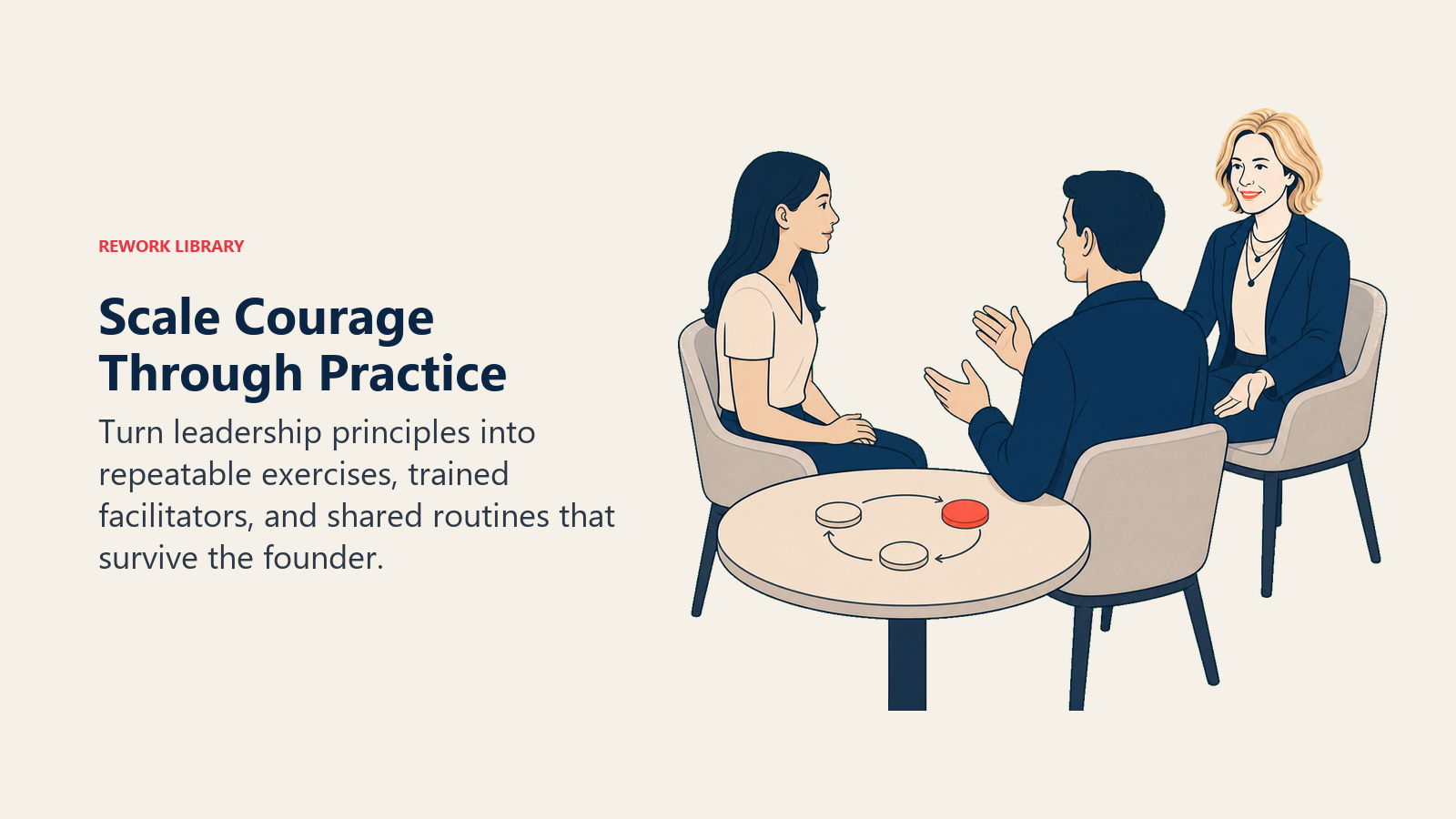
The Dare to Lead certification program trains facilitators to deliver a multi-day leadership workshop to organizational teams. Netflix, Pixar, SAP, NASA, Microsoft, the US military, and hundreds of other organizations have sent teams through it. Tens of thousands of facilitators have been certified globally.
This is not an accident of popularity. Brown made a deliberate decision to build a licensing and training infrastructure rather than simply selling books and keynote appearances. That infrastructure means the methodology can be deployed inside organizations by internal facilitators, with consistency, without Brown having to be in the room.
The 2019 Netflix special "The Call to Courage" was part of the same strategy: reach a broader audience that might never attend a corporate workshop but might encounter the framework for the first time through streaming video. It was one of the first non-performer specials Netflix produced, which signals both the reach of Brown's audience and the platform's bet that her ideas had mass appeal.
For leaders thinking about how to scale an organizational capability, the Dare to Lead model is worth studying not for its content but for its architecture. Brown didn't create dependency on her presence. She built a certifiable, replicable system that can operate without her.
What Brené Brown Would Do in Your Role
If you're a CEO, Brown's most direct challenge to you is about the armor you've built around your own uncertainty. Not whether you admit mistakes publicly (though that matters), but whether you've created a cultural norm where your direct reports can bring you bad news without calculation. Brown's research found that most senior leaders believe they're approachable but their direct reports describe a very different experience. The fix isn't a policy. It's behavioral: when you get bad news, your response in the next 60 seconds sets the cultural temperature for how safe it is to tell you the truth again.
If you're a COO or operations leader, the most applicable Brown framework is values operationalization. You likely have stated values. Brown's question is whether those values are observable in behavior during the moments of highest pressure. That's not a culture initiative. That's a question about whether the values you've written on the wall actually change how you make decisions when the decision is hard. Try the exercise from "Dare to Lead": identify your two core values, then audit your last three high-stakes decisions to test whether those values were actually the deciding factor.
If you're a product leader, Brown's BRAVING trust inventory applies directly to the product trio dynamic. BRAVING stands for Boundaries, Reliability, Accountability, Vault (confidentiality), Integrity, Non-judgment, and Generosity. The teams that do the best discovery work are the ones where PM, designer, and engineer can disagree with each other without the disagreement becoming a trust failure. Most product teams have competence trust and don't have relationship trust. The BRAVING inventory gives you a language for diagnosing which component is missing.
If you're in sales or marketing, the armored leadership pattern most common in high-performance sales cultures is perfectionism masquerading as standards. Brown's research is clear that perfectionism isn't about quality, it's about self-protection. The highest-performing sales leaders she studied were the ones who created environments where reps could talk honestly about what wasn't working without shame. That's not softness. It's information flow. A culture where reps hide objection patterns or quietly discount deals without flagging it is a culture where shame is running the performance system.
Applying Brown's Framework with Rework
Vulnerability-driven leadership gets harder as teams distribute. When directs work from five cities, you lose the hallway cues that tell you whether bad news is safe to share, and armored leadership fills the gap with status reports that hide problems until they're too big to fix. The fix isn't more meetings; it's building infrastructure where the truth can travel quickly and without political cost.
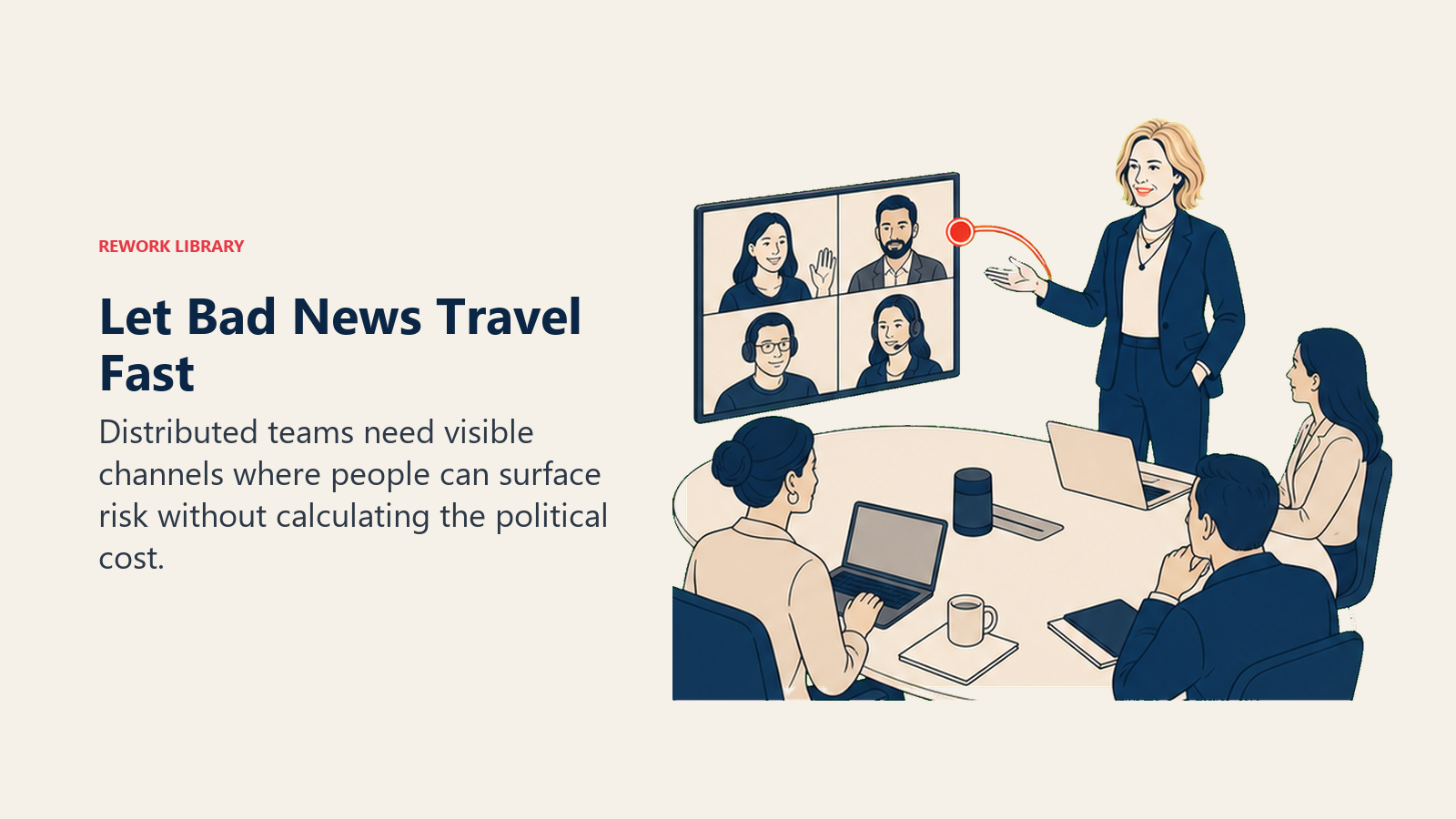
Rework supports psychological safety at scale by making work visible without making it performative. Cross-functional threads in Rework Chat keep rumbling conversations documented and searchable, so a retro insight in engineering is reachable by the product lead who needs it. Task ownership and commitments live in Rework Work Ops, so accountability is tied to the work itself rather than enforced through manager pressure. Shared pipelines in Rework CRM let a rep flag a stuck deal without escalating, because the data tells the story before the shame response kicks in.
Brown's research is clear that safety comes from small, repeated signals, how a leader responds in the first 60 seconds after bad news. Rework gives distributed leaders the surface area to send those signals consistently, from $99/month billed yearly for the Process or Project Engine, or $69/month billed yearly for the Sales Engine, each with 5 seats included.
Notable Quotes and Lessons Beyond the Boardroom
"Vulnerability is not winning or losing; it's having the courage to show up and be seen when we have no control over the outcome." Brown wrote this in "Daring Greatly," and it's a more precise definition than the pop-culture version of vulnerability as emotional openness. What she's describing is specifically the willingness to act without certainty of result, which is the definition of most significant leadership decisions anyway.
Her distinction between "armored leadership" and "daring leadership" is worth applying literally: make a list of the behaviors you use to protect yourself from discomfort at work. Perfectionism, cynicism, numbing, staying busy. Brown's research found that those behaviors don't eliminate discomfort. They eliminate the information you need to lead well. Armor keeps others out, but it also keeps the leader in a closed loop where they can't hear what's actually happening. Kim Scott's radical candor framework is the operational counterweight to this: where Brown names the emotional armor that blocks feedback, Scott gives you the behavioral system for creating it anyway.
"You can't get to courage without going through vulnerability." That's not a motivational statement. It's a causal claim grounded in her data. Brown's research found that courage, which she defines behaviorally as acting despite uncertainty and risk, requires the capacity to tolerate exposure. You can't build that capacity through techniques alone. You build it by repeatedly choosing to engage with discomfort rather than retreat from it.
Where This Style Breaks
Brown's framework works best when senior leadership has already established psychological safety as a cultural norm. In cultures where showing uncertainty is read as weakness, certain high-pressure sales organizations, financial firms, command-and-control environments, vulnerability without cultural infrastructure can accelerate the career risk it's supposed to mitigate.
Her research is also predominantly qualitative. Practitioners applying it in data-heavy organizations sometimes struggle to translate the frameworks into metrics and process. "Rumble with vulnerability" is not a KPI. Adam Grant's organizational psychology work provides the empirical complement here, where Brown builds frameworks from shame research, Grant runs controlled studies on giving, reciprocity, and psychological safety that quantify what Brown describes qualitatively.
And the mass-market translation of her work has a real cost. The version of "be vulnerable" that circulates in corporate hallways often means emotional disclosure at the wrong moment, with the wrong people, in contexts where it backfires. Brown herself addresses the distinction between vulnerability and oversharing, but that nuance doesn't survive the summary. If you're applying her work, read the full books, not the keynote takeaways.
Frequently Asked Questions about Brené Brown's Leadership
Who is Brené Brown?
Brené Brown is a research professor at the University of Houston Graduate College of Social Work who has spent more than two decades studying vulnerability, shame, courage, and empathy. She is the author of five #1 New York Times bestsellers and the creator of the Dare to Lead leadership framework used by Netflix, Pixar, NASA, and the US military.
What does vulnerability mean in leadership?
Brown defines vulnerability as "uncertainty, risk, and emotional exposure", the willingness to show up and be seen when the outcome is not guaranteed. In leadership, this means naming what you don't know, staying in hard conversations without withdrawing, and acting on values under pressure. It is not oversharing, emotional disclosure, or weakness.
What is daring leadership?
Daring leadership is Brown's four-skillset model from Dare to Lead (2018): rumbling with vulnerability, living into your values, braving trust, and learning to rise from failure. It is the opposite of armored leadership, which relies on perfectionism, cynicism, and busyness to protect the leader from discomfort at the cost of information flow and innovation.
What is the difference between shame and guilt per Brown?
Brown distinguishes guilt ("I did something wrong") from shame ("I am wrong"). Guilt is adaptive and motivates change; shame is corrosive and tends to drive blame displacement, hiding mistakes, and poor decisions under pressure. Shame resilience, the capacity to receive criticism without identity collapse, is a core leadership competency in her research.
What are Brené Brown's most important books?
For leaders, the essential sequence is Daring Greatly (2012), which introduced the vulnerability research; Rising Strong (2015), which covers failure recovery; Dare to Lead (2018), the direct organizational application with the BRAVING trust model; and Atlas of the Heart (2021), a mapping of 87 emotions and the language for discussing them at work.
What can CEOs learn from Brené Brown?
The sharpest takeaway for CEOs is that most senior leaders believe they are approachable while their direct reports describe a different experience. Brown's research argues the gap closes through behavior, not policy, specifically how the CEO reacts in the first 60 seconds after receiving bad news. That response sets the cultural temperature for whether people tell the truth the next time.
For related reading on leadership culture and team performance, see Peter Drucker Leadership Style, Patty McCord Leadership Style, Satya Nadella Leadership Style, and Building Psychologically Safe Teams.

On this page
- The Vulnerability Doctrine (Daring Leadership Model)
- Leadership Style Breakdown
- Key Leadership Traits
- The 3 Decisions That Defined Brené Brown as a Leader
- 1. Giving the 2010 TEDxHouston Talk on Vulnerability
- 2. Writing "Dare to Lead" as a Direct Management Application
- 3. Building the Dare to Lead Certification at Scale
- What Brené Brown Would Do in Your Role
- Applying Brown's Framework with Rework
- Notable Quotes and Lessons Beyond the Boardroom
- Where This Style Breaks