John D. Rockefeller's Leadership Style
Turn this article into takeaways for your work.


Each assistant summarizes the article only for you and suggests best practices for your work.
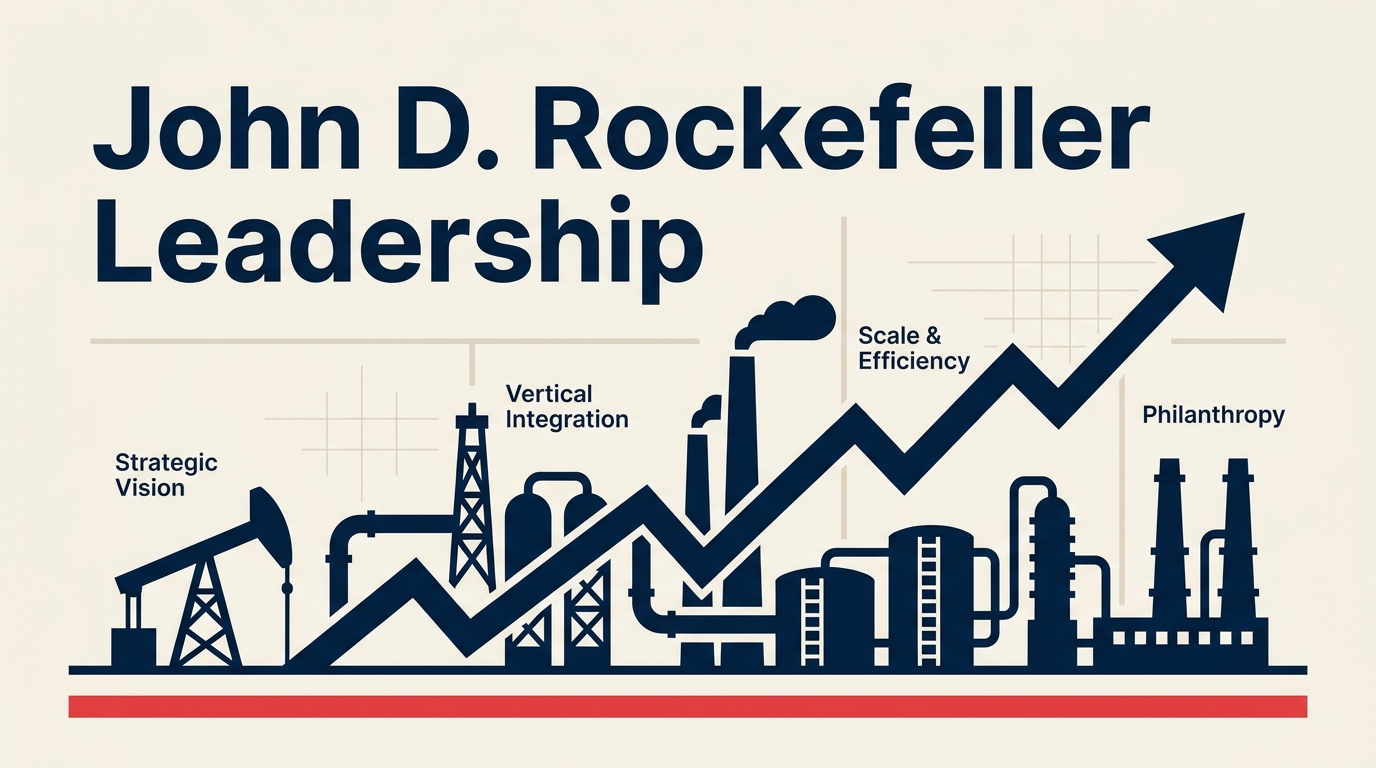
John D. Rockefeller's leadership style built the most dominant industrial company in American history and made him the wealthiest person the modern world had seen. But the real story isn't about personal wealth. It's about how he turned a chaotic, inefficient industry into a tightly engineered machine.
At a time when the oil business was characterized by brutal price swings, wasteful practices, and unreliable supply chains, Rockefeller brought a bookkeeper's precision and a strategist's patience. He didn't lead through inspiration or charisma. He led through systems, numbers, and relentless operational discipline.
Who was John D. Rockefeller?
John Davison Rockefeller (1839-1937) was an American industrialist who co-founded Standard Oil Company in 1870 and built it into the dominant force in US petroleum refining, transportation, and distribution. At its peak, Standard Oil controlled roughly 90 percent of US oil refining capacity and set the effective price of kerosene across the country.
Beyond business, Rockefeller became the single largest philanthropist in American history. He gave away more than half a billion dollars during his lifetime, funding the University of Chicago, the Rockefeller Institute for Medical Research (now Rockefeller University), and the General Education Board. In today's dollars, his peak net worth is estimated to have exceeded $400 billion, making him by most measures the wealthiest private individual in recorded modern history.
Key Facts:
- Standard Oil founded: 1870 in Cleveland, Ohio (Source: Standard Oil Trust corporate records)
- Peak US refining market share: approximately 90 percent by the early 1880s (Source: Ron Chernow, Titan, 1998)
- Antitrust breakup: US Supreme Court ordered Standard Oil's dissolution in May 1911 under the Sherman Antitrust Act (Source: Standard Oil Co. of New Jersey v. United States, 221 U.S. 1)
- Lifetime philanthropy: estimated $530 million given away by his death in 1937 (Source: Rockefeller Archive Center)
John D. Rockefeller's leadership style
Rockefeller led through operational precision, patience, and a willingness to take a long view that most of his competitors couldn't match.
His first instinct in any business situation was to understand the numbers completely. Before making any significant decision about expansion, pricing, or acquisition, he wanted to know the cost structure of every part of the operation. This wasn't bureaucratic caution. It was the foundation of his competitive advantage. When Rockefeller understood that his refineries could produce kerosene at a lower per-barrel cost than anyone else in the industry, he used that gap aggressively to underprice competitors until they sold to him or went out of business.
The approach was systematic rather than opportunistic. He didn't chase the next deal on instinct. He built Standard Oil's dominance through a deliberate sequence: reduce costs, use the savings to undercut rivals, acquire them when they faltered, then integrate their operations into Standard's network and reduce costs again. Each cycle made the machine stronger.
What made this possible was Rockefeller's trust in process over personality. He hired capable managers and gave them real authority. He built reporting systems that gave him visibility into every major operation without requiring him to be physically present everywhere. He was notoriously calm in negotiations, willing to wait out a counterpart far longer than they expected, because he was almost always in the stronger financial position to do so.
He also had a genuine long-term orientation that his contemporaries rarely matched. When his associates pushed for short-term profits, he consistently argued for reinvestment. He spent heavily to build Standard Oil's own pipeline network rather than remain dependent on railroads. He invested in better refining technology. He structured the company to retain earnings rather than pay them out, which gave Standard Oil a capital depth that no competitor could replicate.
Key leadership principles
| Principle | What it meant in practice | Modern takeaway |
|---|---|---|
| Relentless cost discipline | Rockefeller tracked production costs at every refinery and cut anything that didn't justify its expense | Know your unit economics better than your competitors do; cost advantage compounds |
| Consolidate and integrate | Standard Oil owned its pipelines, tank cars, warehouses, and distribution networks | Vertical integration removes leverage points competitors can exploit |
| Reinvest before paying out | Profits went back into the business to fund expansion and technology improvements | Building durable capability usually beats maximizing short-term distributions |
| Measure everything | Rockefeller kept detailed ledgers from his first job as a bookkeeper and never stopped | Decisions made with clear data beat gut-feel decisions in competitive markets |
| Delegate to strong operators | He gave real authority to managers like John Archbold and Henry Flagler and held them accountable for results | Effective delegation multiplies what a leader can build |
The dark side: monopoly and the Standard Oil breakup
Standard Oil's dominance was real, and so were the methods Rockefeller used to build it.
The most damaging documented practice was the use of secret railroad rebates. Standard Oil negotiated preferential freight rates from railroads including the Erie and the New York Central, and in some cases received "drawbacks," payments from the railroads on shipments made by Standard's competitors. This meant that even refiners who were equally efficient on their own production costs couldn't ship oil at the same rate Standard could. The structural advantage was built into the transportation system itself, not just Standard's operations.
Ida Tarbell's investigative series in McClure's Magazine, published between 1902 and 1904 and later collected as The History of the Standard Oil Company, documented these practices in detail using internal Standard Oil documents and interviews with competitors who had been driven out. The reporting became one of the defining examples of investigative journalism in American history, and it directly fueled the antitrust action that followed.
The US Supreme Court ruled in May 1911 that Standard Oil violated the Sherman Antitrust Act and ordered the company broken into 34 separate entities. The successor companies included Standard Oil of New Jersey (which became Exxon), Standard Oil of New York (Mobil), Standard Oil of Indiana (Amoco), and several others that eventually merged into what are now some of the world's largest energy companies.
Rockefeller personally benefited financially from the breakup, since he held shares in all 34 successor companies and their combined value on the open market exceeded Standard Oil's pre-dissolution price. But the legal ruling established a precedent for US antitrust enforcement that shaped regulatory policy for decades.
The harder question for leadership students is where the line fell between extraordinary competitive execution and deliberate market manipulation. Rockefeller maintained throughout his life that Standard Oil's efficiency genuinely benefited consumers through lower kerosene prices, and on that specific point the data largely supports him. But the methods used to eliminate competition went beyond operational excellence into practices that courts ultimately found to be structural coercion.
Lessons for modern leaders
Lesson 1: Build cost advantage as a strategic weapon
Rockefeller didn't compete on marketing or product differentiation. He competed on cost. He drove Standard Oil's per-barrel refining cost so far below the industry average that competitors literally couldn't match his pricing even when they were operating efficiently. For modern leaders, the lesson isn't to replicate his specific methods. It's to understand cost structure deeply enough that you can use it as a deliberate competitive lever, not just a financial reporting exercise.
Lesson 2: Control critical chokepoints in your value chain
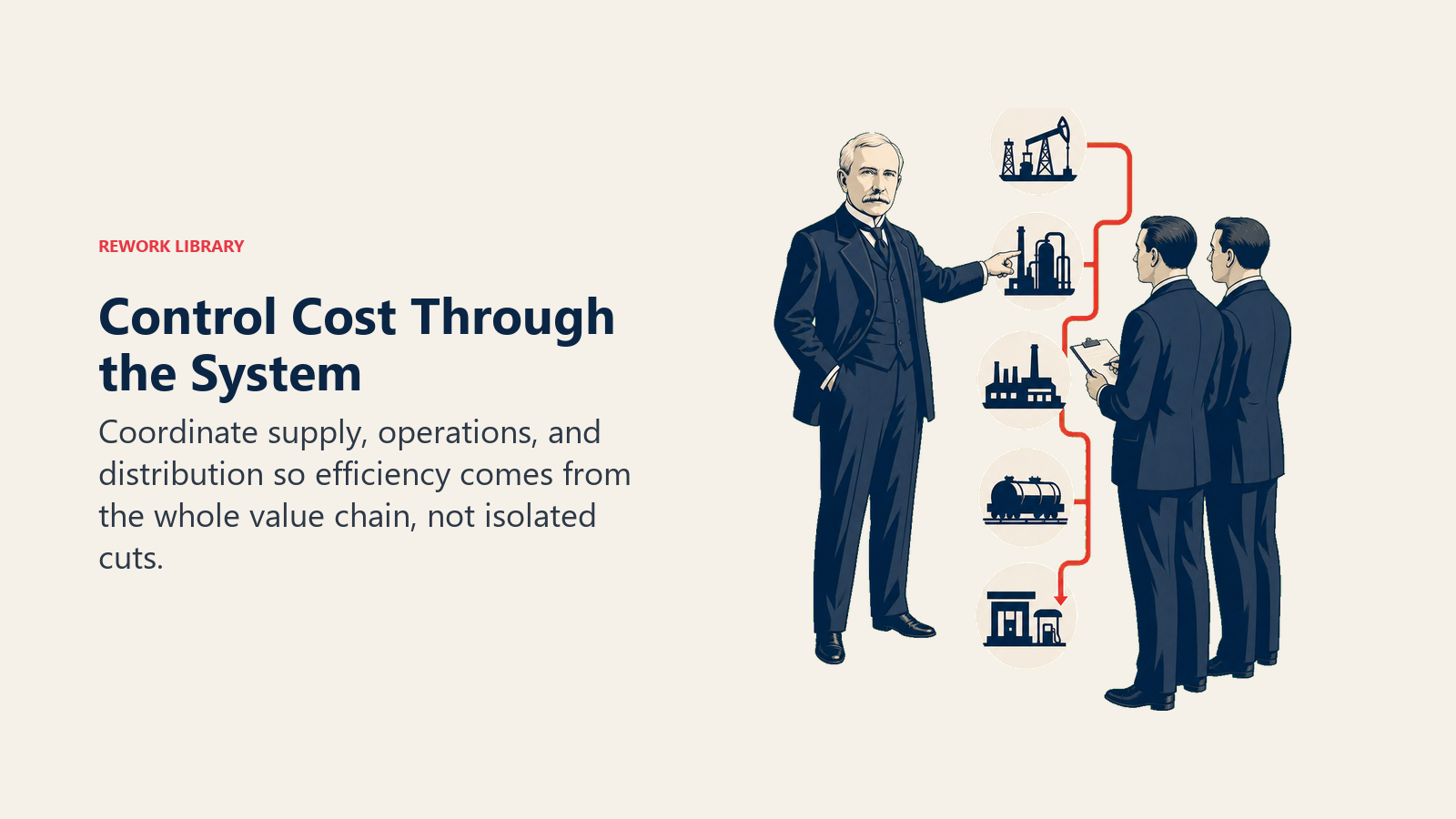
Standard Oil's real power came from owning pipelines, storage, and distribution networks, not just refineries. Once Standard controlled the pipes, every independent refiner was dependent on Standard's infrastructure to get product to market. Leaders building businesses today face analogous decisions about which parts of their value chain are genuinely strategic and which they can safely leave to third parties. Owning a platform others depend on is different from being one of many tenants on someone else's platform.
Lesson 3: Patience is a competitive advantage
Rockefeller was a notoriously patient negotiator. He would sit through silence in a meeting, accept a slower acquisition timeline, and let competitors exhaust themselves financially rather than forcing quick resolutions. This patience was possible because Standard Oil's financial position was almost always stronger than the counterparty's. Building that kind of structural patience, through capital reserves, recurring revenue, or long customer contracts, is what allowed Rockefeller to negotiate from a position that looked effortless but was actually deeply engineered.
Lesson 4: Use philanthropy as genuine stewardship
Rockefeller's giving wasn't branding. He gave away more than half a billion dollars through foundations, universities, and public health initiatives at a time when there was no tax incentive to do so and when his public reputation was actively negative due to the antitrust proceedings. His approach to philanthropy was as systematic as his approach to business: he studied where his capital could have the highest leverage, funded institutions rather than one-off gifts, and insisted on accountability for results. The University of Chicago and the Rockefeller Institute for Medical Research were investments in infrastructure, not image. Modern leaders whose companies have genuine market power should take that seriously.
Lesson 5: Separate what works from what's ethical
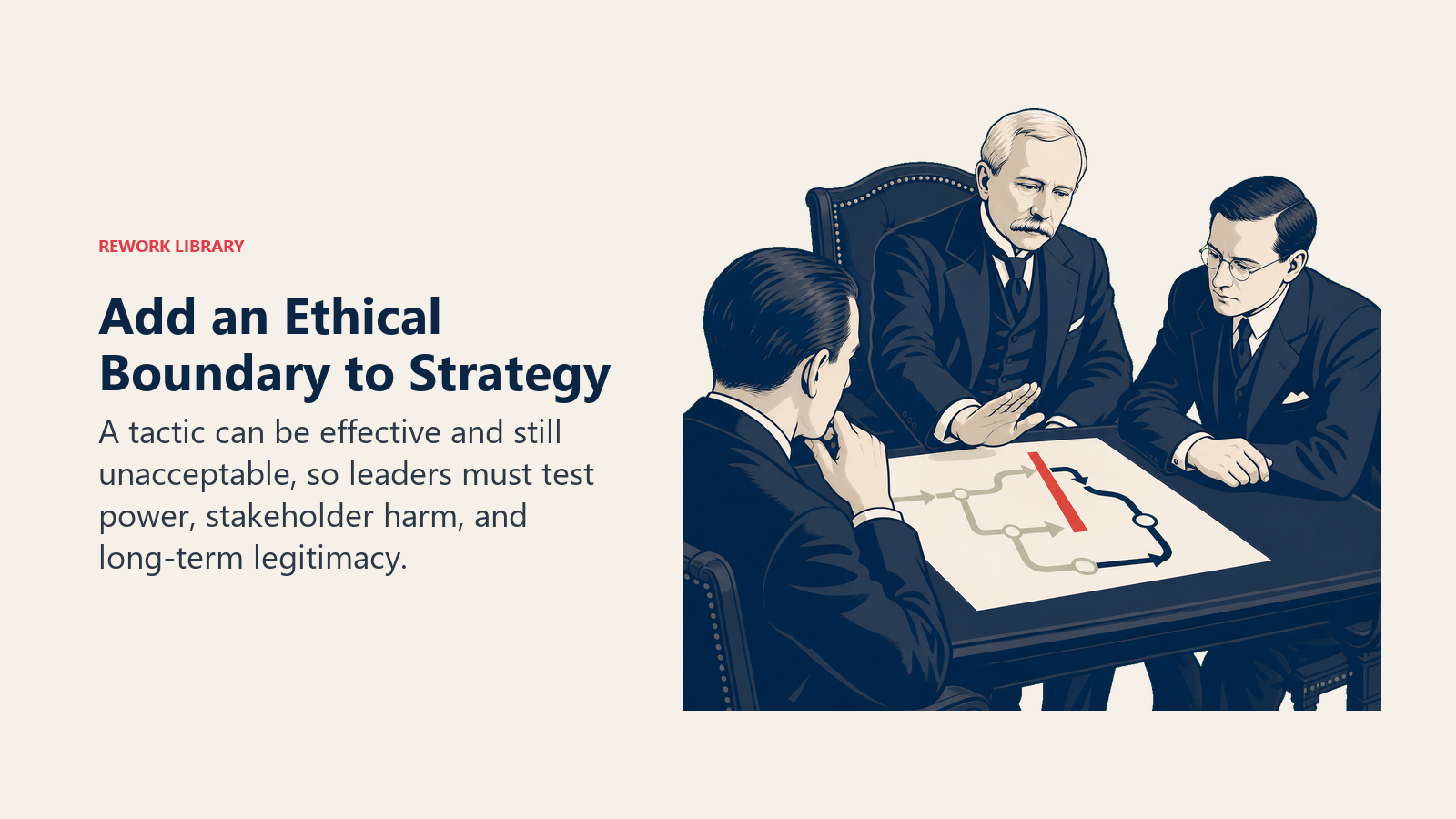
The most useful lesson Rockefeller offers is a cautionary one. Some of what made Standard Oil dominant was operationally brilliant and genuinely created value. And some of it was structural coercion that courts eventually ruled illegal. Leaders studying Rockefeller need to be honest about which is which. The cost discipline, the vertical integration, the long-term reinvestment orientation, the delegation to strong operators: these are transferable leadership practices. The secret railroad rebates and the drawback arrangements were structural market manipulation. Treating the first category as the model and the second as the warning is the right way to engage with his legacy.
Rockefeller vs other industrial-era leaders
| Dimension | John D. Rockefeller | Andrew Carnegie | Henry Ford |
|---|---|---|---|
| Core industry | Oil refining and distribution | Steel production | Automobile manufacturing |
| Competitive approach | Cost dominance + vertical integration + acquisition | Scale + vertical integration + wage competition | Mass production + assembly-line efficiency |
| Leadership style | Systematic, data-driven, patient, indirect | Ambitious, personally driven, socially engaged | Authoritarian, operationally relentless, politically erratic |
| Attitude toward competition | Eliminate or absorb it | Outproduce it | Ignore it |
| Philanthropic legacy | University of Chicago, Rockefeller University, public health | Carnegie libraries, Carnegie Mellon, Carnegie Hall | Limited philanthropic footprint relative to wealth |
| Antitrust outcome | Forced breakup in 1911 | No formal action | No formal action |
Both Rockefeller and Henry Ford led through operational excellence, but Ford's methods were public and visible while Rockefeller's most powerful competitive tools operated largely behind the scenes. Carnegie shared Rockefeller's instinct for vertical integration but was more comfortable with personal public engagement. Where Ford was impulsive and Carnegie was gregarious, Rockefeller was almost invisible. He preferred his operations to speak for him.
Rockefeller's story resists simple conclusions. He was a genuinely brilliant operator who created real economic value by bringing efficiency to a wasteful industry. He was also a monopolist who used methods that courts ultimately found coercive and that destroyed legitimate competition. And he was a philanthropist who gave away wealth at a scale that funded institutions still operating more than a century later. Understanding John D. Rockefeller's leadership means holding all three of those things at once, not selecting the one that fits the story you want to tell. That tension, between competitive brilliance and ethical overreach, is where the most useful lessons live.

On this page
- Who was John D. Rockefeller?
- John D. Rockefeller's leadership style
- Key leadership principles
- The dark side: monopoly and the Standard Oil breakup
- Lessons for modern leaders
- Lesson 1: Build cost advantage as a strategic weapon
- Lesson 2: Control critical chokepoints in your value chain
- Lesson 3: Patience is a competitive advantage
- Lesson 4: Use philanthropy as genuine stewardship
- Lesson 5: Separate what works from what's ethical
- Rockefeller vs other industrial-era leaders