Laszlo Bock Leadership Style: Data-Driven People Ops, Hiring Science, and What Google Learned from 50,000 Employees
Turn this article into takeaways for your work.


Each assistant summarizes the article only for you and suggests best practices for your work.
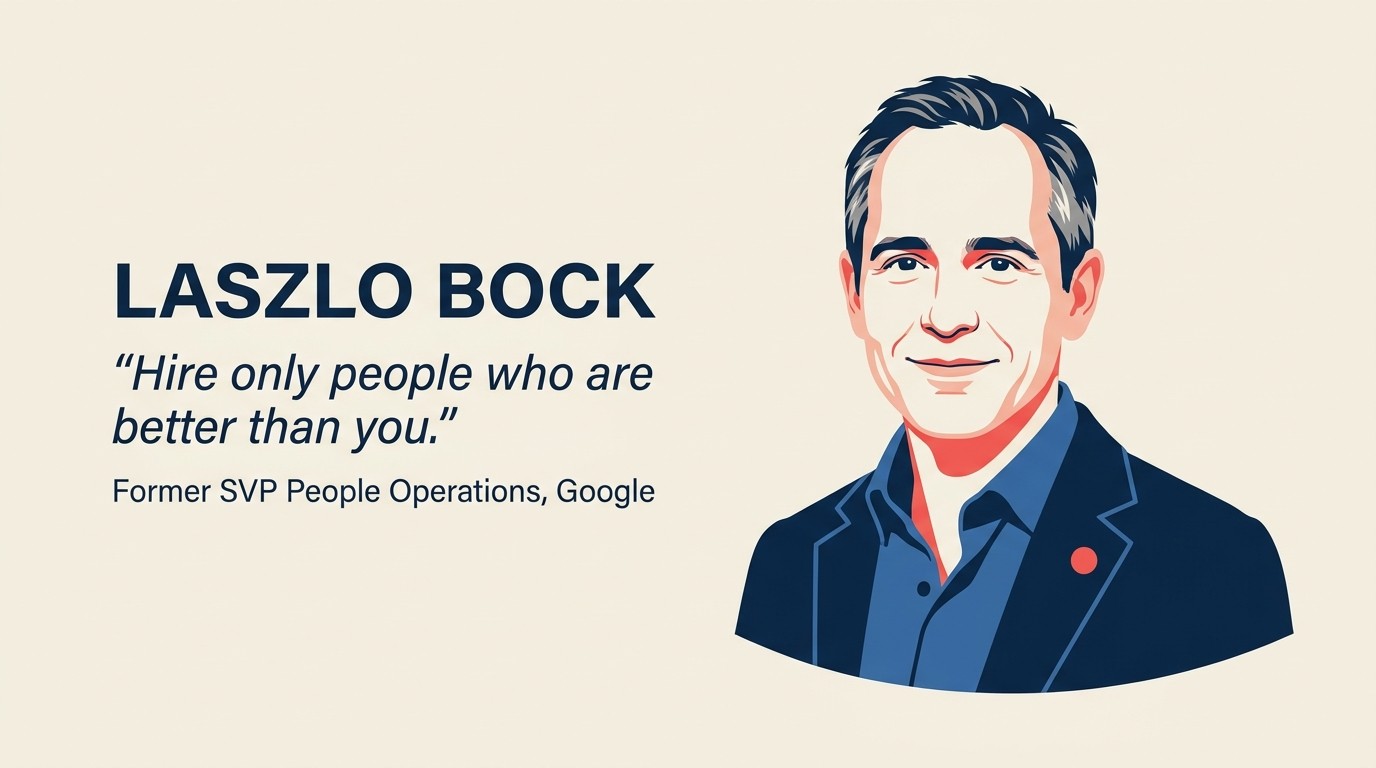
When Laszlo Bock joined Google in 2006, the company had roughly 6,000 employees and a culture running on founder instinct. When he left in 2016, it had grown past 60,000, and Google had spent a decade running controlled experiments on what makes teams effective, what interview questions actually predict performance, and whether managers matter at all. His era overlapped directly with Sundar Pichai as the Google CEO who scaled that culture forward. On the people-ops frontier, Patty McCord ran a parallel experiment at Netflix, while Adam Grant at Wharton gave the underlying org-psych research its practitioner framing, and Kim Scott took manager frameworks from Google directly into Apple University.
Most companies ask those questions at a gut level. Google built statistical models. Bock was the person running those models.
His 10-year tenure as SVP of People Operations produced Project Oxygen (what makes a good manager), Project Aristotle (what makes a team effective), a wholesale rejection of brain-teaser interview questions, and a set of hiring practices now used across thousands of companies. "Work Rules!", his 2015 book summarizing what Google learned, is one of the most data-dense management books published in the past decade.
If your hiring process still relies on gut feel and "culture fit," and your management philosophy hasn't been stress-tested against data, it's the most direct challenge to how you're building your team.
Key Facts: Laszlo Bock
- Role at Google: SVP of People Operations, 2006-2016, oversaw headcount growth from ~6,000 to 60,000 employees (10x).
- Signature research: Project Oxygen (8 manager behaviors) and Project Aristotle (psychological safety as top team-performance predictor).
- re:Work program: Launched Google's public-facing People Ops platform (rework.withgoogle.com) publishing internal research, templates, and guides for HR practitioners worldwide.
- Book: Work Rules! Insights from Inside Google That Will Transform How You Live and Lead (2015), New York Times bestseller, translated into 20+ languages.
- Founded Humu (2017): People ops AI company built on "nudge engine" behavioral science; acquired by Perceptyx in 2023.
- Education: Yale MBA; previously at McKinsey and General Electric before Google.
The Bock Nudge Model
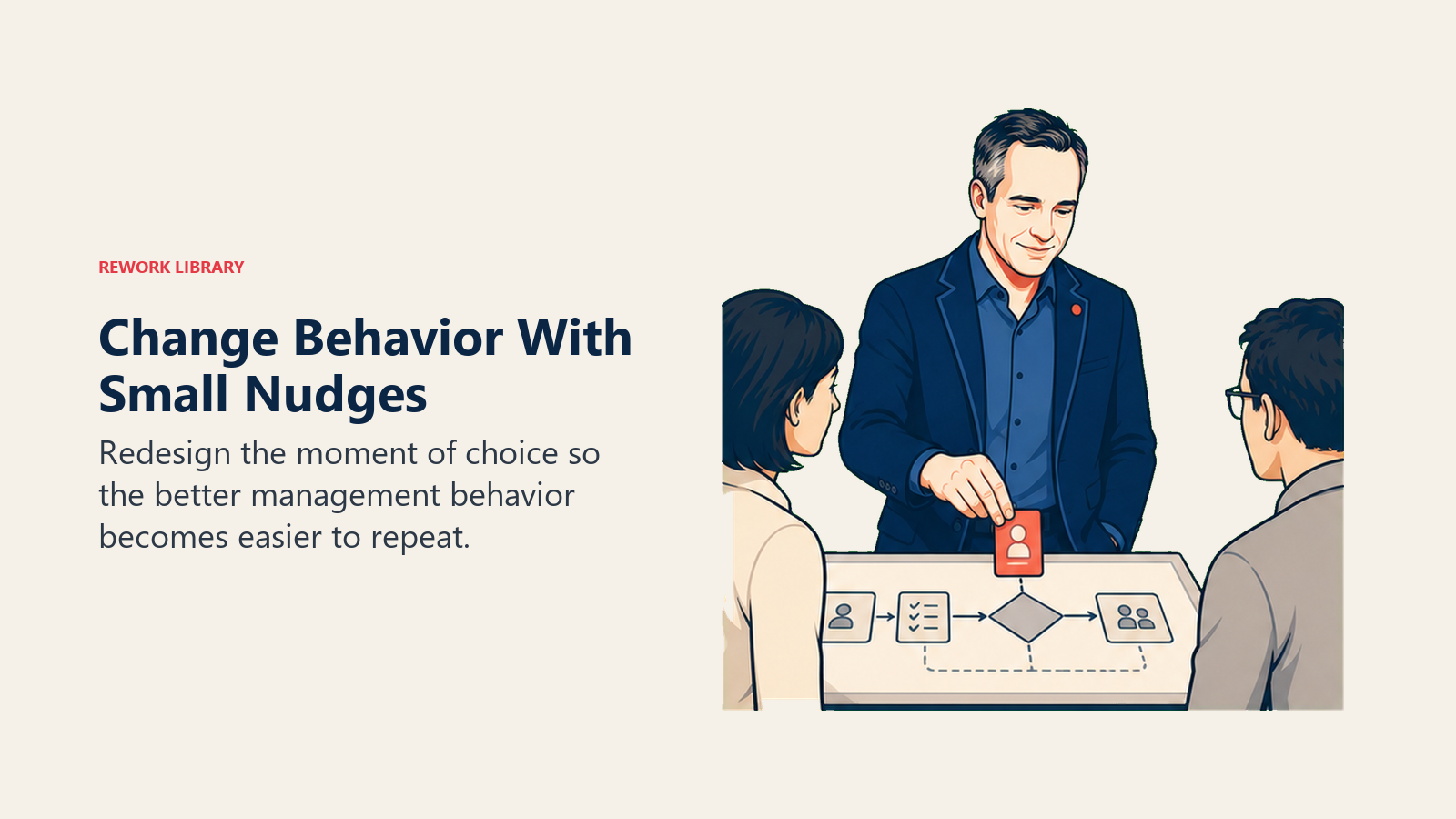
The Bock Nudge Model is a data-driven people operations doctrine that replaces HR intuition with controlled experiments and small, specific behavioral prompts. It argues that manager and team performance improve faster through one timed, actionable nudge at a decision moment than through policy changes, values statements, or training programs. Organizations adopt it by measuring what actually predicts performance, publishing the findings internally, and acting on the results even when they contradict received management wisdom.
Leadership Style Breakdown
| Style | Weight | How it showed up |
|---|---|---|
| Evidence-Based People Designer | 65% | Bock's signature contribution was applying experimental rigor to questions that HR had previously answered with intuition. He ran randomized controlled experiments on interview formats, studied manager behavior across tens of thousands of performance reviews, and published the findings internally, then acted on them even when they contradicted received wisdom. When the data showed brain-teaser questions had near-zero correlation with job performance, Google stopped asking them. When Project Oxygen revealed that managers' technical brilliance ranked eighth out of eight effective behaviors, Google restructured its management development curriculum accordingly. The evidence drove the decisions. |
| Servant-to-Scale Leader | 35% | Bock consistently framed his role as building systems that made 60,000 people more effective, not as managing HR as a function. He pushed authority for people decisions as far down the organization as the data suggested was safe. His argument in "Work Rules!" is that managers should have less power over individual career outcomes (hiring, firing, performance rating) than most companies give them, because individual manager judgment is too variable and too unaccountable. Structurally, he was building an organization that ran well with less management intervention, not one that depended on more of it. |
The 65/35 split reflects Bock's method: most people operations leaders use data to report on what's happening (attrition rates, engagement scores, time-to-fill). Bock used data to test whether current practices were actually working and to redesign them when they weren't. The servant-to-scale piece is the operational translation of that: you build systems that amplify the judgment of people who are doing the work, rather than systems that centralize judgment in HR or management. That's a harder architecture to build than a dashboard, but it scales in ways that dashboards don't.
Key Leadership Traits
| Trait | Rating | What it means in practice |
|---|---|---|
| Statistical rigor in people decisions | Exceptional | Bock's team analyzed over 10,000 observations of manager behavior to produce Project Oxygen's eight behaviors. They didn't survey employees about what they liked in a manager. They correlated specific observable manager behaviors with team performance, employee retention, and satisfaction scores. The distinction matters: survey-based research tells you what people prefer. Behavioral analysis tells you what actually predicts outcomes. Bock was running the latter, which is harder and more useful. |
| Intellectual humility about received HR wisdom | Very High | Google had been using brain-teaser questions in interviews for years when Bock commissioned the analysis that showed they predicted nothing. Changing a practice that Googlers associated with their culture required Bock to be publicly willing to say the practice was wrong, not "less optimal," but actually wrong and worth removing. He's done the same with GPA requirements (dropped for most roles after finding no correlation with performance past the first two years) and with the "brilliant jerk" tolerance that early Google culture had quietly normalized. |
| Commitment to transparency | High | Bock published Google's People Ops research internally and then externally through "Work Rules!" He didn't treat the findings as competitive advantage. He treated them as contributions to how companies in general should hire and manage people. That transparency built credibility with Google employees (who could see the data behind policies affecting them) and with the broader HR community. It also created accountability: once you've published that brain-teaser questions don't work, you can't quietly bring them back. |
| Ability to operationalize values at scale | High | Google's stated value of "don't be evil" is easy to say and hard to enforce across 60,000 people in 50 countries. Bock's contribution wasn't to articulate values more clearly, it was to build processes that made them observable and measurable. Structured interviews with standardized scoring rubrics make hiring decisions auditable. Calibration sessions for performance ratings make scoring variance visible. He built an organization where values showed up in process design, not just in posters. |
The 3 Decisions That Defined Laszlo Bock as a Leader
1. Killing GPA and Brain-Teaser Interview Questions at Google
When Google was small, its interview process was famous for questions like "How many golf balls fit in a school bus?" or "How would you move Mount Fuji?" The logic was that these questions tested analytical thinking under pressure. They were also fun to ask and easy to evaluate as "good" or "bad" at Google's own standards.
Bock commissioned an analysis of whether these questions predicted anything. The answer was no. Brain-teaser performance had essentially zero correlation with job performance at Google. The questions were testing something, comfort with lateral thinking exercises, willingness to perform under observation, familiarity with the interview genre, but not the skills that determined whether someone would be effective in the role.
The same analysis ran on GPA. For most roles, GPA predicted job performance for the first two years and then stopped predicting anything. For technical roles where academic excellence correlated with specific skill requirements, it retained some signal. For most of the rest of Google's jobs, it was filtering out candidates who had built their careers through unconventional paths, which is exactly the kind of candidate that tends to bring in new perspectives.
Google's replacement was structured behavioral interviews with standardized scoring rubrics. Instead of asking "how many piano tuners are there in Chicago," interviewers were trained to ask specific questions about past behavior: "Tell me about a time you had to make a decision with incomplete data." The answer was evaluated against a rubric that everyone interviewing for the role used consistently, so that a candidate's assessment didn't depend on which interviewer they happened to get.
The hiring committee structure added another layer: no individual manager could hire or veto a candidate unilaterally. Hiring decisions required a committee review, which reduced the bias that individual interviewers bring to decisions they make alone. It slowed the hiring process. It also made it significantly more consistent.
For you: the brain-teaser question trap is still very common. The question "how many golf balls fit in a school bus" tells you whether someone has practiced that kind of question. If your interview process includes any question that you'd describe as "seeing how they think," ask yourself how you're scoring it, who else is seeing the answer, and what your data says about whether it predicts performance. If you don't have data, you're doing what Google was doing before Bock ran the analysis.
2. Project Oxygen: What Google's Managers Actually Did Well
In 2008, Google's People Analytics team ran an internal study trying to answer a question that the engineering culture had raised before: do managers at Google actually matter? The engineering ethos at early Google was that brilliant individual contributors didn't need managers, they needed to be left alone. The implied thesis was that management was overhead.
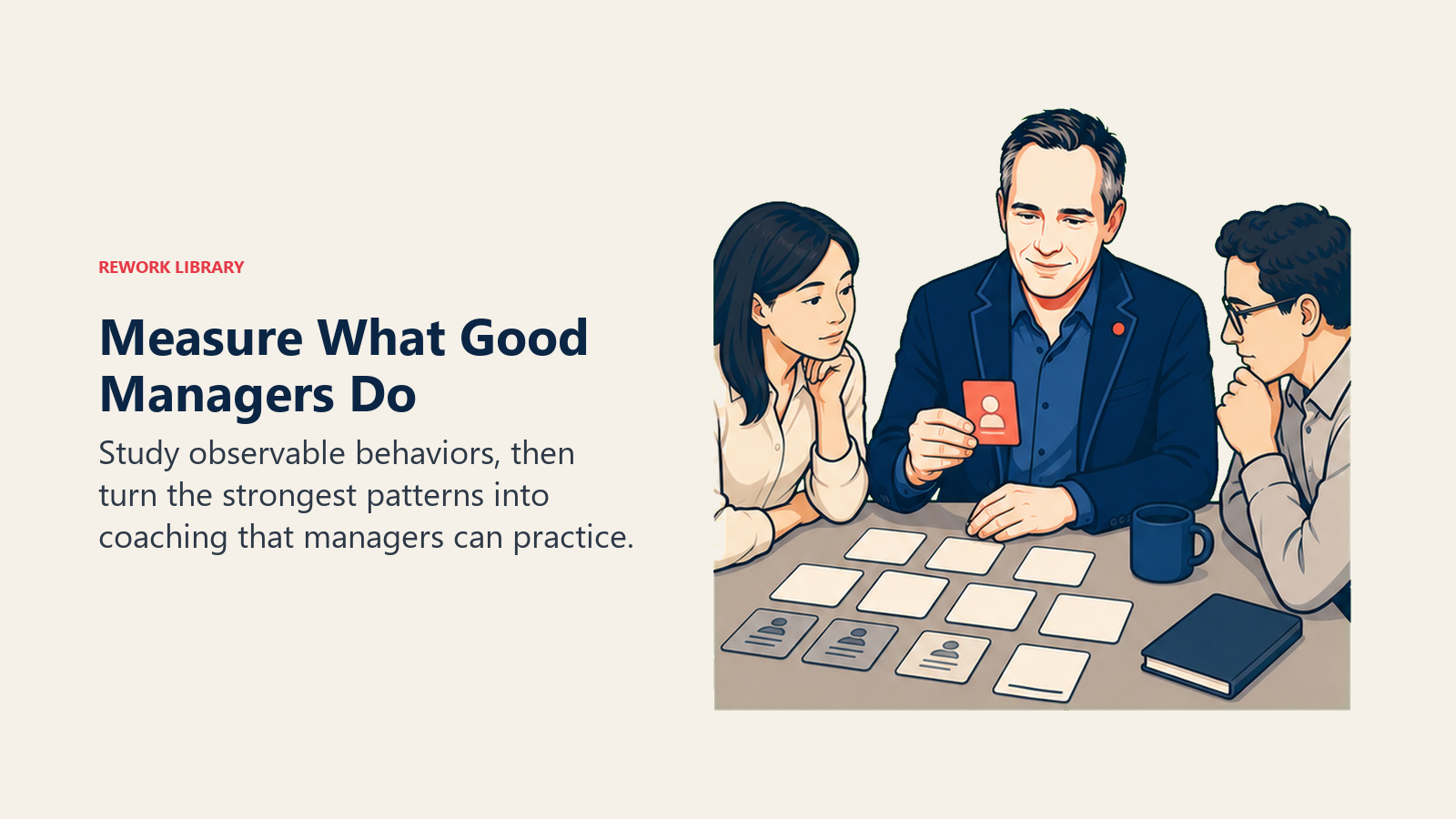
Project Oxygen tested that thesis. The team analyzed over 10,000 observations of manager behavior, correlated those behaviors with team performance data, employee satisfaction scores, and retention rates, and identified the eight behaviors that most strongly predicted high team performance.
The number-one behavior wasn't technical brilliance. It wasn't strategic vision or decisive leadership. It was "be a good coach." The ranking looked like this: be a good coach, empower the team and don't micromanage, create an inclusive team environment showing concern for success and wellbeing, be productive and results-oriented, be a good communicator and listen to the team, support career development and discuss performance, have a clear vision and strategy, and, eighth, have key technical skills so you can advise the team.
Google published this internally and used it to redesign management training. But the more important outcome was behavioral: managers who scored poorly on the coaching dimension were coached on it specifically. Performance discussions incorporated the Project Oxygen framework. Promotion decisions for managers were evaluated against it.
The research didn't show that technical skills don't matter. It showed that for people already hired into Google's engineering-heavy culture, technical skills were table stakes, everyone had them. The differentiating variable for manager effectiveness was the relationship and coaching skills that the engineering culture had spent a decade treating as soft.
For you: Project Oxygen's number-one finding is actionable without any data infrastructure. If you're evaluating the managers who report to you, or if you're assessing your own management effectiveness, the eight behaviors give you a specific rubric. The coaching dimension is the most commonly underdeveloped. Ask yourself: when was the last time you gave a direct report feedback that changed what they worked on or how they worked? If you can't name a specific instance in the last 30 days, you're probably scoring low on the dimension that matters most.
3. Leaving Google to Found Humu
When Bock left Google in 2016, he could have gone to any number of established technology companies or venture funds. Instead, he co-founded Humu with Wayne Crosby and Jessie Wisdom, two former Google People Analytics researchers. The company's core product was a "nudge engine": a platform that sent weekly behavioral science-based prompts to managers and employees, calibrated to their specific context and goals.
The theory behind Humu was specific: most behavior change at work fails because it asks people to change in too many ways at once, or because the change required is too abstract (be a better coach, be more inclusive) without specifics about what to do in the next week. The nudge engine was designed to send one actionable prompt at a time, timed to when it would be most relevant, based on what the platform knew about the employee's role and recent activities.
Humu raised significant funding, worked with clients including Sweetgreen and several major tech companies, and was acquired by Perceptyx in 2023 rather than achieving a standalone exit. That outcome is worth reading honestly. The product was genuinely innovative and the theory of behavior change was sound. But nudge-based platforms face a distribution problem: they require enterprise HR buyers to believe that small behavioral prompts will produce measurable business outcomes, and that's a hard sell in a budget environment where HR technology spending is often justified by headcount reduction or compliance, not by coaching improvements.
What Humu's outcome reveals about Bock's leadership model: he was willing to bet that the research insights from Google's People Analytics team could be productized at scale. That bet was correct in that the product worked. The market timing and go-to-market model were harder than the technology. As a leadership case study, it's honest about the gap between knowing what changes behavior in an organization (Bock's research background) and building a business around that knowledge.
For you: the nudge engine concept is available to you without Humu's platform. The core insight is that behavior change at work happens one specific action at a time, not through policy changes or training programs. If you want your managers to be better coaches, the most effective intervention isn't a workshop, it's a prompt during a specific situation where coaching is needed, with a specific suggested action. You can do that in a 1:1 agenda, a team meeting structure, or a Slack message at the right moment. The infrastructure matters less than the specificity.
What Laszlo Bock Would Do in Your Role
If you're a CEO, Bock's most applicable insight is about the cost of your hiring process relative to its predictive accuracy. Most CEOs evaluate their hiring by outcome (did we make a good hire?) rather than by process (does our interview process actually predict good hires?). Those aren't the same question. Bock would push you to audit the correlation between how candidates perform in your interview process and how they perform in the first 18 months. If there's no data, you can't answer the question. If there's data and the correlation is weak, you have an expensive problem that's creating your talent issues downstream.
If you're a COO or operations leader, Project Oxygen's emphasis on "don't micromanage" has a specific operational meaning. Bock found that managers who over-supervised their teams produced lower performance and higher attrition, even when the micromanagement was technically competent. The COO translation: the processes you build should give teams clear goals and clear feedback mechanisms, not prescribe how work gets done. If your ops infrastructure spends more time monitoring activity than measuring outcomes, you're building a micromanagement system that the Project Oxygen data says will underperform.
If you're a product leader, Project Aristotle's psychological safety finding is directly applicable to how you run product development. Google's team effectiveness research found that psychological safety, whether team members felt safe to take interpersonal risks, was the most important predictor of team performance, above team composition, individual skills, or structure. For a product team, psychological safety shows up in one specific place: whether engineers feel safe telling product managers when a requirement is wrong. If they don't, you'll ship the wrong product on time. Bock would build that safety before building the roadmap.
If you're in sales or marketing, Bock's structured interview research has a direct application to how you hire salespeople. Most sales hiring over-indexes on energy, communication style, and performance in unstructured conversation, which is exactly what a good interview candidate is trained to deliver. Bock would push you to design a structured interview process for sales roles with specific, standardized questions about past sales behaviors, evaluated against a consistent rubric. It feels slower. It produces significantly better predictive accuracy.
Running Bock's Playbook Without Google's Data Infrastructure
Evidence-based people operations sounds prohibitive, most companies don't have 10,000 manager observations to correlate with performance data. They don't need them. What they need is visibility across hiring, onboarding, 1:1s, and cross-team handoffs so the HR team can see which behaviors correlate with outcomes in their own context. Rework gives People Ops leaders that horizontal view: hiring pipelines, new-hire ramp status, manager 1:1 cadence, and cross-team project ownership all live in one workspace, so HR isn't reconstructing the evidence from five tools. When a sales team's attrition spikes, you can see whether the manager has been running 1:1s, whether onboarding tasks were completed, and whether the structured interview rubric was used, in minutes, not a six-week audit. That's Bock's doctrine made operationally practical at companies that don't have a People Analytics team of 60.
Notable Quotes and Lessons Beyond the Boardroom
Bock's most useful published quote is from "Work Rules!": "Most hiring is a waste of everyone's time." He's describing the average interview process, not his own. The argument is that unstructured interviews, where the interviewer asks whatever questions come to mind, add almost no predictive value over chance. You'd do nearly as well flipping a coin. Given how much time organizations spend on hiring and how much is at stake in each hire, that's a costly inefficiency that most companies have accepted as normal.
On Project Aristotle's findings, Bock has been consistent: "The teams that work best are the ones where people feel safe enough to say I don't know, I made a mistake, I disagree." He's paraphrasing Amy Edmondson's psychological safety research, which Google's team validated at scale. The finding matters because most managers think psychological safety means being nice. It doesn't. It means creating conditions where people bring problems to the surface early, before they become expensive. That's a performance outcome, not a culture preference.
The less-quoted Bock insight concerns the limits of data-driven HR in organizations that don't actually want to hear what the data says. He's been candid about this post-Google: the data-first approach to people operations works when organizational leadership is willing to act on findings that challenge current behavior. At Google, leadership was willing. Bock has noted that many companies he's spoken with since 2016 want the data collection without the accountability it creates. That's a more honest description of why data-driven HR often stalls than most consultants will give you.
Where This Style Breaks
Bock's approach requires two things most growing companies don't have: enough data to draw statistical conclusions, and enough organizational will to act on findings that contradict what leadership already believes. Project Oxygen worked at Google because Sundar Pichai and Eric Schmidt were willing to be told by data that technical brilliance was the eighth most important management behavior. At companies where leadership believes it knows how people should be managed and treats data as confirmation rather than investigation, data-driven people ops becomes a very expensive opinion-collection exercise.
The scale dependency is also real. Bock's studies required tens of thousands of data points to produce actionable findings. At a 200-person company, you don't have enough managers to run a statistically valid Project Oxygen equivalent. You can apply the conclusions from Google's research without replicating the research, but you need to be honest about the difference between applying someone else's findings and generating your own. Humu's acquisition without a standalone exit is worth remembering as a reminder that the research insight doesn't automatically translate to a scalable product or process.
Frequently Asked Questions about Laszlo Bock's People Operations
Who is Laszlo Bock?
Laszlo Bock is the former SVP of People Operations at Google (2006-2016), where he oversaw the company's growth from roughly 6,000 to 60,000 employees. He later co-founded Humu, a people ops AI company acquired by Perceptyx in 2023, and is the author of the 2015 bestseller Work Rules!.
What is 'Work Rules!' about?
Published in 2015, Work Rules! Insights from Inside Google That Will Transform How You Live and Lead distills what Google's People Analytics team learned from a decade of controlled experiments on hiring, management, and team effectiveness. It's one of the most data-dense management books of the past decade and a New York Times bestseller.
How did Bock build Google's data-driven HR?
Bock's team replaced HR intuition with experimental rigor, running randomized analyses on interview formats, correlating manager behaviors with team performance across tens of thousands of observations, and redesigning hiring and management practices based on the findings. Brain-teaser interview questions were dropped after analysis showed zero correlation with job performance.
What is the re:Work program?
re:Work (rework.withgoogle.com) is Google's public-facing People Ops platform that Bock's team launched to share internal research, guides, and templates with HR practitioners worldwide. It made the findings from Project Oxygen, Project Aristotle, and Google's structured hiring methodology freely available outside Google.
What is Humu and Bock's role?
Humu was a people ops company Bock co-founded in 2017 with former Google People Analytics researchers Wayne Crosby and Jessie Wisdom. Its "nudge engine" sent weekly behavioral-science-based prompts to managers and employees. Humu worked with clients including Sweetgreen and was acquired by Perceptyx in 2023.
What can HR leaders learn from Laszlo Bock?
Three practical lessons: audit whether your hiring process actually predicts performance (most don't), rank manager effectiveness by coaching behavior rather than technical brilliance (Project Oxygen's finding), and build psychological safety as a performance outcome rather than a culture preference (Project Aristotle's finding). Each is actionable without Google-scale data infrastructure.
Learn More
- Patty McCord Leadership Style: High-Performance Teams, Radical Honesty, and the Culture Deck That Changed HR
- Adam Grant Leadership Style: Givers, Rethinking, and the Organizational Psychology of Getting Work Done
- Reed Hastings Leadership Style: No Rules, Three Pivots, and a Culture Deck That Changed Management

On this page
- Key Facts: Laszlo Bock
- The Bock Nudge Model
- Leadership Style Breakdown
- Key Leadership Traits
- The 3 Decisions That Defined Laszlo Bock as a Leader
- 1. Killing GPA and Brain-Teaser Interview Questions at Google
- 2. Project Oxygen: What Google's Managers Actually Did Well
- 3. Leaving Google to Found Humu
- What Laszlo Bock Would Do in Your Role
- Running Bock's Playbook Without Google's Data Infrastructure
- Notable Quotes and Lessons Beyond the Boardroom
- Where This Style Breaks
- Learn More