Sam Walton's Leadership Style at Walmart
Turn this article into takeaways for your work.


Each assistant summarizes the article only for you and suggests best practices for your work.
Sam Walton's leadership style turned a single dime store in Rogers, Arkansas into the largest retailer on the planet. His approach wasn't complicated, but it was consistent: give people low prices, respect the associates who make that possible, and never spend a dollar you don't have to.
Most leaders who build at that scale get accused of ruthlessness. Walton's story is different. He drove a beat-up pickup truck, flew coach, and split motel rooms with his buyers on buying trips. He knew the names of store managers he hadn't seen in years. When people describe him as a servant leader, they aren't reaching for flattery. It's an accurate read of how he actually ran the company.
Key Facts
- Walmart's first store opened in Rogers, Arkansas in 1962 (Walmart, corporate history)
- Sam's Club, Walton's members-only warehouse retail brand, launched in 1983 (Sam's Club, founding records)
- Walton published his memoir "Made in America" in 1992, the year he died (Simon & Schuster, 1992)
Who was Sam Walton?
Sam Walton (1918-1992) was an American retailer who founded both Walmart and Sam's Club. Born in Kingfisher, Oklahoma, he got his start in retail at a JCPenney store and later ran Ben Franklin franchise stores in Newport and Bentonville, Arkansas. When his landlord refused to renew his Newport lease after seeing how successful the store had become, Walton moved to Bentonville and opened his own store from scratch. He was 44.
What he'd learned from the franchise years was that smaller towns were being ignored. Big department stores clustered around cities. Rural customers paid whatever local merchants charged because they had no alternative. Walton saw that gap and built an entire business model around closing it. Low prices in places where low prices didn't exist yet. That insight drove every strategic decision Walmart made in its first two decades.
He grew the company through a combination of obsessive cost control, early investment in logistics technology, and a genuine belief that the people stocking shelves had ideas worth listening to. By the time he died in April 1992, Walmart was the largest retailer in the United States. He'd also become the wealthiest person in America, though almost none of his colleagues would have guessed it from the way he behaved.
Sam Walton's leadership style
Walton's approach was a blend of servant leadership and participative leadership, with a layer of radical frugality that ran through everything. He didn't see himself as sitting above the organization. He saw himself as working for two groups: the associates who ran the stores and the customers those associates served.
Servant leadership, at its core, means treating the people you manage as the primary beneficiaries of your leadership rather than the other way around. Walton put it directly in "Made in America": if you take care of your associates, they'll take care of your customers. He shared profits with hourly workers through a profit-sharing plan introduced in 1971, years before it was a standard retail practice. He visited stores constantly, not to inspect and criticize but to ask questions and collect ideas.
The participative piece showed up in what became known as management-by-walking-around. Walton flew his own plane to visit hundreds of Walmart stores every year. He'd walk the floor, talk to department managers, ask what was selling and what wasn't, write down names. He credited store-level associates with some of Walmart's best merchandising ideas. And he meant it. When a greeter at a Walmart in Louisiana told him that having someone say hello at the door reduced shoplifting and made customers feel welcome, Walton rolled the concept out across the entire chain.
Frugality was the third pillar, and it was non-negotiable. He believed that every dollar saved in operations was a dollar that could be passed to the customer as a lower price. He negotiated hard with suppliers, cut overhead relentlessly, and modeled the behavior himself. His pickup truck became a symbol. So did his haircuts. He got them for a few dollars from a local barber rather than spending company money on anything that looked like executive luxury.
Key leadership principles
Walton's "Ten Rules for Building a Business," laid out in his memoir, distill his philosophy into practical guidance. Several show up consistently in how Walmart actually operated:
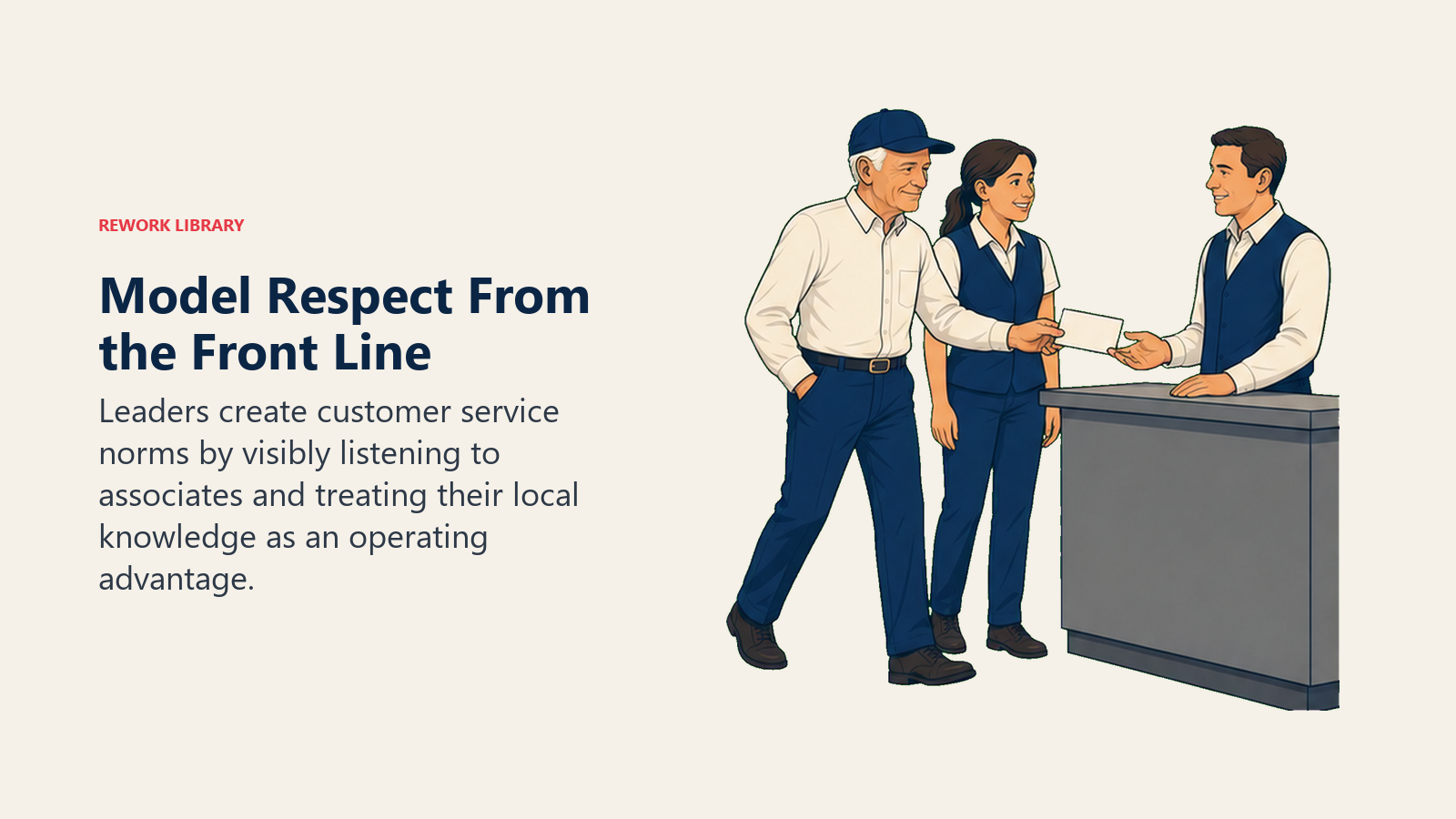
Serve the associates, and they serve the customer. Walton believed happy, respected employees created better customer experiences. Profit-sharing, open communication, and treating store workers as partners weren't just HR policies. They were his competitive strategy. He argued that a motivated associate would go out of their way for a customer in ways that no policy manual could mandate.
The 10-foot rule. Walton had a personal rule: if a customer came within ten feet of him in a store, he made eye contact, greeted them, and asked if he could help. He asked every Walmart associate to do the same. It seems small, but the principle behind it is meaningful: approachability is a choice, and it starts with the people at the top modeling it first.
The sundown rule. Requests from customers, suppliers, or colleagues should be answered before the end of the business day. Not "soon." Not "when I get to it." Before sundown. Walton used this to communicate a bias toward speed and responsiveness. He thought procrastination was disrespectful.
Frugality in everything. He once said that Walmart's secret was finding ways to do things more efficiently than competitors and passing those savings to customers. He meant it at every level. Buyers flew economy and shared rooms. Headquarters in Bentonville was deliberately modest. He saw overhead as theft from customers.
Learn from competitors. Walton was a famous copier of good ideas. He visited Kmart stores, Price Club, and Costco. When he saw something that worked, he adapted it. He had no ego about the source of a good idea. His view was that if a competitor figured out something better, your job was to learn from them before they scaled it further.
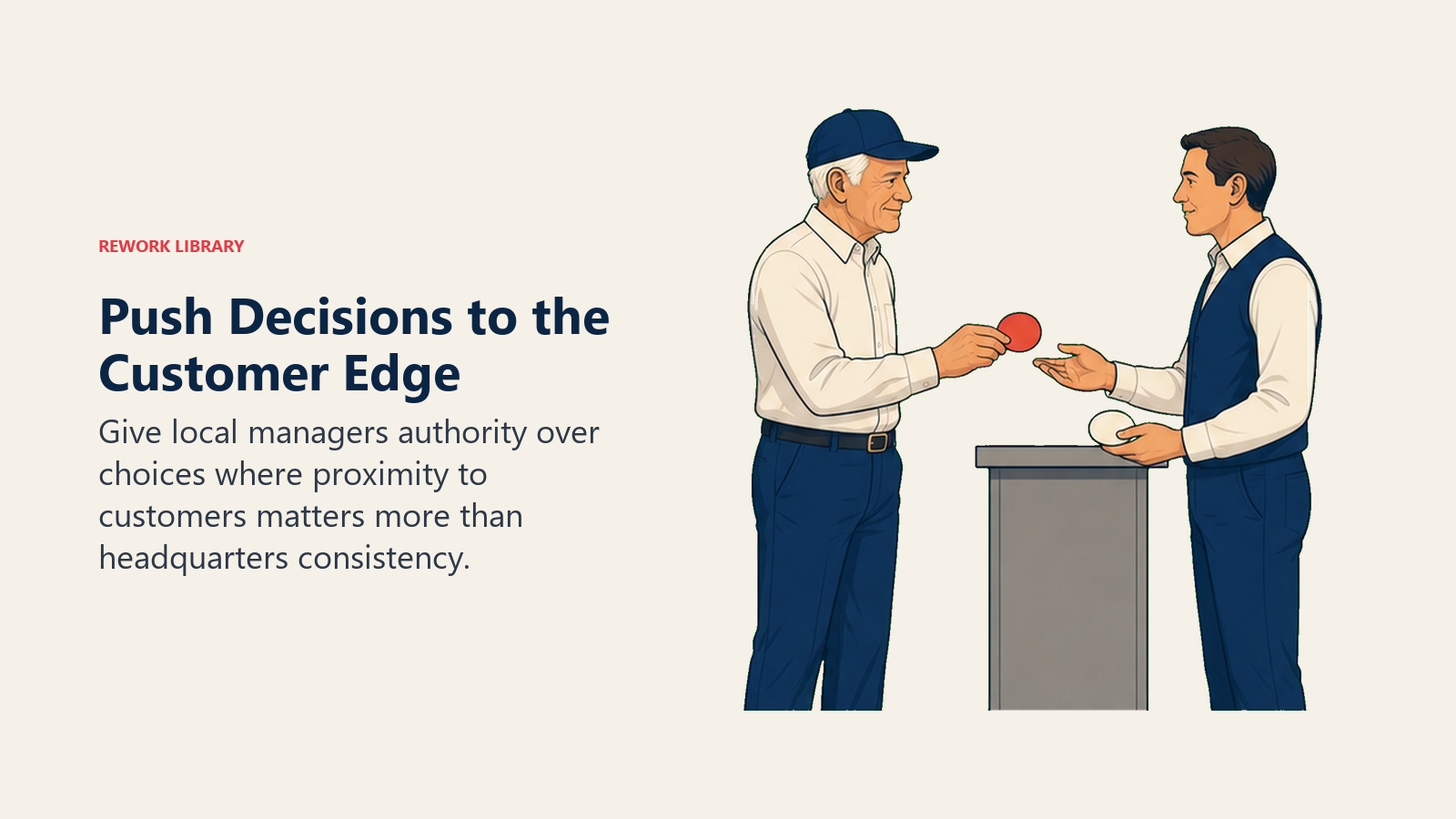
Push decisions to the front line. He trusted store managers to make merchandising and staffing calls without waiting for headquarters approval. This was unusual for a company of Walmart's size. Most chains of that scale centralize decision-making as they grow. Walton decentralized on purpose, because the people closest to customers had the best information.
Walton's principles in practice
| Principle | What it looked like at Walmart | Lesson for leaders |
|---|---|---|
| Serve associates first | Profit-sharing introduced for hourly workers in 1971; store-level ideas regularly adopted company-wide | Your frontline employees have insights your management team doesn't. Build a real channel for them. |
| The 10-foot rule | Walton modeled personal customer greeting behavior and asked every associate to do the same | Culture starts with what leaders demonstrate, not what they write in policies. |
| The sundown rule | Requests answered same day as a company norm; responsiveness treated as a core value | Speed of response signals respect. Slow responses signal indifference, whatever your intentions. |
| Radical frugality | Buyers shared motel rooms; headquarters kept deliberately plain; executive perks were minimal | Cost discipline compounds. Small savings on overhead add up to pricing power that competitors can't match. |
| Learning from competitors | Walton personally visited Kmart, Price Club, and Costco to study what they did well | Competitive intelligence is a leadership responsibility, not just a strategy team function. |
| Front-line autonomy | Store managers empowered to make merchandising decisions without HQ sign-off | Centralization protects consistency. Decentralization protects speed. Know which one your business needs at each stage. |
Lessons for today's leaders
Walton's model holds lessons that apply well outside retail. The specific tactics are dated; the underlying logic isn't.
On culture: Walton demonstrated that a culture of respect for frontline workers is a competitive advantage, not just an ethical choice. Companies that treat hourly employees as interchangeable parts consistently underperform in service quality. The mechanism is straightforward: people who feel respected work harder and stay longer. Lower turnover means better product knowledge, smoother customer interactions, and lower training costs. Walton understood this before it became a business school case study.
On frugality: The discipline Walton applied to overhead is transferable to any organization. The question isn't whether to cut costs but where to cut them. Walton cut costs that were invisible to customers (executive travel, headquarters facilities, administrative overhead) and invested in costs that directly served customers (inventory, logistics, store staffing). His cost leadership strategy was never about being cheap. It was about being disciplined about where money went.
On learning from competitors: Most executives track competitors defensively, looking for threats. Walton tracked them offensively, looking for ideas. He had no pride about copying something that worked. That orientation toward learning rather than defending is rare at senior levels and disproportionately valuable. It requires admitting that your competitors sometimes figure things out before you do. Walton was comfortable with that.
On decision-making at scale: As companies grow, authority tends to migrate upward. Walton fought this instinct deliberately. He pushed decisions down to store managers because he knew that the people closest to customers had the best information. The competitive advantage he built was partly organizational: a big company that moved like a smaller one because decisions didn't have to travel up and down a chain of command.
| Situation | Walton's approach | What to try |
|---|---|---|
| Frontline engagement | Weekly store visits; questions, not directives | Schedule regular skip-level conversations with people two or three levels below you. Listen more than you talk. |
| Cost pressure | Cut overhead before cutting people or service | Audit executive expenses and perks before touching operational budgets. The signal matters as much as the savings. |
| Learning from rivals | Personally visited competitor stores | Assign a senior leader to track and report on competitor best practices quarterly. Make it a learning exercise, not an intelligence brief. |
| Scaling decisions | Empowered store managers to act without HQ approval | Identify which decisions require central coordination and which ones slow you down. Push the second group out to the field. |
Walton's approach wasn't suited to every context. Fast-moving technology markets, where standards and products change quarter to quarter, need more centralization and tighter product control than retail shelf-stocking. And his style worked in part because he was the founder and had a cultural authority that professional CEOs often don't have. But the underlying instincts, respect the people closest to customers, control costs methodically, stay curious about competitors, and make decisions at the right level, are as applicable today as they were in the 1970s.
His leadership profile fits naturally alongside Ray Kroc's systems-first approach at McDonald's and Jeff Bezos's customer-obsession model at Amazon. All three built scale businesses with distinctive operating philosophies. Walton's distinguishing feature was the sincerity of his people focus. Kroc enforced standards through systems; Bezos through metrics. Walton did it by showing up, learning names, and making sure people felt seen.
Frequently Asked Questions about Sam Walton's Leadership Style
What was Sam Walton's leadership style?
Walton blended servant leadership and participative leadership with radical frugality. He believed that caring for frontline associates would lead those associates to care for customers, and he backed that belief with profit-sharing, store visits, and a consistent pattern of listening to and implementing ideas from store-level employees. He also modeled frugality himself, driving a pickup truck and splitting motel rooms on buying trips to reinforce the cost culture he expected throughout the organization.
What is the 10-foot rule at Walmart?
The 10-foot rule was Walton's personal commitment to greet any customer who came within ten feet of him in a store. He asked Walmart associates to apply the same behavior. The principle behind it is about approachability as a cultural value: a company that takes customers seriously demonstrates that at the point of contact, not just in its marketing.
What is the sundown rule?
The sundown rule holds that any request from a customer, colleague, or supplier should be answered before the end of the business day. Walton treated responsiveness as a form of respect. He thought slow responses communicated indifference regardless of intent, and he used the sundown rule to set a visible norm around speed and follow-through.
How did Sam Walton treat Walmart employees?
Walton consistently referred to Walmart workers as "associates" rather than employees, which he meant as a genuine statement of status. He introduced a profit-sharing plan for hourly workers in 1971, visited stores personally to ask for input, and regularly implemented ideas from store-level staff. He argued that a treated-well associate would consistently outperform a managed-at associate when it came to customer service.
What was Sam Walton's management approach?
Walton practiced management-by-walking-around at a scale that was unusual for a company of Walmart's size. He flew his own small plane to visit hundreds of stores each year, walked the floors, asked questions, collected ideas, and maintained relationships with managers he might not have seen for months. He also pushed decision-making authority down to store managers rather than centralizing it at headquarters, which kept the company responsive even as it scaled.
Walton died in April 1992, just weeks after receiving the Presidential Medal of Freedom. Walmart continued to grow after his death, eventually becoming the largest private employer in the United States. But the principles he built around, serve the people who serve the customer, cut costs that don't touch the customer, and stay curious about everyone doing it better than you, are what made the initial scaling possible. Those principles transferred because they were real. He didn't just write them down. He lived them, visibly, for three decades.
For leaders studying adjacent approaches, Henry Ford's productivity-first manufacturing philosophy offers a useful contrast. Ford centralized and standardized; Walton decentralized and listened. Both built category-defining organizations. The difference in their methods reflects a genuine debate about where competitive advantage comes from in large organizations.
Learn More
- Servant Leadership: What It Is and How to Practice It
- Participative Leadership Style: Getting Teams to Think, Not Just Execute
- Cost Leadership Strategy: Competing on Price Without Destroying Margins
- Competitive Advantage: How to Build and Sustain It
- Ray Kroc Leadership Style: Systems Obsession and the Franchise Machine
- Jeff Bezos Leadership Style at Amazon
- Henry Ford Leadership Style: Productivity, Scale, and the Assembly Line
