Grant Cardone Leadership Style: 10X Everything or Don't Start
Turn this article into takeaways for your work.


Each assistant summarizes the article only for you and suggests best practices for your work.
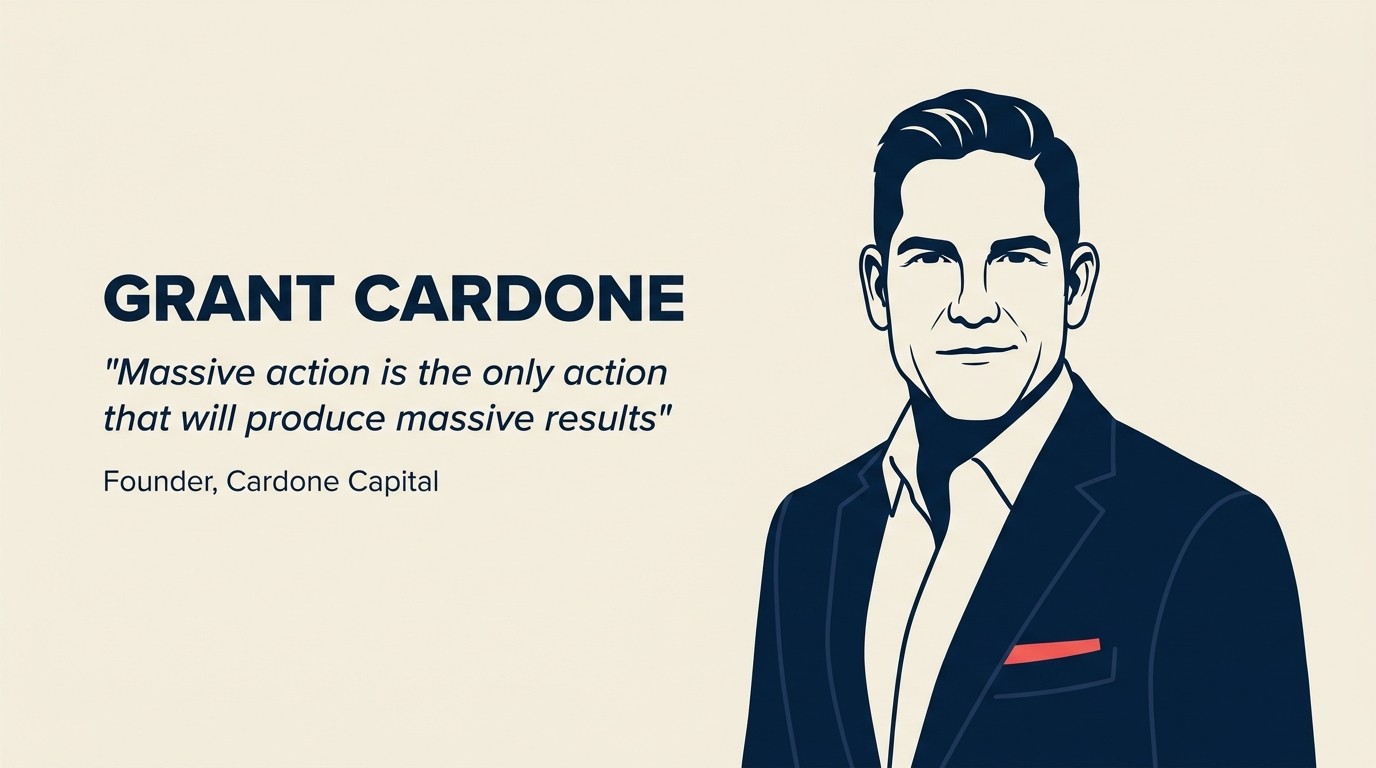
Grant Cardone's leadership style centers on the 10X Rule: a resource-allocation framework that says to multiply your goal and the effort you assume it takes by ten, then build your plan against that larger version. It pairs aggressive target-setting with high-volume, high-discipline sales execution, and it is how he built a $5B real estate portfolio and trained over 1 million salespeople.
Key Facts
- Founder, Cardone Capital, multifamily real estate private equity firm with roughly $5B in assets under management, concentrated in Sun Belt Class B/C properties.
- Author, "The 10X Rule" (2011) and "Sell or Be Sold," both core texts in modern sales training canon.
- 10X Growth Conference, annual business conference grown from ~1,000 attendees in 2017 to 15,000+, serving as a lead-generation platform for his training products.
- Social media reach, combined following of 15M+ across YouTube, Instagram, LinkedIn, and X, with daily publishing cadence.
- Background, started as a car-dealership salesman in Louisiana before building Cardone Training Technologies, Cardone Ventures, and Cardone Capital into a multi-business operating group.
The 10X Rule (The Cardone Obsessive Action Doctrine)
The 10X Rule is Grant Cardone's resource-allocation framework: multiply your goal and the effort you assume it requires by 10, then build your plan against the 10X version rather than the baseline. The doctrine argues that "normal action" is the most dangerous level of effort because it produces below-threshold results while creating the illusion of progress, so operators must commit to massive, sustained action calibrated to an above-normal objective.
Grant Cardone published "The 10X Rule" in 2011 with a simple argument: whatever you think your goal requires in effort, multiply it by 10, and whatever you think your market opportunity is, multiply that by 10 too. Most people write that off as motivational noise. But Cardone built a $5 billion real estate portfolio, runs Cardone Ventures as a business growth consultancy, hosts the 10X Growth Conference with 15,000+ attendees, and has trained over 1 million salespeople through Cardone University.
Whether you agree with his style or not, the operational output is hard to argue with.
The 10X model isn't just a mindset. It's a resource-allocation framework. Don't budget for what you need; budget for 10 times what you think you need, and the actual result often lands closer to your original goal. Cardone's central observation is that most people and companies fail not because their goal was wrong but because they set their resource allocation at normal levels for an above-normal objective. Then, when results fall short, they conclude the goal was unrealistic rather than that the effort was insufficient.
He grew up in Lake Charles, Louisiana, turned around a drug addiction in his mid-20s through the discipline of sales training, and built everything he has from a standing start with no institutional advantage. The self-made trajectory mirrors Brian Tracy's own origin story, both men discovered sales as a discipline rather than a profession and turned systematic practice into a career. And both share intellectual DNA with Zig Ziglar, whose conviction that selling is a transferable skill worth mastering at depth set the tone for the generation of trainers that followed. That origin story matters less as biography and more as evidence for his argument: the gap between where you are and where you want to be is almost always an effort gap, not a talent gap.
Leadership Style Breakdown
| Style | Weight | How it showed up |
|---|---|---|
| High-Volume Sales Operator | 60% | Cardone built his business philosophy around the mechanics of sales, not the psychology of sales, not the strategy of sales, but the raw operational discipline of doing more of the right activities more consistently than anyone else. His training programs at Cardone University focus on prospecting activity, follow-up sequences, objection patterns, and call-to-close ratios. The metrics are specific: follow up 12 times before giving up on a prospect; most salespeople quit after 2 attempts; the sale often closes on follow-up 5-8. He treats sales as an engineering problem with predictable inputs and outputs. |
| Aggressive Growth Multiplier | 40% | The 10X framework is a growth philosophy that operates at the intersection of target-setting and resource allocation. Cardone doesn't just argue for bigger goals, he argues that normal-scale goals are dangerous because they require you to operate at normal intensity, and normal intensity doesn't create the buffer you need when the market, the economy, or your execution falls short. His real estate business, his content business, and his conference business all reflect this: scale faster than seems necessary so that the real result is above baseline even when things go sideways. |
The 60/40 split reflects what Cardone actually does versus what he talks about most. His public persona is dominated by the growth multiplier framing: 10X, be obsessed, massive action. His actual business operations are built on high-volume, high-discipline sales execution. The philosophy gets the attention; the execution is what generates the money.
Key Leadership Traits
| Trait | Rating | What it means in practice |
|---|---|---|
| Rejection Tolerance | Exceptional | Cardone treats "no" as the beginning of the sales process, not the end. His research and experience put the average closed deal between follow-up attempt 5 and 8; most salespeople abandon the prospect after 2 rejections. The practical implication isn't to pester prospects, it's to build a structured follow-up system that adds value at each contact point so persistence doesn't feel like harassment. Cardone's own follow-up discipline, documented in both "Sell or Be Sold" and his training programs, involves alternating channels (call, email, LinkedIn, text, video message) with different value offers at each touch. |
| Obsession with Activity Metrics | Very High | Cardone's management philosophy for sales teams is built on tracking inputs, calls made, contacts reached, presentations given, follow-ups completed, rather than outputs. His argument: outputs lag inputs by weeks or months; if you manage the number, you're always behind. If you manage the activity, you can intervene before the pipeline dries up. He applies this to himself: his YouTube channel publishes daily, he posts to multiple social platforms every day, his sales training content is updated continuously. Volume isn't a substitute for quality, but in his framework, volume is how you find quality, by creating enough surface area that the right opportunities emerge. |
| Visibility Doctrine | High | Cardone's "obscurity kills businesses" argument is that most companies underinvest in being known relative to how much they invest in building a product. His visibility doctrine: it's better to be known than to be perfect. This is operationalized through his own content strategy, 1M+ YouTube subscribers, daily social media activity, the 10X Growth Conference as an annual visibility platform, and through his business coaching work at Cardone Ventures, where brand visibility and lead generation are among the first things he addresses. |
| Real Estate Operator Discipline | Strong | Cardone Capital's $5B+ portfolio is concentrated in Class B/C multifamily properties in Sun Belt markets, a specific strategy built around cash flow from rental income rather than appreciation speculation. Forbes profiled Cardone as one of the most prominent voices in this asset class. His investment philosophy: own the asset, control the cash flow, don't wait for appreciation. The operational discipline behind Cardone Capital is different from the motivational content he's known for, it's property management, debt structuring, investor relations, and market cycle analysis. The two Cardones (the motivational speaker and the real estate operator) are both real; most people only see the first one. |
The 3 Frameworks That Defined Grant Cardone
1. The 10X Rule: Why Under-Setting Goals Is More Dangerous Than Failing to Hit Them
The central argument in "The 10X Rule" is counterintuitive: the primary risk in setting targets isn't that you'll set them too high and fall short. It's that you'll set them too low and hit them, and then discover you've allocated your resources against the wrong scale.

Cardone's framework: people consistently underestimate the effort, time, capital, and attention required to achieve meaningful outcomes. They do this because their reference point is past experience at normal scale, and meaningful outcomes usually require above-normal scale. The result: they set goals that feel ambitious but actually represent the floor of what's necessary, resource them at normal levels, and then blame execution or market conditions when the results are modest.
His prescription: take your target and multiply it by 10. Then build your resource plan around the 10X version. The actual result will likely land somewhere between your original target and the 10X version, which is usually where the real opportunity was all along.
This has a specific budget application for sales leaders. If you think you need 50 leads to close 5 deals, build a system to generate 500 leads. If you hit 500 leads and only 8% close, you've got 40 deals. If you'd built for 50 leads and hit 8%, you've got 4 deals and a budget conversation. The 10X resource allocation creates the buffer that makes normal execution variance survivable.
The framework also explains Cardone's sales follow-up doctrine. If you think you need 3 follow-up attempts to close a deal, do 12. If the deal closes on attempt 3, you wasted 9 attempts. But if most deals close on attempt 6-8 (which his data suggests), then building for 3 means you're abandoning most of your pipeline at exactly the point where it would have converted.
For operators evaluating the framework: it works best as a diagnostic tool rather than a literal multiplier. The question it asks is valuable ("are we under-resourcing this relative to what it actually requires?") even if 10x is the wrong multiplier for every decision.
2. The 4 Degrees of Action: Why Normal Action Is the Most Dangerous Level
Cardone maps human behavior across four levels: doing nothing, retreating, taking normal action, and taking massive action. His counterintuitive argument is that the third level, normal action, is more dangerous than the first two.
Here's why. If you do nothing or retreat, you know you're not making progress. The feedback is immediate and clear. But normal action creates the illusion of progress while delivering below-threshold results. Most people who fail at a business goal aren't lazy. They're working at normal intensity on a problem that requires massive-action intensity, and the feedback loop is slow enough that they don't notice the mismatch until significant time has passed.
Massive action (Cardone's fourth level) isn't about working yourself to exhaustion. It's about identifying the activities that actually move the needle and doing those at a volume that feels disproportionate. In sales, that might mean 50 outbound calls a day when your peers are doing 15. In content, it might mean publishing daily when others publish weekly. In real estate, it might mean making offers on 30 properties to close 2.
The practical test Cardone applies: if your current level of activity wouldn't feel uncomfortable to a casual observer, you're probably at level 3. Massive action should feel like too much, because it's calibrated against a 10X goal, not a normal goal.
The limits of this framework are real, and Cardone acknowledges some of them. Massive action in a wrong direction is worse than normal action in the right direction. Volume without quality creates noise that damages relationships. The 4 degrees framework is most useful as an audit tool: for each major initiative, assess honestly whether you're executing at massive action or normal action, and whether the intensity matches the scale of the objective.
3. Cardone's Sales Process: Agree, Reverse, Close Again
Cardone's core sales technique, documented in "Sell or Be Sold" and refined across his training programs, is built around a three-step response to objections: agree with the prospect, reverse the objection, close again.

The logic behind agreeing first: most salespeople respond to objections defensively, which triggers the prospect's resistance. Agreeing with the objection (not capitulating on the price or the product, but validating that the concern is reasonable) reduces the adversarial dynamic. "You're right, this is a significant investment" is not a concession. It's a de-escalation that keeps the conversation open.
Reversing the objection means reframing it from a stop to a consideration. "You're right, this is a significant investment. That's exactly why I want to make sure you understand the specific return you'll see in the first 90 days." The objection becomes the entry point for the value conversation rather than the exit.
Closing again means that every conversation should end with a clear next step or a direct ask for the decision. Cardone's "be-back bus" metaphor (the bus that prospects say they'll take before they decide, and that never comes back) is his way of saying that if the prospect leaves without a commitment, the probability of closing approaches zero. Not because prospects lie, but because their competing priorities will fill the space.
The operational application for sales leaders is in training objection responses. Build a library of the 10-15 most common objections your team encounters, then run structured practice with the agree-reverse-close sequence for each one. The sequence needs to be automatic before it's in front of a prospect.
What Grant Cardone Would Do in Your Role
If you're a CEO, the 10X diagnostic is the highest-value thing you can take from Cardone's work. Look at your company's three most important growth initiatives and ask: are we resourced at the level required to actually hit the objective, or at the level that feels reasonable given current constraints? The gap between those two is often the explanation for why big goals stay aspirational while smaller, better-resourced ones get executed. Run the 10X audit before your next planning cycle.
If you're a COO, Cardone's activity-metrics discipline has a specific application in how you manage revenue operations. Build dashboards that track input metrics (contacts made, proposals sent, follow-ups completed) alongside output metrics. If you only manage output, you're always lagging. If you manage inputs daily, you can identify pipeline problems 60-90 days before they show up in the revenue numbers.
If you're a product leader, the visibility doctrine has an underrated application in go-to-market. Most product teams build in relative obscurity, assuming that a better product will find its own audience. Cardone's argument is that obscurity compounds. The longer you're unknown, the harder it becomes to establish credibility when you need it. Build visibility mechanisms (content, community, partnerships) at the same time you build product, not after you launch.
If you're in sales or marketing, the follow-up data is the most immediately applicable thing in Cardone's work. Pull your CRM data and calculate your current average number of follow-up attempts before a deal closes or dies. Compare it to the 5-8 range Cardone's data points to. Research from Harvard Business Review on sales persistence shows most buyers require multiple interactions before a purchase decision, a finding that reinforces the follow-up doctrine. If your team is abandoning prospects at attempt 2 or 3, you're leaving convertible pipeline behind. Build a structured 12-touch follow-up sequence with alternating channels and value-add content at each step. Track whether deals that receive 8+ touches close at higher rates than those that don't.
How Rework Supports a Cardone-Style Sales Operation
Cardone's doctrine is aggressive goal-setting plus volume-over-optimization, 10X the pipeline, 12-touch follow-up cadences, daily activity quotas that create the surface area where real deals emerge. That philosophy only works when the sales stack can absorb the volume without dropping touches. Rework's Sales Engine, starting at $69/month billed yearly with 5 sales seats included, is built for exactly this kind of high-velocity pipeline execution: multi-step follow-up across calls, email, and WhatsApp; activity dashboards that surface input metrics (contacts made, attempts logged, proposals sent) alongside output metrics so managers can intervene 60–90 days before pipeline droughts show up in revenue; and AI-assisted follow-up drafting that keeps the 8th touch as valuable as the 1st. For teams running a Cardone-style 10X resource allocation, Rework gives operators the execution layer, so the extra 500 leads, 12 follow-ups, and daily call targets get worked systematically instead of abandoned mid-sequence.
Notable Quotes and Lessons Beyond the Boardroom
Cardone's most operationally useful quote: "Success is your duty, obligation, and responsibility." The motivational framing is deliberate, but the underlying argument is about accountability architecture. He's saying you can't treat success as optional or aspirational. You have to treat it as a commitment with consequences.
From "The 10X Rule": "Never reduce a target. Instead, increase actions." This is a precise restatement of his core thesis: the response to underperformance is never to lower the bar; it's to raise the activity level. Most companies do the opposite during difficult quarters.
Cardone's own story has a specific lesson that gets lost in the motivational packaging. He turned around a drug addiction in his mid-20s through sales. Not therapy, not a support network, but through the structure and discipline of learning to sell, which gave him a metric-based system for measuring his own progress that he could execute regardless of how he felt. That's a specific use case for activity-based discipline: when your internal state is unreliable, external metrics become the scaffolding.
His 10X Growth Conference, grown from 1,000 to 15,000+ attendees since 2017, is also worth examining as a business model. The real estate side of his operation invites a different comparison. Warren Buffett's long-term compounding philosophy is in many ways the inverse of Cardone's 10X leverage doctrine, Buffett buys undervalued assets and holds indefinitely; Cardone buys cash-flowing properties and scales aggressively through debt, but both approaches share the same foundational insight: own the asset, control the economics, don't depend on appreciation to make the numbers work. It's Cardone's Stadium Pitch in practice (without using that term): an event that simultaneously demonstrates his content, generates leads for his training products, creates media content, and builds relationships with speakers who then amplify his reach. The conference is a sales funnel disguised as an event.
Where This Style Breaks
Cardone's 10X activity model works in high-volume transactional sales where buyer decisions are made quickly. It breaks down in 6-month enterprise deals where 50 additional touchpoints create friction rather than closings. His visibility doctrine (post everywhere, every day) consumes resources that early-stage companies with limited content bandwidth can't justify. The real estate portfolio's success is partly a function of timing and debt structuring. Cardone Capital's returns were built in a low-interest-rate environment that no longer exists, and the same leverage that amplified gains then amplifies risk now.
The rejection-as-fuel mindset can also create cultures where salespeople optimize for activity metrics and burn through their ICP list in the first six months rather than building long-term relationships. That's a real cost in markets where the same buyers recur year after year. And his polarizing personal brand (Trump-aligned politics, SEC investigations into fund disclosures, the aggressive persona) creates credibility problems in enterprise environments where brand alignment matters.
Frequently Asked Questions about Grant Cardone's Sales Philosophy
Who is Grant Cardone?
Grant Cardone is a sales trainer, author, and real estate investor who started as a car-dealership salesman in Louisiana and built Cardone Training Technologies, Cardone Ventures, and Cardone Capital. He is best known for "The 10X Rule" (2011), "Sell or Be Sold," the 10X Growth Conference, and a social-media following of 15M+ across platforms.
What is the 10X Rule?
The 10X Rule is Cardone's resource-allocation framework: take your target and the effort you think it requires, multiply both by 10, and plan against the 10X version. The argument is that most goals fail not because they were too ambitious but because operators resourced them at normal levels for an above-normal objective.
What is Cardone Capital?
Cardone Capital is Grant Cardone's private-equity firm focused on multifamily real estate, with roughly $5B in assets under management. The portfolio is concentrated in Class B/C apartment properties in Sun Belt markets, built around cash flow from rental income rather than appreciation speculation.
What is Cardone's approach to sales?
Cardone treats sales as a high-volume operational discipline rather than a psychological art. His core technique is agree-reverse-close: validate the prospect's objection, reframe it as an entry point to value, and always end with a clear next commitment. His data points to most deals closing between follow-up attempts 5 and 8, while most salespeople quit after attempt 2.
What is the 10X Growth Conference?
The 10X Growth Conference is Cardone's annual business event, grown from about 1,000 attendees in 2017 to 15,000+ at its peak. It functions simultaneously as a training platform, a lead-generation funnel for Cardone's coaching products, and a media-content engine.
What can modern salespeople learn from Grant Cardone?
The most transferable lessons are the follow-up doctrine (build structured 8–12 touch sequences across multiple channels instead of abandoning at attempt 2), activity-metric management (track inputs daily so pipeline problems surface 60–90 days before revenue drops), and the 10X diagnostic (audit whether current resource allocation actually matches the scale of the stated objective).
Learn More

On this page
- The 10X Rule (The Cardone Obsessive Action Doctrine)
- Leadership Style Breakdown
- Key Leadership Traits
- The 3 Frameworks That Defined Grant Cardone
- 1. The 10X Rule: Why Under-Setting Goals Is More Dangerous Than Failing to Hit Them
- 2. The 4 Degrees of Action: Why Normal Action Is the Most Dangerous Level
- 3. Cardone's Sales Process: Agree, Reverse, Close Again
- What Grant Cardone Would Do in Your Role
- How Rework Supports a Cardone-Style Sales Operation
- Notable Quotes and Lessons Beyond the Boardroom
- Where This Style Breaks
- Learn More