Will Larson Leadership Style: The Practitioner-Author Who Made Engineering Leadership a Craft
Turn this article into takeaways for your work.


Each assistant summarizes the article only for you and suggests best practices for your work.
Most engineering leaders get promoted because they code well. Will Larson became influential because he wrote clearly about what actually breaks at scale: org structures, staff-level expectations, and the invisible debt that accumulates in growing infrastructure teams.
Key Facts: Will Larson at a Glance
- Current role: CTO at Carta since 2022 (moved from Calm), leading engineering org design at the equity management platform.
- Prior leadership: Head of Foundation Engineering at Stripe, engineering leadership at Uber during hypergrowth, infrastructure at Digg.
- Books: "An Elegant Puzzle: Systems of Engineering Management" (2019), "Staff Engineer: Leadership Beyond the Management Track" (2021), "The Engineering Executive's Primer" (2024), all published through Stripe Press.
- Writing practice: Operates lethain.com for 15+ years, publishing working frameworks and refining them in public.
- Signature contribution: Defining the four Staff Engineer archetypes (Tech Lead, Architect, Solver, Right Hand), giving the industry a shared vocabulary for senior IC leadership.
The Larson Engineering Leadership Ladder
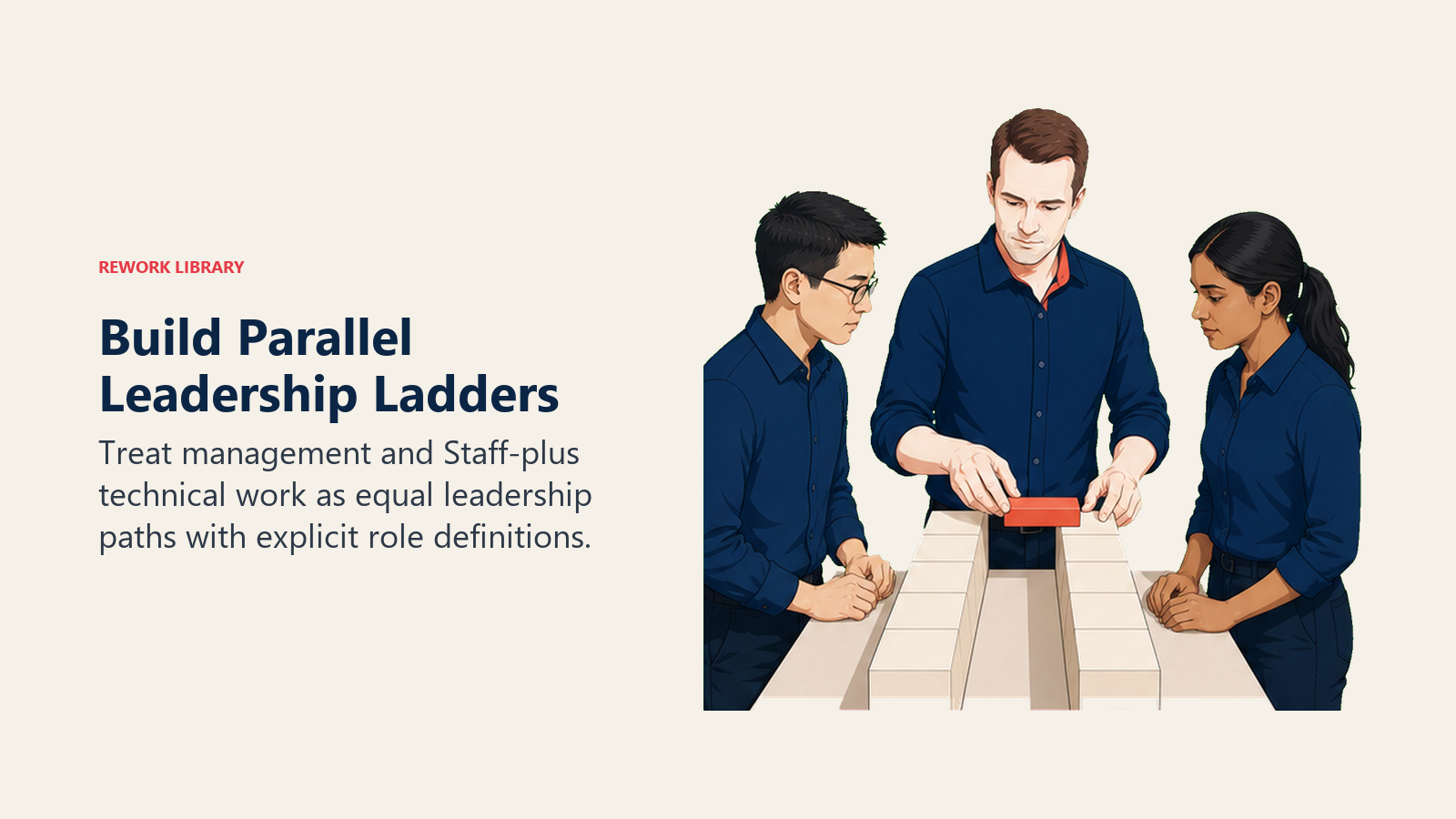
The Larson Engineering Leadership Ladder is a dual-track model that treats engineering management and Staff-plus IC work as parallel leadership paths of equal organizational weight, not as a hierarchy where management sits above technical contribution. The ladder defines distinct archetypes at each Staff-plus level (Tech Lead, Architect, Solver, Right Hand) and pairs them with management archetypes so companies can develop, hire, and evaluate senior leaders against explicit role definitions rather than implicit expectations.
At Digg, he saw early-stage chaos. At Uber, he managed infrastructure through hypergrowth. At Stripe, he ran Developer Tools and Foundation Engineering while the company was building toward an IPO. Since 2021, he's been CTO of Calm, applying the same frameworks at a consumer product company where quality is the entire brand promise.
His two books, "An Elegant Puzzle: Systems of Engineering Management" (2019) and "Staff Engineer: Leadership Beyond the Management Track" (2021), aren't airport reads. Both are published through Stripe Press, which has become an outlier in management publishing by betting on dense, practitioner-authored work over broadly accessible airport reads. They're working manuals that engineering organizations at Shopify, Stripe, and Netflix actually use to structure how they develop senior talent and run engineering teams. Camille Fournier's "The Manager's Path" is the natural companion read, her ladder framework covers the management track while Larson's "Staff Engineer" covers the IC track that Fournier explicitly sets aside. A third book, "The Engineering Executive's Primer," followed in 2024 and extended his frameworks to the full CTO role.
If you're scaling a technical team and don't know how to think about senior IC development or engineering org design, Larson is the most precise thinker on both.
Leadership Style Breakdown
| Style | Weight | How it showed up |
|---|---|---|
| Systems Thinker | 60% | Larson approaches engineering management as an organizational design problem, not a people problem. His most influential frameworks (team health metrics, the concept of "waves of organizational change," staff engineer archetypes) are all systems-level models. He's less interested in whether a specific manager is good or bad and more interested in whether the system around them produces the outcomes the organization needs. At Uber and Stripe, that meant designing infrastructure team structures that could absorb rapid headcount growth without creating coordination debt that would compound later. |
| Practitioner-Educator | 40% | Larson has been documenting his thinking publicly on lethain.com for years before either book existed. That discipline, writing about what he's actually doing rather than what he thinks in the abstract, is what gives his frameworks operational specificity. "An Elegant Puzzle" reads like notes from someone actively managing at scale, not a retrospective written after the fact. His willingness to publish half-formed thinking and refine it publicly is the educator part: he treats the blog as a working document, not a polished product. |
The 60/40 split means Larson is most useful to operators who are trying to design systems, not to those who need interpersonal coaching. His frameworks are architectural: given an organization of this shape, with these team sizes and these seniority ratios, here's what tends to break and here's why.
Key Leadership Traits
| Trait | Rating | What it means in practice |
|---|---|---|
| Written clarity as a leadership tool | Exceptional | Larson's writing is precise in a way that's uncommon in management content. He defines terms explicitly before using them, distinguishes between concepts that other writers conflate, and tests his frameworks against edge cases rather than presenting them as universally applicable. "Staff Engineer" succeeds as a book because it defines four specific archetypes (Tech Lead, Architect, Solver, Right Hand) and distinguishes the organizational contexts where each archetype is most useful. That precision is itself a leadership practice: it forces rigorous thinking before the framework gets shared. |
| Org-design precision | Very High | Larson thinks about engineering teams in terms of team topology: how many people, what seniority distribution, how much autonomy, what kind of work. His concept of the "team health check," assessing whether a team is thriving, surviving, or struggling, gives managers an objective framework for resource allocation decisions. The argument: you don't add headcount uniformly; you invest in thriving teams and stabilize struggling ones. That's not intuitive advice. Most organizations add headcount where the loudest problems are, which is usually the struggling teams. That's exactly backwards from what produces return. |
| Comfort with ambiguity at scale | High | Larson has worked in organizations at multiple stages: early (Digg), hypergrowth (Uber), pre-IPO (Stripe), and mature consumer product (Calm). He's genuinely comfortable with the idea that frameworks that work at one scale stop working at another, and his writing reflects that. He doesn't present "An Elegant Puzzle" as a universal management guide. He's explicit about which frameworks apply to which organizational contexts, which is a level of epistemic honesty that makes the frameworks more trustworthy, not less. |
| Servant leadership for senior ICs | High | "Staff Engineer" exists because Larson observed a pattern: most companies have no coherent framework for developing engineers who don't want to be managers. The result is that the best senior engineers either get pushed into management (where some thrive and others are miserable) or plateau at a Senior Engineer level without a clear path to growing in scope and impact. His four archetypes give companies a vocabulary for what senior IC leadership looks like, which is the prerequisite for developing it intentionally. |
The 3 Decisions That Defined Will Larson
Writing "An Elegant Puzzle" While Still an Active Engineering Manager
Most practitioners write books after leaving operating roles, a retrospective written from a distance. Larson wrote "An Elegant Puzzle" in 2019 while he was actively managing engineering teams at Stripe. That's the detail that matters. The book reads the way it does, specific, current, tested, because it was written by someone in the middle of the problems it addresses, not someone reconstructing them from memory.
The decision to publish while still operating required a level of intellectual transparency that most executives avoid. Writing about how to manage organizational systems while you're managing them means committing publicly to frameworks that might not work, and it means your peers and reports can read exactly how you think about your job. Larson made that commitment anyway, and the specificity of the book is the result.
For operators, the lesson is about knowledge hoarding versus knowledge publishing. Most experienced managers keep their frameworks to themselves or share them only with their own teams. Larson's decision to share publicly created a much larger return: books used at scale by organizations he's never worked at, at the cost of competitive advantage he was willing to give up. Kelsey Hightower made the same bet with "Kubernetes the Hard Way", publishing deep technical knowledge for free on GitHub rather than behind a paywall, and reaping community trust that no paywalled course could replicate. That's a deliberate calculation about where the value is.
Defining the "Staff Engineer" Archetype
Before "Staff Engineer" (2021), most technology companies had a Staff Engineer job title without a coherent definition of what the job was. The result was consistent: Staff Engineers hired from outside often failed to meet expectations because both sides had different mental models of what the role required. ICs who reached Staff level often didn't know how to grow further. And companies that wanted to develop senior technical leadership had no framework for what to develop.
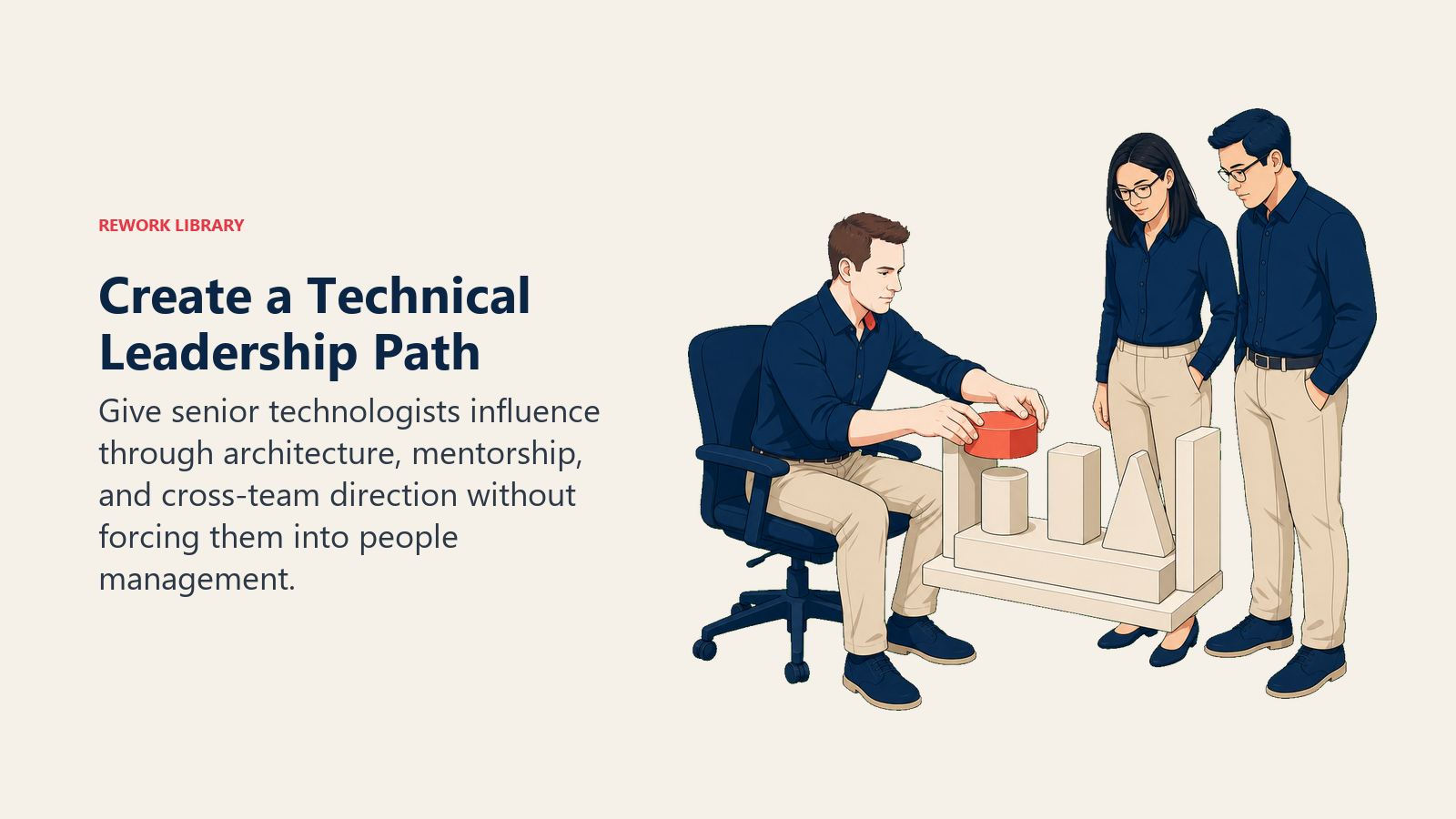
Larson's four archetypes gave the industry a vocabulary: Tech Lead (driving technical direction for a team), Architect (owning the technical strategy for a specific domain), Solver (parachuted into hard problems), and Right Hand (extending an executive's capacity). That vocabulary made a thousand conversations possible that were previously impossible: "what kind of Staff Engineer do we need here?" is a question you can only ask once you have the taxonomy.
The real contribution wasn't the archetypes themselves. Practitioners who thought carefully about senior ICs could have identified similar categories. The contribution was writing it down clearly and making it publicly available, so the vocabulary could spread beyond Larson's own organization.
Joining Calm as CTO: Choosing Depth Over Prestige
After Stripe, Larson had options that would have kept him in a higher-profile role or taken him to a larger company. He joined Calm in 2021 as CTO instead. Calm is a consumer wellness app with millions of users, smaller in engineering headcount than Stripe, less prestigious in the infrastructure engineering world, and facing a different set of technical challenges.
The choice matters because it says something about what Larson is actually testing. His frameworks from "An Elegant Puzzle" were developed in high-growth infrastructure contexts at Uber and Stripe. Calm is a consumer product company where the engineering challenges are different: product quality, content delivery, and mobile experience rather than distributed systems at scale. Running his frameworks at Calm is a genuine experiment: do they generalize, or are they context-specific?
His public writing from Calm (continued on lethain.com) suggests the frameworks generalize more than they don't, though they require adaptation. That's the practitioner-educator feedback loop in action.
What Will Larson Would Do in Your Role
If you're a CEO, Larson's most useful framework is the team health check. Before you add headcount to a struggling team, ask whether the team is struggling because it's under-resourced or because it has other problems that headcount won't solve. Larson's observation is that struggling teams often have structural problems (unclear ownership, misaligned expectations, wrong seniority distribution), and adding more people to a structurally broken team makes it harder to fix, not easier. The right investment in a struggling team is usually stability work (clear ownership, explicit expectations) before growth.
If you're a COO, Larson's writing on waves of organizational change is worth your time. His argument: organizational changes are most successful when they're sequenced, not simultaneous. If you're trying to change your team structure, your performance review process, and your tooling in the same quarter, you're creating compounding uncertainty that makes all three changes harder to implement. His recommendation is to sequence changes: land one, stabilize it, then run the next. That's not always possible, but when it is, it produces better results than simultaneous transformation.
If you're a product leader, Larson's staff engineer archetypes are directly applicable to how you work with senior ICs on your product team. The "Tech Lead" archetype maps cleanly to a senior product engineer who drives technical direction for a specific product area. The "Solver" maps to the engineer you bring in when there's a hard problem nobody else has been able to crack. Knowing which archetype you need for a specific role changes how you hire and how you evaluate performance. It also changes the conversation with engineering leadership about what senior technical talent the product needs.
If you're in sales or marketing, Larson's writing on clarity as a leadership tool applies to how you build your team's knowledge base. Martin Fowler's public writing on refactoring and software design follows the same discipline, publishing working frameworks before they're fully settled, then refining them in public with community feedback. Most sales organizations have senior reps who carry institutional knowledge in their heads: competitors, customer objections, deal structures, win/loss patterns. That knowledge stays local unless there's a deliberate mechanism for extracting and distributing it. Larson's practice of writing down frameworks before they're fully formed, and publishing them where teams can challenge them, is a knowledge distribution model that sales and marketing organizations can adapt.
The Rework Take: Engineering Leadership as Craft + Scalable Org Design
Larson's core insight, that engineering leadership is a craft practiced through deliberate organizational design, not a soft skill applied on top of technical work, is the operating assumption behind how Rework builds for engineering orgs. His Staff-plus archetypes and team health frameworks only work when the team has shared infrastructure for ownership, work tracking, and decision documentation. That's the gap Rework Work Ops closes. Engineering leaders using Rework can model team topology (who owns what, at which seniority distribution), track work at the granularity Larson's frameworks require, and keep cross-functional alignment visible without adding coordination meetings. Starting at $99/month billed yearly for the Project Engine, Rework gives engineering managers the substrate to implement Larson's architectural approach, distinct Staff archetypes working inside clearly-owned team boundaries, without building custom tooling. When the system around senior ICs is designed intentionally, the ladder stops being aspirational and becomes operational. See Rework pricing.
Notable Quotes and Lessons Beyond the Boardroom
Larson has written on lethain.com: "Most of the org-design problems I see are actually problems of unclear ownership." That observation is worth sitting with. Teams that are fighting over who owns a decision, or teams that aren't making decisions because no one is sure who should, usually don't have a people problem. They have an ownership design problem. Clarifying ownership without changing any headcount or reporting structure will often unlock more organizational velocity than any other single intervention.
On waves of organizational change, from "An Elegant Puzzle": "Organizations are always in the middle of the last change and not yet ready for the next one." His point is that transformation fatigue is real and compounds. Every change you make requires the organization to spend adaptation energy, time and attention that comes at the cost of execution. Organizations that change too frequently never fully adapt to any single change, which means each change delivers less value than it should. The sequencing question isn't just tactical; it's about managing organizational adaptation capacity.
He's also been direct about the limits of his own frameworks. In a 2023 lethain.com post, he wrote that the manager-versus-staff-engineer framing he used in his books was probably too binary. The real question is about the kind of impact you want to have, not which ladder you're on. That's a meaningful update to the framing he published in 2021, and the fact that he makes it publicly is part of what makes his writing trustworthy.
Where This Style Breaks
Larson's systems-first approach assumes good-faith actors and a stable enough organization to implement frameworks over time. In turnaround situations, where the primary problem is political dysfunction or an executive team that can't make decisions, the methodical systems-oriented pace feels out of sync with urgency. His frameworks require enough organizational stability to absorb them.
His practitioner model also assumes a written communication culture. "An Elegant Puzzle" and "Staff Engineer" are books about engineering organizations that write things down. The frameworks struggle in organizations where decisions happen verbally, documentation is ignored, and institutional knowledge lives in people rather than systems. If your engineering organization doesn't have a culture of writing, Larson's tools for distributing that knowledge won't find purchase until the culture changes first.
Frequently Asked Questions about Will Larson's Engineering Leadership
Who is Will Larson?
Will Larson is CTO of Carta (since 2022) and an influential engineering leadership author. He previously led infrastructure and foundation engineering at Stripe, Uber, and Digg, and has written publicly on lethain.com for 15+ years. His three books, "An Elegant Puzzle," "Staff Engineer," and "The Engineering Executive's Primer", are widely used at companies like Shopify, Stripe, and Netflix to structure how engineering organizations develop senior talent.
What is 'An Elegant Puzzle' about?
Published in 2019 through Stripe Press, "An Elegant Puzzle: Systems of Engineering Management" treats engineering management as an organizational design problem rather than a people problem. It introduces frameworks Larson developed while actively managing at Stripe, team health checks, waves of organizational change, and headcount investment logic, with a bias toward systems-level intervention over individual coaching.
What is the Staff Engineer path per Larson?
Larson defines four Staff Engineer archetypes: Tech Lead (driving technical direction for a team), Architect (owning technical strategy for a domain), Solver (parachuted into hard problems), and Right Hand (extending an executive's capacity). The taxonomy gives companies a shared vocabulary for what senior IC leadership actually looks like, making it possible to hire, develop, and evaluate Staff-plus engineers against explicit role definitions.
What is Larson's CTO role at Carta?
Larson joined Carta as CTO in 2022, leading engineering at the equity management and cap table platform used by startups, VCs, and public companies. The role applies his frameworks, team topology, staff archetypes, waves of change, to a fintech company with regulatory and reliability demands different from consumer or developer-platform contexts.
What is 'The Engineering Executive's Primer'?
Released in 2024, "The Engineering Executive's Primer" extends Larson's earlier work to the full engineering executive role, CTO, VP of Engineering, and similar positions. It covers strategy setting, cross-functional alignment, board communication, and the specific failure modes that trip up technical executives at scale, filling the gap between individual management craft (Elegant Puzzle) and senior IC leadership (Staff Engineer).
What can engineering managers learn from Will Larson?
Engineering managers learn three durable lessons from Larson: treat org design as the primary lever (structural problems don't yield to headcount), invest in thriving teams rather than struggling ones (counter to most managerial instinct), and write frameworks down publicly so they can be tested and refined. Combined, these shift the manager's role from interpersonal coach to organizational architect working with explicit, examinable models.
For related reading on engineering management, see Camille Fournier Leadership Style, Gene Kim Leadership Style, Martin Fowler Leadership Style, and Kelsey Hightower Leadership Style.

On this page
- Key Facts: Will Larson at a Glance
- The Larson Engineering Leadership Ladder
- Leadership Style Breakdown
- Key Leadership Traits
- The 3 Decisions That Defined Will Larson
- Writing "An Elegant Puzzle" While Still an Active Engineering Manager
- Defining the "Staff Engineer" Archetype
- Joining Calm as CTO: Choosing Depth Over Prestige
- What Will Larson Would Do in Your Role
- The Rework Take: Engineering Leadership as Craft + Scalable Org Design
- Notable Quotes and Lessons Beyond the Boardroom
- Where This Style Breaks