Chris Voss Leadership Style: Tactical Empathy Over Pressure
Turn this article into takeaways for your work.


Each assistant summarizes the article only for you and suggests best practices for your work.
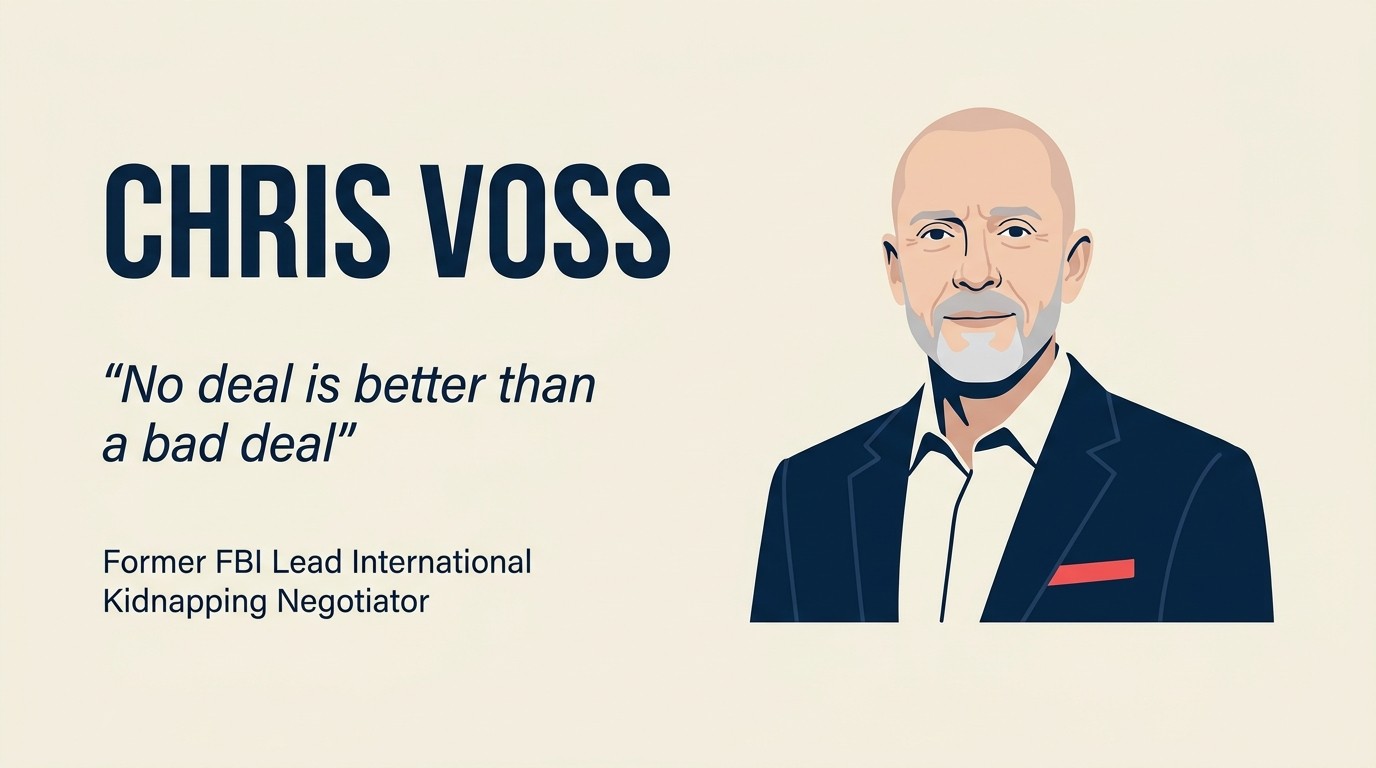
Key Facts: Chris Voss served 24 years in the FBI, including as the Bureau's lead international kidnapping negotiator, before founding the Black Swan Group in 2008. His 2016 book Never Split the Difference has sold more than 2 million copies and is taught in MBA negotiation programs at Harvard, Georgetown, and USC. His core contribution: translating FBI hostage-negotiation mechanics, tactical empathy, mirroring, labeling, calibrated questions, into a repeatable framework for business deals, procurement standoffs, and late-stage sales negotiation.
Tactical Empathy (The Mirror & Label Method)
Tactical empathy is the disciplined practice of identifying and articulating the other side's emotional state and underlying interests without judgment, then using that understanding to shift the conversation toward resolution. The mirror & label method operationalizes it in two moves: mirroring (repeating the last three words of what the counterpart said, with an upward inflection, to keep them talking) and labeling (naming their feeling as an observation, "It seems like..." or "It sounds like...", to validate without agreeing). Together they lower defensiveness and surface the real constraint driving the negotiation.
Chris Voss spent 24 years as an FBI hostage negotiator, including time as the lead international kidnapping negotiator, and came away with a counterintuitive conclusion: the person who tries to control a negotiation usually loses it. The person who understands what the other side actually needs, and makes it safe to say it out loud, usually wins.
He published those conclusions in Never Split the Difference in 2016. It sold more than a million copies and became required reading in sales orgs that had spent decades training reps to push harder, present more features, and overcome objections. Voss's argument was the opposite: stop trying to convince people. Start trying to understand them.
That argument matters specifically for B2B sales in 2026 because the deals that are hardest to close, multi-stakeholder enterprise sales, late-stage procurement negotiations, internal budget fights, are exactly the deals where pressure tactics backfire. Procurement teams are trained to resist them. Senior executives don't respond to feature lists. What they respond to is a counterpart who clearly understands their position.
That's what Voss teaches. And there's more tactical precision in his framework than most people extract from the book on a first read.
Leadership Style Breakdown
| Style | Weight | How it showed up |
|---|---|---|
| Empathic Listener | 60% | Voss's foundational move, in hostage situations and in sales training, is to create the conditions where the other side tells you what they actually want, not what they're supposed to want. This means listening longer than feels comfortable, asking open questions, and resisting the urge to fill silence with your own talking points. His FBI work required this because the hostage-taker's stated demand was almost never the real driver. Getting to the real driver required patience and precision, not pressure. |
| Psychological Tactician | 40% | The tools Voss uses, labeling, mirroring, calibrated questions, the late-night FM DJ voice, are not passive listening techniques. They're active interventions designed to shift the emotional state of the conversation in a specific direction. He uses them deliberately, with sequencing, and with a clear outcome in mind. The empathy isn't soft. It's structured. |
The 60/40 split is important to understand. Voss isn't teaching you to be nicer in negotiations. He's teaching you to use emotional intelligence as a precision instrument. The listening exists in service of the tactical objective.
Key Leadership Traits
| Trait | Rating | What it means in practice |
|---|---|---|
| Emotional control | Exceptional | Voss negotiated with kidnappers, terrorists, and people in genuine psychological crisis. His ability to remain calm under extreme pressure wasn't a personality trait he was born with, it was trained, over 24 years, under conditions most people will never face. In business contexts, the equivalent is the ability to stay composed when a deal is falling apart, a procurement team plays hardball, or an executive says something that's factually wrong. Emotional reactivity in those moments costs deals. |
| Patience | Very High | Hostage negotiations routinely lasted days or weeks. Voss learned to treat time as a tool rather than a constraint. In business negotiations, the equivalent is resisting the pressure to close before the other side is ready, because a close before readiness usually produces a bad deal, a difficult implementation, or buyer's remorse that shows up in churn. |
| Precision language | Very High | Voss's techniques depend on specific phrasing. "It seems like you're frustrated with the current situation" works differently than "I understand you're frustrated." The first labels and invites a response. The second claims understanding and shuts down the emotional processing. That precision is learnable, but it requires actual practice, not just conceptual familiarity. |
| Counter-intuitive thinking | High | The most cited example: Voss argues that "No" is a better response to get than "Yes" early in a negotiation. "Yes" creates pressure and defensiveness. "No" creates a sense of safety, the other side feels they've maintained control, and that safety opens the conversation. His instruction to sales teams: ask "Is now a bad time?" rather than "Is now a good time?" The first gets a real answer. The second gets a polite brush-off. |
The 3 Frameworks That Defined Voss
Tactical Empathy
Tactical empathy is Voss's foundational concept, and it's frequently misunderstood. It doesn't mean you agree with the other side. It doesn't mean you like them. It means you understand their perspective well enough to articulate it back to them accurately, and you do so without judgment.

In a hostage situation, this might sound like: "I understand you feel the police have left you no options." You're not validating the hostage-taking. You're demonstrating that you've heard and understood the emotional reality the person is operating from. That demonstration creates a small but important shift: the other side feels heard, which lowers their defensiveness and makes them more likely to engage with what you actually need from them.
In a B2B context, the equivalent happens in procurement negotiations. The procurement team isn't being difficult because they enjoy it. They're being difficult because they have constraints, budget cycles, vendor approval processes, internal stakeholders to manage, that your standard close timeline doesn't account for. If you demonstrate that you understand those constraints specifically, rather than treating them as objections to overcome, you change the dynamic of the conversation.
The mistake most salespeople make with this concept is performing empathy rather than practicing it. Saying "I understand how you feel" without actually understanding anything is detectable. The real technique requires listening long enough to understand what the other side actually cares about, then naming it.
Labeling and Mirroring
Labels and mirrors are Voss's two most practical tools, and they work together.
A label is a statement that names the other side's emotional state, delivered as an observation rather than a claim. "It seems like..." or "It sounds like..." are the standard openers. "It sounds like the timeline is the main concern here." The label does three things: it confirms you were listening, it gives the other side a chance to correct you if you've misread the situation, and it validates the emotion without requiring you to agree with it. The response to a good label is almost always more information.
Mirroring is simpler: repeat the last three words (or the three most important words) of what the other person just said, with a slight upward inflection. It keeps the other person talking without you having to say anything substantive. It communicates that you're paying attention. And it often produces the most important information in a conversation, because people continue a thought they've started rather than beginning a new one.
In practice, these techniques feel strange until you've used them enough times to internalize them. Voss recommends practicing in low-stakes everyday conversations before trying them in high-stakes sales or negotiation contexts. The mechanics have to be automatic enough that you're not thinking about them while you're also managing the substance of a difficult conversation.
The Late-Night FM DJ Voice and Calibrated Questions
Voss identifies three vocal registers: a positive/playful voice, a direct/assertive voice, and the late-night FM DJ voice, slow, calm, deliberate, with a slight downward inflection at the end of sentences. He recommends the third one for defusing tension, delivering hard news, and establishing authority without aggression.
Most people in high-pressure business conversations default to either nervous energy (voice goes up, pace accelerates) or defensive authority (voice gets harder, more clipped). Neither works particularly well. The FM DJ voice communicates composure and signals that you're not rattled, which in itself changes how the other side reads the situation.
Calibrated questions are open-ended questions that start with "How" or "What" and shift the burden of problem-solving to the other side. "How am I supposed to do that?" is Voss's canonical example. It sounds like pushback, but it doesn't close a door, it opens a space for the other side to think about your constraints, which is where solutions come from. "What's making this timeline difficult?" is better than "Why can't you move faster?" because "Why" puts people on the defensive. "What" invites them into the problem.
These questions are particularly effective in late-stage deal negotiations where you've hit a stall. Instead of pushing harder or offering a discount, a calibrated question puts the other side in the position of solving the problem with you rather than against you.
What Voss Would Do in Your Role
If you're a CEO navigating a high-stakes negotiation, a partnership deal, a financing round, an acquisition conversation, Voss's first instruction would be to identify what the other side actually needs, not what they're saying they need. Stated positions ("we need a 20% price reduction") almost always have underlying interests ("our procurement team needs to show their board a win"). If you can find and address the underlying interest, you can often hold your position on the stated ask. The technique: label the stated position, listen for what comes back, and keep asking until you're talking about the real constraint.

If you're a COO managing vendor relationships or contract renewals, the practical Voss application is in how you run the first meeting after a problem. When a vendor relationship has gone wrong, most companies open with their grievance list. Voss would start with a label: "It seems like there have been some communication issues on both sides." That framing invites the vendor into a problem-solving conversation rather than a defensive one. You get better outcomes from vendors who feel heard than from vendors who are managing your anger.
If you're a product leader running customer discovery interviews, tactical empathy is the operating mode that produces real insight rather than confirmation bias. The labeling technique is particularly useful here: "It sounds like the workaround you built is taking a lot of time" will get a more honest response than "Would you pay for a feature that solved that?" The first opens. The second triggers anchoring and social desirability bias.
If you're a VP of Sales or CRO, the highest-leverage place to apply Voss is late-stage deal rescue. When a deal has stalled and the champion has gone quiet, the worst move is more outreach pushing for a decision. The better move is a single message that labels the situation honestly: "It feels like things have gotten complicated on your end." That opens a real conversation about what changed, which is the only information that lets you determine whether the deal is rescuable or dead.
How This Plays Out in a Rework Pipeline
Voss's framework only compounds when reps can capture and revisit what the buyer actually said, not a summary, not a feature checklist, but the specific phrasing that revealed the real constraint. In a Rework CRM pipeline, that looks like tagging labels and calibrated-question responses directly onto the deal record: "procurement flagged timeline, not price," "champion went quiet after VP review," "used FM DJ voice on discount pushback, got real objection." Deal notes stop being status updates and start being a tactical-empathy transcript. Managers running late-stage deal reviews can spot where a mirror would have unlocked more information, or where a rep jumped to a close before the counterpart said "no" comfortably. At scale, that's the difference between a sales org that read Never Split the Difference and one that actually runs it, and it's where cross-team lead notes from SDR through CS keep the empathy loop intact past the handoff.
Notable Quotes & Lessons Beyond the Boardroom
Voss writes: "He who has learned to disagree without being disagreeable has discovered the most valuable secret of negotiation." That sounds like management advice. In practice, it describes the specific skill of holding your position under pressure without triggering defensiveness in the other party, which is exactly what happens when a calibrated question lands correctly. You're not agreeing. But you're not pushing back in a way that shuts the conversation down.
The other quote that holds up to repeated reading, and one that Voss has elaborated on through The Black Swan Group training programs, is: "The most dangerous negotiating myth is that 'Yes' is the goal. 'Yes' is often meaningless. What you want is a committed 'Yes.' And the path to that is through a genuine 'No.'" This is the counter-intuitive core of his system. A "yes" that comes before the other side has processed their reservations isn't commitment, it's a temporary agreement that will fall apart at implementation. A "no" that leads to a real conversation about what's actually possible is the start of a durable deal.
His FBI background gives all of this a useful reference point: when the stakes were someone's life, tactical empathy wasn't optional. It was the only tool that actually worked. The discipline it required in those contexts translates into business, but only if you treat it as a discipline rather than a communication style.
Where This Style Breaks
Voss's framework assumes the other side has an emotional stake in the outcome, that there's a real human being on the other side of the conversation who will respond to being heard and understood. That's true in most sales contexts. It's less true in purely transactional, commodity-driven, or fully automated procurement processes where the "other side" is a scoring rubric rather than a person.
The techniques also don't scale without training. A single well-trained negotiator using labels and calibrated questions will dramatically outperform a team that's read the book but hasn't practiced the mechanics. Some academic negotiation researchers, including people associated with Harvard's Program on Negotiation, have noted that Voss's case evidence is anecdotal rather than controlled-study validated, which is a fair methodological critique. And in orgs where the techniques are deployed without relationship groundwork, labeling can read as manipulative rather than empathetic. The difference is usually visible to the person on the receiving end within about three exchanges.
Frequently Asked Questions about Chris Voss's Negotiation Method
Who is Chris Voss?
Chris Voss is a former FBI lead international kidnapping negotiator who spent 24 years with the Bureau. He founded the Black Swan Group in 2008 and authored the 2016 bestseller Never Split the Difference, which has sold more than 2 million copies and is taught in MBA programs at Harvard, Georgetown, and USC.
What is tactical empathy?
Tactical empathy is the disciplined practice of understanding the other side's perspective accurately enough to articulate it back to them without judgment. It is not agreement or sympathy, it's emotional intelligence used as a precision instrument to lower defensiveness and surface the real drivers behind a stated position.
What is the 'mirror and label' technique?
Mirroring means repeating the last three words of what the counterpart just said, with a slight upward inflection, which keeps them talking and surfaces more information. Labeling means naming their apparent emotional state as an observation, "It seems like..." or "It sounds like...", which validates the feeling without requiring you to agree, and almost always produces more detail in response.
Why is 'no' better than 'yes' in negotiation per Voss?
Voss argues that an early "yes" creates pressure and defensiveness, while "no" makes the counterpart feel they've maintained control, which lowers their guard. The path to a durable, committed agreement runs through a genuine "no" that opens an honest conversation, not a premature "yes" that falls apart at implementation.
What is Never Split the Difference?
Never Split the Difference is Voss's 2016 book, co-authored with Tahl Raz, that translates FBI hostage-negotiation techniques into business applications. Its title rejects the conventional wisdom of meeting in the middle, arguing instead that compromise often produces bad outcomes and that understanding the counterpart's real interests yields better deals.
What can modern salespeople learn from Chris Voss?
Salespeople can apply labels, mirrors, calibrated "how" and "what" questions, and the late-night FM DJ voice to late-stage deal rescue, procurement standoffs, and multi-stakeholder enterprise sales. The core shift is from pushing features and overcoming objections to listening long enough to identify the real constraint, then naming it, which outperforms pressure tactics against sophisticated B2B buyers.
Learn More
- How to Run a Late-Stage Deal Review That Actually Saves Deals
- Sales Negotiation Tactics That Work When the Price Is Right
- Neil Rackham Leadership Style: Research-First, Question Everything
- Aaron Ross Leadership Style: The SDR Model and the Architecture of Predictable Revenue
- Marc Benioff Leadership Style: How Salesforce's CEO Built the Cloud CRM Era

On this page
- Tactical Empathy (The Mirror & Label Method)
- Leadership Style Breakdown
- Key Leadership Traits
- The 3 Frameworks That Defined Voss
- Tactical Empathy
- Labeling and Mirroring
- The Late-Night FM DJ Voice and Calibrated Questions
- What Voss Would Do in Your Role
- How This Plays Out in a Rework Pipeline
- Notable Quotes & Lessons Beyond the Boardroom
- Where This Style Breaks
- Learn More