Werner Vogels Leadership Style: The CTO Who Built AWS From the Inside Out
Turn this article into takeaways for your work.


Each assistant summarizes the article only for you and suggests best practices for your work.
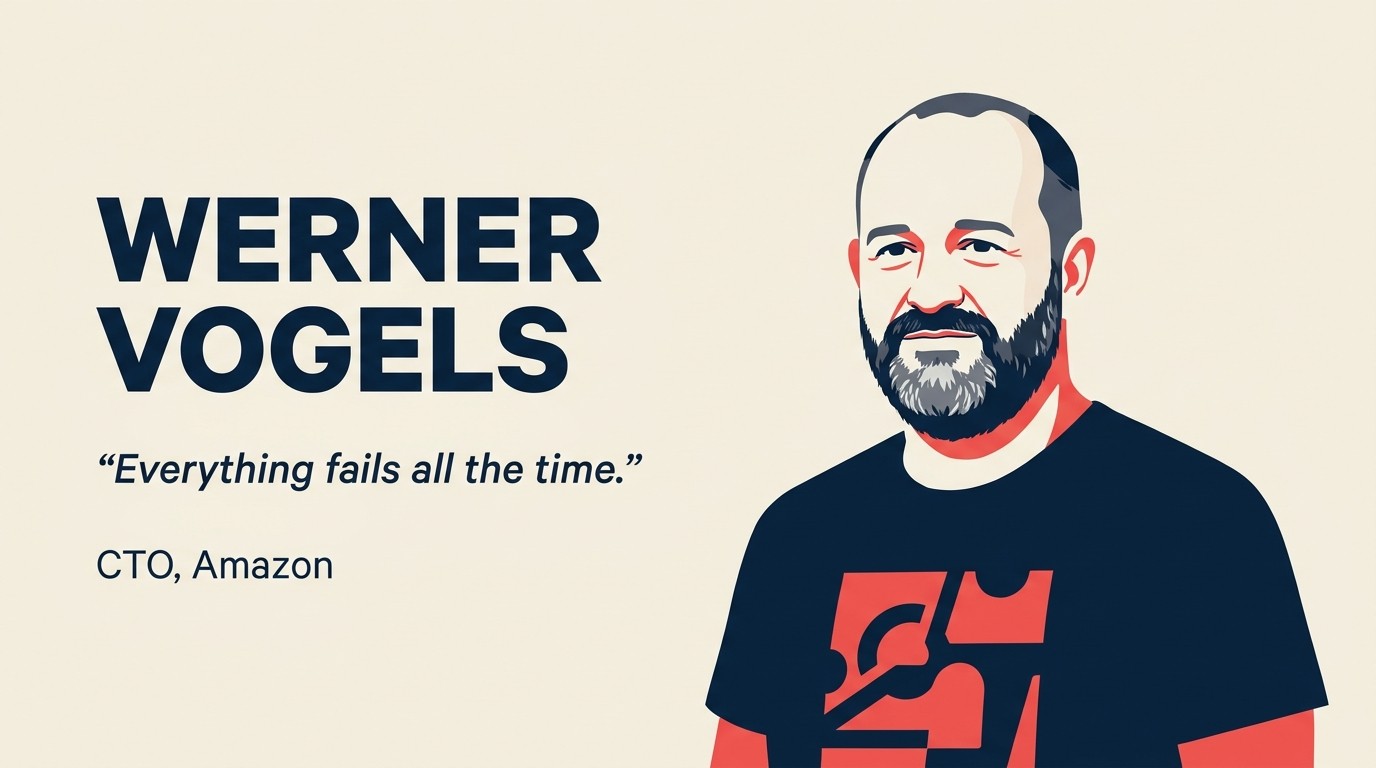
Key Facts: Werner Vogels (b. 1958) has served as Chief Technology Officer of Amazon since 2005 (joined 2004 as Director of Systems Research). He holds a PhD from Vrije Universiteit Amsterdam, where he researched scalable enterprise computing before Amazon recruited him. He is the architect of AWS's distributed systems foundations and a principal theorist of eventually-consistent data systems, ideas formalized in his co-authored Dynamo paper (2007) that underpin DynamoDB. His "Everything fails all the time" principle and "You build it, you run it" DevOps ethos have become industry-standard doctrine. He has written continuously on his blog All Things Distributed for more than 20 years, making him one of the longest-running publicly-writing CTOs in tech.
The Vogels You-Build-It-You-Run-It Model
The Vogels You-Build-It-You-Run-It Model is an engineering leadership framework in which the team that designs and ships a software service also owns its production operation, monitoring it, responding to incidents, and fixing failures directly. Paired with its companion axiom "everything fails all the time," the model treats failure as an expected operating condition rather than an exception, forcing design for graceful degradation from the first line of code. The result is a tight feedback loop between design decisions and operational consequences, which Vogels argues is the fastest route to real software reliability at scale.
Werner Vogels was a distributed systems professor at Vrije Universiteit Amsterdam when Amazon recruited him in 2004. He has written about these ideas continuously on his blog All Things Distributed since 2005. He wasn't a startup founder or a product visionary. He was an academic who'd spent years researching how to build reliable software that doesn't fall over when individual components fail.
Amazon needed that specific expertise because Amazon was falling over. The company had grown into a complex tangle of dependencies, teams calling other teams' code directly, no clear service boundaries, deployments that broke unrelated systems. Vogels joined as Director of Systems Research in 2004 and became CTO in 2005. He then spent the next two decades co-authoring the engineering mandates that became the blueprint for how large-scale technology organizations structure themselves.
"You build it, you run it" is standard doctrine at companies he never worked for. The API mandate, microservices architecture, and the idea that development teams should own their systems in production, these are Vogels-adjacent ideas even when his name isn't attached to them.
What makes him useful to study isn't just the technical output. It's how an academic mind applied to an operator problem produced principles that scaled to a $100 billion business.
Leadership Style Breakdown
| Style | Weight | How it showed up |
|---|---|---|
| API-First Architect | 60% | Vogels's background in distributed systems gave him a specific lens: systems that expose clean interfaces are resilient; systems that share internal state are fragile. He applied that lens to Amazon's organizational architecture. Teams that expose their functionality through APIs can be independently deployed, independently scaled, and independently owned. Teams that call each other's internal code create cascading failure modes. His contribution was making that distributed systems principle into an organizational mandate, and then enforcing it. |
| Operator-Humility Leader | 40% | Vogels leads with a posture that's unusual for CTOs: he talks frequently about what fails, what Amazon got wrong, and what he still doesn't know. His annual re:Invent letters and his "All Things Distributed" blog are notable for intellectual honesty rather than product boosterism. He lets engineers shine publicly. He's not trying to be the most visible person on stage. That posture creates an organizational permission structure, if the CTO is willing to say "we got this wrong," teams are more likely to surface problems early rather than managing upward appearance. |
The 60/40 split explains why Vogels is studied both as a technical architect and as a culture builder. The API-first architecture is the structural contribution. The operator-humility posture is what made it possible for thousands of engineers to implement that architecture honestly, including in the places where it was hard and slow.
Key Leadership Traits
| Trait | Rating | What it means in practice |
|---|---|---|
| Distributed systems thinking at org scale | Exceptional | Most engineers apply distributed systems concepts to their software. Vogels applied them to his organization. Loose coupling, independent deployability, clear interfaces, failure isolation, these are software design principles that he translated into team structure requirements. When he talks about "two-pizza teams" or service boundaries, he's not describing team size preferences. He's describing the same resilience properties he would apply to software: each unit should be able to operate independently, fail independently, and be understood by its owners without requiring knowledge of the whole. |
| Customer obsession translated into engineering mandates | Very High | Vogels consistently translates customer experience requirements into engineering requirements. "Everything fails all the time" isn't a pessimistic statement, it's an engineering requirement that every system must be designed to degrade gracefully when components fail. If the customer experience is a four-nines availability SLA, that requirement cascades into every architectural decision downstream. He refuses to let engineering teams treat reliability as a configuration choice; it has to be designed in. |
| Radical ownership ("you build it, you run it") | Very High | Before DevOps had a name, Vogels was articulating the principle that development teams should own their systems in production. The traditional model, dev writes the code, ops runs it, creates a handoff that degrades quality. When the team that writes the code also pages at 2am when it breaks, the quality bar changes. Reliability becomes a first-class feature, not an ops problem. This requires hiring engineers who are willing to take that accountability, building the tooling that makes on-call manageable, and creating culture where production incidents are learning events rather than blame events. |
| Consistent long-form public communication | High | Vogels has maintained his "All Things Distributed" blog since 2005, over 20 years of technical writing that reflects both his research background and his Amazon experience. The blog is notable for covering failures and nuances alongside successes. His annual CTO letters at re:Invent review commitments made in previous years and acknowledge where Amazon didn't deliver. That 20-year public record of intellectual honesty is itself a leadership tool: it demonstrates to every engineer at Amazon and in the broader industry what the standard for technical integrity looks like. |
The 3 Decisions That Defined Werner Vogels
1. The API Mandate
The Bezos API Mandate, tied directly to the growth of Amazon Web Services, is often described as Jeff Bezos's idea. That's partially accurate. Bezos wrote the mandate. But Vogels operationalized it, enforced it, and built the architectural principles around it.
The mandate, roughly: every team must expose its data and functionality through service interfaces. No back-door integration, no direct database reads from other teams' systems, no shared internal code. All communication happens through the interface. And the interfaces must be designed so that they could be exposed to external developers, not because Amazon planned to expose them, but because that constraint forces you to design interfaces that are actually clean rather than convenient shortcuts.
The business consequence of that mandate is AWS. Amazon had to build internal service infrastructure that was reliable enough and clean enough to serve external customers. The services they were running internally, compute, storage, database, messaging, turned out to be the services other companies needed too. AWS wasn't planned as a product from the beginning. It emerged from an internal architecture discipline that Vogels championed and enforced.
For operators today, the API mandate principle translates to: what in your organization is integrated through informal relationships, direct data access, or undocumented dependencies rather than through explicit, owned interfaces? Those informal integrations are your operational debt. When any one component changes, everything that depends on it in undocumented ways breaks in unexpected ways. The API mandate doesn't require building REST APIs for internal team communication, it requires asking who owns each system, what the contract between systems is, and what happens when a component fails or changes.
2. "You Build It, You Run It"
Vogels articulated this principle in a 2006 interview, but he'd been implementing it at Amazon for two years before that. The concept predates the DevOps movement by several years and anticipates most of what DevOps eventually codified.
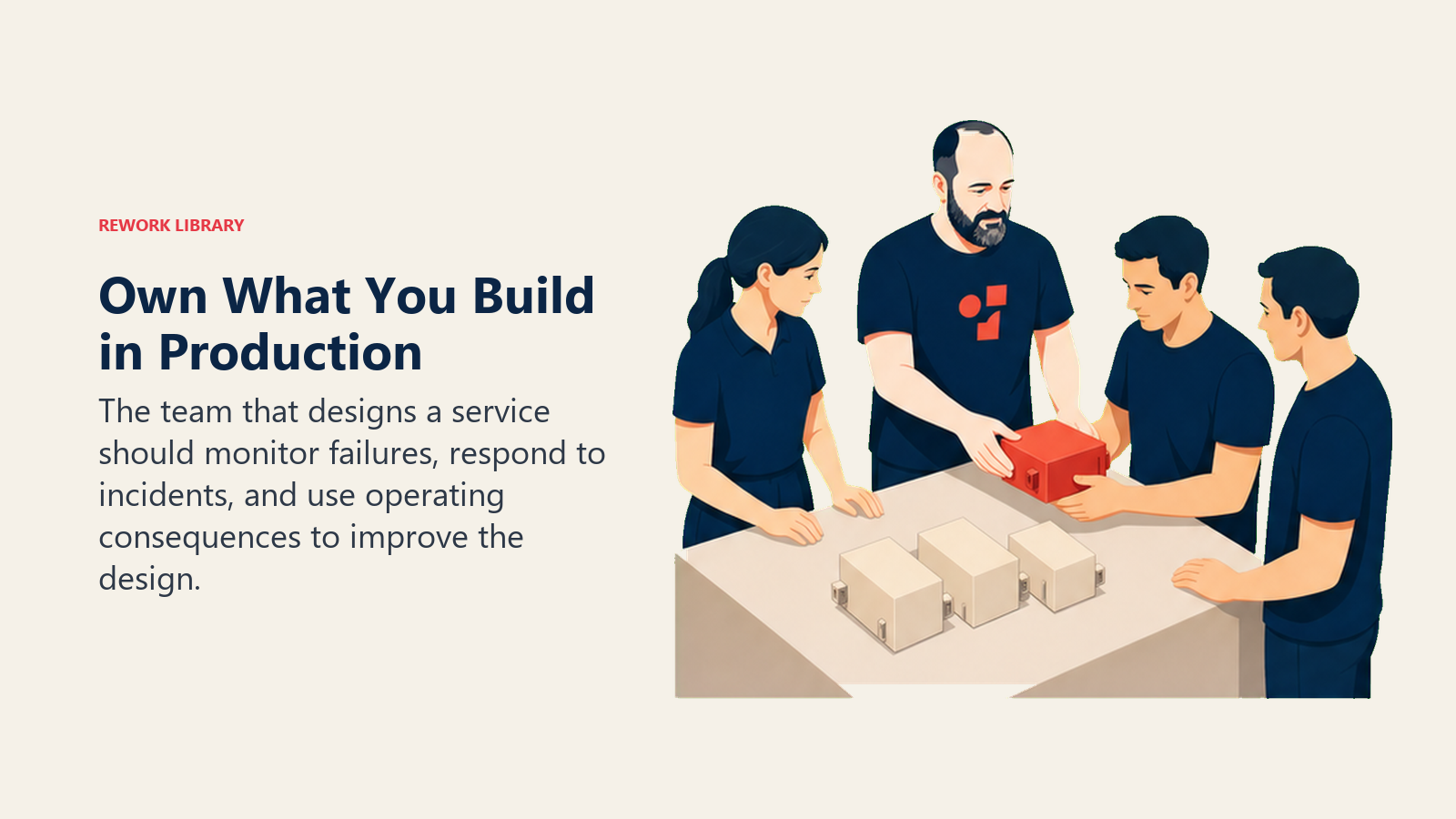
The argument is straightforward: software engineers make different design decisions when they know they'll be woken up at 2am if the system fails. Operational empathy, understanding how your code behaves in production, is built through owning the consequences of your decisions. When dev and ops are separate teams, the incentive gradient is misaligned: dev wants to ship features, ops wants stability, and the handoff between them becomes a negotiation rather than a shared responsibility.
"You build it, you run it" removes that handoff. The team that ships the feature also monitors it, responds to incidents, and fixes the problems that appear in production. That creates a direct feedback loop between design decisions and operational consequences, the fastest possible way to improve software reliability.
This model requires investment. You need to build monitoring, alerting, and on-call tooling that makes production ownership manageable for development engineers. You need to create a culture where production incidents are treated as learning opportunities rather than performance incidents, otherwise the on-call accountability creates the kind of fear that degrades the feedback loop. And you need to hire engineers who are willing to take that accountability, which not all engineers are.
Amazon made that investment, and AWS's reliability record reflects it. Andy Jassy, who built and led AWS before becoming Amazon CEO, scaled this ownership culture across thousands of engineers, demonstrating that the model works at a size far beyond what most observers thought possible when Vogels first articulated it. The companies that adopted "you build it, you run it" after seeing AWS succeed often adopted the phrase without the underlying infrastructure investment, which is why some implementations of the model burned out engineering teams.
3. The Annual CTO Letter
Every year at AWS re:Invent, Vogels publishes an open letter that reviews Amazon's commitments from the previous year, acknowledges where Amazon fell short, and sets out priorities for the coming year. He's been doing this since the early years of AWS.
That format, annual public commitment with explicit accountability review, is unusual for a corporate CTO. Most annual letters are forward-looking: here are our exciting plans for the next year. Vogels's letters are backward-looking first: here's what we said we'd do, here's what we did, here's what we didn't do and why.
The effect is twofold. Externally, it creates trust with the developer and enterprise customer community that AWS's commitments are made in good faith, because there's a public record of whether past commitments were honored. Internally, it creates a standard of accountability that cascades through the organization: if the CTO is publicly accountable for what he says AWS will deliver, every team contributing to those commitments understands that failure to deliver has real consequences.
The model is transferable. Most organizations make commitments in quarterly planning cycles and evaluate them in retrospectives that never surface publicly. Vogels's contribution is demonstrating that public accountability, stated specifically enough to be falsifiable, changes how seriously those commitments are taken.
What Werner Vogels Would Do in Your Role
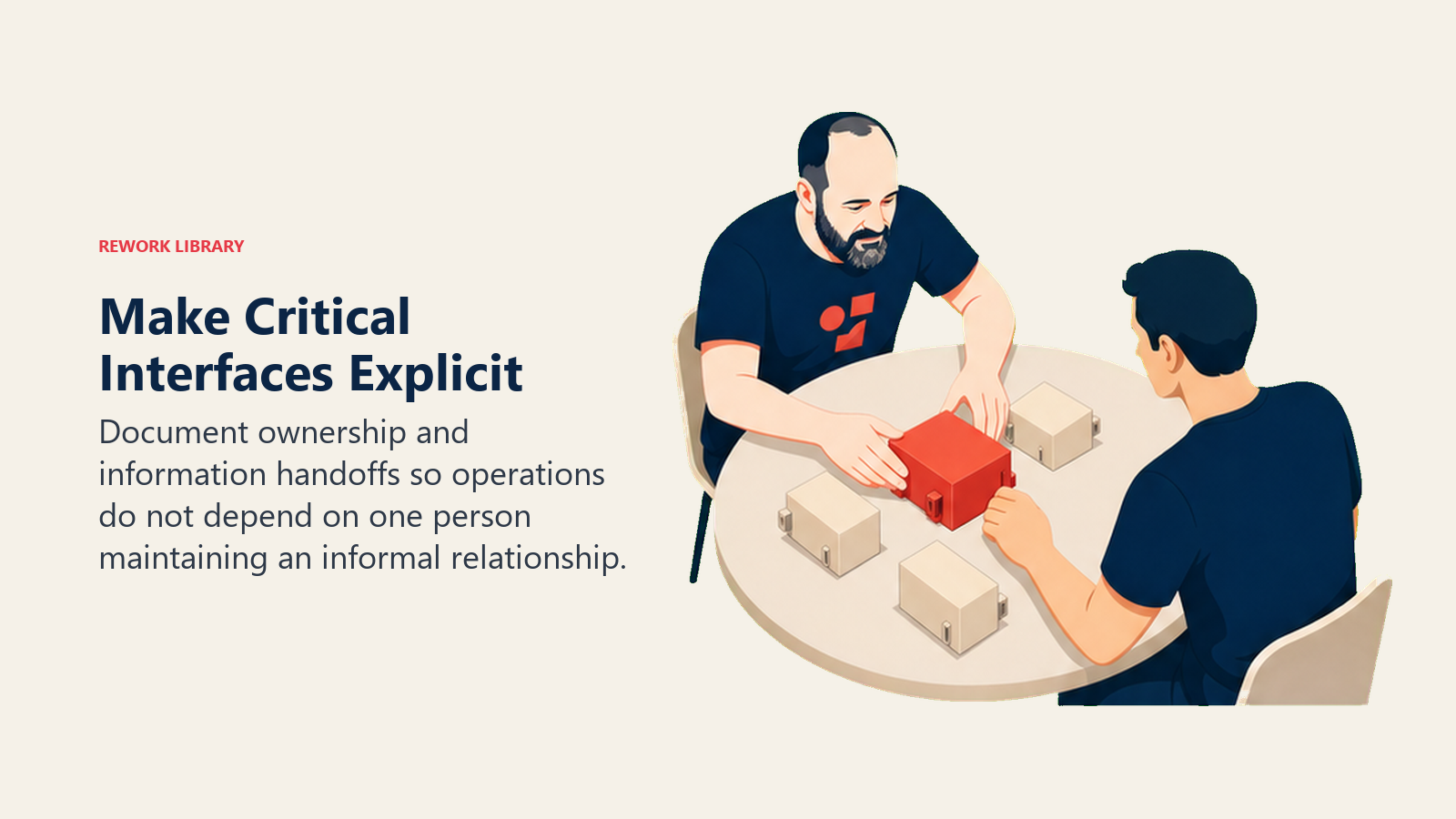
If you're a CEO, the API mandate principle applies to your organizational interfaces, not just your software. Every time one team gets information from another through an informal relationship rather than a documented process, you've created an undocumented dependency. It works fine until the person at the center of that relationship leaves, gets sick, or changes roles. Ask your COO to map the critical information flows in your organization and identify which ones exist only because specific people maintain them. Those are your operational single points of failure. Vogels would make the interface explicit and owned rather than informal and person-dependent.
If you're a COO, "you build it, you run it" has an operations-management equivalent: the people who design a process should experience the consequences of how it works. If your operations team designs onboarding workflows that customer success reps hate, and the operations team never talks to customers or reps directly, the feedback loop is broken. Build the equivalent of production ownership into your process design: whoever specifies a process should spend time in the system they specified, regularly enough to feel the friction they've created.
If you're a product leader, Vogels's "everything fails all the time" principle is worth applying to your product requirements. Most product requirements are written as happy-path specifications: what happens when everything works. The interesting requirements, the ones that determine your product's reliability, are the failure modes: what happens when the API call fails, when the user loses connectivity mid-flow, when the third-party integration returns unexpected data. Ask your team what percentage of your requirements document covers failure paths. If it's under 20%, you're designing a product that will behave unexpectedly in production in ways you didn't anticipate.
If you're in sales or marketing, Vogels's long-form public communication model has a direct application in account management and customer success. Most vendor communication is forward-looking: here's what we're building, here's our roadmap, here's what's coming. Vogels's approach is backward-looking first: here's what we committed to, here's what we delivered, here's where we fell short and why. Your most important enterprise customers would respond better to that format than to another quarterly roadmap deck. They know your product has gaps. The question they're actually asking is whether you're honest about them.
How Rework Translates Vogels's Engineering Doctrine to Small-Team Ownership
Vogels built his model on the assumption that you have the headcount to put every service behind a team that owns it in production. Most companies running on Rework don't. What Rework does is collapse the gap between "who designs the workflow" and "who runs it daily" inside a single operational surface, the person who sets up the CRM pipeline, automation rules, and escalation logic is the same person who gets paged when a deal stalls or an SLA breaks. That's the small-team version of "you build it, you run it," and it works because the failure signal and the fix live in the same tool. Rework also encodes the "everything fails all the time" posture into its defaults: every automation has visible failure states, every owner field is required, and every handoff is a logged event rather than a Slack DM. For a 10-person operations team, that's the realistic path to Vogels's reliability standard, you can't hire a platform team, but you can make ownership and failure visible by construction.
Notable Quotes & Lessons Beyond the Boardroom
From his All Things Distributed blog: "Everything fails all the time." That statement, which he's returned to in various forms across more than 20 years of writing, captures the core distributed systems principle: reliability isn't about preventing failures. It's about designing systems that continue to function when components fail. In software, that means graceful degradation, circuit breakers, and retry logic. In organizations, it means designing processes that continue to function when a key person is unavailable, a vendor fails to deliver, or a system goes down.
At re:Invent 2022, Vogels described the cloud's promise this way: "The ability to experiment at a low cost is one of the most powerful gifts technology has given us." That's not a marketing statement, it's an architectural one. When you can spin up infrastructure in minutes and pay only for what you use, the cost of a failed experiment drops to nearly zero. That changes what's worth trying. Most organizations with legacy infrastructure make bet-the-quarter decisions about infrastructure because the cost of being wrong is high. Vogels's argument is that the right response to uncertainty is to make the cost of experiments low, not to improve your predictions.
He also talks rarely about his own failures, which makes the instances when he does notable. In a 2022 interview, he acknowledged that Amazon's early database choices created significant migration debt that took years to resolve. Jeff Dean at Google faced similar architectural reckoning moments, the kind that happen when systems built for one scale stop working at the next, and the willingness to name those publicly is what separates engineers who become institutional knowledge from engineers who become institutional mythology. The willingness to name specific technical decisions that turned out to be wrong, not vaguely acknowledge that mistakes were made, is the intellectual standard he sets publicly and presumably holds internally.
Where This Style Breaks
"You build it, you run it" requires senior engineers who are willing to own production. It works poorly in cost-constrained startups with junior teams, because the on-call burden on a small team with limited experience can become unsustainable quickly. Amazon could invest in the monitoring, tooling, and incident response infrastructure that makes production ownership manageable. A 15-person startup can't.
The API-first mandate also slows down early-stage companies that need to move fast. Enforcing clean service boundaries before you know what your product is creates unnecessary overhead. Vogels's principles are optimized for organizations that already have product-market fit and are scaling complexity. They're the wrong tools for discovering product-market fit in the first place.
And platform lock-in is a legitimate criticism of the AWS architectural approach. When you build deeply on AWS primitives, DynamoDB, SQS, Lambda, moving to a different cloud or on-premise becomes expensive. Vogels's counter-argument is that operational efficiency now is worth portability cost later. That trade-off is real, and it's a decision every engineering leader should make explicitly rather than defaulting into.
Frequently Asked Questions about Werner Vogels's Engineering Philosophy
Who is Werner Vogels?
Werner Vogels (b. 1958) is the Chief Technology Officer of Amazon, a role he has held since 2005. Born in the Netherlands, he earned a PhD from Vrije Universiteit Amsterdam and worked as a distributed systems researcher before Amazon recruited him in 2004. He is the architect of AWS's distributed systems foundations and one of the most influential engineering leaders of the cloud era.
What is Vogels's 'everything fails all the time' principle?
"Everything fails all the time" is Vogels's core design axiom: in any sufficiently large system, individual components will fail constantly, disks, networks, services, power. The principle rejects reliability through prevention and demands reliability through graceful degradation. Engineers must design systems that continue functioning when components fail, using techniques like retries, circuit breakers, redundancy, and eventual consistency rather than assuming the happy path.
What is 'you build it, you run it'?
It is the doctrine, articulated by Vogels in a 2006 ACM Queue interview, that the same team which designs and ships a service also operates it in production. They monitor it, respond to its pages at 2am, and fix its incidents. The model collapses the traditional dev/ops handoff, aligns incentives around reliability, and became one of the foundational ideas of the DevOps movement.
How did Vogels architect AWS?
Vogels didn't invent AWS as a product, but he operationalized the internal architecture discipline that made it possible. He enforced the API mandate, every team must expose functionality only through documented service interfaces, and championed independently-deployable services with clear ownership. Those internal services (compute, storage, queues, databases) were reliable and clean enough to expose externally, which became AWS. He also co-authored the 2007 Dynamo paper that underpins DynamoDB.
What is eventually-consistent distributed systems?
Eventual consistency is a data consistency model in which updates to a distributed system propagate to all replicas over time rather than instantly. Reads may temporarily return stale data, but given no new updates, all replicas converge to the same value. Vogels formalized the model in his influential 2008 ACM paper "Eventually Consistent," arguing it is the right trade-off for globally-distributed systems where strict consistency would kill availability. DynamoDB, S3, and much of AWS rest on this idea.
What can engineering leaders learn from Werner Vogels?
Three things translate beyond AWS. First, design for failure by default, assume components will break and make degradation a product feature. Second, collapse the dev/ops handoff so the team that builds a system owns it in production. Third, practice long-form public accountability, Vogels's annual re:Invent letters review what was promised and what was delivered, creating a standard of intellectual honesty that cascades through the organization.
For related reading on engineering architecture and scaling, see Linus Torvalds Leadership Style, Andy Grove Leadership Style, and Martin Fowler Leadership Style.

On this page
- The Vogels You-Build-It-You-Run-It Model
- Leadership Style Breakdown
- Key Leadership Traits
- The 3 Decisions That Defined Werner Vogels
- 1. The API Mandate
- 2. "You Build It, You Run It"
- 3. The Annual CTO Letter
- What Werner Vogels Would Do in Your Role
- How Rework Translates Vogels's Engineering Doctrine to Small-Team Ownership
- Notable Quotes & Lessons Beyond the Boardroom
- Where This Style Breaks