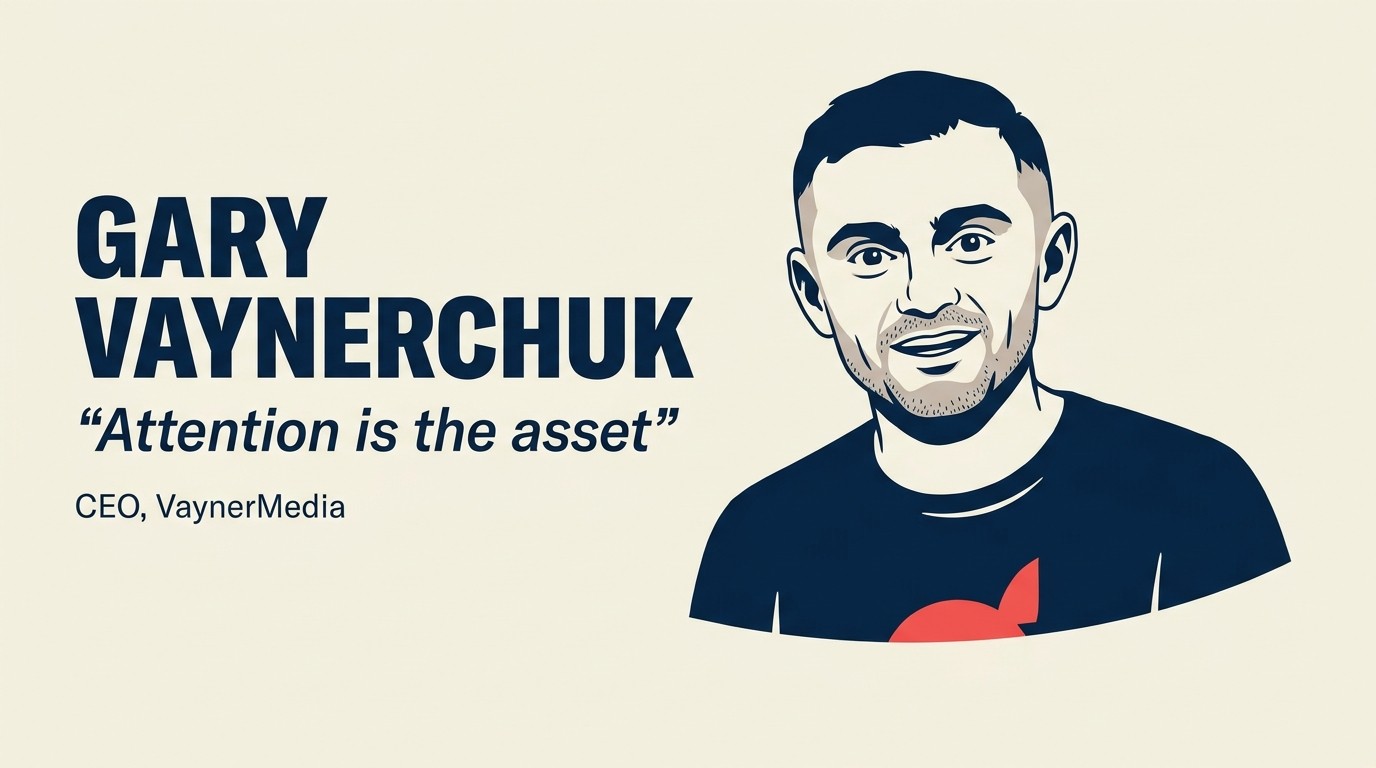
Gary Vaynerchuk Leadership Style: Attention as the Only Asset That Matters
Turn this article into takeaways for your work.


Each assistant summarizes the article only for you and suggests best practices for your work.
In 2006, Gary Vaynerchuk was running his father's liquor store in Springfield, New Jersey. The store did $3 million a year. He launched Wine Library TV, a daily video show about wine posted to YouTube, with no production budget, no audience, and no obvious business model. He did it anyway, five days a week, for the next five years.
By 2010, the store was doing $60 million a year. He'd grown it 20x without a single dollar of paid advertising, using email newsletters, community engagement, and daily video content on a platform that most brands hadn't taken seriously yet.
That's the core of what Gary Vaynerchuk teaches, and it's not about wine or video or YouTube specifically. It's about paying attention to where attention is underpriced and acting before the price adjusts. He did it with YouTube in 2006. He did it with Twitter and Facebook in 2008 and 2009. He did it with Instagram in 2011 and TikTok in 2018. Each time, he was early enough that the cost of reaching people was a fraction of what it became 24 months later.
He co-founded VaynerMedia in 2009 with his brother AJ. The agency now serves Fortune 500 clients including PepsiCo, Johnson & Johnson, and the NFL, with revenues exceeding $100 million annually. His thesis hasn't changed: attention is the asset, and the question is always where you can get it cheapest.
Key Facts About Gary Vaynerchuk
- Born: November 14, 1975, in Babruysk, Belarus (emigrated to the US in 1978)
- Wine Library: Scaled his family's liquor store from $3M to $60M in annual revenue (2006–2010) via Wine Library TV on YouTube
- VaynerMedia: Co-founded with brother AJ Vaynerchuk in 2009; 1,000+ employees with offices in New York, LA, London, and Singapore
- Marquee clients: PepsiCo, Anheuser-Busch, Johnson & Johnson, the NFL, and General Electric, competing directly with legacy shops like Ogilvy
- Bestselling author: Crush It! (2009), The Thank You Economy (2011), Jab, Jab, Jab, Right Hook (2013, New York Times bestseller), #AskGaryVee (2016), Crushing It! (2018), Twelve and a Half (2021)
- Social reach: 50M+ followers across Instagram, TikTok, YouTube, X, LinkedIn, and Facebook combined
- Angel investor: Early positions in Facebook, Twitter, Tumblr, Uber, Venmo, Snapchat, and Coinbase, most before Series A
- VeeFriends: Launched NFT/IP project in May 2021; one of the top-grossing NFT collections before the 2022 market collapse
The Attention Economy Doctrine (The Jab Jab Jab Right Hook Model)
The Attention Economy Doctrine holds that attention is the only asset that matters in modern business, and that it is priced like any market, cheapest where advertiser demand has not yet caught up to user presence. The Jab Jab Jab Right Hook Model operationalizes this: give value repeatedly (jabs) on the platform where attention is underpriced, then make the ask (right hook) only after goodwill compounds into permission. Winning requires both the timing instinct to arrive early and the stamina to deliver daily value before monetizing.
Leadership Style Breakdown
| Style | Weight | How it showed up |
|---|---|---|
| Platform-First Mover | 55% | Vaynerchuk's pattern across 20 years is consistent: identify a new platform while it's still underpriced, build a significant audience before the platform raises ad rates or gets crowded, and then use that audience as distribution for whatever comes next. He's described this explicitly as "attention arbitrage", the same asset allocation logic that drives financial arbitrage, applied to audience attention. Wine Library TV wasn't about wine; it was about capturing early YouTube audience at zero cost. VaynerMedia's early advantage was that its founder could explain to Fortune 500 CMOs exactly how platforms he'd already used personally would behave as they scaled. |
| Volume-as-Strategy Operator | 45% | GaryVee produces content at a pace that most individuals and most organizations can't match. His "document don't create" framework is the operational logic behind this: treat your daily business decisions as content rather than generating original content from scratch. That approach produces volume, his team captures him throughout the day and packages it into dozens of pieces of content across platforms. The philosophy is that consistency and volume build trust in a way that occasional high-production-value pieces don't. Whether that's true depends on the platform and the audience, but it's how he built the largest personal brand in the marketing and entrepreneurship space. |
The combination is unusual because most platform-first thinkers are early adopters who can't execute at scale, and most volume operators don't have the timing instinct. Vaynerchuk has both, which is why he's been able to replicate the Wine Library playbook across multiple platforms over two decades rather than getting it right once.
Key Leadership Traits
| Trait | Rating | What it means in practice |
|---|---|---|
| Platform timing instinct | Exceptional | He was an early investor in Twitter, Tumblr, Uber, Venmo, Snapchat, and Facebook, most before their Series A rounds. He also called TikTok as the dominant platform for organic reach in 2018, two years before most brands had accounts. That's not luck across 15+ calls; it's a consistent ability to recognize when a platform is at the point where engagement is high but advertiser demand is low. Most executives wait for a platform to prove itself before committing. Vaynerchuk's thesis is that by the time it's proven, the arbitrage is gone. |
| Jab-before-right-hook patience | Very High | The Jab Jab Jab Right Hook framework, from his 2013 book of the same name, is essentially a content strategy framework built around delayed reciprocity. Give value repeatedly, inform, entertain, help, before you ask for anything. Most brands do the opposite: every piece of content is a soft sell or a direct call to action. Vaynerchuk's argument is that brands that build genuine goodwill through consistent value delivery convert better when they finally ask because they've earned the right to ask. |
| Self-awareness about his own loudness | High | Vaynerchuk is unusually self-aware about the fact that his personal brand is a business asset and a business liability simultaneously. He's loud, direct, and profane in a way that builds strong affinity among his audience and creates equally strong skepticism among people who find that style grating. He doesn't try to moderate it, he's explicitly argued that authenticity at the risk of repelling some people is better than blandness that attracts nobody. That's a coherent personal brand strategy, even if it's not replicable for every operator. |
| Clouds and Dirt thinking | High | The "Clouds and Dirt" framework is about operating at two levels simultaneously: macro vision that spans years (clouds) and daily execution that spans hours (dirt). He argues that the messy middle, quarterly strategy, annual planning, 18-month roadmaps, is where most business energy gets absorbed without producing either vision clarity or operational results. You need both the long view and the daily execution. The middle layer tends to produce overhead without output. |
The 3 Frameworks That Defined Gary Vaynerchuk
3 Jab Jab Jab Right Hook: Give Before You Ask
The Jab Jab Jab Right Hook framework, published as a book in 2013, is the most practically applicable of Vaynerchuk's ideas for anyone running a content-driven marketing operation. The metaphor is from boxing: a jab is a quick, light punch that sets up the right hook, the big punch that ends the fight. In content terms, a jab is value-first content (a how-to article, an entertaining video, a genuinely useful insight) and the right hook is the ask (buy this, sign up here, schedule a call).
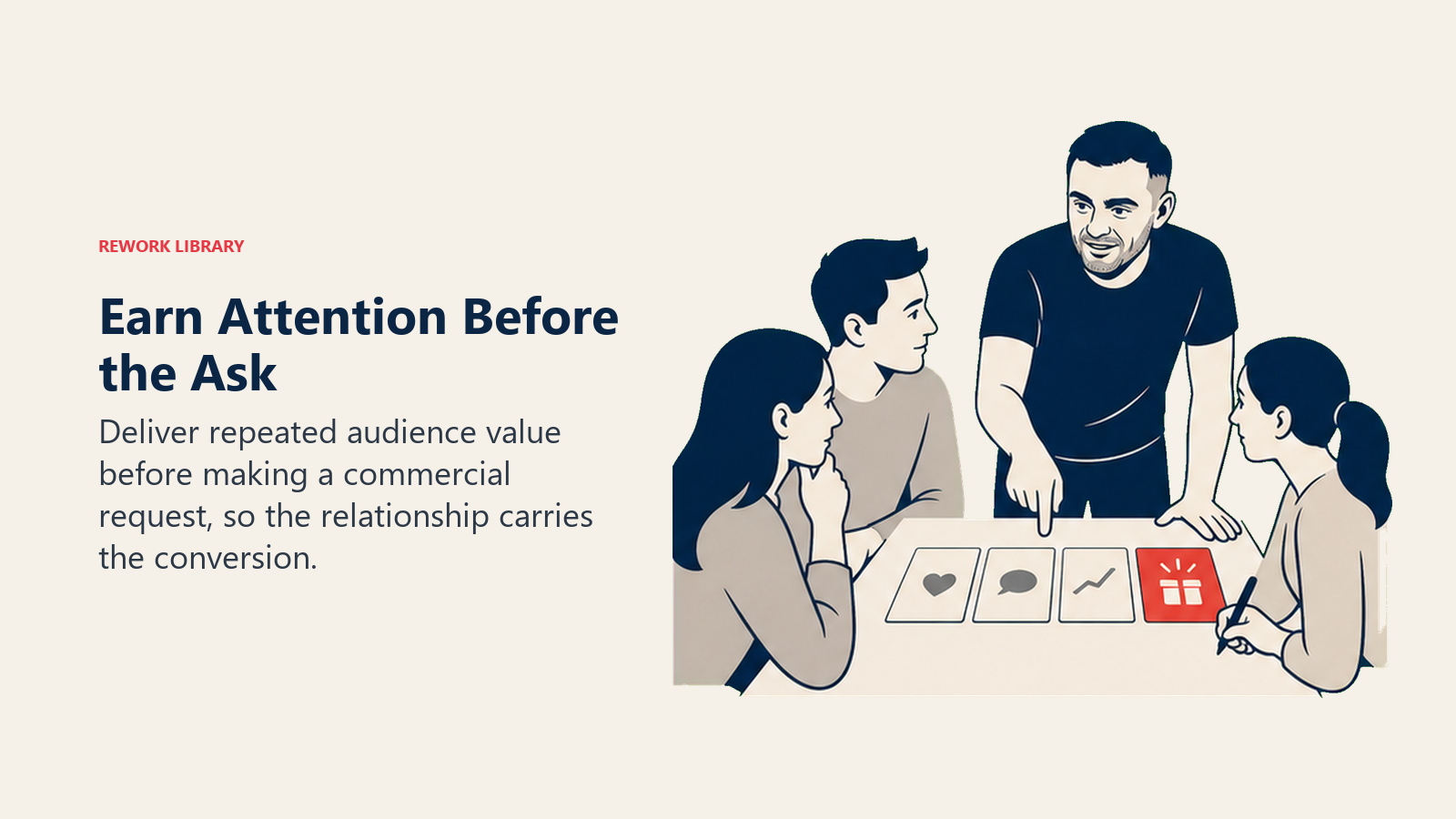
Most brand content on social media is a right hook with no jabs. It's promotional. It asks for attention without having earned it. Vaynerchuk's argument is that audiences have become expert at recognizing and ignoring this pattern. They follow accounts that consistently give them something useful or entertaining, and they convert when those accounts occasionally ask for something in return.
The operational discipline the framework requires is uncomfortable for most marketing teams. It means producing three, four, or five pieces of pure value content for every piece of promotional content, and measuring the promotional content's performance against the context of the value content that preceded it. Most teams reverse the ratio because they're measured on leads generated, not trust built. Vaynerchuk would say that's a measurement problem, not a content strategy problem.
For B2B operators, the framework translates directly: before your next product demo request email, ask how many genuinely useful things you've sent that prospect in the last 30 days. If the answer is zero, the conversion rate is going to reflect that.
2. Clouds and Dirt: Vision Plus Execution, Skip the Middle
The Clouds and Dirt model is Vaynerchuk's critique of middle-management planning culture, and it's his most useful framework for operators at the executive level. The clouds are long-term strategic vision: where is the market going in five years, where is attention moving, what platform or channel is underpriced right now? The dirt is daily execution: what did you ship today, who did you call, what content went out?
The messy middle, the annual strategic planning cycle, the quarterly review process, the 18-month product roadmap, absorbs enormous organizational energy, according to Vaynerchuk, and produces neither clarity nor output. It's a compromise between vision and execution that delivers neither. Organizations with strong clouds and strong dirt, but minimal middle, move faster and produce more because they're not spending a third of their time in planning cycles that delay execution without improving it.
This isn't an argument against planning. It's an argument about what planning is for. If your quarterly planning process produces a 40-page document that everyone ignores in month two, you have a middle-management performance problem, not a planning problem. Vaynerchuk's prescription is to shorten the planning layer drastically, increase the frequency of direction-setting conversations at the top, and push execution authority as far down the organization as possible.
The counterpoint is that "skip the middle" advice is much easier to give from a founder position than to execute inside a complex organization. COOs who actually run planning cycles will recognize that the middle layer exists partly because without it, the clouds and dirt drift apart. That's a real tension Vaynerchuk's framework doesn't resolve.
3. Attention Arbitrage: Go Where It's Cheap Before Everyone Else
The attention arbitrage thesis is the unifying logic behind everything Vaynerchuk has done since 2006. The argument is: every platform's advertising value is a function of supply (advertiser demand) and demand (user attention). When a platform is new and growing but advertiser demand is still low, the cost of reaching a given audience size is much cheaper than it will be when the platform matures and brand budgets follow the audience.

Vaynerchuk's pattern is to identify platforms at that early stage, build a large organic audience before the price adjusts, and then either use that audience directly or build businesses that help other brands do the same thing. VaynerMedia's early growth was explicitly built on this: he could sell Fortune 500 brands a credible social media strategy in 2009 and 2010 because he'd already executed one personally, and most of his competitors were still explaining why social media wasn't a real marketing channel.
The practical question for any operator is: where is attention cheap right now? That requires looking at platforms and channels where audience engagement is high but advertiser demand hasn't caught up. In 2025, that analysis might point to audio, niche creator communities, or emerging international platforms rather than the established channels where ad inventory is expensive and organic reach is near zero. The specific answer changes every 18 to 24 months. The discipline of asking the question doesn't.
What Gary Vaynerchuk Would Do in Your Role
If you're a CEO, Vaynerchuk's question for you is whether you're personally visible in your category. He's argued consistently that in a world where attention is fragmented and brand trust is low, the founder or CEO's personal brand is the most credible signal a company has. That doesn't mean you need to be on TikTok, it means you need to be somewhere your buyers go, saying things worth reading or watching. Most CEOs outsource this completely to the marketing team and then wonder why their brand feels generic. Vaynerchuk would say the CEO's authentic voice is worth more than any agency-produced content calendar.
If you're a COO, the Clouds and Dirt framework has direct operational implications. Look honestly at your planning and review cadence: how many hours per month does your leadership team spend in planning processes that don't produce either strategic clarity or faster execution? That number is usually higher than anyone admits. Vaynerchuk's prescription is to compress planning cycles, push more execution decisions down the org, and use the time saved to actually increase the frequency of direction-setting conversations at the top. Quarterly planning that takes 60 person-days to produce an output that gets revised in 30 days is a volume-of-middle problem.
If you're a product leader, the jab-right-hook logic applies to your product's onboarding and activation flow. Before you ask a new user to do the hard thing, invite a teammate, integrate a tool, set up a workflow, how much value have you delivered? Most product onboarding sequences are impatient. They ask for the right hook before throwing any jabs. Vaynerchuk's framework suggests mapping your onboarding against the value-ask ratio: at each step, are you giving the user something useful, or are you asking them to do work that primarily benefits you?
If you're in sales or marketing, the attention arbitrage question is worth running as a quarterly exercise: which channels in your category are currently underpriced, and what would it take to build a meaningful presence there before your competitors do? The channels that are easy and obviously effective are usually the most crowded and most expensive. The channels that are slightly awkward or not yet proven are often where a 12-month early-mover advantage exists. Most marketing teams default to the proven channels and compete on budget rather than timing. That's a Vaynerchuk category error.
How Rework Applies Vaynerchuk's Attention-First Thinking
Vaynerchuk's argument that attention-first marketing beats paid-acquisition shortcuts is baked into how Rework approaches its own category. Instead of leading with gated demos and bottom-funnel ad spend, we publish hundreds of executive-depth articles across leadership, sales operations, and lead management, the jabs, daily across six languages so professionals find us organically where their attention is underpriced today. The right hook, product trial, pricing, the Sales Engine from $69/month and the Process Engine from $99/month, billed yearly, only appears after the reader has pulled value from multiple pieces. Managing this kind of high-volume content operation is exactly what Rework is built for: planning the editorial calendar, tracking which jabs earn attention, routing conversion signals to sales without breaking the value-first rhythm. The patience to give before asking is the moat. Platforms change; the doctrine doesn't.
Notable Quotes & Lessons Beyond the Boardroom
"All your ideas may be solid or even good... but you have to actually execute on them for them to matter." He's made this point in various forms throughout Crush It!, Jab Jab Jab Right Hook, and his YouTube content. The consistent message is that the asymmetry between people who have good ideas and people who execute on them is far larger than the asymmetry between people with good ideas and people with great ones. Most operators have more good ideas than they have execution capacity. The constraint is almost never insight.
"Without hustle, talent will only carry you so far." From #AskGaryVee, 2016. The hustle thesis is the most frequently criticized part of his public brand, it's accused of romanticizing overwork and ignoring that volume-first strategies depend on personal stamina that not every operator has or should want. That critique has some merit. But the underlying principle, that building an audience, a platform, or a business from zero requires consistent output over an extended period rather than occasional excellence, is accurate and worth taking seriously regardless of how you feel about the word hustle.
The other honest lesson from Vaynerchuk's career is his NFT chapter. His VeeFriends project, launched in 2021, generated significant revenue and attention in the NFT peak. By 2022 and 2023, as NFT valuations collapsed, it became a credibility liability. He maintained his position publicly and defended his long-term thesis. Whether that was conviction or sunk-cost thinking is still an open question. The lesson isn't that you shouldn't make bets. It's that the same instinct that makes you early on the upside makes you hold too long on the downside.
Where This Style Breaks
Vaynerchuk's model depends on a personal brand large enough to generate organic reach, most executives don't have that and can't build it fast enough to matter in a 12-month planning cycle. His volume-first content strategy is optimized for consumer social platforms, not B2B enterprise sales cycles where the buyer is a committee rather than an individual scrolling a feed. Clouds and Dirt skips the operational middle where most COOs actually live and where most scaling failures originate. And his "document don't create" advice produces enormous content volume but not always content worth consuming, the signal-to-noise ratio in GaryVee content is low, and replicating his volume without his specific platform timing instincts often produces noise, not brand equity.
Frequently Asked Questions about Gary Vaynerchuk's Marketing Philosophy
Who is Gary Vaynerchuk?
Gary Vaynerchuk (born 1975 in Babruysk, Belarus; raised in New Jersey) is an entrepreneur, author, and investor who scaled his family's Wine Library from $3M to $60M using early YouTube and email marketing, co-founded VaynerMedia in 2009 with his brother AJ, and has written six bestsellers including Crush It! and Jab, Jab, Jab, Right Hook. He commands more than 40 million followers across platforms and has been an early-stage investor in Facebook, Twitter, Uber, Venmo, Snapchat, and Coinbase.
What is Vaynerchuk's attention thesis?
His thesis is that attention is the only asset that matters in modern business, and that it trades at different prices on different platforms. A platform is cheapest in the window when users have arrived but advertisers haven't, that's the arbitrage. Brands that build organic audiences during that window reach people at a fraction of the cost they'll pay once the platform matures. Winning means pattern-matching that window over and over, not picking one channel forever.
What is Jab Jab Jab Right Hook?
Jab Jab Jab Right Hook is Vaynerchuk's 2013 bestseller and the operating system behind his content strategy. Jabs are value-first posts, useful, entertaining, informative, that ask for nothing. The right hook is the eventual business ask (buy, subscribe, book a demo). The ratio matters: roughly three to four jabs per right hook, because audiences convert on the ask only after goodwill has compounded enough to earn it.
How did VaynerMedia grow so fast?
VaynerMedia launched in 2009 when most Fortune 500 brands still treated social media as an experiment. Vaynerchuk could walk into pitches having already executed the Wine Library playbook personally, which gave him credibility his competitors couldn't match. The agency rode the industry's shift into social-first advertising, layered in creative shops and performance media, and now generates over $300M in revenue with more than 1,000 employees across New York, LA, London, and Singapore, serving PepsiCo, Johnson & Johnson, Anheuser-Busch, and the NFL.
What does GaryVee say about patience?
Vaynerchuk's most-cited framing is "macro patience, micro speed", move fast on daily execution, but judge results on a 10- to 20-year horizon. His book The Thank You Economy and his repeated "50-year plan for VaynerMedia" statements argue that attention and trust compound slowly but, once built, create a moat competitors can't buy with paid media. Most entrepreneurs, in his view, quit the jab cycle two or three years too early.
What can modern marketers learn from Gary Vaynerchuk?
Three durable lessons. First, audit where attention is underpriced in your category right now, it's rarely the proven, crowded channels. Second, ship value-first content consistently before making the ask; the jab-to-right-hook ratio is a discipline, not a nice-to-have. Third, don't outsource the founder or executive voice to a content calendar, authentic, personally visible leadership is still the single most credible signal a B2B brand can send, and it's what Vaynerchuk has quietly turned into VaynerMedia's largest acquisition channel.
For related reading, see Neil Patel Leadership Style, David Ogilvy Leadership Style, Philip Kotler Leadership Style, Seth Godin Leadership Style, Neil Rackham Leadership Style, and Brian Chesky Leadership Style.

On this page
- Key Facts About Gary Vaynerchuk
- The Attention Economy Doctrine (The Jab Jab Jab Right Hook Model)
- Leadership Style Breakdown
- Key Leadership Traits
- The 3 Frameworks That Defined Gary Vaynerchuk
- 3 Jab Jab Jab Right Hook: Give Before You Ask
- 2. Clouds and Dirt: Vision Plus Execution, Skip the Middle
- 3. Attention Arbitrage: Go Where It's Cheap Before Everyone Else
- What Gary Vaynerchuk Would Do in Your Role
- How Rework Applies Vaynerchuk's Attention-First Thinking
- Notable Quotes & Lessons Beyond the Boardroom
- Where This Style Breaks