Mary Barra Leadership Style: How an Engineer-CEO Steered GM Through Crisis and Into EVs
Turn this article into takeaways for your work.


Each assistant summarizes the article only for you and suggests best practices for your work.
Key Facts: Mary Barra (born 1961) became CEO of General Motors on January 15, 2014, the first woman to lead a Big Three automaker. Within weeks she was managing the ignition-switch recall crisis, ultimately linked to 124 deaths and a $2.5 billion combined cost in fines, settlements, and recall expenses. A trained electrical engineer (Kettering University, formerly General Motors Institute), she spent 30+ years inside GM before the top job. She added Chair of the Board in January 2016, committed $35 billion to the Ultium EV platform in 2021, and invested heavily in Cruise autonomous-vehicle technology. Her engineer-first operating model defined GM's post-bankruptcy era.
The Engineer-CEO Turnaround Doctrine
The Engineer-CEO Turnaround Doctrine is a leadership model where technical fluency at the top is used to rebuild institutional credibility before making structural bets. The CEO owns inherited crises transparently, restructures escalation paths so problems surface early, and only then deploys concentrated capital into long-horizon transformation. Accountability precedes ambition, you can't ask an organization to absorb a $35 billion pivot until it trusts leadership to tell the truth about a $2.5 billion failure.
Most new CEOs spend their first six weeks getting oriented. Mary Barra spent hers in front of Congress. She became General Motors' CEO on January 15, 2014, the first woman to lead a Big 3 automaker, and within weeks was testifying before the US Senate about an ignition-switch defect linked to 124 deaths that GM had known about internally for over a decade. The company was paying $900 million in DOJ settlements. The press was brutal.
That opening defines her leadership story more than any product launch or strategic pivot. How a leader handles a crisis they didn't create, on day one, with every camera pointed at them, tells you everything about their actual operating model. Barra didn't deflect, lawyer up publicly, or run a PR cleanup campaign. She went direct, acknowledged the failure clearly, and set up a process to fix it. Then she stayed.
Over the next decade she killed Opel, pulled GM out of Australia, India, and Russia, pledged $35 billion to electric vehicles, and kept GM profitable through a global chip shortage, a UAW strike that cost the company $1.1 billion, and the full commoditization of the truck business. She's not the most glamorous CEO in manufacturing. But she's one of the most durable.
Leadership Style Breakdown
| Style | Weight | How it showed up |
|---|---|---|
| Accountable Operator | 60% | Took direct ownership of the ignition-switch crisis from week one. Restructured safety reporting so engineers could escalate problems without bureaucratic filtering. Made the organizational accountability structure visible rather than diffused across committees. |
| Transformational | 40% | Committed GM to a fully electric lineup by 2035, a structural bet that required abandoning profitable ICE investment cycles. Exited four international markets to concentrate capital. Built the Ultium battery platform as the company's long-term technical foundation rather than licensing from a third party. |
The 60/40 split isn't about time allocation. It's about sequencing. Barra established operational credibility and accountability first, then used that credibility to make transformational bets that would have been impossible without it. You can't ask an organization to absorb a $35 billion bet on an uncertain technology when it doesn't trust its own leadership to tell the truth about problems. The discipline-first-then-transformation sequence echoes what Jack Welch built at GE, establish hard operational standards before making structural bets on the future.
Key Leadership Traits
| Trait | Rating | What it means in practice |
|---|---|---|
| Crisis transparency | Exceptional | Barra set up an independent compensation fund for ignition-switch victims, appointed an external attorney (Kenneth Feinberg) to administer it, and testified personally before Congress twice. She didn't hide behind legal process. That approach cost GM money in the short term but built institutional credibility that held up through subsequent scrutiny. |
| Engineering discipline | Very High | Barra spent 30+ years at GM in engineering and manufacturing before the CEO role, including stints running global product development and manufacturing. Her background, and the collaborative leadership style it produced, is detailed in her Wikipedia profile, which traces her path from GM's General Motors Institute co-op program at age 18 to the corner office. She understands the technical decisions behind the products GM sells. That fluency means she can't be managed by specialists who speak a different language. It also means she asks harder questions about product quality than most non-engineer CEOs would. |
| Long-horizon thinking | Very High | The EV commitment, made in 2021, won't be fully validated until 2030 or beyond. Barra made that bet in an environment where Tesla's head start was significant, where battery costs were still high, and where the union relationship was tense. She held the direction even as execution slipped against original timelines. Whether it pays off is still open. The commitment itself was a leadership decision. |
| Stakeholder credibility | High | Running a company with 163,000 employees, a unionized workforce, multiple national regulators, environmental advocates, and institutional investors who want quarterly returns requires managing contradictory pressures simultaneously. Barra hasn't made everyone happy. But she's built enough credibility with each constituency to avoid the kind of coalition collapse that ended previous GM regimes. |
The 3 Decisions That Defined Mary Barra as a Leader
1. Owning the Ignition-Switch Recall (2014)
The ignition-switch defect had been known inside GM since at least 2004. The switch could be knocked off by a heavy keychain or knee bump while driving, which cut power to airbags and power steering. GM engineers had flagged it internally, but the problem was passed between departments without being escalated for a recall. By 2014, the defect was linked to 124 deaths.
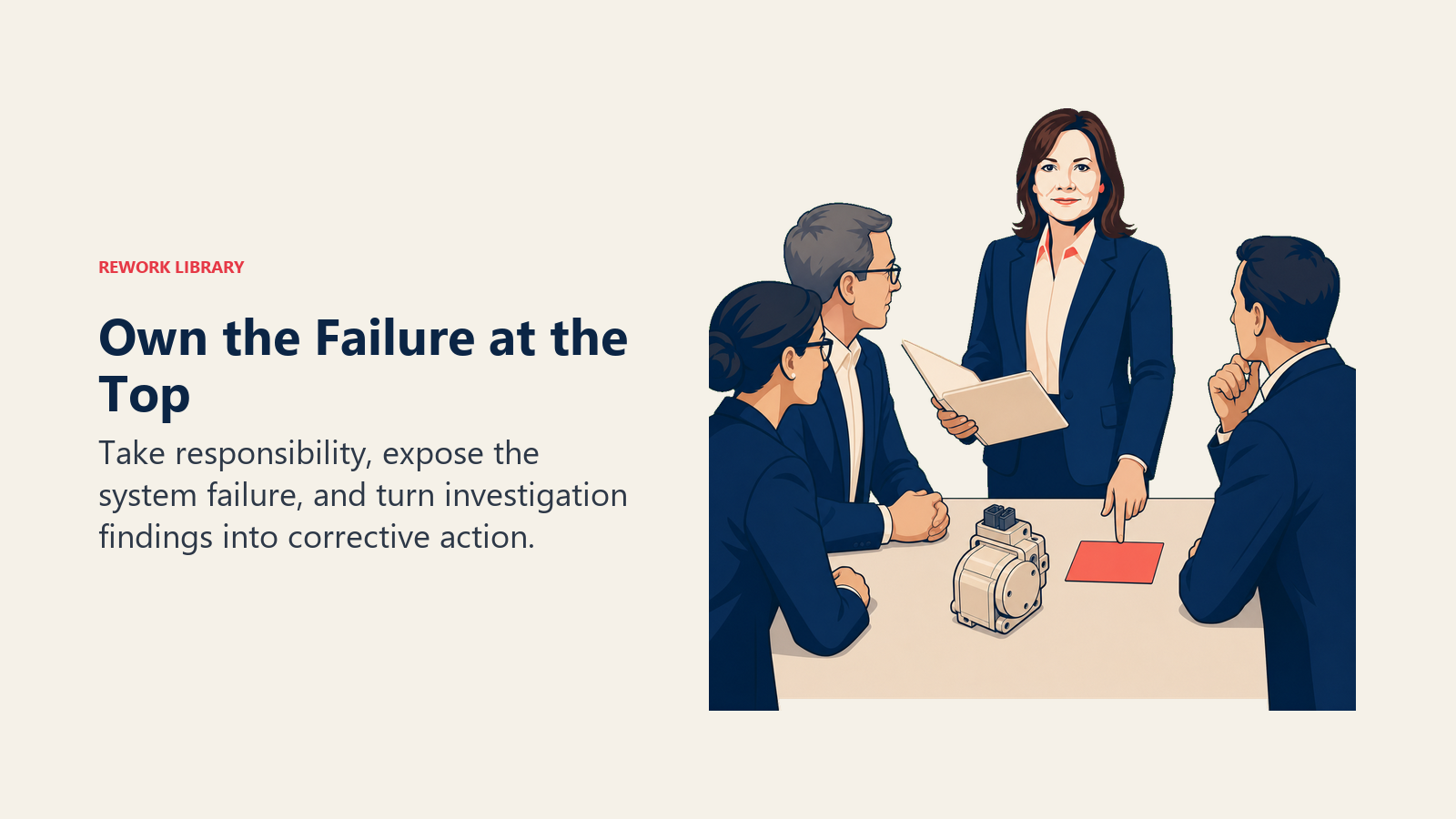
Barra became CEO six weeks before the recall was made public. She could have argued she'd just arrived. She didn't. She established an internal compensation fund, hired former US Attorney Anton Valukas to conduct an independent investigation, released his 315-page report publicly (which named executives and described the internal failures in detail), and appeared before Congress personally rather than sending lawyers. Harvard Business Review called this approach a model for crisis ownership, noting in its analysis that CEOs who own the crisis rather than manage it tend to rebuild institutional trust faster.
The Valukas report was damning. It described a "culture of cost-cutting over quality" and named specific individuals who knew about the defect and didn't escalate. Barra released it anyway.
What this shows: owning a crisis you didn't create is harder than owning one you did. There's a real temptation to frame it as a legacy problem, let the legal team control the narrative, and wait for the news cycle to move on. Barra chose the opposite posture, and it worked because it was credible. The Congressional testimony was painful, but it was a controlled burn. The alternative, a years-long drip of leaked documents and legal discovery, would have been far more damaging.
There's also a structural lesson buried in the Valukas report. The report found that GM had a "pattern of incompetence and neglect" but also that the company's culture made it nearly impossible for engineers to escalate safety issues without having to win multiple bureaucratic arguments. Barra changed the reporting structure so safety engineers had a direct line to the board's audit committee, bypassing the normal management chain. That's not a cultural change. It's an organizational change that makes the cultural norm enforceable.
For you: if you inherit a problem from a predecessor, the cleanest move is usually the most transparent one. Document it fully, put someone independent in charge of the review, and don't let your lawyers determine what becomes public. And then change the system that allowed the problem to exist, not just the people who were in the room when it happened.
2. Committing GM to an All-EV Lineup by 2035
In January 2021, GM announced it would phase out internal combustion engines across its entire global lineup by 2035. To back it, Barra committed $35 billion in EV and autonomous vehicle investment through 2025. She also announced the Ultium battery platform, a proprietary modular architecture that GM would use across its EV lineup rather than buying battery technology from suppliers.
The strategic logic was clear: GM was losing the EV narrative to Tesla, and the internal combustion engine business was going to get regulated away in its most important markets within two decades. The choice was to invest now and shape the transition, or invest later and be shaped by it.
Execution has been harder than the announcement. The Chevy Bolt experienced battery fires that led to a $1.8 billion recall from LG Energy Solution. The Silverado EV and Blazer EV launched later than planned and with software problems. The 2023 UAW strike disrupted production. The original plan to produce 400,000 EVs in North America by mid-2024 was revised downward significantly.
But the strategic bet itself was sound. Barra's approach to the execution failures was consistent with her crisis transparency model: acknowledge the problems, fix the root causes where possible, and don't pretend the original timeline was realistic when it clearly wasn't.
The Ultium decision specifically deserves attention. Rather than licensing battery technology from CATL or LG and getting to market faster, Barra committed GM to building its own battery chemistry and pack architecture. That choice meant slower ramp but higher long-term control. It also meant GM had to build manufacturing competency that didn't exist internally, including a $2.3 billion joint-venture gigafactory with LG Energy Solution in Ohio. That gigafactory was announced in 2019 and began production in 2022. The ramp took longer than expected. But the asset now belongs to GM in a way that licensing never would.
For you: the lesson isn't about EVs. It's about making a directional commitment before the market forces you to, and then owning the critical technology rather than renting it. Companies that commit to a transformation on their own terms, and build proprietary capability in the process, tend to end up in stronger positions than those who license their way to market. Messy execution over 4 years beats clean execution with permanent dependency.
3. Exiting Unprofitable International Markets
Between 2015 and 2017, GM exited Australia, New Zealand, Thailand, India, South Africa, and Russia, and sold its European Opel/Vauxhall operations to PSA Group for about $2.3 billion. These weren't markets where GM was a minor player. Opel had been part of GM since 1929. Holden had been in Australia since 1931.
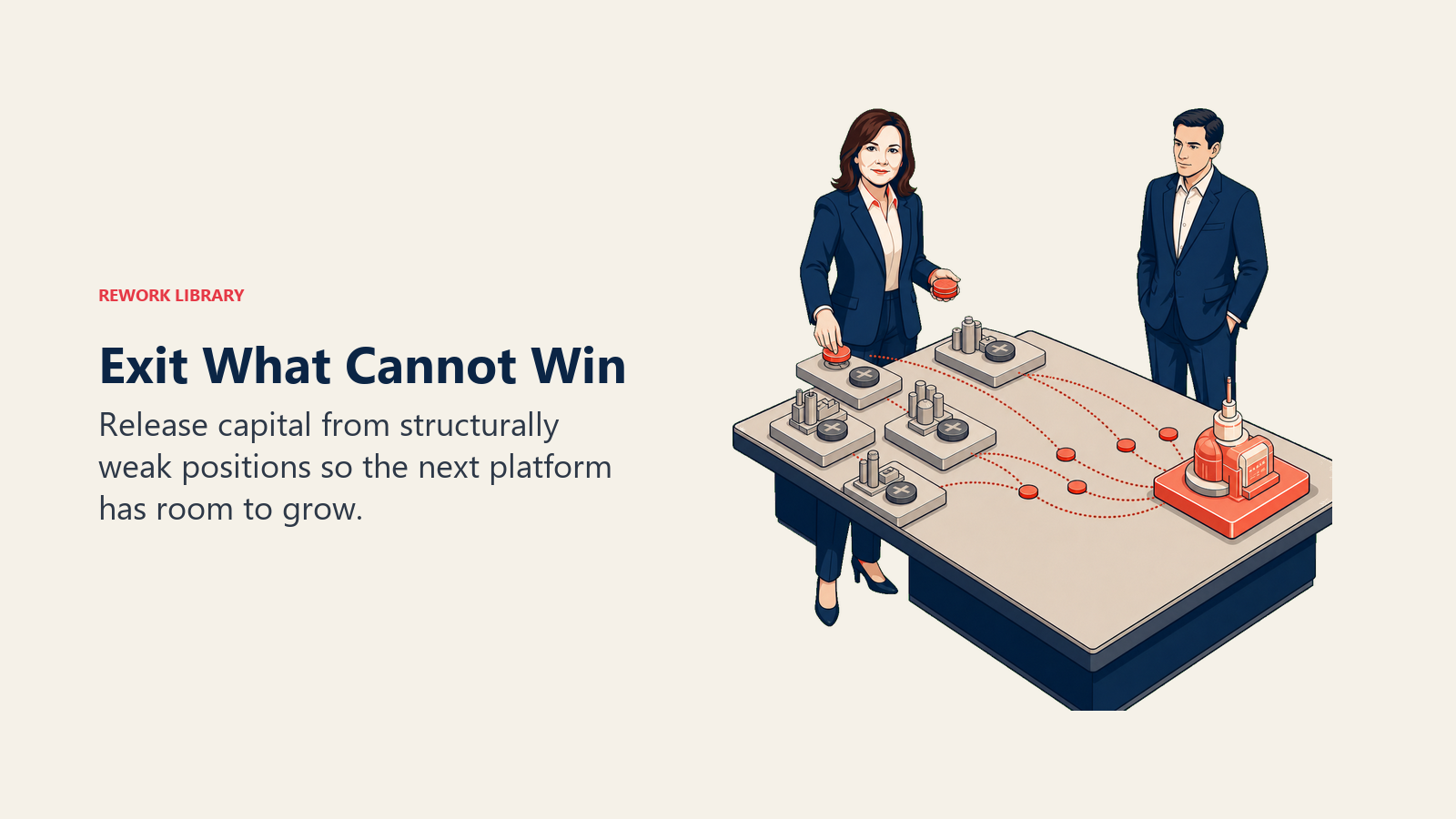
The exits were controversial internally and in those markets. But they were the right operational call. GM was losing money in all of those markets at scale, competing against local manufacturers with structural cost advantages and against Japanese and Korean competitors who'd spent decades optimizing for those segments. The capital deployed to sustain those losses was capital that couldn't fund the EV transition. Peter Drucker's framework on management by objectives is useful here, concentrate resources where results are achievable, abandon what can't be made productive.
Barra was explicit about the logic: GM would compete where it could win and exit where it couldn't. That sounds simple. Most CEOs don't do it. They hold onto legacy markets because of history, because of employee headcount optics, or because admitting you can't compete somewhere feels like failure. Barra treated it as a financial discipline decision, not an ego decision.
The freed capital directly funded the $35 billion EV investment commitment. You can draw a straight line from the Opel sale to the Ultium platform.
Barra also changed what GM measured internally after the exits. When you're running operations in 10 countries, executive attention is distributed thinly across geographies that don't all deserve equal weight. Pulling out of four markets concentrated reporting, accountability, and senior attention on North America, China, and the specific EV program milestones. That concentration made the EV investment legible in a way it wouldn't have been if leadership attention was split across struggling operations in five continents.
For you: what are the markets, products, or customer segments in your business where you're sustaining losses to preserve optionality or avoid admitting defeat? The capital and management attention you're spending there is the exact cost of not being fully committed somewhere you can win. And when you exit, make sure the exit concentrates attention on what remains, not just frees up budget.
What Mary Barra Would Do in Your Role
If you're a CEO running a 50-500 person company, Barra's most transferable behavior is separating accountability from blame. When the ignition-switch crisis broke, she didn't fire people to look decisive and she didn't protect people to look loyal. She commissioned an independent review, released the findings publicly, and let the evidence determine consequences. Most leaders conflate accountability with punishment. Barra ran them as separate processes. The review determined what happened. The consequences followed the review. That sequence matters. It's slower than firing someone on day two, but it produces organizational trust that a fast, visible punishment never does.
If you're a COO or operations leader, the Ultium platform decision is worth your attention. GM could have bought battery technology from suppliers to get to market faster. Barra chose to build proprietary capability instead, accepting a slower ramp in exchange for long-term control over costs and design. The discipline to resist the faster but dependent path is genuinely hard when your board wants quarterly proof points and your competitors are already shipping. Ask yourself whether the operational shortcuts you're taking right now are creating dependencies that will limit you in three years. The faster path today often costs significantly more in the long run.
If you're a product leader, the EV launch timeline failures hold a practical lesson. GM committed publicly to timelines that were probably optimistic under ideal conditions, and conditions weren't ideal. The software problems on the Blazer EV and the Silverado EV were partly a function of trying to ship hardware and software simultaneously without the software development culture that Tesla, Rivian, and Lucid had built over years. If your product has a software dependency and your team doesn't have deep software competency, that gap will appear at launch, not in planning. Barra would say: audit the competency before you commit the timeline.
If you're a sales or marketing leader, Barra's portfolio exits offer a framing you can use internally. When she exited international markets, she reframed the decision as "winning where we play" rather than "retreating from losses." That framing is more defensible to investors, employees, and customers than an admission of competitive weakness. It's also accurate. Look at your customer segments and ask which ones you're actively winning, which ones are marginal, and whether you've told that story internally yet. Most teams carry a few segments out of habit that they couldn't win even with double the resources. Naming that honestly is a leadership act.
How Rework Supports a Barra-Style Operating Model
Barra's doctrine depends on two structural capabilities most organizations can't produce on demand: safety and quality signals that escalate without being filtered by middle management, and cross-functional visibility during a transformation that spans engineering, supply chain, manufacturing, and sales. Her fix at GM was to rewire reporting lines directly to the board's audit committee, an organizational change, not a cultural one. Smaller companies rarely have the scale for that kind of dedicated structure, but they still face the same escalation-and-visibility problem during a recall, a product pivot, or a go-to-market shift.
Rework gives operations leaders the cross-team visibility layer that makes engineer-CEO accountability possible at mid-market scale. Project and issue workflows expose where problems are actually stuck, which team owns them, how long they've been open, and whether they've been escalated or quietly closed. When a recall, launch slip, or pivot hits, leadership sees the full operational picture in one place instead of reconstructing it from departmental status decks. That's the practical foundation under Barra's "own it transparently" posture: you can only own what you can actually see. The Project Engine starts at $99/month billed yearly with 5 seats included, with the Sales Engine from $69/month billed yearly when the transformation touches customer-facing teams too.
Notable Quotes and Lessons Beyond the Boardroom
Before the quotes, a number worth anchoring to: when Barra became CEO in January 2014, GM's market cap was around $53 billion. It was a company 11 months out of bankruptcy (GM exited Chapter 11 in July 2009) and still regarded by many investors as structurally impaired. By 2023, GM's market cap had grown to around $50-55 billion, roughly flat. That sounds disappointing until you factor in the $900M DOJ settlement, $1.1B UAW strike cost, $1.8B battery recall, and the $35B EV investment that's still paying off. She held the financial line through an extraordinary sequence of self-inflicted and externally imposed disruptions. The stability itself is the accomplishment.
Barra has consistently used direct, unglamorous language about what GM is trying to do. On the recall crisis, she said: "Something went wrong with our process in this instance, and terrible things happened." That sentence, delivered in Congressional testimony, is worth parsing. She didn't say the process was flawed. She said something went wrong with the process. She owned it as a company failure, not a systems failure.
On the EV transformation, she's said: "We want to be the most inclusive company in the world. To do that, we have to win in this transition." The connection between inclusion goals and business competitiveness isn't accidental. Barra is consistent about linking GM's strategic commitments to workforce and customer demographics.
The less-reported trait worth noting: Barra is an engineer who has done every job in the company. She ran manufacturing plants, she ran product development, she ran HR. That breadth means she doesn't get managed by specialists because she's been a specialist in most of the domains that matter. If you're a CEO who came up through one function, that's a real gap. She'd tell you to close it deliberately.
She's also spoken directly about the pace of change the automotive industry faces: "The auto industry is going to change more in the next 5 to 10 years than it has in the past 50." Harvard Business Review explored this dimension of her leadership in a CEO Series podcast on GM's commitment to an eco-friendly future, where she laid out the strategic rationale for the EV timeline in her own words. That assessment, from 2016, explains the EV commitment she made in 2021. The challenge of leading a legacy institution through a technology transition is one Peter Drucker anticipated, organizations must be willing to abandon what made them successful in order to build what comes next. She didn't pivot because she was forced to. She pivoted because her read of the timeline was that waiting would be more expensive than moving. Whether she's right is still being tested. But the logic behind the timing is clear and defensible, which is more than most transformation announcements can claim.
Where This Style Breaks
Barra's measured, consensus-building approach was exactly right for GM's crisis years and the early EV transition. But the automotive industry is now being challenged by companies that move at software speed. Tesla ships over-the-air updates that fix and improve vehicles post-sale. Rivian builds vehicles that feel like consumer electronics. Barra's style produces decisions that are well-reasoned and well-supported, but they take time.
The 2023 UAW strike cost $1.1 billion and disrupted EV production at a critical moment. The resolution required significant wage concessions. Managing a unionized workforce with decades of established norms is genuinely hard. But a company trying to compete with Tesla on software agility while also managing 100-year-old labor agreements is fighting a structural disadvantage that careful leadership alone can't fully close. Barra's style is well-suited to large, complex organizations. It's less suited to the speed the EV competitive environment actually demands.
Frequently Asked Questions about Mary Barra's Leadership
Who is Mary Barra?
Mary Barra (born 1961) is the Chair and CEO of General Motors. She became CEO on January 15, 2014, the first woman to lead a Big Three automaker, and added the Chair role in January 2016. A trained electrical engineer from Kettering University (formerly General Motors Institute), she joined GM at 18 through its co-op program and spent 30+ years in engineering, manufacturing, product development, and HR roles before the top job.
How did Barra handle the ignition-switch recall crisis?
She owned it directly despite inheriting it. Within weeks of becoming CEO she testified before Congress, commissioned an independent investigation by former US Attorney Anton Valukas, publicly released the 315-page Valukas report (which named executives by name), and created a victim compensation fund administered by independent attorney Kenneth Feinberg. She also restructured GM's safety reporting so engineers could escalate directly to the board's audit committee. The defect was ultimately linked to 124 deaths and roughly $2.5 billion in combined fines, settlements, and recall costs.
What is GM's EV strategy under Barra?
In January 2021, Barra committed GM to phasing out internal combustion engines across its global lineup by 2035, backed by $35 billion in EV and autonomous-vehicle investment through 2025. The strategy emphasizes owning core battery technology rather than licensing from suppliers, concentrating capital after exiting unprofitable markets (Opel, Holden, India, Russia), and using Ultium as a shared platform across brands.
What is the Ultium platform?
Ultium is GM's proprietary modular EV battery and drivetrain architecture, announced in 2020. It's designed to span vehicle types from Chevy Bolts to Hummer EVs to commercial trucks on a common battery-cell and motor system. GM built Ultium Cells LLC, a $2.3 billion joint venture with LG Energy Solution, to manufacture the cells domestically. The choice to build proprietary capability rather than license from CATL or LG meant a slower ramp but long-term control over costs and design.
How does Barra's engineering background shape her leadership?
It means she can't be managed by technical specialists speaking a different language. She's run plants, product development, and global operations, so she asks harder product-quality questions than most non-engineer CEOs. It also shapes her crisis posture, engineers treat a defect as a root-cause problem to fix in the system, not a PR problem to contain. That's why her response to the ignition-switch recall emphasized restructuring escalation paths, not just punishing individuals.
What can modern CEOs learn from Mary Barra?
Three durable lessons: (1) own inherited crises transparently, the clean, public version always beats the slow leak, (2) make directional bets before the market forces you to, and own the critical technology instead of renting it, and (3) exit where you can't win so you can concentrate capital and attention where you can. Her overall pattern, establish accountability credibility first, then use it to make transformational bets, is a repeatable sequence for any leader stepping into a struggling organization.
Learn More
If this profile shaped how you're thinking about leading through transformation, these articles go deeper:

On this page
- The Engineer-CEO Turnaround Doctrine
- Leadership Style Breakdown
- Key Leadership Traits
- The 3 Decisions That Defined Mary Barra as a Leader
- 1. Owning the Ignition-Switch Recall (2014)
- 2. Committing GM to an All-EV Lineup by 2035
- 3. Exiting Unprofitable International Markets
- What Mary Barra Would Do in Your Role
- How Rework Supports a Barra-Style Operating Model
- Notable Quotes and Lessons Beyond the Boardroom
- Where This Style Breaks
- Learn More