Peter Thiel Leadership Style: Zero to One and the Logic of Monopoly
Turn this article into takeaways for your work.


Each assistant summarizes the article only for you and suggests best practices for your work.
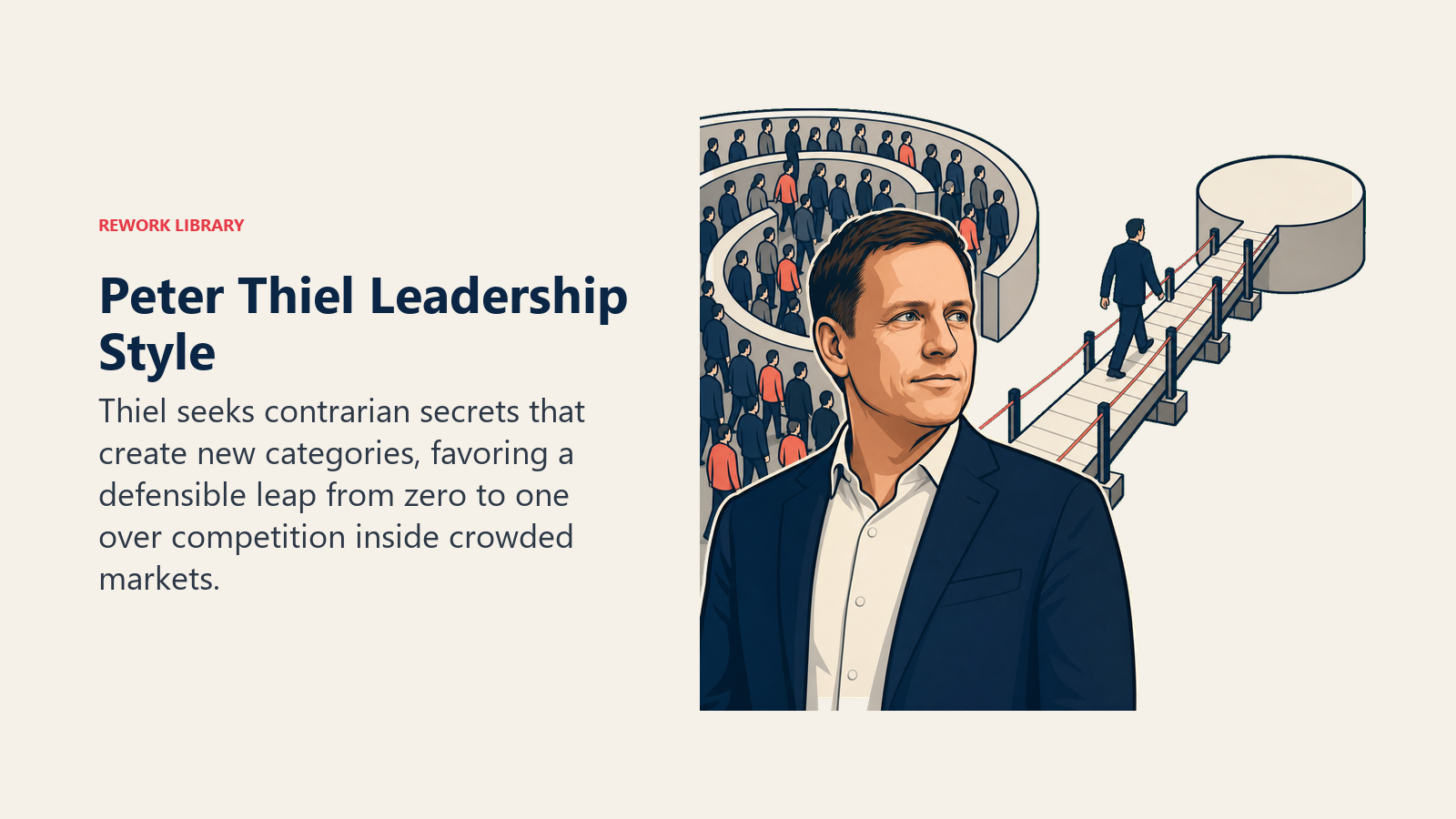
Peter Thiel's business philosophy is one of the most internally consistent and most debated frameworks in modern business strategy. It's built on a simple premise: competition is for losers. The most valuable companies don't compete for existing market share; they create new categories where they have no direct competition at all.
Thiel co-founded PayPal with Elon Musk and others in 1999, sold it to eBay in 2002 for $1.5 billion, and then made the first outside investment in Facebook in 2004 for $500,000, which grew to roughly $1 billion at the IPO. He later co-founded Palantir Technologies and Founders Fund, becoming one of the most influential figures in Silicon Valley despite, or because of, his willingness to hold positions that diverge sharply from the consensus.
Leadership Style Breakdown
| Style | Weight | How it showed up |
|---|---|---|
| Contrarian thesis | Very High | Core to every significant decision; asks "what do others believe that's wrong?" |
| Long-term orientation | High | Palantir ran at a loss for years to build government relationships others wouldn't touch |
| Intellectual rigor | High | Stanford Law, philosophy background; argues from first principles not precedent |
| Selectivity | High | Small portfolio, concentrated bets; avoids diversification as a strategy |
The "Zero to One" Framework
Thiel's most widely applied framework comes from his Stanford course on startups and his 2014 book "Zero to One: Notes on Startups, or How to Build the Future."
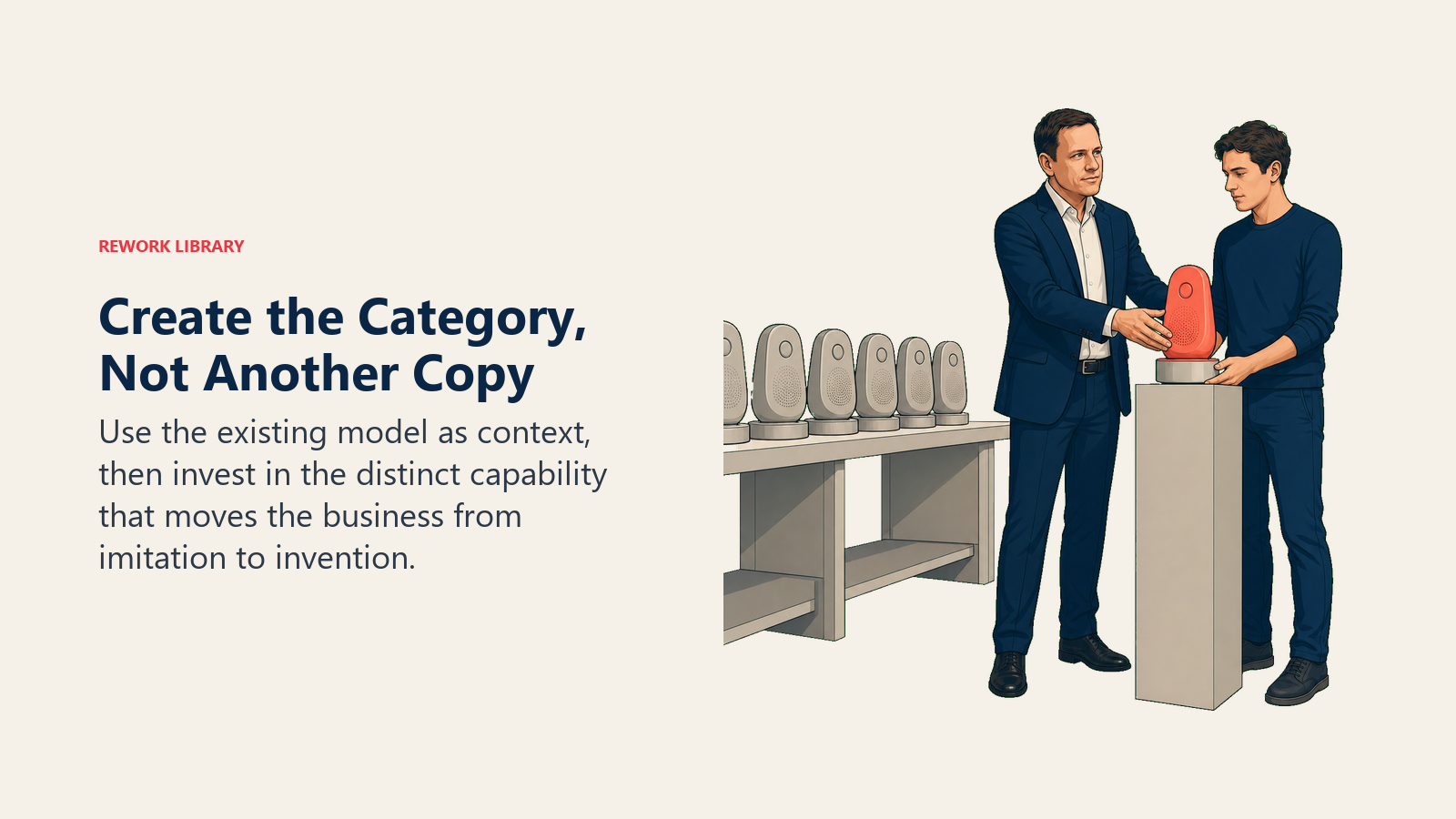
The core distinction is between horizontal progress (copying things that work, going from 1 to n) and vertical progress (creating something new, going from 0 to 1). His argument is that horizontal progress is what most companies do and most business education teaches. But vertical progress, building something that doesn't exist yet, is where the most value is created and where competition is structurally absent.
For operators, this framework cuts through a common strategic mistake: spending most of your competitive energy on incremental improvements to existing products in established categories. Thiel's question for any strategic decision is: does this take us from 1 to n (better execution in an existing market) or from 0 to 1 (creating a market that doesn't yet exist)?
Neither is wrong. But being clear about which game you're playing changes how you evaluate success, how you staff the effort, and what the ceiling on returns looks like.
The Contrarian Question
Thiel's most-cited intellectual habit is what he calls the contrarian question: "What important truth do very few people agree with you on?"
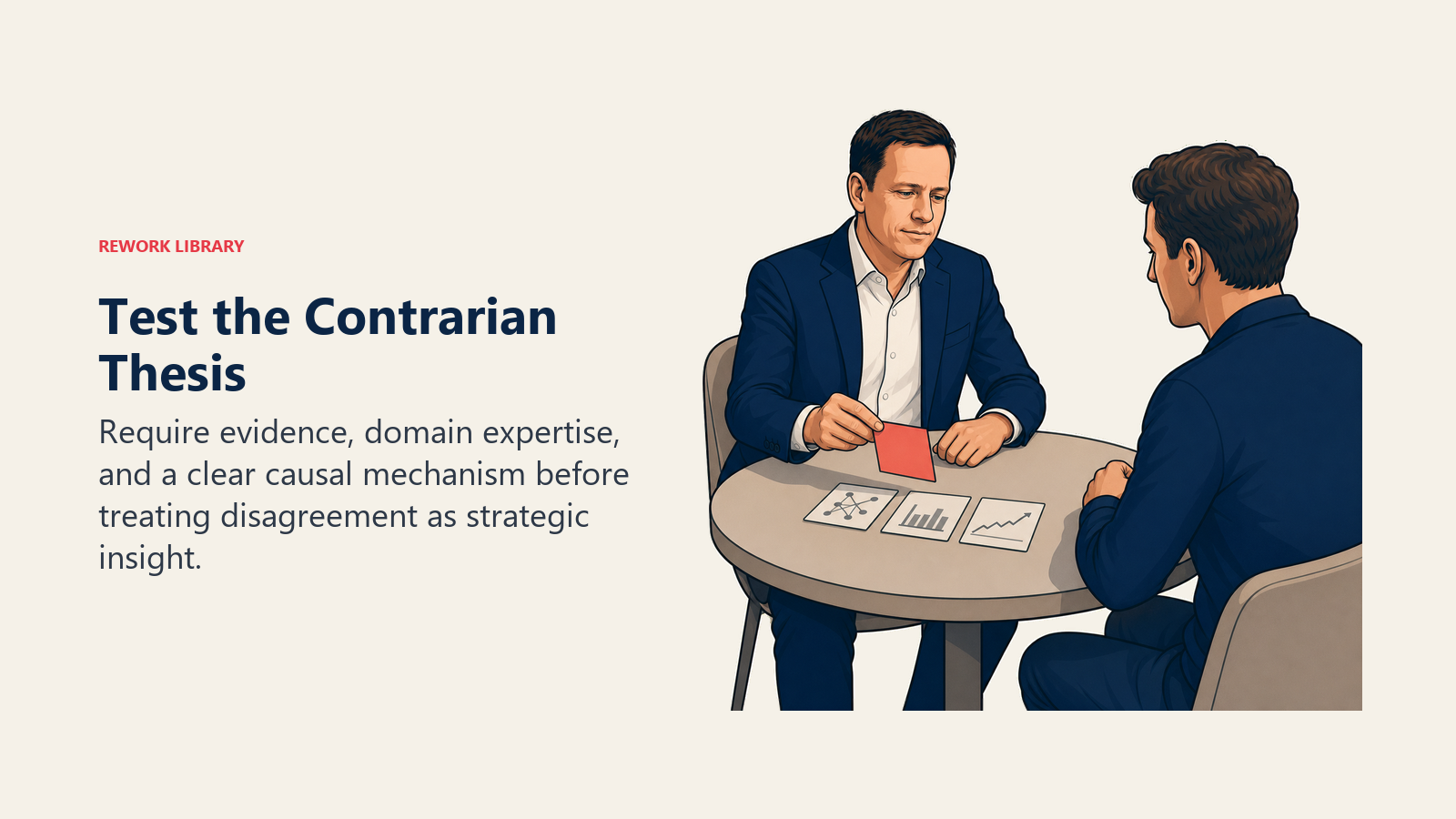
He applies this both to investment decisions and to strategic planning. The logic: if your thesis is widely held, the market has already priced it in. The only way to generate outsized returns, in investing or in business strategy, is to be right about something that most informed people are wrong about.
The practical difficulty is distinguishing a contrarian thesis from a wrong thesis. Most contrarian views turn out to be wrong. Thiel's documented approach to testing contrarian positions:
- Is the thesis wrong because it lacks evidence, or because it lacks consensus? Evidence matters; consensus doesn't.
- If the thesis is right, when will the evidence make it obvious to others? The timing of consensus shifting determines the window of competitive advantage.
- What would have to be true about the world for this to be false? If you can't construct a falsifiable version of your thesis, it's not a thesis, it's a belief.
For directors: this framework is directly applicable to strategic planning. Before you commit to a strategic direction, apply the contrarian test. If your strategy could have been written by your main competitor last quarter, it's probably consensus thinking priced into the market.
Monopoly Vs. Competition
One of Thiel's central business arguments is that monopolies, despite their bad reputation, are the desired end state for a successful company. His definition of monopoly is not the exploitative regulatory kind. It's the innovation kind: a company that is so much better at something that no other firm can offer a close substitute.
His observation: companies in competitive markets work hard, produce thin margins, and rarely create lasting value. Companies with monopoly positions (Google in search, early Facebook in social networks) generate outsized profits that fund further innovation.
The practical implication for operators building business lines or product strategies: optimizing for a market where you're one of many similar competitors is a ceiling strategy. Sustainable competitive advantage requires being meaningfully differentiated on dimensions that matter to customers and that competitors can't easily replicate.
Thiel's framework for achieving monopoly in business: proprietary technology that's at least 10x better than the closest alternative on a key dimension, network effects that improve the product as more users join, economies of scale that make it progressively harder for smaller competitors to match costs, and strong branding that creates customer preference independent of feature comparison.
PayPal and the "PayPal Mafia"
The PayPal founding team has become a case study in deliberate talent selection. Thiel and his co-founders built a team that disproportionately went on to found and lead significant companies: YouTube, LinkedIn, Yelp, Palantir, Tesla (Musk was involved in early PayPal via X.com merger).
The documented principle behind the team-building: Thiel selected for people who had strong, idiosyncratic views and could articulate why those views were right and consensus was wrong. The interview process included questions designed to surface whether candidates had genuine contrarian positions they'd thought through, versus performing contrarianism to sound interesting.
For directors building high-performance teams: the PayPal hiring lens is a useful screen. Strong teams are built from people with substantive, well-reasoned views that differ from each other, not from people who can execute playbooks they've already seen. The diversity that matters is intellectual diversity, different mental models and information sets that, when combined, produce better group decisions.
Palantir and Long-Horizon Strategy
Thiel co-founded Palantir in 2003. For most of its first decade, the company lost money, built slowly, and focused heavily on U.S. government intelligence and defense contracts, a market that most technology investors avoided as too slow, too regulated, and too difficult to scale.
This reflects a documented Thiel principle: valuable businesses are often ones where the barrier to entry is patience rather than capital or technology. Government relationships take years to build. Regulatory expertise accumulates slowly. Most competitors exit these markets precisely because they're slow.
By 2020, Palantir went public with a valuation above $20 billion, having built a position in government data infrastructure that no fast-moving startup competitor could quickly replicate.
For operators in complex B2B markets: this is one of the most direct operational translations of Thiel's framework. The markets that require patient relationship-building, deep domain expertise, or sustained regulatory navigation are often the ones that produce the most durable competitive positions. The barrier is not capital; it's willingness to think in multi-year timelines.
Where His Approach Has Limits
Thiel's framework is most applicable when you're building new markets or making early-stage bets. It's less useful for operating in mature markets where differentiation is incremental rather than categorical.
His public skepticism about diversity initiatives has generated significant controversy. This is a documented aspect of his public profile. The business implications for operators are worth noting separately from the validity of the positions: leaders whose public positions are controversial can become reputational risks for organizations that associate with them. Whether that risk matters depends on the organization's stakeholder base and industry.
His contrarian framework also has a selection-bias problem: we learn about the contrarian bets that worked (Facebook, PayPal). The ones that didn't work are less documented.
What Directors Can Take From Thiel
The monopoly question for product strategy. Before committing to a product roadmap, ask: what would it take to be 10x better than the closest alternative on the dimensions that matter most to customers? If the answer is "we can't get there in any reasonable timeframe," the market may be too competitive to generate durable returns.
The contrarian test for strategic plans. Before approving a strategic plan, apply Thiel's question: "What important truth does this plan depend on that most people in our market would disagree with?" If the answer is "nothing, our plan is consensus," the upside is likely capped.
Long-horizon patience as a competitive weapon. In markets where building requires sustained, multi-year investment in relationships, expertise, or infrastructure, the firms with the patience to play the long game have a structural advantage over those optimizing for quarterly metrics.
Key Facts
- Peter Thiel co-founded PayPal in 1999 and sold it to eBay in 2002 for $1.5 billion
- His $500,000 investment in Facebook in 2004 grew to approximately $1 billion at the 2012 IPO
- "Zero to One" (2014), based on his Stanford course, is among the most-assigned books in startup and MBA programs
- Palantir, co-founded in 2003, went public in 2020 with a valuation above $20 billion
Learn More
