Jeb Blount's Leadership Style: The Fanatical Prospecting Mindset That Built Sales Gravy
Turn this article into takeaways for your work.


Each assistant summarizes the article only for you and suggests best practices for your work.
Jeb Blount started selling door-to-door. He spent years running sales organizations in corporate environments before he built Sales Gravy, which is now one of the most-downloaded sales training platforms globally. The Sales Gravy podcast has published more than 600 episodes. He has written more than 10 books, including "Fanatical Prospecting" (2015), "Sales EQ" (2017), "Objections" (2018), and "Virtual Selling" (2020).
Key Facts: Jeb Blount is CEO of Sales Gravy, the world's largest sales training platform, and the author of 15+ bestsellers including "Fanatical Prospecting" (2015), "Sales EQ" (2017), "Objections" (2018), "INKED" (2020), and "Virtual Selling" (2020). His Sales Gravy podcast has surpassed 200 million downloads, and he contributes regularly to Forbes on sales performance and leadership.
What distinguishes Blount from most sales trainers is that he worked in the field before he taught from the stage. He wasn't a researcher who studied salespeople. He was a sales rep and sales leader who hit quotas and managed teams before he became a consultant. That practitioner background gives his frameworks a specificity that academic sales training rarely achieves.
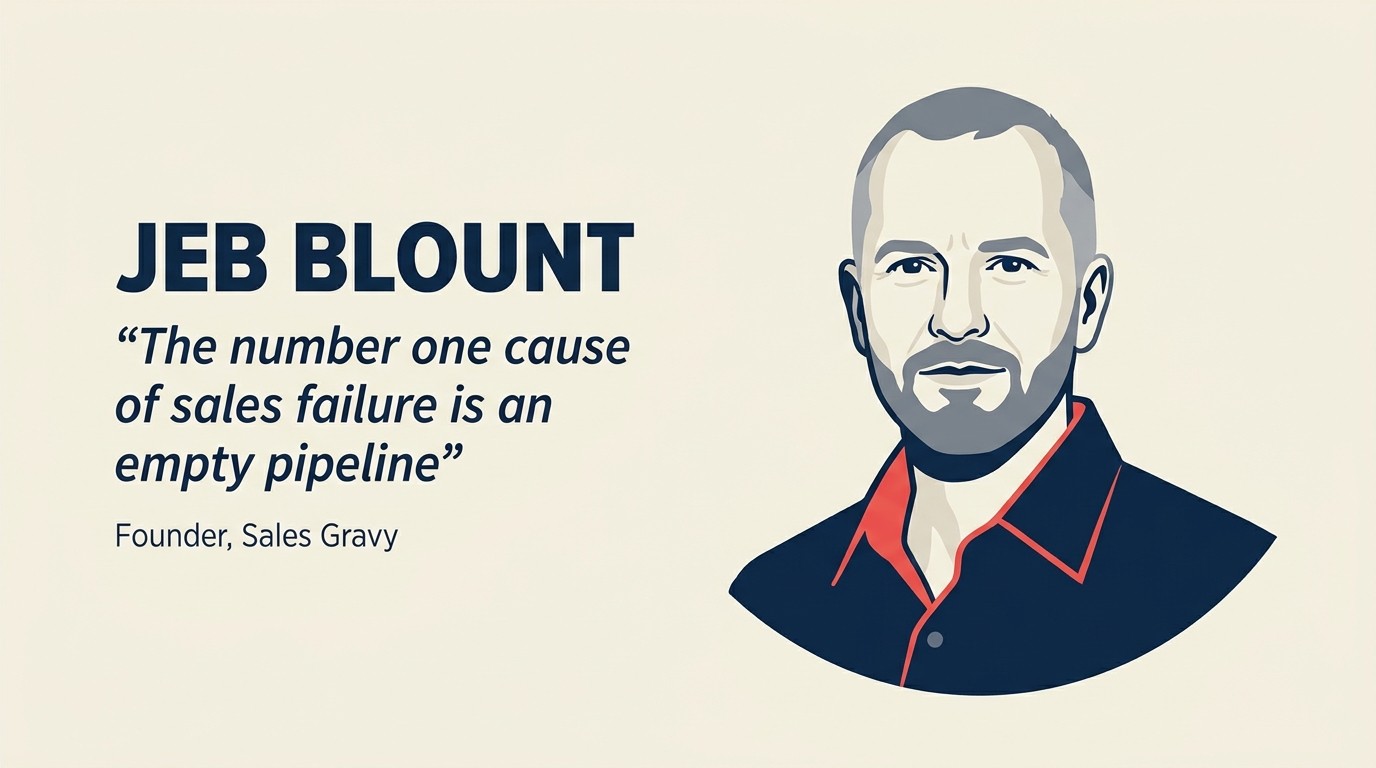
His core thesis, articulated in "Fanatical Prospecting," is direct: the number one cause of sales failure is an empty pipeline. Not poor closing skills, not bad messaging, not misaligned product. An empty pipeline. And the fix is not a technology stack or a sequencing platform. It's daily non-negotiable prospecting activity, maintained through every season of the sales cycle. The operational systems that keep that pipeline healthy, qualification, follow-up cadence, handoff from prospecting to close, are covered in depth in the lead management library.
That thesis was contrarian when he wrote it. It remains partially contrarian now.
Leadership Style Breakdown
| Style | Weight | How it showed up |
|---|---|---|
| Directive | 65% | Blount doesn't traffic in ambiguity about what good performance looks like. His frameworks are specific: here's the activity, here's the frequency, here's the sequence. He's critical of sales cultures that prioritize "social selling" or "content marketing" as prospecting substitutes. His position is that phone calls work, that they've always worked, and that the shift away from them is driven by rep discomfort rather than buyer data. That's a directive posture, he tells you what to do and why, and expects you to do it. |
| Coach | 35% | The coaching dimension shows up in his emotional intelligence work. "Sales EQ" and "Objections" are not activity-volume books, they're about understanding why buyers resist and how to respond in ways that lower resistance rather than increase pressure. This requires genuine curiosity about the buyer's internal state, which is coaching-oriented behavior. Blount understands that the directive and coaching dimensions create tension, and he works that tension explicitly: you have to be disciplined about activity and adaptive in conversation. |
The 65/35 split produces some friction. Blount's directive orientation (high activity, non-negotiable prospecting, phone-first) can conflict with his emotional intelligence framework when implemented by managers who take the directive part seriously and skip the adaptive part. The teams that get full value from his work tend to be the ones that do both: clear activity standards AND genuine sales EQ development.
Key Leadership Traits
| Trait | Rating | What it means in practice |
|---|---|---|
| Anti-Passive Pipeline | Very High | Blount's most consistent argument is that passive pipeline generation, inbound, content, social, can supplement prospecting but can't replace it. His data point: the salespeople who consistently hit quota are the ones who prospect daily regardless of how much inbound they're receiving. The instinct to reduce outbound activity when inbound is good is a trap. When inbound slows (and it always slows), the reps who maintained prospecting discipline have pipeline. The ones who didn't are starting from zero. |
| Multi-Channel Discipline | Very High | The "Triple Threat" concept, combining phone, email, and social in a sequenced approach, is Blount's most practical tactical contribution. He argues that each channel reaches different buyer states and that using all three simultaneously increases the probability of connecting with any given prospect. His specific position on phone is worth noting: he believes most sales coaches moved away from phone because their reps hated making calls, not because the channel stopped working. He has data to support this. |
| Sales EQ | High | Blount's emotional intelligence framework is applied rather than theoretical. He's not interested in abstract EQ scores, he's interested in what happens in the specific moment when a buyer says "we're not interested" or "send me some information." His argument: most reps respond to resistance with either pressure (which confirms the buyer's desire to disengage) or retreat (which confirms that the rep doesn't believe enough in the product to hold the conversation). Sales EQ is the ability to hold the moment, acknowledge the resistance, and stay curious rather than reactive. |
| Volume as Cultural Foundation | Strong | Blount's view on prospecting activity is that volume isn't just a number, it's a cultural signal. Teams where everyone prospects daily, openly, visibly, create a different competitive environment than teams where prospecting is something you do when you feel like it. The 30-Day Blitz concept operationalizes this: a coordinated team-wide push where every rep commits to maximum prospecting activity for 30 consecutive days. The goal isn't just pipeline. It's resetting the team's baseline belief about what consistent activity looks like. |
The Blount 30-Day Rule
The Blount 30-Day Rule, a pillar of the Fanatical Prospecting Doctrine, states that the prospecting activity (or inactivity) you execute today determines the pipeline, deals, and commissions you will earn approximately 90 days from now. Skip 30 consecutive days of disciplined outbound work and a revenue trough becomes mathematically certain a quarter later, regardless of closing skill. The doctrine treats daily prospecting as a non-negotiable professional standard, not a motivational preference.
The 3 Frameworks That Defined Jeb Blount
1. Fanatical Prospecting: The Non-Negotiable Daily Minimum
The thesis of "Fanatical Prospecting" fits in one sentence: the salespeople who maintain a full pipeline regardless of business conditions are the ones who hit quota consistently. Everything else follows from that.
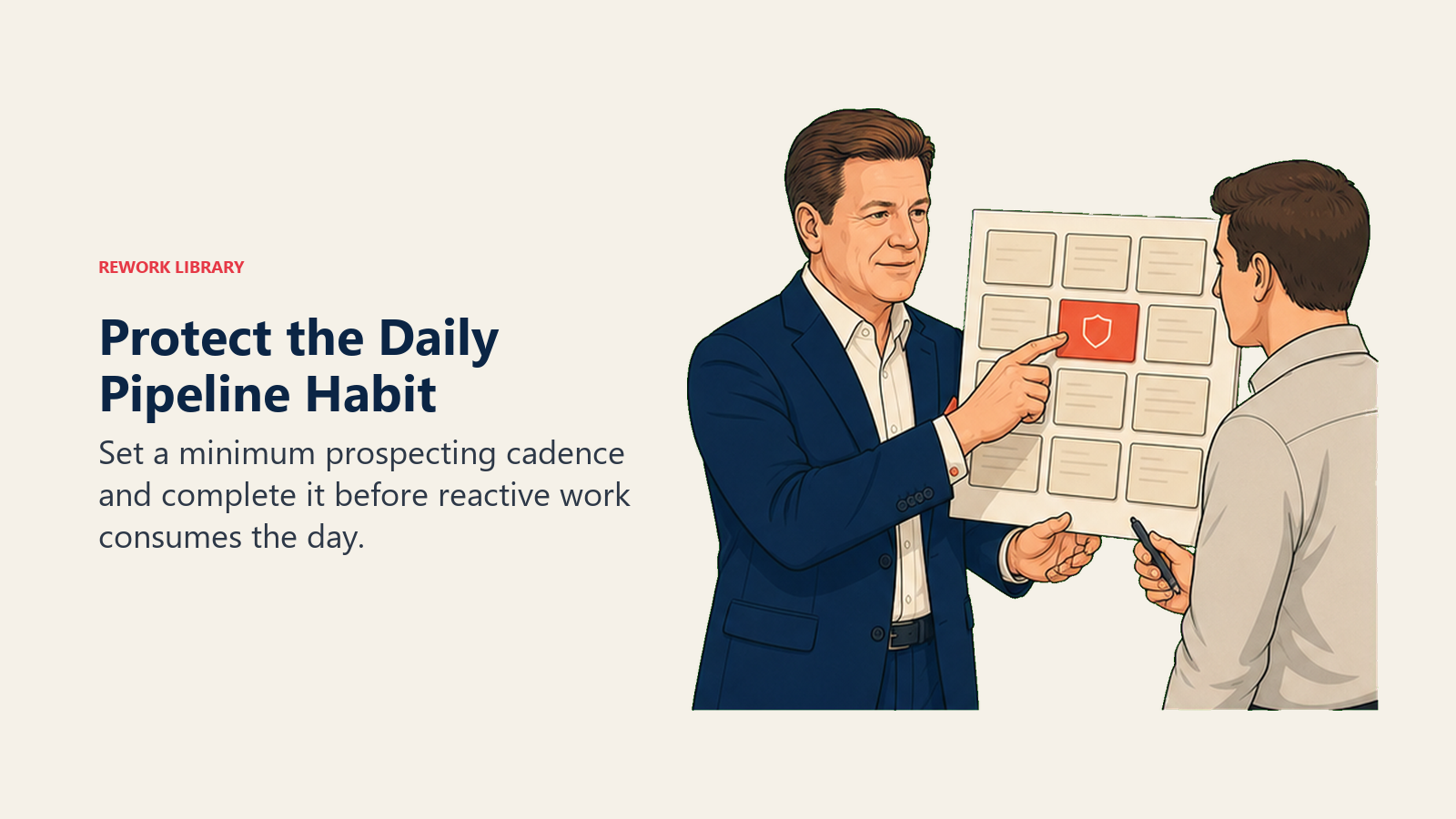
Blount's structural argument is about pipeline decay. A deal in your pipeline today has a half-life. Prospects go cold, budgets freeze, champions leave, priorities shift. If you're not continuously adding new opportunities at the top of the funnel, the mathematical reality is that your pipeline shrinks over time regardless of how good your closing rate is. The rep who closes 40% of a full pipeline outperforms the rep who closes 60% of a thin one.
The "fanatical" part is about removing the conditions on prospecting. Blount's position is that reps should prospect every day, when they have other meetings, when they're having a good month, when they just closed a big deal, when inbound is strong. The moment you make prospecting conditional ("I'll prospect more when my pipeline gets thin"), you've introduced a lag into your revenue model. That gap shows up as a down quarter three to six months later.
For sales managers, this has a direct management implication. Activity standards need to be non-negotiable, not guidelines. The difference: guidelines are things you remind people about when performance drops. Non-negotiables are things that are enforced consistently, proactively, as a condition of being on the team. Most sales cultures have guidelines and call them non-negotiables.
2. The Objections Framework: Staying in the Moment
"Objections" (2018) is Blount's most underrated book. It's not about overcoming objections in the traditional sense. It's about staying in the conversation when a buyer signals discomfort.

His core observation: most salespeople fold too early. A buyer says "we're happy with our current vendor" or "now's not a good time" and the rep either pushes harder (which creates resistance) or retreats (which closes the loop). Both responses are wrong. Both come from the same source: the rep treating the objection as a verdict rather than a signal.
Blount's framework distinguishes between four types of objections: reflex reactions (automatic "no" before the buyer has processed the ask), brush-offs (a softer version designed to end the conversation), real objections (genuine concerns about fit, timing, or budget), and conditions (circumstances where the deal genuinely can't happen). Most salespeople treat all four the same way. Blount's argument is that reflex reactions and brush-offs don't require a counter-argument. They require a response that keeps the conversation going without increasing pressure.
The practical technique is the "acknowledgment + question" pattern. When a buyer says "we're not interested," the response isn't to justify why they should be interested. It's to acknowledge the response without accepting it as final: "I hear you. A lot of the people I talk to say the same thing before they know why I'm calling. Can I take 30 seconds?" That's not a high-pressure close. It's an invitation to stay in the conversation, which is the only thing that can change the outcome.
3. The 30-Day Blitz
The 30-Day Blitz is Blount's most underused management tool and his most immediately actionable one.
The concept: for 30 consecutive days, the entire sales team commits to maximum prospecting activity. Every available hour that isn't scheduled with existing customers or pipeline activities goes to prospecting. Tracking is public and visible. The goal isn't just to fill pipeline. It's to recalibrate the team's baseline understanding of what high activity looks like.
Most sales teams operate at a comfortable cruising speed that feels like high activity until you actually measure it. A blitz period forces reps to discover their actual capacity, which is almost always higher than they thought. And it creates social accountability: when everyone is doing it, no one has the option of skipping without it being visible.
Blount's data from running this with dozens of sales teams: pipeline generated during a blitz period is approximately 3x the pipeline generated during a normal 30-day period, and the effect persists for 60-90 days after the blitz ends because reps internalize a higher activity baseline.
For VPs of Sales planning a new half: a blitz in the first 30 days of a quarter, combined with clear daily activity tracking, produces pipeline that shows up as revenue in Q3 when you need it most. Most teams plan Q3 revenue in Q2 discovery. The blitz is the mechanism.
What Jeb Blount Would Do in Your Role
If you're a CEO, Blount would tell you to look at your sales team's prospecting activity data before he looked at any other metric. Not pipeline value. Not close rate. Not average deal size. How many outbound contacts is each rep making each week, and has that number been consistent for the past 12 months? If it varies dramatically (spikes when the team is behind, drops when they're ahead) you have a pipeline discipline problem that will produce a revenue volatility problem. The fix isn't hiring better closers.
If you're a COO building a revenue operations function, Blount's framework has a specific implication for how you design your SDR and AE activity metrics. Most RevOps teams track outcomes (pipeline, demos, opportunities created) and ignore inputs (outbound contacts per day, call connect rate, multi-channel sequence completion). Blount's position: if you track and enforce the inputs, the outputs take care of themselves. If you only track the outputs, you manage the symptoms instead of the cause.
If you're in product, Blount's sales EQ framework is relevant to how you think about objection handling in demos. Product teams that train AEs on feature lists produce reps who respond to buyer skepticism with more features. Product teams that train AEs on the buyer's underlying concerns (what does this objection tell us about what the buyer is afraid of or uncertain about?) produce reps who have more useful conversations. The demo is a sales conversation, not a product presentation.
If you're in sales or marketing, the anti-passive pipeline thesis has the most direct implication. If your current demand generation model is primarily inbound-dependent, you're running a fragile revenue model. Inbound volume correlates with content investment, algorithm changes, competitive presence, and market conditions, none of which you control. Outbound prospecting correlates with headcount, activity discipline, and ICP clarity, which you do control. Blount's argument isn't to abandon inbound. It's to make sure your outbound doesn't atrophy because inbound is comfortable.
The Rework Analysis
Blount's doctrine rests on two load-bearing disciplines: sustained daily prospecting activity and the emotional intelligence to stay in the conversation once the buyer resists. Both collapse without an operating system that makes the behavior visible and the coaching specific. That is where Rework CRM earns its keep. Daily call, email, and LinkedIn activity is captured at the rep level and rolled up to the manager dashboard, so "non-negotiable minimums" stop being a poster on the wall and become a number on a screen. Activity trends predict pipeline 60-90 days out, the exact horizon the 30-Day Rule points to, which lets leaders intervene before a revenue trough shows up in the forecast. For Sales EQ, call recordings and sequenced talk-track fields turn objection moments into coachable artifacts, not vague memories. Rework's Sales Engine starts at $69/month billed yearly for 5 sales seats, which is typically less than the cost of one missed quarter caused by the pipeline decay Blount warned about.
Notable Quotes and Lessons Beyond the Boardroom
"Amateurs wait until they feel like prospecting. Professionals prospect whether they feel like it or not."
This is the operational core of Blount's entire framework. The distinction between amateur and professional behavior isn't skill. It's the decision to perform regardless of mood. Most sales leaders know this. Most don't build systems that enforce it.
"The pipe is the pulse of your sales organization."
Blount uses this to make pipeline a leadership metric, not just a sales metric. If the CEO or COO isn't looking at top-of-funnel activity as a regular indicator of organizational health, they're reading a lagging indicator (revenue) instead of the leading indicator (pipeline inputs) that predicts it.
"Rejection is not failure. Failure is giving up."
This is the motivational dimension of his framework, grounded in a specific professional context. In sales, rejection is structural, not personal. The buyer who says no isn't saying you're bad. They're saying this particular offer doesn't fit this particular situation right now. Blount's point is that conflating rejection with failure is the cognitive error that causes reps to reduce activity when they should be maintaining it.
Blount's personal trajectory from door-to-door sales to one of the most downloaded sales training platforms in the world is itself an argument for his thesis. He didn't get there through a breakthrough insight or a connected mentor. He got there through consistent high-volume output (writing, speaking, publishing, training) sustained over decades. The fanatical prospecting philosophy isn't just what he teaches. It's how he built everything he has.
Where This Style Breaks
Blount's outbound-first thesis is under genuine pressure in 2024-2026, and he should be taken seriously on this.
The economics of high-volume cold outreach are deteriorating. AI-generated outbound has flooded buyers' inboxes. Connection rates on cold calls in B2B are declining across industries. The "dial more" solution to declining connect rates produces diminishing returns when every seller is dialing more simultaneously. Harvard Business Review's analysis of modern B2B buying documented how buyers complete more of their decision journey independently before engaging sellers, a structural shift that affects every outbound-first model.
Blount has acknowledged this evolution in his more recent work and has moved toward a more nuanced multi-channel message. Jill Konrath has gone further, building her SNAP Selling and Agile Selling frameworks explicitly around the reality of time-pressed, distraction-saturated modern buyers, a complementary update to Blount's volume-first doctrine that addresses the "what do you say when you do connect" question he sometimes leaves under-specified. But the core of his brand is still high-volume outbound, and teams that implement his early frameworks without accounting for current channel saturation will see lower yields than his data suggested in 2015.
The second limitation is cultural fit. A fanatical prospecting culture works well for teams that are staffed for it, specifically high-energy sellers who are motivated by activity and transparent accountability. It can produce burnout in teams with different profiles, particularly if the framework is implemented as pressure rather than professional standard.
Frequently Asked Questions about Jeb Blount's Sales Philosophy
Who is Jeb Blount?
Jeb Blount is the CEO of Sales Gravy, the world's largest sales training platform, and the author of 15+ bestsellers including "Fanatical Prospecting," "Sales EQ," "Objections," "INKED," and "Virtual Selling." He is a regular Forbes contributor, and his Sales Gravy podcast has surpassed 200 million downloads.
What is Fanatical Prospecting?
Fanatical Prospecting is Blount's doctrine that an empty pipeline is the number one cause of sales failure, and the only reliable fix is daily, non-negotiable prospecting activity across phone, email, and social channels, maintained regardless of current pipeline health, closed deals, or inbound volume.
What is the 30-Day Rule in sales?
Blount's 30-Day Rule states that the prospecting work you do today produces pipeline, deals, and commissions roughly 90 days from now. Skip 30 days of disciplined outbound and a revenue gap becomes mathematically certain one quarter later, no matter how strong your closing skills are.
What is Sales EQ per Blount?
Sales EQ is Blount's applied emotional intelligence framework for sellers. It's the ability to stay curious and composed the moment a buyer resists, acknowledging the objection without either escalating pressure or retreating, so the conversation continues long enough to surface the real concern behind the reflex response.
What is Sales Gravy?
Sales Gravy is the training, coaching, and media company Blount founded and leads as CEO. It publishes the Sales Gravy podcast (200M+ downloads), runs live and virtual training programs, and is widely referenced as the largest dedicated sales training platform in the world.
What can modern salespeople learn from Jeb Blount?
That activity discipline is a professional standard, not a motivational state; that phone, email, and social work together as a Triple Threat rather than as substitutes; and that objections are signals to stay in the conversation, not verdicts to accept or overpower. The reps who internalize this outperform talent-led peers over any multi-year window.
Learn More
- Aaron Ross Leadership Style: How Predictable Revenue Invented the Modern SDR Model
- Trish Bertuzzi Leadership Style: The Woman Who Designed the Modern SDR Organization
- Dale Carnegie Leadership Style: Why 30 Million People Still Follow a 1936 Playbook
- Neil Rackham Leadership Style: How the SPIN Selling Framework Changed B2B Sales Forever
- Mark Roberge Leadership Style: The Science of Scaling Revenue at HubSpot

On this page
- Leadership Style Breakdown
- Key Leadership Traits
- The Blount 30-Day Rule
- The 3 Frameworks That Defined Jeb Blount
- 1. Fanatical Prospecting: The Non-Negotiable Daily Minimum
- 2. The Objections Framework: Staying in the Moment
- 3. The 30-Day Blitz
- What Jeb Blount Would Do in Your Role
- The Rework Analysis
- Notable Quotes and Lessons Beyond the Boardroom
- Where This Style Breaks
- Learn More