Andy Jassy Leadership Style: From AWS Founder to Amazon CEO in the Post-Bezos Era
Turn this article into takeaways for your work.


Each assistant summarizes the article only for you and suggests best practices for your work.
Key Facts, Andy Jassy at a Glance
- Born: 1968 (Scarsdale, New York)
- Joined Amazon: 1997, straight out of Harvard Business School
- Founded AWS: 2003, after a year of writing the founding strategy document with Bezos
- AWS scale under his watch: Grew to over $100B in annual revenue run rate
- Became Amazon CEO: July 5, 2021, succeeding Jeff Bezos
- 2022-2023 restructuring: Led approximately 27,000 layoffs in Amazon's largest workforce reduction
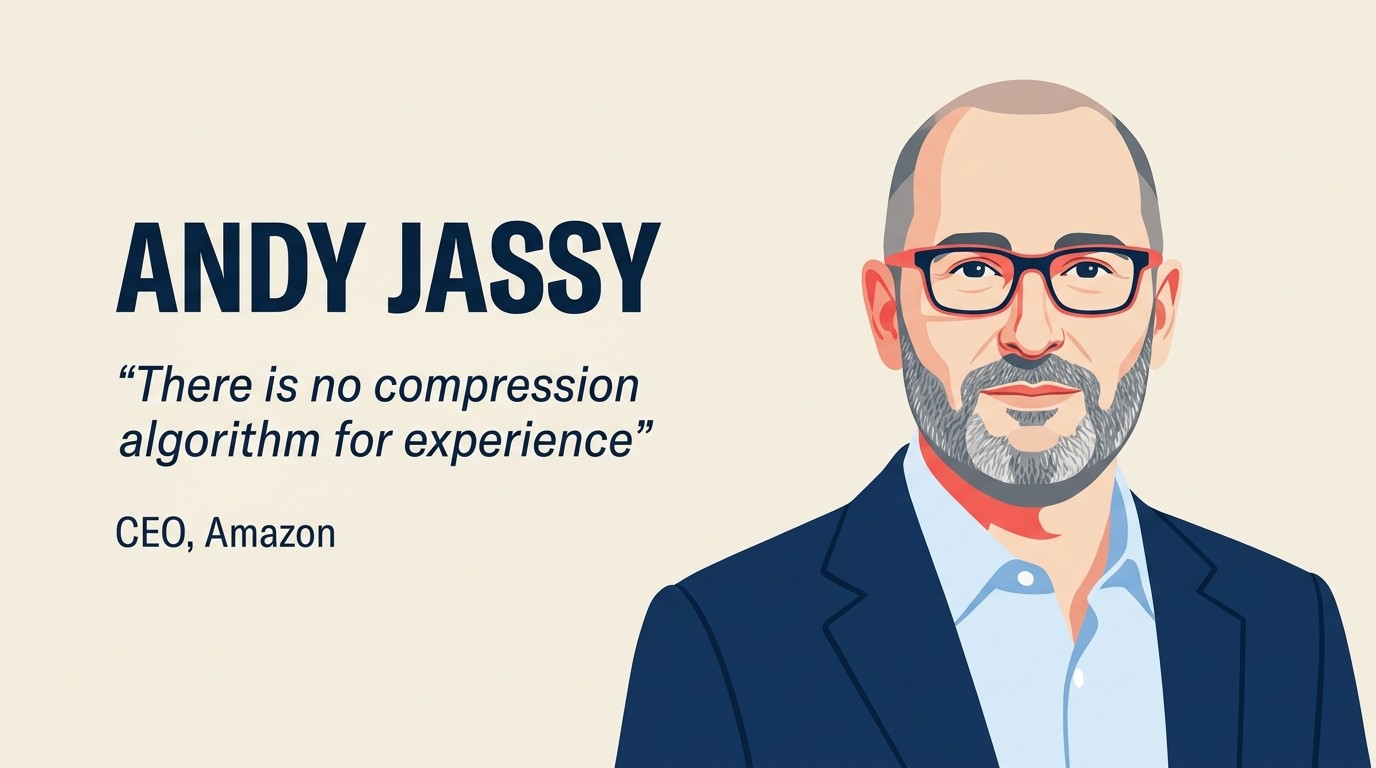
- Signature quote: "There is no compression algorithm for experience."
Andy Jassy built AWS from a two-pizza team with no revenue into a business that generated over $90 billion in annual revenue in 2023 and funds most of what Amazon does in retail. His Wikipedia profile traces the full arc from Harvard Business School graduate to Bezos's designated successor as Amazon CEO in July 2021. That alone would make him worth studying. But the real leadership test came in July 2021, when he took over as Amazon CEO from Jeff Bezos, arguably the most consequential succession in modern business history.
Bezos didn't just found Amazon. He was Amazon. His 14 Leadership Principles, his PR/FAQ memo format, his S-Team meeting rituals, all of it was built around his thinking style and decision-making preferences. For any successor, that's a suffocating institutional inheritance. For Jassy, it was familiar territory. He'd been running a company within the company for 18 years. The post-founder transition challenge is one Tim Cook navigated at Apple as well, both inherited founder-shaped institutions and chose operational deepening over reinvention. Sundar Pichai's quiet succession at Google follows the same pattern: a long-tenured insider who earned the role through operational credibility rather than a public leadership campaign.
Since then, he's cut 27,000 jobs, rationalized Amazon's bloated post-pandemic footprint, and made what may prove to be the most important strategic bet of the decade: going all-in on AI infrastructure at a time when many corporate boards were treating it as a pilot program.
If you're navigating a post-founder transition, a high-growth-to-profitability pivot, or an organization that runs on structured rigor, Jassy's approach has more to teach than almost any other CEO working today.
Leadership Style Breakdown
| Style | Weight | How it showed up |
|---|---|---|
| Builder-Operator | 65% | Jassy's default move has always been to build the underlying infrastructure that makes the real product possible. At AWS, that meant building cloud before customers knew they needed it. At Amazon post-2021, it meant cutting the structural inefficiencies accumulated during the 2020-2021 hiring surge before they became permanent. He treats organizations the way engineers treat systems: find the bottlenecks, eliminate them, then scale. |
| Structural Thinker | 35% | Jassy runs on written reasoning. The six-page narrative memo, the PR/FAQ process, the dive-deep culture he inherited from Bezos and personally reinforced, these aren't cultural quirks. They're a belief that decisions made from fully-written, rigorously-tested arguments are more durable than decisions made from slides and gut instinct. He applies this to org structure, product strategy, and cost decisions alike. |
The 65/35 split reflects where Jassy actually spends his energy. He's not primarily a visionary communicator. He's a builder who thinks in systems and platforms. His public profile is lower-key than Bezos. His operating rigor is, if anything, higher.
The Jassy Efficiency Doctrine (Builder-Operator Model)
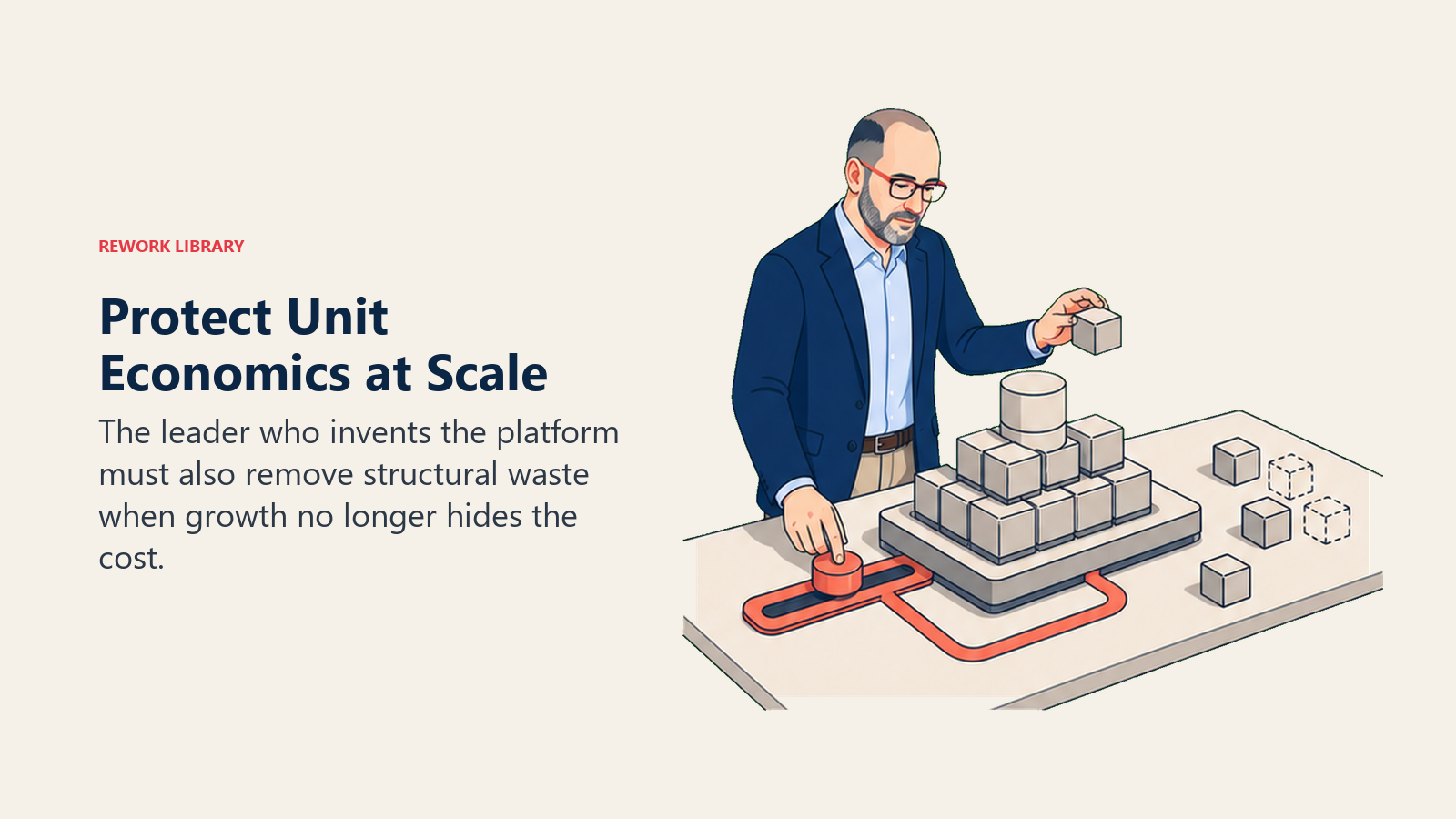
The Jassy Efficiency Doctrine is the discipline of running an organization as if it were an engineered system: identify the missing infrastructure, build it before demand is visible, and continuously eliminate structural waste through written reasoning rather than slide-driven intuition. It treats leadership as two inseparable roles, the builder who invents the platform, and the operator who protects its unit economics at scale. Its test is simple: can every major decision survive a six-page narrative defense, and would you still fund it if growth flattened tomorrow?
Key Leadership Traits
| Trait | Rating | What it means in practice |
|---|---|---|
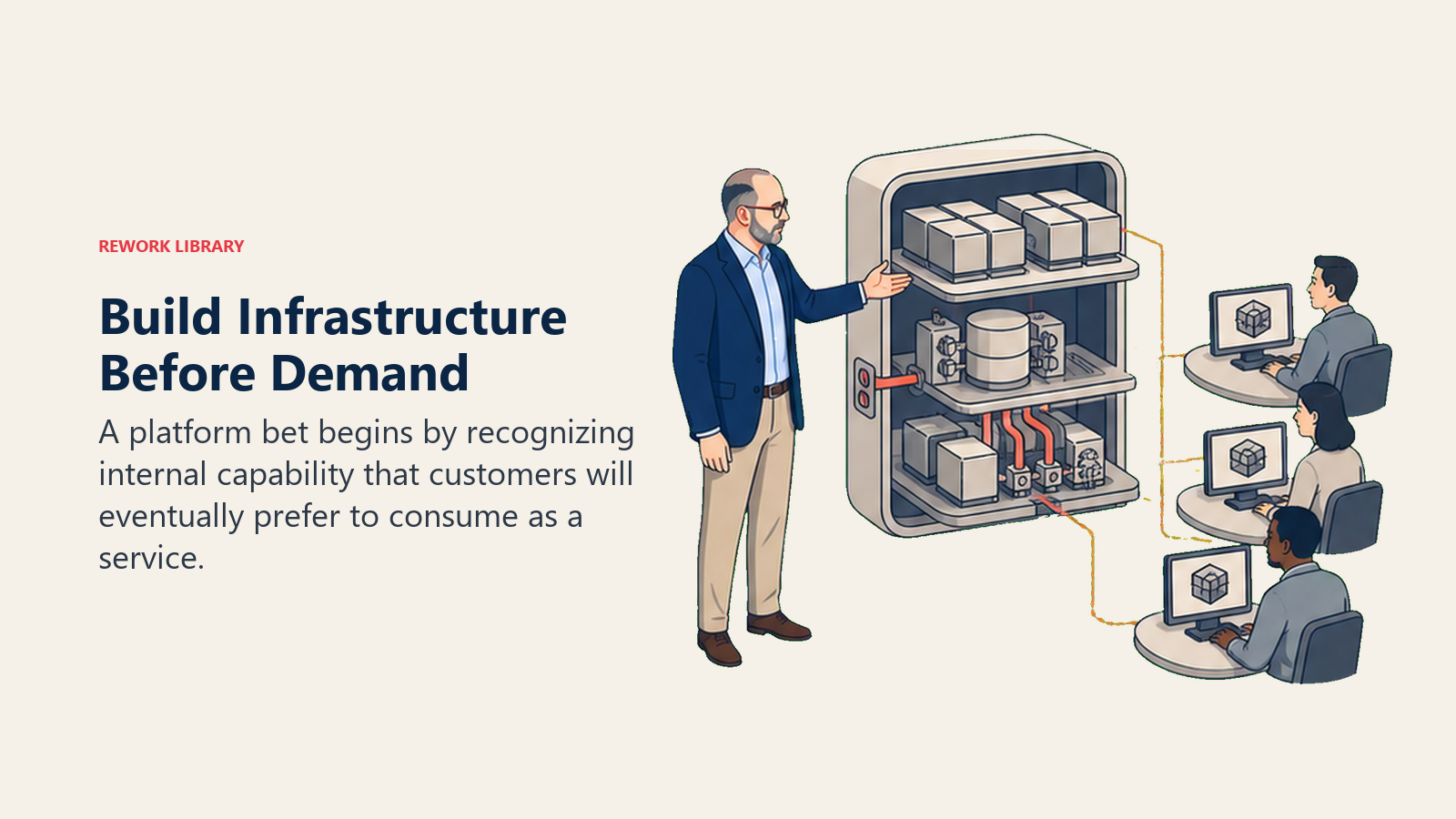
| Platform thinking | Exceptional | Jassy saw in 2003 that Amazon's internal infrastructure, the storage, compute, and database tools they'd built for themselves, could be productized for external customers. That insight wasn't obvious. AWS was built on the premise that other companies would pay to consume technology as a utility rather than build it themselves. He was right by about a decade ahead of most enterprises catching up. His career is built on identifying what infrastructure is missing, then building it before demand is visible. |
| Written-communication discipline | Very High | Amazon's six-pager memo culture is real, and Jassy is its most rigorous practitioner. Meetings at Amazon start with 20-30 minutes of silent reading. No slide decks. No verbal setup. The written document does the persuasion, which means it has to be complete, precise, and anticipate counterarguments. Jassy has extended this discipline to his own communications as CEO. If you can't write it clearly, you don't understand it clearly. |
| Cost-structure focus | High | His 2022-2023 response to Amazon's over-hiring was direct and fast. Amazon had added roughly 500,000 employees between 2019 and 2021. When post-pandemic demand normalized, Jassy cut 27,000 roles across multiple rounds, closed or cancelled projects, and pulled back from same-day delivery expansion. That level of cost discipline in a company with 1.5 million global employees requires both analytical conviction and willingness to absorb public criticism. He did both. |
| Managing under founder shadow | Medium | Jassy was Bezos's shadow for 15 months before the CEO transition, the formal Amazon program where senior leaders learn directly from Bezos. That's a feature for continuity and a bug for differentiation. He inherited the Leadership Principles, the org structure, and the culture wholesale. His individual leadership imprint as Amazon CEO is still forming. Boards considering post-founder succession should note: operational continuity and leadership freshness are in tension. Jassy leans hard toward continuity. |
The 3 Decisions That Defined Andy Jassy as a Leader
1. Pitching and Building AWS from Scratch Inside Amazon (2003-2006)
In 2003, Jassy was asked to work directly with Bezos to develop a strategy for Amazon Web Services. At the time, the concept didn't exist in any coherent form. Amazon had built significant internal infrastructure to run its own operations, and the hypothesis, that external developers and companies would pay to use that infrastructure as a service, was unproven.
Jassy spent a year working on the framework before any product was built. He wrote the founding document for AWS: what it would offer, who the customer was, how it would be priced, and why Amazon was uniquely positioned to build it. That document-first approach is now embedded in Amazon culture as the PR/FAQ process, but Jassy lived it at its most consequential. Jeff Bezos's long-term thinking made that kind of multi-year, pre-revenue investment possible, Jassy had a CEO who was structurally built for patience. Jeff Wilke's Amazon operations work ran in parallel, building the fulfillment and logistics infrastructure that AWS's commercial success would eventually subsidize.
AWS launched S3 (storage) in March 2006 and EC2 (compute) in August 2006. By 2010, it was the dominant cloud platform. The Amazon Web Services Wikipedia article documents the founding timeline in detail, including how Jassy mapped out the "Internet OS" vision in 2003 before a single product existed. By 2023, it was generating $90.8 billion in annual revenue with operating margins above 30%, the most profitable large-scale business Amazon has ever run.
The leadership lesson: Jassy didn't wait for a customer mandate. He worked from a structural insight (the infrastructure problem is universal, not just Amazon's) and built conviction through rigorous written analysis before committing resources. That's different from vision-driven bets. It's hypothesis-driven investment.
2. Amazon Layoffs and Cost Restructuring in 2022-2023
When Jassy took over in July 2021, Amazon had just come off the most aggressive hiring period in its history. Headcount had roughly doubled from 2019 to 2021 as e-commerce demand spiked during the pandemic. By late 2022, it was clear the demand hadn't permanently reset. It had been pulled forward.
Jassy's response was methodical and large-scale. Amazon cut approximately 18,000 corporate roles in early 2023, then continued trimming through the year across Alexa, AWS, retail, and devices. The Amazon company Wikipedia article covers the full scope of the 2022-2023 restructuring, including the warehouse and corporate headcount changes that followed the pandemic-era hiring surge. He shut down physical store experiments, including Amazon Style and several Amazon Fresh locations. He restructured the devices org and eliminated several products that hadn't found real market traction.
What made this notable wasn't just the scale. It was the speed of the pivot from growth-at-all-costs to unit economics. Jassy communicated the reasoning clearly in a letter to employees that cited specific cost and revenue dynamics rather than vague strategy language. He was direct about what had gone wrong and what the fix required.
For operators running companies that over-hired or over-invested during a high-growth period: the longer you wait to make the structural correction, the more it costs. Jassy's moves in 2022-2023 were painful and public. They were also early enough to let Amazon rebuild operating leverage before the next growth cycle.
3. Doubling Down on AI Infrastructure While Others Hesitated
In 2023, while many large enterprises were still treating generative AI as an experiment, Jassy made a series of commitments that amounted to an infrastructure bet: Amazon would invest tens of billions in AI training chips, data center capacity, and custom silicon (Trainium and Inferentia) to position AWS as the preferred infrastructure layer for AI workloads.
This included a $4 billion investment commitment to Anthropic, making Amazon a strategic partner for one of the leading AI model companies. The decision to invest at infrastructure scale before enterprise demand was proven mirrors the approach Marc Benioff took with Salesforce's cloud platform, both leaders made the bet that enterprises would eventually consume technology as a service, and built the plumbing first. It included the launch of Amazon Bedrock, a managed AI service letting developers access multiple foundation models through AWS. And it included a continued push on AWS's own AI coding assistant, Amazon Q.
The bet is that enterprise AI workloads will be as transformational for cloud infrastructure as the original internet-era shift to cloud was in 2006-2012. If he's right, AWS's next decade looks like its first. If he's wrong, Amazon will have built significant stranded capacity.
What this decision reflects about Jassy's leadership: he makes big bets when he has structural conviction, not when consensus forms. He's done it twice now at major scale, once with cloud computing in 2003, once with AI infrastructure in 2023. Both times, the investment preceded clear market proof.
What Andy Jassy Would Do in Your Role
If you're a CEO running a 50-500 person company, the Jassy move is to identify the infrastructure your industry is missing and ask whether you're positioned to build it. Not as a product feature, as a platform. What do your customers spend money on that they'd prefer to consume as a service? What does your company do internally that others would pay for? That line of thinking is where AWS started.
If you're a COO or operations leader, the six-pager discipline is directly applicable at any scale. Pick the three biggest operational decisions your team makes this quarter. Before any of them go to a meeting, require a written document that defines the problem, the decision options, the tradeoffs, and the recommendation with reasoning. Watch how the quality of the eventual decision changes. Jassy runs this process because it works, not because Amazon is big.
If you're a product leader, Jassy's PR/FAQ process is worth adopting as a forcing function. Before any new product or feature gets resources, write the press release announcing its launch and the FAQ answering the hardest customer questions. If you can't write those clearly, the product isn't ready to build. This catches vague product thinking before it becomes expensive engineering work.
If you're a sales or marketing leader, the lesson is about positioning for infrastructure value rather than feature value. AWS didn't sell storage. It sold the ability to scale without capital expenditure. Whatever you're selling, ask whether your positioning communicates the underlying infrastructure value, the thing that changes what your customer can build or do, rather than just the features they'll use day one.
The Rework Take: Builder-Operator Leadership for Growth-Stage Teams
Jassy's career proves a quiet rule: the builder and the operator cannot be different people. The same leader who writes the six-pager founding a new platform has to write the six-pager cutting 27,000 jobs when the economics shift. One without the other produces either beautiful architecture nobody can afford or disciplined austerity with nothing left to scale.
For growth-stage teams between 50 and 500 people, that dual posture is almost impossible to hold manually. Leaders end up visionary on Tuesdays and reactive on Thursdays because the operational signal is buried in ten disconnected tools. Rework closes that gap by keeping sales pipeline, lead management, cross-team chat, and work operations in a single system of record, so the builder-side bets and the operator-side metrics are visible in the same view. That's how you run Jassy's doctrine without a 1.5 million person org behind you, see Rework's pricing for how the CRM and Work Ops stacks compose.
Notable Quotes and Lessons Beyond the Boardroom
Jeff Bezos, in his 2021 letter announcing the CEO transition, wrote that Jassy "has the highest bandwidth of any human I've ever met." That's a specific kind of compliment from someone who built a company around cognitive throughput. What it means operationally: Jassy processes large amounts of complex information without losing track of details or first principles. That's the trait that let him build AWS conceptually before it existed as a product.
Jassy's own most consistent public message is about long-term thinking under short-term pressure. "If you're going to take big swings, you have to be willing to be misunderstood for a long period of time," he said during an interview in 2023. That's not a leadership platitude. It's a description of what it actually felt like to build AWS in 2003-2006, when it looked like an expensive experiment, and what it feels like to build AI infrastructure in 2023-2025 when profitability questions are immediate.
The practical implication: your most important long-term bets will probably be your most publicly criticized ones in the near term. If no one is questioning whether you should be doing something, it's probably not big enough.
Where This Style Breaks
Jassy's structured, written-reasoning approach is built for complexity and scale. It's not built for speed. In consumer-facing categories where taste, culture, and creative instinct drive decisions, Amazon has consistently underperformed. Alexa is a decade-old product that never found sustained consumer relevance. Amazon's entertainment bets, including buying MGM for $8.5 billion in 2022, are still searching for a creative identity. Fire Phone was a product-market-fit failure that a less rigorous, more intuitive process might have killed sooner.
The deeper structural constraint is that Jassy's leadership style is optimized for infrastructure businesses with long investment horizons and platform economics. That's a minority of the decisions Amazon makes. The retail business, the consumer devices business, and the entertainment business all require creative judgment, cultural intuition, and speed of iteration that the six-pager process actively works against.
If you're applying his methods, use them where they fit: complex decisions with multiple stakeholders, high-stakes resource allocation, and problems where being wrong is expensive. Don't use them for consumer product design or market entry decisions where speed and customer intuition matter more than analytical rigor.
Frequently Asked Questions about Andy Jassy's Leadership
Who is Andy Jassy?
Andy Jassy is the CEO of Amazon, a role he took over from Jeff Bezos in July 2021. Before that, he founded and led Amazon Web Services (AWS), growing it from a 2003 internal strategy project into a cloud business exceeding $100 billion in annual revenue run rate. He joined Amazon in 1997 straight out of Harvard Business School.
How did Andy Jassy build AWS?
Jassy spent 2003 writing the founding strategy document for AWS before a single product was built, working directly with Bezos on what the "Internet OS" would offer. AWS formally launched S3 in March 2006 and EC2 in August 2006. Jassy ran it as a separate company inside Amazon for 15 years, scaling it to dominant cloud market share before he was promoted to Amazon CEO.
What changed when Jassy succeeded Bezos as CEO?
Operational continuity was preserved, Jassy kept the 14 Leadership Principles, the PR/FAQ process, and the six-pager culture Bezos built. What changed was the posture. Jassy moved Amazon from growth-at-all-costs to disciplined unit economics, cut structural cost, and redirected capital toward AI infrastructure. His leadership imprint is lower-key in public but more operationally rigorous internally.
Why did Jassy layoff 27,000 Amazon employees?
Amazon roughly doubled headcount between 2019 and 2021 as pandemic e-commerce demand surged. When demand normalized in 2022, Jassy concluded the expansion had been pulled forward rather than permanently shifted. He announced approximately 18,000 corporate cuts in early 2023 and continued trimming across AWS, Alexa, devices, and retail through the year, totaling around 27,000 roles, while also shutting physical store experiments and cancelled products.
What is Jassy's leadership philosophy?
Jassy is a builder-operator. He believes durable decisions come from written reasoning, not slides or verbal pitches, and that the job of a leader is to find missing infrastructure and build it before demand is obvious. He runs on the six-pager discipline, favors long-term structural bets (cloud in 2003, AI in 2023), and is willing to absorb public criticism on cost cuts to protect long-term operating leverage.
What can modern CEOs learn from Andy Jassy?
Three things. First, the best bets are infrastructure bets made before consensus forms, both AWS and Amazon's AI push fit this pattern. Second, written reasoning beats verbal persuasion for high-stakes decisions; adopt the six-pager or PR/FAQ process at any scale. Third, when your cost structure gets out of line with reality, act fast and explain the reasoning directly to employees, delay makes the eventual correction more painful, not less.
Learn More
- How to Use the Amazon PR/FAQ Framework for Product Decisions
- Post-Founder CEO: How to Lead a Company That Wasn't Built Around You
- Cost Structure Discipline: When and How to Cut for Long-Term Health

On this page
- Leadership Style Breakdown
- The Jassy Efficiency Doctrine (Builder-Operator Model)
- Key Leadership Traits
- The 3 Decisions That Defined Andy Jassy as a Leader
- 1. Pitching and Building AWS from Scratch Inside Amazon (2003-2006)
- 2. Amazon Layoffs and Cost Restructuring in 2022-2023
- 3. Doubling Down on AI Infrastructure While Others Hesitated
- What Andy Jassy Would Do in Your Role
- The Rework Take: Builder-Operator Leadership for Growth-Stage Teams
- Notable Quotes and Lessons Beyond the Boardroom
- Where This Style Breaks
- Learn More