Elon Musk Leadership Style: How First Principles Thinking and Extreme Risk Tolerance Built Multiple Industries
Turn this article into takeaways for your work.


Each assistant summarizes the article only for you and suggests best practices for your work.
There are leaders who build companies. And there are leaders who build industries. Elon Musk has done both, more than once, in sectors that most investors and engineers had written off as either impossible or not worth trying.
He didn't just co-found Tesla. He bet his remaining fortune on it when the company was weeks from bankruptcy and the global financial crisis had frozen capital markets. He didn't just found SpaceX. He designed rockets from scratch using first principles reasoning when every aerospace veteran told him it couldn't be done for the budget he had. And when he acquired Twitter for $44 billion, buying it from Jack Dorsey, the founder who had already been pushed out once, he did it in a way that was widely described as impulsive, then tried to rebuild the entire company in under six months.
You don't have to like every decision Musk has made to learn from how he makes decisions. The pattern underneath the chaos is more coherent than it looks from the outside.
"When something is important enough, you do it even if the odds are not in your favor.", Elon Musk
Key Facts
- Born: 1971, Pretoria, South Africa
- Zip2: Co-founded 1995 (online city guides for newspapers), sold to Compaq for $307 million in 1999
- PayPal: Co-founded X.com (merged to form PayPal), sold to eBay for $1.5 billion in 2002
- SpaceX: Founded 2002; Falcon 1 became the first privately developed liquid-fuel rocket to reach orbit in 2008; first private crewed spaceflight (Crew Dragon Demo-2) in 2020; pioneered reusable Falcon 9 booster landing (2015) and Starship full-stack reusability program
- Tesla: Joined as lead investor and chairman in 2004 seed round, CEO since 2008; took the company from near-bankruptcy to peak market capitalization above $1 trillion in 2021
- Neuralink: Co-founded 2016 (brain-computer interfaces), first human implant in 2024
- Twitter/X: Acquired for $44 billion in October 2022 and rebranded to X
- xAI: Founded 2023 (AI research), released Grok chatbot that same year
- Other ventures: Starlink (satellite internet), The Boring Company (tunneling)
- Net worth: Exceeded $300 billion in 2024, making him the world's richest person
First Principles Thinking (The Musk Extreme Risk Doctrine)
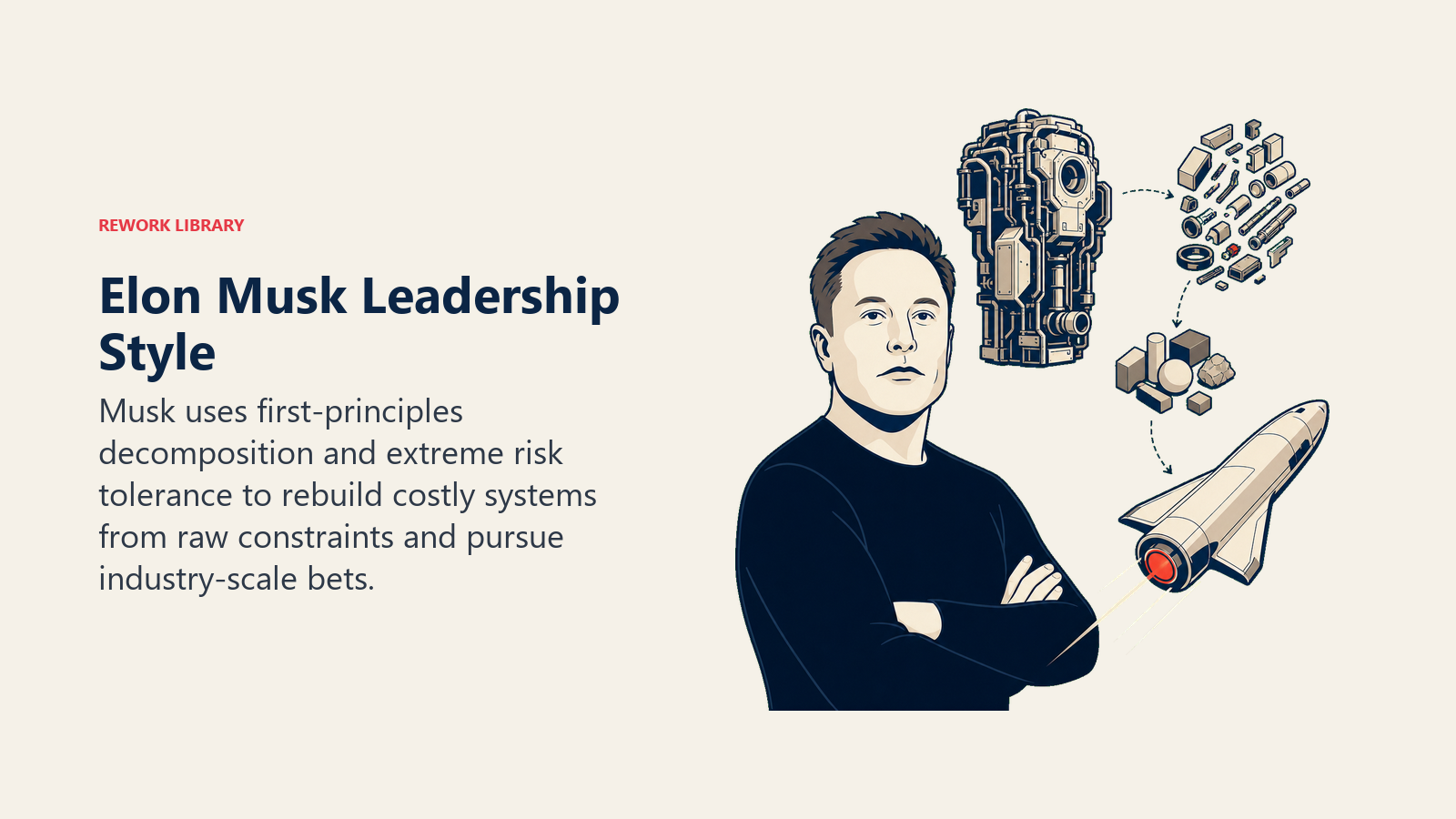
First principles thinking is the practice of reducing a problem to its most fundamental, physically or mathematically irreducible components, then rebuilding a solution from those components rather than reasoning by analogy to what competitors do. Musk pairs this with an extreme risk doctrine: concentrate personal capital, reputation, and decision authority into bets the market considers impossible, and treat the resulting urgency as a forcing function for engineering breakthroughs. The combination trades consensus and stability for speed and originality.

Leadership Style Breakdown
| Style | Weight | How it showed up |
|---|---|---|
| Visionary | 80% | Set 10-20 year targets that most engineers considered science fiction, then worked backward to the engineering required to reach them. Framed company missions around civilizational stakes, not market share. |
| Autocratic | 20% | Final authority over product decisions, engineering standards, and organizational structure. Rapid firings and restructurings when results didn't meet expectations. Low tolerance for process that slowed execution. |
The 80/20 split is important to understand correctly. Musk's autocratic tendencies don't come from a desire to control. They come from a belief that speed and quality degrade when decisions are made by committee. His style is autocratic as a tool, not as a personality default. That distinction matters when you're figuring out what's worth borrowing.
Key Leadership Traits
| Trait | Rating | What it means in practice |
|---|---|---|
| Risk Taking | Exceptional | Invested his entire PayPal payout into Tesla and SpaceX simultaneously during a period when both were near failure. Said publicly that he thought there was a less-than-50% chance either would survive. That's not bravado, it's a revealed preference for mission over personal financial safety. |
| Innovation | Very High | Innovation at Musk's companies isn't a department or a process. It's an operating constraint. The question isn't "how do we improve this 10%?", it's "why does this work this way at all, and what would we build if we started from physics?" |
| First Principles Thinking | Very High | Instead of reasoning from analogy ("rockets cost this much because that's what rockets cost"), Musk reasons from components ("what are the raw materials, and what should the engineering cost from scratch?"). SpaceX reduced launch costs by roughly 90% using this approach. |
| Intensity | High | Musk is known for working 80-100 hour weeks and expecting similar dedication from senior leaders. He has described his own work schedule as the only way he knows how to manage multiple complex companies simultaneously. Whether that's admirable or pathological depends on your perspective, but the output is real. |
The 3 Decisions That Defined Musk as a Leader
1. Tesla's All-In Bet on Electric Vehicles
By 2008, Tesla had burned through most of its funding and the Roadster was running into serious production problems. The financial crisis had made fundraising nearly impossible. Musk had just gone through a divorce. He had enough personal capital left to save either Tesla or SpaceX, but not both.
He split the money between them, took the CEO role at Tesla himself, and made a public commitment that the company would succeed. This wasn't optimism. It was a deliberate decision to act as if failure wasn't an option, because he'd concluded that both companies needed to survive for his broader goals to make sense.
What this shows about his leadership: Musk operates on a commitment model, not a hedging model. He doesn't spread risk to protect himself. He concentrates it to signal to his teams and investors that he believes the outcome is achievable. That signal has organizational consequences. Teams working for someone who has everything on the line behave differently than teams working for someone with multiple exits available.
For today's leaders: genuine commitment is a leadership tool. The executives who hedge their bets signal to their organizations that the initiative isn't really a priority. You don't have to risk your personal finances, but you do have to demonstrate that the stakes are real.
2. SpaceX and the Reusable Rocket Program
Every aerospace expert Musk consulted before starting SpaceX told him it would fail. Rockets were expensive because the materials were expensive, the engineering was complex, and the regulatory environment was punishing. The established players had decades of institutional knowledge.
Musk's response was to go back to first principles. He priced out the raw materials, estimated the engineering complexity without the institutional overhead, and concluded that launch costs could be reduced by an order of magnitude. Then SpaceX built the team, ran the experiments, and proved it.
The Falcon 9's reusable first stage (landing a rocket booster back on a drone ship or a landing pad) was called impossible until SpaceX did it in December 2015. It's now routine. NASA and the US military, which had previously used SpaceX as a cost-efficient alternative, have since made it their primary launch provider.
The leadership lesson here isn't "challenge conventional wisdom." It's more specific than that. When experts tell you something costs what it costs, ask whether the cost is physical or institutional. Physical costs don't change because you try harder. Institutional costs are negotiable if you're willing to rebuild the institution.
3. Acquiring Twitter
Musk's acquisition of Twitter in October 2022 for $44 billion is studied as either a cautionary tale or a bold experiment in organizational transformation, depending on who's doing the studying. What's not disputed is what happened: he immediately fired roughly half the company, restructured teams without transition plans, made public product decisions on his personal account, and pushed the remaining staff to work at a pace many described as unsustainable.
From a pure organizational management standpoint, many of the changes were destabilizing. Advertisers paused spending. Several senior executives who he brought in left within months. The platform experienced multiple outages. And yet, by some metrics, the platform's usage increased during the period of chaos.
What this reveals about Musk's leadership style is something important: he applies the same tolerance for short-term dysfunction to organizations that he applies to rocket launches. SpaceX had three failed rocket launches before its first successful one. He treated Twitter's initial instability the same way: as an acceptable cost of rapid restructuring.
Whether that analogy holds for social media companies is an open question. Rockets don't have advertiser relationships or network effects that depend on trust. But the decision-making framework is consistent.
What Musk Would Do in Your Role
If you're a CEO running a capital-intensive business, the first principles lesson is most directly applicable. Before your next major capital allocation decision, ask your team to start from physics (or its equivalent in your industry) rather than from market pricing. What would this actually cost to build if you ignored what incumbents charge? The gap between that number and current market rates is your opportunity.
If you're a COO or VP of Engineering, the intensity lesson is double-edged. Musk's output under extreme personal work hours is real, but it's also partly a function of his specific cognitive wiring and his ability to hold extraordinary complexity in working memory. What you can borrow is the intolerance for unnecessary process. Musk's teams move fast partly because he eliminates approvals, meetings, and sign-off chains that don't produce better outcomes. Audit your own approval chains this week. Much of SpaceX's daily operations are actually run by Gwynne Shotwell, SpaceX's day-to-day president, a detail often lost in coverage of Musk as a lone genius. Her operational discipline is what converts his engineering bets into a functioning commercial business.
If you're a product leader, the innovation lesson is about the quality of the question you're asking. "How do we improve this feature?" is a different question than "why does this feature exist in this form?" Musk's teams spend time on the second question. Most product teams spend almost all their time on the first.
If you're a sales or growth leader, the commitment signal matters. Musk's ability to attract talent and capital to seemingly impossible ventures is partly a function of how unambiguously he communicates personal conviction. You can't fake that conviction. But you can practice articulating your actual thesis for why your company wins, and doing it with less hedging.
How Rework Supports First-Principles Product Design and Forcing-Function Urgency
Musk's operating model rests on two moves: design products from physics rather than from competitor benchmarks, and use self-imposed deadlines as forcing functions that expose operational slack the org would otherwise tolerate. Rework is built to make both moves easier. A single workspace for sales, support, lead management, and cross-functional work means the handoff latency Musk spends his career attacking shows up as a visible queue rather than hiding inside email threads and weekly syncs. Shared pipelines and automation surface which approvals, status meetings, and duplicated checklists are actually adding quality and which are just absorbing calendar time, the same audit Musk performs manually when he tours a factory floor. For founders shipping big outcomes with lean headcount, Rework's Sales Engine and Process Engine (from $69 and $99 per month billed yearly, each with 5 seats included) replace the fragmented tooling stack that quietly slows first-principles teams down. Start at rework.com/pricing.
The Shadow Side: What Musk Got Wrong
The burnout culture Musk builds is real and documented. Multiple engineers who worked at Tesla and SpaceX describe brilliant outcomes alongside genuine psychological damage: anxiety, relationship breakdowns, health problems attributed to sustained overwork. Some of those engineers consider it worth it in retrospect. Many don't.
The Twitter acquisition exposed a different problem: Musk's organizational transformation tools work for engineering teams building physical products, where you can run experiments and measure outcomes against clear physical constraints. They're less suited to media and advertising-dependent platforms, where trust is a slow-building asset and advertiser relationships require sustained, stable engagement. He appeared to underestimate how different the business dynamics were.
His management volatility (the late-night tweets announcing policy changes, the abrupt firings, the public conflicts with regulators and executives) creates organizational uncertainty that talented people, especially those with other options, find difficult to sustain. SpaceX and Tesla have retained key engineering talent partly because the mission is genuinely motivating. But they've also had attrition in leadership roles that reflects the cost of working inside that level of unpredictability.
And there's a broader question about concentration of power. One person controlling both the world's leading rocket company and a major global communications platform raises legitimately complex questions about accountability structures that go beyond what a single leader can personally decide is good governance. Mark Zuckerberg's dual-class founder control at Meta represents the same structural dynamic, a founder using share structure to insulate long-term bets from shareholder pressure, though Zuckerberg has operated within a more conventional corporate governance framework than Musk has. Patrick Collison's long-term founder approach at Stripe offers a useful third reference point: extreme ambition and long time horizons without the volatility that defines how both Musk and Zuckerberg wield founder authority.
Leadership Lessons You Can Use This Week
1. Pick one assumption to question from first principles. Choose one cost, one process, or one product decision that your team treats as fixed because "that's how it's done." Ask what it would cost or look like if you started from the underlying physics of the problem. You don't have to act on the answer immediately, but the exercise changes how you see the room.
2. Remove one approval step. Find a decision in your organization that requires three or more sign-offs and ask whether the outcome would actually be worse with one. Musk's velocity comes partly from cutting process that adds time without adding quality. One approval step removed this week is a signal about your priorities.
3. Communicate your stakes more explicitly. This week, in one conversation with your team, be more specific about why you believe the initiative matters and what success or failure means to you personally. Conviction is contagious, but only when it's expressed. Hedged language communicates hedged commitment.
4. Test intensity as a variable, not a constant. Musk works at peak intensity because he's built his life around it. You probably haven't. But you can identify one quarter where you deliberately increase your own output and attention on a specific area and see what it unlocks. Intensity as a temporary mode, deployed strategically, is different from intensity as a permanent cultural requirement.
Frequently Asked Questions about Elon Musk's Leadership
Who is Elon Musk?
Elon Musk (b. 1971, Pretoria) co-founded Zip2 and PayPal, founded SpaceX in 2002, led Tesla's seed round in 2003 and has served as CEO since 2008, co-founded Neuralink in 2016, acquired Twitter for $44 billion in 2022 and rebranded it to X, and founded xAI in 2023. In 2024 his net worth exceeded $300 billion, making him the world's richest person.
What is first principles thinking?
First principles thinking is the practice of breaking a problem down to its fundamental physical or mathematical components and reasoning up from there, rather than copying what competitors do. Musk famously used it at SpaceX, pricing raw materials for a rocket from scratch, and reduced launch costs by roughly an order of magnitude compared to legacy aerospace contractors.
How did Musk save Tesla from near-bankruptcy?
By late 2008 Tesla had nearly run out of cash, the Roadster's production was troubled, and the financial crisis had frozen fundraising. Musk took over as CEO, invested the bulk of his remaining personal capital into the company, closed a final funding round in the last week of December 2008, and later secured a $465 million loan from the US Department of Energy. Tesla went public in 2010 and eventually reached a market cap above $1 trillion in 2021.
What is Musk's approach to engineering at SpaceX?
SpaceX engineering is organized around first principles costing, vertical integration (designing and manufacturing most components in-house rather than buying from suppliers), and rapid iteration with hardware. The Falcon 9's reusable first stage, landed successfully in December 2015 and now routine, was the direct output of that approach, and the Starship program extends full-stack reusability to both booster and upper stage. Musk personally leads weekly engineering reviews and pushes for timelines that most aerospace incumbents call impossible.
Why is Elon Musk so controversial?
Musk's controversies cluster around three areas: labor and management intensity (long hours, rapid firings, a "hardcore" culture documented by former employees), public communication (late-night tweets announcing policy changes, confrontations with regulators and executives, contested posts on X), and concentration of power (one individual controlling the world's leading rocket company, a major EV maker, and a global communications platform raises governance questions that go beyond any single company's board).
What can founders learn from Elon Musk?
Three things translate well beyond his specific personality. First, reason from first principles on any cost or constraint your industry treats as fixed. Second, concentrate commitment rather than hedging, teams behave differently when the founder has genuine skin in the game. Third, aggressively remove approval layers that add time without adding quality. The burnout intensity and the public volatility are harder to borrow without damage, so most founders should treat those as warnings rather than templates.
Learn More
If this profile is shaping how you think about bold leadership and first principles, these articles go deeper:

On this page
- Key Facts
- First Principles Thinking (The Musk Extreme Risk Doctrine)
- Leadership Style Breakdown
- Key Leadership Traits
- The 3 Decisions That Defined Musk as a Leader
- 1. Tesla's All-In Bet on Electric Vehicles
- 2. SpaceX and the Reusable Rocket Program
- 3. Acquiring Twitter
- What Musk Would Do in Your Role
- How Rework Supports First-Principles Product Design and Forcing-Function Urgency
- The Shadow Side: What Musk Got Wrong
- Leadership Lessons You Can Use This Week
- Learn More