Jack Welch Leadership Style: How GE's Legendary CEO Turned Operational Rigor into Competitive Advantage
Turn this article into takeaways for your work.


Each assistant summarizes the article only for you and suggests best practices for your work.
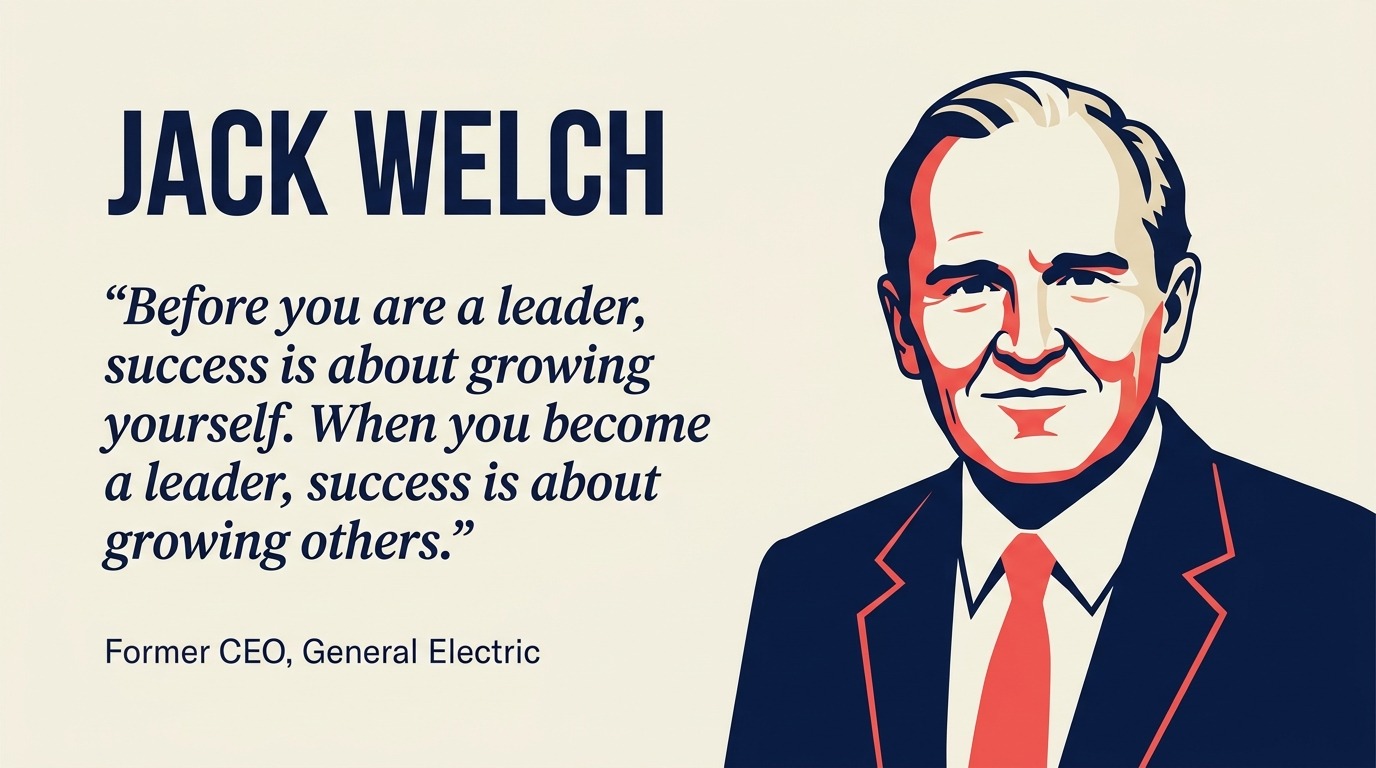
Key Facts: Jack Welch (1935-2020) served as CEO of General Electric from 1981 to 2001, growing its market capitalization from roughly $14 billion to over $410 billion, a ~29x increase. He institutionalized the "rank-and-yank" vitality curve (top 20% / middle 70% / bottom 10%), enforced a "#1 or #2" market-position doctrine that led GE to sell or close more than 200 businesses, and scaled Six Sigma across every GE business unit starting in 1995. Fortune named him "Manager of the Century" in 1999. His 2001 memoir "Jack: Straight from the Gut" was a #1 bestseller, followed by "Winning" (2005).
The Welch Operational Rigor Model
The Welch Operational Rigor Model is a CEO operating system built on three enforced disciplines: portfolio concentration (be #1 or #2 in every market or exit), forced talent differentiation (annually rank people and act on the distribution), and process rigor at scale (train every manager in a single quality methodology and tie promotion to it). Its power comes from refusing to carry underperforming businesses, underperforming people, or undisciplined processes, and its fragility comes from the same refusal, which can hollow out R&D, psychological safety, and long-cycle bets.
When Jack Welch took over General Electric in 1981, the company was a profitable but sluggish industrial conglomerate. His intellectual lineage runs directly through Peter Drucker's effective-executive framework, Drucker believed the CEO's primary job was managing knowledge workers toward defined results, and Welch operationalized that belief at a scale Drucker had never personally run. When he left in 2001, GE's market cap had grown from $14 billion to over $400 billion. Fortune named him "Manager of the Century." Business schools studied his playbook for two decades.
Then GE's stock collapsed. The empire he built started unwinding almost immediately after he departed. By 2018, GE was removed from the Dow Jones Industrial Average. By 2021, it was breaking itself apart.
That arc (spectacular rise, complicated legacy) makes Welch one of the most instructive leaders in modern business history. His methods worked. They also created vulnerabilities that took a decade to materialize. Understanding both sides gives you something more useful than a hero story.
Leadership Style Breakdown
| Style | Weight | How it showed up |
|---|---|---|
| Transformational | 65% | Reshaped GE's entire business model, culture, and talent philosophy. Set a vision employees could internalize, "be number one or number two in every market or get out", and made the organization move toward it with unusual speed. |
| Autocratic | 35% | Top-down decisions on business unit exits, leadership cuts, and organizational structure. Welch didn't build consensus on strategic direction. He communicated it and expected execution. |
The ratio explains a lot about how Welch's style both worked and didn't. The transformational energy attracted talented executives who wanted to operate inside a clear philosophy. The autocratic layer meant that philosophy wasn't up for debate. That combination is powerful in a controlled environment and fragile when the person driving it leaves.
Key Leadership Traits
| Trait | Rating | What it means in practice |
|---|---|---|
| Decisiveness | Exceptional | Welch didn't agonize over hard calls. He made them fast and moved on. The first five years of his tenure involved selling or closing more than 200 businesses and laying off 100,000 employees. He didn't frame this as painful, he framed it as necessary. That speed of decision kept the organization from death-by-hesitation. |
| Talent Development | Very High | Crotonville, GE's leadership development center, became a serious competitive advantage under Welch. He spent personal time there regularly. He believed leadership was a learnable skill and that building a pipeline of capable executives was the CEO's primary job. Several Welch-era GE executives went on to run major companies. |
| Operational Rigor | High | Six Sigma wasn't invented at GE, but Welch scaled it further than anyone had. He required all GE managers to be trained in Six Sigma methodology and tied promotions to it. The result was a culture that took process improvement seriously rather than treating it as a compliance checkbox. |
| Candor | High | Welch's book is literally titled "Winning" and one of its central ideas is that most organizations suffer from a lack of candor, a reluctance to say what's actually true in meetings, performance reviews, and strategy sessions. He modeled directness and expected it in return. |
The 3 Decisions That Defined Welch as a Leader
1. Rank-and-Yank: Differentiating the Workforce
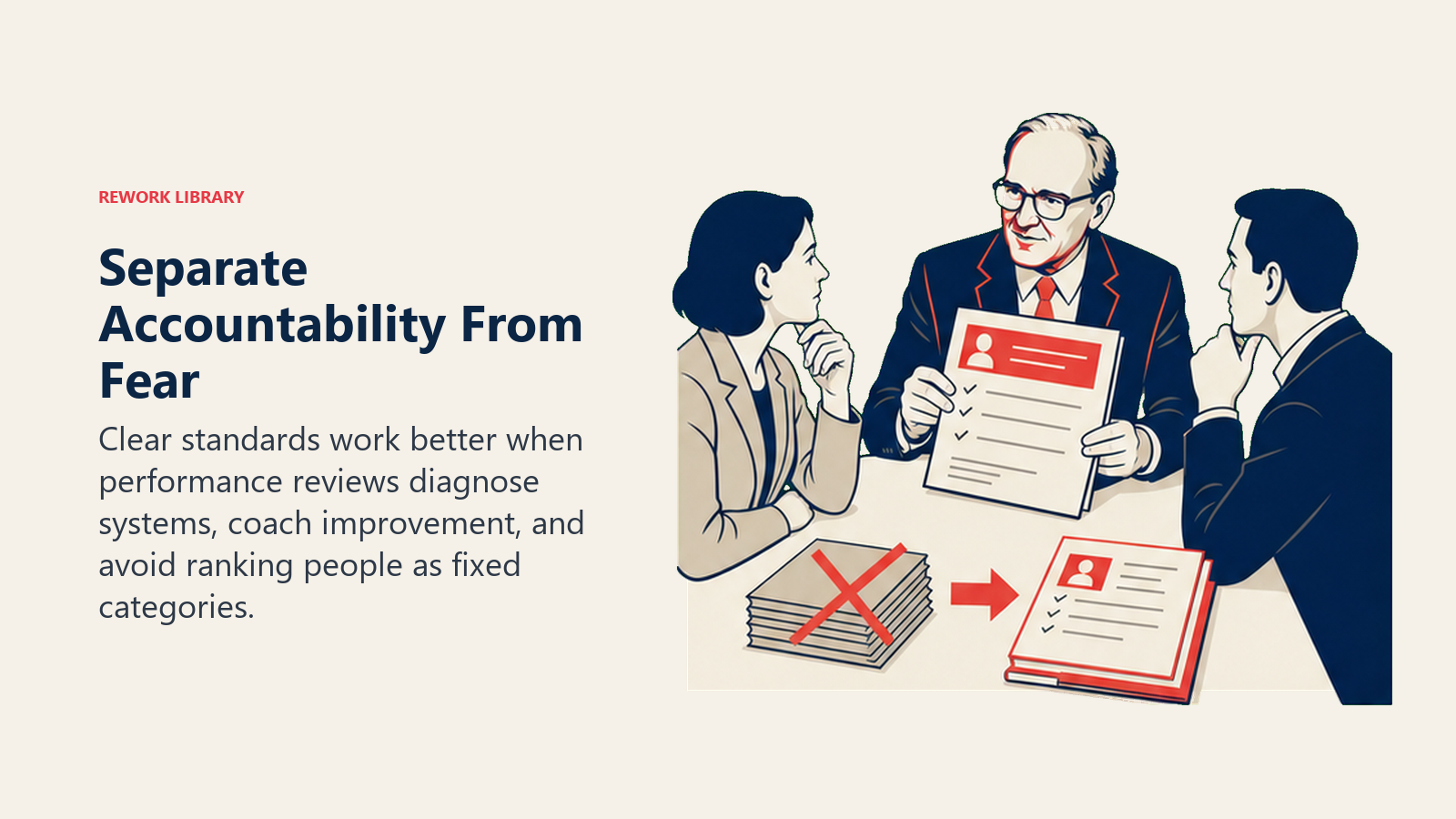
Early in his tenure, Welch institutionalized a performance management system that ranked employees and required the bottom 10% to be let go every year, regardless of absolute performance. The top 20% were rewarded aggressively with compensation and development opportunities. The middle 70% were coached and retained. The bottom 10% were out.
This practice, often called "rank-and-yank" or the vitality curve, was immediately controversial. Critics argued it created internal competition, destroyed trust, and often removed people who were simply in harder roles or worse-performing business units rather than genuinely underperforming.
What it shows about Welch: he believed that talent density was a competitive moat and that organizations naturally accumulate underperformers if there's no mechanism to remove them. He framed the annual cuts as honest: giving people clarity about where they stood rather than letting them spend years in a role where they'd never advance.
For today's leaders: the specific mechanism isn't what matters. What matters is whether your organization has a real process for identifying and addressing performance gaps, or whether difficult talent conversations get indefinitely deferred. Most companies do the latter. Welch forced the former. The question is whether you can find a version of that discipline that doesn't also destroy psychological safety.
2. The GE Capital Expansion
Welch transformed GE Capital from a financing arm for GE's industrial products into a standalone financial services business that eventually generated more than 40% of GE's profits. He expanded it into mortgages, insurance, credit cards, and commercial real estate.
At the time, this looked like genius. Financial services businesses had high margins, didn't require manufacturing capital, and could grow quickly. GE's industrial credibility gave GE Capital implicit backing that let it borrow cheaply and expand fast.
The leadership decision was to use a capital-light industrial company's balance sheet to lever into capital-intensive financial services. It worked for 20 years and then became the primary driver of GE's near-collapse in 2008-2009 when credit markets froze.
The lesson here is one Welch didn't live to see play out during his tenure: a decision can look exceptional for a decade and still be structurally wrong. GE Capital's profits masked declining industrial performance and created a concentration of financial risk that was invisible during the expansion phase. When you're evaluating your own "winning" strategy, ask what it would take for this to fail catastrophically. Welch either didn't ask that question or didn't like the answer.
3. Scaling Six Sigma Across GE
In 1995, Welch committed GE to Six Sigma across every business unit. He required all GE executives to have Six Sigma training before they could be promoted. He tied a meaningful portion of bonuses to Six Sigma project outcomes. He brought in outside experts and built internal certification programs.
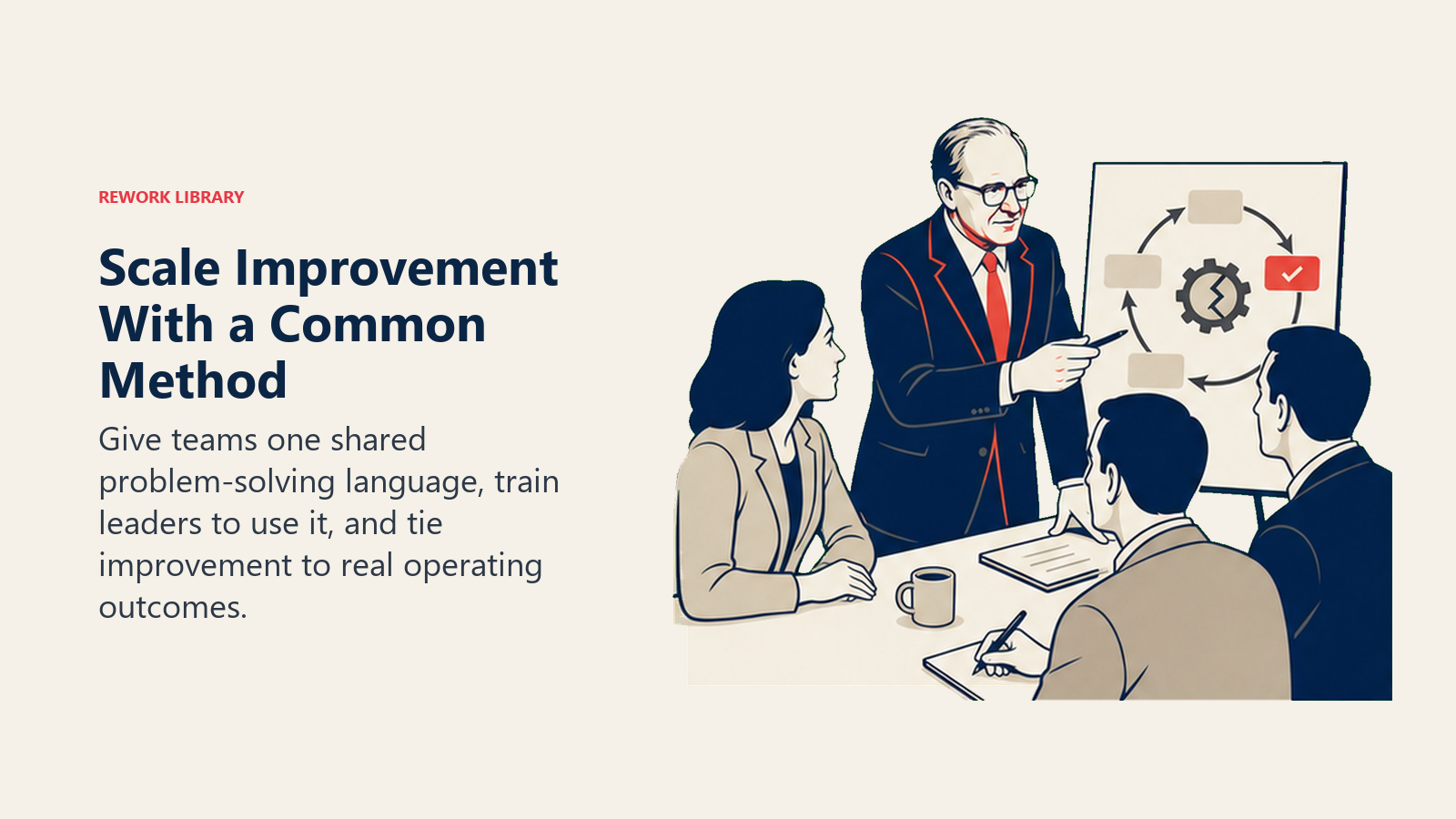
The results were measurable. GE reported more than $10 billion in savings from Six Sigma in the first five years. Quality defects fell. Customer complaints dropped. The operational culture tightened in ways that compounded over time.
But the implementation also showed Welch's tendency to overrotate. Critics inside and outside GE argued that Six Sigma, applied to innovation and R&D functions, killed exploratory thinking. When every project has to define its defect rate upfront, teams optimize for predictable outputs rather than uncertain but high-potential experiments. GE's R&D capability, which had produced important industrial innovations for decades, atrophied during the Six Sigma era in ways that didn't show up immediately.
What this shows: operational rigor is a genuine competitive advantage. But the tools of operational improvement aren't neutral. They have a culture embedded in them. Before you deploy a major process discipline across your organization, ask which functions it will strengthen and which it will accidentally hollow out.
What Welch Would Do in Your Role
If you're a CEO of a multi-business company, the most Welch-like move is enforcing your portfolio thesis. Welch's "number one or number two" rule wasn't about pride. It was about resource allocation. Businesses that can't win their market don't deserve continued investment. Walk through your business units or product lines and ask honestly which ones you'd start today. The ones you wouldn't are candidates for reallocation or exit.
If you're a COO or operations leader, Six Sigma's underlying insight (that most quality problems are systemic, not individual) is worth taking seriously. Andy Grove built Intel using a comparable operational philosophy, management by objectives, high output metrics, and the same intolerance for ambiguity in accountability that defined Welch's GE. The two represent the peak of 1980s-90s institutional operator thinking. You don't have to implement the full methodology, but the habit of asking "where are our defect rates highest and what process is producing them?" is one of the highest-value questions in operations.
If you're a people or HR leader, the talent differentiation principle deserves examination. Not the 10% cuts specifically, but the underlying question: do your managers actually have candid performance conversations, or do they defer them until situations become untenable? Most organizations have a systemic avoidance of honest feedback. Welch created a structure that forced the conversation. You need some version of that structure.
If you're a CFO or finance leader, GE Capital's story is the most useful one for you. It's a case study in how financial engineering can paper over operational weakness for long enough that the paper becomes the company. Ask which of your current revenue sources is masking something you should be fixing.
The Rework Angle: Performance Differentiation and Portfolio Discipline, Without the Collateral Damage
Welch's model depended on one thing most companies still don't have: real visibility into how each team, product line, and revenue source is actually performing, in near real time. Rank-and-yank collapses into politics without trustworthy data. Portfolio discipline collapses into gut-feel without unit-level metrics. That's the gap Rework closes for operators running Welch-style rigor today. Rework ties CRM pipeline, lead management, and team execution into one system, so a CEO can see which business units are actually #1 or #2 in their market, and which managers are quietly protecting underperformers. You don't need annual 10% cuts to get the Welch benefit. You need monthly visibility into who's delivering and which bets are compounding, so honest conversations happen before the problem ossifies. That's differentiation with data instead of differentiation with fear.
The Shadow Side: What Welch Got Wrong
The rank-and-yank system caused real damage that didn't show up on financial statements. Employees optimized for surviving the review rather than doing good work. Teams competed rather than collaborated. People learned to manage perceptions rather than manage outcomes. The culture it produced was combative in ways that eventually hurt talent retention.
GE Capital's growth, celebrated during Welch's tenure, became the primary reason GE required a government bailout during the 2008 financial crisis. The risk was embedded in the strategy. Welch just ran fast enough that it didn't detonate on his watch. His successors inherited that fuse.
The short-termism charge also has merit. Welch's compensation system rewarded quarterly and annual performance heavily. The result was that executives optimized for visible near-term results over long-cycle investments. GE's industrial R&D suffered. Its ability to out-innovate competitors eroded. The compounding effects of those underinvestments showed up a decade after Welch left.
There's also the question of succession planning. Welch's search for a successor was famously rigorous. He spent years evaluating internal candidates. But the process was so focused on finding someone who could continue Welch's model that it may have underweighted the question of whether that model still fit the coming environment. Compare that to Bob Iger's long-tenure arc at Disney, another institution-runner who had to decide, twice, whether to stay or hand off, and whose succession choices shaped the company's trajectory more than any single acquisition. Jeff Immelt, Welch's chosen successor, inherited a company built for a world that was about to change significantly.
The honest assessment: Welch's operational discipline and talent philosophy are genuine contributions to management thinking. His financial diversification strategy and short-term orientation created fragilities that took a generation to fully manifest. You can use his playbook selectively if you're clear about which parts of it are timeless and which were products of a specific era.
Leadership Lessons You Can Use This Week
1. Enforce your portfolio rule. Pick one business unit, product line, or initiative that doesn't meet your "number one or number two" standard. This week, make a decision about it. Don't move it to next quarter's review. The deferral is the problem.
2. Have the candor conversation. Find one situation in your organization where everyone knows the truth but no one is saying it out loud. Name it in your next leadership meeting. That act of naming is the Welch move: not the bluntness, but the willingness to break the organizational avoidance pattern.
3. Audit your talent differentiation process. When did your managers last have a candid conversation with a low performer that actually changed the situation? If the answer is "not recently," your performance management system is decorative, not functional.
4. Stress-test your winning strategy. For your most profitable business unit or product, write one paragraph on the scenario that makes it fail catastrophically. If you can't write it (or don't want to), that's exactly when you need to.
Frequently Asked Questions about Jack Welch's Leadership
Who was Jack Welch?
Jack Welch (1935-2020) was the Chairman and CEO of General Electric from 1981 to 2001. During his 20-year tenure he grew GE's market capitalization from roughly $14 billion to over $410 billion, and Fortune named him "Manager of the Century" in 1999. He is one of the most studied, and most debated, CEOs in modern business history.
What is rank-and-yank (the vitality curve)?
Rank-and-yank, which Welch called the "vitality curve," is a forced-distribution performance system. Managers rank employees each year into three buckets: the top 20% get outsized rewards and development, the middle 70% are coached and retained, and the bottom 10% are let go, regardless of absolute performance. Welch argued it forced honest conversations; critics argued it damaged collaboration and psychological safety.
How did Welch grow GE's market cap from $14B to $410B?
Three levers. First, portfolio concentration, selling or closing over 200 businesses that weren't #1 or #2 in their market. Second, the GE Capital expansion, which at peak generated more than 40% of GE's profits. Third, operational rigor via Six Sigma and aggressive talent differentiation. The combination produced roughly 29x market-cap growth over 20 years.
What is the #1 or #2 doctrine?
Welch's rule that every GE business unit had to be the number one or number two player in its market, or get fixed, sold, or closed. It was a resource-allocation discipline disguised as a competitive-position rule. It prevented GE from spreading capital across businesses that couldn't win, and it forced portfolio honesty most conglomerates avoid.
Why is Welch controversial today?
Three reasons. Rank-and-yank is now widely seen as damaging to trust and collaboration, and most companies (including GE under later leadership) have abandoned it. The GE Capital strategy that looked brilliant during his tenure nearly collapsed GE in the 2008 financial crisis. And his short-term incentive design is blamed for hollowing out GE's industrial R&D, which compounded into a lost decade after he retired.
What can modern CEOs learn from Jack Welch?
Keep the portfolio discipline and the insistence on candid performance conversations, those travel. Reject the forced 10% cuts and the quarterly-earnings obsession, those don't. The durable Welch lesson is that a CEO's job is to allocate capital and talent honestly, not to avoid hard conversations. Modern operators can get the benefit with better data and without the cultural damage.
Learn More
If this profile gave you frameworks worth applying, these articles go deeper on the core ideas:

On this page
- The Welch Operational Rigor Model
- Leadership Style Breakdown
- Key Leadership Traits
- The 3 Decisions That Defined Welch as a Leader
- 1. Rank-and-Yank: Differentiating the Workforce
- 2. The GE Capital Expansion
- 3. Scaling Six Sigma Across GE
- What Welch Would Do in Your Role
- The Rework Angle: Performance Differentiation and Portfolio Discipline, Without the Collateral Damage
- The Shadow Side: What Welch Got Wrong
- Leadership Lessons You Can Use This Week
- Learn More