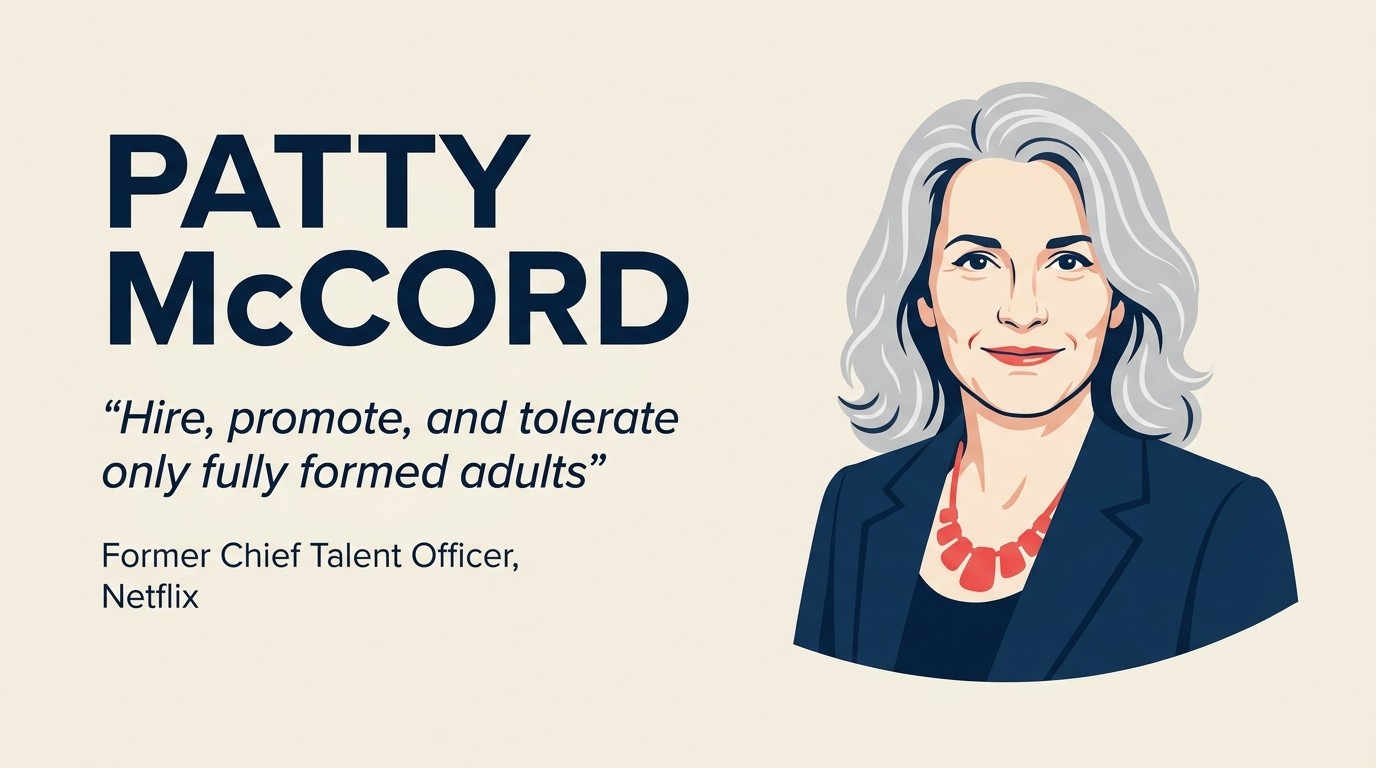
Patty McCord Leadership Style: High-Performance Teams, Radical Honesty, and the Culture Deck That Changed HR
Turn this article into takeaways for your work.


Each assistant summarizes the article only for you and suggests best practices for your work.
Key Facts
- Role: Former Chief Talent Officer, Netflix (1998–2012)
- Signature work: Co-architect with Reed Hastings of the Netflix Culture Deck (2009), viewed 20M+ times and called "the most important document to come out of Silicon Valley" by Sheryl Sandberg
- Tenure: 14 years at Netflix, scaling from roughly 30 to thousands of employees across the DVD, streaming, and original content eras
- Book: Powerful: Building a Culture of Freedom and Responsibility (2018)
- Post-Netflix: Consultant and advisor to 100+ companies including Google, Microsoft, and HBO
- Core paradigm: The "adult company", treat employees as fully formed adults, trade managed underperformance for generous severance, replace annual reviews with real-time candor
The Netflix Culture Deck
The Netflix Culture Deck is a 125-slide document co-authored by Patty McCord and Reed Hastings in 2009 that articulates Netflix's real operating principles, talent density, freedom and responsibility, context over control, and the keeper test, rather than aspirational corporate values. It became the reference template for modern Silicon Valley people operations and is the most downloaded management document of the internet era.
The Netflix Culture Deck has been viewed over 20 million times. Sheryl Sandberg called it "the most important document ever to come out of Silicon Valley." Patty McCord co-wrote it in 2009 with Reed Hastings, and then Netflix let her go the same year. Partly because she'd hired people who no longer needed her.
That's the purest expression of her philosophy: build a team so good it eventually outgrows the person who built it.
McCord joined Netflix in 1998 as an HR consultant, became a full employee, and served as Chief Talent Officer for 14 years while the company grew from roughly 30 employees to thousands. Her work sits at an intersection shared by Reed Hastings, her former boss and the Culture Deck's co-author, alongside Laszlo Bock as a parallel people-ops pioneer, Kim Scott on candor frameworks, and Adam Grant on the organizational psychology behind those same norms. She helped scale through the DVD era, the transition to streaming, and the early original content bets. When she left in 2012, she didn't go quietly. She spent the next decade consulting for over 100 companies, and her consistent finding was the same everywhere: companies adopted Culture Deck language without dismantling the processes that made that language irrelevant.
If you're managing people and still using HR processes designed for compliance rather than performance, McCord's framework is a direct challenge to how you're thinking about your job.
Leadership Style Breakdown
| Style | Weight | How it showed up |
|---|---|---|
| Performance-First Architect | 60% | McCord built Netflix's people model around a single north star: hire the best person for where the company is going, not where it's been. She designed the severance model ("adequate performance gets generous severance"), restructured the performance review process to eliminate annual cycles, and pushed managers to treat every hiring decision as a choice about what kind of team they intended to build. The architecture was always forward-looking. She wasn't managing the team she had, she was designing the team the next chapter of Netflix needed. |
| Candor-Driven Coach | 40% | McCord didn't just implement honest feedback as a policy, she modeled it. Her own departure from Netflix was handled publicly and without bitterness, consistent with the culture she'd built. Her consulting work involves telling CEOs directly that their HR processes are infantilizing their employees. Her book "Powerful" (2018) is written in the same register: direct, occasionally uncomfortable, and devoid of the motivational framing that makes most HR books easy to agree with and easy to ignore. |
The 60/40 split reflects a sequence, not a contradiction. McCord believed that candor without a performance-first architecture is just noise. If your team culture doesn't reward honesty with action, direct feedback becomes theater. She built the structure first (high-performance standards, clear severance expectations, real-time feedback) and then the candor norms fit inside that structure naturally. Most managers try it the other way and wonder why their honest conversations don't change anything.
Key Leadership Traits
| Trait | Rating | What it means in practice |
|---|---|---|
| Radical honesty in feedback | Exceptional | McCord's approach to feedback isn't a communication style, it's a structural commitment. Managers at Netflix weren't expected to soften the keeper test question. "Would I fight to keep this person?" is a binary question. If the answer is no, the next question is what you're going to do about it, not when the next performance review cycle is. McCord pushed managers to have that conversation directly with the person, not wait for a formal process to create the occasion. |
| Intolerance for mediocrity-by-process | Very High | The target of most of McCord's critique isn't underperformers, it's the HR machinery that protects underperformers from honest conversations. Performance Improvement Plans, annual review cycles, rating systems calibrated to normal distributions: she views all of these as mechanisms that delay accountability while pretending to manage it. Her argument in "Powerful" is that these processes exist primarily to protect companies from legal risk, and they do so at the cost of everyone's time and the team's overall performance standard. |
| Respect for adult professionals | High | McCord's "fully formed adults" framing is more than a rhetorical flourish. She argues that most HR processes implicitly treat employees as people who need to be managed toward correct behavior rather than trusted to make good decisions given clear context. Unlimited vacation, no expense reports, real-time feedback, these aren't perks. They're signals that the company trusts employees to exercise judgment. She believes that trust, extended seriously, attracts and retains exactly the people you want. |
| Systems thinking in people design | High | McCord didn't design individual policies. She designed a system in which the policies reinforced each other. Generous severance only works if managers actually use the keeper test. Real-time feedback only works if there's no annual review cycle creating a false occasion for candor. Unlimited vacation only works if performance expectations are clear enough that people self-regulate. Each element depends on the others being in place. Companies that adopt one element in isolation usually find it doesn't work, not because the element is wrong, but because the system it belongs to isn't there. |
The 3 Decisions That Defined Patty McCord as a Leader
1. Co-Writing the Netflix Culture Deck in 2009
The Culture Deck started as an internal document. McCord and Hastings were trying to articulate Netflix's actual operating principles for new employees, not aspirational values, but the real ones. The document's influence on Silicon Valley is documented in HBR's 2014 piece "How Netflix Reinvented HR", still one of the magazine's most-read management articles. The result was 125 slides covering talent density, freedom and responsibility, compensation philosophy, and what "adequate performance" actually meant.
The most quoted line is also the most misread: "Adequate performance gets a generous severance package." Most people read this as harsh. McCord's actual argument is the opposite. She believed that keeping someone in a role they're no longer growing in, or that the company has moved past, isn't kind, it's a mutual waste that often ends in a worse separation anyway. Generous severance is the company's part of an honest bargain. The employee gets a real conversation about where things stand, not six months of managed underperformance and a surprise exit.
The deck also distinguished between values that companies claim and values that actually govern decisions. Netflix's stated value wasn't "integrity", it was a specific list of behaviors that managers were expected to model. The test for a real value was whether someone would be fired for violating it. If the answer was no, it wasn't a value. It was a slogan.
What got misread most widely: companies copied the formatting and the language. They created culture decks with slides about candor and high performance and freedom. They left in place the HR processes, annual reviews, PIPs, rating calibrations, that those values were supposed to replace. McCord has spent the decade since "Powerful" was published explaining why that half-measure doesn't work. The words aren't the culture. The decisions are.
For you: if your company has stated values, run them through the Netflix test. For each value, ask: would we actually fire someone for consistently violating this? If the answer is no for even one of them, you've identified the gap between your stated culture and your operational one. That gap is what McCord's consulting work is usually about.
2. Eliminating Annual Performance Reviews
Netflix didn't just modify its performance review process. It eliminated the annual cycle entirely and replaced it with real-time, context-specific conversations.
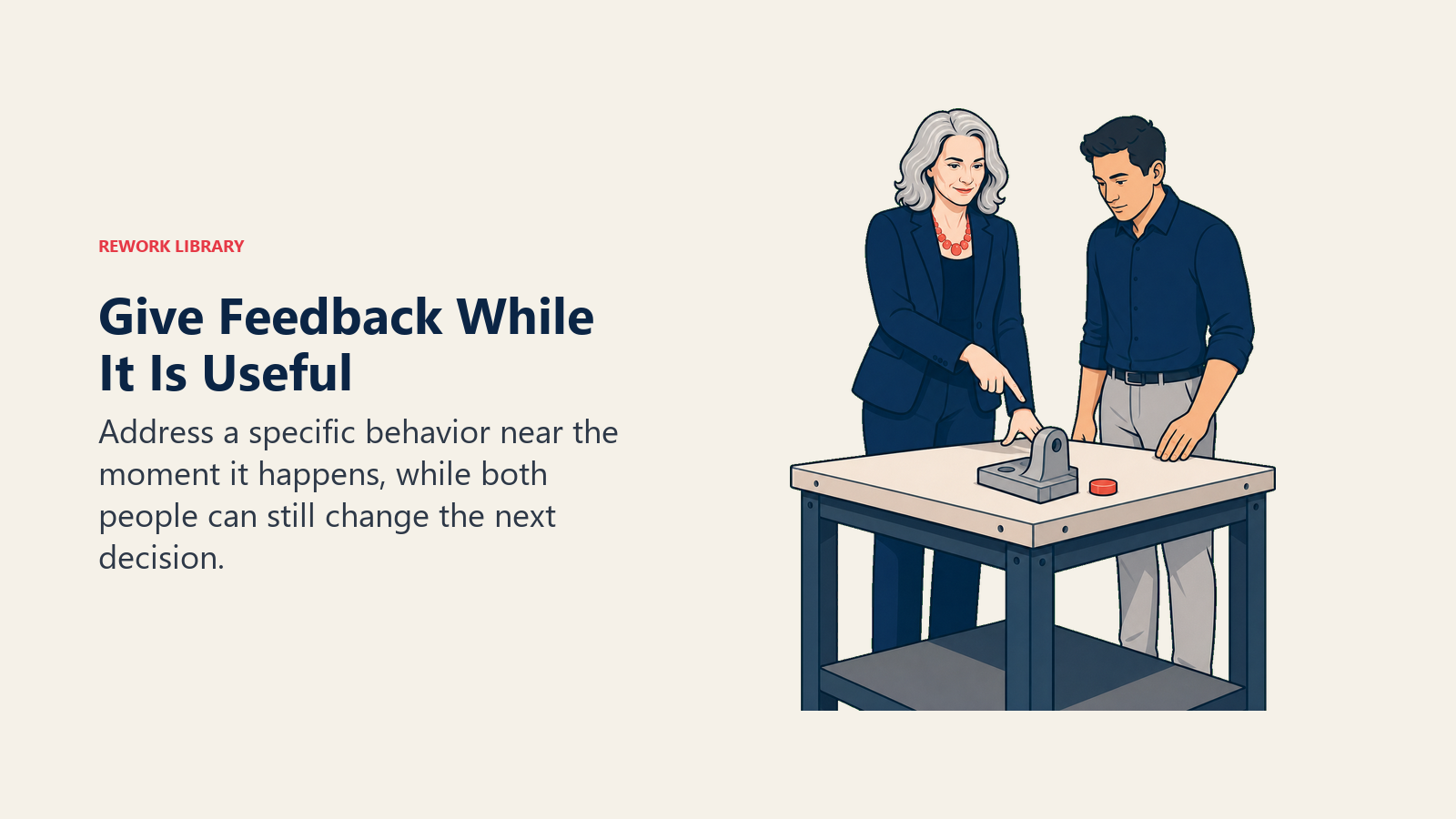
The logic was simple: annual reviews create an artificial clock for feedback that has nothing to do with when the feedback is most useful. If a manager notices a problem with someone's work in March, waiting until December to address it costs both parties nine months. And by December, the specific incident that would have been useful to discuss is so far in the past that the conversation becomes abstract.
McCord also challenged the rating scale assumption. Most performance management systems ask managers to rate employees on a 1-5 scale, then calibrate those ratings across the organization to ensure a normal distribution. She argued this is backwards: if you're calibrating ratings to fit a curve, you're not measuring performance, you're sorting people. The calibration exercise tells you who's relatively better than whom, not whether any individual is doing the job the company needs done.
The replacement wasn't a formal alternative system. It was an expectation that managers have real conversations about performance as the work happens. A quarterly conversation about where the role is going, what the company needs from it, and whether the person in it is the right person for where things are headed. Not documentation for HR. An actual conversation between a manager and an employee.
Companies that have tried to copy this have generally failed because they removed the annual review without building the management culture that makes real-time feedback work. Real-time feedback requires managers who are comfortable delivering it without a formal process to hide behind. That's a harder cultural change than changing the review schedule, and most companies underestimate it.
For you: before eliminating your annual review process, ask whether your managers can have a direct conversation about underperformance without a formal occasion to justify it. If they can't, and most managers can't, without training and cultural reinforcement, you'll end up with no formal process and no informal one either. McCord's sequence was: build the candor norms first, then remove the process that makes them unnecessary.
3. Leaving Netflix in 2012 and What She Found Consulting Elsewhere
McCord's departure from Netflix in 2012 is often treated as an interesting biographical footnote. It's more useful as a data point about the model she'd built. She'd hired her own replacement. That's consistent with the principle she'd advocated for 14 years: the right person for the role is whoever's right for where the company is going, not whoever built the role. When she was no longer the right person, the culture she'd designed produced the outcome it was designed to produce.
What she found when she started consulting was more instructive than anything in the Culture Deck. Companies across industries had read the deck and adopted its surface features. They used phrases like "talent density" and "freedom and responsibility." They put slides in their internal decks about treating employees as adults. And then they kept their HR business partners writing PIPs. They kept their annual review cycles. They kept their compensation bands that made it impossible to pay the best people at the top of the market.
Her consistent diagnosis: the Culture Deck works as a system. You can't adopt one element without the others because the elements depend on each other. Generous severance only makes sense if managers use the keeper test honestly. The keeper test only works if compensation is high enough that keeping someone is actually a choice worth fighting for. Real-time feedback only replaces annual reviews if managers are skilled and willing enough to deliver it.
The companies that implemented it most successfully, in her observation, were the ones that started with the hardest change: getting their managers to have honest conversations about performance without a process forcing the occasion. Everything else followed from that.
For you: if you're considering any part of the Netflix model, start with the management behavior, not the policy. Change the policy first and you'll just have a different rule that your managers work around the same way they worked around the old one.
What Patty McCord Would Do in Your Role
If you're a CEO, McCord would push you to apply the keeper test to your own leadership team before applying it anywhere else in the organization. For each of your direct reports, ask: if this person told me today they were leaving, how hard would I fight? Then ask whether the people you'd fight hardest for are the ones you're investing in most. If there's a gap, if the people you'd miss most aren't the ones getting your attention, your development investment, and your best opportunities, you're misallocating the most important resource you have.
If you're a COO or operations leader, McCord's challenge to you is specific: how much of your current HR infrastructure exists to protect the company from legal risk versus to build a high-performing team? Those aren't always contradictory, but they often are. PIPs, rating calibrations, structured annual review formats, these were mostly designed by lawyers, not managers. McCord would ask you to identify which processes are actually improving performance outcomes and which are just creating documentation. Then eliminate the ones that only serve the documentation function.
If you're a product leader, the "context not control" principle has a direct translation to how you structure your team. McCord's argument is that employees with full business context make better decisions than employees following process. For a product team, that means sharing customer data, business model constraints, competitive analysis, and strategy directly with the people making product decisions, not summarizing it for them. If your engineers don't know why the feature they're building matters to the business, they can't make good tradeoffs when the requirement is ambiguous, which it always is.
If you're a sales or marketing leader, McCord's most useful insight for your function is the mismatch between what companies say they want from salespeople and what they actually measure. Companies claim they want consultative sellers who build long-term relationships. Then they measure daily call volume, monthly quota attainment, and weekly pipeline coverage. The metrics design the behavior. If you want different behavior, change what you measure, not just what you say in the kickoff deck.
How Rework Supports a McCord-Style Operating Model
McCord's philosophy assumes two structural things: adult-to-adult work relationships, and culture that lives as a working document rather than a poster. Both are operational problems, not HR aspirations. Rework's Work Ops gives autonomous teams the shared context McCord's model depends on, business goals, project status, customer data, and decisions visible to the people doing the work, not summarized up and filtered down. When engineers, sellers, and operators can see the same dashboards their managers see, "context not control" stops being a slogan and becomes how the company actually runs.
Rework's Sales Engine (from $69/month billed yearly, with 5 sales seats included) extends the same logic to revenue teams: pipeline, account history, and deal context are shared by default, so managers don't need status rituals to know what's happening, and sellers don't need to be managed through daily call counts. The keeper test, real-time feedback, and high talent density all become easier to sustain when the underlying system treats people as capable of self-directing against clear goals, which is exactly the operating posture McCord spent 14 years designing into Netflix.
Notable Quotes and Lessons Beyond the Boardroom
McCord's most useful quote comes from her consulting work: "Most companies have built HR processes to protect themselves from employees, not to build great teams." Her framework aligns with broader research on high-performance work systems published by MIT Sloan Management Review, which consistently finds that trust-based management outperforms compliance-based management on retention and output. It's blunter than most people expect from an HR leader, which is exactly the point. She's describing a structural problem that most organizations won't acknowledge because the same people who benefit from the protection are the ones who'd have to change the processes.
On motivation, "Powerful" makes an argument that runs against most management psychology: McCord believes the search for "what motivates employees" is usually the wrong question. She argues that adults who've been given real context about what the company needs, hired into roles that match their skills, and paid at the top of the market don't need to be motivated. They need to be trusted. The motivation conversation is often a symptom of a hiring or compensation problem that's easier to address through engagement surveys than through the actual fix.
Her "you don't need to be a family, you need to be a high-performing team" line parallels Reed Hastings' own framing in the Culture Deck, which makes sense, since they wrote it together. But McCord has expanded the argument in ways Hastings didn't: she points out that the family metaphor isn't just strategically wrong. It's unkind. It creates a false expectation of unconditional loyalty that neither the company nor the employee can actually deliver, and then the pretense of family loyalty makes the inevitable separation worse for everyone. A team has clear roles, clear performance expectations, and clear consequences. That clarity, she argues, is more respectful than the ambiguity of family.
Where This Style Breaks
McCord's model works at scale with senior professionals who've opted into a high-performance culture. At a Series A startup with 15 employees, many of them junior, the keeper test is academic, you can't replace everyone who's not optimal when the replacement cost is four months and the company needs all hands. The "fully formed adults" framing also presumes a labor market that gives employees real options. In industries with lower compensation and fewer alternatives, the freedom and responsibility model looks less like trust and more like asking people to self-manage without the leverage to negotiate.
The generous severance premise also requires a compensation budget most growth-stage companies don't have. McCord built her model at a company that could afford to pay everyone at the top of the market. For operators who can't, the keeper test is less a tool and more an aspiration. Apply her principles selectively: the real-time feedback norms and the context-over-control philosophy don't require the same budget the severance model does.
Learn More
- Reed Hastings Leadership Style: No Rules, Three Pivots, and a Culture Deck That Changed Management
- Laszlo Bock Leadership Style: Data-Driven People Ops, Hiring Science, and What Google Learned from 50,000 Employees
- Kim Scott Leadership Style: Radical Candor, Care Personally, and the Feedback Framework That Changed Management

On this page
- The Netflix Culture Deck
- Leadership Style Breakdown
- Key Leadership Traits
- The 3 Decisions That Defined Patty McCord as a Leader
- 1. Co-Writing the Netflix Culture Deck in 2009
- 2. Eliminating Annual Performance Reviews
- 3. Leaving Netflix in 2012 and What She Found Consulting Elsewhere
- What Patty McCord Would Do in Your Role
- How Rework Supports a McCord-Style Operating Model
- Notable Quotes and Lessons Beyond the Boardroom
- Where This Style Breaks
- Learn More