Mark Zuckerberg Leadership Style: Move Fast, Pivot Hard, Own the Platform
Turn this article into takeaways for your work.


Each assistant summarizes the article only for you and suggests best practices for your work.
Key Facts: Mark Zuckerberg at a Glance
- Born: May 14, 1984 (Dobbs Ferry, New York)
- Founded Facebook: February 2004, from a Harvard dorm room as a sophomore
- Role: Chairman & CEO of Meta Platforms (formerly Facebook, Inc.) since 2004
- Defining acquisitions: Instagram ($1B, 2012), WhatsApp ($19B, 2014), Oculus VR ($2B, 2014)
- Metaverse pivot: Rebranded Facebook to Meta in October 2021
- Year of Efficiency: Announced 2023, roughly 21,000 layoffs, org delayering, AI reallocation
- AI bet: Open-sourced the Llama family of large language models starting 2023
- Philanthropy: Chan Zuckerberg Initiative, $3B+ committed toward science, education, and health
The Zuckerberg Year-of-Efficiency Model
Also called the "Move Fast, Pivot Hard Doctrine," it's the idea that a founder-operator should cut organizational slack aggressively before committing resources to the next platform bet, not as a cost-reduction exercise, but as a prerequisite for credibility on the new thesis. Efficiency isn't the goal; it's the clearing action that makes the next pivot executable. In Meta's case, 2023's headcount cuts and management delayering funded the AI infrastructure buildout that followed.
Most founders talk about long-term thinking. Mark Zuckerberg actually does it, and he's in a position most founders never reach: 20+ years running the same company, at a scale that affects 3 billion people daily, with enough share structure control that no board or activist investor can remove him.
That context matters for everything that follows. His decisions aren't evaluated the way a hired CEO's would be. He doesn't have to manage to quarterly expectations. He can burn $40 billion on a hardware bet, take the losses publicly, and then pivot without losing his seat. That's an unusual operating environment, and it produces an unusual style.
What's worth studying here isn't whether you like Zuckerberg. It's how a 19-year-old college sophomore who built a social network in his dorm room in 2004 managed to keep it relevant, and dominant, for two decades. Three pivots, each bigger than the last, each made before the market fully validated it.
Leadership Style Breakdown
| Style | Weight | How it showed up |
|---|---|---|
| Founder-Operator | 70% | Retains hands-on product involvement even at 3 billion users. Runs direct IC reviews. During the 2023 "Year of Efficiency," he personally restructured org layers and set engineering output standards rather than delegating it to HR. The dual-class share structure (his votes count ~10x) means he doesn't manage by consensus, he manages by conviction, then communicates it down. |
| Long-Horizon Strategist | 30% | Each major platform shift (mobile 2012, VR 2021, AI 2023) was announced years before it paid off, often while the existing business still had room to optimize. He builds for where attention is going, not where it is. The $19B WhatsApp acquisition and $1B Instagram deal were both made when those apps were tiny and cash-flow negative. |
The 70/30 split reflects the tension in how Zuckerberg runs Meta. Day-to-day, he's deeply operational, product reviews, direct reports, engineering culture setting. But the big bets are made with a 10-year lens, which means they look wrong for most of the time they're being executed. Steve Jobs ran a similar founder-product model at Apple, Jobs's product obsession across two decades is the closest historical parallel, though Jobs's aesthetic instincts differed sharply from Zuckerberg's data-first reasoning.
Key Leadership Traits
| Trait | Rating | What it means in practice |
|---|---|---|
| Conviction under pressure | Exceptional | Held the Metaverse bet through four straight years of Reality Labs losses, public mockery, employee frustration, and activist investor pressure, before eventually pivoting. Right or wrong on the thesis, that's genuine conviction. Most leaders would have retreated in year two. |
| Speed of adaptation | Very High | The mobile pivot in 2012 is the clearest example. Facebook's stock had fallen 50% post-IPO. The mobile product was behind. Within 18 months, Zuckerberg restructured the entire engineering org around mobile-first, acquired Instagram as a hedge, and rebuilt the ad product. It worked completely. |
| Resource allocation clarity | High | "Year of Efficiency" in 2023 cut 21,000 employees, flattened management layers, and redirected budget toward AI infrastructure. The stock tripled in twelve months. He was willing to publicly admit the previous years of over-hiring were his mistake, and then fix it operationally rather than just rhetorically. |
| Founder control as strategy | High | The dual-class share structure isn't just governance, it's a leadership philosophy. It removes the constraint of short-term shareholder pressure. It also removes the accountability mechanism that forces most leaders to confront bad decisions faster. The Metaverse bet took longer to abandon partly because no one could force the issue. |
The 3 Decisions That Defined Zuckerberg as a Leader
1. The Mobile Pivot in 2012
Facebook went public in May 2012 at a $104 billion valuation. By September, the stock was down 50%. The core problem wasn't user growth, it was that Facebook's ad revenue was almost entirely desktop-based, and users were rapidly shifting to mobile. The mobile app was slow, buggy, and built on a hybrid HTML5 framework that couldn't keep pace with native iOS performance.
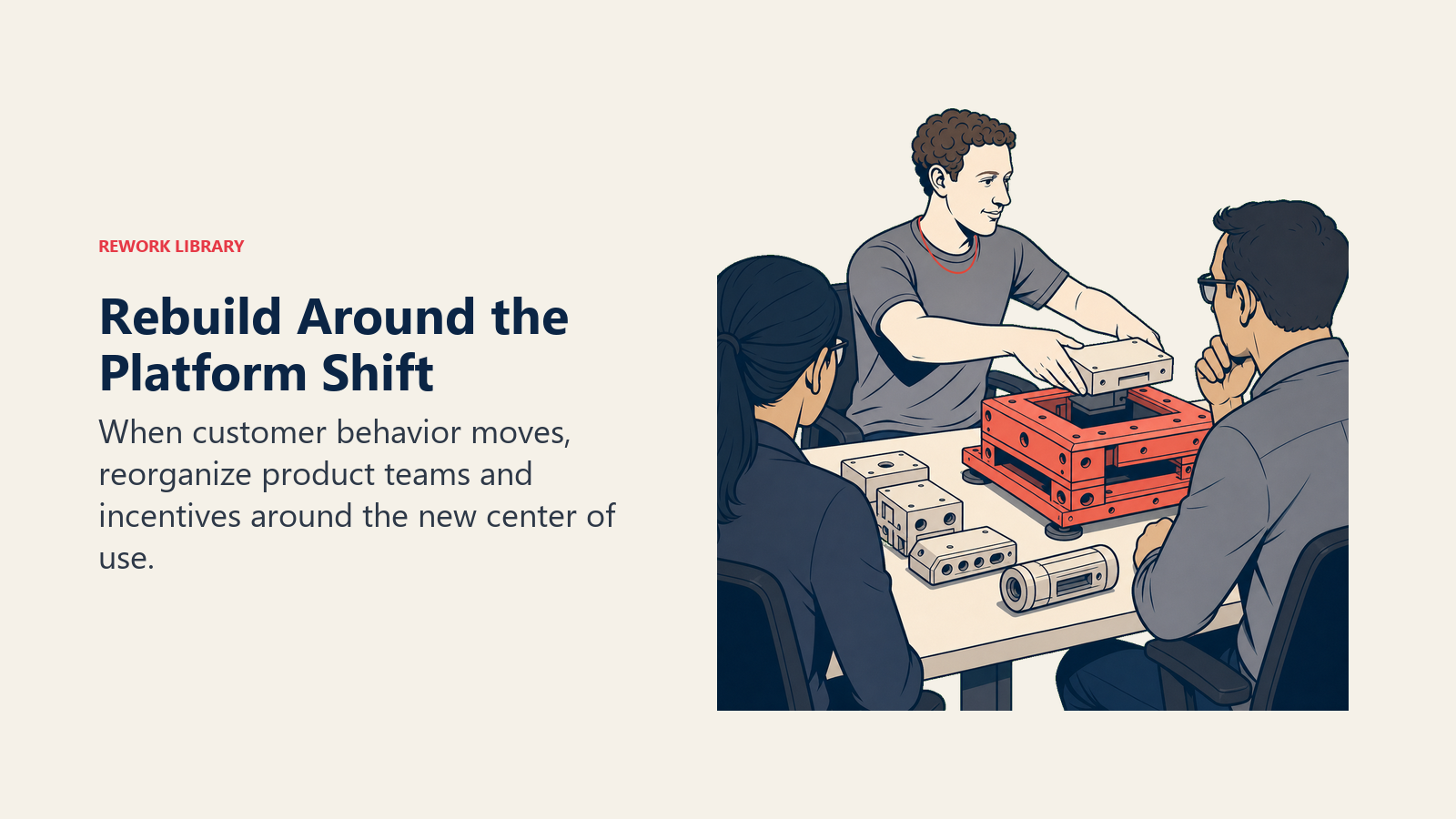
What Zuckerberg did next is the clearest example of his operating style. He didn't run a strategy review. He made a call: the company would go native on mobile, immediately. Engineering org restructured. Priorities reordered. He also bought Instagram for $1 billion in April 2012, before the IPO, when it had 13 employees and no revenue. Internally, some questioned whether that was a distraction from the core platform problems.
It wasn't. Instagram became one of the most valuable acquisitions in tech history. And the native mobile rebuild turned Facebook's ad business into the growth engine that drove a decade of revenue expansion. By 2015, mobile was more than 70% of Facebook's ad revenue.
The lesson isn't that he was right about everything. It's that he identified the single biggest threat to the business, moved resources toward solving it without a committee process, and made a hedge bet (Instagram) that covered the scenario where the core fix wasn't enough.
2. The $19 Billion WhatsApp Acquisition in 2014
When Zuckerberg paid $19 billion for WhatsApp in February 2014, it was the largest acquisition of a venture-backed company at that point in history. Brian Chesky has described similar founder-mode conviction driving Airbnb's platform decisions, Chesky's founder-led product strategy shows how the same hands-on operating instinct plays out at a smaller scale without dual-class share protection. WhatsApp had 450 million users, 55 employees, and revenue of roughly $20 million. The implied price-per-user was $42. By any conventional financial model, it looked irrational.
The actual logic was platform defense. WhatsApp was growing fastest in international markets where Facebook's monetization was weakest. It was also the primary communication layer for hundreds of millions of users in Southeast Asia, Latin America, and India, markets where Facebook Messenger hadn't established the same position. Letting WhatsApp continue to grow independently risked creating a parallel communication platform that Facebook didn't control.
That framing, platform defense plus international distribution, made the $19 billion look different. Zuckerberg wasn't buying revenue. He was buying an entry point into markets he needed for long-term dominance, and removing the most credible alternative communication platform before it could become a competitor.
WhatsApp now has more than 2 billion users. It's integrated into Meta's advertising and business messaging infrastructure. The acquisition is widely considered one of the best in tech history.
3. The Year of Efficiency in 2023
After two years of aggressive pandemic-era hiring that added roughly 27,000 employees between 2020 and 2022, Meta's business softened sharply in late 2022 due to Apple's iOS privacy changes (which hit ad targeting), a broader digital advertising slowdown, and Reality Labs losses that had reached $13.7 billion in 2022 alone.
Zuckerberg's response in 2023 was unusually direct. He called the prior period's over-hiring his mistake, cut 21,000 jobs across two rounds of layoffs, flattened management layers (removing an entire tier of middle management in many orgs), and told his engineering teams he was raising the bar for individual output, expecting more work per person, not more people. He explicitly used the phrase "the most important year in Meta's history."
What made this notable wasn't the layoffs themselves, plenty of tech companies cut headcount in 2023. It was the combination: public accountability for the error, structural fix (org delayering), and resource reallocation toward AI infrastructure in the same announcement cycle. The stock went from under $90 in November 2022 to over $550 by early 2024.
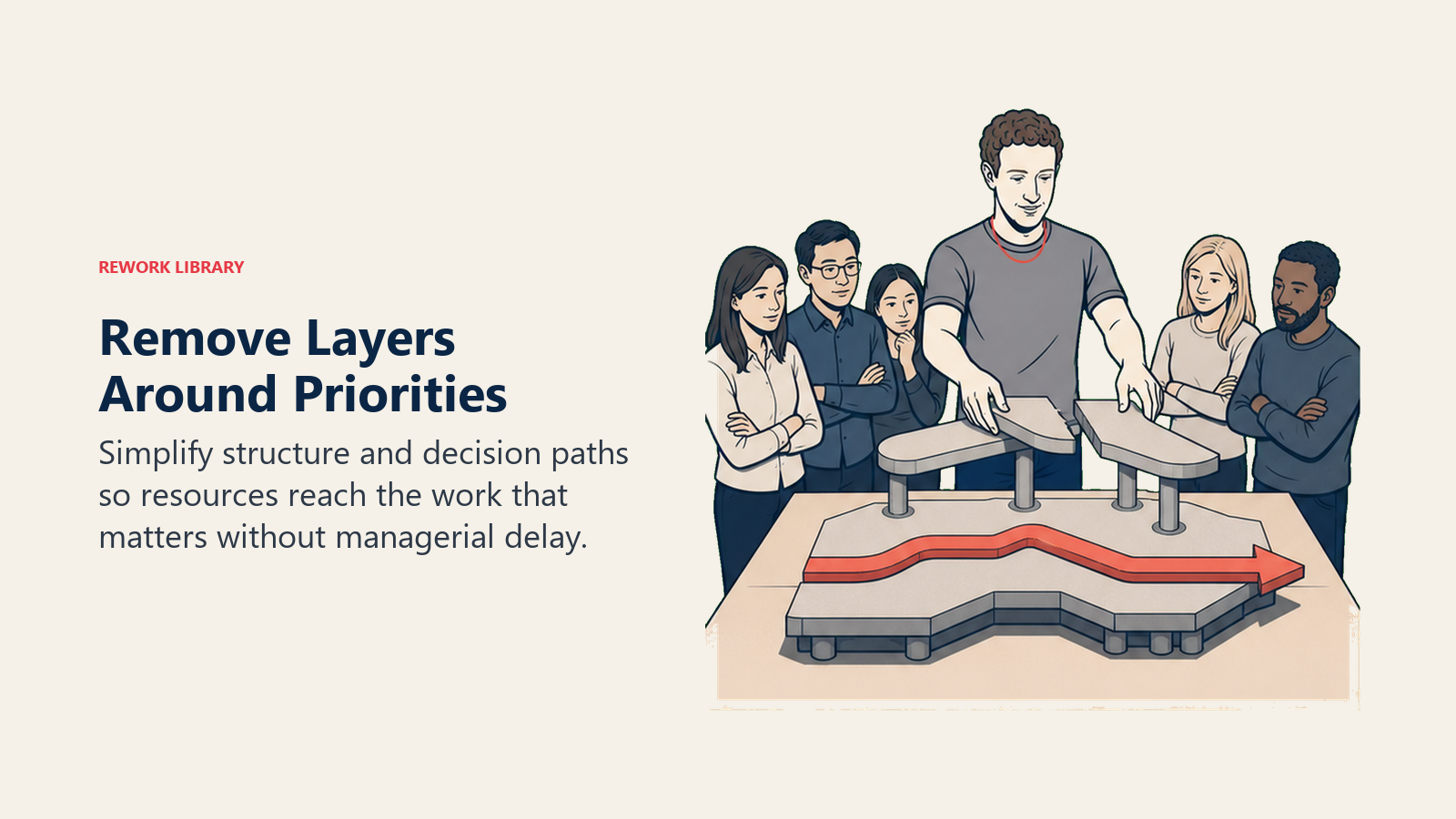
The operating lesson: Zuckerberg didn't treat efficiency as a cost-cutting exercise. He treated it as a prerequisite for making a new bet, AI, credibly. You can't move resources toward a new thesis if they're spread across the organizational overhead you accumulated during the last thesis.
What Zuckerberg Would Do in Your Role
If you're a CEO running a 50-500 person company, the most Zuckerberg-like move available to you is probably a platform defense decision. Look at what's growing adjacent to your core product that you don't control. Is there an acquisition, partnership, or product expansion that you should be making now, before it's large enough to threaten you, that looks expensive relative to current revenue but cheap relative to the strategic position it protects? Instagram cost $1 billion when Facebook was worth $100 billion. That ratio matters.
If you're a COO managing organizational structure, the Year of Efficiency has a specific operational takeaway: management layers slow down information and create decision bottlenecks that get worse as the company grows. Zuckerberg didn't just cut headcount, he cut org levels. If your company has more than four layers between your CEO and your individual contributors, you probably have at least one layer that's primarily managing managers rather than driving output. That layer costs more than its salary.
If you're a product leader, the mobile pivot in 2012 is a template for how to handle a platform transition that threatens your current architecture. Don't rebuild incrementally while defending the existing system. Pick the new platform, commit the resources, and rebuild toward it, even if it creates short-term quality regression. The hybrid HTML5 approach Facebook was taking in 2012 was trying to serve both platforms adequately. It served neither well. You know the equivalent tradeoff in your stack right now.
If you're a sales or marketing leader, Zuckerberg's advertising product decisions are directly relevant. The post-iOS 14.5 hit in 2021 and 2022 wasn't a failure of ad targeting technology, it was a dependency on Apple's data infrastructure that Meta had built without controlling. His response was to invest in Advantage+ (AI-driven targeting without user-level data) and on-platform conversion. The lesson: every distribution or data channel you don't own is a liability that will eventually be regulated, restricted, or priced against you. Build toward first-party data and direct conversion before the third-party channel disappears.
The Rework Analysis: Aggressive Pivots Require Operational Slack You Can See
Zuckerberg's model works because he can see where the slack lives before he cuts. Most mid-market CEOs can't. They know headcount grew too fast during the last expansion, but they don't know which teams carry redundant workflow, which managers review work that already gets reviewed upstream, or which tools overlap. That visibility gap turns every "Year of Efficiency" attempt into an across-the-board cut rather than a surgical one, and across-the-board cuts damage the teams you need for the next bet.
This is where Rework becomes load-bearing during a transition. A unified work operations and CRM stack (from $99/month for the Process or Project Engine and $69/month for the Sales Engine, billed yearly) surfaces cross-team dependencies, duplicated task chains, and pipeline velocity by owner, the operational signals you need before you restructure. Instead of cutting 15% evenly, you see which 15% of workflow is actually slack, and which 15% is the muscle funding next year's pivot. Zuckerberg had an internal analytics org for this. Smaller companies need a platform that gives the same view without the headcount.
Notable Quotes & Lessons Beyond the Boardroom
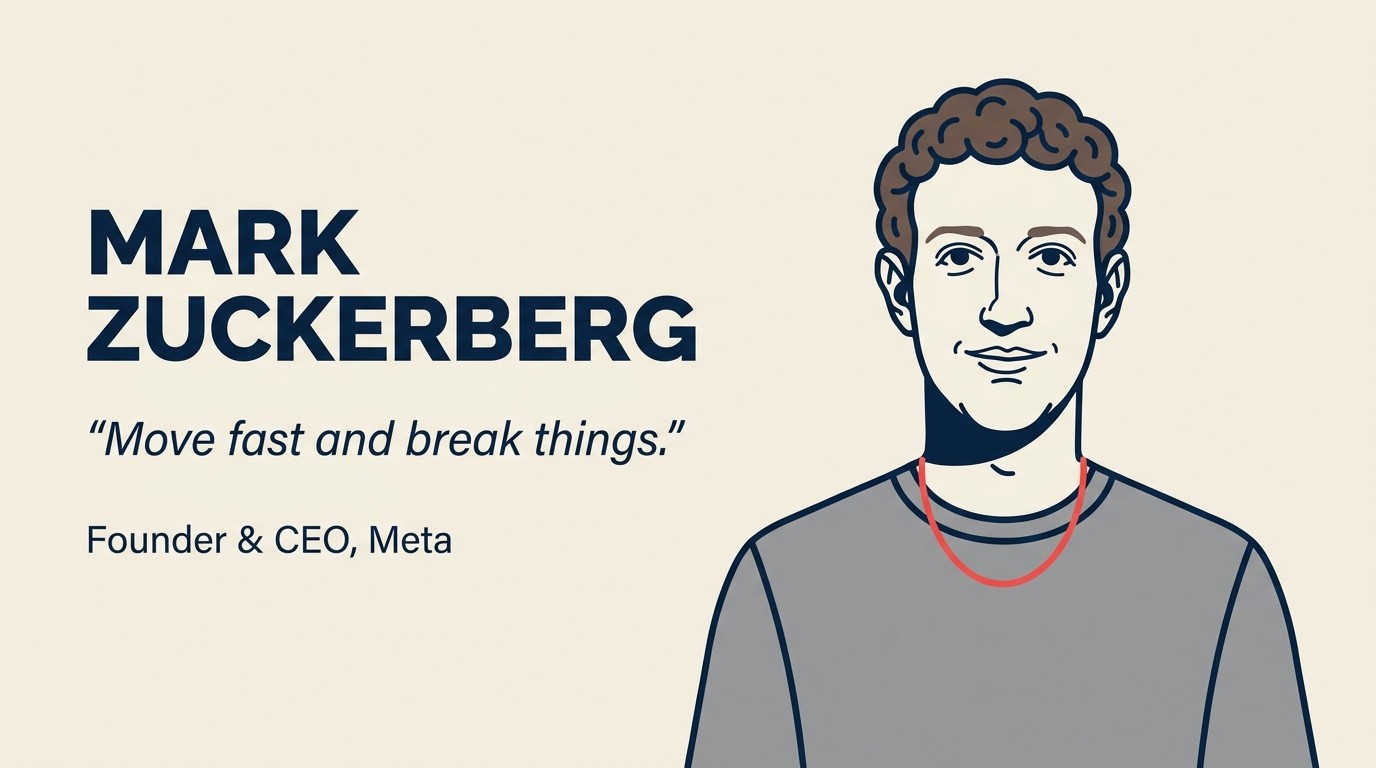
Zuckerberg has been publicly quotable in ways that are both useful and overused. "Move fast and break things" is the famous one, but he actually retired that phrase inside Meta around 2014 when the company was large enough that breaking things had real customer consequences. He replaced it with "Move fast with stable infrastructure." That's a more honest description of how scale changes the cost of mistakes.
The more instructive quote came during his 2023 earnings calls: "I think if you look at the results, the company is performing well. But I also want to be honest that a lot of this came from cutting costs that we shouldn't have taken on in the first place." That admission, publicly delivered on a call watched by analysts and investors, is unusual for a CEO at his level. Most executives in that position would frame the same facts as strategic repositioning rather than acknowledged error.
"The biggest risk is not taking any risk." He's said versions of this in multiple interviews, and it tracks with his actual decisions. The WhatsApp acquisition, the Instagram acquisition, the Metaverse bet, and the Llama open-source AI release were all made against conventional wisdom at the time. Some paid off faster than others. But the pattern is consistent: when Zuckerberg identifies a long-horizon platform shift, he makes a move sized to the potential, not the current evidence.
Where This Style Breaks
Zuckerberg's founder-control model protects long-horizon bets but removes the accountability mechanism that catches bad ones faster. The Metaverse consumed more than $40 billion in Reality Labs losses over three years before the AI pivot. A CEO without dual-class control would have faced board pressure to change course by year two. The freedom to stay with a conviction longer than the evidence supports cuts both ways. Elon Musk operates under similar dual-class insulation at Tesla and SpaceX, Musk's founder-CEO approach with concentrated control is the extreme version of this dynamic, where the same structural protection that enables moonshots also enables unchecked course errors. And Sundar Pichai faces the direct competitor version of this question daily, Pichai's navigation of the Google-Meta rivalry shows what it looks like to lead a platform company without the founder-control insulation Zuckerberg has always had.
His style also struggles with trust at scale. The Facebook–Cambridge Analytica data scandal, the January 6th moderation debates, and the ongoing teen mental health litigation all reflect a platform that grew faster than its governance did. "Move fast" as an organizational value produces speed in product and chaos in accountability. The companies most associated with Zuckerberg's model tend to have product velocity and institutional credibility problems at the same time, because those two things are harder to hold together than they look from the outside.
Frequently Asked Questions about Mark Zuckerberg's Leadership
Who is Mark Zuckerberg?
Mark Zuckerberg (b. 1984) is the co-founder, chairman, and CEO of Meta Platforms. He started Facebook from his Harvard dorm room in February 2004 and has run the company continuously since, taking it through the mobile, social graph, VR/Metaverse, and AI eras.
What did 'move fast and break things' mean?
It was Facebook's early engineering motto, meaning ship code quickly and accept occasional breakage as the price of speed. Zuckerberg retired the phrase internally around 2014, replacing it with "Move fast with stable infrastructure" once Meta's scale made breakage too costly for users.
Why did Zuckerberg pivot to the metaverse?
He rebranded Facebook to Meta in October 2021 to signal a long-horizon bet that immersive computing (VR/AR) would be the next major platform after mobile. The thesis was platform control, not being a tenant on Apple and Google's operating systems again. Reality Labs accumulated over $40B in losses before the 2023 AI pivot reallocated priority.
What was the 'Year of Efficiency'?
Zuckerberg's 2023 initiative that cut roughly 21,000 jobs across two layoff rounds, flattened management layers, and redirected capital toward AI infrastructure. He publicly described the prior over-hiring as his mistake. Meta's stock rose from under $90 in late 2022 to over $550 by early 2024.
Why did Meta release Llama as open source?
To commoditize the model layer and prevent any single closed-model competitor (OpenAI, Google) from owning the AI platform Meta depends on. Open-sourcing Llama lowers the cost and raises the quality of the open ecosystem, which benefits Meta as a frontier model trainer and deployer without giving a rival lock-in.
What can founders learn from Mark Zuckerberg?
Three things: make platform-defense acquisitions before targets are expensive (Instagram at $1B, WhatsApp at $19B when their revenue was near zero), cut organizational slack before committing to a new thesis rather than stacking bets on existing overhead, and treat long-horizon bets as portfolio exposure, size them to the potential, not the current evidence.
Learn More

On this page
- Key Facts: Mark Zuckerberg at a Glance
- The Zuckerberg Year-of-Efficiency Model
- Leadership Style Breakdown
- Key Leadership Traits
- The 3 Decisions That Defined Zuckerberg as a Leader
- 1. The Mobile Pivot in 2012
- 2. The $19 Billion WhatsApp Acquisition in 2014
- 3. The Year of Efficiency in 2023
- What Zuckerberg Would Do in Your Role
- The Rework Analysis: Aggressive Pivots Require Operational Slack You Can See
- Notable Quotes & Lessons Beyond the Boardroom
- Where This Style Breaks
- Learn More