Brian Halligan Leadership Style: Build the Category, Own the Market
Turn this article into takeaways for your work.


Each assistant summarizes the article only for you and suggests best practices for your work.
Key Facts: Brian Halligan co-founded HubSpot in 2006 with Dharmesh Shah out of MIT Sloan, coining the term "inbound marketing" to describe the practice of earning buyer attention through content rather than interruption. He published Inbound Marketing in 2009, the definitional book on the methodology, and took HubSpot public on the NYSE in October 2014 at $25 per share. Halligan served as CEO from founding until 2021, scaling HubSpot past $1B+ ARR, and transitioned to Executive Chairman after a snowmobile accident prompted a leadership handoff to Yamini Rangan. He resigned that role effective May 8, 2025 and moved to a non-executive seat on the board, where Lorrie Norrington has served as chairperson since.
Brian Halligan co-founded HubSpot in 2006 with Dharmesh Shah out of MIT Sloan, named an approach to marketing that already existed but had no brand, "inbound", and then spent 15 years proving it at $2.6 billion ARR scale. That's category creation at its most deliberate.
Halligan didn't invent content marketing, SEO, or email nurturing. He packaged them into a coherent ideology, wrote a book (Inbound Marketing, 2009), built a software product to execute the ideology, and trained an entire generation of marketers to think in his framework. HubSpot Academy certified millions of practitioners. The HubSpot Culture Code, a 128-slide deck published openly in 2013, has been viewed more than 5 million times and became a benchmark for how SaaS companies talk about culture. HubSpot went public in October 2014, pricing its IPO at $25 per share and raising $125 million on the NYSE. He stepped down as CEO in 2021 after a snowmobile accident and became Executive Chairman. HubSpot today has 215,000+ customers across 135 countries.
The playbook he built isn't just a marketing story. It's a model for how to own a market by owning the vocabulary your customers use to describe their problem. The go-to-market infrastructure Halligan built relied on his CRO Mark Roberge to translate the inbound methodology into a repeatable sales system, a combination that proved category creation and systematic revenue execution could work together without sacrificing either. And like Marc Benioff at Salesforce, Halligan understood that naming a movement was as important as building the software.
The Inbound Marketing Doctrine (The Flywheel Model)
Halligan's Inbound Marketing Doctrine states that the company that names a buying behavior owns the vocabulary buyers use to evaluate every vendor in the category. Earn attention through content, convert it through methodology-aligned software, and retain it through a flywheel in which delighted customers generate the next cycle of acquisition. The framework you publish becomes a stronger moat than the features you ship, because methodologies compound while feature parity is inevitable.
Leadership Style Breakdown
| Style | Weight | How it showed up |
|---|---|---|
| Category Creator | 55% | Halligan's most consequential decision wasn't a product feature or a pricing model, it was the decision to give a name to a practice that thousands of marketers were already doing without a unifying label. "Inbound marketing" was a term that, once introduced, made Halligan and Shah the definitional authorities for a whole school of marketing thought. Every company that adopted the inbound framework became a HubSpot case study. Every marketer who got certified in inbound through HubSpot Academy became a potential HubSpot customer or advocate. The category name was the distribution strategy. |
| Operator Who Executes on Vision | 45% | Halligan wasn't just a category theorist. He ran HubSpot as CEO from founding through a 2014 IPO at $25 per share, watched it peak at $900+ per share, and managed the organizational complexity of scaling from a 2-person startup to a company generating $2.6B in annual revenue. That's a 15-year operating run that required genuine execution discipline across hiring, culture, product prioritization, and public-company governance. His willingness to hand off the CEO role to Yamini Rangan in 2021, and to do it cleanly from an Executive Chairman position, is a mark of someone who understood the difference between founder identity and company health. |
The combination of category-creation thinking and operational discipline is rare. Most category creators build vision but struggle with the execution mechanics at scale. Halligan did both, and HubSpot's ARR growth from 2006 to 2021 is the evidence.
Key Leadership Traits
| Trait | Rating | What it means in practice |
|---|---|---|
| Ideological framing of product positioning | Exceptional | Halligan understood that software categories aren't won on features, they're won on frameworks. By positioning HubSpot as the product that executes the inbound methodology, he made the methodology the moat. Competitors could build similar tools. They couldn't easily displace the framework that millions of marketers had learned first. The product became the canonical implementation of a mental model, which is a more durable competitive position than being the fastest or cheapest option in a commodity category. |
| Willingness to publish the playbook | Very High | Halligan's instinct throughout HubSpot's growth was to share the methodology openly rather than protect it as proprietary knowledge. The book, the blog, the HubSpot Academy certifications, the Culture Code, all of it was published for free. That openness was counterintuitive but strategically sound: the more marketers learned the inbound framework, the more they wanted the software that implemented it. Publishing the playbook created demand for the product rather than giving away competitive advantage. |
| Scaling through partner and education ecosystems | High | HubSpot's partner program and its academy weren't afterthoughts. They were deliberate ecosystem investments that expanded the company's reach beyond what a direct sales force could cover. Agencies that became HubSpot partners had an incentive to recommend HubSpot to every client. Marketers who earned HubSpot certifications became evangelists for the platform at their employers. The ecosystem did distribution work that would have cost HubSpot far more to accomplish through traditional sales. |
| Long-tenure CEO discipline (15 years) | High | Most SaaS CEOs either get replaced by their boards or exit through acquisition within 7 years. Halligan ran HubSpot for 15 years through multiple product pivots, a successful IPO, and significant competitive pressure from Salesforce, Marketo, and others. That tenure requires a specific kind of discipline: the ability to change your mind on tactical questions while staying consistent on the strategic identity of the company, and the humility to hire people who are better than you at specific functions without feeling threatened by them. |
The 3 Frameworks That Defined Brian Halligan
1. Inbound Methodology: Attract, Engage, Delight
The inbound methodology is simple enough to fit on a single diagram, which is part of why it spread. Instead of buying attention through outbound interruption, cold calls, display ads, purchased email lists, inbound argued that companies should earn attention by creating content that answers the questions buyers are already asking. Attract people who are looking for what you offer, engage them with content that helps them make better decisions, and delight them after the sale so they become advocates who attract more buyers.
That three-part framework gave marketing teams a shared language for what they were trying to accomplish at each stage of the customer relationship. Before inbound, marketing and sales often operated with different vocabularies and different metrics. The inbound funnel, which HubSpot replaced with the flywheel in 2018, but which served the company well for a decade, gave both functions a shared map.
The practical implication for operators is about positioning, not tactics. Halligan's insight was that buyers who find you through content they sought out are better qualified and cheaper to acquire than buyers you interrupt. That's still true. But the mechanism for earning attention has shifted. When Halligan wrote Inbound Marketing in 2009, Google search was the primary discovery channel for B2B buyers. Now it's fragmented across search, social, communities, and podcasts. The principle holds; the execution requires updating.
2. The Flywheel Model
At INBOUND 2018, Halligan announced that HubSpot was retiring the funnel metaphor and replacing it with a flywheel. The difference matters. A funnel treats customer acquisition as a linear process that ends at the sale. A flywheel treats customers as a force that propels the business forward: happy customers refer new customers, reduce churn, and enable expansion revenue that compounds over time.
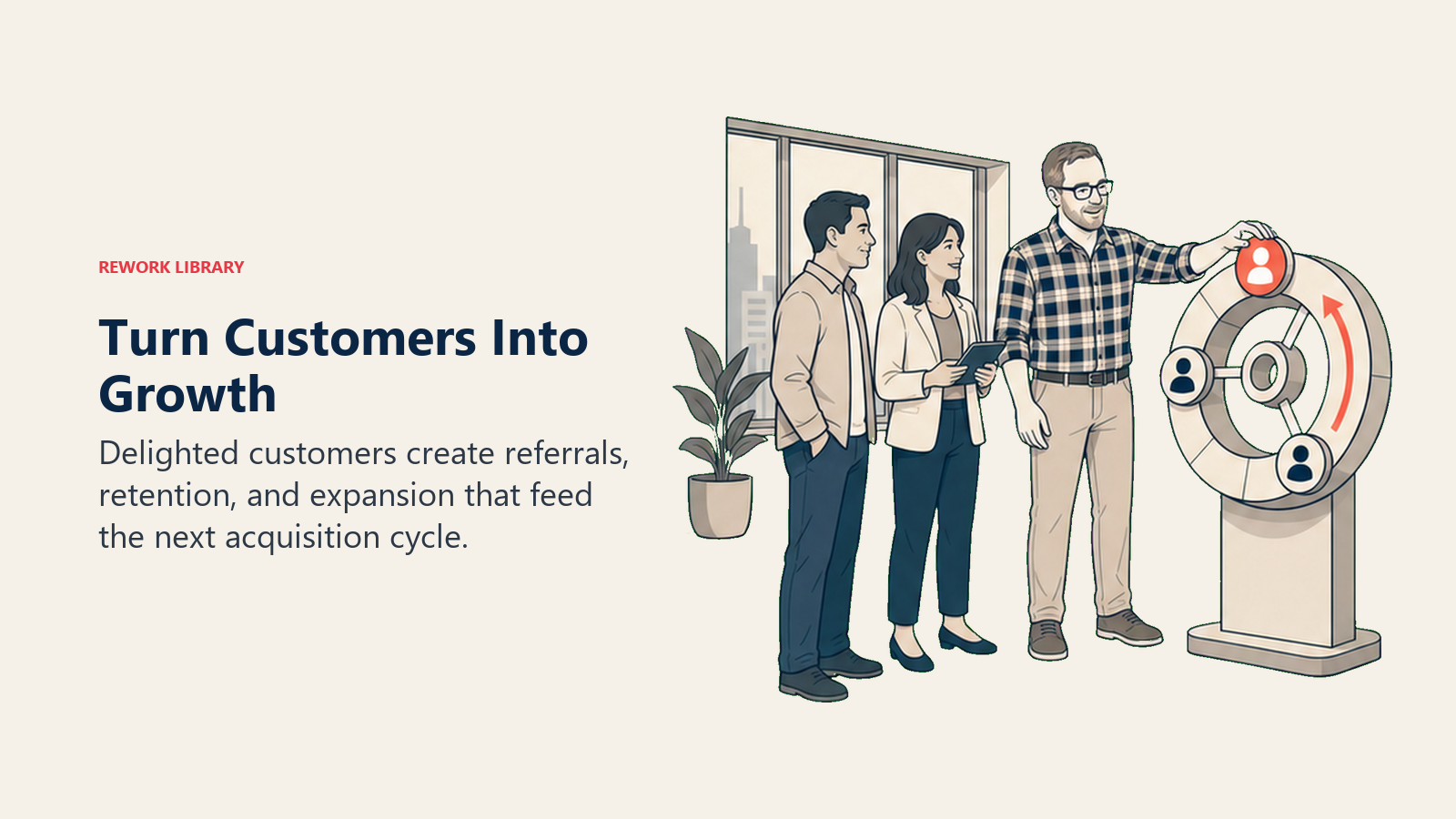
The announcement was both a genuine strategic insight and a smart positioning move. By 2018, HubSpot was heavily invested in customer success infrastructure, and the flywheel model gave that investment a narrative. It also positioned HubSpot ahead of the customer success trend that was reshaping how SaaS companies thought about growth.
But the flywheel model carried a harder implication that Halligan was willing to state publicly: the funnel model made customer success someone else's problem, because the funnel ended at the sale. The flywheel made customer success the engine. That means your product needs to actually work, your onboarding needs to create genuine value quickly, and your support function needs to solve problems rather than deflect them. For most companies, that requires organizational redesign, not just a metaphor change.
For operators, the flywheel reframe asks a specific question: what percentage of your new customer acquisitions come from customer referrals, expansion from existing accounts, or word-of-mouth driven by customer success? If that number is under 20%, your flywheel isn't spinning. You're still operating as a funnel business with flywheel branding.
3. Culture as Product Moat
The HubSpot Culture Code was a 128-slide deck that Dharmesh Shah wrote in 2013 with input from Halligan and the leadership team. It described what HubSpot actually valued, not the generic "integrity, innovation, teamwork" list that every company publishes, but specific operating principles about hiring, transparency, autonomy, and what the company expected from its employees and from itself.
Publishing it openly was a deliberate move. Halligan understood that culture is a talent acquisition tool. Companies that are clear about what they stand for attract people who want to work there and screen out people who don't fit. The Culture Code's 5 million+ views weren't just a vanity metric, they represented millions of potential candidates who had pre-qualified themselves against HubSpot's values before ever speaking to a recruiter.
But Halligan also knew the culture document created an accountability standard. When HubSpot published that it valued transparency and autonomy, employees had a document to point to when those values were violated. That accountability cut both ways: it forced the company to live up to its own stated culture in ways that a private value system doesn't.
For leaders, the lesson is about the difference between culture as an HR function and culture as a strategic asset. Most culture initiatives are inward-facing, designed to align employees. Halligan treated culture as an outward-facing tool for talent acquisition and brand differentiation. That's a different kind of investment, and it requires publishing things your legal team will want to keep private.
What Brian Halligan Would Do in Your Role
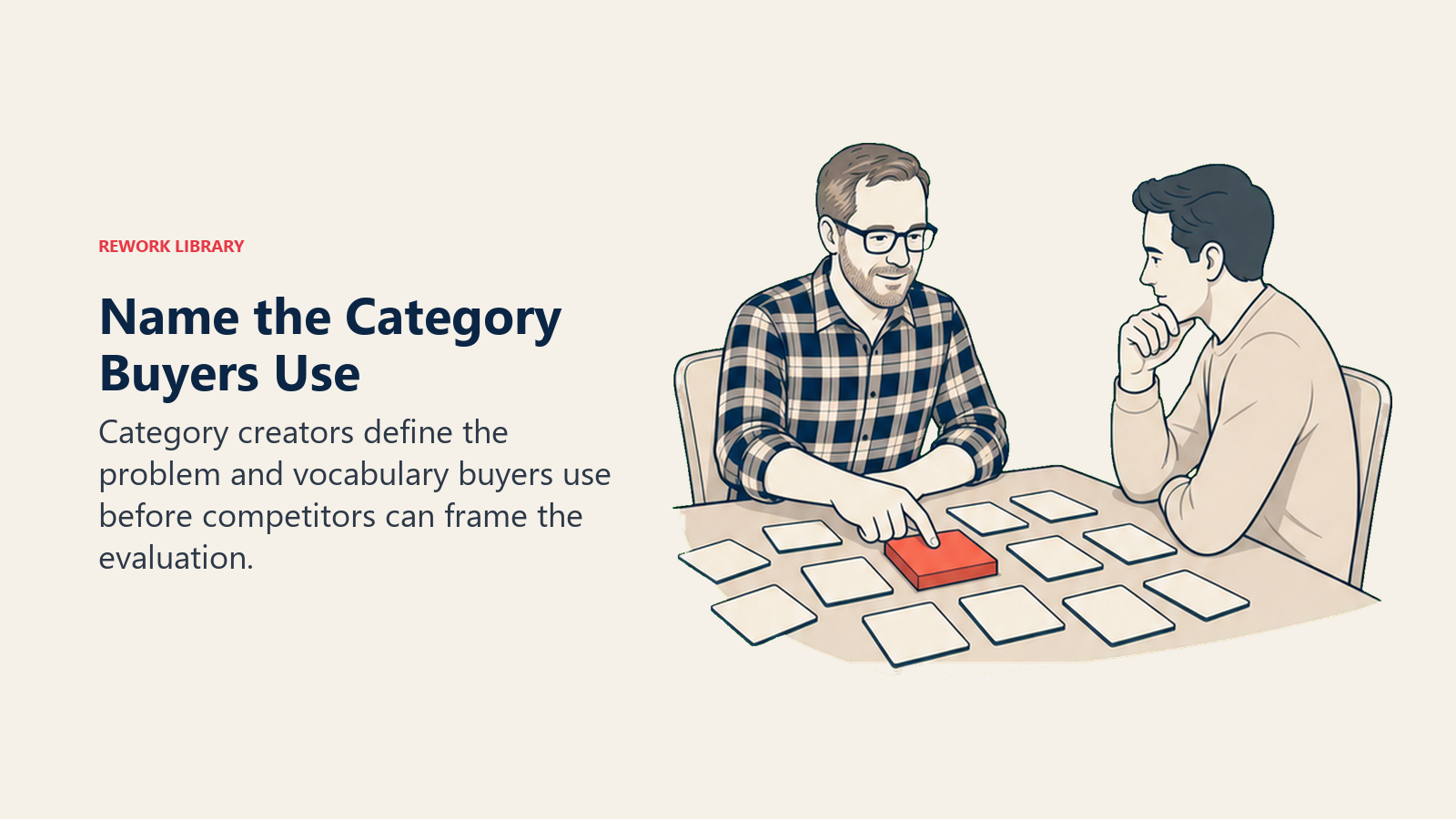
If you're a CEO, Halligan's most direct question is about whether you're competing in a category or creating one. Most companies compete, they look at the existing market, identify the leader, and position themselves as better, cheaper, or more focused. Category creation requires a different move: naming the problem in a way your competitors haven't, then owning the vocabulary. The companies that do this, HubSpot with inbound, Salesforce with CRM as a service, Slack with "where work happens", don't just win market share. They define the evaluative criteria buyers use to assess all the competitors. That's a structural advantage. Halligan would ask what term you could coin that makes your framing the default.
If you're a COO, the Halligan insight is about ecosystem leverage. HubSpot's agency partner program and academy certifications were operational investments that created distribution at scale without a proportional increase in headcount. Most COOs build distribution through direct channels, sales teams, marketing spend, events. Halligan's model asks: who has an existing relationship with your buyers, and how do you make it worth their while to recommend your product? Partners, educators, and communities can distribute your product at a fraction of the cost of direct sales if you design the incentive structure correctly.
If you're a product leader, Halligan's flywheel model has a specific implication for how you prioritize features. The funnel model produces a product roadmap biased toward acquisition: features that help close deals, convert trials, and impress prospects during demos. The flywheel model shifts the priority toward features that create customer success after the sale, features that reduce time-to-value, enable expansion, and give customers reasons to recommend the product. If your roadmap is mostly acquisition-focused, you're building a funnel business even if your deck calls it a flywheel.
If you're in sales or marketing, the inbound methodology's most practical element is the content audit it implies. What questions are your ideal customers asking at each stage of their decision process, and do you have content that answers each one? Most companies have content at the top of the funnel, awareness pieces, thought leadership, brand content, and a significant gap in the middle, where buyers are comparing options and trying to understand whether your approach fits their specific situation. Halligan would fill that gap before building more awareness content.
How Rework Operationalizes the Halligan Playbook
Inbound-first B2B marketing only compounds when the funnel is actually visible end-to-end. Most teams produce content, capture leads, then lose them in the handoff between marketing automation and CRM, which breaks the flywheel Halligan described. Rework closes that gap by putting inbound funnel visibility and lead routing in the same workspace your sales team already lives in. Content source, first-touch campaign, MQL-to-SQL conversion timing, and sales-accepted status all live on one record, so you can actually measure which inbound plays generate pipeline rather than just traffic. Lead routing rules fire the moment a form converts, pushing qualified inbound leads to the right rep by territory, account tier, or ICP fit, no queue, no delay, no manual triage. That matters because inbound leads decay fast: the 5-minute response rule Halligan's own team documented only works if routing is automated. For marketing leaders running a HubSpot-style playbook on a leaner stack, Rework gives you the flywheel infrastructure without the enterprise license cost.
Notable Quotes and Lessons Beyond the Boardroom
From Inbound Marketing (2009): "Instead of one-way interruption, web marketing is about delivering useful content at just the right moment when a buyer needs it." That's the core thesis in a sentence, and it held up for 15 years in a way that most marketing book arguments don't. The underlying insight, that buyers are doing research before they engage with salespeople, and that being useful during that research creates preference, has only become more true as buyers have gotten better at avoiding outbound contact.
Halligan was also publicly candid about the 2021 snowmobile accident that led to his departure from the CEO role. The accident required months of recovery and gave him perspective on what he'd been sacrificing for the company during 15 years as CEO. He described the transition to Executive Chairman as the right decision for both the company and his health, a rare instance of a founder publicly acknowledging that the company would be better served by new operating leadership while he remained in a strategic capacity.
The broader lesson from HubSpot's trajectory is about the patience category creation requires. Rand Fishkin built Moz on a similar content-first, community-before-product compounding logic, and ran into the same wall when VC timelines demanded acceleration faster than the flywheel could spin. Halligan scaled past that inflection point; Fishkin stepped away from it. Both stories are instructive about what category creation costs at different funding levels. HubSpot was founded in 2006 and didn't cross $100M ARR until 2013, 7 years. Halligan operated through that long growth period without abandoning the category-creation thesis for a faster path. That patience was only possible because the underlying unit economics were strong enough to sustain the company without requiring a pivot to a shorter-cycle revenue model.
Where This Style Breaks
The inbound model assumes buyers search before they buy, but in enterprise deals, relationships and outbound sequencing still close the biggest contracts. HubSpot's own revenue motion is heavily outbound at the enterprise tier, which is a quiet admission that the inbound thesis has a ceiling. Category creation is also expensive and slow: it took Halligan 7 years before HubSpot hit $100M ARR, and most operators don't have the runway or the patience for that timeline. The culture-first playbook creates retention expectations that are hard to sustain when you need to do a 10% reduction, and HubSpot has done those reductions, creating a tension between the published culture values and the operational reality of a public company managing margins.
Frequently Asked Questions about Brian Halligan's Leadership
Who is Brian Halligan?
Brian Halligan is the co-founder and former CEO of HubSpot, which he started with Dharmesh Shah in 2006 out of MIT Sloan. He coined the term "inbound marketing," authored the 2009 book of the same name, and led HubSpot through its 2014 NYSE IPO and past $1B+ ARR before stepping down as CEO in 2021 to become Executive Chairman. He held that role until May 2025 and now sits on the board as a non-executive director.
What is inbound marketing?
Inbound marketing is a methodology Halligan popularized in which companies earn buyer attention by publishing useful content that answers the questions prospects are already researching, rather than interrupting them through cold calls, purchased lists, or display ads. The three stages are attract, engage, and delight, the goal is to pull qualified buyers toward your product through content, SEO, email, and education rather than pushing messages at them.
How did HubSpot create a new marketing category?
HubSpot packaged pre-existing practices, content marketing, SEO, email nurturing, under the single label "inbound," then built software, a book, HubSpot Academy certifications, and a partner ecosystem that all reinforced the methodology. By making HubSpot the canonical implementation of inbound, Halligan turned the framework itself into a distribution engine: every marketer who learned inbound was a potential HubSpot customer.
What is the flywheel model vs the funnel?
The funnel treats customer acquisition as linear and ending at the sale. The flywheel, which Halligan introduced at INBOUND 2018, treats customers as a force that compounds growth through referrals, expansion revenue, and reduced churn. The practical shift is that customer success becomes an acquisition channel rather than a cost center, which changes how product roadmaps, onboarding, and support are prioritized.
What is Halligan's leadership philosophy?
Halligan's philosophy combined category creation with long-tenure operational discipline. He believed in publishing the playbook openly, books, academy certifications, the HubSpot Culture Code deck, because the more people learned the methodology, the more they wanted the software that implemented it. He also modeled clean succession, handing the CEO role to Yamini Rangan in 2021 while remaining strategically involved as Executive Chairman.
What can SaaS CEOs learn from Brian Halligan?
The core lesson is that owning the vocabulary your customers use to describe their problem is more durable than owning features. SaaS CEOs should ask whether they're competing in a category or creating one, invest in ecosystems (partners, education, communities) that distribute the product at scale, and treat culture as an outward-facing asset for talent acquisition, not just an internal HR function. Halligan's 15-year CEO tenure also shows the patience category creation requires.
For related reading, see Rand Fishkin Leadership Style, Ann Handley Leadership Style, Philip Kotler Leadership Style, David Ogilvy Leadership Style, and Peter Drucker Leadership Style.

On this page
- The Inbound Marketing Doctrine (The Flywheel Model)
- Leadership Style Breakdown
- Key Leadership Traits
- The 3 Frameworks That Defined Brian Halligan
- 1. Inbound Methodology: Attract, Engage, Delight
- 2. The Flywheel Model
- 3. Culture as Product Moat
- What Brian Halligan Would Do in Your Role
- How Rework Operationalizes the Halligan Playbook
- Notable Quotes and Lessons Beyond the Boardroom
- Where This Style Breaks