Mark Roberge Leadership Style: Engineering a Repeatable Sales Machine
Turn this article into takeaways for your work.


Each assistant summarizes the article only for you and suggests best practices for your work.
Key Facts, Mark Roberge
- Role at HubSpot: 4th employee, Chief Revenue Officer 2007–2014
- Scale achieved: Grew HubSpot revenue from $0 to $100M+ ARR; took the company public in 2014
- Signature book: The Sales Acceleration Formula (Wiley, 2015), bestseller on data-driven sales management
- Current roles: Senior Lecturer, Harvard Business School (since 2017); Managing Director, Stage 2 Capital
- Background: MIT engineering degree; ran engineering teams before pivoting to sales leadership
- Legacy: Pioneered data-driven sales hiring, the scorecard-based model that replaced gut-feel recruiting in SaaS
The Roberge Data-Driven Hiring Model
The Roberge Data-Driven Hiring Model is a structured sales-recruiting system that scores every candidate numerically across five predictive attributes, prior success, intelligence, work ethic, curiosity, and coachability, and continuously recalibrates those weights against actual on-the-job performance. It treats hiring as a repeatable experiment rather than an intuition call, turning sales recruiting into applied statistics.
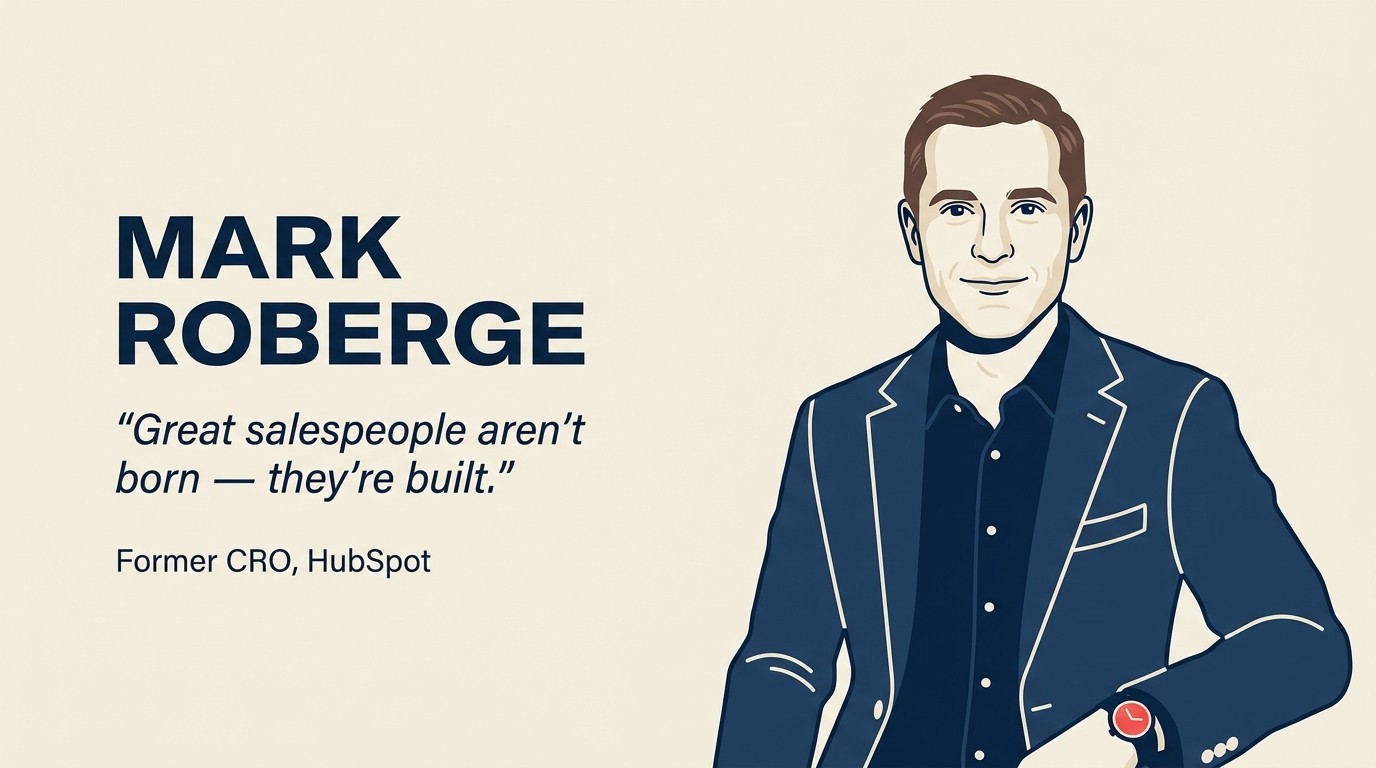
Mark Roberge joined HubSpot in 2007 as its fourth sales hire. He had an MIT Sloan engineering degree, no prior sales management experience, and a thesis that most sales organizations were run on intuition when they should be run on data.
Over the next seven years, he scaled HubSpot's revenue from $0 to $100M ARR. When the company went public in 2014, he was its Chief Revenue Officer. He did it without the charismatic closer archetype that most sales leaders try to hire. Instead, he built a scoring system for hiring, a metrics framework for ramp, and a training curriculum built around buyer personas rather than product features.
In 2015, he published The Sales Acceleration Formula, which laid out exactly how he did it. He's been teaching it at Harvard Business School since 2017 and investing in growth-stage SaaS companies through Stage 2 Capital.
The reason Roberge matters isn't nostalgia for HubSpot's early days. It's that most sales scaling problems today are the same ones he solved with structured systems in 2007. The question is whether you're willing to apply the same engineering discipline to your revenue org that you apply to your product.
Leadership Style Breakdown
| Style | Weight | How it showed up |
|---|---|---|
| Data-Driven Operator | 65% | Roberge didn't believe in hiring on gut feel, managing by quota, or coaching by anecdote. Every hire had a scorecard. Every rep had a metrics dashboard tied to leading indicators, not just closed revenue. When reps underperformed, he traced it back to the specific metric that was off, not a vague "effort" problem. This isn't how most CROs operate. Most measure what's easy, bookings and pipeline, and coach what's comfortable, attitude and hustle. Roberge measured what was predictive and coached the specific gap. |
| Systematic Builder | 35% | He approached the sales organization as an engineering problem: define the inputs, test the process, measure the output, iterate. His buyer persona-based training model replaced the standard product demo script with a curriculum designed around what buyers actually cared about at each stage of their decision. He built the HubSpot sales playbook the way a product team builds a product, iteratively, with feedback loops and documented versions. |
The 65/35 split matters because neither element works without the other. Pure data without a system to act on it is reporting. A system without data is bureaucracy. Roberge's contribution was combining them into an operating model that could scale.
Key Leadership Traits
| Trait | Rating | What it means in practice |
|---|---|---|
| Analytical Rigor | Very High | Roberge built a hiring scorecard before he hired his first rep. It weighted five attributes: prior success, intelligence, work ethic, curiosity, and coachability. He assigned numerical scores to each candidate across all five dimensions, tracked the correlation between scores and performance over time, and adjusted the weights based on what predicted success in HubSpot's specific context. This isn't talent management theory. It's applied statistics. He ran his hiring process as a repeatable experiment. |
| Coachability Obsession | Very High | He didn't hire for experience. He hired for coachability, the willingness to receive feedback, adjust behavior, and improve. His argument: experienced sales reps often arrive with habits that worked in their last job and resist changes that would make them effective in this one. A coachable rep with less experience would outperform an experienced rep with entrenched habits in a market like HubSpot's, where the sales motion was genuinely new. This counterintuitive hiring principle was central to how he built the team. |
| Process Discipline | High | Every new rep at HubSpot followed the same 90-day ramp process. The process was documented, tracked, and reviewed. Deviations were flagged early. Roberge didn't let reps "find their own style" in the first six months, he wanted them to master the playbook before they improvised. This produced a more uniform level of baseline competency and made it much easier to diagnose what was wrong when performance lagged. |
| Scalable Thinking | High | Roberge's compensation model was designed to reward the behaviors that predicted long-term revenue health, not just the behaviors that closed deals fastest. He tied rep bonuses partly to customer success metrics, churn rates, net revenue retention, so that reps had a financial incentive to qualify deals carefully rather than just push anything through the funnel. This is a structurally different incentive model from most SaaS sales orgs, where the rep's job ends at signature. |
The 3 Frameworks That Defined Roberge
1. The Sales Hiring Formula
Roberge's hiring formula starts with a premise most sales leaders resist: the attributes that predict sales success are measurable before you hire someone, and they're not primarily experience or a "killer instinct."
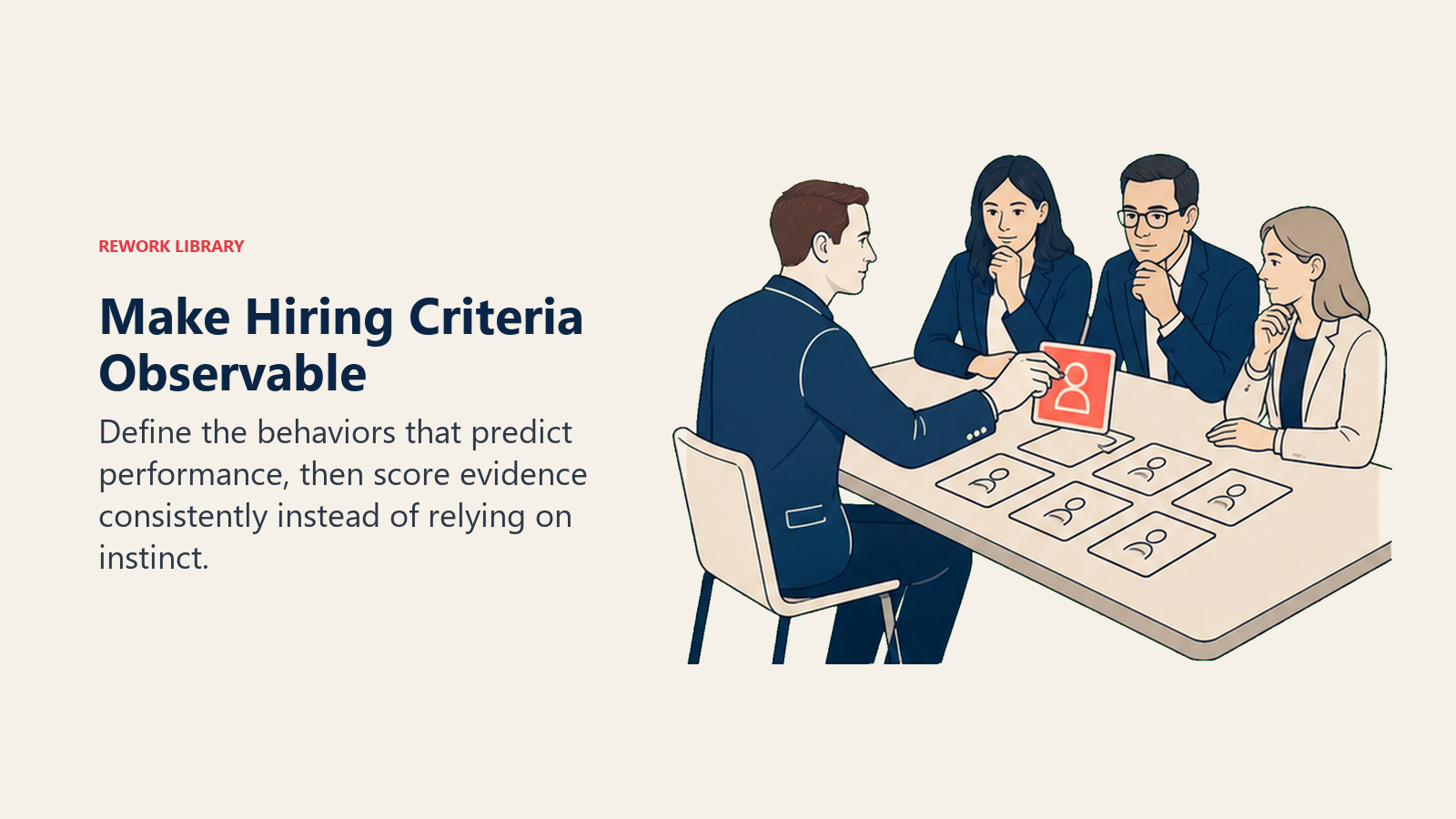
His scorecard weighted five attributes: prior success in any domain (not just sales), raw intelligence, work ethic, curiosity, and coachability. He interviewed for each one with structured questions and scored candidates numerically. He tracked the correlation between scores and first-year quota attainment, adjusted the weights when the data suggested something wasn't predicting correctly, and treated the scorecard as a living tool rather than a fixed template.
The coachability criterion deserves specific attention. Roberge defined coachability not as passivity but as the demonstrated ability to receive critical feedback, integrate it, and change behavior. He tested for it in the interview by giving candidates feedback they hadn't asked for and observing whether they argued, deflected, or genuinely engaged.
The implication for your hiring process: if you're evaluating candidates primarily on their sales resume and your gut reaction in the room, you're operating on less information than Roberge used to evaluate salespeople in 2008. The better version is to define which attributes actually predict success in your specific market, they'll differ from HubSpot's, and build a structured scorecard to measure them consistently.
2. The Sales Acceleration Formula (Metrics-Driven Ramp)
Once Roberge had a team, he needed a way to manage performance that didn't rely on quota-as-the-only-metric.
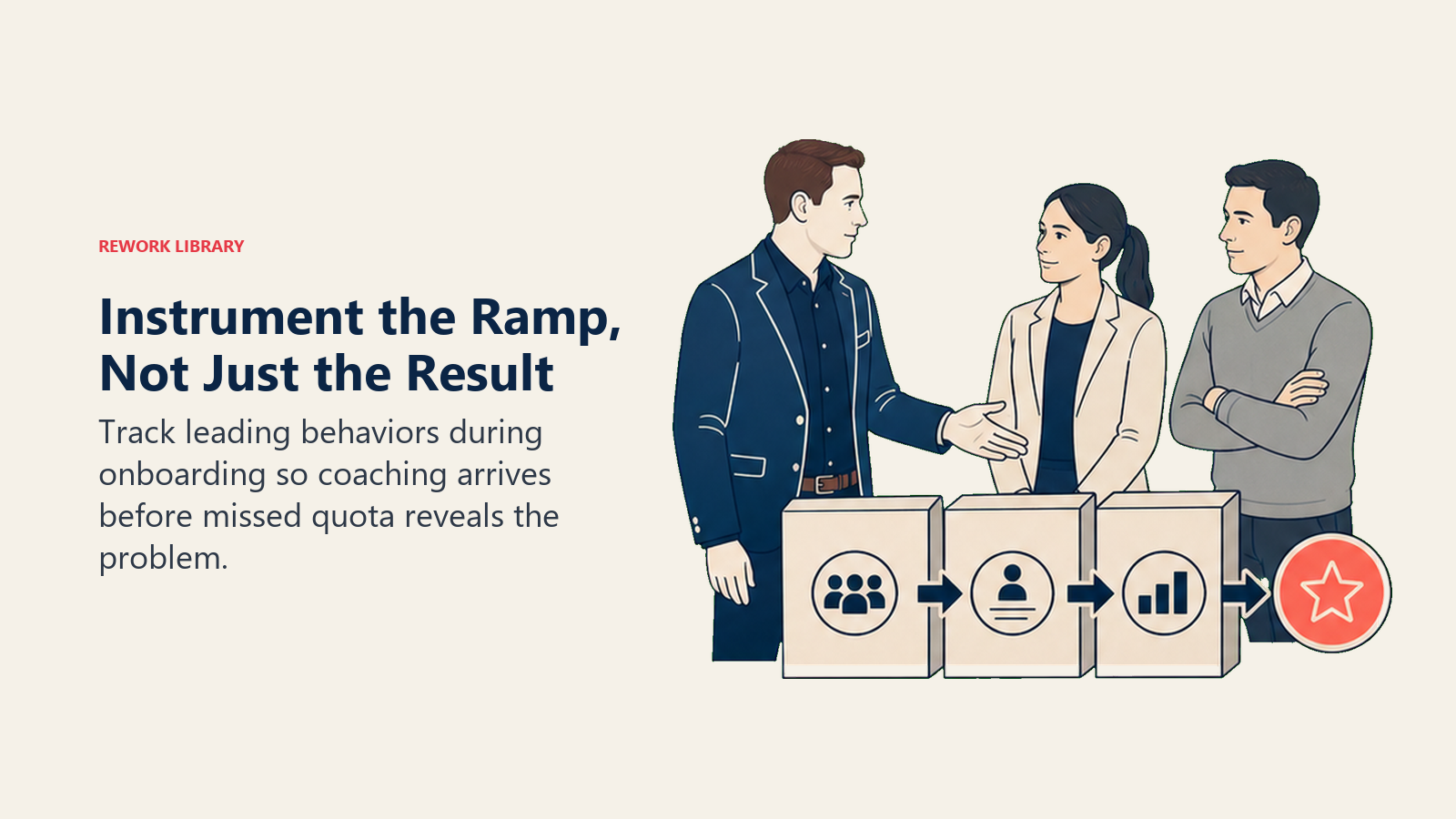
His answer was an activity-effectiveness-impact model he called AEI. Activity metrics tracked what reps were doing: calls made, emails sent, demos booked. Effectiveness metrics tracked how well they were doing it: connect rates, show rates, conversion between stages. Impact metrics tracked what it produced: pipeline created, revenue closed, customer retention.
The key insight is that quota alone is a lagging indicator. By the time a rep misses their number, it's too late to course-correct that quarter. But if you're watching activity and effectiveness weekly, you can identify where a rep is breaking down and intervene early. A rep with strong activity and weak effectiveness has a skills problem. A rep with strong effectiveness and weak activity has a motivation problem. Those require completely different management responses.
Roberge also connected this model to compensation. Reps weren't rewarded only for revenue closed. They were rewarded partly for customer success outcomes, which forced alignment between what the rep sold and what the customer actually needed. The reps who over-promised to close a deal paid a compensation penalty when the customer churned. That's a structural check on short-term deal pressure.
3. Customer Success as Revenue Driver
Before Roberge, most SaaS companies treated customer success as a support function. You closed the deal, handed the customer to a customer success manager, and moved on to the next prospect. The two teams operated in separate incentive structures with minimal information sharing.
Roberge's view was that this separation was both economically irrational and structurally bad for the sales org. If your customer success team is seeing churn signals early, and that information isn't flowing back to the sales team, you'll keep selling to the wrong customers in the wrong way. You'll optimize for acquisition metrics while your retention metrics quietly collapse.
At HubSpot, he built feedback loops between sales and customer success. Reps received data on the retention and expansion rates of the customers they'd closed. Customers who churned within 12 months triggered a review of the sales process that closed them. This isn't punitive, it's diagnostic. But it requires a willingness to hold the sales org accountable for outcomes that extend past the contract signature.
The practical implication: if your sales comp plan ends at close and your customer success team is a separate P&L, you've structurally disconnected the incentive to sell well from the incentive to close fast. Roberge's model says that's a design flaw, not a departmental boundary.
What Roberge Would Do in Your Role
If you're a CEO, the most important thing Roberge would do is build a hiring scorecard before your next sales leadership hire, not after. Most founding CEOs hire their first VP of Sales on instinct, pattern-match to a previous employer's sales leader, and then discover two quarters later that the hire doesn't fit the company's stage. Roberge would define, in advance, what attributes predict success in your specific market, test candidates against them, and track actual performance against predicted performance over time. The feedback loop is the discipline.
If you're a COO or revenue operations leader, Roberge's AEI framework gives you a practical template for building a leading-indicator dashboard. Your current dashboard probably shows pipeline and bookings. Add activity rates and conversion rates between each funnel stage. Run weekly reviews where you identify which metric is off for each underperforming rep, not just which rep is underperforming. That shift changes the management conversation from judgment to diagnosis.
If you're a product leader, Roberge's buyer persona-based training model has direct implications for how you build your sales enablement materials. If your sales team is still leading with product features in demos, you're optimizing for what's easy to explain, not what buyers care about. Roberge's training curriculum at HubSpot started with the buyer's problem and built backward to the product capability. That's a product-marketing collaboration, not just a sales training fix.
If you're a sales or marketing leader, the customer success integration point is the highest-leverage change available to most teams right now. Get the churn data on customers your team closed in the last 18 months. Segment it by which rep sold them, which persona they were, and which product tier they bought. The pattern will tell you more about your sales process quality than any pipeline review. And if you don't have that data, building the infrastructure to generate it is the project.
How Rework Supports Engineering-Driven Sales Leadership
Roberge's model only works when leading indicators, hiring scorecards, and customer outcomes live in one system, not scattered across a CRM, a spreadsheet, and a BI dashboard that nobody trusts. Rework CRM is built for that operator mindset. Activity metrics, stage-conversion rates, and rep-level effectiveness aren't bolt-on reports; they're native to how pipelines are structured, so the AEI diagnostic Roberge describes is something you can run weekly without a data engineer.
For teams adopting his coachability-over-experience hiring principle, Rework's lead and deal history gives managers the evidence base for structured coaching, which reps stall at qualification, which close fast but churn, which personas convert best for each rep. And because Rework connects sales execution to post-sale workflows (from $69/month billed yearly for the Sales Engine, $99/month for the Process Engine), the feedback loop between close and retention that Roberge built at HubSpot is a single-platform reality instead of a cross-department integration project. That's engineering discipline applied to revenue, on infrastructure designed for it.
Notable Quotes and Lessons Beyond the Boardroom
In The Sales Acceleration Formula, Roberge writes: "The best sales managers in the world know exactly what their sales reps are doing wrong. The average sales manager feels something is off but can't pinpoint the problem." That distinction, knowing versus feeling, is the entire argument of his operating model. You can't coach what you can't measure, and you can't measure what you haven't defined.
He's also consistent about the limits of charisma as a management tool: "I had never worked in sales before I was asked to run HubSpot's sales team. But I had run engineering teams. And I thought, why don't we treat this the same way?" That's a genuinely unusual starting premise for a sales leader, and it's why his model looks so different from the standard playbook.
Now at Harvard Business School and Stage 2 Capital, Roberge frames the next evolution of his thesis around go-to-market fit as a separate problem from product-market fit. He argues that most scaling failures at growth-stage companies aren't product problems, they're sales model problems. The company found a product that works but then tried to scale it with a sales motion that doesn't fit the buyer's decision process, the deal size, or the distribution channel. That's a different diagnosis than most VCs apply to a growth miss, and it's worth taking seriously.
Where This Style Breaks
Roberge's formula-first approach was built for mid-market inbound SaaS at a specific growth stage. It doesn't transfer cleanly to enterprise sales, where relationship capital and political navigation matter more than process efficiency. His coachability-over-experience hiring principle can also miss domain experts who bring genuine expertise that would take years to develop through coaching. And at very early stage, heavy process discipline can slow down the iteration speed a founding sales team needs to find product-market fit. If your team is still figuring out who to call and what to say, a formal AEI dashboard may add overhead before you have the baseline data to make it useful. The formula works best when the inputs are stable enough to measure.
Frequently Asked Questions about Mark Roberge's Sales Leadership
Who is Mark Roberge?
Mark Roberge is the former Chief Revenue Officer of HubSpot, where he was the fourth employee and scaled revenue from $0 to over $100M ARR between 2007 and 2014. He's now a Senior Lecturer at Harvard Business School and Managing Director at Stage 2 Capital, a venture firm focused on go-to-market fit for growth-stage SaaS companies.
What is the Sales Acceleration Formula?
The Sales Acceleration Formula is Roberge's 2015 bestselling book that lays out how he scaled HubSpot's sales team using data-driven hiring, metrics-based ramp management, and buyer-persona training. Its core argument is that repeatable revenue growth is an engineering problem, define the inputs, test the process, measure the output, iterate, not a charisma problem.
How did Roberge hire salespeople at HubSpot?
He built a structured scorecard that scored every candidate numerically on five attributes: prior success, intelligence, work ethic, curiosity, and coachability. He tracked the correlation between those scores and first-year quota attainment, then recalibrated the weights as data accumulated. This replaced resume-and-gut-feel hiring with a repeatable, testable process.
What is engineering-driven sales?
Engineering-driven sales is Roberge's approach of applying software-engineering discipline, documented processes, leading indicators, iterative testing, and version-controlled playbooks, to building a revenue organization. Instead of coaching by anecdote or managing by quota, leaders diagnose specific metric breakdowns and intervene with targeted fixes.
What is Roberge's role at Harvard Business School?
Roberge has been a Senior Lecturer at Harvard Business School since 2017, where he teaches entrepreneurial sales and marketing to MBA students. His HBS course material builds on the same operating model he developed at HubSpot and continues to iterate on through his investing work at Stage 2 Capital.
What can sales leaders learn from Mark Roberge?
The core lesson is that sales scaling is a systems problem, not a talent problem. Leaders should define which attributes predict success in their specific market, build scorecards and leading-indicator dashboards, tie compensation to customer outcomes (not just bookings), and treat the sales playbook as a product that iterates with feedback. Coachability beats experience when the sales motion is genuinely new.
Learn More
- Sales Operations Leadership: Building a Revenue Engine
- Aaron Ross Leadership Style: The SDR Model and the Architecture of Predictable Revenue
- How to Build a Sales Hiring Process That Actually Predicts Performance
- Customer Success as Revenue Strategy: Moving Beyond the Support Model
- Neil Rackham Leadership Style: Research-First, Question Everything
- Jill Konrath Leadership Style: Selling to the Overloaded Buyer
- Marc Benioff Leadership Style: How Salesforce's CEO Built the Cloud CRM Era

On this page
- The Roberge Data-Driven Hiring Model
- Leadership Style Breakdown
- Key Leadership Traits
- The 3 Frameworks That Defined Roberge
- 1. The Sales Hiring Formula
- 2. The Sales Acceleration Formula (Metrics-Driven Ramp)
- 3. Customer Success as Revenue Driver
- What Roberge Would Do in Your Role
- How Rework Supports Engineering-Driven Sales Leadership
- Notable Quotes and Lessons Beyond the Boardroom
- Where This Style Breaks
- Learn More