Lisa Su Leadership Style: Engineering Discipline and the AMD Turnaround Playbook
Turn this article into takeaways for your work.


Each assistant summarizes the article only for you and suggests best practices for your work.
Key Facts: Lisa Su (born 1969) has served as AMD's CEO since October 2014. She took the company from near-bankruptcy, stock trading around $2 a share, to a market capitalization above $260 billion with shares above $200 at their peak. She holds a PhD in electrical engineering from MIT and personally architected the direction behind AMD's EPYC server CPUs and Ryzen consumer CPUs. In 2022, AMD closed its $49 billion acquisition of Xilinx, the largest semiconductor deal in history at the time. In 2023, TIME named her CEO of the Year.
The AMD Turnaround Doctrine (The Su Engineering-First Model)
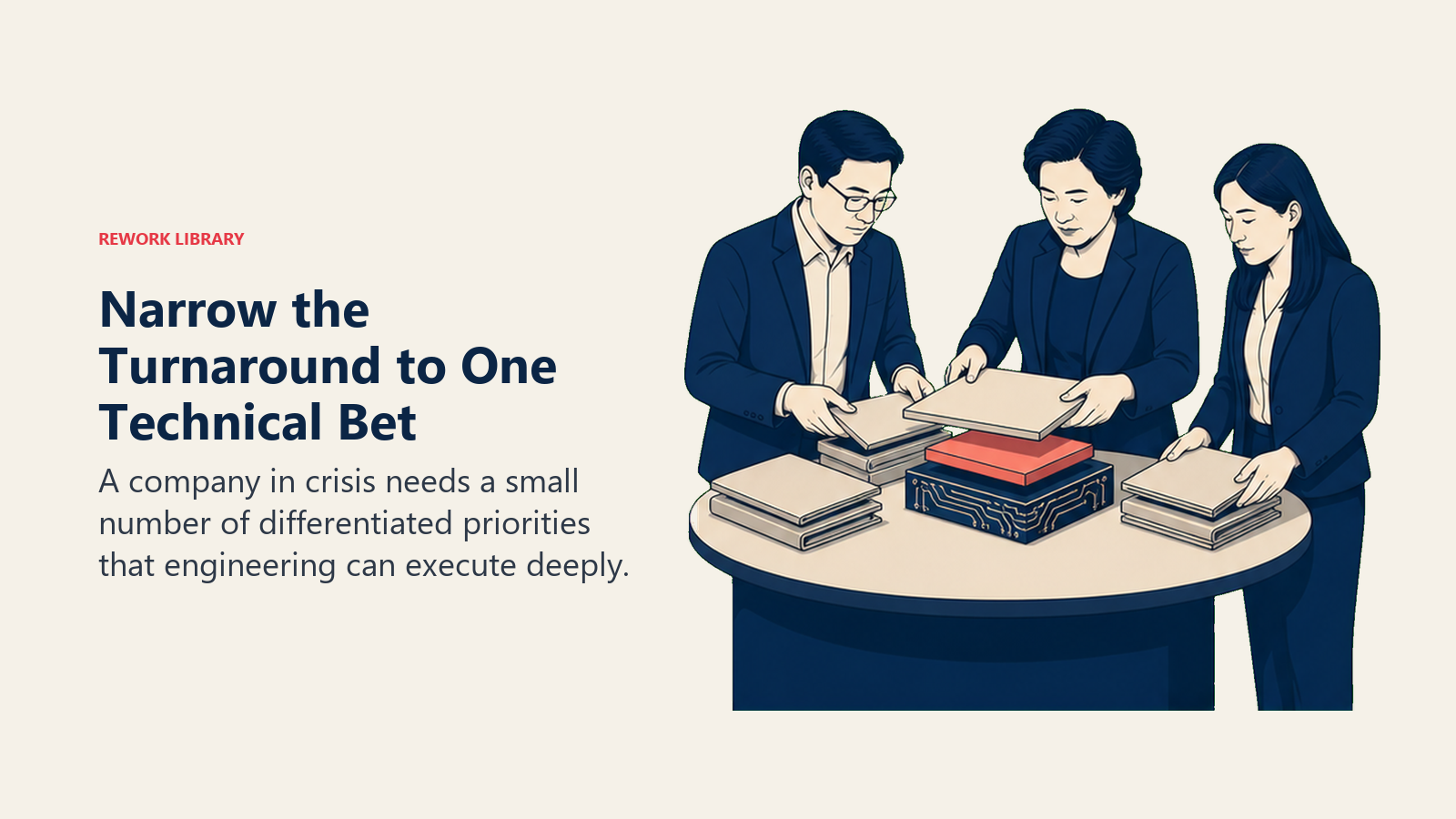
A turnaround playbook that protects core architecture R&D through the worst financial years, sequences market re-entry behind proven product benchmarks, and refuses to substitute financial engineering for engineering itself. The doctrine holds that in technical businesses, the CEO must retain enough technical depth to distinguish real performance data from managed narratives, and that cost cuts which touch foundational R&D guarantee the next cycle's failure.
When Lisa Su became AMD's CEO in October 2014, the stock was trading around $2 a share. The company had lost over $1 billion the year before. Analysts were writing pieces about whether AMD would survive at all. A decade later, the stock sits above $150, after touching highs near $200, and AMD's EPYC processors are running inside major cloud data centers that used to belong exclusively to Intel.
That turnaround isn't luck, and it's not just one good product cycle. It's a repeatable approach to leadership that anyone running a company or a function under pressure can actually use.
Su's profile matters specifically because she's an engineer-turned-CEO who didn't drift away from technical depth when she moved into the top seat. That combination is rare, and it's the source of most of her best decisions. She didn't just manage AMD's recovery. She engineered it.
Leadership Style Breakdown
Lisa Su's leadership style is engineering-first turnaround leadership: she stays technically deep enough to separate real performance from managed narratives, protects core R&D through the worst financial years, and sequences market re-entry behind proven product benchmarks. The result was AMD's climb from a $2 stock to a $260 billion peak. The breakdown below shows the 70/30 split between her engineering-led instinct and turnaround-operator discipline.
| Style | Weight | How it showed up |
|---|---|---|
| Engineering-Led | 70% | Stayed hands-on in technical reviews. Prioritized deep understanding of product performance over market positioning. Made major bets (Zen, EPYC, MI300) based on architecture analysis, not just analyst reports. Hired operators and engineers, not primarily MBAs. |
| Turnaround Operator | 30% | Sequenced the recovery deliberately: fix the product roadmap first, then push into new markets. Cut costs sharply enough to buy runway, but never cut the R&D that would fund the comeback. Communicated the plan clearly and held the organization to it. |
The 70/30 split is important. Su wasn't primarily a cost-cutter or a financial engineer. She was primarily a product leader who understood that AMD's survival depended on shipping CPUs that beat Intel on performance per dollar. The operator discipline existed to protect that product mission, not replace it.
Key Leadership Traits
| Trait | Rating | What it means in practice |
|---|---|---|
| Technical Depth | Exceptional | Su's MIT PhD in electrical engineering wasn't decorative. She led technical reviews with enough rigor that engineers couldn't hand-wave past problems. That depth raised the quality bar across product development and made it harder to ship mediocre work. |
| Conviction Under Pressure | Very High | When AMD was burning cash in 2015-2016, Su committed to the Zen architecture anyway. Wall Street wanted short-term cost cuts. She chose a multi-year CPU redesign. It took until 2017 to see results, and she held the line the whole way through. |
| Market Sequencing | High | Su didn't try to fix gaming GPUs, data-center CPUs, and consumer laptops simultaneously. She picked a beachhead (Ryzen desktop CPUs), proved the architecture worked, then expanded into data center (EPYC) and eventually AI acceleration (MI300). Sequence mattered as much as strategy. |
| Talent Judgment | High | She built an executive team that could execute technically complex plans. AMD under Su promoted engineers into senior roles and hired operators who could work within a deeply technical culture. The result was less political drift and more product discipline than AMD had managed in years. |
The 3 Decisions That Defined Lisa Su as a Leader
1. Betting the Company on Zen (2015-2017)
When Su became CEO, AMD was using a CPU architecture called Bulldozer that was losing badly to Intel on performance per watt. The honest internal assessment was that AMD couldn't patch its way to competitive products. It needed a ground-up redesign.
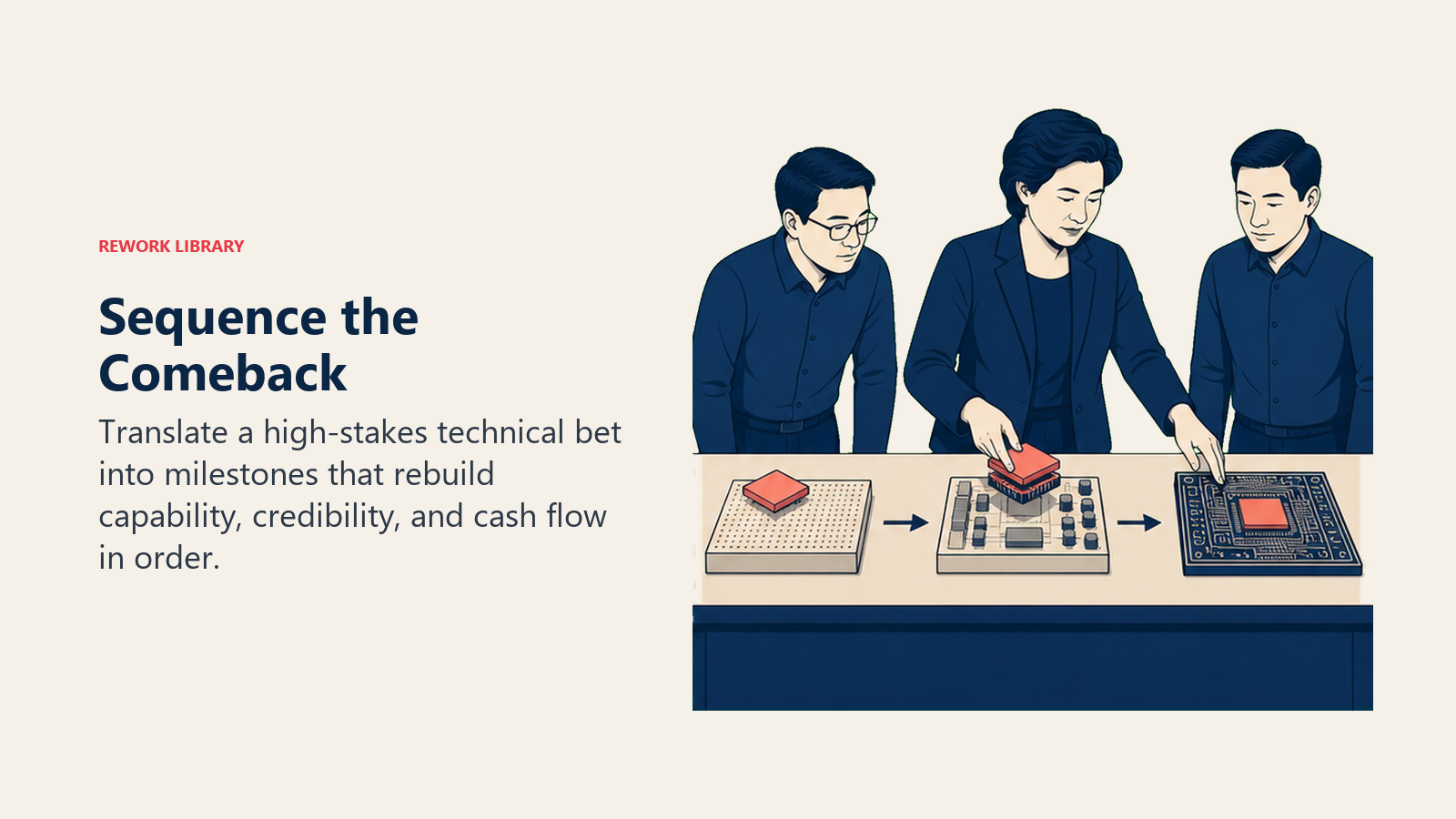
The Zen architecture project had already started before Su took the top job, but she owned the decision to keep funding it through AMD's worst financial years. In 2015 and 2016, AMD had nearly no margin for error. The company was drawing down cash reserves. The board was not uniformly convinced that a multi-year architecture bet was the right move.
Su kept the budget. Zen launched in March 2017 as the Ryzen processor line, and it benchmarked within a few percent of Intel's best chips at significantly lower prices. It wasn't just a product win. It reset the market's perception of AMD as a company capable of technical competition. Ryzen gave AMD a platform to build everything else on.
The leadership lesson: when your turnaround depends on a core capability being rebuilt, you don't get to hedge that investment without gutting the recovery itself. Su understood that Zen wasn't a feature, it was the foundation. Cutting it to hit short-term earnings would have made the quarterly numbers look better and killed the company within three years.
2. The EPYC Push into Data-Center CPUs (2018-2022)
Building a competitive consumer CPU was step one. Convincing hyperscale cloud customers to replace Intel server chips with AMD silicon was a completely different problem.
Intel owned the data-center CPU market with margins above 50%. Customers trusted Intel's Xeon platform, had built tooling around it, and had no pressing reason to switch. Su's team had to win on performance-per-dollar by a wide enough margin that the switching costs were worth it.
AMD's EPYC processors delivered that margin. The architecture advantage from Zen carried over, and AMD's chiplet design, multiple smaller dies connected on a single package, allowed them to scale core counts faster than Intel's monolithic approach. By 2022, AMD held roughly 20% of the data-center CPU market, a number that would have looked impossible in 2016.
This decision shows something specific about Su's approach: she didn't pursue the data-center market until the product was genuinely ready. She didn't try to buy share with price cuts or over-promise on benchmarks. She waited until the architecture gave her a real argument, then went after the market hard. That sequencing, prove the product, then push into premium markets, runs through her entire tenure.
3. The Xilinx Acquisition ($49B, 2022)
In October 2020, AMD announced it would acquire Xilinx, the leading FPGA chipmaker, for $49 billion in stock. At the time, AMD's market cap was roughly $110 billion. This was not a small deal.
FPGAs are programmable chips used in data centers, telecommunications, aerospace, and automotive applications. They're complementary to CPUs and GPUs but serve different workloads. Su's thesis was that AI and data-center infrastructure would increasingly require specialized, adaptive computing, not just more general-purpose CPU cores.
The deal closed in February 2022 after a 16-month regulatory process. It added roughly $3.7 billion in annual revenue and gave AMD a meaningful position in programmable logic that neither Intel nor NVIDIA could quickly replicate.
What this shows about Su's leadership: she was willing to make a bet at scale before the AI infrastructure buildout was obvious to everyone. The Xilinx acquisition positioned AMD for the AI hardware wave a full year before ChatGPT made that wave impossible to ignore. That kind of forward timing doesn't come from reading analyst reports, it comes from deep technical conviction about where compute is going.
What Lisa Su Would Do in Your Role
If you're a CEO running a 50-500 person company, Su's most transferable move is sequencing your recovery or growth around the one capability that makes everything else possible. AMD didn't fix its GPU business, its mobile business, and its server business simultaneously. It fixed the CPU architecture first because everything downstream depended on it. If your company is struggling across multiple fronts, ask which one capability, product, sales motion, unit economics, everything else is downstream of. Fix that one first and resist the pressure to spread attention.
If you're a COO or operations leader, the Su lesson is that runway and conviction have to coexist. She cut costs enough to buy AMD two to three years of survival, but she protected the R&D budget that funded the turnaround. If you're running operations in a constrained environment, your job isn't to minimize spend uniformly. It's to minimize spend everywhere except the bets that determine whether the company wins. That requires knowing which bets those are, which means being close enough to the product to have an informed opinion.
If you're a product leader, Su's engineering-depth approach is the trait to borrow most directly. She stayed in technical reviews. She asked hard questions about performance numbers. She didn't manage AMD's product strategy from a dashboard. That presence raised the quality of decisions made below her because everyone knew she could tell the difference between a real result and a managed one. Even if you don't have a PhD, the practice of staying close enough to the product to ask uncomfortable technical questions is learnable. And it changes the culture faster than any process change.
If you're a sales or marketing leader, Su's EPYC story is your playbook. She didn't walk into hyperscale data centers with a price discount and a relationship. She walked in with benchmark data that was hard to argue with, after the product had proven itself in consumer markets first. If you're trying to break into an enterprise segment dominated by an incumbent, the shortcut isn't the sales motion, it's the product proof points. Build those first, then sell.
How Rework Supports the Su Engineering-First Model
Su's operating model depends on small, dense teams where the CEO and senior operators stay close enough to the product to ask hard technical questions. That intensity breaks down when leadership loses visibility into what's actually happening at the workbench level. Rework gives engineering-led CEOs and COOs a single workspace for product roadmaps, cross-functional execution, and the customer-facing motion (CRM, sales ops, lead management) on top, so the same leadership team can run technical reviews in the morning and review pipeline quality in the afternoon without context-switching across five tools.
The patient-turnaround discipline Su modeled, protecting R&D while cutting selectively elsewhere, also requires honest visibility into which bets are working. Rework's unified work and customer data lets a 50-500 person company run Su's sequencing logic: prove the core product, then expand into adjacent markets, with the same operational dashboard across both phases. For engineering-first leaders who don't want to choose between deep product focus and commercial discipline, consolidating on Rework removes the tool sprawl that usually forces that trade-off.
Notable Quotes & Lessons Beyond the Boardroom
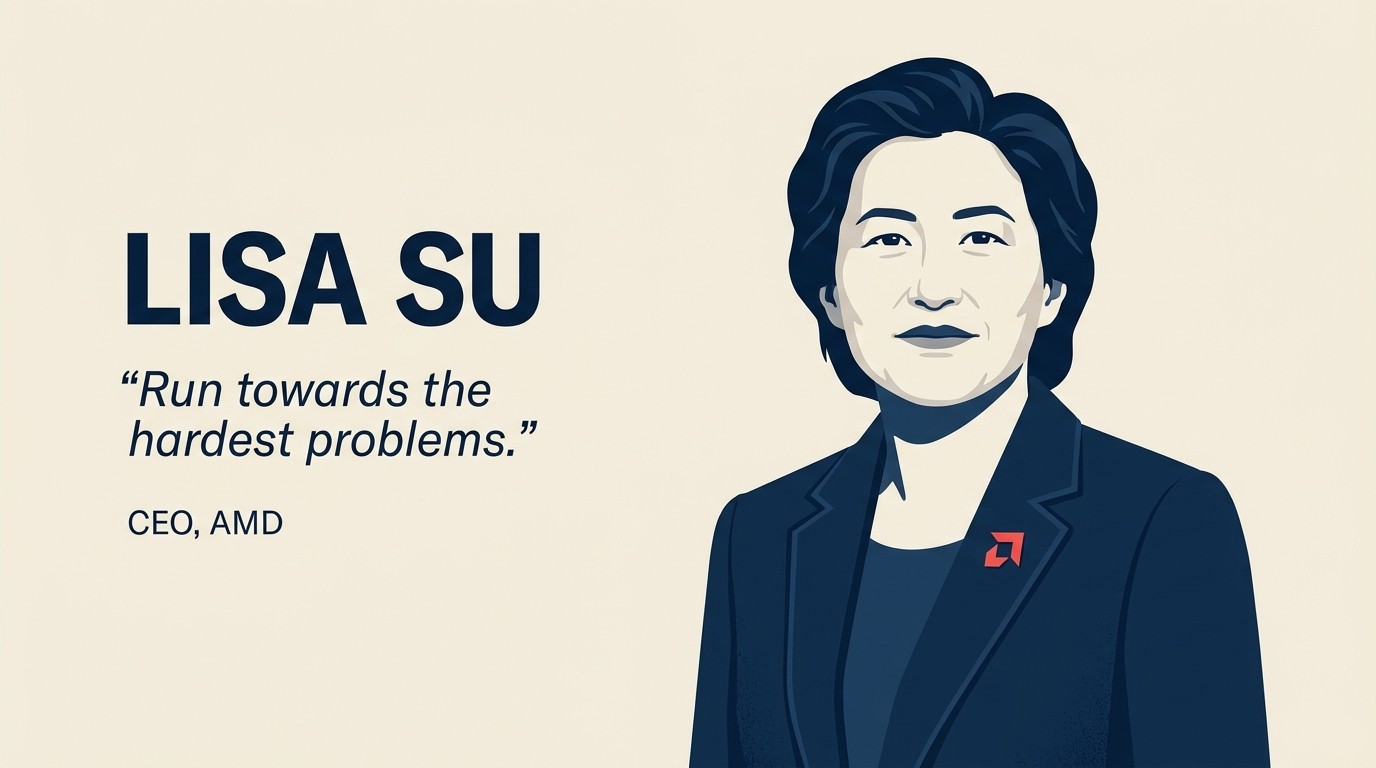
Su has said publicly that AMD's core mantra is "we choose to do hard things." It sounds like a motivational poster line until you realize she was saying it in 2015 while AMD was losing money and her investors were asking whether the company should simply be sold for parts. It wasn't aspirational branding. It was a description of the only strategy available to them.
"If I could give you one piece of advice, it's: don't be afraid of hard problems. The harder the problem, the more it's worth solving." She's said variations of this in interviews and commencement speeches over the years. The consistency matters. Su doesn't code-switch between the public persona and the internal one. The engineers who work for her describe the same person they see in media appearances.
Her transparency about AMD's competitive gaps is also unusual for a CEO. When asked about AMD's AI GPU position relative to NVIDIA, where the gap remains substantial, she doesn't claim parity. She describes where AMD is investing and what the realistic timeline looks like. That kind of honest communication builds more credibility with investors and customers than manufactured optimism, even when the gap is uncomfortable to acknowledge.
Where This Style Breaks
Su's approach works well when the core problem is a technical one and the solution is a better product. It's less suited to markets where technical superiority doesn't win. AMD's gaming GPU business is a good example: despite genuine architectural improvements, AMD's GPU market share in gaming has declined because NVIDIA's software ecosystem (CUDA, DLSS) and brand power create a moat that better hardware alone can't easily breach.
Her engineering-heavy leadership model also creates succession risk. AMD's bench of technically credible executives who can run at her level is narrower than she'd probably like. When your culture selects for deep technical credibility, the pool of internal successors is smaller than at a more generalist company.
And the EPYC sequencing model assumes you have time to wait for proof points before scaling. Companies facing faster-moving competitive threats, where the window to establish position is measured in months, not years, may not have the luxury of Su's deliberate pace.
Frequently Asked Questions about Lisa Su's Leadership
Who is Lisa Su?
Lisa Su (born 1969) is the CEO of AMD, a role she has held since October 2014. She holds a PhD in electrical engineering from MIT and is one of the semiconductor industry's most technically credentialed CEOs. In 2023, TIME named her CEO of the Year following AMD's decade-long turnaround under her leadership.
How did Su turn around AMD?
Su inherited AMD with its stock near $2 a share and a business losing over $1 billion a year. She protected the R&D budget for the Zen CPU architecture through AMD's worst financial years, shipped Ryzen desktop CPUs in 2017 to reset market perception, then used that foundation to push into server CPUs (EPYC) and AI acceleration. The market cap climbed past $260 billion at its peak.
What is Su's approach to long-horizon engineering bets?
She funds them even when short-term financials argue against it, as long as the bet targets a foundational capability the rest of the business depends on. The Zen architecture decision in 2015-2016 is the clearest example, a multi-year CPU redesign funded through years of cash burn because patching the existing Bulldozer architecture wouldn't produce competitive products.
Why did AMD acquire Xilinx?
AMD announced the $49 billion all-stock deal in October 2020 and closed it in February 2022. Su's thesis was that AI and data-center workloads would increasingly demand specialized, adaptive compute, not just more general-purpose CPU cores. Xilinx's FPGAs gave AMD a programmable-logic position in data center, telecom, aerospace, and automotive that neither Intel nor NVIDIA could quickly replicate.
What makes Su an engineering-first CEO?
She stayed in technical reviews after becoming CEO, asked rigorous performance questions that engineers couldn't hand-wave past, and hired operators who could work inside a deeply technical culture. Her MIT PhD gave her enough depth to distinguish real results from managed ones, which raised the quality bar across AMD's product development.
What can tech CEOs learn from Lisa Su?
Sequence your turnaround around the one capability everything else depends on, protect the R&D that funds the comeback even when cost pressure is severe, prove the product in one market before expanding into premium adjacent markets, and stay close enough to the technical work to ask uncomfortable questions. Conviction without technical depth becomes wishful thinking; depth without conviction becomes passive analysis.
Explore related profiles: Andy Grove Leadership Style, Intel's semiconductor foundation that AMD had to beat. Jensen Huang at NVIDIA, the rival CEO whose CUDA bet put AMD on defense in AI acceleration. Satya Nadella's Microsoft turnaround, the closest recent parallel to Su's playbook: inherit a struggling incumbent, pick a core architecture bet, and execute the rebuild over five years.

On this page
- The AMD Turnaround Doctrine (The Su Engineering-First Model)
- Leadership Style Breakdown
- Key Leadership Traits
- The 3 Decisions That Defined Lisa Su as a Leader
- 1. Betting the Company on Zen (2015-2017)
- 2. The EPYC Push into Data-Center CPUs (2018-2022)
- 3. The Xilinx Acquisition ($49B, 2022)
- What Lisa Su Would Do in Your Role
- How Rework Supports the Su Engineering-First Model
- Notable Quotes & Lessons Beyond the Boardroom
- Where This Style Breaks